
Judge, 1922-08-19 · page 21 of 36
Judge — August 19, 1922 — page 21: what you’re looking at
What you’re looking at
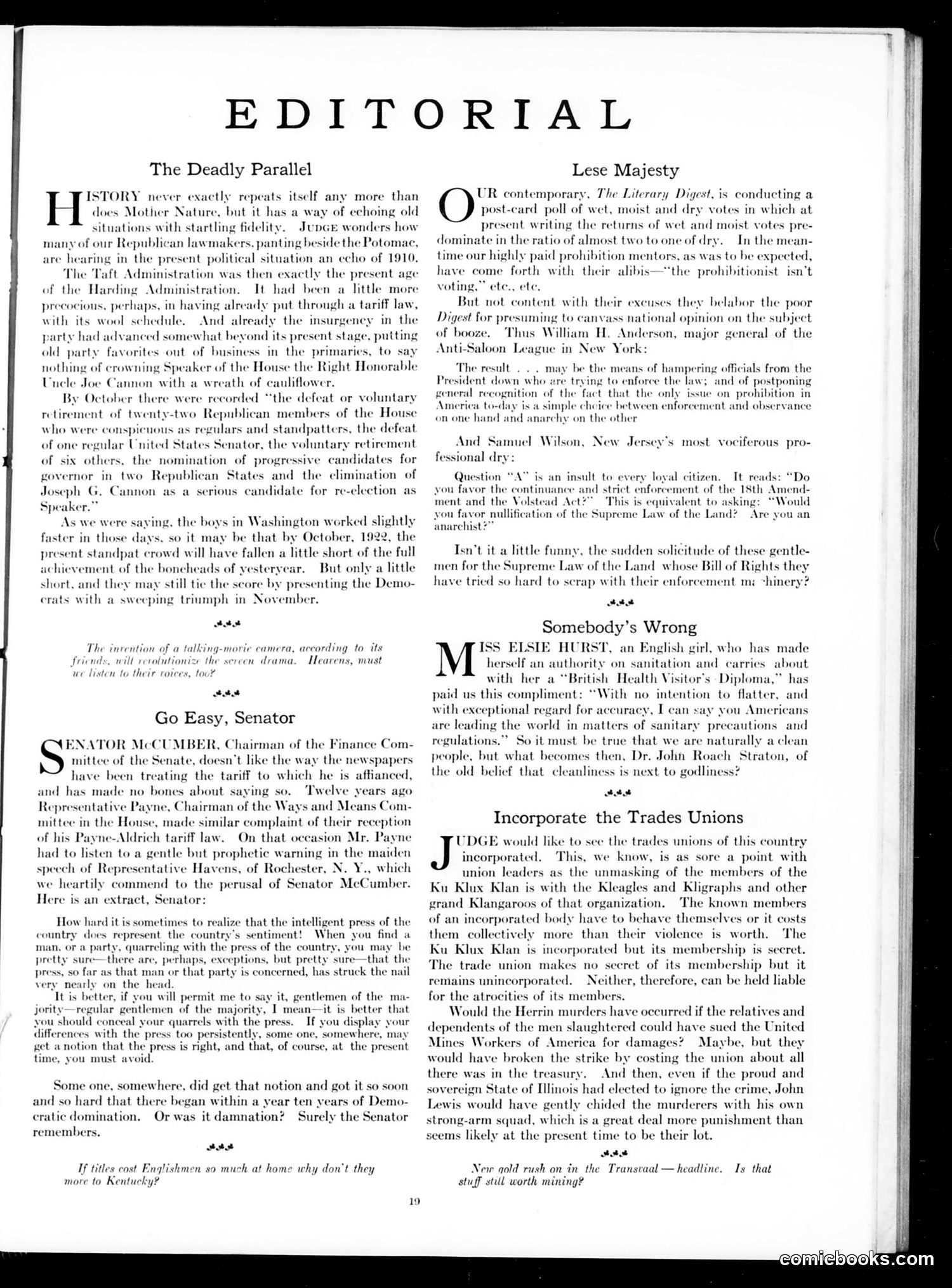
This editorial page critiques Republican political leadership through historical parallels and contemporary commentary: **"The Deadly Parallel"** compares the Harding Administration (circa 1922) to Taft's era (1910), noting both faced insurgent movements within the Republican party. Judge suggests Republican "standpatters" may face similar defeats by October 1922 as they did a decade earlier. **"Go Easy, Senator"** mocks Senator McCumber's complaints about press criticism of his tariff bill. Judge quotes a 1910 speech warning that politicians attacking the press appear defensive—implying McCumber's complaints validate press criticism rather than refuting it. **"Lese Majesty"** attacks the *Literary Digest*'s poll methodology on Prohibition, suggesting prohibitionists are defensive about public opinion on alcohol regulation. **"Somebody's Wrong"** and **"Incorporate the Trades Unions"** appear to address labor and sanitation issues, though details are unclear from the visible text. The page's overall tone: Republican leadership appears vulnerable and unconvincing.
📄 Transcribed text from this page (OCR, searchable)
Machine-transcribed from the original scan — historical spelling and the odd misread are preserved.
EDITORIAL The Deadly Parallel TORY never exactly repeats itself any more than s Mother Nature, but it has a way of echoing old situations with startling fidelity. JupGe wonders how an lawmakers. panting beside the Potomac, ation an echo of 1910. many of our Republi are hearing in the present political sit The Taft Administration was then exactly the present age of the Harding Administration. It had been a little more precocious, perhaps, in having already put through a tariff law, with its wool schedule. And already the insurgeney in the party had advanced somewhat beyond its present stage, putting old party favorites out of business in the primaries, to say nothing of crowning Speaker of the House the Right Honorable Unele Joe Cannon with a wreath of cauliflower. By October there were recorded “the defeat or voluntary retirement of twenty-two Republican members of the House Who were conspicuous as regulars and standpatters, the defeat of one regular United States Senator, the voluntary retirement of six others, the nomination of progressive candidates for governor in two Republican States and the elimination of Joseph G. Cannon as a serious candidate for re-election as ker.” As we were saying, the boys in Washington worked slightly s. so it may be that by October, 1922, the little short of the full But only a little senting the Demo- faster in those present standpat crowd will have fallen achievement of the boncheads of yestery short, and they may still tie the score by p crats with a sweeping triumph in November. eet will revolutionize the Heavens, must friend. sereen drama, we listen to their voices, Stk Go Easy, Senator ATOR McCUMBER, Chairman of the Finance Com- mittee of the Senate, doesn’t like the way the newspapers have been treating the tariff to which he is affianced, about saying so. Twelve years ago Representative Payne, Chairman of the Ways and Me: mittee in the House, made similar complaint of their reception of his Payne-Aldrich tariff law. On that occasion Mr. Payne had to listen to a gentle but prophetic warning in the maiden speech of Representative Havens, of Rochester, which we heartily commend to the perusal of Senator McCumber. and has made no bon ns Com- Here is an extract, Senator: How hard it is sometimes to realize that the intelligent press of the country does represent the country’s sentiment! When you find a rty, quarreling with the press of the country, you may be there perhaps, exceptions, but pretty sure—that the nor that party is concerned, has struck the nail d Are pretty sure press, so far as that m: very nearly on the h It is better, if you will permit me to say it, gentlemen of the ma- regular gentlemen of the majority, 1 mean—it is better that You should conceal your quarrels with the press. If you display your differences with the press too persistently, some one, somewhe get a notion that the press is right, and that, of course, at the present time, you must avoid jority Some one, somewhere, did get that notion and got it so soon and so hard that there began within a year ten years of Demo- Or was it damnation? Surely the Senator »mination. remembers. stot If titles cost Englishmen so much at home why don't they mote to Kentucky? Lese Majesty UR contemporary, The Literary Digest, is conducting a post-card poll of wet, moist and dry votes in which at present writing the returns of wet and moist votes pre- In the mean- time our highly paid prohibition mentor: to be expected, have come forth with their alibis—‘the prohibitionist isn’t dominate in the ratio of almost two to one of dry as Wa voting,” ete., ete. But not content with their excuses they belabor the poor Digest for presuming to canvass national opinion on the subject ze. Thus William H. Anderson, major general of the tloon League in New York: may be the means of hampering officials from the President down who ere trying to enforce the law; and of postponing general recognition of the fact that the only issue on prohibition in America t is a simple choice between enforcement and observance on one | anarchy on the other result... ne And Samuel Wilson, New Jersey's most vociferous pro- fessional dry: Question “A” ‘y loyal citizen. Tt reads: “Do vor the continuance and strict enforcement of the 18th Amend- and the Volstead Act?” This is equivalent to asking: “Would you favor nullification of the Supreme Law of the Land? Are you an anarchist?” is an insult to ev Isn't it a little funny, the sudden solicitude of these gentle- men for the Supreme Law of the Land whose Bill of Rights they have tried so hard to scrap with their enforcement mi *hinery? ttt Somebody’s Wrong ISS ELSIE HURST, an English girl, who has made herself an authority on sanitation and carries about with her a “British Health Visitor's Diploma,” has paid us this compliment: “With no intention to flatter, and with exceptional regard for accuracy, I can say you Ameri are leading the world in matters of sanitary precautions regulations.” So it must be true that we are nati people, but what becomes then, Dr. John Roach + the old belief that cleanliness is next to godliness? ans nd yaclean raton, of sat Incorporate the Trades Unions UDGE would like to see the trades unions of this country incorporated. This, we know, is as sore a point with union leaders as the unmasking of the members of the Ku Klux Klan is with the Kleagles and Kligraphs and other grand Klangaroos of that organization. The known membc of an incorporated body have to beh themselves or it costs them collectively more than their violence is worth. The Ku Klux Klan is incorporated but its membership is secret. The trade union makes no secret of its membership but it Neither, therefore, can be held liable remains unincorporated. for the atrocities of its members. Would the Herrin murders have occurred if the relatives and dependents of the men slaughtered could have sued the United Mines Workers of America for damages? Maybe, but they would have broken the strike by costing the union about all there was in the treasury. And then, even if the proud and sovereign State of Illinois had elected to ignore the crime, John Lewis would have gently chided the murderers with his own strong-arm squad, which is a great deal more punishment than ns likely at the present time to be their lot. se New qold rush on in the Transvaal — headline. Is that stuff stil worth mining?