
A complete issue · 37 pages · 1922
Judge — June 24, 1922
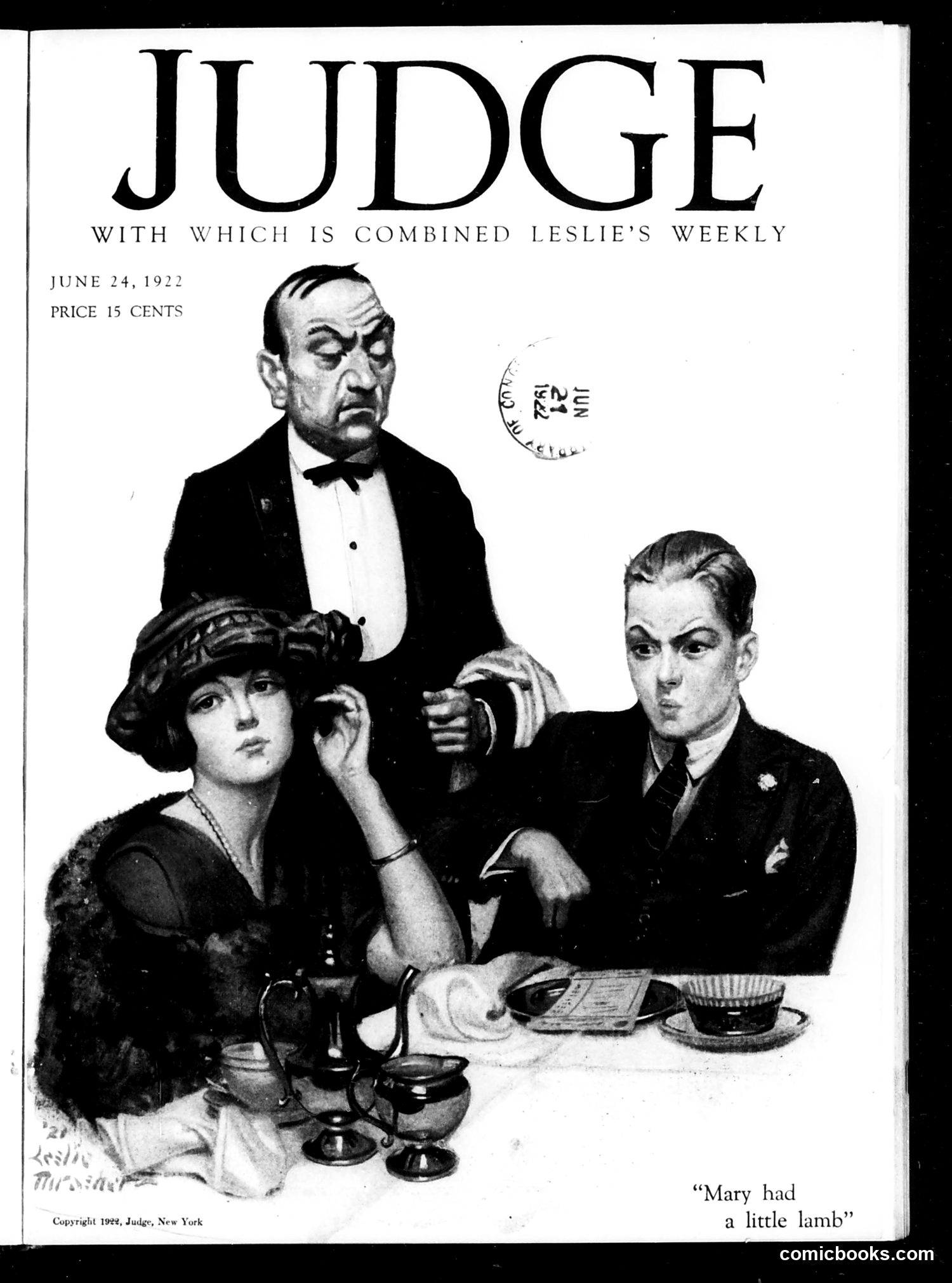
This is the cover of Judge magazine from June 24, 1922. The illustration shows three figures at a dining table with the caption "Mary had a little lamb." The cartoon appears to be a satirical take on the nursery rhyme, likely referencing a contemporary scandal or situation from 1922. The exaggerated facial expressions and formal dress suggest social commentary—possibly about infidelity, deception, or a society scandal. The man in the back (drawn with particularly menacing features) and the tension between the seated figures implies conflict or transgression. Without additional context about specific 1922 events or public figures, I cannot definitively identify who these characters represent. The satire relies on readers' knowledge of contemporary gossip or news that is now obscure. The title's innocent reference contrasts with the obviously sinister atmosphere, creating the joke.
This page is primarily an **announcement, not satire or a cartoon**. It announces Judge magazine's merger with Leslie's Weekly, effective June 24, 1922. The combined publication will be called "Judge." The text emphasizes the consolidation strengthens both publications by combining "America's oldest illustrated weekly" with "America's oldest humorous weekly." Notable contributors mentioned include William Allen White, Heywood Broun, and others—lending credibility to the merger. The announcement stresses Judge will maintain its satirical traditions while expanding editorial departments (Motors, Radio, Investment) staffed by nationally-known authorities. It promises subscribers of either magazine will receive their full quota of issues without extra charge. The small illustration appears to be a decorative signature or logo rather than political commentary.
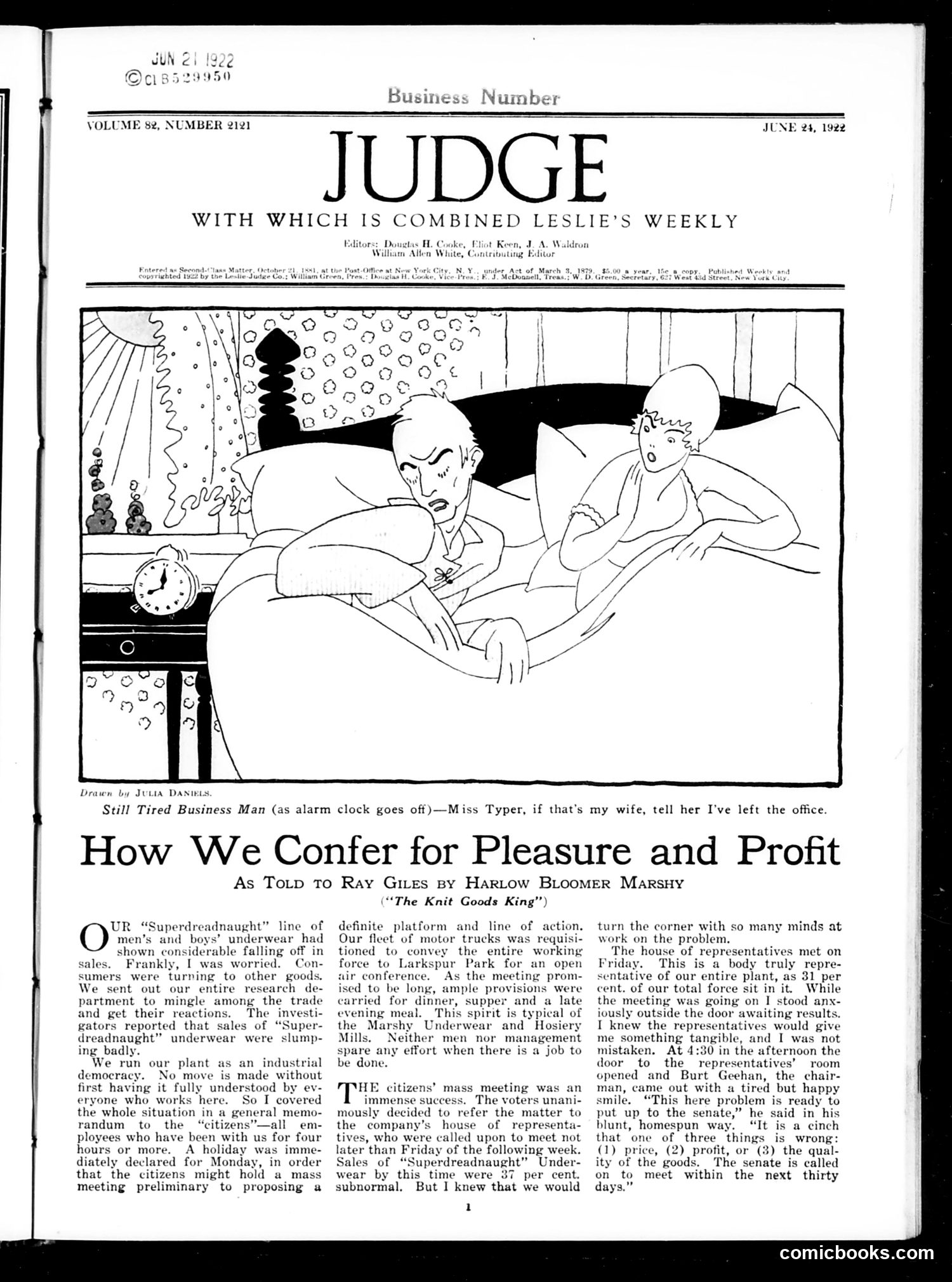
The main cartoon, titled "Still Tired Business Man," depicts a bald man in bed with a woman, as an alarm clock rings at his bedside. The joke plays on the double meaning of "office"—the man tells his wife to say he's "left the office," using it as a euphemism for staying in bed rather than going to work. This satirizes the "tired businessman" trope popular in 1920s humor—the exhausted male worker seeking escape from professional duties. The cartoon reflects post-WWI American culture's preoccupation with leisure, domesticity, and the tension between work obligations and personal pleasure. The illustration's style is typical of Judge's sophisticated line-drawing aesthetic.
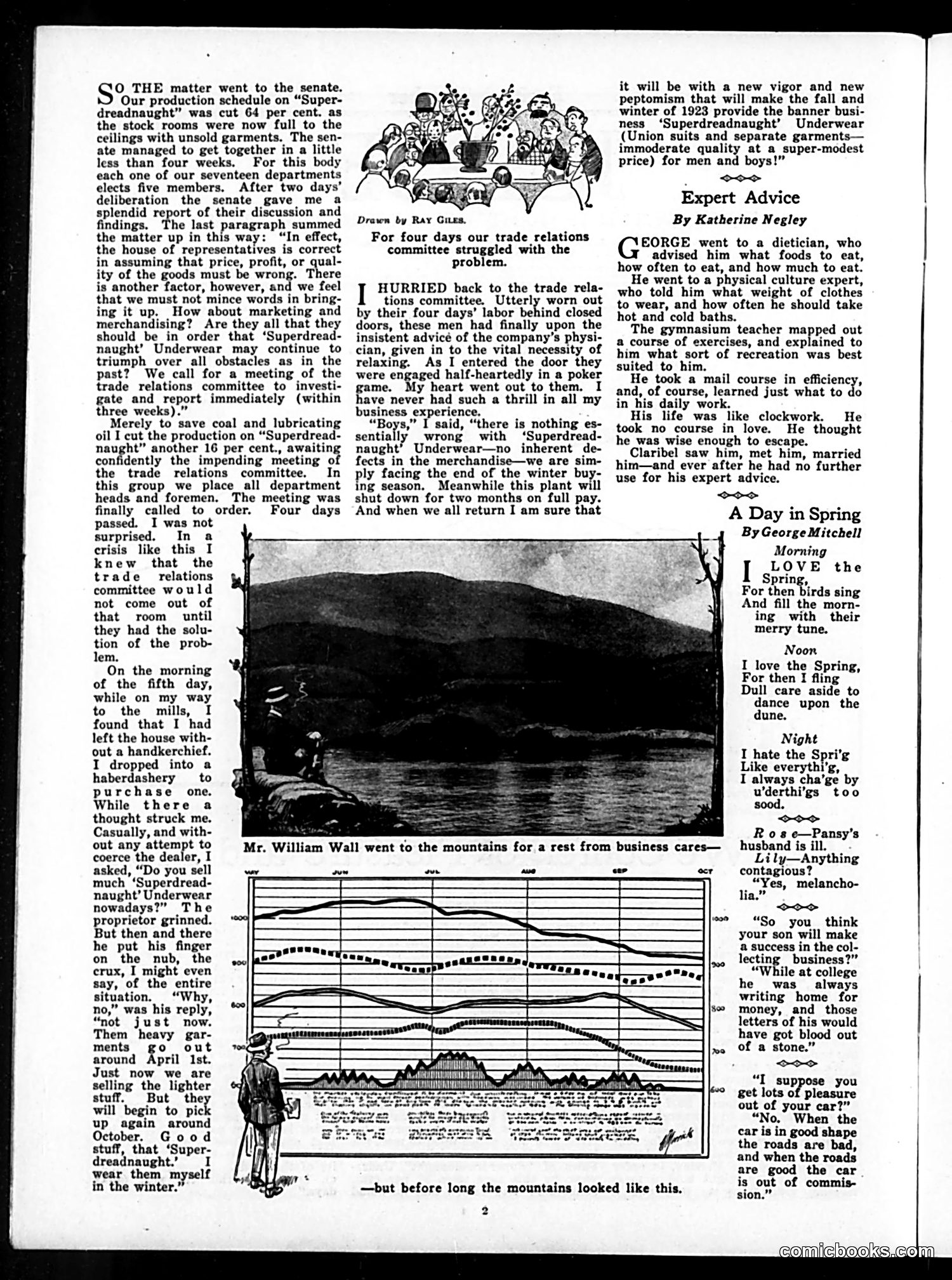
This page contains **business/trade commentary rather than political satire**. The main text discusses a "Superdreadnaught Underwear" marketing crisis: a trade relations committee spent four days resolving production and pricing problems with the garment. The company planned to halt production for two months while paying workers, then resume sales in October. The **mountain graph** illustrates business fluctuations, with a man (Mr. William Wall) traveling to mountains for rest from "business cares"—contrasting peaceful nature against commercial stress. The right column contains unrelated content: a poem "A Day in Spring" by George Mitchell and advice columns about love and business. This appears to be a **satirical business/lifestyle magazine page** mocking commercial anxieties of the era, not addressing political issues.
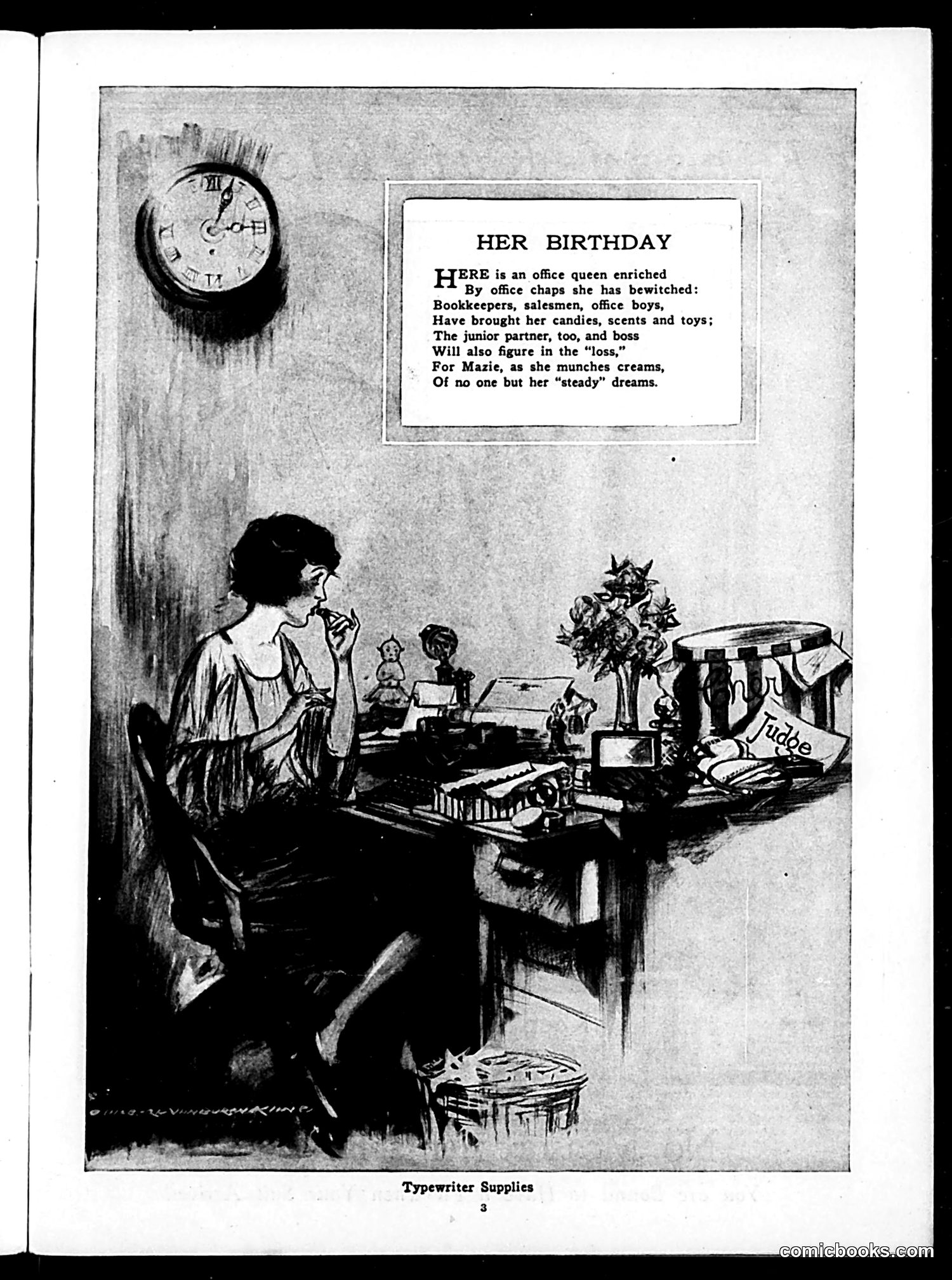
This page presents a satirical poem about an "office queen" named Mazie who has charmed her workplace colleagues into lavishing her with birthday gifts. The illustration shows a woman at her office desk surrounded by presents: candles, scents, toys, and flowers. The satire targets the social dynamics of early 20th-century office culture, where a popular female employee could manipulate her male coworkers—bookkeepers, salesmen, office boys, even the junior partner and boss—into giving her gifts. The humor lies in mocking both Mazie's ability to enchant these men and their willingness to indulge her "steady" dreams through material generosity. It's a commentary on office romance and workplace favoritism of the era.
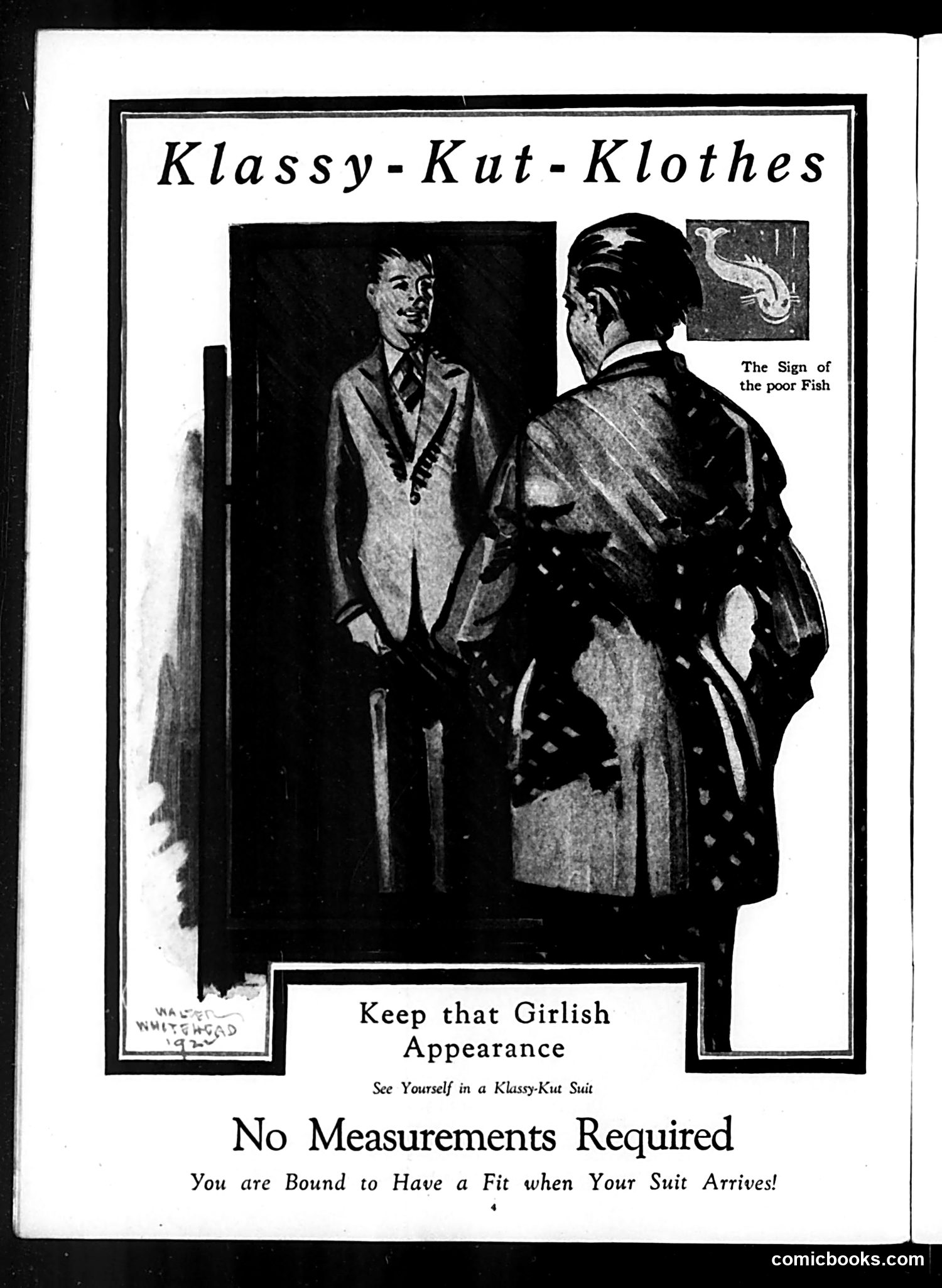
This is primarily a **clothing advertisement** rather than political satire. It advertises "Klassy-Kut-Klothes," a mail-order suit company, using the slogan "Keep that Girlish Appearance." The ad depicts a young woman admiring herself in a mirror while wearing a tailored suit, with a man viewing her from behind. The "Sign of the poor Fish" (a decorative fish symbol) appears on the wall—likely a humorous reference suggesting that men who don't appreciate well-dressed women are foolish. The pitch emphasizes convenience: "No Measurements Required" and "You are Bound to Have a Fit when Your Suit Arrives!"—a pun on both garment fit and emotional reaction. The ad targets women seeking fashionable, affordable clothing through mail order, a then-modern shopping convenience.
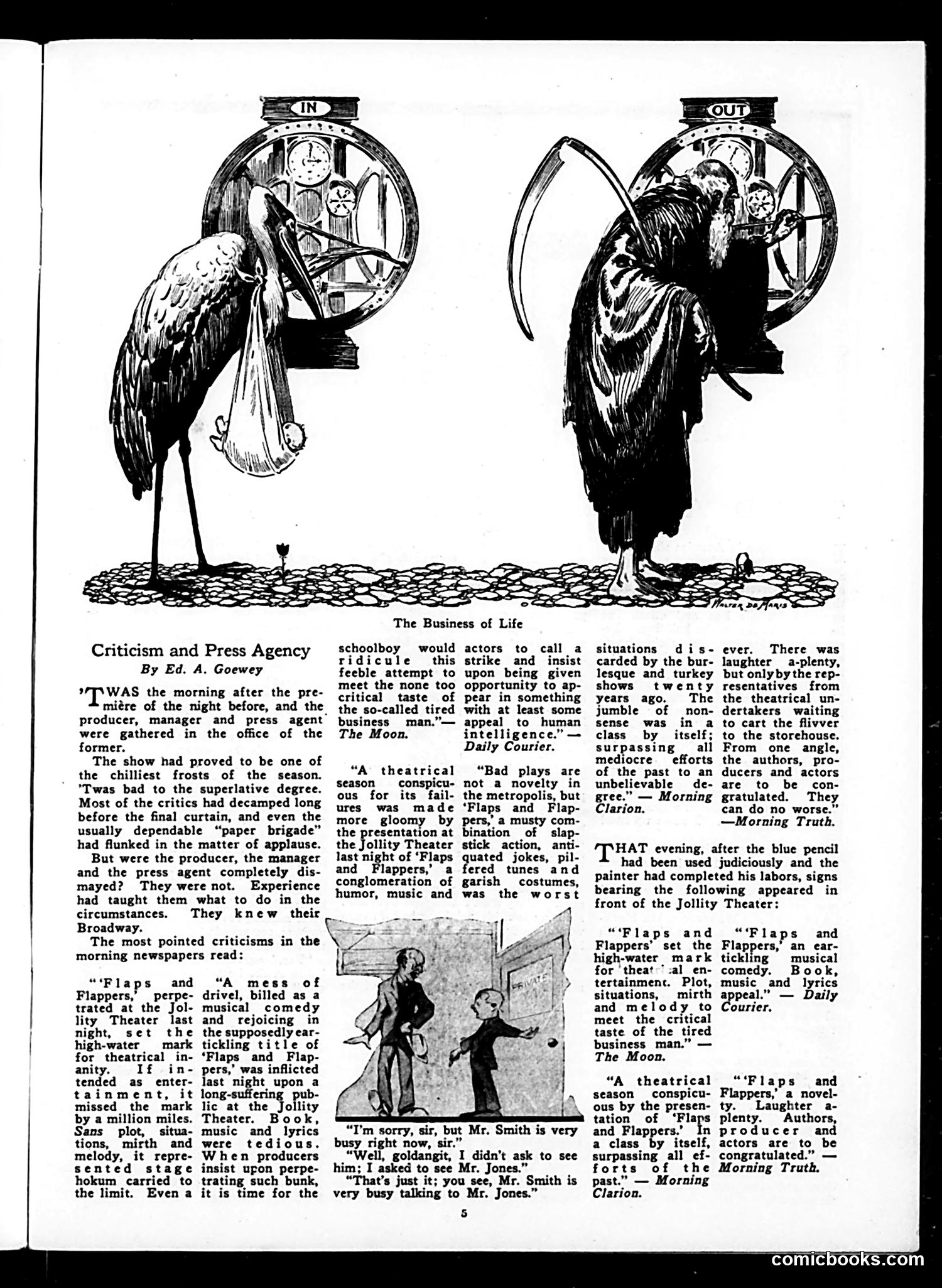
This page satirizes theatrical press agents and their manipulation of bad reviews. The main cartoon shows personified Death ("IN") and the Grim Reaper ("OUT")—a visual metaphor for a show's brief, doomed run at the Jollity Theater. The article describes a producer, manager, and press agent responding to uniformly terrible reviews of their show "Flaps and Flappers" (a musical comedy). Rather than being discouraged, they're unbothered—they "knew their Broadway" and understood that any publicity serves the theatrical business. The smaller cartoon illustrates press-agent tactics: a character claims Mr. Smith is unavailable, but admits he's actually "very busy talking to Mr. Jones"—exposing the deceptive excuses used to dodge unwanted visitors. The satire targets both bad theater and the cynical machinery that keeps it running: producers who tolerate mediocre work, critics whose reviews vary wildly, and especially press agents who exploit the system regardless of actual quality.
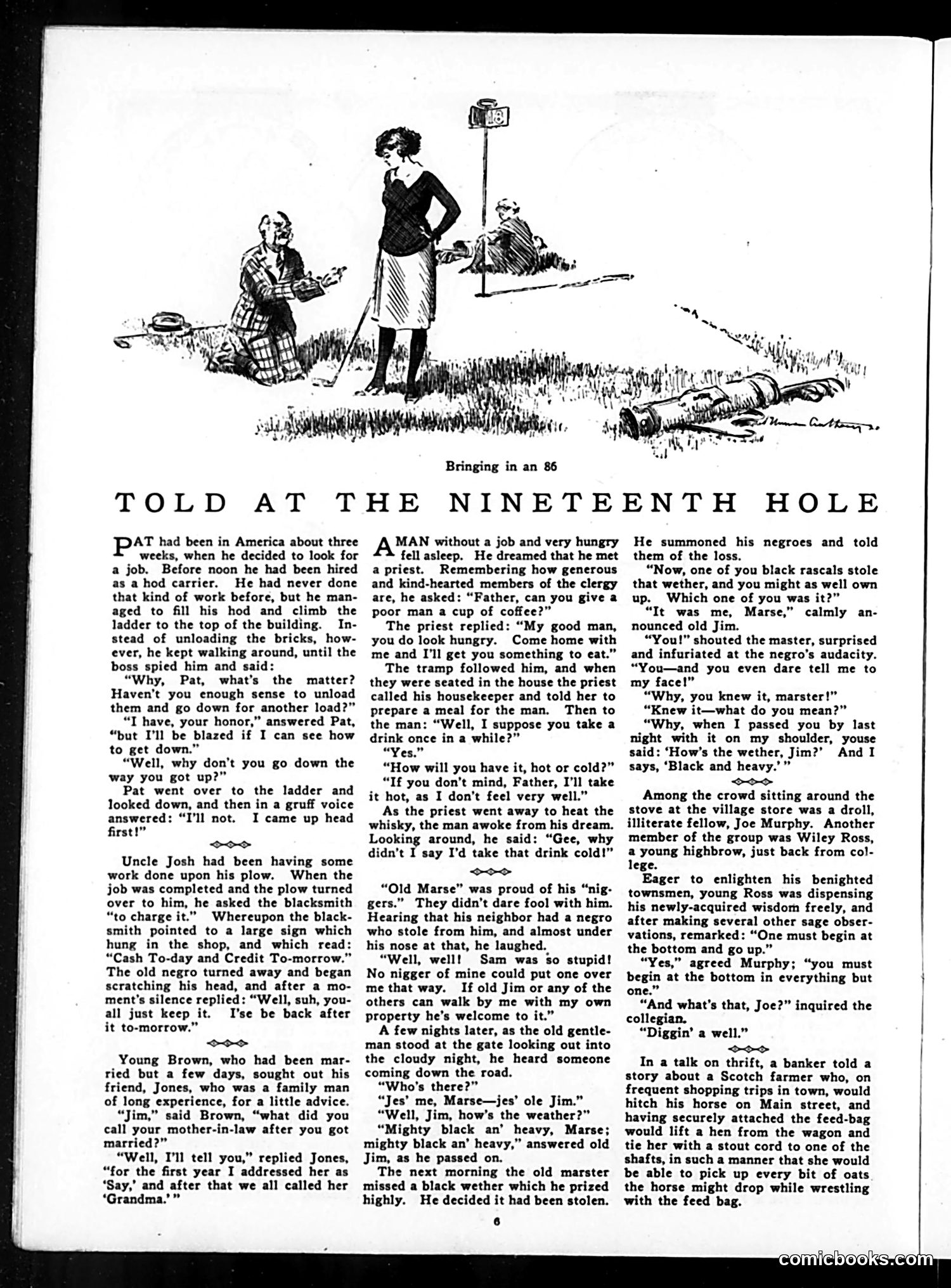
This page from *Judge* magazine contains racist humor typical of early 20th-century American satire. The illustrated story "Told at the Nineteenth Hole" (a golf club setting) presents several anecdotes meant to be funny, though they reveal period attitudes toward race and class. The main illustrated narrative mocks an enslaved Black man named Jim who steals his owner's sheep. The "joke" relies on racial stereotypes: Jim's supposed stupidity, servility, and the master's shock that an enslaved person would dare admit wrongdoing. The phrase "black an' heavy" is a crude pun suggesting Jim's darkness enabled the theft. The surrounding brief jokes also traffic in ethnic stereotypes (Irish immigrant "Pat," unnamed Black characters) and gender mockery (the mother-in-law joke). For modern readers: this content demonstrates how mainstream American publications once normalized dehumanizing racial caricature as entertainment. The humor depends entirely on racist assumptions about intelligence, dishonesty, and social hierarchy that the publication's audience apparently found amusing.
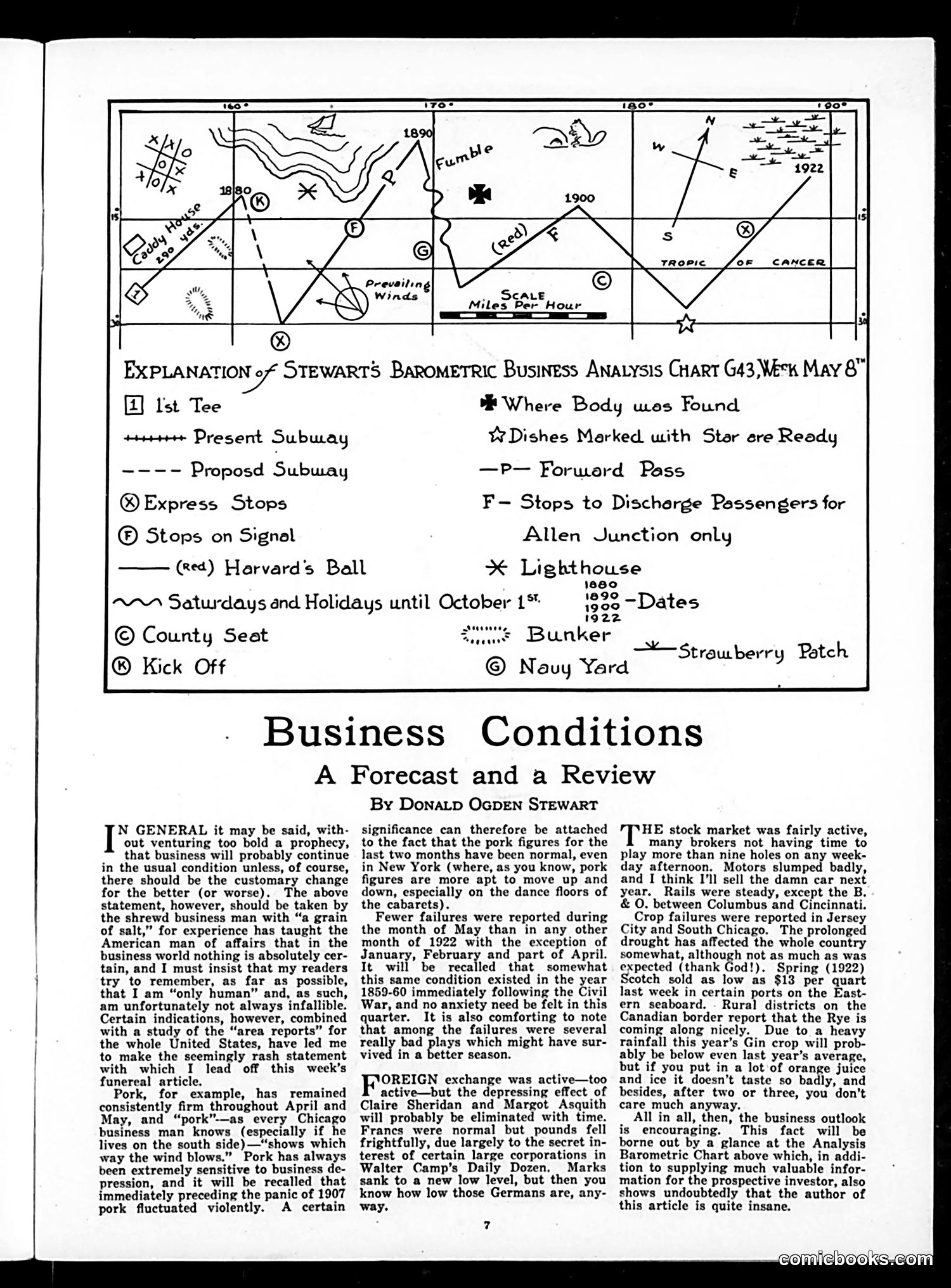
This is a satirical business commentary disguised as serious financial analysis. Stewart mocks pompous economic forecasting by making absurd correlations: pork prices indicate business health; failure of bad theatrical plays is "comforting"; foreign currency movements result from celebrity gossip (Claire Sheridan and Margot Asquith); crop failures in "Jersey City and South Chicago" (urban areas, not farmland); and gin production depends on rainfall. The accompanying "Barometric Business Analysis Chart" appears to be a deliberately incomprehensible overlay of subway maps, sports references, and random symbols—parodying the pseudo-scientific charts that financial analysts use to appear authoritative. Stewart's point: business analysis is often fraudulent nonsense dressed in technical language. The humor targets both overly confident forecasters and readers who accept dubious economic "expertise" without question—relevant satire in 1922's volatile post-war economy.
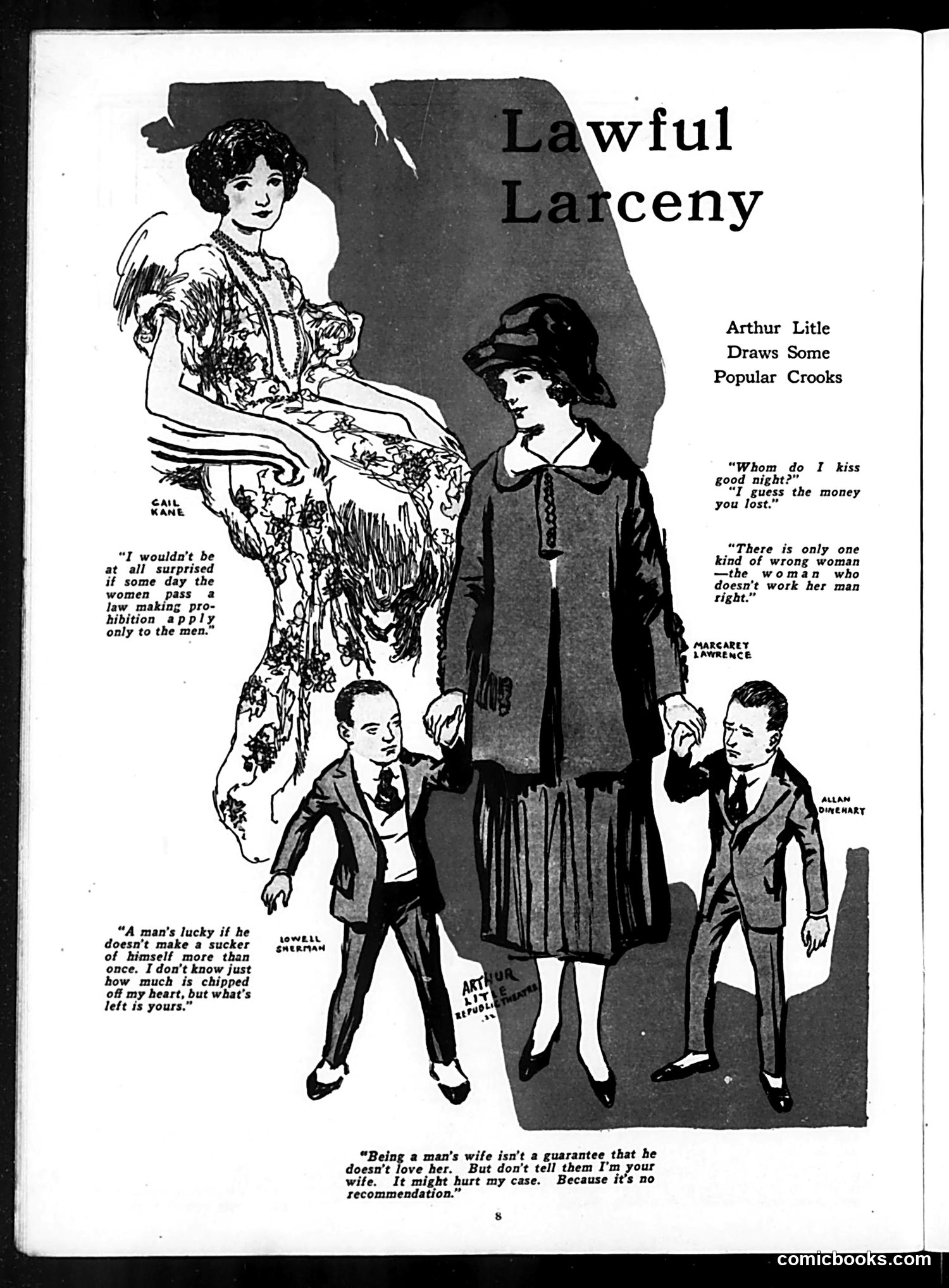
This page from *Judge* magazine features cartoonist Arthur Little's satirical drawings depicting "popular crooks"—criminals portrayed as romantic or marital figures. The humor targets gender dynamics and dishonesty in relationships. The central figure is a tall woman with two small men flanking her, suggesting she manipulates multiple male partners. The accompanying quotes mock both men and women: women are criticized for not "working" their husbands properly; men are portrayed as foolish for making emotional commitments they regret. The title "Lawful Larceny" equates marriage to theft—suggesting spouses financially exploit each other. One quote explicitly warns against admitting to marriage, as it "hurts my case," treating matrimony as a legal liability rather than commitment. The satire reflects early 20th-century cynicism about marriage as transactional rather than romantic, with women portrayed as cunning operators and men as gullible dupes. The humor is caustic commentary on marital relations and gender roles of the era.
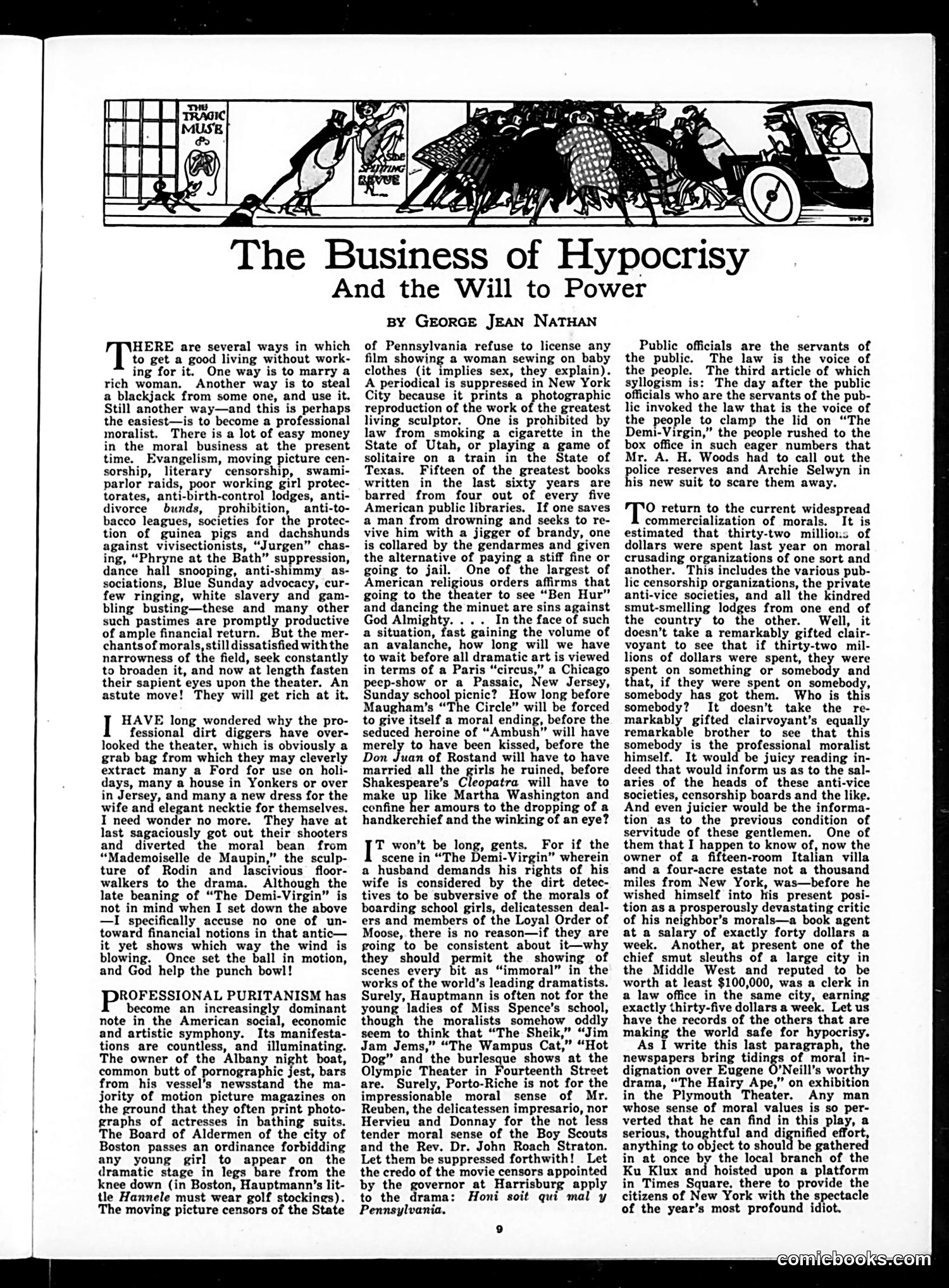
This satirical article attacks American moral censorship movements of the early 20th century. Nathan argues that "professional moralists"—those profiting from censorship campaigns—have discovered theater as their latest financial opportunity. The text catalogs absurd censorship examples: Pennsylvania banning films showing women sewing baby clothes; Boston requiring actresses to wear golf stockings; Utah prohibiting cigarette smoking; Boston suppressing "The Demi-Virgin"; and libraries banning fifteen classic books. Nathan cites Pennsylvania motion-picture censors and mentions the banning of specific plays. The satire's point: moral crusaders aren't genuinely righteous but are exploiting public anxiety to build profitable careers through censorship boards, "anti-vice societies," and similar organizations. Nathan sarcastically calls this "easy money" compared to actual work, accusing these "merchants of morals" of hypocrisy—hence the title. The cartoon strip above illustrates these various censorship activities in action.
This page from *Judge* magazine contains three humorous short stories, each employing ethnic and social stereotypes common to early 20th-century American humor. The **First Prize story** uses Irish dialect humor, depicting an Irish laborer ("Pat") at a lime works outwitting coworkers who played a prank on him. The **Second Prize story** mocks both mountaineer dialect and Republican politics, culminating in a joke where a Tennessee mountaineer responds that if his grandfather and father were horse thieves, he'd "be a Republican"—a dig at the Republican Party's corruption or moral standing. The third story features racial caricature, presenting an African American woman misunderstanding cinema as reality, speaking in exaggerated dialect. The longer narratives employ ethnic and colonial stereotypes: one satirizes Germans as obsessively orderly; another presents an African colonizer ("King Topknot") as comically savage. **The satire works through crude stereotyping**—the humor derives from depicting working-class, rural, Black, immigrant, and non-Western peoples as foolish or uncivilized. This reflects *Judge*'s intended elite readership finding amusement in perceived social inferiors.
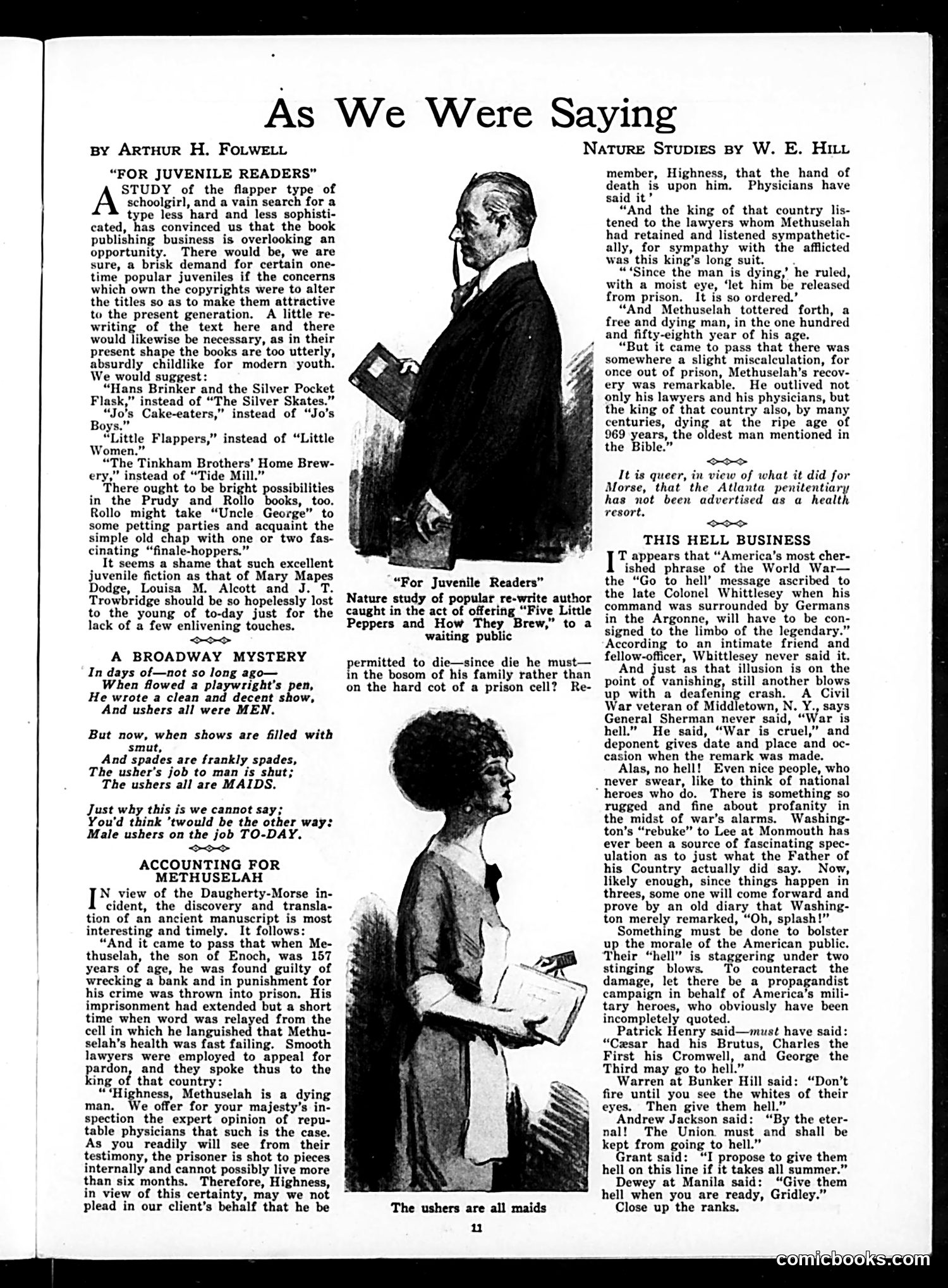
This page contains two satirical pieces mocking 1920s social trends: **"For Juvenile Readers"** (top): Arthur H. Folwell ridicules how publishers could update classic children's books for "modern youth" by renaming them to reflect 1920s flappers and Prohibition culture. "The Silver Skates" becomes "The Silver Pocket Flask"; "Little Women" becomes "Little Flappers." The satire targets both the era's youth culture and publishers' perceived desperation to remain relevant. **"Accounting for Methuselah"** (bottom): This likely references the Daugherty-Morse scandal (Attorney General Harry Daugherty's associate). The piece ironically describes an ancient prisoner released on medical grounds—a transparent allegory to contemporary corruption where political connections secured early prison releases. The "dying man" motif suggests cynical manipulation of sympathetic arguments. **"Broadway Mystery"**: A brief joke noting female ushers now work in theaters showing indecent shows, implying moral decline. The page reflects Judge's skeptical take on Prohibition-era excess and political corruption.
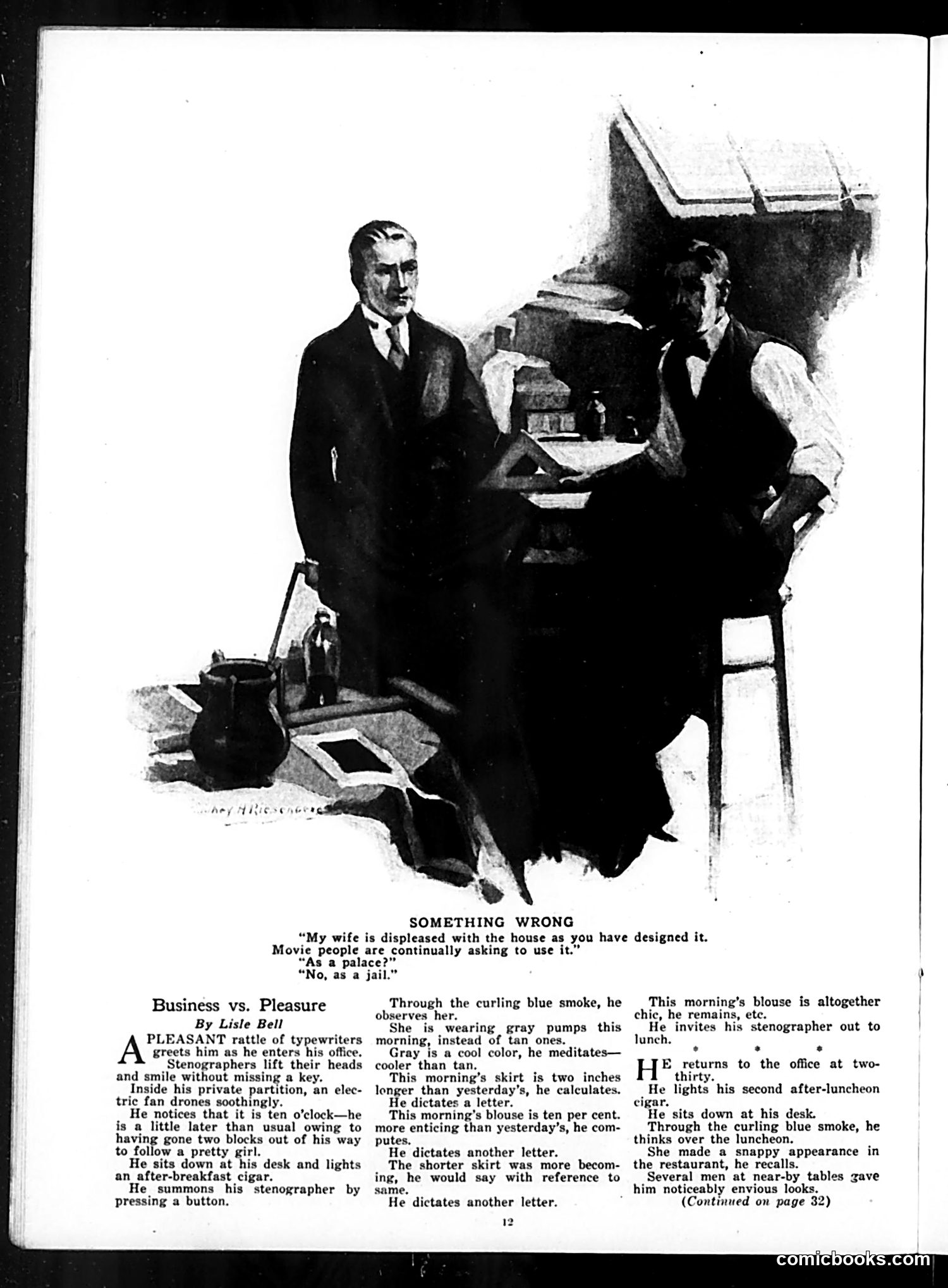
This satirical story by Lisle Bell mocks the distraction of office romance. The narrative follows a businessman whose productivity dissolves as he becomes preoccupied with his stenographer's appearance—her pumps, skirt length, and blouse. The humor lies in the absurd contrast between his supposed work (dictating letters) and his actual mental activity (analyzing her clothing and calculating how much more "enticing" she looks). The joke escalates when he invites her to lunch, then spends the afternoon reliving the experience and basking in the envy of other men. The accompanying illustration shows the scene setup: a well-dressed man in an office with his female employees, depicting the professional setting where this distraction occurs. For modern readers: this reflects early 20th-century office dynamics where young women (stenographers/secretaries) were common workplace fixtures, and male bosses' romantic interests were treated as both inevitable and comedic rather than problematic.
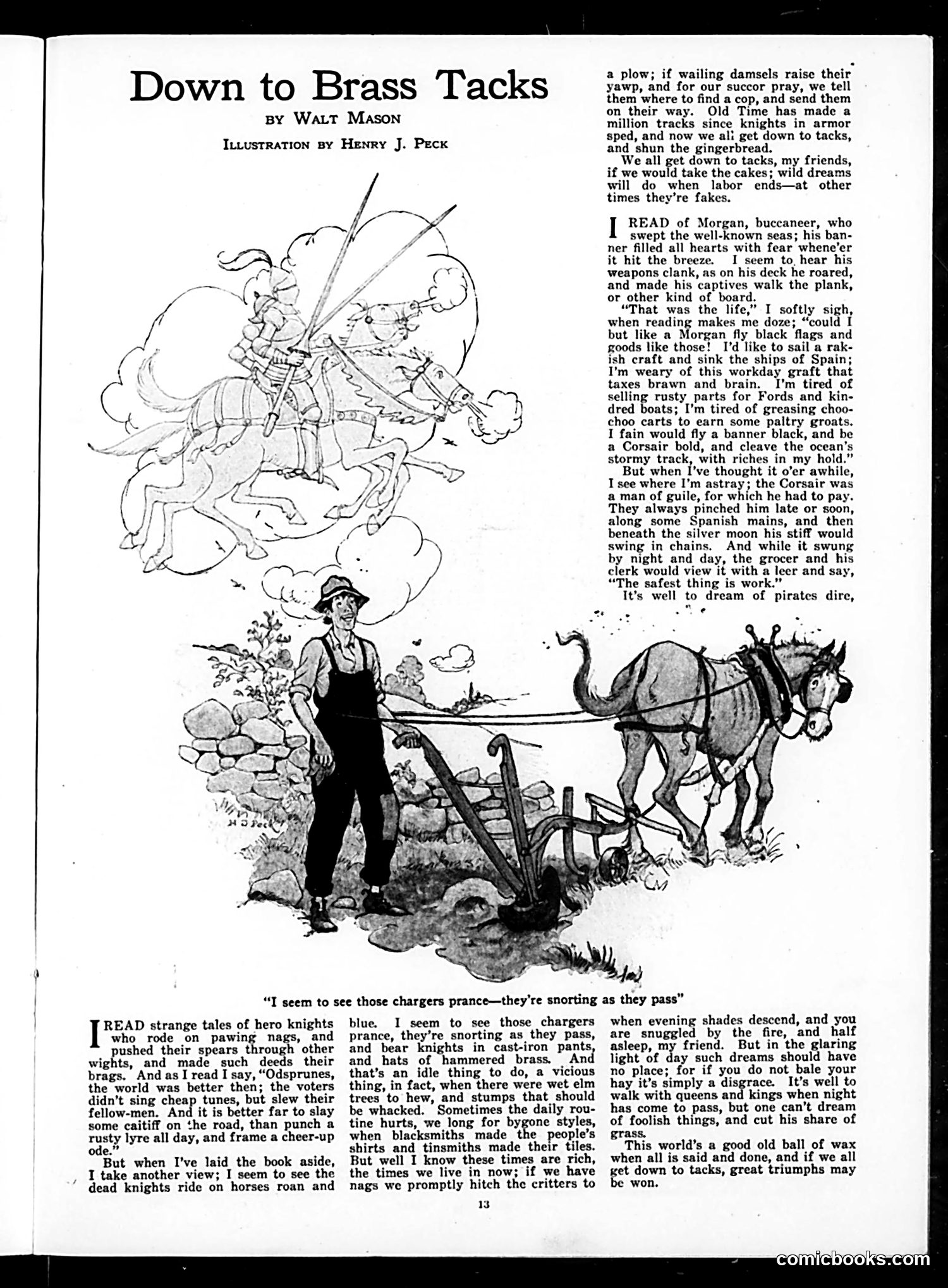
This page presents a nostalgic critique dressed as whimsy. The poem contrasts romantic fantasies—medieval knights, pirate adventure—with grinding modern reality: selling car parts, greasing "choo-choo carts" for meager wages. The central argument: daydreaming about heroic pasts is fine at night, but during daylight one must focus on actual work ("bale your hay"). The repeated phrase "down to brass tacks" means getting to practical business. The Henry J. Peck illustrations reinforce this: a fantastical dream-vision of mounted knights and Corsairs floats above a realistic scene of a workman with a plow and horse. The satire targets workers tempted by escapism when facing tedious labor. Mason's message is essentially conservative—dreams are acceptable leisure, but prosperity requires disciplined work. The tone is sympathetic to working-class exhaustion while ultimately exhorting acceptance of one's lot.
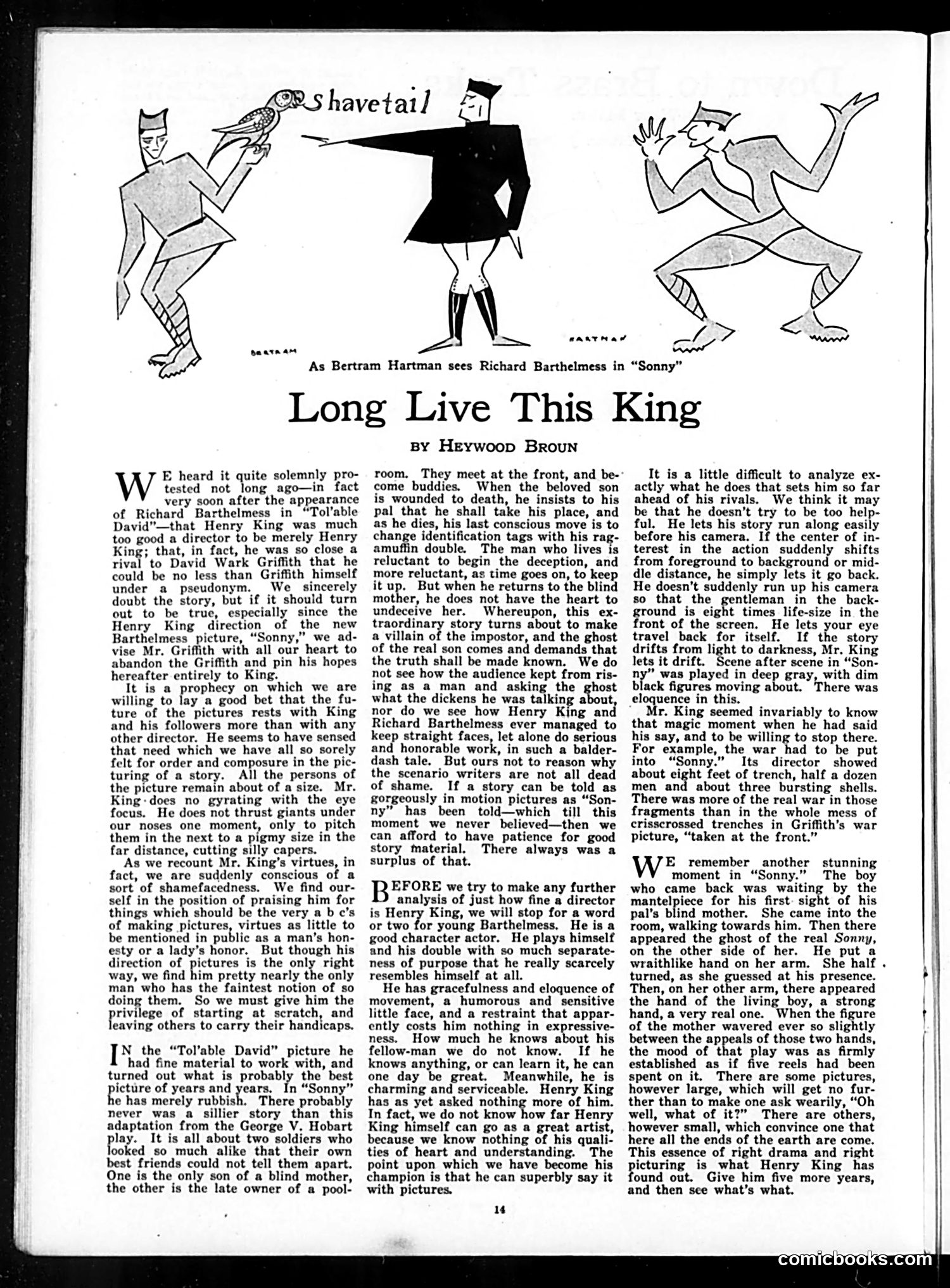
This is a favorable review by Heywood Broun of director **Henry King**'s film *Sonny*, starring actor **Richard Barthelmess**. The cartoons show stylized interpretations of the film's comedic situations. King is praised as an exceptionally skilled director who maintains visual discipline—keeping characters proportionate and focused, avoiding the exaggerated camera tricks that were common in silent films. Broun argues King should be recognized as a serious artist, not overshadowed by David Wark Griffith (then cinema's preeminent director). The irony of the review is that while *Sonny*'s plot is criticized as "rubbish"—a contrived story about soldiers swapping identities involving a ghostly demand for truth—King's directorial mastery supposedly elevates even this absurd material into compelling cinema. Broun essentially argues that King's technical skill and restraint matter more than the script's quality.
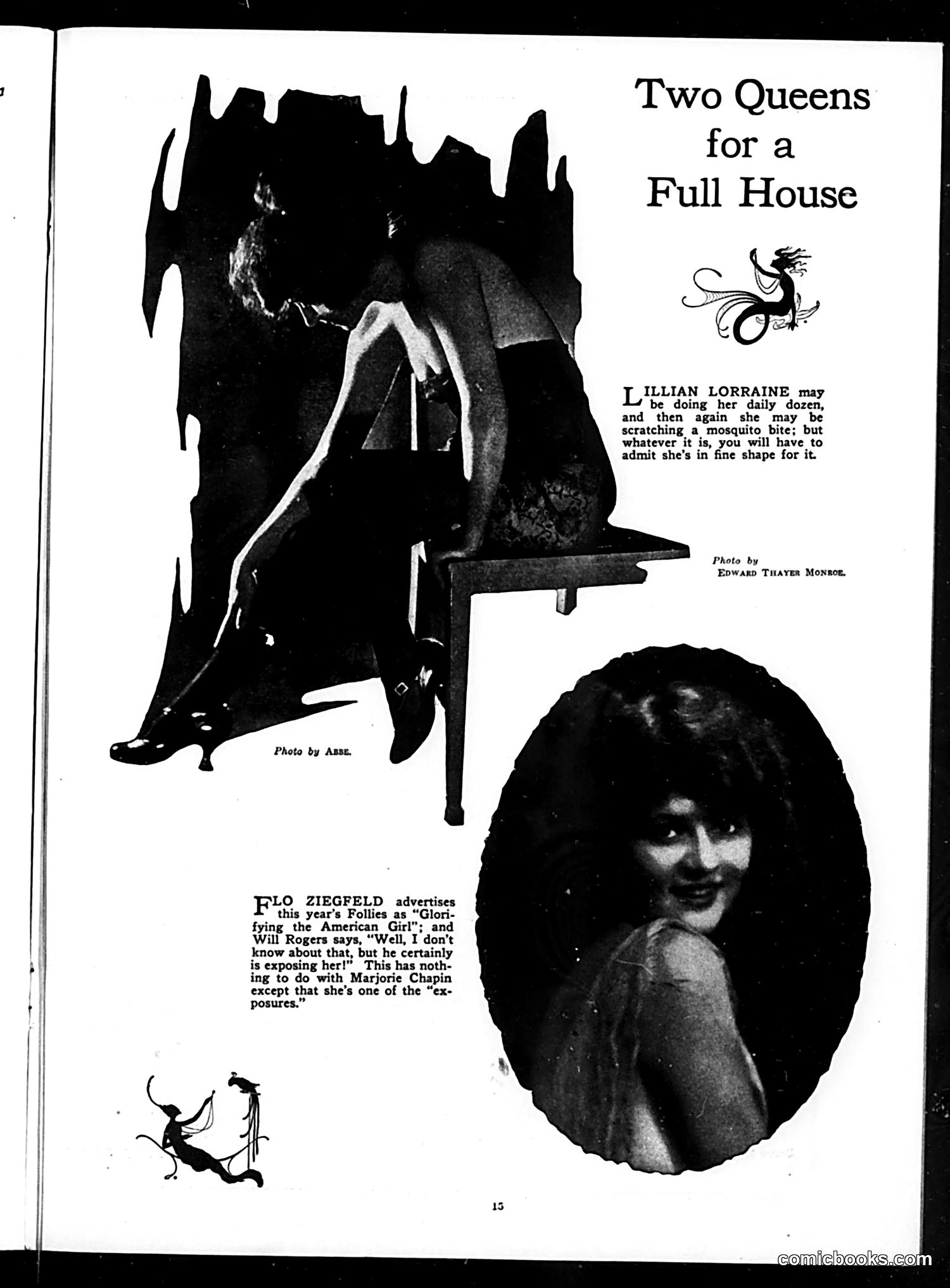
This page satirizes the Ziegfeld Follies, a famous Broadway revue known for featuring glamorous women. The two photographs show performers from the show—Lillian Lorraine (top) and Marjorie Chapin (bottom). The humor centers on a double meaning: Flo Ziegfeld advertises the Follies as "Glorifying the American Girl," but comedian Will Rogers quips that Ziegfeld is actually "exposing her" instead—a play on words referencing both the Follies' famous bare-midriff costumes and the idea of revealing/exposing performers. The title "Two Queens for a Full House" is a poker reference, suggesting these women are the prize attractions. The page mocks both Ziegfeld's marketing and the era's sexual display in entertainment, presenting it as the true draw rather than any genuine artistic merit. It's typical Judge magazine satire of theatrical showmanship and publicity.
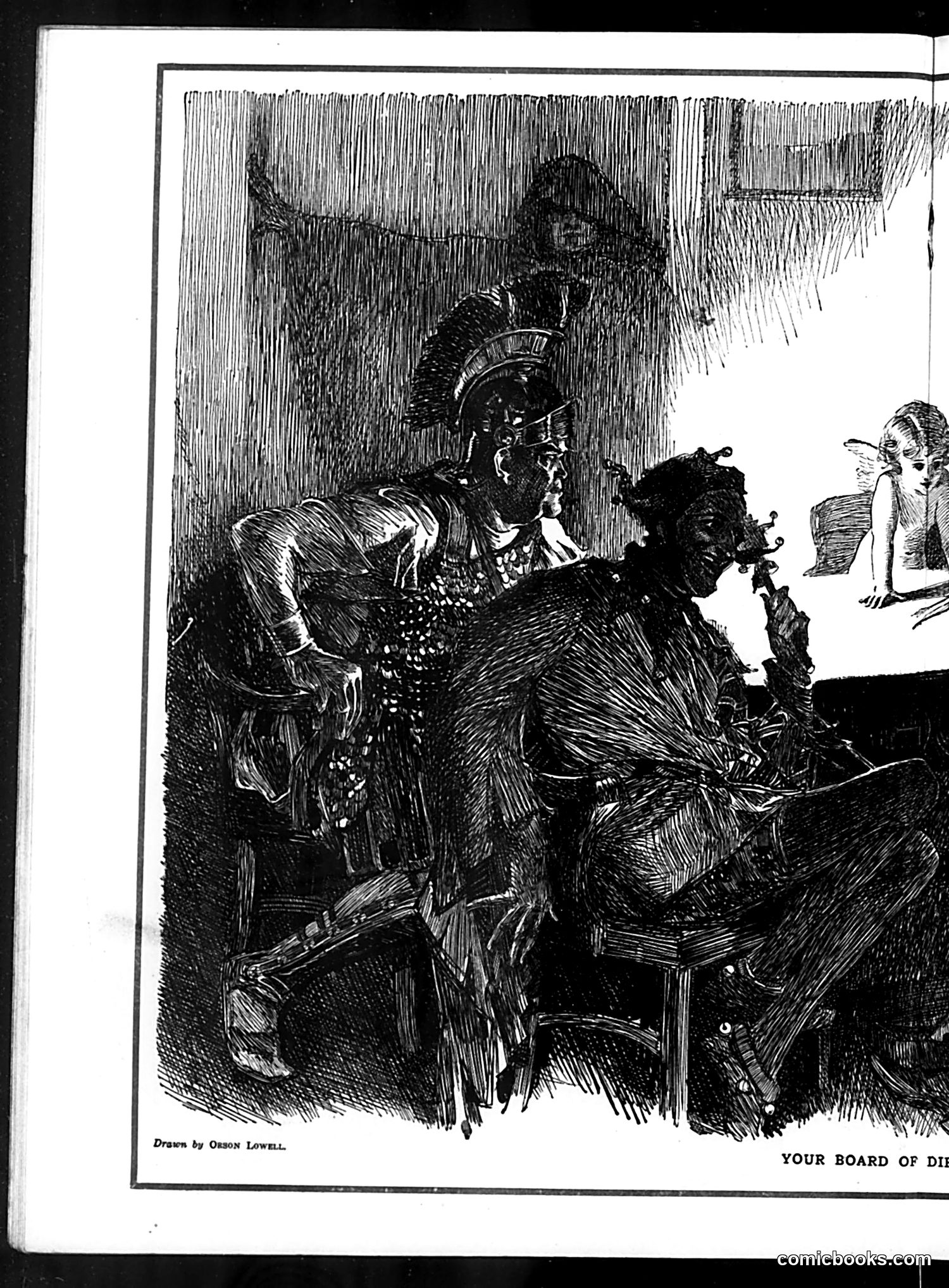
This political cartoon by Orson Lowell appears incomplete on the visible page—the bottom is cut off, showing only partial text "YOUR BOARD OF DI[RECTORS]." The image depicts what appears to be a formal dining or board meeting scene. A military or formally-dressed figure with ornate headgear and decorative regalia dominates the left side, facing another figure. The setting suggests an official or governmental context. Without the complete caption or full text, I cannot definitively identify the specific figures or the precise political/social critique intended. The cartoon likely satirizes either military leadership, corporate governance, or diplomatic relations of the Judge magazine era, but the exact reference remains unclear from this truncated page. The formal dress and apparent hierarchy suggest commentary on power dynamics or institutional authority.
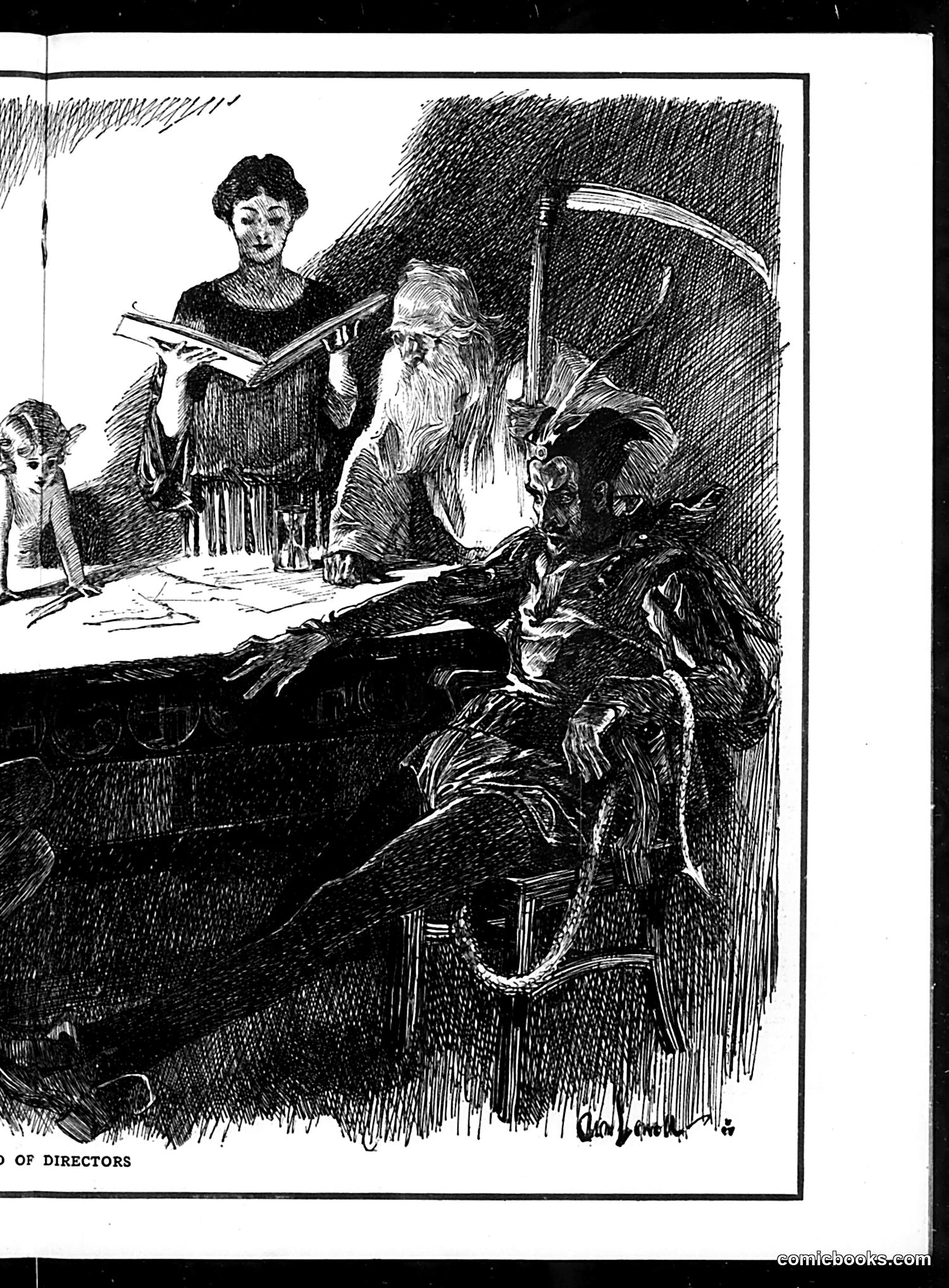
This appears to be a satirical cartoon from *Judge* magazine depicting a board of directors meeting. The image shows five figures around a table: a bearded elderly man (center-right) with a scythe—a clear reference to Death or the Grim Reaper—alongside what appear to be business executives or politicians. A woman stands reading a document while another figure observes. The satire likely critiques corporate leadership or governance as destructive or deadly to the organization or public interest. The presence of Death among the "directors" suggests the cartoonist is arguing these leaders are ruinous, incompetent, or corrupt—leading the company to its demise. Without additional context or visible text identifying specific individuals, the exact political/corporate targets remain unclear, though the visual metaphor is unmistakable: these directors are killing their organization.
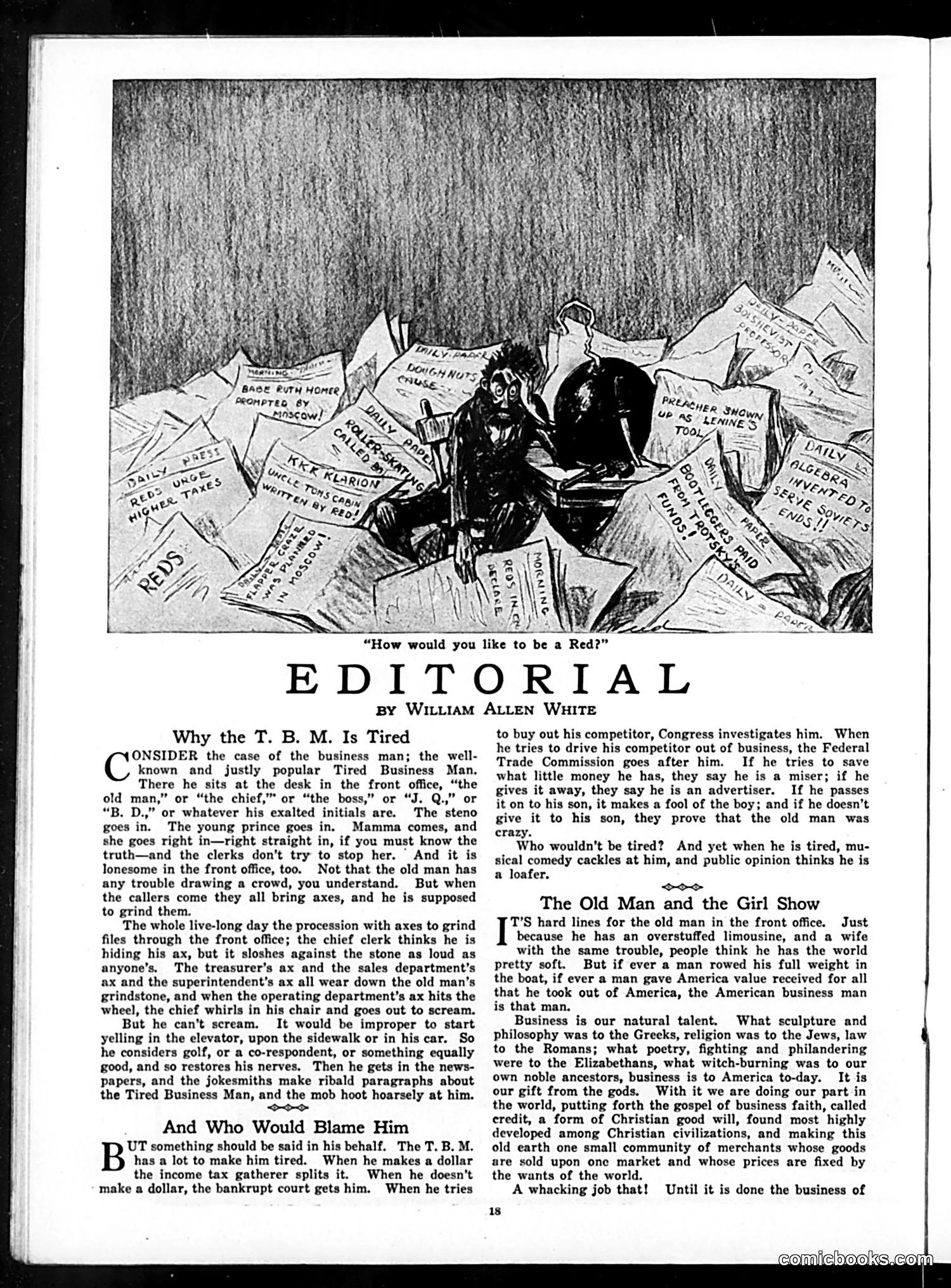
The cartoon depicts two figures (likely representing businessmen or capitalists) buried under a mountain of newspapers bearing headlines about business scandals and investigations. The caption poses a rhetorical question about becoming a "Red"—slang for communist or radical. White's accompanying editorial defends American businessmen, particularly the "Tired Business Man" archetype. It satirizes how business leaders face constant criticism and regulatory scrutiny: the income tax takes their profits, bankruptcy courts pursue them when they fail, Congress investigates buyout attempts, and the Federal Trade Commission monitors their competitive practices. The piece treats business itself as America's noble calling—equivalent to art, religion, or philosophy in other civilizations. White argues businessmen deserve respect rather than mockery for sustaining the nation's economic system through "credit" and "Christian good will." The cartoon's headline sarcastically suggests that constant attacks on business might drive capitalists toward communism, inverting typical 1920s Red-scare rhetoric by portraying businessmen as victims rather than threats.
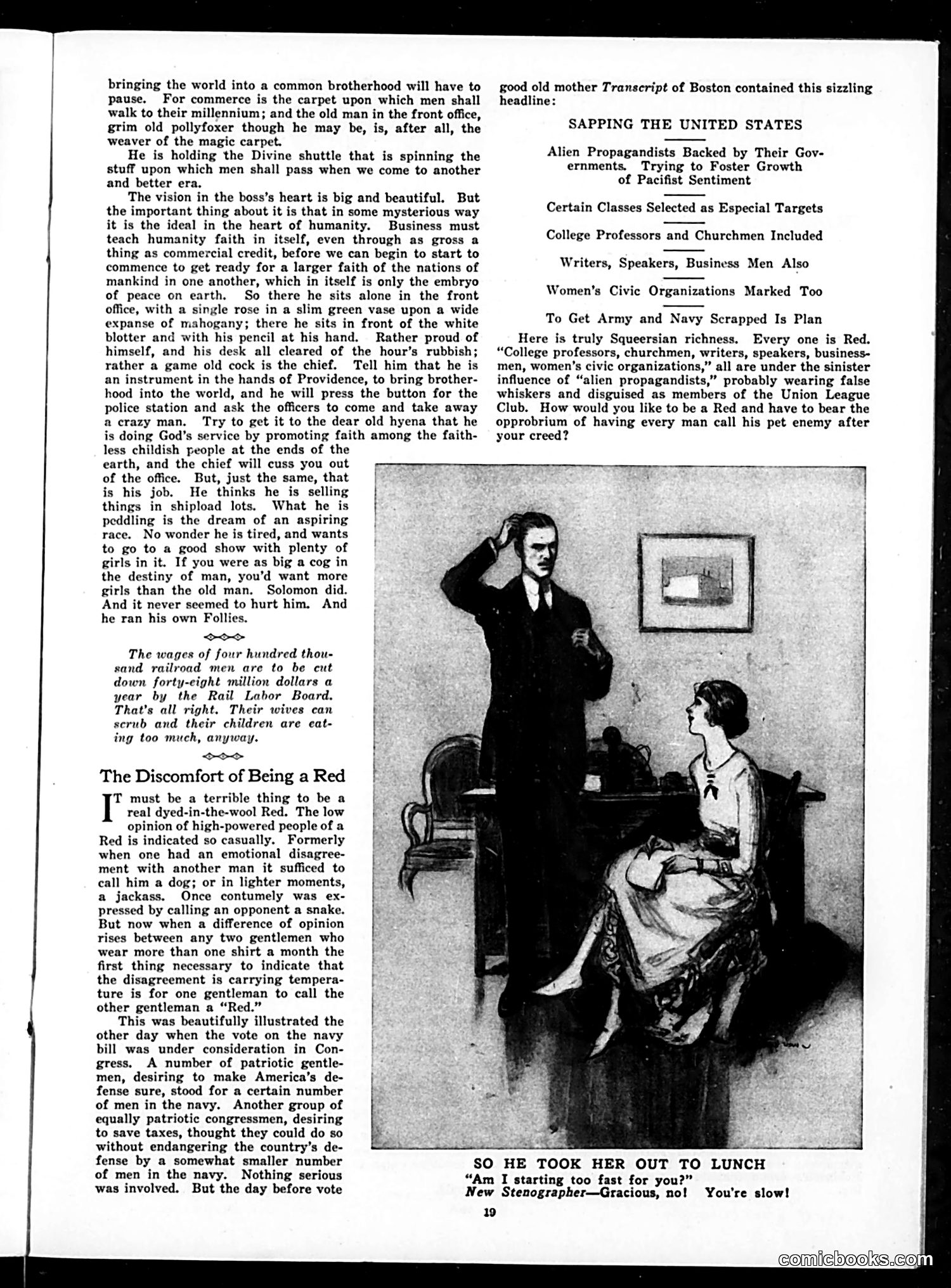
This page from Judge satirizes Red Scare hysteria of the early 1920s. The headline "SAPPING THE UNITED STATES" mocks paranoid claims that "alien propagandists" are infiltrating American institutions—colleges, churches, civic organizations—to promote pacifism and disarm the military. The accompanying cartoon depicts a businessman taking a woman to lunch, captioned "Am I starting too fast for you?" / "You're slow!"—a flirtation joke unrelated to the political content. The essay "The Discomfort of Being a Red" sarcastically observes how easily anyone can be labeled a "Red" (communist/radical) during this period. Disagreeing with someone now automatically invites the accusation of being a communist sympathizer. Judge ridicules the absurdity: respectable businessmen, professors, and civic leaders are all suddenly "under the sinister influence" of foreign agitators merely for holding dissenting views. The satire targets McCarthyist-style witch hunts before McCarthy himself, exposing the era's irrational fear-mongering.
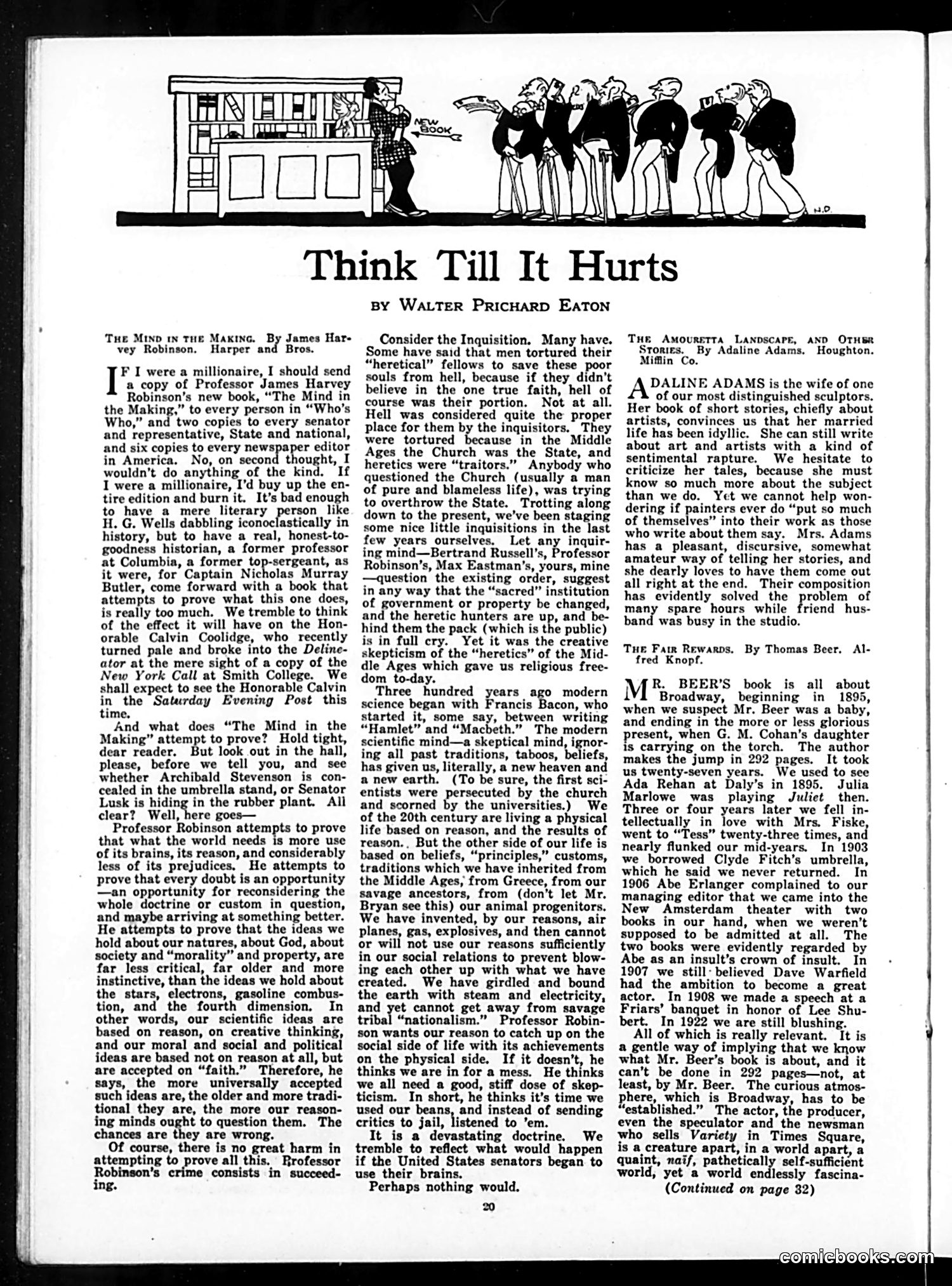
This piece satirizes the American establishment's hostility toward critical thinking. The cartoon depicts a figure (representing Professor James Harvey Robinson, author of "The Mind in the Making") being chased by a mob of men in suits and hats—representing politicians, editors, and the general public. Robinson's crime: publishing a book arguing that society should rely more on reason and less on inherited prejudices and "faith." Eaton's essay, using darkly ironic examples from the Spanish Inquisition to contemporary America, compares modern suppression of dissenting intellectuals to religious persecution. The references to "Senator Lusk" and "Archibald Stevenson" appear to be contemporary figures involved in anti-radical activities (likely post-WWI Red Scare paranoia). The joke is that simply advocating rational questioning of established institutions marks one as dangerous—the very antithesis of the book's message.
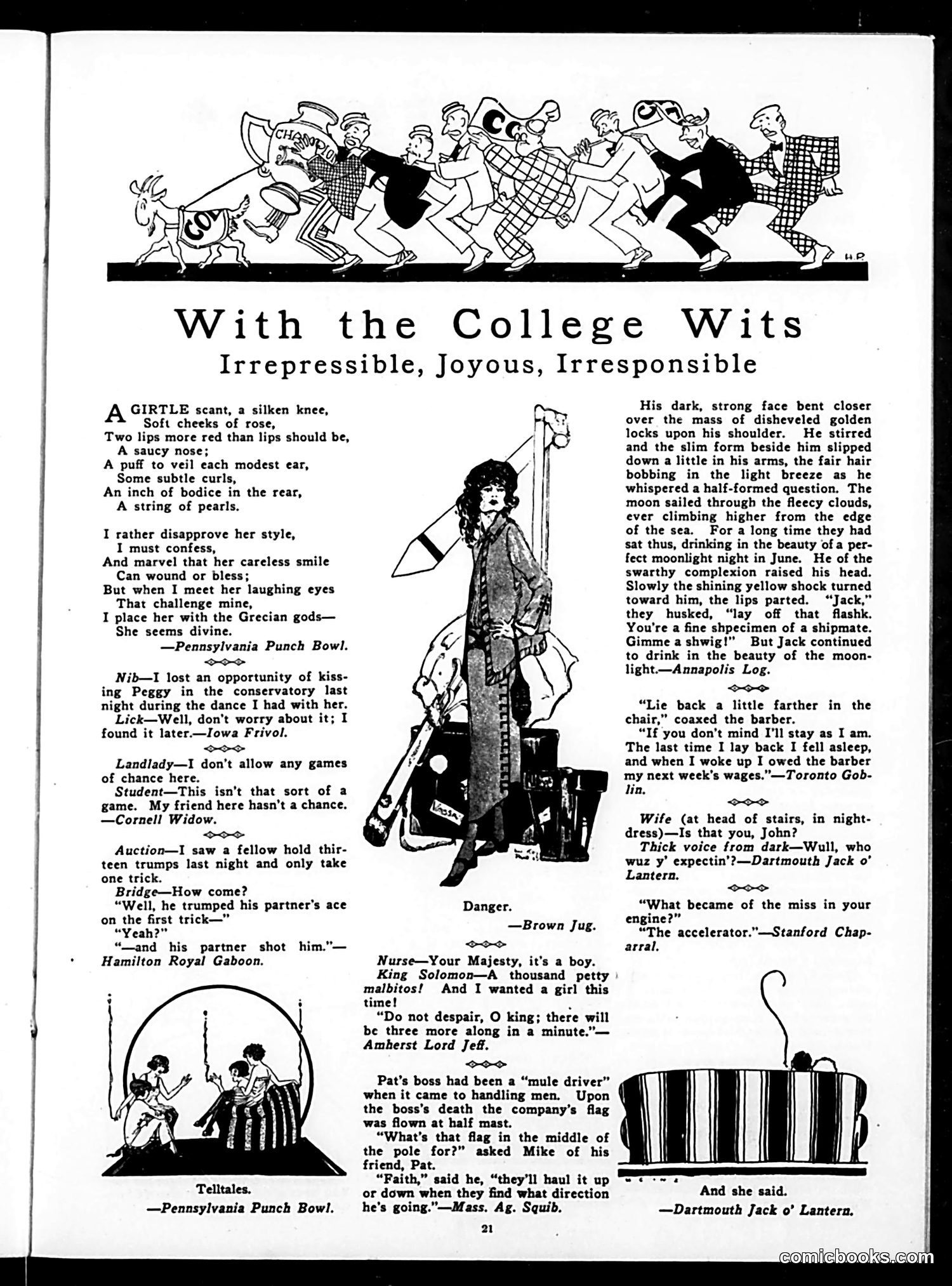
This page collects humorous anecdotes and poems from college humor magazines of the early 20th century, reflecting undergraduate life and romantic preoccupations of that era. **The content includes:** - **Poetry about female beauty** (Pennsylvania Punch Bowl) - A romanticized description of an attractive college woman, presented as "divine" - **Dating/romance jokes** - References to kissing opportunities, dance hall encounters, and courtship rituals typical of supervised college social life - **Card game humor** (Bridge/Auction) - A joke about bridge players, culminating in violence over a bad play - **Wordplay and puns** - Including double-entendres about romance and automobiles ("accelerator" as a missed romantic opportunity) - **Illustrations** depicting romantic or humorous college scenarios The page satirizes college life through crude jokes, sentimental romance, and situations emphasizing young men's social anxieties around courtship—reflecting early-1900s attitudes toward gender, dating protocols, and undergraduate culture that modern readers would find dated and often inappropriate.
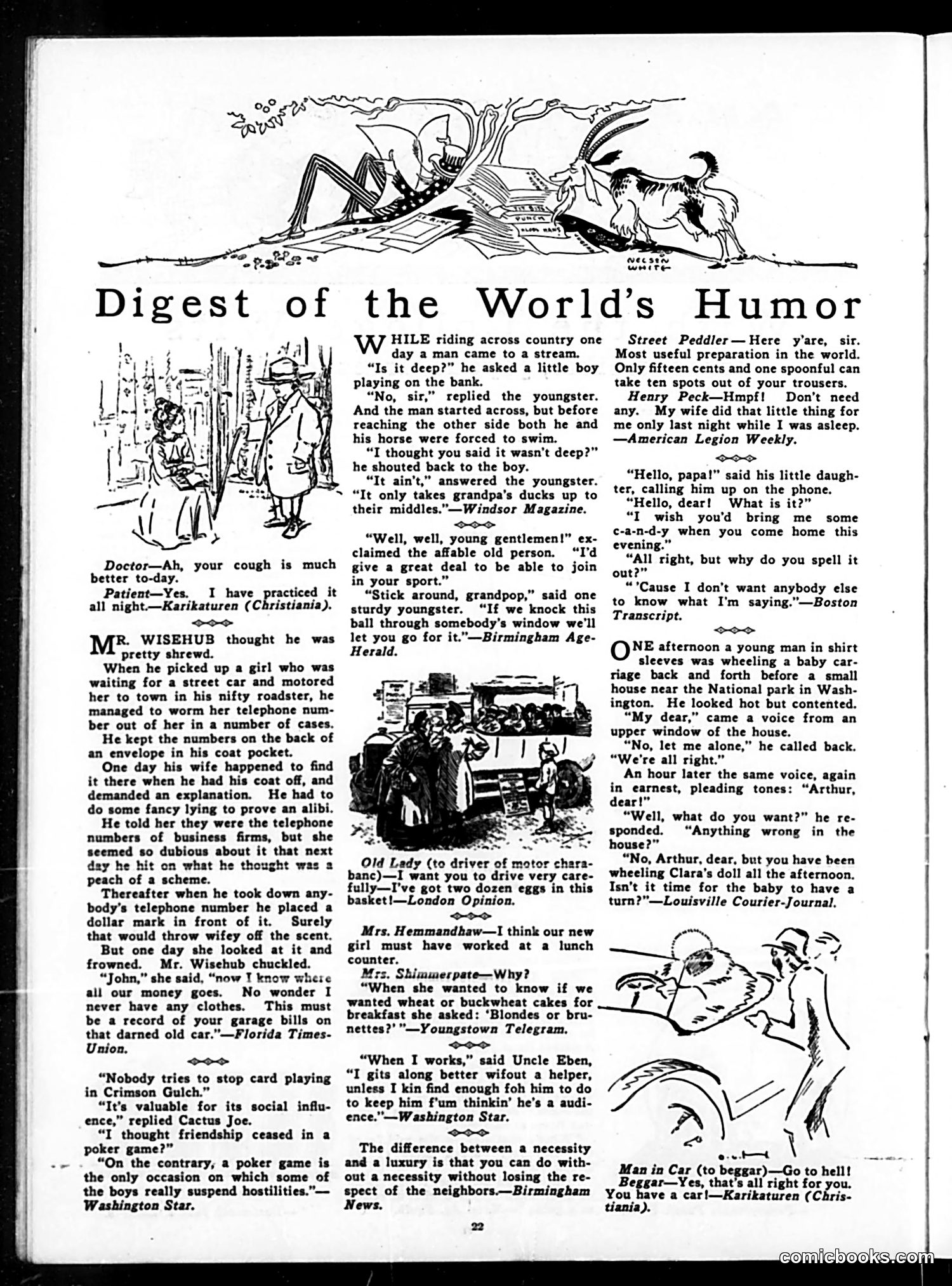
This is a humor compilation page from *Judge* magazine featuring brief jokes and anecdotes from various sources, arranged in short vignettes with accompanying illustrations. The cartoons depict everyday domestic and social situations: a man caught in an alibi about phone numbers (implying infidelity), a boy misleading a traveler about stream depth, a con artist selling dubious spot remover, a child spelling "candy" over the phone to hide it from others, and a young man pushing a baby carriage while his wife is out. The humor relies on common early-20th-century scenarios—marital deception, childhood mischief, consumer gullibility, and gender role reversals. One joke plays on a Black dialect speaker's philosophy about labor. The jokes assume a middle-class, domestic audience familiar with cars, telephones, and servants. There's no evident political satire here—this is purely social comedy targeting universal human behaviors like dishonesty, vanity, and domestic friction.
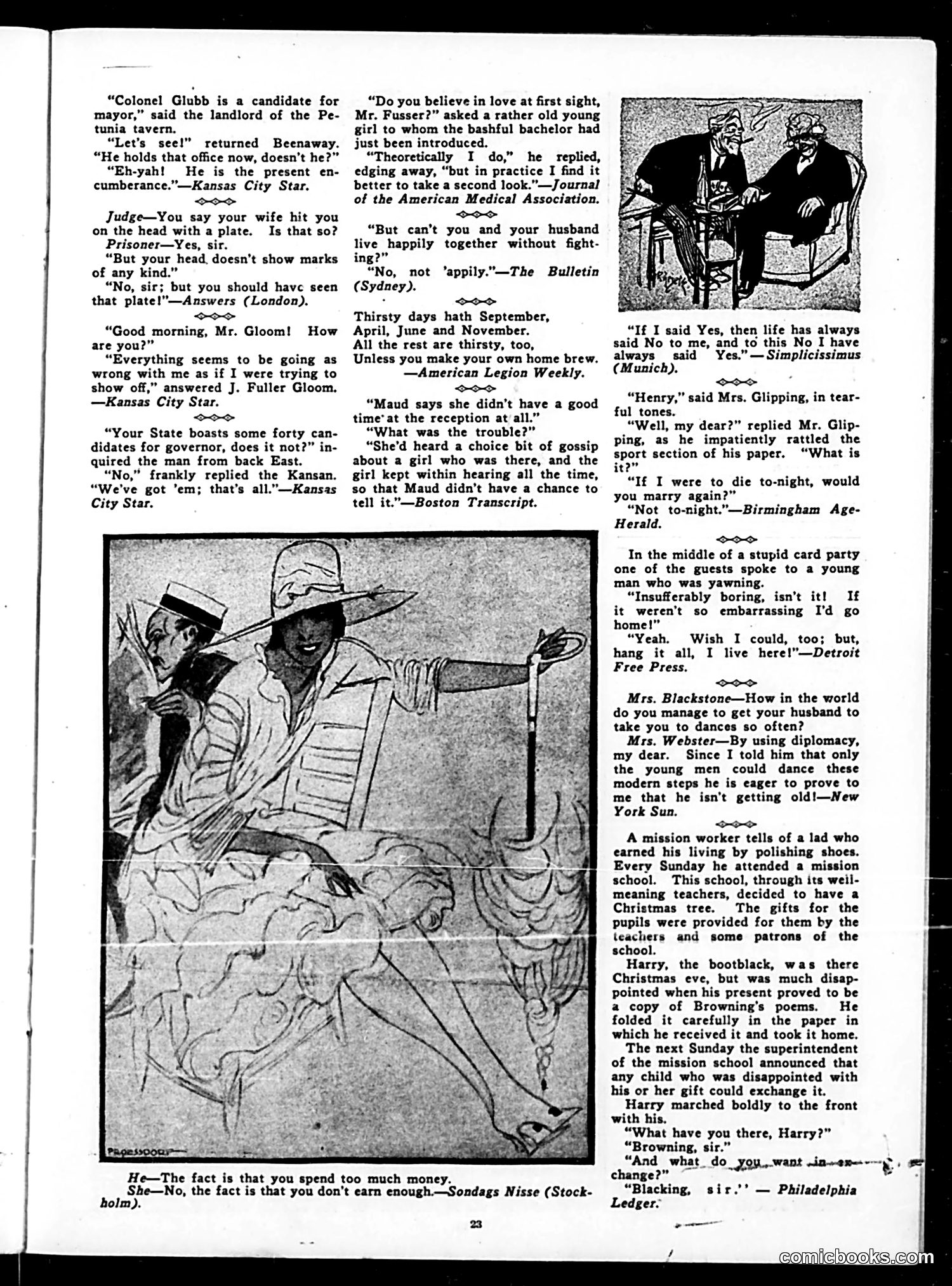
This page from Judge magazine contains multiple brief satirical jokes and anecdotes typical of early 20th-century American humor. The large cartoon depicts a cowboy or rancher on horseback, apparently exaggerating his riding skills or misadventures—the humor likely relies on physical comedy rather than specific political reference. The text comprises short jokes sourced from various newspapers and publications, covering universal themes: marital discord, political incompetence, romantic awkwardness, and social pretension. One notable item concerns a poor bootblack disappointed receiving Browning's poetry instead of shoe-blacking supplies—gentle satire of well-meaning but tone-deaf charitable institutions prioritizing "culture" over practical utility. The humor is largely apolitical and domestic, reflecting Judge's general satirical approach to everyday American life rather than specific current events.
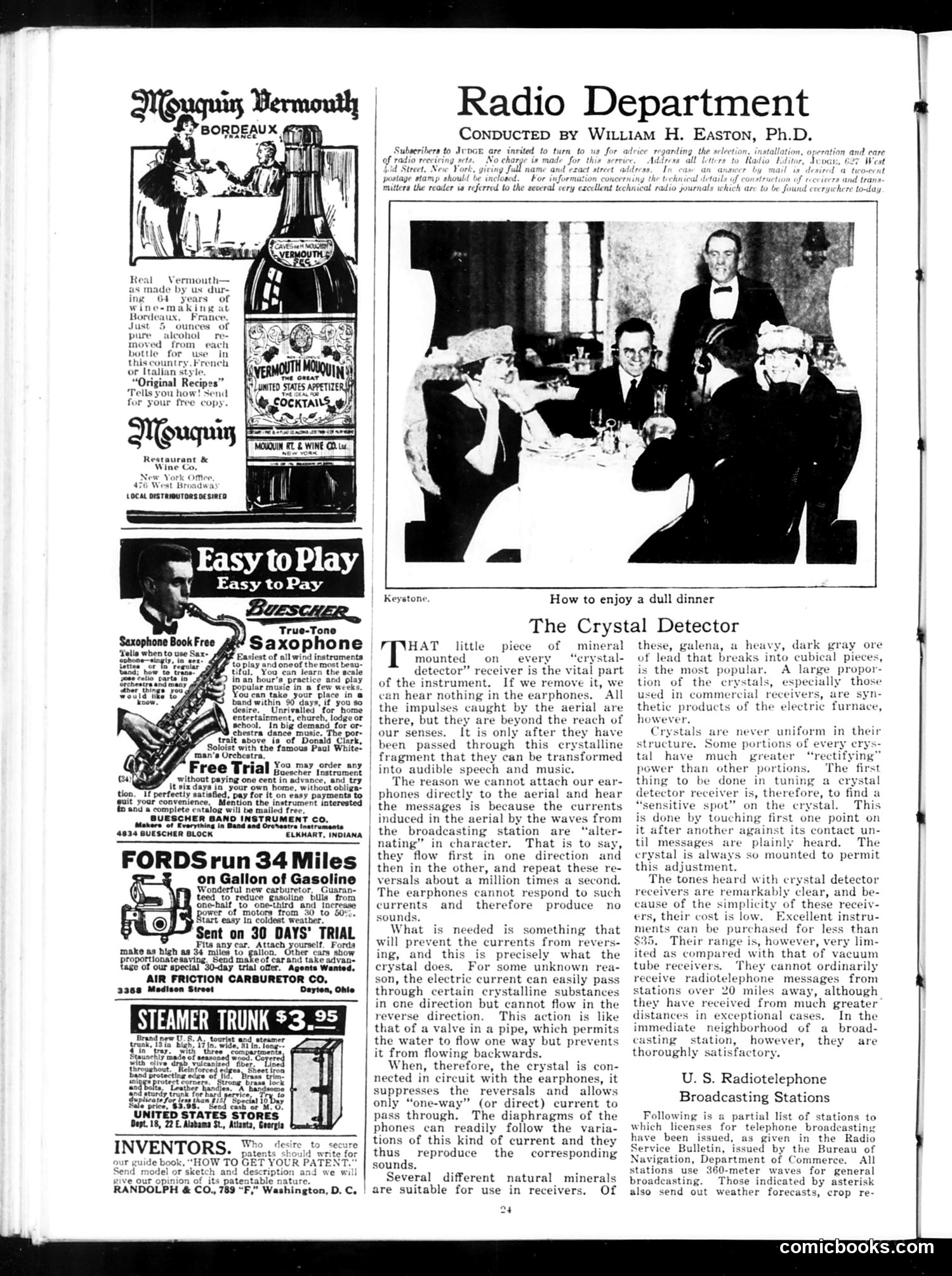
This page is primarily **advertising and instructional content** rather than political satire. The main elements are: **The "Radio Department" section** (right side) features educational content about crystal detectors—early radio receiver components. Conductor William H. Easton explains how galena crystals convert alternating electrical currents into audible sound, addressing practical questions from radio enthusiasts. This reflects the **early 1920s radio boom** when crystal sets were common amateur technology. **The photograph** titled "How to enjoy a dull dinner" shows well-dressed men at a formal dinner, apparently listening to radio (though the connection is unclear from the image alone). The joke likely satirizes how radio was becoming such an entertainment obsession that people would tune in even at social events. **The advertisements** (left side) include instruments, carburetors, and trunks—typical period merchandise. There is **no clear political satire** on this page; it's a snapshot of 1920s consumer culture and the early radio craze.
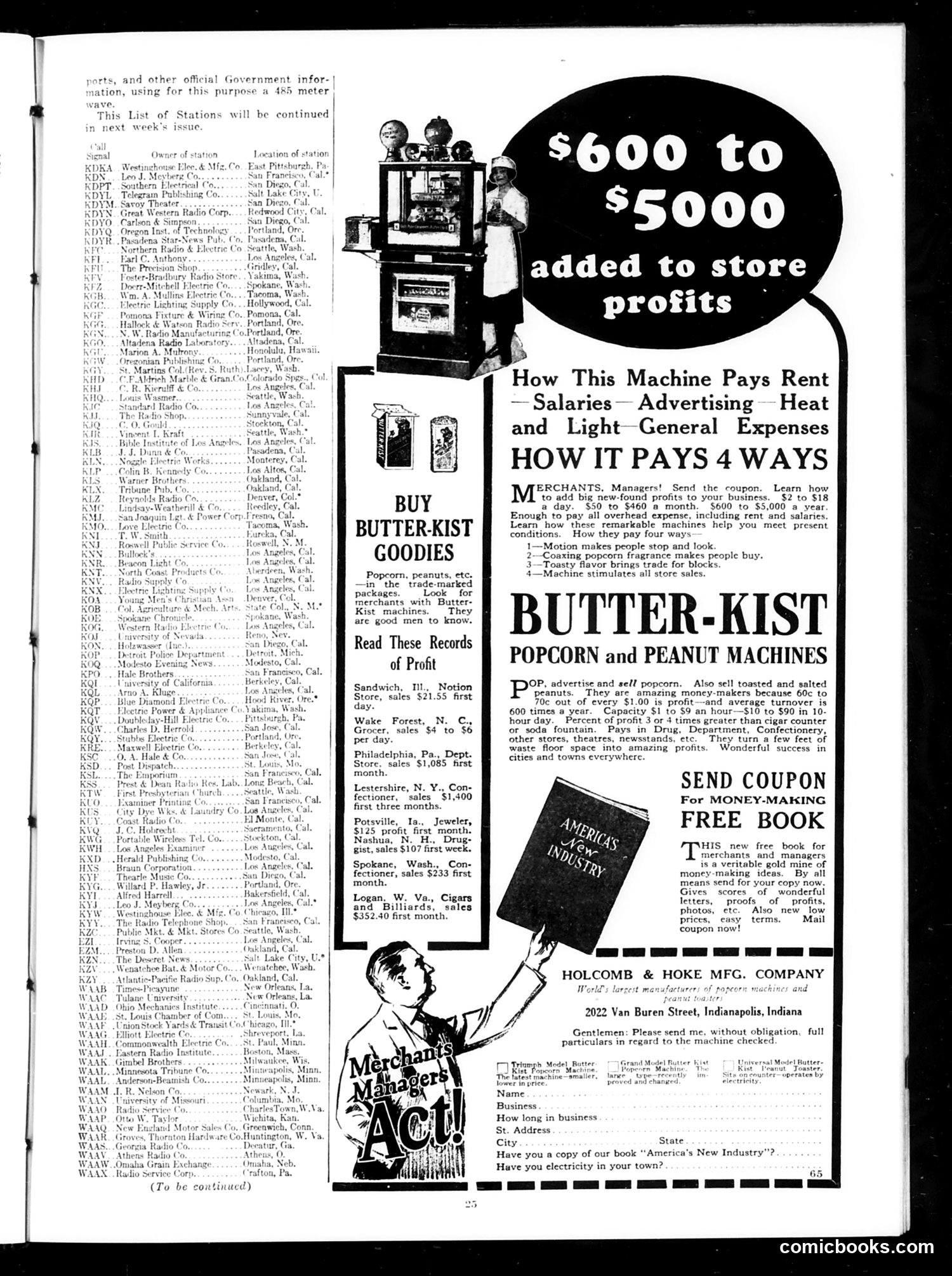
This page is primarily **commercial advertising**, not satirical content. It promotes Butter-Kist popcorn and peanut vending machines manufactured by Holcomb & Hoke MFG. Company (Indianapolis). The advertisement targets store owners and managers with claims that these machines generate substantial profits ($600-$5,000 yearly) while paying overhead costs. It emphasizes four profit mechanisms: motion attracts customers, popcorn aroma drives purchases, quality encourages repeat business, and machines stimulate overall sales. The page includes testimonial "Records of Profit" from various businesses (grocers, jewelers, drug stores) documenting sales success, a coupon offering a free "money-making" guide, and a list of radio stations (left margin) — likely Judge's advertising circulation information. A cartoon figure labeled "Merchants Action" holds the promotional book, though this appears decorative rather than satirical commentary. This represents typical early 20th-century trade magazine advertising promoting vending machine investment opportunities.
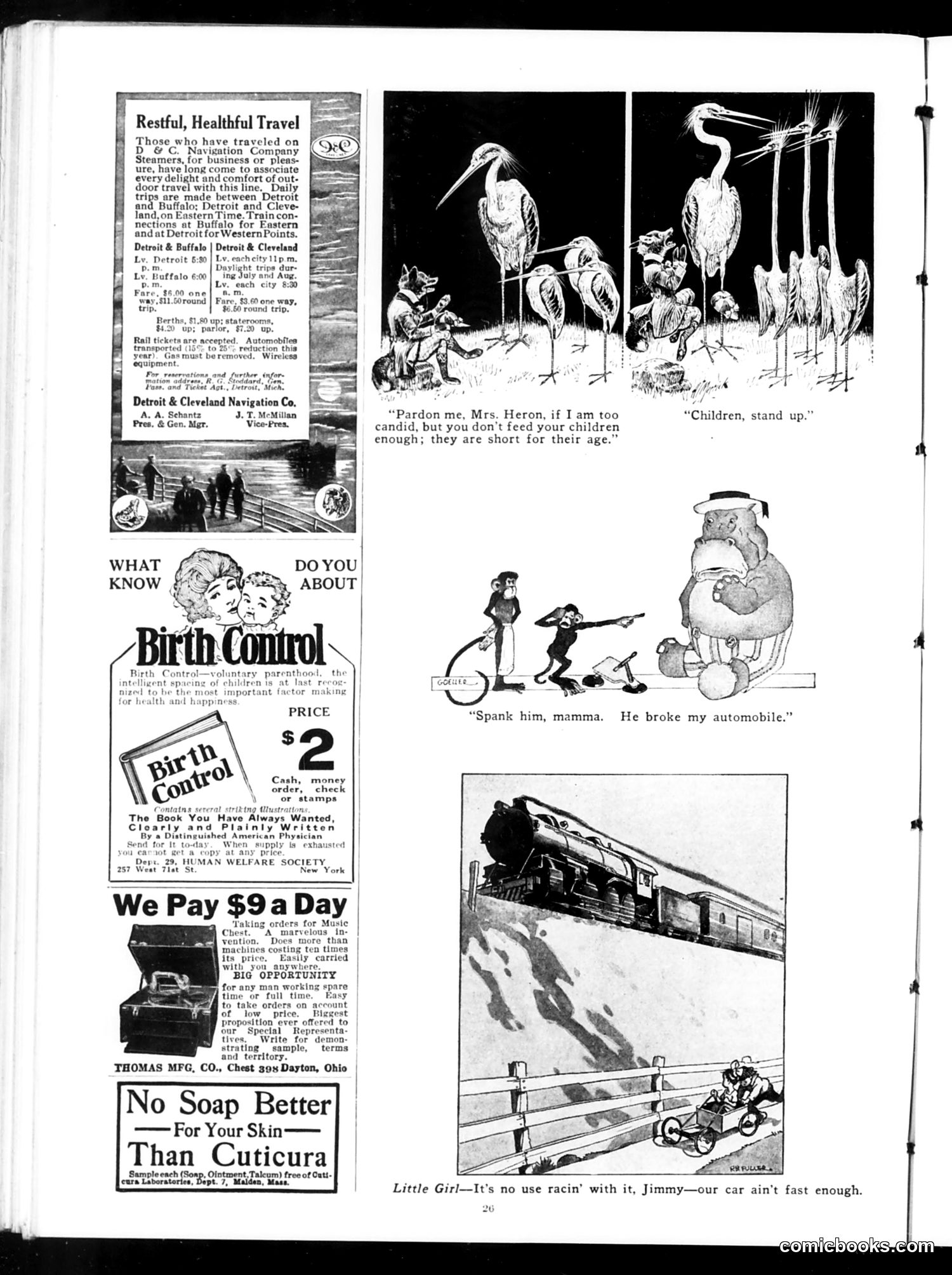
This page contains three distinct cartoons satirizing early 20th-century American parenting and consumerism. **Top cartoon**: A mother heron is criticized for undersized chicks. The satire targets anxious parents who obsess over children's physical development, suggesting unrealistic expectations about growth. **Middle cartoon**: A child asks his mother to punish him for breaking "my automobile"—likely a toy car. The joke mocks wealthy families where even children own automobiles, and the child's casual destruction of expensive property, revealing both parental indulgence and child entitlement. **Bottom cartoon**: A girl tells her brother their car is inadequate for racing. The satire ridicules automotive culture and the mentality of speed-obsessed Americans, particularly the absurdity of children demanding faster vehicles. The ads surrounding these cartoons—for birth control, musical instruments, soap, and travel—reflect Progressive Era consumer culture. Together, the page satirizes modern parenting anxieties, childhood materialism, and America's nascent automobile obsession.
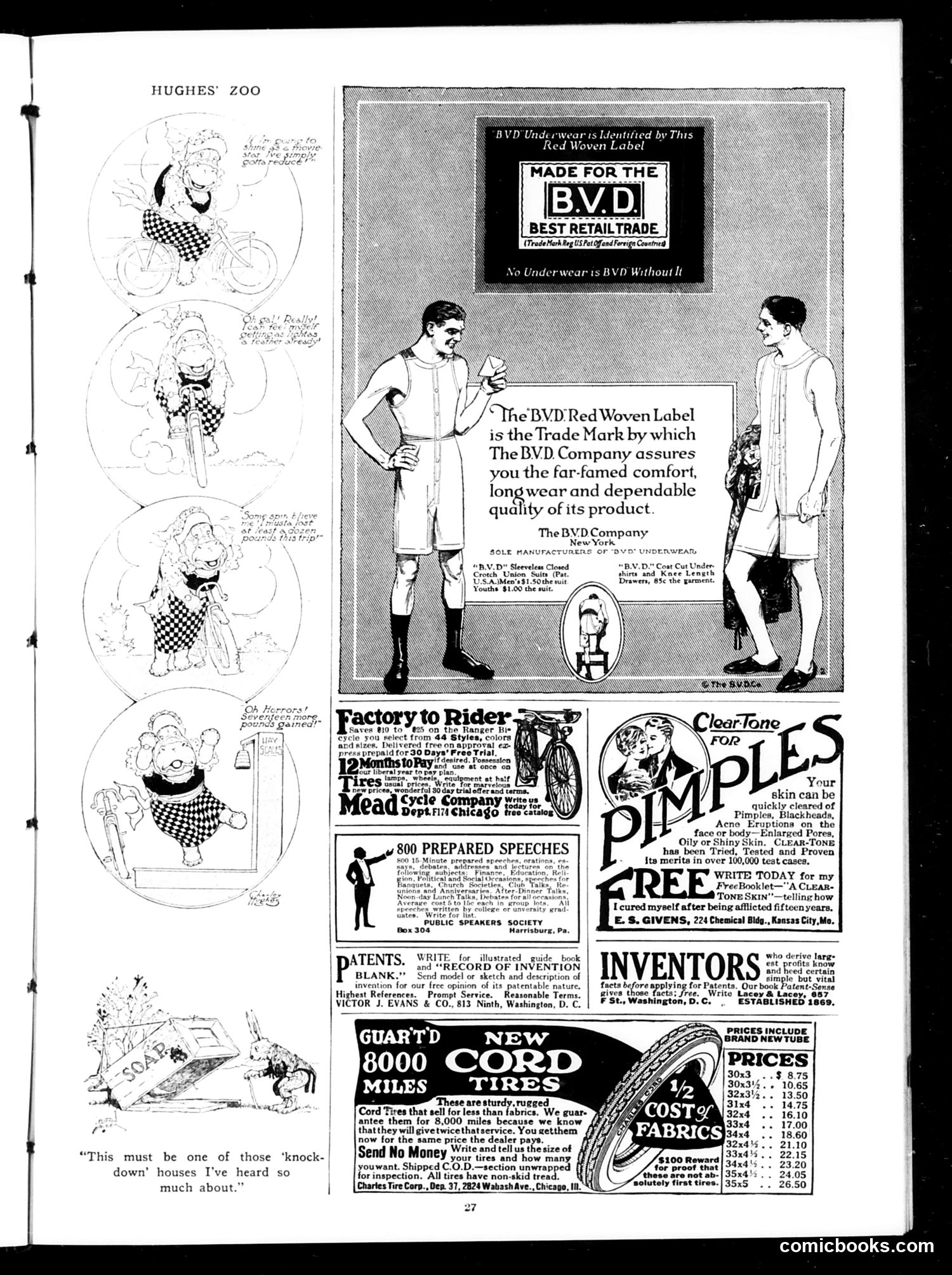
This page is primarily **advertising**, not political satire. The left side contains a multi-panel comic strip titled "Hughes' Zoo" (artist unclear from image), depicting what appears to be humorous domestic or social situations involving a woman in a checkered dress. The majority of the page features period advertisements for: - **BVD underwear** (emphasizing the red woven label as quality assurance) - **Tire, patent, and skin-care products** - Various mail-order goods typical of early 20th-century magazines The single cartoon caption at bottom—"This must be one of those 'knock-down' houses I've heard so much about"—appears to be a separate joke about prefabricated or collapsible housing, a contemporary phenomenon. **Overall**: This is a standard Judge magazine page mixing light humor with commercial advertisements rather than political commentary.
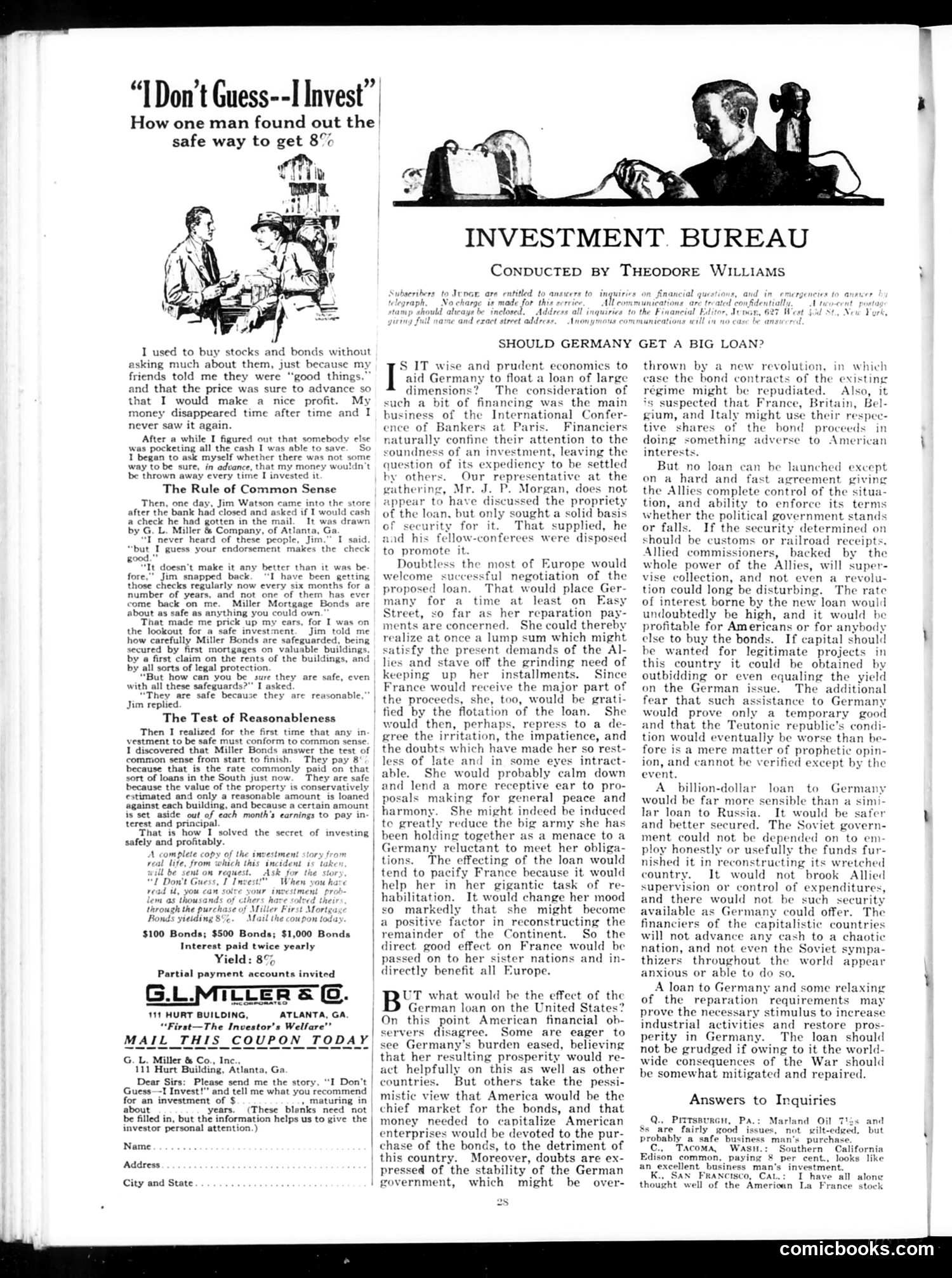
This page combines a financial advertisement with editorial commentary on post-WWI economic policy. The **left section** is an advertisement for G.L. Miller & Company bonds (Atlanta, Georgia), presented as a testimonial narrative. A man learns to invest cautiously after losing money on friends' stock tips, then discovers the safety of mortgage bonds backed by real property and regular earnings. The pitch emphasizes 8% returns and "common sense" investing—a response to the 1920s investment culture where many Americans gambled on stocks. The **right section**, "Investment Bureau" conducted by Theodore Williams, addresses whether Germany should receive a large international loan. This references the **Dawes Plan era** (mid-1920s), when American bankers including J.P. Morgan negotiated German reparations financing. The columnist argues a loan could stabilize Germany economically, reduce European instability, and benefit American trade—while cautioning that the German government's stability remains questionable. Together, the page positions careful, secured investing as morally superior to speculation, while endorsing international financial cooperation for post-war reconstruction.
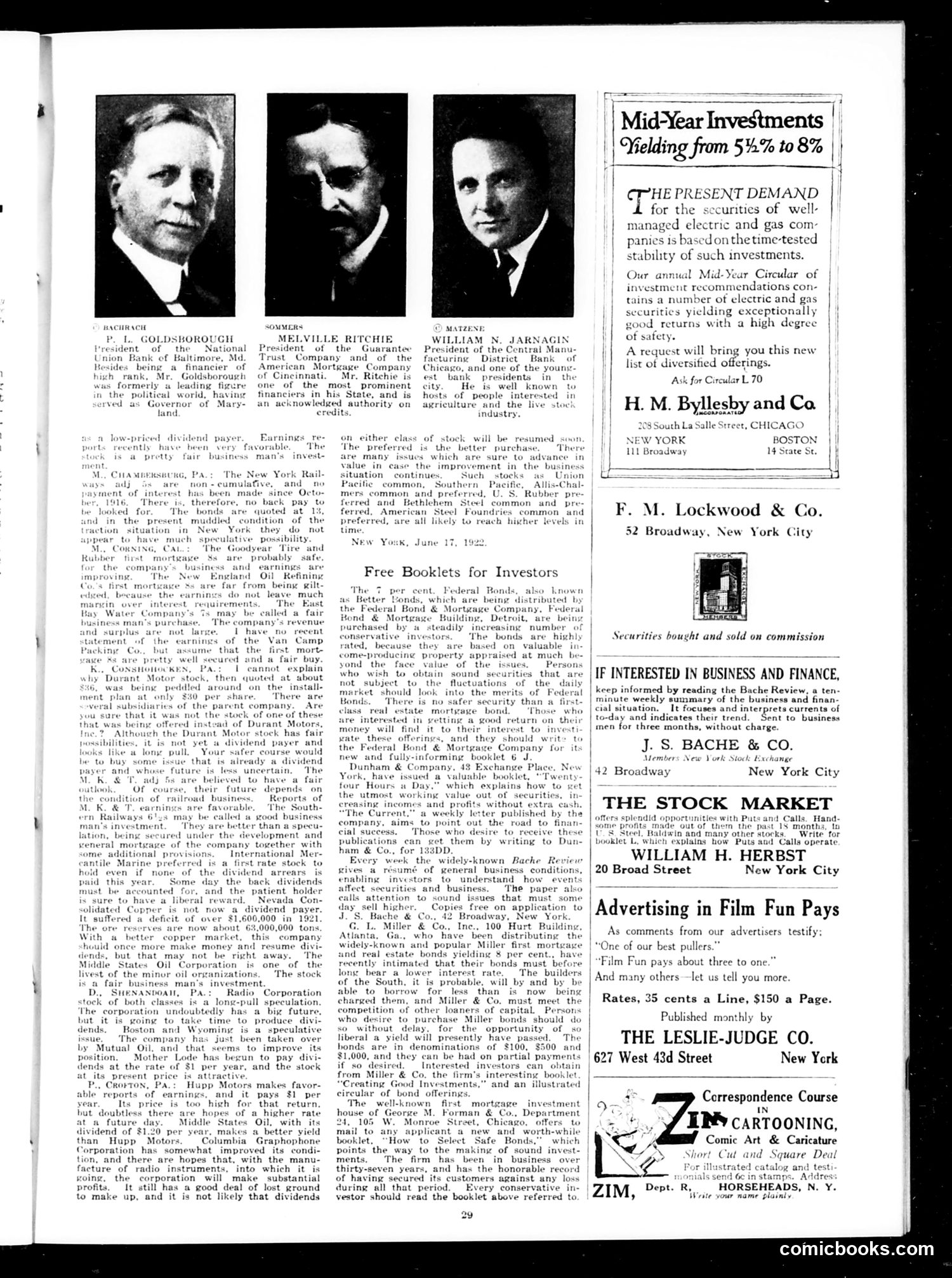
This page is primarily **financial advertising and investment advice**, not political satire. The three photographs show prominent bankers and financiers of 1922 (Goldsborough, Ritchie, and Jarnagin), presented as credible sources. The main content discusses **investment securities** — bonds from electric, gas, and railroad companies yielding 5½-8%. Multiple investment firms (H.M. Byllesby, F.M. Lockwood, J.S. Bache) advertise their services and free booklets for investors. A brief editorial discusses low-dividend stocks and speculative purchases, cautioning readers about Durant Motor stock being "peddled around on the installment plan" — suggesting skepticism toward aggressive sales tactics. The page reflects the **post-WWI investment boom** of the early 1920s, when publications marketed securities to middle-class readers. There is no identifiable political cartoon or satire here.
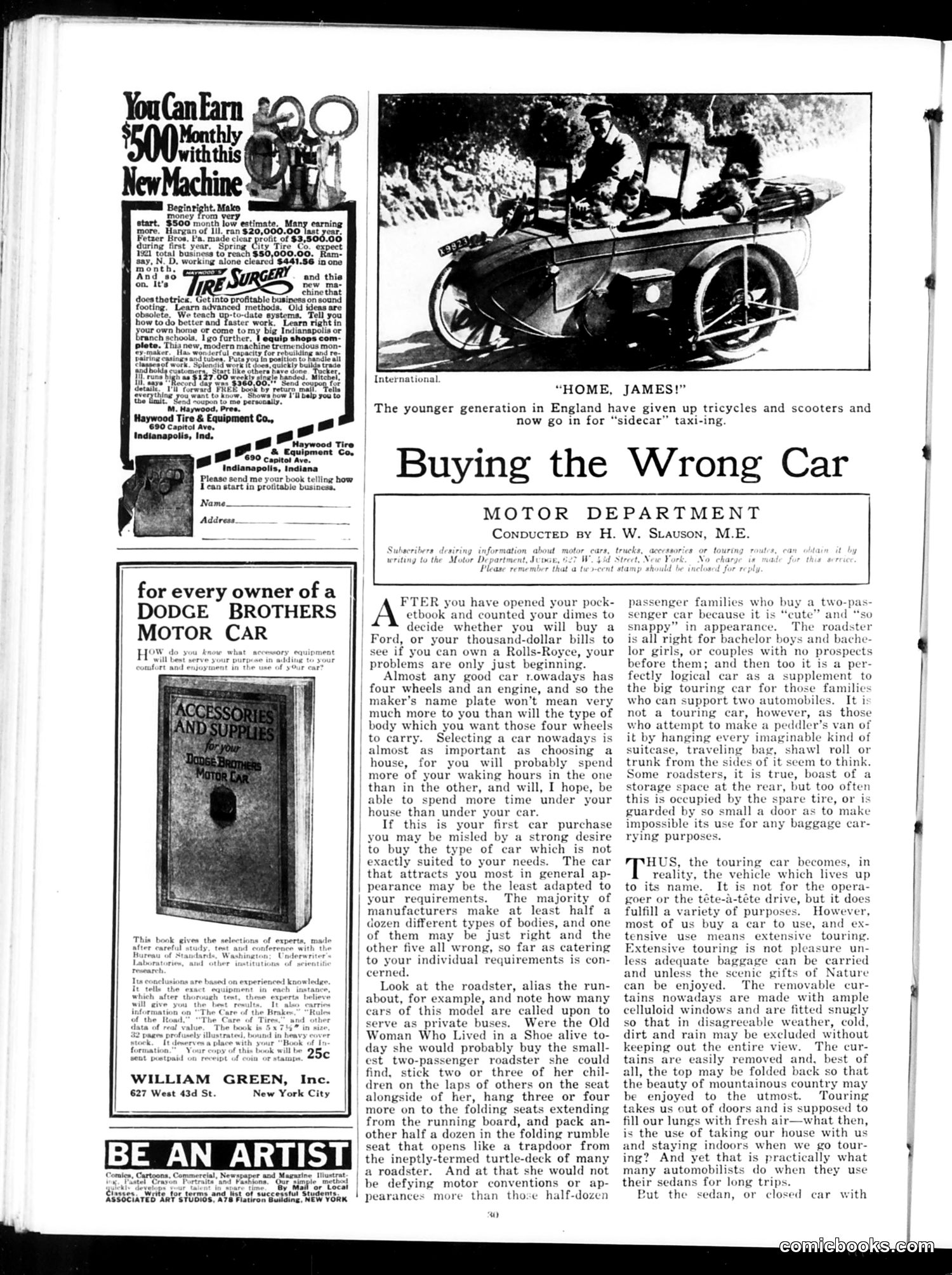
This page combines advertisements with editorial content satirizing automobile purchasing decisions. **The Cartoon ("Home, James!"):** The illustration depicts young English people riding in a motorcycle sidecar, captioned as "sidecar taxi-ing." The joke mocks the younger generation's adoption of this mode of transportation as an alternative to traditional vehicles—likely a post-WWI commentary on how economic conditions or changing habits have made motorcycles fashionable among those who previously might have used cars or carriages. **"Buying the Wrong Car" Editorial:** The motor department column, conducted by H.W. Slauson, advises car buyers against purchasing based solely on appearance ("cute" and "snappy" models) rather than practical needs. It specifically critiques the roadster—a two-passenger vehicle—when families attempt to use it like a touring car, hanging luggage everywhere. The piece advocates matching vehicle type to actual requirements: roadsters for singles/couples, touring cars for families needing capacity. **Context:** This reflects 1920s automobile culture when car types were proliferating and consumers needed guidance distinguishing between models suited to their lifestyles versus impractical vanity purchases.
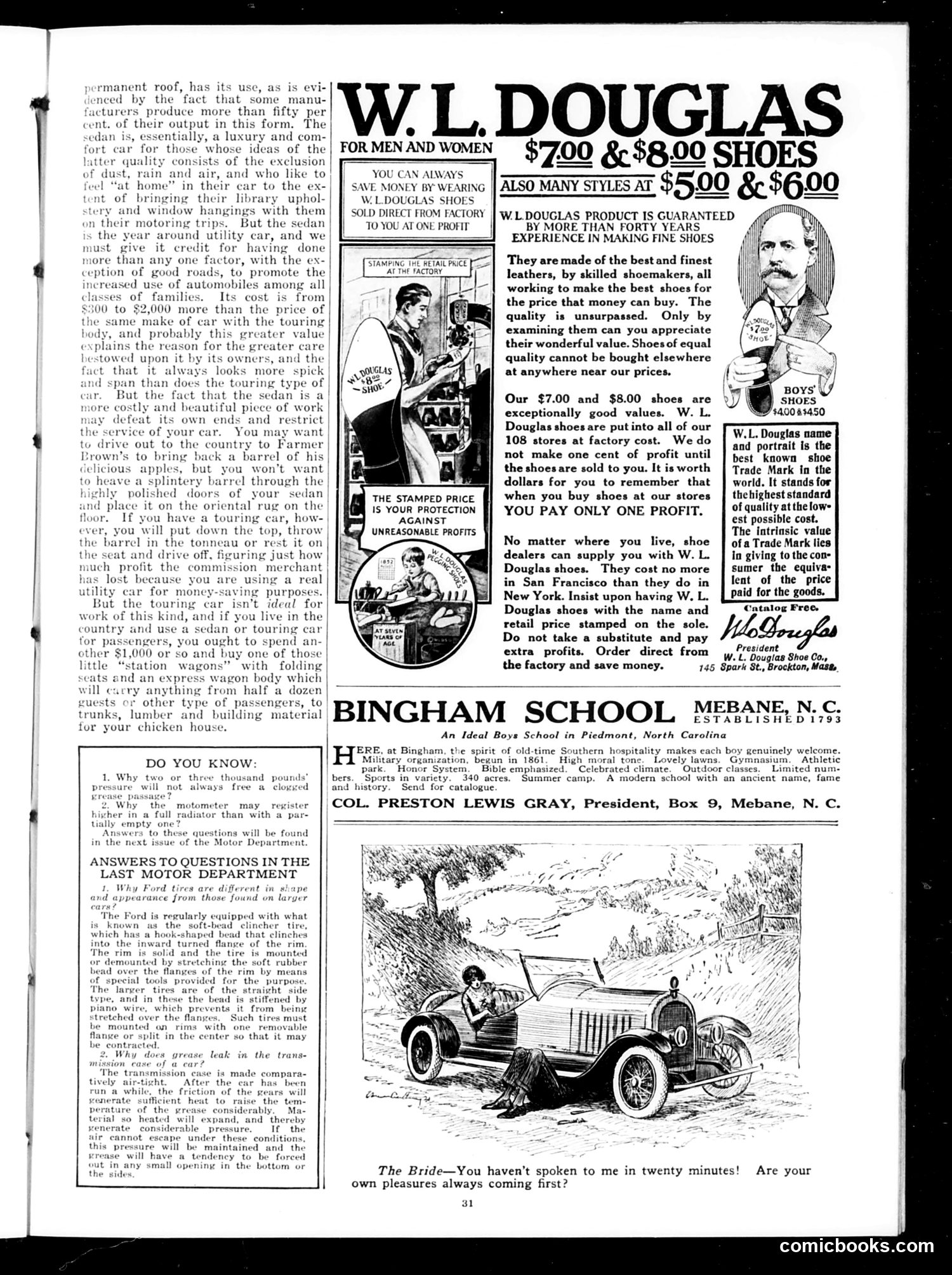
This page is primarily **advertising**, not political satire. The dominant content is a W.L. Douglas shoe advertisement featuring the company founder's portrait and marketing claims about factory-direct sales eliminating middleman profits. The only cartoon element is a small illustration at page bottom showing a couple in a car with the caption "The Bride—You haven't spoken to me in twenty minutes! Are your own pleasures always coming first?" This is **domestic humor**, not political satire—a common Judge magazine genre mocking marital dynamics and the husband's obsession with automobiles during the early automotive era. The page also includes unrelated content: technical automotive Q&A about car suspension and tires, and an advertisement for Bingham School in North Carolina. There is **no political commentary or social satire** on this page—it's a commercial publication showcasing period advertising.
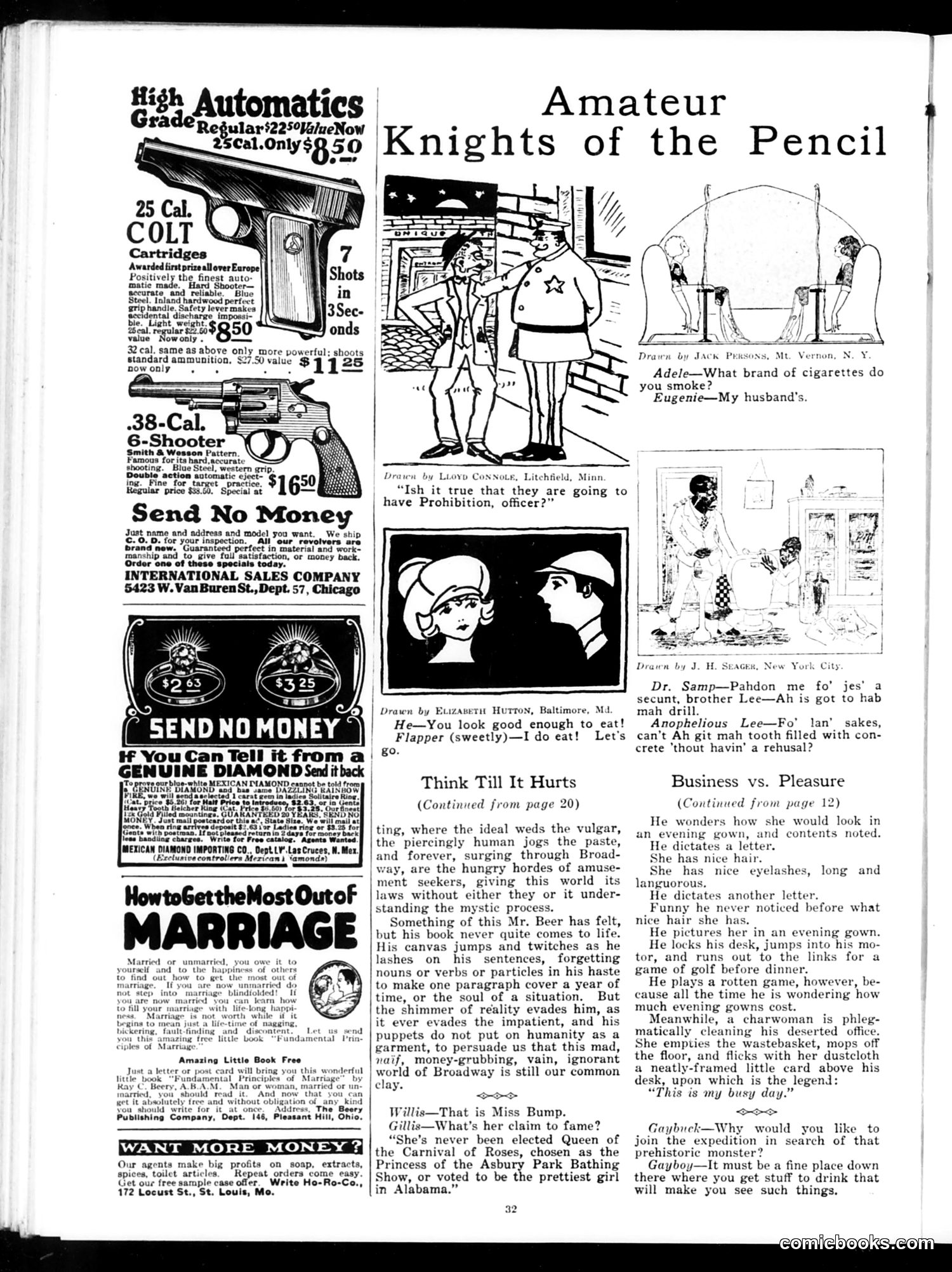
This page features several short comics satirizing early 20th-century American social life. The "Amateur Knights of the Pencil" section collects brief gag cartoons: **Key jokes:** - A woman asks a police officer about Prohibition (alcohol ban), suggesting naive misunderstanding of the law - A "flapper" (young woman) responds to a man's flirtation by saying she literally eats—a play on "looking good enough to eat" - A woman smokes her husband's brand of cigarettes (suggesting marital dependence or lack of individuality) - Two Black men discuss dental work in dialect humor (reflecting period racial stereotypes) - A businessman gets distracted from work by an attractive female employee, affecting his golf game The page also contains advertisements for firearms, diamonds, and self-help books typical of 1920s magazines. The cartoons reflect Jazz Age attitudes toward Prohibition, gender roles, and workplace dynamics, with humor often relying on wordplay and period stereotypes now considered offensive.
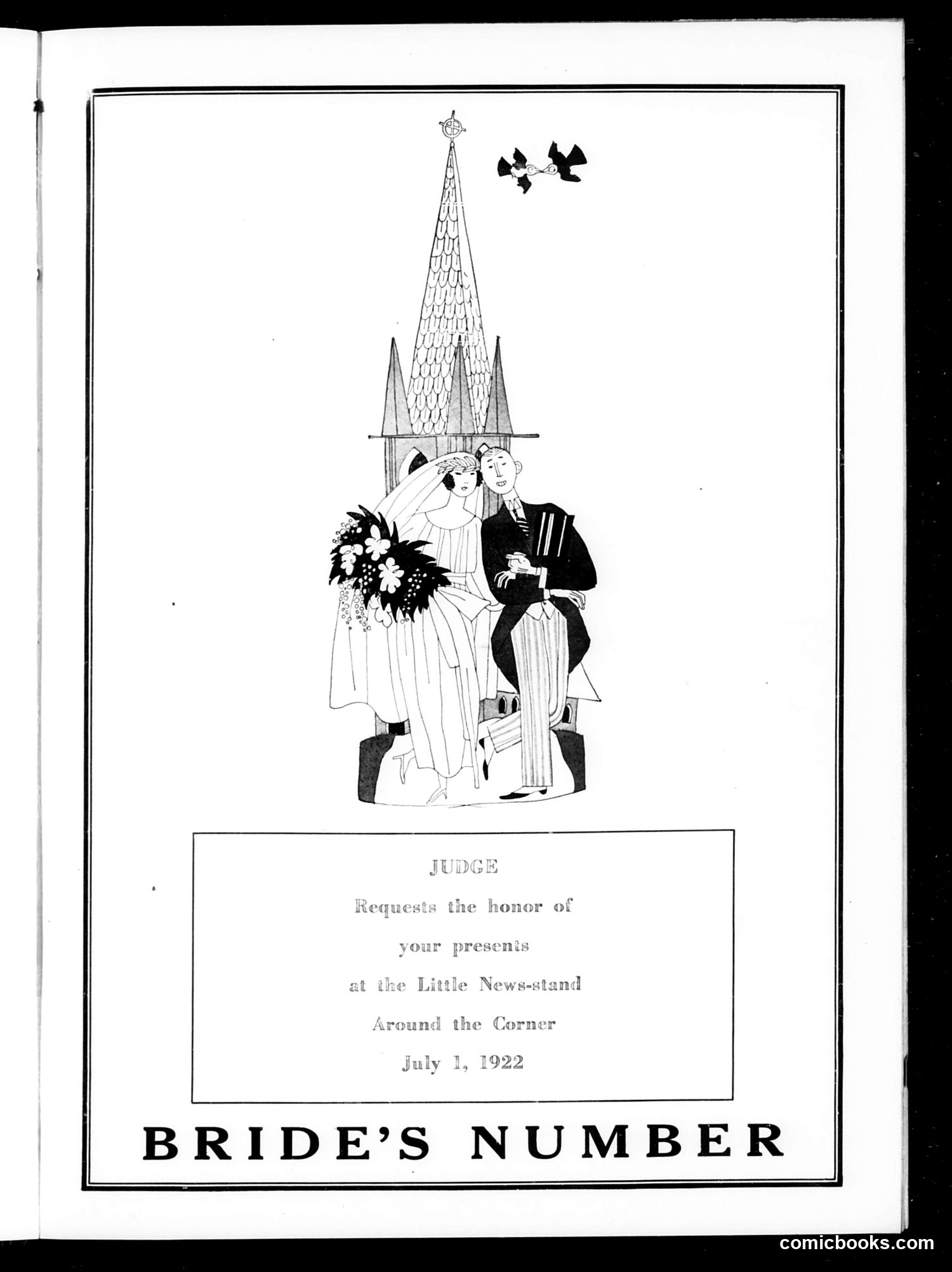
This is a title page for Judge magazine's "Bride's Number" issue from July 1, 1922. The illustration shows a bride and groom standing before a church with a tall spire, with birds flying above. Below is a formal invitation from "Judge" requesting the honor of the reader's presence at "the Little News-stand Around the Corner." This appears to be a special themed issue celebrating weddings and matrimony, likely containing articles, cartoons, and advertisements relevant to brides and newlyweds. The formal invitation mimics actual wedding invitations, creating a humorous conceit that the magazine itself is the "event" being celebrated. The artwork employs the elegant Art Deco style typical of 1920s design.
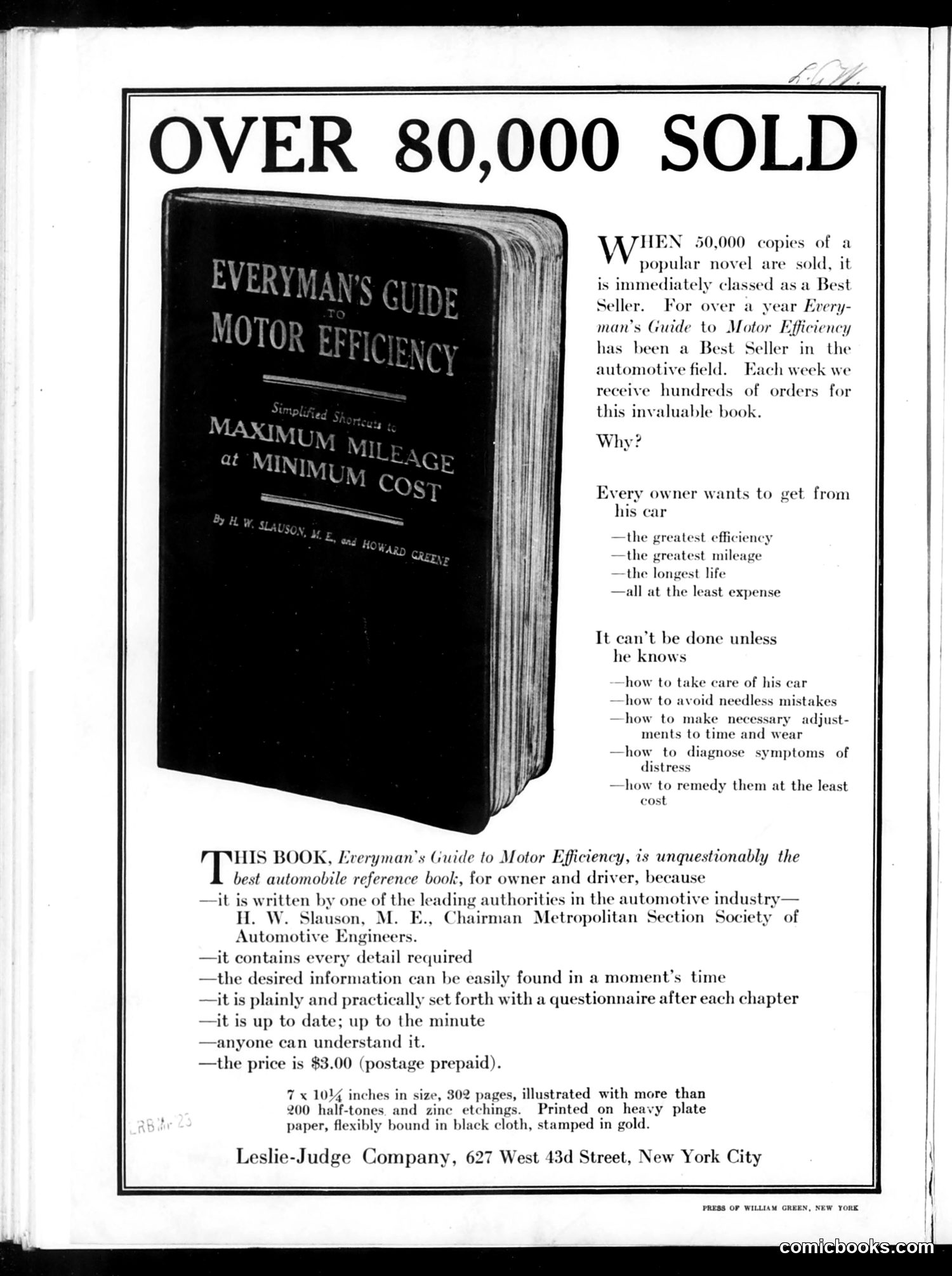
This page is **not a cartoon** but rather a full-page advertisement disguised as editorial content in *Judge* magazine. It promotes *Everyman's Guide to Motor Efficiency*, a bestselling automotive reference book. The ad uses the format of a magazine article to lend credibility, claiming the book has sold over 80,000 copies and receives hundreds of weekly orders. The pitch emphasizes practical benefits: car owners want efficiency, mileage, and longevity at low cost. The book supposedly delivers this through expert guidance on maintenance, diagnosis, and repair—presented as essential knowledge no car owner can do without. The author, H.W. Slauson, is identified as chairman of the Society of Automotive Engineers, positioning him as authoritative. The $3.00 price and detailed specifications (302 pages, illustrated, bound in black cloth) suggest a premium, serious reference work aimed at early automotive-era car owners concerned with economical operation.

I can see this is a blank or nearly blank page from Judge magazine, with only "comicbooks.com" visible at the bottom right corner. There is no discernible cartoon, illustration, satirical content, or meaningful text to analyze on this page. The page appears to be either a blank leaf, an advertisement space, or possibly a scanning artifact. Without visible political figures, caricatures, social commentary, or satirical imagery, I cannot provide interpretation of any cartoon or historical context. A clearer or different page from this Judge issue would be needed for analysis.