
Judge, 1922-06-24 · page 11 of 37
Judge — June 24, 1922 — page 11: what you’re looking at
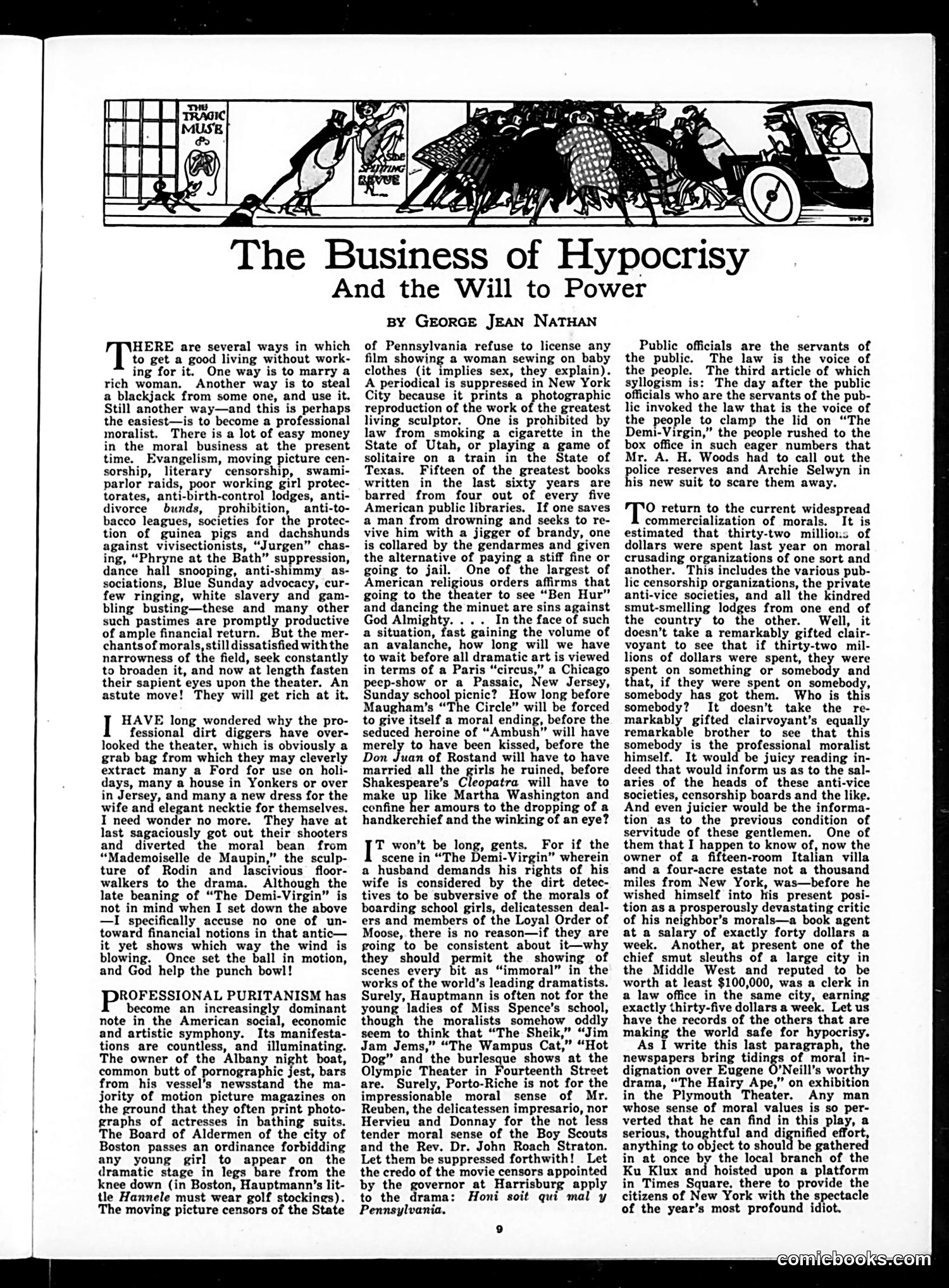
What you’re looking at
This satirical article attacks American moral censorship movements of the early 20th century. Nathan argues that "professional moralists"—those profiting from censorship campaigns—have discovered theater as their latest financial opportunity. The text catalogs absurd censorship examples: Pennsylvania banning films showing women sewing baby clothes; Boston requiring actresses to wear golf stockings; Utah prohibiting cigarette smoking; Boston suppressing "The Demi-Virgin"; and libraries banning fifteen classic books. Nathan cites Pennsylvania motion-picture censors and mentions the banning of specific plays. The satire's point: moral crusaders aren't genuinely righteous but are exploiting public anxiety to build profitable careers through censorship boards, "anti-vice societies," and similar organizations. Nathan sarcastically calls this "easy money" compared to actual work, accusing these "merchants of morals" of hypocrisy—hence the title. The cartoon strip above illustrates these various censorship activities in action.
📄 Transcribed text from this page (OCR, searchable)
Machine-transcribed from the original scan — historical spelling and the odd misread are preserved.
The Business of Hypocrisy N And the Will to Power HERE are several ways in which to get a good living without work- ing for it. One way is to marry a rich woman. Another way is to steal a blackjack from some one, and use it. Still another way—and this is perhaps the easiest—is to become a professional moralist. There is a lot of easy money in the moral business at the present time. Evangelism, moving picture cen- sorship, literary censorship, swami- parlor raids, poor working girl protec- torates, anti-birth-control lodges, anti- divorce bunds, prohibition, anti-to- bacco leagues, societies for the protec- tion of guinea pigs and dachshunds against vivisectionists, “Jurgen” chas- ing, “Phryne at the Bath” suppression, dance hall snooping, anti-shimmy as- sociations, Blue Sunday advocacy, cur- few ringing, white slavery and gam- bling busting—these and many other such pastimes are promptly productive of ample financial return. But the mer- chantsof morals, still dissatisfied withthe narrowness of the field, seek constantly to broaden it, and now at length fasten their sapient eyes upon the theater. An astute move! They will get rich at it. HAVE long wondered why the pro- fessional dirt diggers have over- looked the theater, which is obviously a grab bag from which they may cleverly extract many a Ford for use on holi- days, many a house in Yonkers or over in Jersey, and many a new dress for the wife and elegant necktie for themselves. I need wonder no more. They have at last sagaciously got out their shooters and diverted the moral bean from “Mademoiselle de Maupin,” the sculp- ture of Rodin and lascivious floor- walkers to the drama. Although the late beaning of “The Demi-Virgin” is not in mind when I set down the above —I specifically accuse no one of un- toward financial notions in that antic— it yet shows which way the wind is blowing. Once set the ball in motion, and God help the punch bowl! ROFESSIONAL PURITANISM has become an increasingly dominant note in the American social, economic and artistic symphony. Its manifesta- tions are countless, and illuminating. The owner of the Albany night boat, common butt of pornographic jest, bars from his vessel’s newsstand the ma- jority of motion picture magazines on the ground that they often print photo- graphs of actresses in bathing suits. The Board of Aldermen of the city of Boston passes an ordinance forbidding any young girl to appear on the dramatic stage in legs bare from the knee down (in Boston, Hauptmann’s lit- tle Hannele must wear golf stockings). The moving picture censors of the State By GEORGE JEAN NATHAN of Pennsylvania refuse to license any film showing a woman sewing on baby clothes (it implies sex, they explain). A periodical is suppressed in New York City because it prints a Photographic reproduction of the work of the greatest living sculptor. One is prohibited by law from smoking a cigarette in the State of Utah, or playing a game of solitaire on a train in the State of Texas. Fifteen of the greatest books written in the last sixty years are barred from four out of every five American public libraries. If one saves a man from drowning and seeks to re- vive him with a jigger of brandy, one is collared by the gendarmes and given the alternative of paying a stiff fine or going to jail. One of the largest of American religious orders affirms that going to the theater to see “Ben Hur” and dancing the minuet are sins against God Almighty. . . . In the face of such a situation, fast gaining the volume of an avalanche, how long will we have to wait before all dramatic art is viewed in terms of a Paris “circus,” a Chicago peep-show or a Passaic, New Jersey, Sunday school picnic? How long before Maugham’s “The Circle” will be forced to give itself a moral ending, before the seduced heroine of “Ambush” will have merely to have been kissed, before the Don Juan of Rostand will have to have married all the girls he ruined, before Shakespeare’s Cleopatra will have to make up like Martha Washington and confine her amours to the dropping of a handkerchief and the winking of an eye? T won't be long, gents. For if the scene in “The Demi-Virgin” wherein a husband demands his rights of his wife is considered by the dirt detec- tives to be subversive of the morals of boarding school girls, delicatessen deal- ers and members of the Loyal Order of Moose, there is no reason—if they are going to be consistent about it—why they should permit the showing of scenes every bit as “immoral” in the works of the world’s leading dramatists. Surely, Hauptmann is often not for the young ladies of Miss Spence’s school, though the moralists somehow oddly seem to think that “The Sheik,” “Jim Jam Jems,” “The Wampus Cat,” “Hot Dog” and the burlesque shows at the Olympic Theater in Fourteenth Street are. Surely, Porto-Riche is not for the impressionable moral sense of Mr. Reuben, the delicatessen impresario, nor Hervieu and Donnay for the not less tender moral sense of the Boy Scouts and the Rev. Dr. John Roach Straton. Let them be suppressed forthwith! Let the credo of the movie censors appointed by the governor at Harrisburg apply to the drama: Honi soit qui mal y Pennsylvania. 9 Public officials are the servants of the public. The law is the voice of the people. The third article of which syllogism is: The day after the public officials who are the servants of the pub- lic invoked the law that is the voice of the people to clamp the lid on “The Demi-Virgin,” the people rushed to the box office in such eager numbers that Mr. A. H. Woods had to call out the lice reserves and Archie Selwyn in is new suit to scare them away. Te return to the current widespread commercialization of morals. It is estimated that thirty-two millions of dollars were spent last year on moral crusading organizations of one sort and another. This includes the various pub- lic censorship organizations, the private anti-vice societies, and all the kindred smut-smelling lodges from one end of the country to the other. Well, it doesn’t take a remarkably gifted clair- voyant to see that if thirty-two mil- lions of dollars were spent, they were spent on something or somebody and that, if they were spent on somebody, somebody has got them. Who is this somebody? It doesn’t take the re- markably gifted clairvoyant’s equally remarkable brother to see that this somebody is the i protessional moralist himself. It would be juicy reading in- deed that would inform us as to the sal- aries of the heads of these anti-vice societies, censorship boards and the like. And even juicier would be the informa- tion as to the previous condition of servitude of these gentlemen. One of them that I happen to know of, now the owner of a fifteen-room Italian villa and a four-acre estate not a thousand miles from New York, was—before he wished himself into his present posi- tion as a prosperously devastating critic of his neighbor’s morals—a book agent at a salary of exactly forty dollars a week. Another, at present one of the chief smut sleuths of a large city in the Middle West and reputed to be worth at least $100,000, was a clerk in a law office in the same city, earning exactly thirty-five dollars a week. Let us have the records of the others that are making the world safe for hypocrisy. As I write this last paragraph, the newspapers bring tidings of moral in- dignation over Eugene O’Neill’s worthy drama, “The Hairy Ape,” on exhibition in the Plymouth Theater. Any man whose sense of moral values is so per- verted that he can find in this play, a serious, thoughtful and dignified effort, anything to object to should be gathered in at once by the local branch of the Ku Klux and hoisted upon a platform in Times Square, there to provide the citizens of New York with the spectacle of the year’s most profound idiot.