
Judge, 1922-06-24 · page 16 of 37
Judge — June 24, 1922 — page 16: what you’re looking at
What you’re looking at
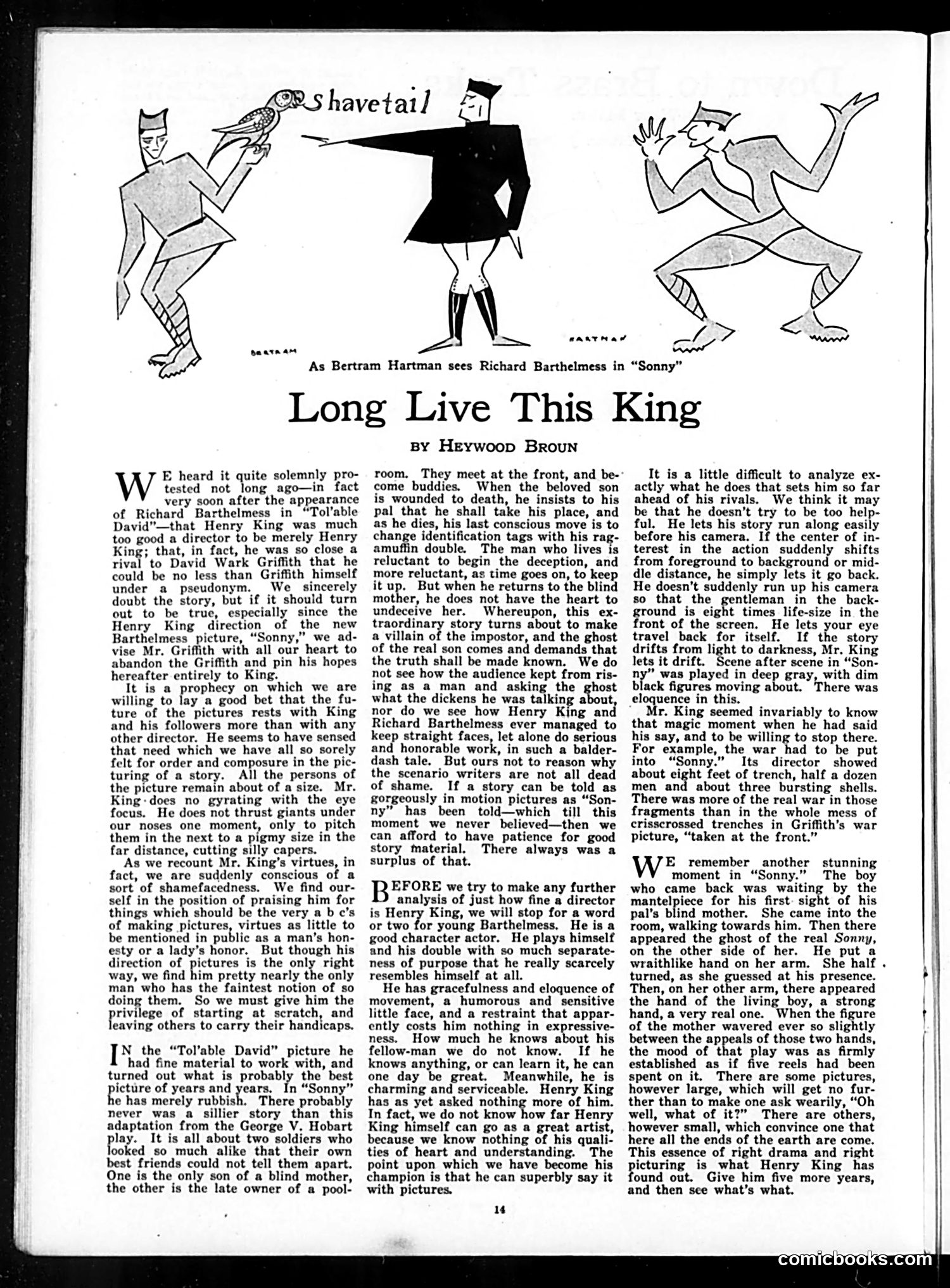
This is a favorable review by Heywood Broun of director **Henry King**'s film *Sonny*, starring actor **Richard Barthelmess**. The cartoons show stylized interpretations of the film's comedic situations. King is praised as an exceptionally skilled director who maintains visual discipline—keeping characters proportionate and focused, avoiding the exaggerated camera tricks that were common in silent films. Broun argues King should be recognized as a serious artist, not overshadowed by David Wark Griffith (then cinema's preeminent director). The irony of the review is that while *Sonny*'s plot is criticized as "rubbish"—a contrived story about soldiers swapping identities involving a ghostly demand for truth—King's directorial mastery supposedly elevates even this absurd material into compelling cinema. Broun essentially argues that King's technical skill and restraint matter more than the script's quality.
📄 Transcribed text from this page (OCR, searchable)
Machine-transcribed from the original scan — historical spelling and the odd misread are preserved.
beara an nAaT Nae As Bertram Hartman sees Richard Barthelmess in “Sonny” Long Live This King E heard it quite solemnly pro- W tested not long ago—in fact very soon after the appearance of Richard Barthelmess in “Tol'able David’—that Henry King was much too good a director to be merely Henry King; that, in fact, he was so close a rival to David Wark Griffith that he could be no less than Griffith himself under a pseudonym. We sincerely doubt the story, but if it should turn out to be true, especially since the Henry King direction of the new Barthelmess picture, “Sonny,” we ad- vise Mr. Griffith with all our heart to abandon the Griffith and pin his hopes hereafter entirely to King. It is a prophecy on which we are willing to lay a good bet that the fu- ture of the pictures rests with King and his followers more than with any other director. He seems to have sensed that need which we have all so sorely felt for order and composure in the pic- turing of a story. All the persons of the picture remain about of a size. Mr. King-does no gyrating with the eye focus. He does not thrust giants under our noses one moment, only to pitch them in the next to a pigmy size in the far distance, cutting silly capers. As we recount Mr. King’s virtues, in fact, we are suddenly conscious of a sort of shamefacedness. We find our- self in the position of praising him for things which should be the very a b c’s of making pictures, virtues as little to be mentioned in public as a man’s hon- esty or a lady’s honor. But though his direction of pictures is the only right way, we find him pretty nearly the only man who has the faintest notion of so doing them. So we must give him the rivilege of starting at scratch, and leaving others to carry their handicaps. N the “Tol’able David” picture he had fine material to work with, and turned out what is probably the best pictire of years and years. In “Sonny” e has merely rubbish. There probably never was a sillier story than this adaptation from the George V. Hobart pays It is all about two soldiers who looked so much alike that their own best friends could not tell them apart. One is the only son of a blind mother, the other is the late owner of a pool- BY Heywoop Broun room. They meet at the front, and be-° come buddies. When the beloved son is wounded to death, he insists to his pal that he shall take his place, and as he dies, his last conscious move is to change identification tags with his rag- amuffin double. The man who lives is reluctant to begin the deception, and more reluctant, as time goes on, to keep it up. But when he returns to the blind mother, he does not have the heart to undeceive her. Whereupon, this ex- traordinary story turns about to make a villain of the impostor, and the ghost of the real son comes and demands that the truth shall be made known. We do not see how the audience kept from ris- ing as a man and asking the ghost what the dickens he was talking about nor do we see how Henry King and Richard Barthelmess ever managed to keep straight faces, let alone do serious and honorable work, in such a balder- dash tale. But ours not to reason why the scenario writers are not all dead of shame. If a story can be told as gorgeously in motion pictures as “Son- ny” has been told—which till this moment we never believed—then we can afford to have patience for good story material. There always was a surplus of that. B EFORE we try to make any further analysis of just how fine a director is Henry King, we will stop for a word 01 or two for young Barthelmess, He is a good character actor. He plays himself and his double with so much separate- ness of purpose that he really scarcely resembles himself at all. He has gracefulness and eloquence of movement, a humorous and sensitive little face, and a restraint that appar- ently costs him nothing in expressive- ness. How much he knows about his fellow-man we do not know. If he knows anything, or can learn it, he can one day be great. Meanwhile, he is charming and serviceable. Henry King has as yet asked nothing more of him. In fact, we do not know how far Henry King himself can go as a great artist, because we know nothing of his quali- ties of heart and understanding. The point upon which we have become his champion is that he can superbly say it with pictures. 14 It is a little difficult to analyze ex- actly what he does that sets him so far ahead of his rivals. We think it may be that he doesn’t try to be too help- ful. He lets his story run along easily before his camera. If the center of in- terest in the action suddenly shifts from foreground to background or mid- dle distance, he simply lets it go back. He doesn’t suddenly run up his camera so that the gentleman in the back- ground is eight times life-size in the front of the screen. He lets your eye travel back for itself. If the story drifts from light to darkness, Mr. King lets it drift. Scene after scene in “Son- Fe was played in deep gray, with dim black figures moving about. There was eloquence in this. Mr. King seemed invariably to know that magic moment when he had said his say, and to be willing to stop there. For example, the war had to be put into “Sonny.” Its director showed about eight feet of trench, half a dozen men and about three bursting shells. There was more of the real war in those fragments than in the whole mess of crisscrossed trenches in Griffith's war picture, “taken at the front.” We. remember another stunning moment in “Sonny.” The boy who came back was waiting by the mantelpiece for his first. sight of his pal’s blind mother. She came into the room, walking towards him. Then there appeared the ghost of the real Sonny, on the other side of her. He put a wraithlike hand on her arm. She half . turned, as she guessed at his presence. Then, on her other arm, there appeared the hand of the living boy, a strong hand, a very real one. When the figure of the mother wavered ever so slightly between the appeals of those two hands, the mood of that play was as firmly established as if five reels had been spent on it. There are some pictures, however large, which will get no fur- ther than to make one ask wearily, “Oh well, what of it?” There are others, however small, which convince one that here all the ends of the earth are come. This essence of right drama and right picturing is what Henry King has found out. Give him five more years, and then see what’s what.