
Judge, 1922-06-24 · page 22 of 37
Judge — June 24, 1922 — page 22: what you’re looking at
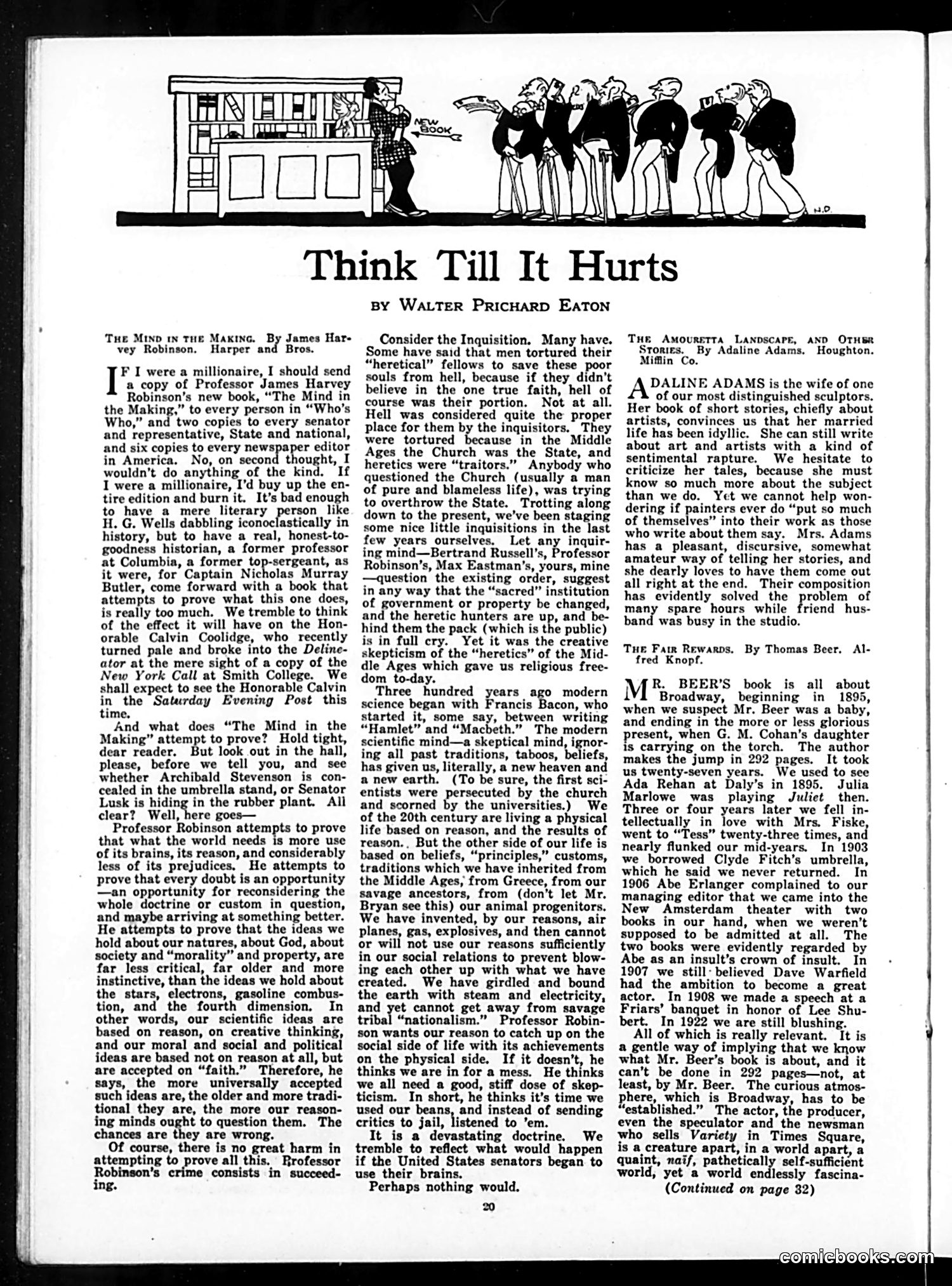
What you’re looking at
This piece satirizes the American establishment's hostility toward critical thinking. The cartoon depicts a figure (representing Professor James Harvey Robinson, author of "The Mind in the Making") being chased by a mob of men in suits and hats—representing politicians, editors, and the general public. Robinson's crime: publishing a book arguing that society should rely more on reason and less on inherited prejudices and "faith." Eaton's essay, using darkly ironic examples from the Spanish Inquisition to contemporary America, compares modern suppression of dissenting intellectuals to religious persecution. The references to "Senator Lusk" and "Archibald Stevenson" appear to be contemporary figures involved in anti-radical activities (likely post-WWI Red Scare paranoia). The joke is that simply advocating rational questioning of established institutions marks one as dangerous—the very antithesis of the book's message.
📄 Transcribed text from this page (OCR, searchable)
Machine-transcribed from the original scan — historical spelling and the odd misread are preserved.
Think Till It Hurts James Har- Tue Mino in THE Maxine. B; Bros. vey Robinson, Harper ani F I were a millionaire, I should send a copy of Professor James Harvey Robinson's new book, “The Mind in the Making,” to every person in “Who's Who,” and two copies to every senator and representative, State and national, and six copies to every newspaper editor in America. No, on second thought, I wouldn’t do anything of the kind. If I were a millionaire, I’d buy up the en- tire edition and burn it. It’s bad enough to have a mere literary pon like H. G. Wells dabbling iconoclastically in history, but to have a real, honest-to- goodness historian, a former professor at Columbia, a former top-ecrecant as it were, for Captain Nicholas Murray Butler, come forward with a book that attempts to prove what this one does, is really too much. We tremble to think of the effect it will have on the Hon- orable Calvin Coolidge, who recently turned pale and broke into the Deline- ator at the mere sight of a copy of the New York Call at Smith College. We shall expect to see the Honorable Calvin in the Saturday Evening Post this time, And what does “The Mind in the Making” attempt to prove? Hold tight, dear reader. But look out in the hall, please, before we tell you, and see whether Archibald Stevenson is con- cealed in the umbrella stand, or Senator Lusk is hiding in the rubber plant. All clear? Well, here goes— Professor Robinson attempts to prove that what the world needs is more use of its brains, its reason, and considerably less of its prejudices, He attempts to prove that every doubt is an opportunity —an opportunity for reconsidering the whole doctrine or custom in question, and maybe arriving at something better. He attempts to prove that the ideas we hold about our natures, about God, about society and “morality” and property, are far less critical, far older and more instinctive, than the ideas we hold about the stars, electrons, gasoline combus- tion, and the fourth dimension. In other words, our scientific ideas are based on reason, on creative thinking, and our moral and social and political ideas are based not on reason at all, but are accepted on “faith.” Therefore, he says, the more universally accepted such ideas are, the older and more tradi- tional they are, the more our reason- ing minds ought to question them. The chances are they are wrong. Of course, there is no great harm in attempting to prove all this. Rrofessor Robinson's crime consists in succeed- ing. BY WALTER PRICHARD EATON Consider the Inquisition. Many have. Some have said that men tortured their “heretical” fellows to save these poor souls from hell, because if they didn’t believe in the one true faith, hell of course was their portion. Not at all. Hell was considered quite the proper place for them by the inquisitors. They were tortured because in the Middle Ages the Church was the State, and heretics were “traitors.” Anybody who questioned the Church (usually a man of pure and blameless life), was trying to overthrow the State. Trotting along down to the present, we've been staging some nice little inquisitions in the last few years ourselves. Let any inquir- ing mind—Bertrand Russell's, Professor Robinson’s, Max Eastman’s, yours, mine —dquestion the existing order, suggest in any way that the “sacred” institution of government or property be changed, and the heretic hunters are upr and be- hind them the pack (which is the public) is in full cry. Yet it was the creative skepticism of the “heretics” of the Mid- dle Ages which gave us religious free- dom to-day. Three hundred years ago modern science began with Francis Bacon, who started it, some say, between writing “Hamlet” and “Macbeth.” The modern scientific mind—a skeptical mind, ignor- ing all past traditions, taboos, beliefs, has given us, literally, a new heaven and a new earth. (To be sure, the first sci- entists were persecuted by the church and scorned by the universities.) We of the 20th century are living a physical life based on reason, and the results of reason., But the other side of our life is based on beliefs, “principles,” customs, traditions which we have inherited from the Middle Ages, from Greece, from our savage ancestors, from (don’t let Mr. Bryan see this) our animal progenitors. We have invented, by our reasons, air planes, gas, explosives, and then cannot or will not use our reasons sufficiently in our social relations to prevent blow- ing each other up with what we have created. We have girdled and bound the earth with steam and electricity, and yet cannot get away from savage tribal “nationalism.” Professor Robin- son wants our reason to catch up on the social side of life with its achievements on the physical side. If it doesn’t, he thinks we are in for a mess. He thinks we all need a good, stiff dose of skep- ticism. In short, he thinks it’s time we used our beans, and instead of sending critics to jail, listened to ’em. It is a devastating doctrine. We tremble to reflect what would happen if the United States senators began to use their brains. Perhaps nothing would. 20 THe Amouretta Lanpscare, AND OTHBR Stories. By Adaline Adams, Houghton. Mifflin Co. DALINE ADAMS is the wife of one of our most distinguished sculptors. Her book of short stories, chiefly about artists, convinces us that her married life has been idyllic. She can still write about art and artists with a kind of sentimental rapture. We hesitate to criticize her tales, because she must know so much more about the subject than we do. Yet we cannot help won- dering if painters ever do “put so much of themselves” into their work as those who write about them say. Mrs. Adams has a pleasant, discursive, somewhat amateur way of telling her stories, and she dearly loves to have them come out all right at the end. Their composition has evidently solved the problem of many spare hours while friend hus- band was busy in the studio. Al- Tue Fam Rewarps. By Thomas Beer. fred Knopf. Mv R. BEER’S book is all about IVI Broadway, beginning in 1895, when we suspect Mr. Beer was a baby, and ending in the more or less glorious present, when G. M. Cohan’s daughter is carrying on the torch. The author makes the jump in 292 pages. It took us twenty-seven years. We used to see Ada Rehan at Daly’s in 1895. Julia Marlowe was playing Juliet then. Three or four years later we fell in- tellectually in love with Mrs. Fiske, went to “Tess” twenty-three times, and nearly flunked our mid-years. In 1903 we borrowed Clyde Fitch’s umbrella, which he said we never returned. In 1906 Abe Erlanger complained to our managing editor that we came into the New Amsterdam theater with two books in our hand, when we weren't supposed to be admitted at all. The two books were evidently regarded by Abe as an insult’s crown of insult. In 1907 we still: believed Dave Warfield had the ambition to become a great actor. In 1908 we made a speech at a Friars’ banquet in honor of Lee Shu- bert. In 1922 we are still blushing. All of which is really relevant. It is a gentle way of implying that we know what Mr. Beer’s book is about, and it can’t be done in 292 pages—not, at least, by Mr. Beer. The curious atmos- phere, which is Broadway, has to be “established.” The actor, the producer, even the speculator and the newsman who sells Variety in Times Square, is a creature apart, in a world apart, a quaint, naif, pathettcally self-sufficient world, yet a world endlessly fascina- (Continued on page 32)