
Judge, 1922-06-24 · page 20 of 37
Judge — June 24, 1922 — page 20: what you’re looking at
What you’re looking at
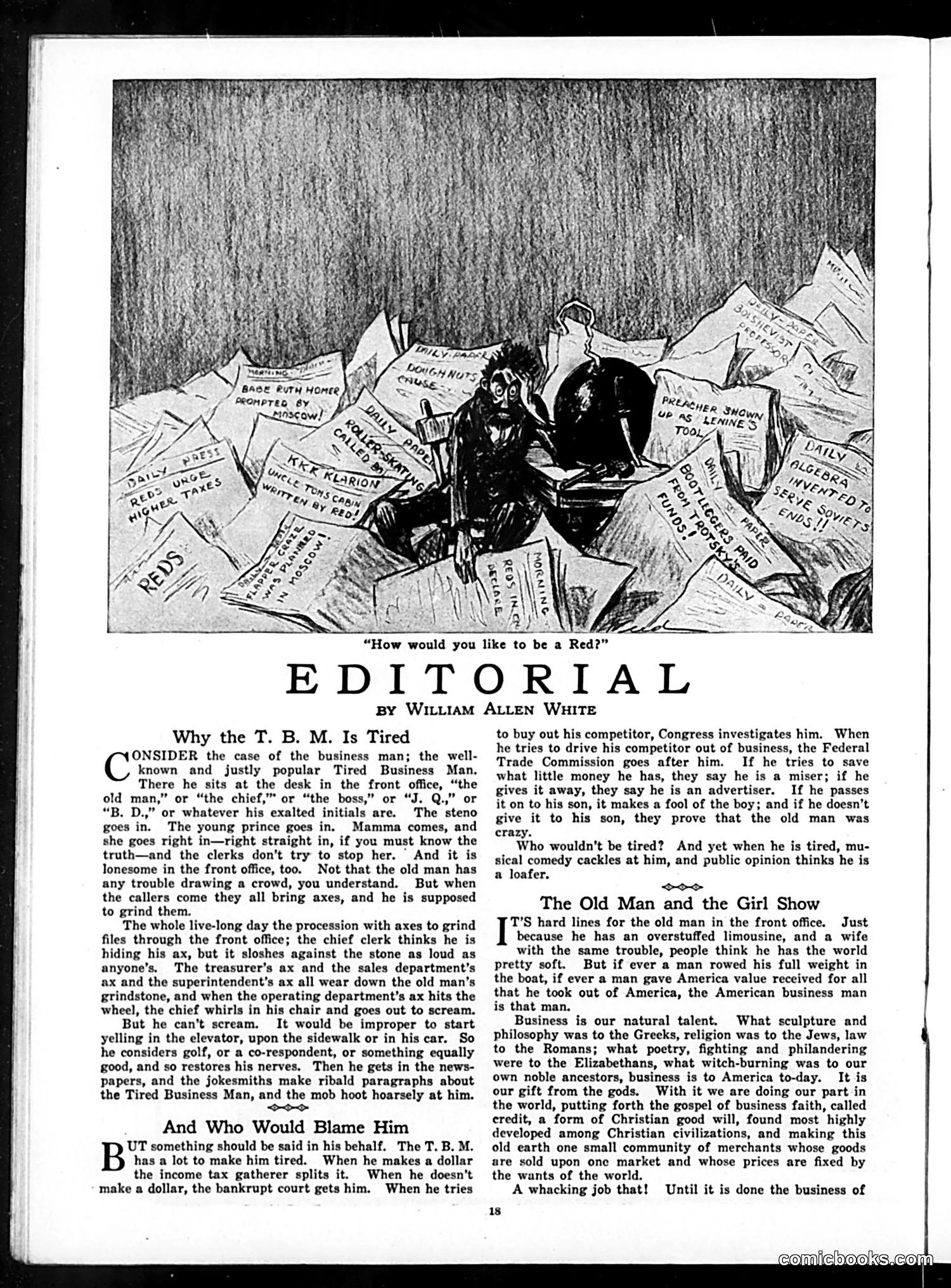
The cartoon depicts two figures (likely representing businessmen or capitalists) buried under a mountain of newspapers bearing headlines about business scandals and investigations. The caption poses a rhetorical question about becoming a "Red"—slang for communist or radical. White's accompanying editorial defends American businessmen, particularly the "Tired Business Man" archetype. It satirizes how business leaders face constant criticism and regulatory scrutiny: the income tax takes their profits, bankruptcy courts pursue them when they fail, Congress investigates buyout attempts, and the Federal Trade Commission monitors their competitive practices. The piece treats business itself as America's noble calling—equivalent to art, religion, or philosophy in other civilizations. White argues businessmen deserve respect rather than mockery for sustaining the nation's economic system through "credit" and "Christian good will." The cartoon's headline sarcastically suggests that constant attacks on business might drive capitalists toward communism, inverting typical 1920s Red-scare rhetoric by portraying businessmen as victims rather than threats.
📄 Transcribed text from this page (OCR, searchable)
Machine-transcribed from the original scan — historical spelling and the odd misread are preserved.
7) BASE RuTH HOMER y PROMPTED BY “How would you like to be a Red? EDITORIAL By WituiaM ALLEN WHITE Why the T. B. M. Is Tired ONSIDER the case of the business man; the well- known and justly popular Tired Business Man. There he sits at the desk in the front office, “the old man,” or “the chief,” or “the boss,” or “J. Q.,” or “B. D.,” or whatever his exalted initials are. The steno goes in. The young prince goes in. Mamma comes, and she goes right in—right straight in, if you must know the truth—and the clerks don’t try to stop her. And it is lonesome in the front office, too. Not that the old man has any trouble drawing a crowd, you understand. But when the callers come they all bring axes, and he is supposed to grind them. The whole live-long day the procession with axes to grind files through the front office; the chief clerk thinks he is hiding his ax, but it sloshes against the stone as loud as anyone’s, The treasurer’s ax and the sales department’s ax and the superintendent's ax all wear down the old man’s grindstone, and when the operating department’s ax hits the wheel, the chief whirls in his chair and goes out to scream. But he can’t scream. It would be improper to start yelling in the elevator, upon the sidewalk or in his car. So he considers golf, or a co-respondent, or something equally good, and so restores his nerves. Then he gets in the news- papers, and the jokesmiths make ribald paragraphs about the Tired Business Man, and the mob hoot hoarsely at him. ead And Who Would Blame Him UT something should be said in his behalf. The T. B. M. has a lot to make him tired. When he makes a dollar the income tax gatherer splits it. When he doesn’t make a dollar, the bankrupt court gets him. When he tries to buy out his competitor, Congress investigates him. When he tries to drive his competitor out of business, the Federal Trade Commission goes after him. If he tries to save what little money he has, they say he is a miser; if he gives it away, they say he is an advertiser. If he passes it on to his son, it makes a fool of the boy; and if he doesn’t give it to his son, they prove that the old man was crazy. Who wouldn’t be tired? And yet when he is tired, mu- sical comedy cackles at him, and public opinion thinks he is a loafer. ~e The Old Man and the Girl Show T’S hard lines for the old man in the front office. Just because he has an overstuffed limousine, and a wife with the same trouble, people think he has the world pretty soft. But if ever a man rowed his full weight in the boat, if ever a man gave America value received for all that he took out of America, the American business man is that man. Business is our natural talent. What sculpture and philosophy was to the Greeks, religion was to the Jews, law to the Romans; what poetry, fighting and philandering were to the Elizabethans, what witch-burning was to our own noble ancestors, business is to America to-day. It is our gift from the gods. With it we are doing our part in the world, putting forth the gospel of business faith, called credit, a form of Christian good will, found most highly developed among Christian civilizations, and making this old earth one small community of merchants whose goods are sold upon one market and whose prices are fixed by the wants of the world. A whacking job that! Until it is done the business of 18