
Judge, 1922-06-24 · page 8 of 37
Judge — June 24, 1922 — page 8: what you’re looking at
What you’re looking at
This page from *Judge* magazine contains racist humor typical of early 20th-century American satire. The illustrated story "Told at the Nineteenth Hole" (a golf club setting) presents several anecdotes meant to be funny, though they reveal period attitudes toward race and class. The main illustrated narrative mocks an enslaved Black man named Jim who steals his owner's sheep. The "joke" relies on racial stereotypes: Jim's supposed stupidity, servility, and the master's shock that an enslaved person would dare admit wrongdoing. The phrase "black an' heavy" is a crude pun suggesting Jim's darkness enabled the theft. The surrounding brief jokes also traffic in ethnic stereotypes (Irish immigrant "Pat," unnamed Black characters) and gender mockery (the mother-in-law joke). For modern readers: this content demonstrates how mainstream American publications once normalized dehumanizing racial caricature as entertainment. The humor depends entirely on racist assumptions about intelligence, dishonesty, and social hierarchy that the publication's audience apparently found amusing.
📄 Transcribed text from this page (OCR, searchable)
Machine-transcribed from the original scan — historical spelling and the odd misread are preserved.
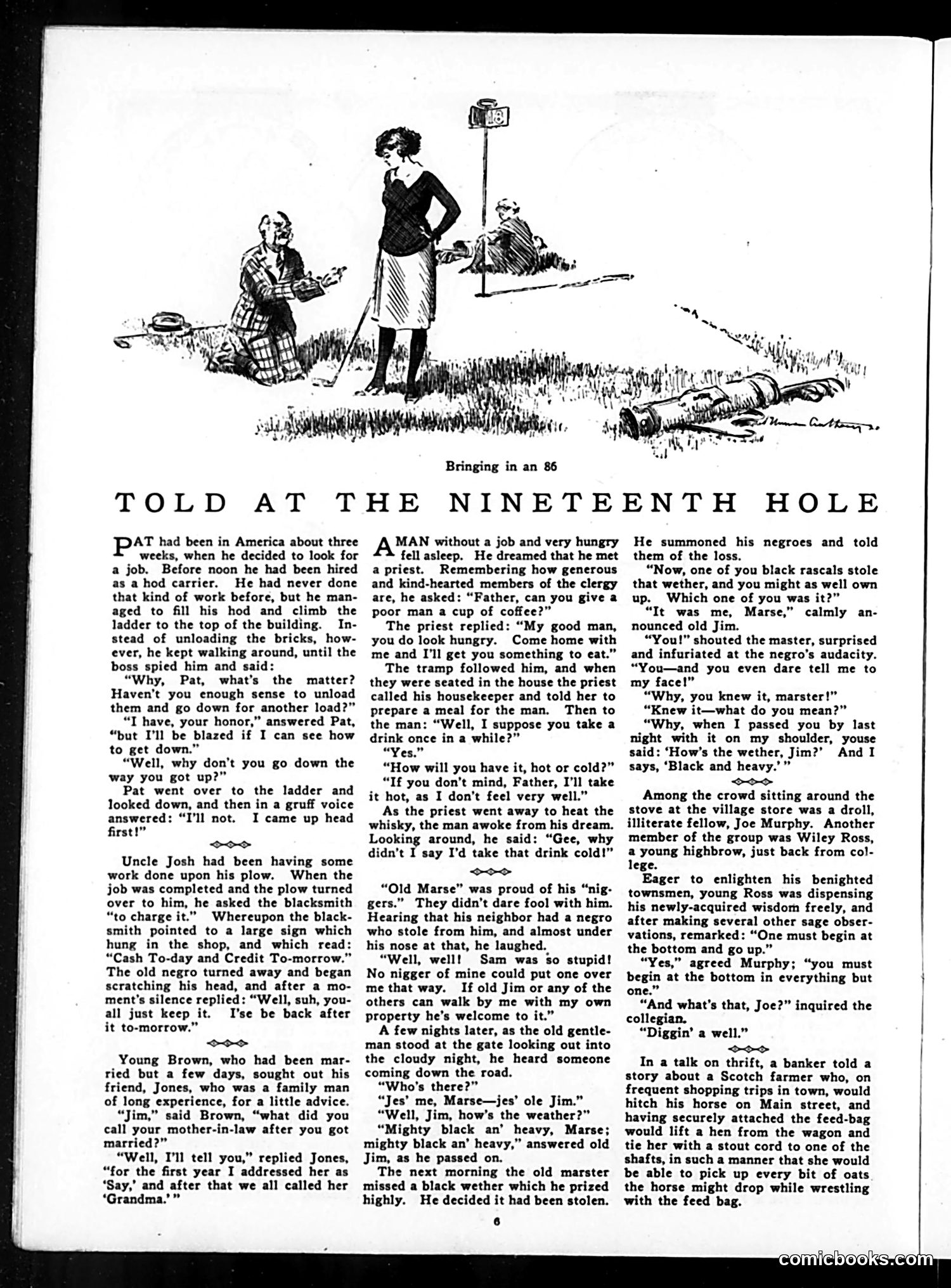
Bringing in an 86 TOLD AT THE NINETEENTH HOLE AT had been in America about three weeks, when he decided to look for a job. Before noon he had been hired as ahod carrier. He had never done that kind of work before, but he man- aged to fill his hod and climb the ladder to the top of the building. In- stead of unloading the bricks, how- ever, he kept walking around, until the boss spied him and said: “Why, Pat, what’s the matter? Haven't you enough sense to unload them and go down for another load?” “I have, your honor,” answered Pat, “but I'll be blazed if I can see how to get down.” “Well, why don’t you go down the ‘way you got up?” Pat went over to the ladder and looked down, and then in a gruff voice answered: “I'll not. I came up head first!” Seanad Uncle Josh had been having some work done upon his plow. When the job was completed and the plow turned over to him, he asked the blacksmith “to charge it.” Whereupon the black- smith pointed to a large sign which hung in the shop, and which read: “Cash To-day and Credit To-morrow.” The old negro turned away and began scratching his head, and after a mo- ment’s silence replied: “Well, suh, you- all just keep it. I’se be back after it to-morrow.” ~~ Young Brown, who had been mar- ried but a few days, sought out his friend, Jones, who was a family man of long experience, for a little advice. “Jim,” said Brown, “what did you call your mother-in-law after you got married?” “Well, I'll tell you,” replied Jones, “for the first year I addressed her as ‘Say,’ and after that we all called her ‘Grandma.’” AMAN without a job and very hungry fell asleep. He dreamed that he met a priest. Remembering how generous and kind-hearted members of the clergy are, he asked: “Father, can you give a poor man a cup of coffee?” The priest replied: “My good man, you do look hungry. Come home with me and I'll get you something to eat.” The tramp followed him, and when they were seated in the house the priest called his housekeeper and told her to prepare eal for the man. Then to the man: “Well, I suppose you take a drink once in a while?” “Yes.” “How will you have it, hot or cold?” “I£ you don’t mind, Father, I'll take it hot, as I don’t feel very well.” As the priest went away to heat the whisky, the man awoke from his dream. Looking around, he said: “Gee, why didn’t I say I'd take that drink cold!” ~_ “Old Marse” was proud of his “nig- gers.” They didn’t dare fool with him. Hearing that his neighbor had a negro who stole from him, and almost under his nose at that, he laughed. “Well, well! Sam was so stupid! No nigger of mine could put one over me that way. If old Jim or any of the others can walk by me with my own property he’s welcome to it.” A few nights later, as the old gentle- man stood at the gate looking out into the cloudy night, he heard someone coming down the road. “Who's there?” “Jes’ me, Marse—jes’ ole Jim.” “Well, Jim, how’s the weather?” “Mighty black an’ heavy, Marse; mighty black an’ heavy,” answered old Jim, as he passed on. The next morning the old marster missed a black wether which he prized highly. He decided it had been stolen. 6 He summoned his negroes and told them of the loss. “Now, one of you black rascals stole that wether, and you might as well own up. Which one of you was it?” “It was me, Marse,” calmly an- nounced old Jim. “You!” shouted the master, surprised and infuriated at the negro’s audacity. “You—and you even dare tell me to my face!” “Why, you knew it, marster!” “Knew it—what do you mean?” “Why, when I passed you by last night with it on my shoulder, youse said: ‘How’s the wether, Jim?’ And I says, ‘Black and heavy.’” Soe Among the crowd sitting around the stove at the village store was a droll, illiterate fellow, Joe Murphy. Another member of the group was Wiley Ross, a young highbrow, just back from col- lege. Eager to enlighten his benighted townsmen, young Ross was dispensing his newly-acquired wisdom freely, and after making several other sage obser- vations, remarked: “One must begin at the bottom and go up.” “Yes,” agreed Murphy; “you must begin at the bottom in everything but one.” “And what's that, Joe?” inquired the collegian. “Diggin’ a well.” Sena In a talk on thrift, a banker told a story about a Scotch farmer who, on frequent shopping trips in town, would hitch his horse on Main street, and having securely attached the feed-bag would lift a hen from the wagon and tie her with a stout cord to one of the shafts, in such a manner that she would be able to pick up every bit of oats the horse might drop while wrestling with the feed bag.