
Judge, 1922-06-24 · page 25 of 37
Judge — June 24, 1922 — page 25: what you’re looking at
What you’re looking at
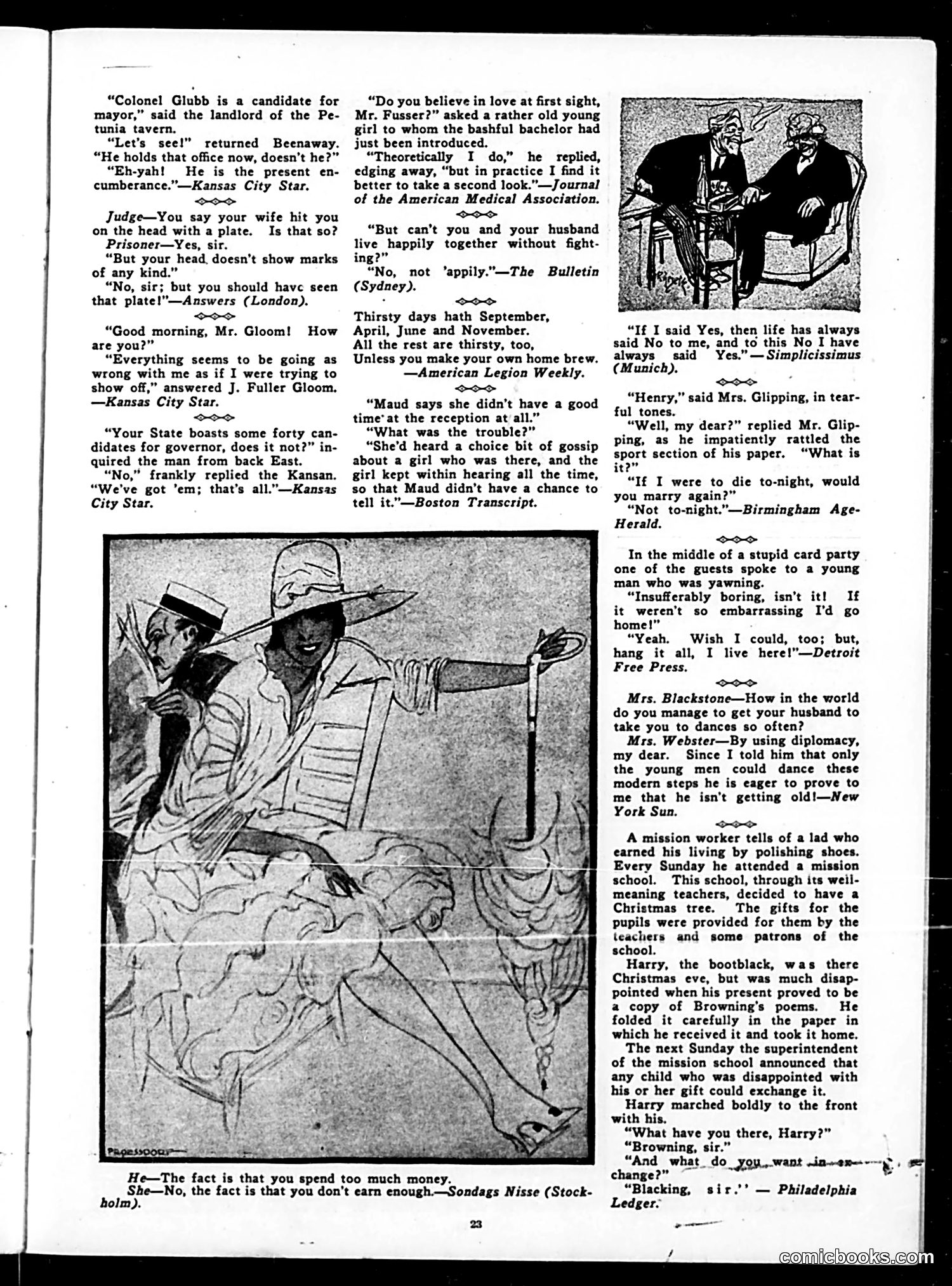
This page from Judge magazine contains multiple brief satirical jokes and anecdotes typical of early 20th-century American humor. The large cartoon depicts a cowboy or rancher on horseback, apparently exaggerating his riding skills or misadventures—the humor likely relies on physical comedy rather than specific political reference. The text comprises short jokes sourced from various newspapers and publications, covering universal themes: marital discord, political incompetence, romantic awkwardness, and social pretension. One notable item concerns a poor bootblack disappointed receiving Browning's poetry instead of shoe-blacking supplies—gentle satire of well-meaning but tone-deaf charitable institutions prioritizing "culture" over practical utility. The humor is largely apolitical and domestic, reflecting Judge's general satirical approach to everyday American life rather than specific current events.
📄 Transcribed text from this page (OCR, searchable)
Machine-transcribed from the original scan — historical spelling and the odd misread are preserved.
“Colonel Glubb is a candidate for mayor,” said the landlord of the Pe- tunia tavern, “Let’s see!” returned Beenaway. “He holds that office now, doesn’t he?” “Eh-yah! He is the present en- cumberance.”—Kansas City Star. cecal Judge—You say your wife hit you on the head with a plate. Is that so? Prisoner—Yes, sir. “But your head. doesn’t show marks of any kind.” “No, sir; but you should havc seen that plate!”"—Answers (London). oo, “Good morning, Mr. Gloom! are you?” “Everything seems to be going as wrong with me as if I were trying to show off,” answered J. Fuller Gloom, —Kansas City Star. oe “Your State boasts some forty can- didates for governor, does it not?” in- quired the man from back East. “No,” frankly replied the Kansan. “We've got ’em; that’s all.”—Kansas City Star. How “Do you believe in love at first sight, Mr. Fusser?” asked a rather old young girl to whom the bashful bachelor had just been introduced. “Theoretically I do,” he replied, edging away, “but in practice I find it better to take a second look.”—Journal of the American Medical Association. ~~! “But can’t you and your husband live happily together without fight- ing?” “No, not ’appily."—The Bulletin (Sydney). ¢ o_o Thirsty days hath September, April, June and November. All the rest are thirsty, too, Unless you make your own home brew. —American Legion Weekly. Second “Maud says she didn’t have a good time’ at the reception at all.” “What was the trouble “She'd heard a choice bit of gossip about a girl who was there, and the girl kept within hearing all the time, so that Maud didn’t have a chance to tell it."—Boston Transcript. He—The fact is that you spend too much money. ol She—Nor the fact is that you don’t earn enough.—Sondags Nisse (Stock- jolm). 23 “If I said Yes, then life has always said No to me, and to this No I have always said Yes.” —Simplicissimus (Munich). of; “Henry,” said Mrs. Glipping, in tear- ful tones. “Well, my dear?” replied Mr. Glip- ping, as he impatiently rattled the sport section of his paper. “What is ite” “If I were to die to-night, would you marry again?” “Not to-night."—Birmingham Age- Herald. ° In the middle of a stupid card party one of the guests spoke to a young man who was yawning. “Insufferably boring, isn’t it! I£ it weren’t so embarrassing I'd go home!” “Yeah. Wish I could, too; but, hang it all, I live here!”—Detroit Free Press. oe Mrs. Blackstone—How in the world do you manage to get your husband to take you to dances so often? Mrs. Webster—By using diplomacy, my dear. Since I told him that only the young men could dance these modern steps he is eager to prove to me that he isn’t getting old!—New York Sun. ~~ A mission worker tells of a lad who earned his living by polishing shoes. Every Sunday he attended a mission school. This school, through its weil- meaning teachers, decided to have a Christmas tree. The gifts for the pupils were provided for them by the teachers and some patrons of the school. Harry, the bootblack, was there Christmas eve, but was much disap- pointed when his present proved to be a copy of Browning’s poems. He folded it carefully in the paper in which he received it and took it home. The next Sunday the superintendent of the mission school announced that any child who was disappointed with his or her gift could exchange it. Harry marched boldly to the front with his, “What have you there, Harry?” “Browning, sir.” “And what. do you.,.want win-en~—; change?” “Blacking, sir.’’ — Philadelphia Ledger: