
Judge, 1922-06-24 · page 13 of 37
Judge — June 24, 1922 — page 13: what you’re looking at
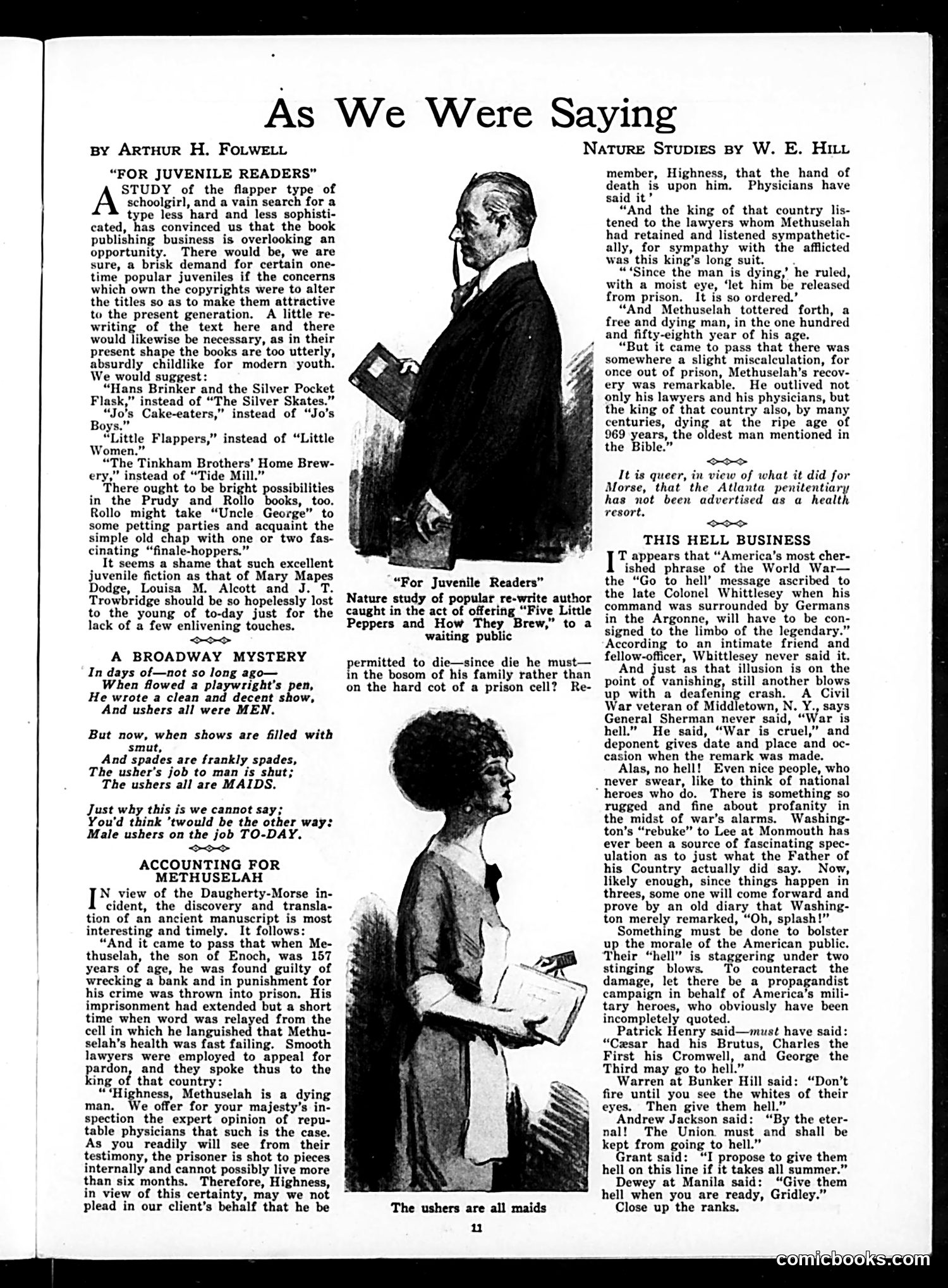
What you’re looking at
This page contains two satirical pieces mocking 1920s social trends: **"For Juvenile Readers"** (top): Arthur H. Folwell ridicules how publishers could update classic children's books for "modern youth" by renaming them to reflect 1920s flappers and Prohibition culture. "The Silver Skates" becomes "The Silver Pocket Flask"; "Little Women" becomes "Little Flappers." The satire targets both the era's youth culture and publishers' perceived desperation to remain relevant. **"Accounting for Methuselah"** (bottom): This likely references the Daugherty-Morse scandal (Attorney General Harry Daugherty's associate). The piece ironically describes an ancient prisoner released on medical grounds—a transparent allegory to contemporary corruption where political connections secured early prison releases. The "dying man" motif suggests cynical manipulation of sympathetic arguments. **"Broadway Mystery"**: A brief joke noting female ushers now work in theaters showing indecent shows, implying moral decline. The page reflects Judge's skeptical take on Prohibition-era excess and political corruption.
📄 Transcribed text from this page (OCR, searchable)
Machine-transcribed from the original scan — historical spelling and the odd misread are preserved.
As We Were Saying Nature Stupies sy W. E. HILi By ARTHUR H. FoLwELi “FOR JUVENILE READERS” STUDY of the flapper type of A schoolgirl, and a vain search for a type less hard and less sophisti- cated, has convinced us that the book publishing business is overlooking an opportunity. There would be, we are sure, a brisk demand for certain one- time popular juveniles if the concerns which own the copyrights were to alter the titles so as to make them attractive to the present generation. A little re- writing of the text here and there would likewise be necessary, as in their present shape the books are too utterly absurdly childlike for modern youth. We would suggest: “Hans Brinker and the Silver Pocket Flask,” instead of “The Silver Skates.” Cake-eaters,” instead of “Jo’s “Little Flappers,” instead of “Little Women.” “The Tinkham Brothers’ Home Brew- ery,” instead of “Tide Mill.” There ought to be bright possibilities in the Prudy and Rollo ks, too. Rollo might take “Uncle George” to some petting parties and acquaint the simple old chap with one or two fas- cinating “finale-hoppers.” It seems a shame that such excellent juvenile fiction as that of Mary Mapes Dodge, Louisa M. Alcott and J. T. Trowbridge should be so hopelessly lost to the young of to-day just for the lack of a few enlivening touches. oe! A BROADWAY MYSTERY In days of—not so long ago— When flowed a playwright’s pen, He wrote a clean and decent show, And ushers all were MEN. But now, when shows are filled with smut, And spades are frankly spades, The usher’s job to man is shut; The ushers all are MAIDS. Just why this is we cannot say; You'd think 'twould be the other way: Male ushers on the job TO-DAY. aed ACCOUNTING FOR METHUSELAH N view of the Daugherty-Morse in- cident, the discovery and transla- tion of an ancient manuscript is most interesting and timely. It follows: “And it came to pass that when Me- thuselah, the son of Enoch, was 157 years of age, he was found guilty of wrecking a bank and in punishment for his crime was thrown into prison. His imprisonment had extended but a short time when word was relayed from the cell in which he languished that Methu- selah’s health was fast failing. Smooth lawyers were employed to appeal for par and they spoke thus to the ing of that country: “‘Highness, Methuselah is a dying man. We offer for your majesty’s in- spection the expert opinion of repu- table physicians that such is the case. As you readily will see from their testimony, the prisoner is shot to pieces internally and cannot possibly live more than six months. Therefore, Highness, in view of this certainty, may we not plead in our client’s behalf that he be “For Juvenile Readers” Nature study of popular re-write author caught in the act of offering “Five Little Peppers and How They Brew,” to a waiting public ermitted to die—since die he must— in the bosom of his family rather than on the hard cot of a prison cell? Re- The ushers are all maids nu member, Highness, that the hand of death is upon him. Physicians have said it’ “And the king of that country lis- tened to the lawyers whom Methuselah had retained and listened sympathetic- ally, for sympathy with the afflicted was this king’s long suit. e “*Since the man is dying,’ he ruled, with a moist eye, ‘let him be released from prison. It is so ordered.’ “And Methuselah tottered forth, a free and dying man, in the one hundred and fifty-eighth year of his age. “But it came to pass that there was somewhere a slight miscalculation, for once out of prison, Methuselah’s recov- ery was remarkable. He outlived not only his lawyers and his physicians, but the king of that country also, by many centuries, dying at the ripe age of 969 years, the oldest man mentioned in the Bible.” oo It is queer, in view of what it did for Morse, that the Atlanta penitentiary has not been advertised as a health resort. oS THIS HELL BUSINESS T appears that “America’s most cher- ished phrase of the World War— the “Go to hell’ message ascribed to the late Colonel Whittlesey when his command was surrounded by Germans in the Argonne, will have to be con- signed to the limbo of the legendary.” According to an intimate friend and fellow-officer, Whittlesey never said it. And just as that illusion is on the point of vanishing, still another blows up with a deafening crash. A Civil War veteran of Middletown, N. Y., says General Sherman never said, “War is hell.” He said, “War is cruel,” and deponent gives date and place and oc- casion when the remark was made. Alas, no hell! Even nice people, who never swear, like to think of national heroes who do. There is something so rugged and fine about profanity in the midst of war’s alarms. Washing- ton’s “rebuke” to Lee at Monmouth has ever been a source of fascinating spec- ulation as to just what the Father of his Country actually did say. Now, likely enough, since things happen in threes, some one will come forward and prove by an old diary that Washing- ton merely remarked, “Oh, splash!” Something must be done to bolster up the morale of the American public. Their “hell” is staggering under two stinging blows. To counteract the damage, let there be a propagandist campaign in behalf of America’s mili- tary heroes, who obviously have been incompletely quoted. Patrick Henry said—must have said: “Cxsar had his Brutus, Charles the First his Cromwell, and George the Third may go to hell.” Warren at Bunker Hill said: “Don’t fire until you see the whites of their eyes. Then give them hell.” Andrew Jackson said: “B nal! The Union must an kept from going to hell.” Grant said: “I propose to give them hell on this line if it takes all summer.” Dewey at Manila said: “Give them hell when you are ready, Gridley.” Close up the ranks, the eter- shall be