
A complete issue · 36 pages · 1922
Judge — April 8, 1922
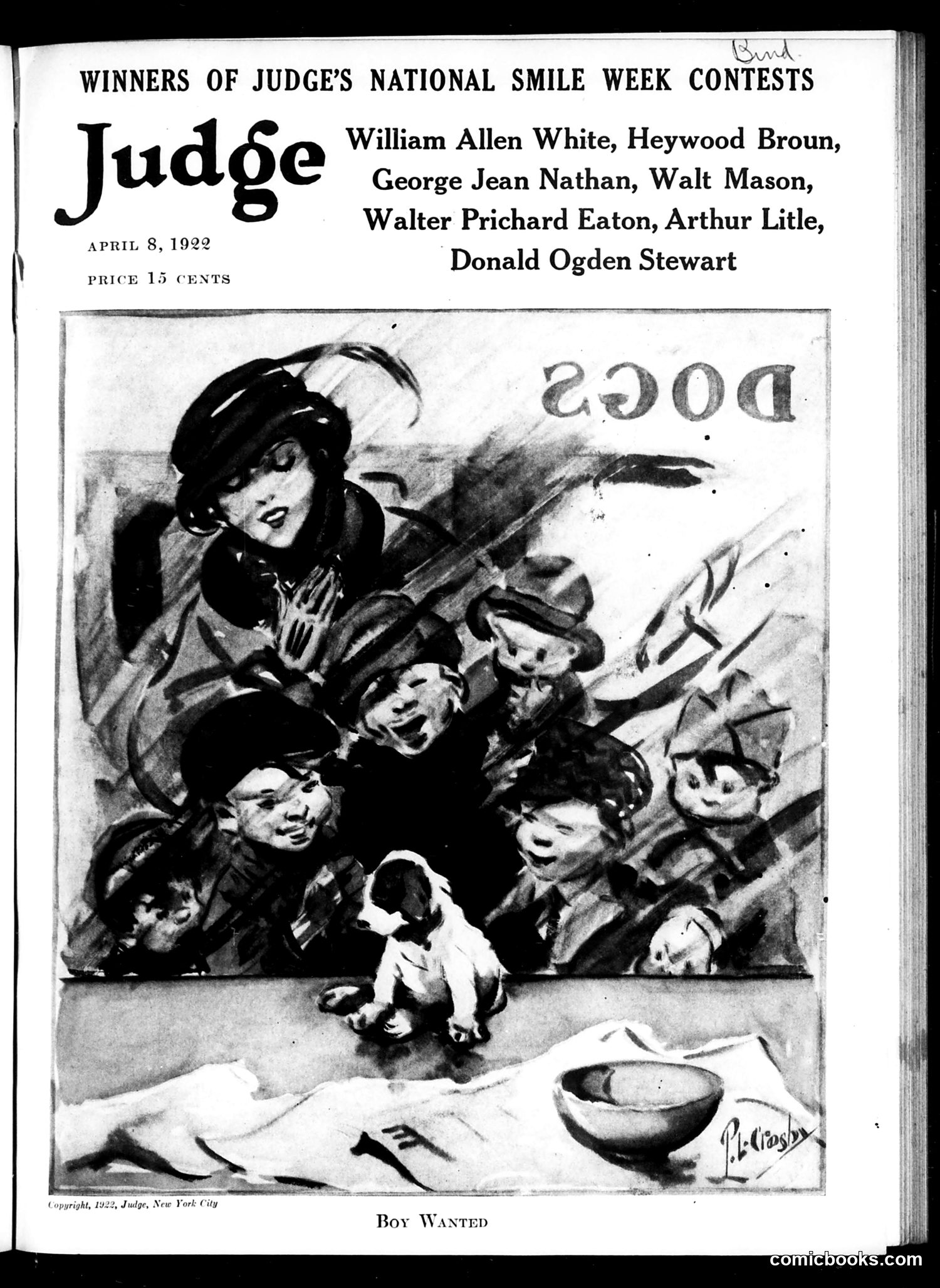
This page announces winners of Judge's National Smile Week Contest from April 8, 1922. The winning illustration, titled "Boy Wanted," depicts a woman surrounded by multiple children of various ages, with a small dog in the foreground. The cartoon's humor likely plays on the phrase "boy wanted"—a common job-posting phrase of the era. Instead, the image shows a woman overwhelmed by numerous children already in her care, suggesting ironic commentary on domestic labor, motherhood, or perhaps family planning concerns of the 1920s. The visual joke contrasts the "wanting" of a boy with the reality of managing many children. The seven named judges were prominent figures in entertainment and media of that period, though their specific roles require additional context to fully explain.
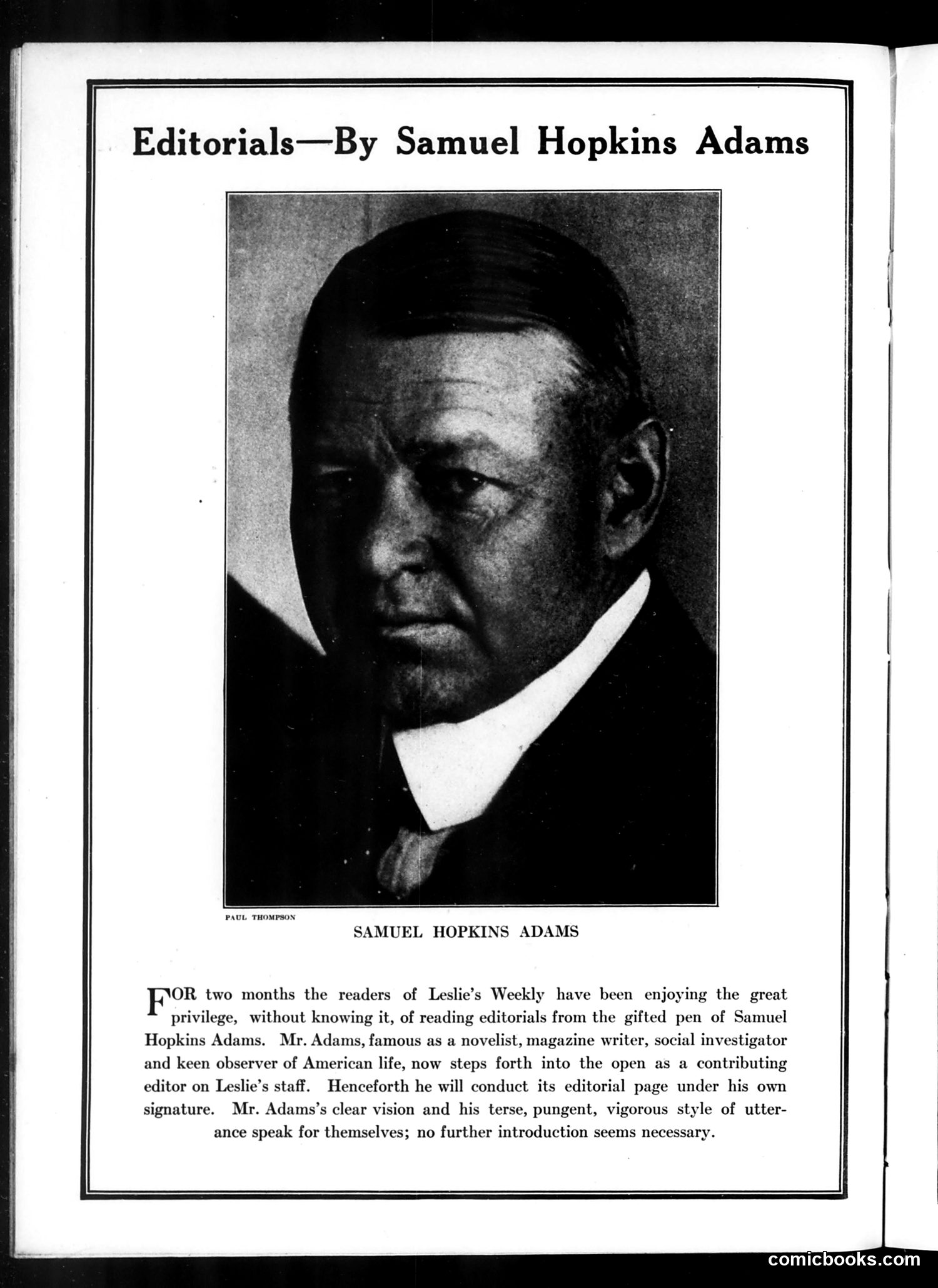
This is not a cartoon page but rather an editorial introduction page from Leslie's Weekly magazine. It features a formal portrait photograph of **Samuel Hopkins Adams**, credited to photographer Paul Thompson. The text announces that Adams, described as a "famous novelist, magazine writer, social investigator and keen observer of American life," will now serve as a contributing editor to Leslie's Weekly, conducting an editorial page under his own signature. The page serves a promotional function—introducing readers to their new editorial voice and establishing his credibility through his existing reputation as a writer and social commentator. This appears to be a straightforward announcement rather than satirical content.
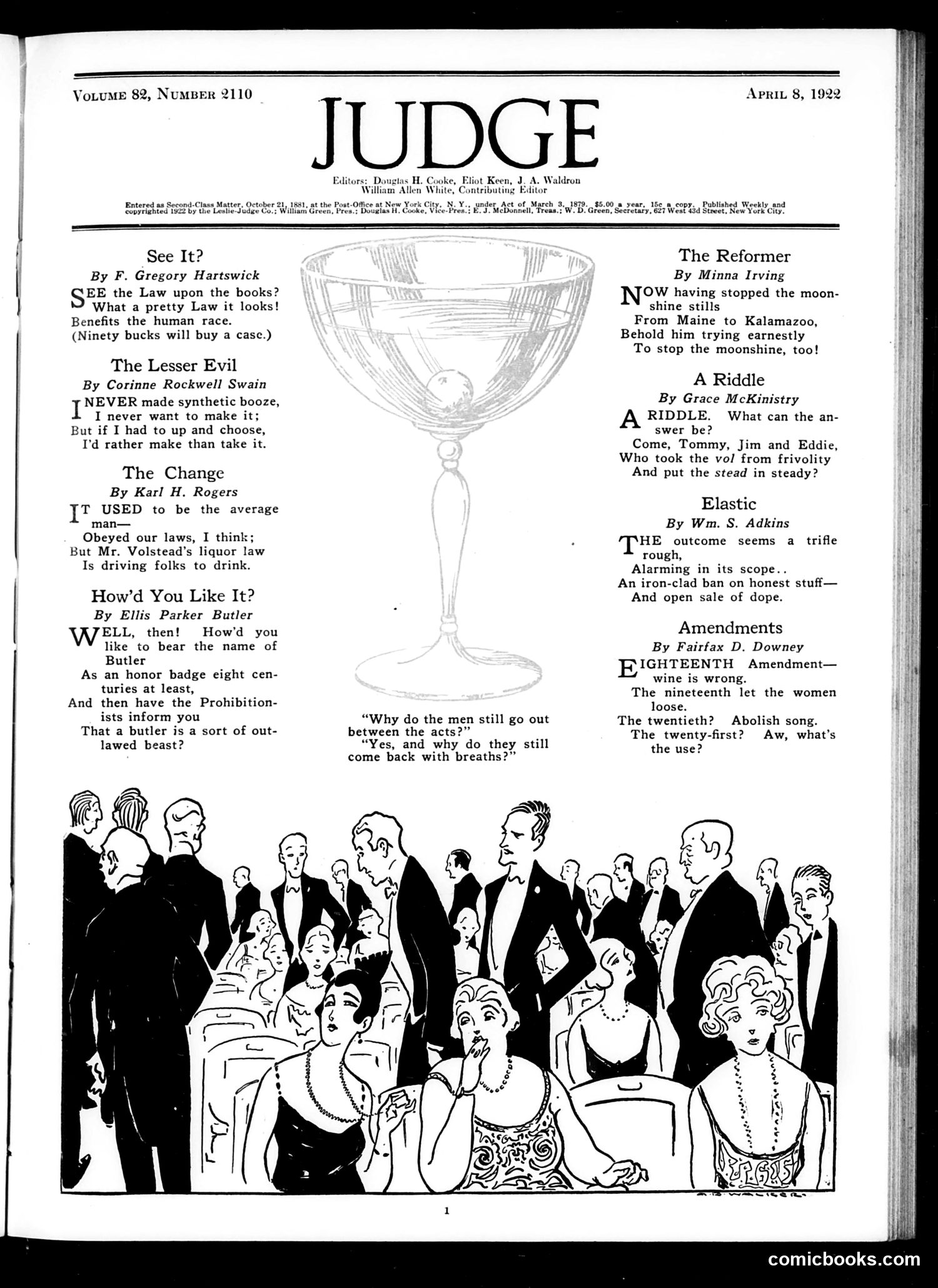
This page contains satirical poetry and one large cartoon about Prohibition's social effects. **The poems** mock Prohibition (which began in 1920): "See It?" ridicules the law's appearance while benefiting bootleggers; "The Lesser Evil" and "The Change" critique how Prohibition drove drinking underground and changed social behavior; "How'd You Like It?" sarcastically asks if being named "Butler" is worth the "honor" of Prohibition enforcers. **The main cartoon** shows well-dressed men and women at what appears to be a formal dinner or party, with the caption asking why men leave "between the acts" and return "with breaths"—implying they're sneaking out to drink illegal alcohol during social events. The overall message: Prohibition wasn't stopping drinking; it was merely making it covert and creating a culture of deception among the social elite.
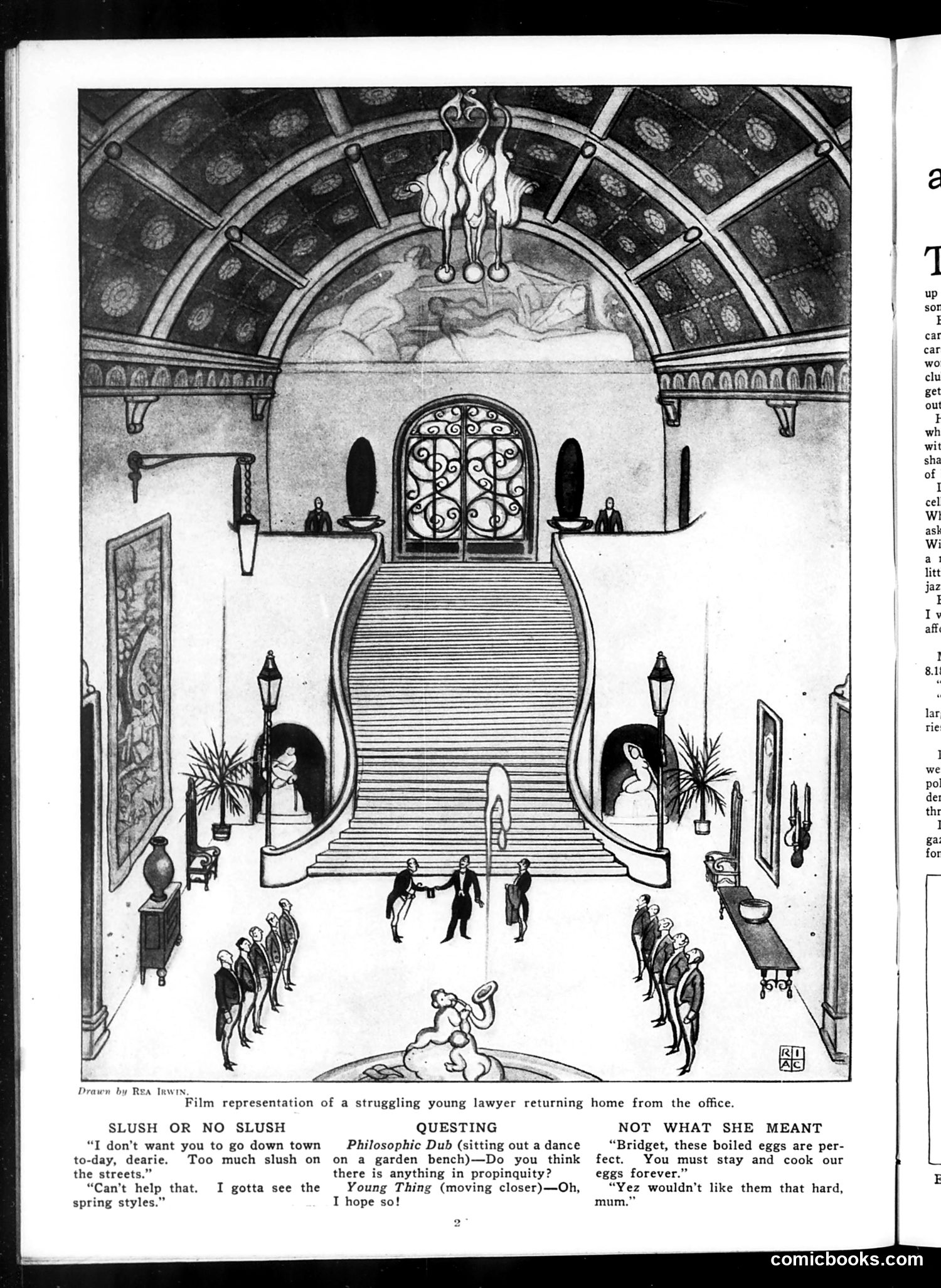
This page from *Judge* magazine features a satirical drawing by Rea Irwin depicting "a struggling young lawyer returning home from the office." The grand architectural setting—with its imposing staircase, ornate doors, and classical dome—contrasts ironically with the lawyer's modest circumstances. The three captioned vignettes below mock domestic life and gender relations of the era. "Slush or No Slush" jokes about a wife's complaint regarding street mud on his clothing. "Questing" presents philosophical banter between spouses about impropriety. "Not What She Meant" depicts a wife's exasperated response to a husband's literal interpretation of her cooking instructions about boiled eggs. The satire targets the gap between professional ambition and domestic reality, while poking fun at miscommunication between husbands and wives in early 20th-century marriage.
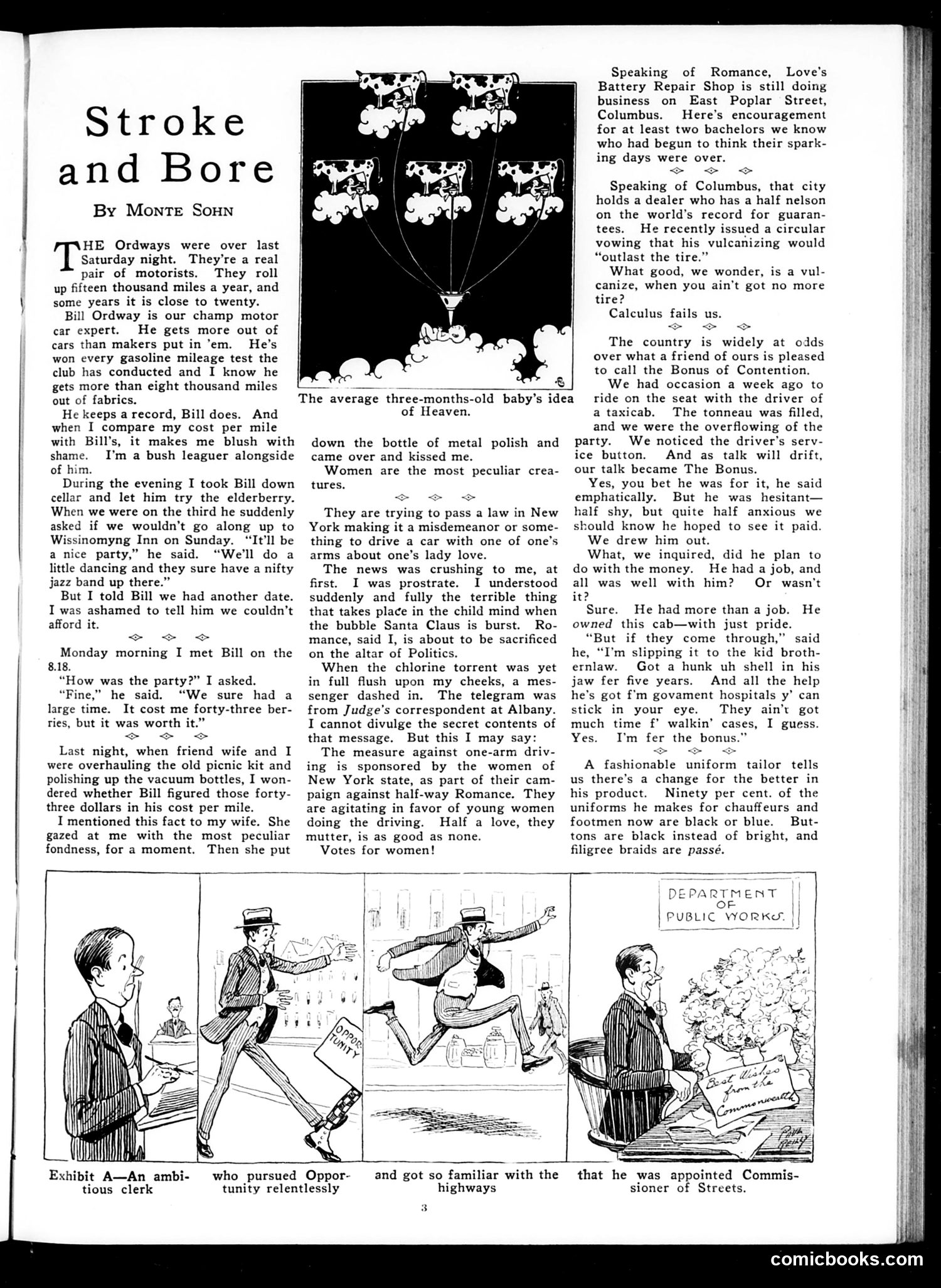
This Judge magazine page combines a humorous essay about motorists with four small political cartoons at the bottom titled "Exhibit A." **Main Article:** Sohn recounts social gatherings with Bill Ordway, described as a skilled motorist and gasoline mileage expert. The anecdote includes gossip about Columbus, Ohio dealers and concerns about women drivers—specifically referencing a campaign against "half-way Romance" (apparently women driving recklessly). The piece satirizes both automotive culture and contemporary debates about women's driving safety. **Bottom Cartoons ("Exhibit A"):** These appear to depict bureaucratic incompetence, showing an ambitious clerk pursuing "Opportunity relentlessly," becoming overly familiar with procedures, and ultimately being appointed "Commissioner of Streets"—suggesting satire of nepotism or political advancement through persistence rather than merit in public works departments.
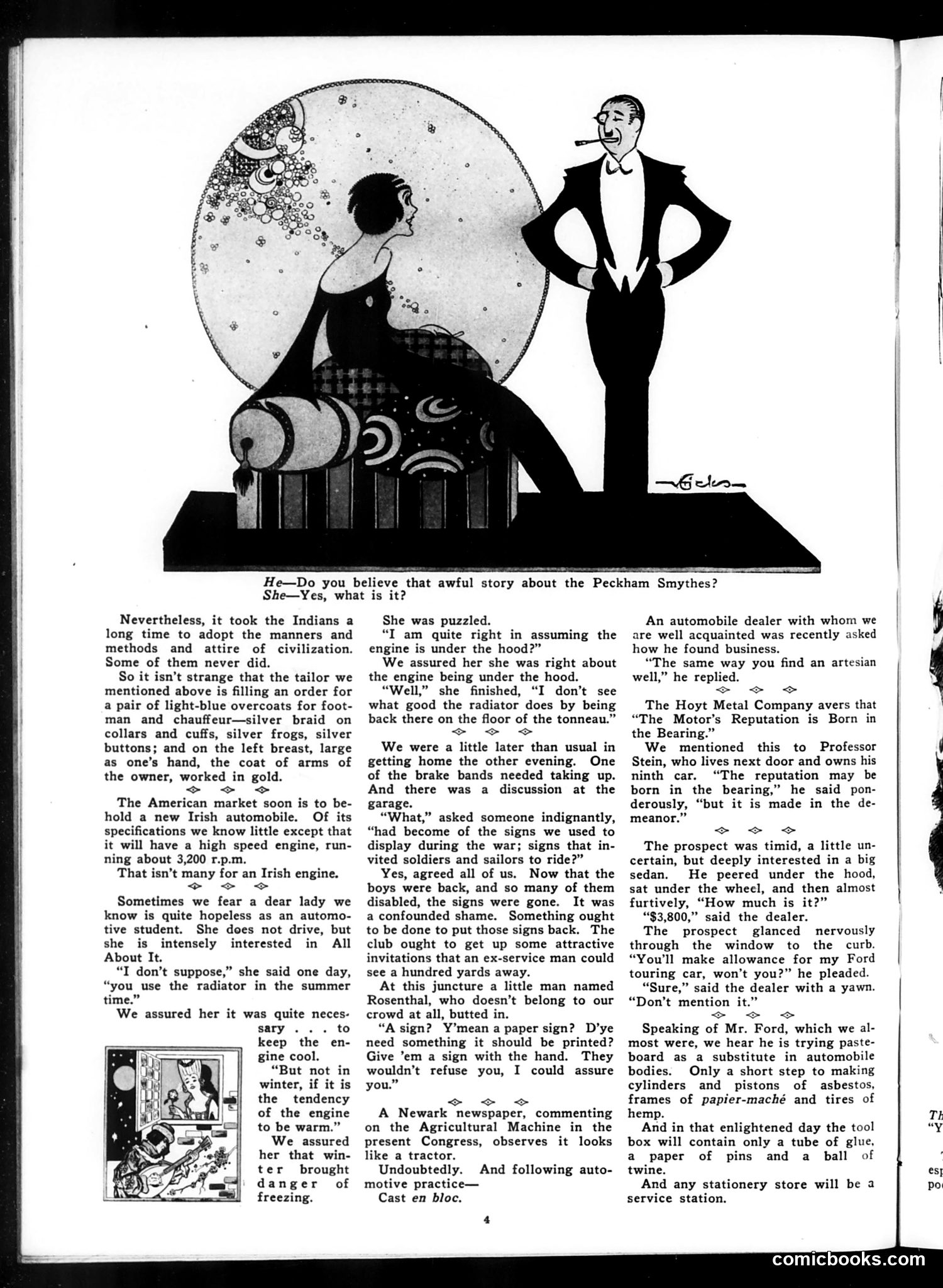
The top cartoon depicts a woman seated on ornate furniture admiring a large decorative moon, while a man in formal attire stands nearby smoking. The caption reveals their conversation about the "Peckham Smythes" — an apparently scandalous social story. The surrounding text discusses Irish automobiles, women drivers, and automotive accessories. One anecdote mocks a woman who doesn't drive but is "intensely interested in all About It," asking about using the radiator in summer. Another story features a car salesman negotiating with a prospect over a Ford touring car. The satire targets early 20th-century automotive culture, gender assumptions about driving, and social pretension among the wealthy classes. The cartoon likely comments on gossip and societal vanity among the elite.
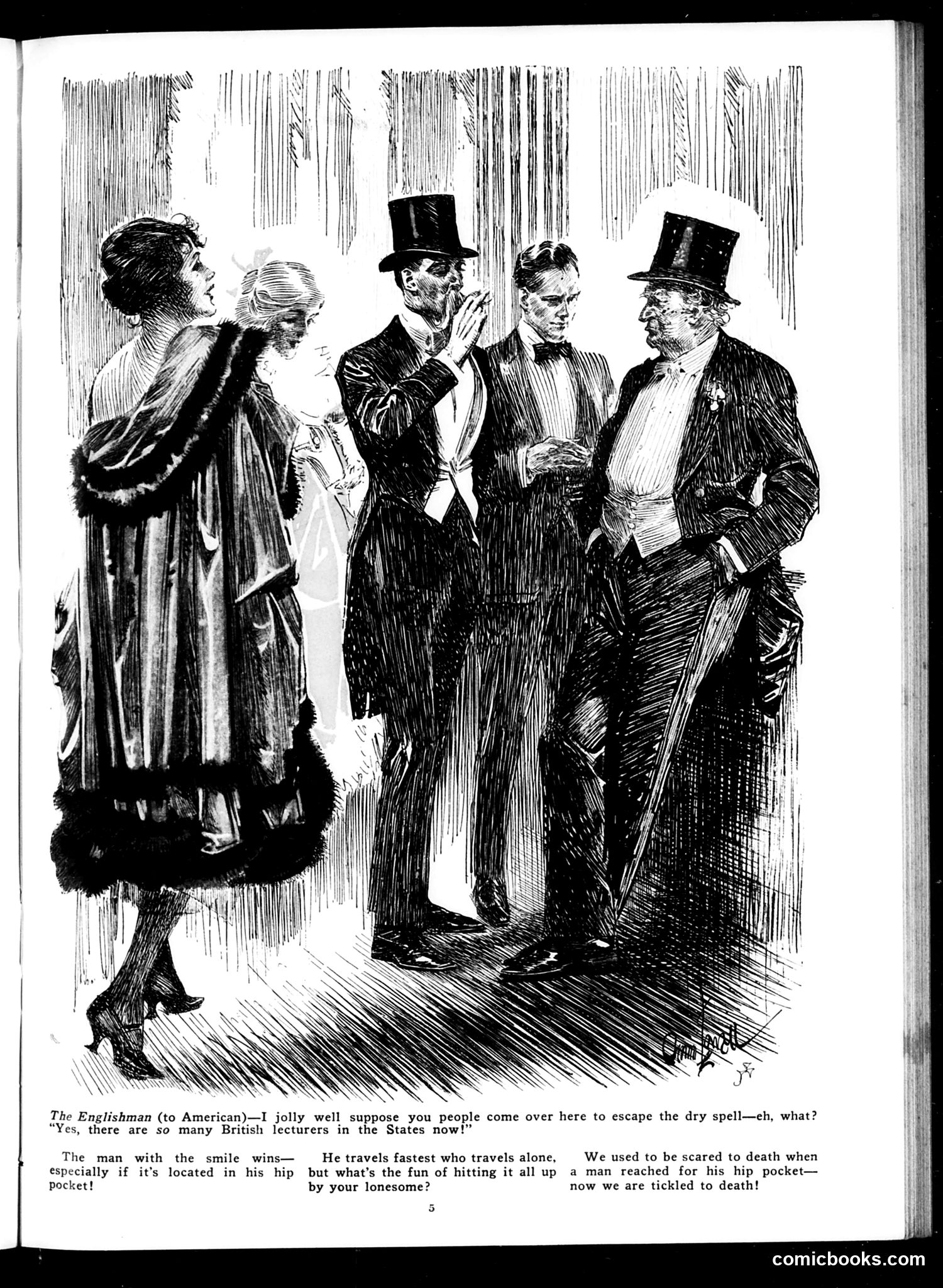
This Judge page satirizes British cultural invasion of America through lecturers. The main cartoon depicts well-dressed men (British lecturers) conversing with an American, mocking how numerous British speakers have become in the United States—so prevalent they're now associated with escaping Britain's "dry spell" (likely Prohibition-related or economic hardship). The three captioned vignettes below use aphorisms to satirize changing American attitudes: one jokes about hip flasks (alcohol), another about solo travel, and the third plays on shifting perceptions of reaching into coat pockets—once a sign of danger, now merely expected drinking behavior. The satire targets both British cultural pretension and American enthusiasm for imported lecturers, while also reflecting Prohibition-era attitudes toward hidden alcohol.
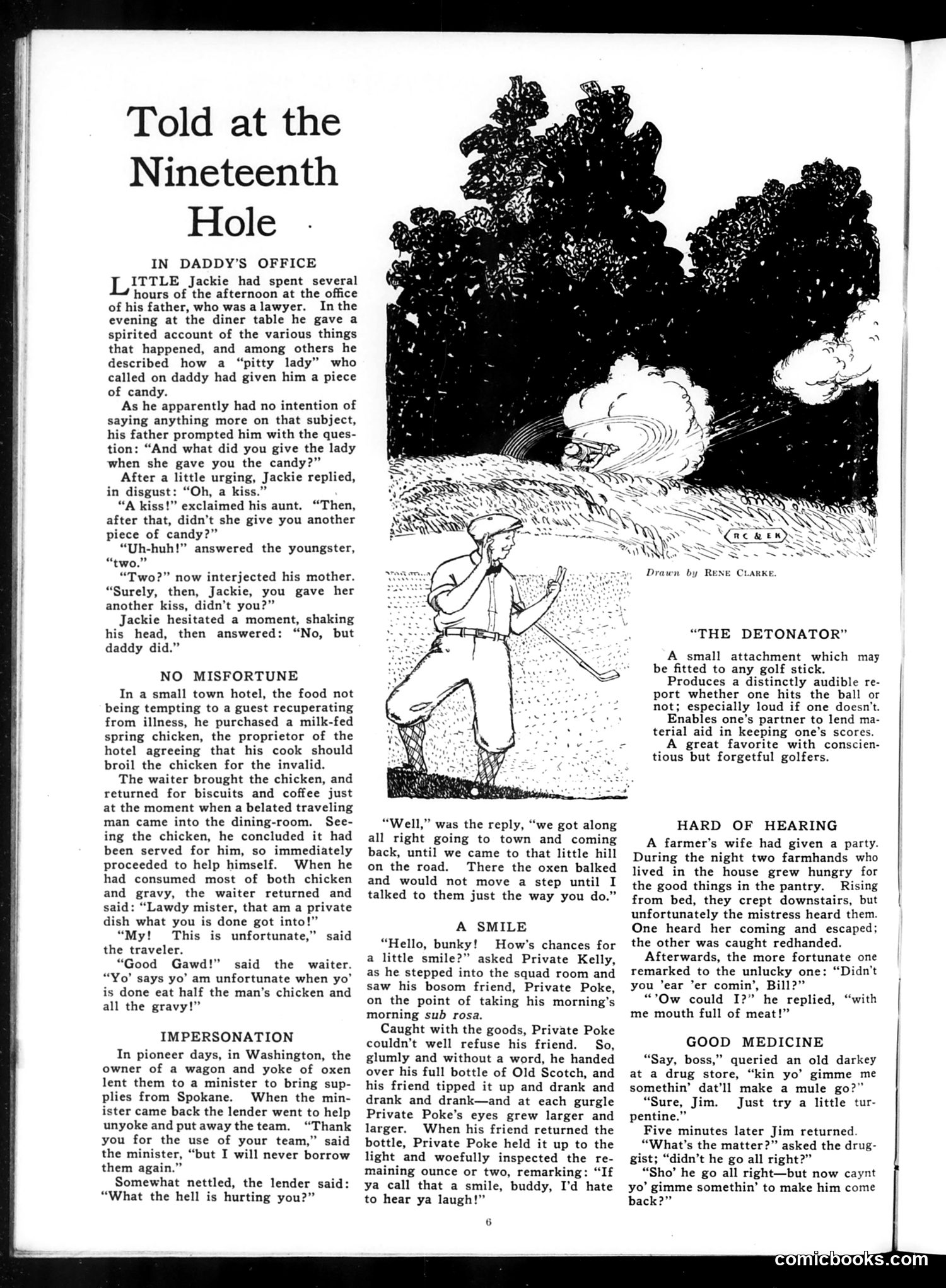
This page collects humorous anecdotes tied to the "nineteenth hole" (the bar at a golf club), a common framing device for Judge's joke compilations. The main cartoon depicts a golfer mid-swing. The accompanying product description, "The Detonator," satirizes forgetful golfers by describing a fake golf-stick attachment that produces loud noise "whether one hits the ball or not; especially loud if one doesn't"—mocking golfers who make poor shots and need audible excuses. The text stories are genteel domestic humor typical of early 20th-century magazines: a child innocently reveals his father kissed a visiting lady, a traveler accidentally eats an invalid's meal, and soldiers/farmers tell jokes about misunderstandings. The humor relies on unexpected twists and mild social embarrassment rather than satire. The "Hard of Hearing" fragment suggests a story about miscommunication—typical of the period's gentle, family-friendly comedy content. No overt political satire is present on this page.
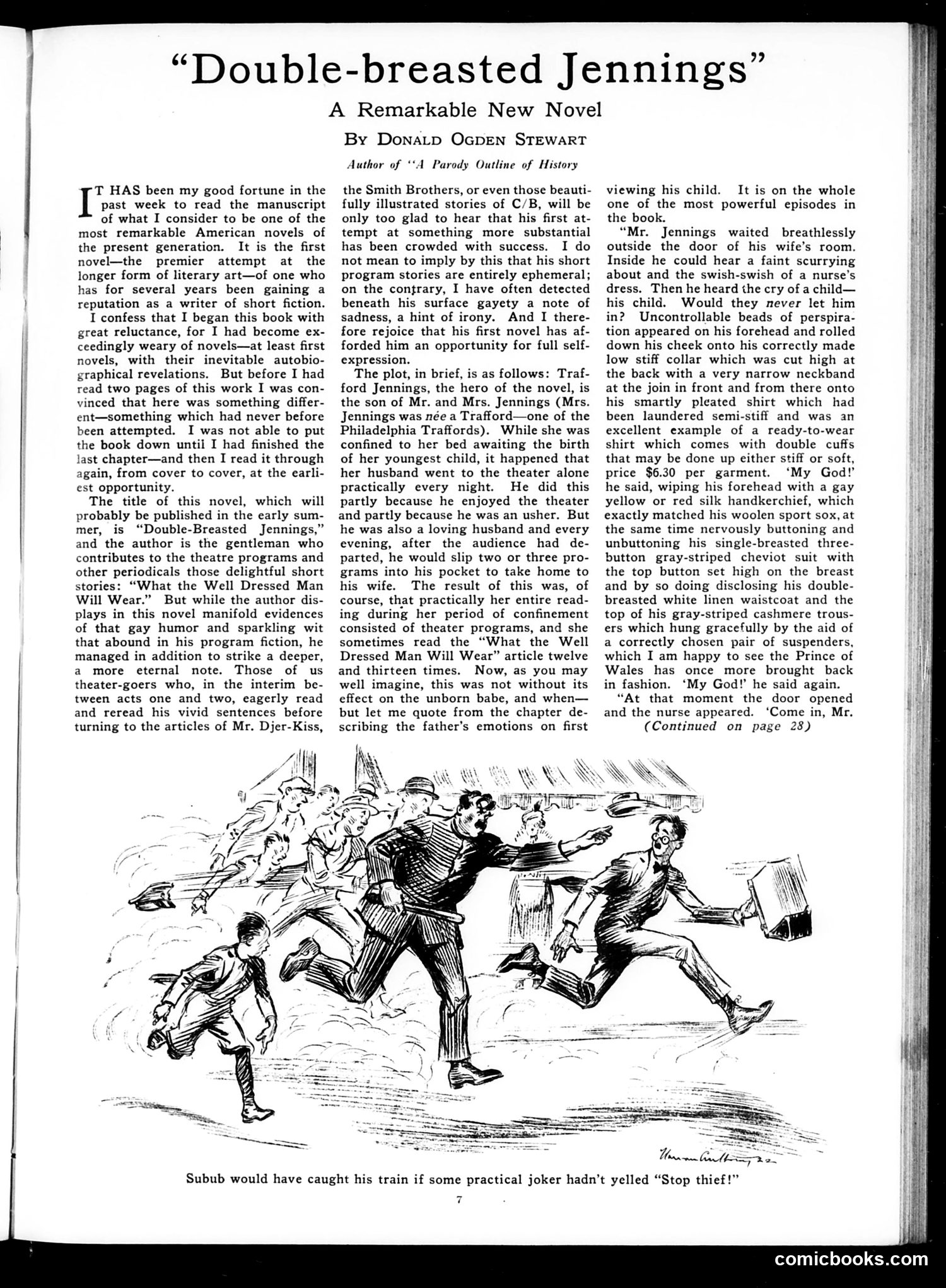
This page satirizes both literary pretension and fashion obsession in early 20th-century America. The text presents a fake "review" of a nonexistent novel called "Double-Breasted Jennings" by Donald Ogden Stewart (a real humorist and playwright). The satire works on multiple levels: it mocks overwrought literary criticism that treats trivial subjects seriously, and ridicules the idea that a child's entire personality could be shaped by a pregnant mother reading theater program fashion columns repeatedly. The absurd premise—that reading "What the Well Dressed Man Will Wear" articles would influence an unborn child—parodies both deterministic psychology and fashion industry self-importance. The cartoon below illustrates the ridiculous plot: a man in a double-breasted suit causes chaos by yelling "Stop thief!" The visual joke reinforces how trivial the novel's central concern (fashionable clothing) truly is, despite the overwrought critical praise above.
This is a theater criticism article by George Jean Nathan reviewing three playwrights. The decorative header shows performers in what appears to be a vaudeville or musical comedy style. **Main Subjects:** - **Eugene O'Neill**: The critic argues O'Neill is producing plays too hastily without proper development. He contrasts O'Neill's weaker recent work ("The First Man") with his better plays ("Beyond the Horizon," "The Emperor Jones"). Nathan uses colorful language—comparing the writing process to drunken composition after cocktails—to suggest O'Neill lacks reflection and maturity in his current output. However, he praises "The Hairy Ape" as more effective theater despite melodramatic elements. - **George M. Cohan**: Mentioned only briefly at the article's end (which continues on another page), described humorously as viewing life "with the eyes of a bootlegger"—likely a Prohibition-era joke about Cohan's lighter, commercial theatrical sensibility versus O'Neill's serious approach. The third playwright mentioned in the title remains unclear from this excerpt.
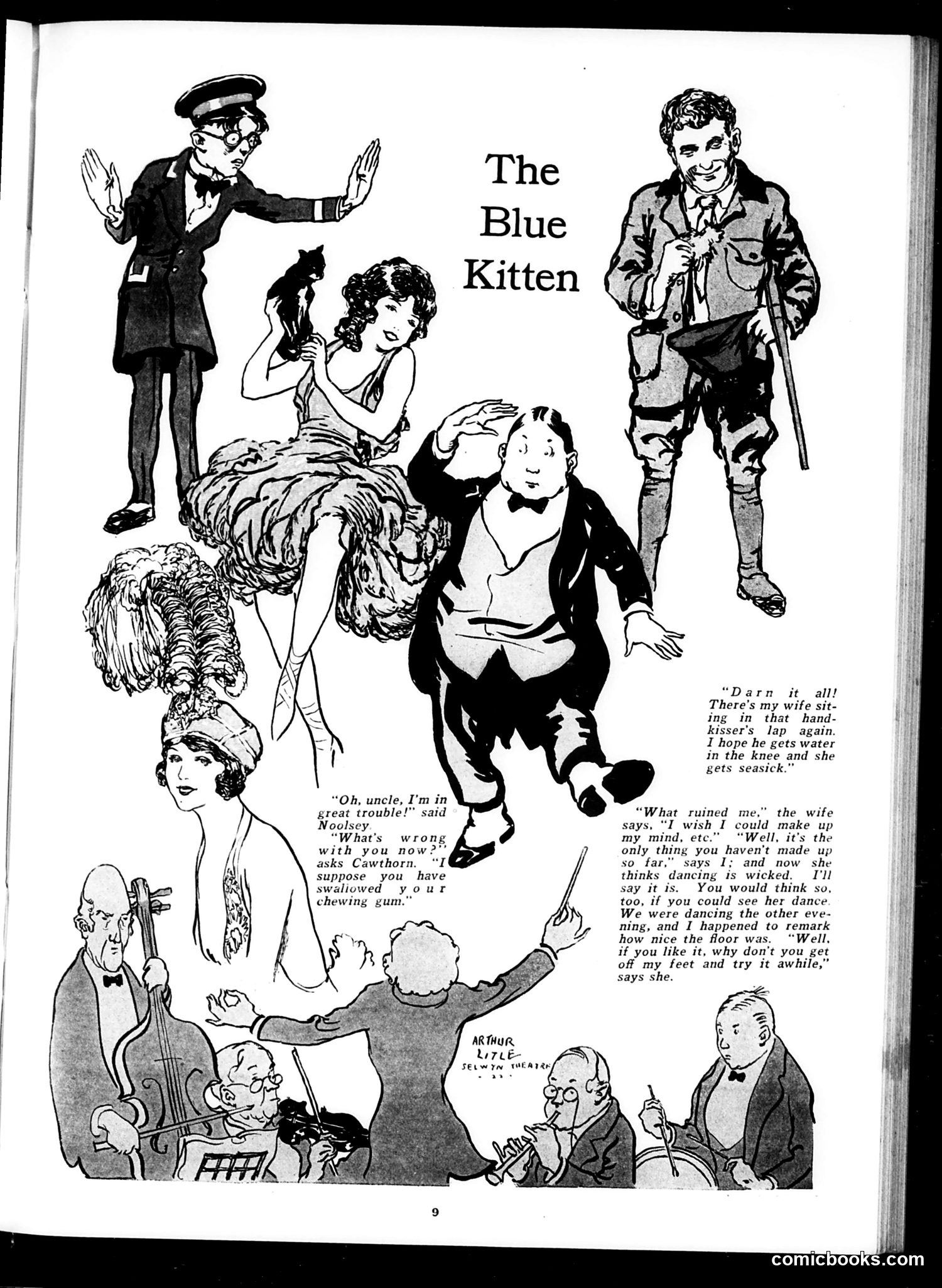
This is a comedy sketch from *Judge*, the American satirical magazine, likely from the 1920s based on the art style and references to "dancing" as morally controversial—reflecting Jazz Age debates about modern entertainment. The comic presents interconnected domestic humor scenarios: Uncle Cawthorn teases young Noosey about swallowing gum; a husband complains about his wife flirting in another man's lap; and most prominently, a wife frustrated with her indecisive husband who mocks her dancing. The husband's closing complaint—that she literally stepped on his feet while dancing—delivers the punchline through physical comedy. The satire targets 1920s social anxieties: changing gender roles, modern leisure activities like dancing (condemned by conservative moralists), and marital dynamics where wives increasingly demanded independence and pleasure. The "blue kitten" title likely refers to the romantic/flirtation subplot. The various male characters (conductor, soldiers, servants) populate a world where social hierarchies are disrupted by modern behavior.
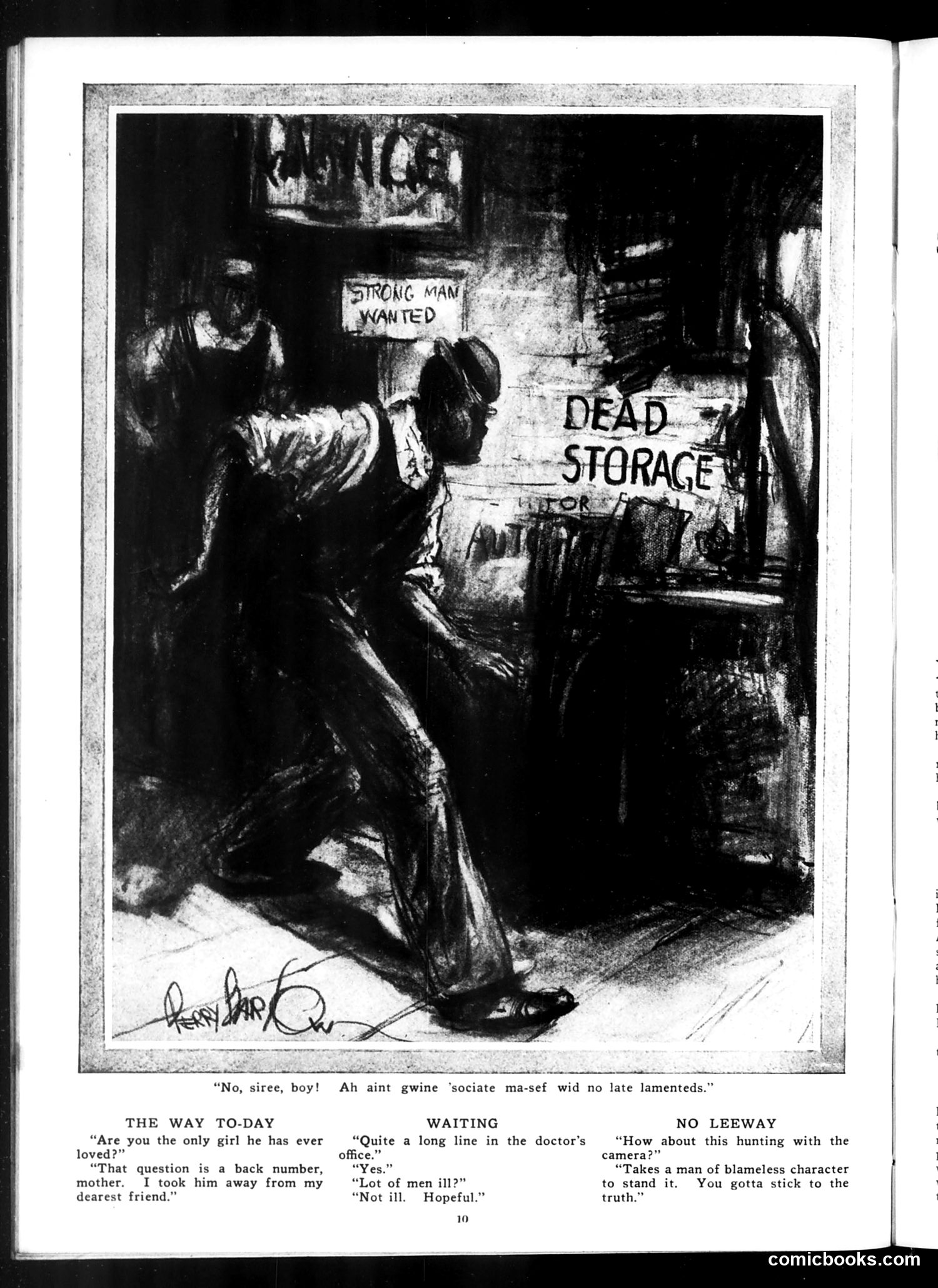
This page from *Judge* magazine contains three separate satirical comics addressing early 20th-century social attitudes. **"The Way To-Day"** mocks modern women's casual approach to relationships—a young woman boasts of stealing her boyfriend from her best friend, treating romance as competitive sport rather than commitment. **"Waiting"** satirizes men seeking medical consultation, with the joke that the "long line" consists not of sick patients but "hopeful" men—likely seeking treatments for venereal diseases, a common social anxiety of the era. **"No Leeway"** plays on tension between hunting/outdoor activities and emerging photography culture. A man refuses to hunt with someone carrying a camera, claiming only those of "blameless character" can be trusted with the camera's truth-telling power—perhaps implying hunters engaged in disreputable behavior they didn't want documented. The artwork style and racial dialect in the header quote reflect the period's casual prejudices.
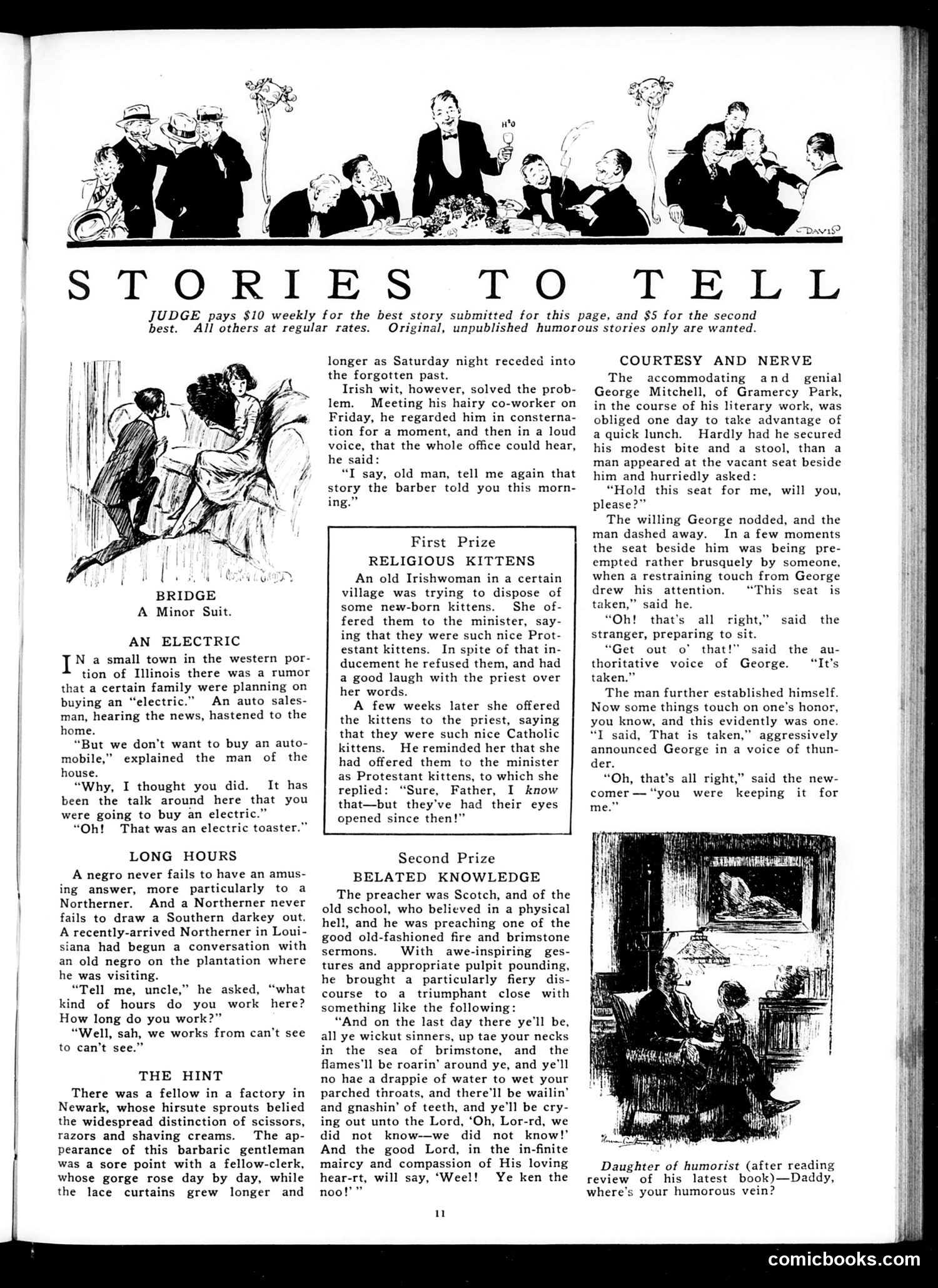
This page presents humorous anecdotes submitted to Judge's "Stories to Tell" contest, offering cash prizes for readers' contributions. The cartoons and stories satirize American social attitudes of the early 20th century. Key content includes ethnic and racial stereotypes typical of the era: an Irish woman's wordplay about kittens converting from "Protestant" to "Catholic," a Scottish preacher's dialect-heavy sermon, and a "darkey" joke featuring racist labor exploitation imagery ("works from can't see to can't see"—sunrise to sunset). A story about mistaking an "electric toaster" for an automobile pokes fun at rural ignorance of modern technology. The cartoon header depicts well-dressed men at what appears to be a formal dinner, suggesting stories of upper-class social situations. These pieces represent Judge's approach: satirizing working-class and rural Americans while reinforcing period prejudices as "amusing" material for educated readers. The content reflects now-offensive comedic conventions acceptable to contemporary audiences.
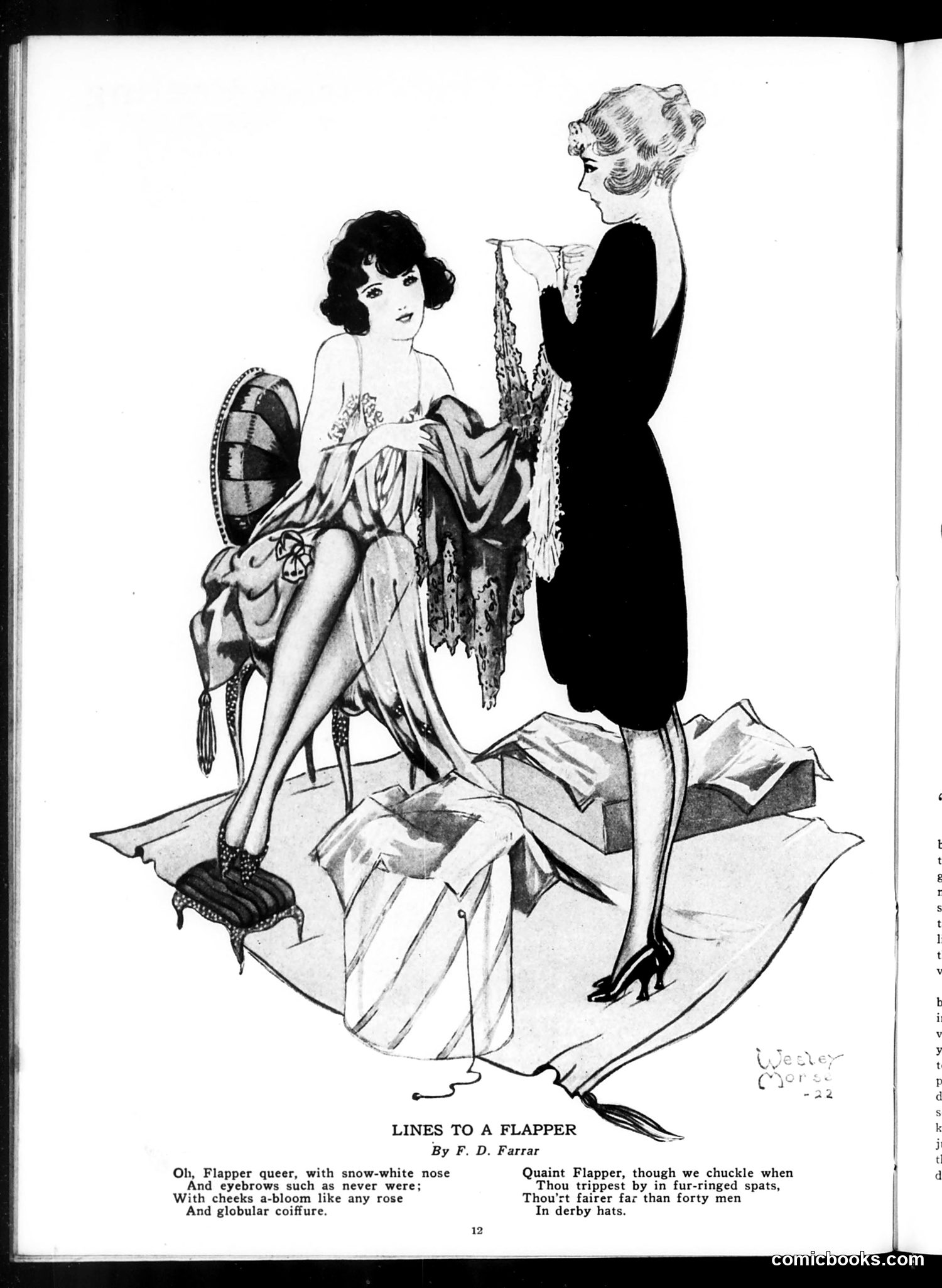
This is a humorous poem satirizing 1920s "flapper" fashion and appearance. The illustration shows two women: one seated, embodying the flapper stereotype with short dark hair, heavy makeup (pale face, dark eyebrows, rouged cheeks), and fashionable accessories like fur-trimmed spats and heeled shoes; the other standing in conservative black dress, representing older-generation values. The poem mocks flappers' exaggerated cosmetics and styling ("snow-white nose," "globular coiffure"—likely referring to the bobbed hairstyle) while backhanded-complimenting them as more attractive than conventionally masculine men in traditional dress. The satire gently ridicules both the flapper trend and contemporary gender presentation, reflecting generational anxiety about post-WWI women's changing social roles and appearance.
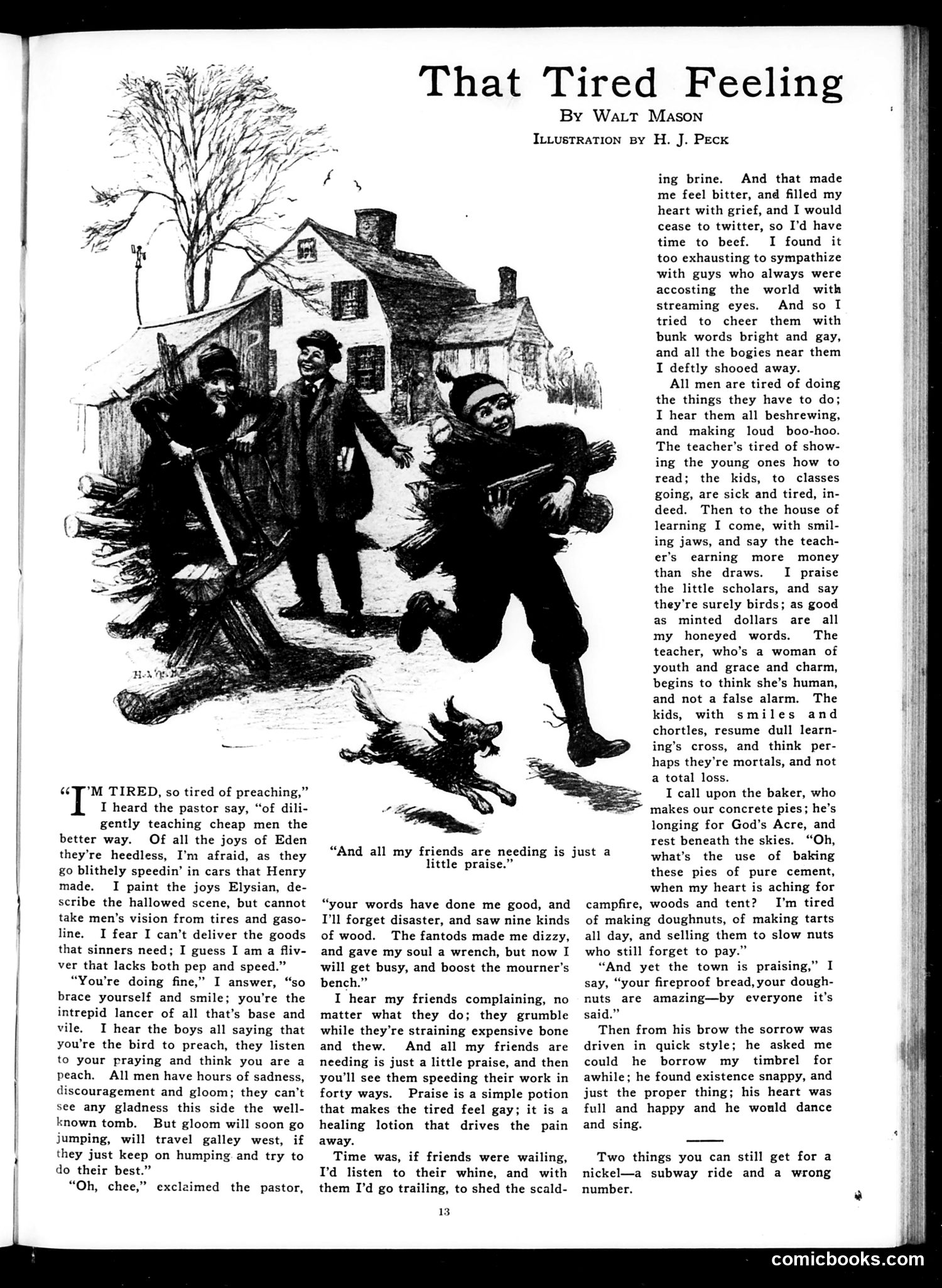
This is a humorous moral essay illustrated with a street scene of children playing. The narrator describes encountering a tired pastor who feels ineffective preaching to people distracted by modern luxuries (Henry Ford's automobiles). The narrator offers simple advice: people need *praise*, not sympathy. The piece satirizes early 20th-century American fatigue and dissatisfaction across social classes—tired teachers, exhausted bakers, discouraged workers. Mason's point is that encouragement and recognition, rather than commiseration, revive people's spirits and productivity. The final line jokes that only subway rides and wrong numbers remain affordable (likely commentary on rising costs during this era). The illustration shows energetic children, contrasting with the essay's theme of universal adult weariness. This reflects *Judge* magazine's satirical commentary on contemporary American life and social attitudes.
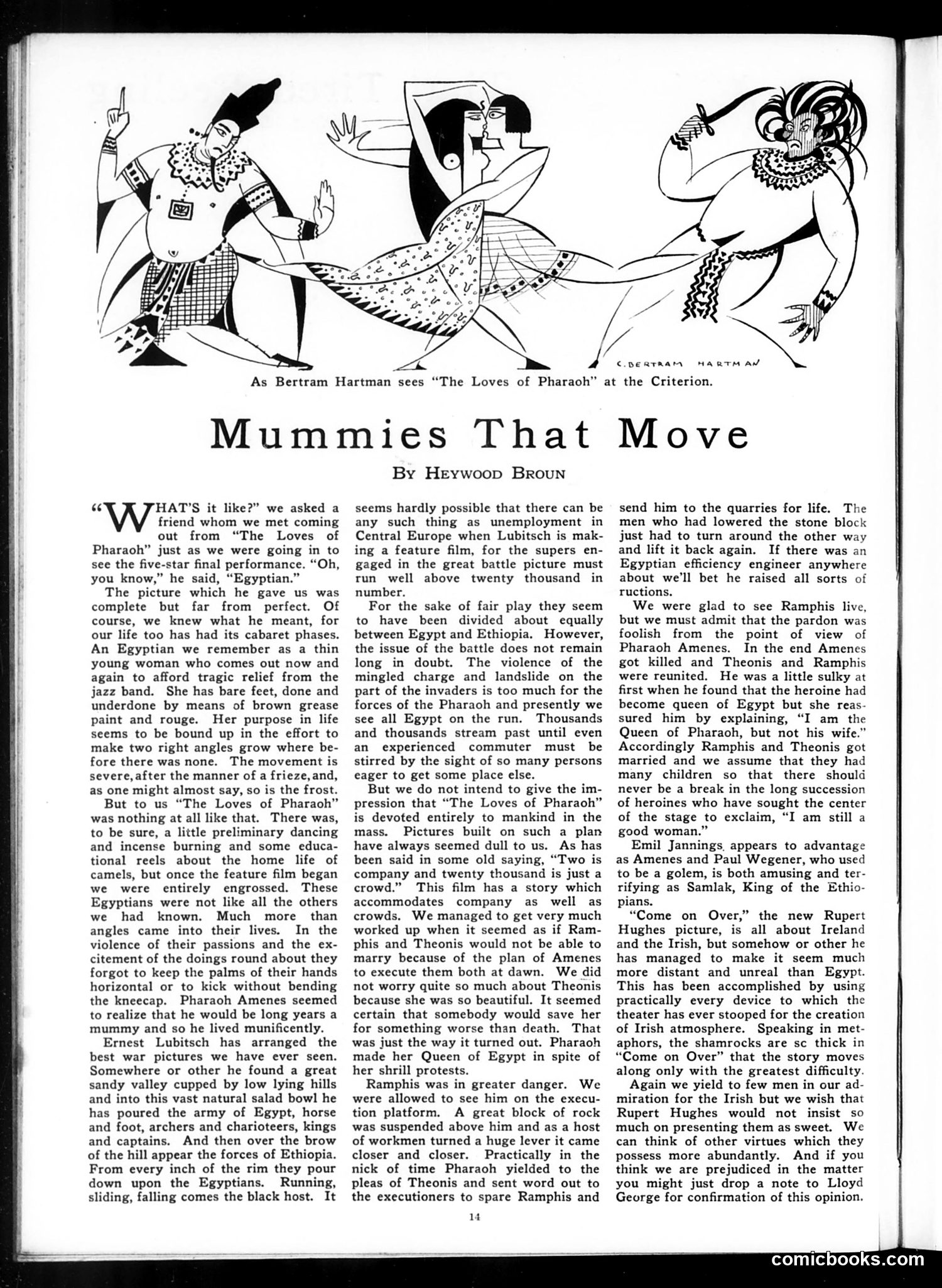
This is a film review by Heywood Broun of Ernst Lubitsch's *The Loves of Pharaoh*, a silent epic. The cartoon at top shows Bertram Hartman's satirical impression of the film's stylized "Egyptian" aesthetic—exaggerated poses and theatrical gestures typical of both stage "Egyptian" dancers and silent cinema. Broun praises Lubitsch's ambitious battle sequences (featuring thousands of extras) while gently mocking the film's melodramatic plot about Pharaoh Amenes preventing lovers Ramphis and Theonis from marrying. He contrasts this with traditional "Egyptian" stage entertainment—thin dancers in minimal costumes performing rigid, geometric movements meant to evoke ancient aesthetics. The review is largely positive, celebrating the film's spectacle and emotional intensity while noting its narrative simplicity. The satire targets not the film itself but rather contemporary expectations of what "Egyptian" entertainment should look like.
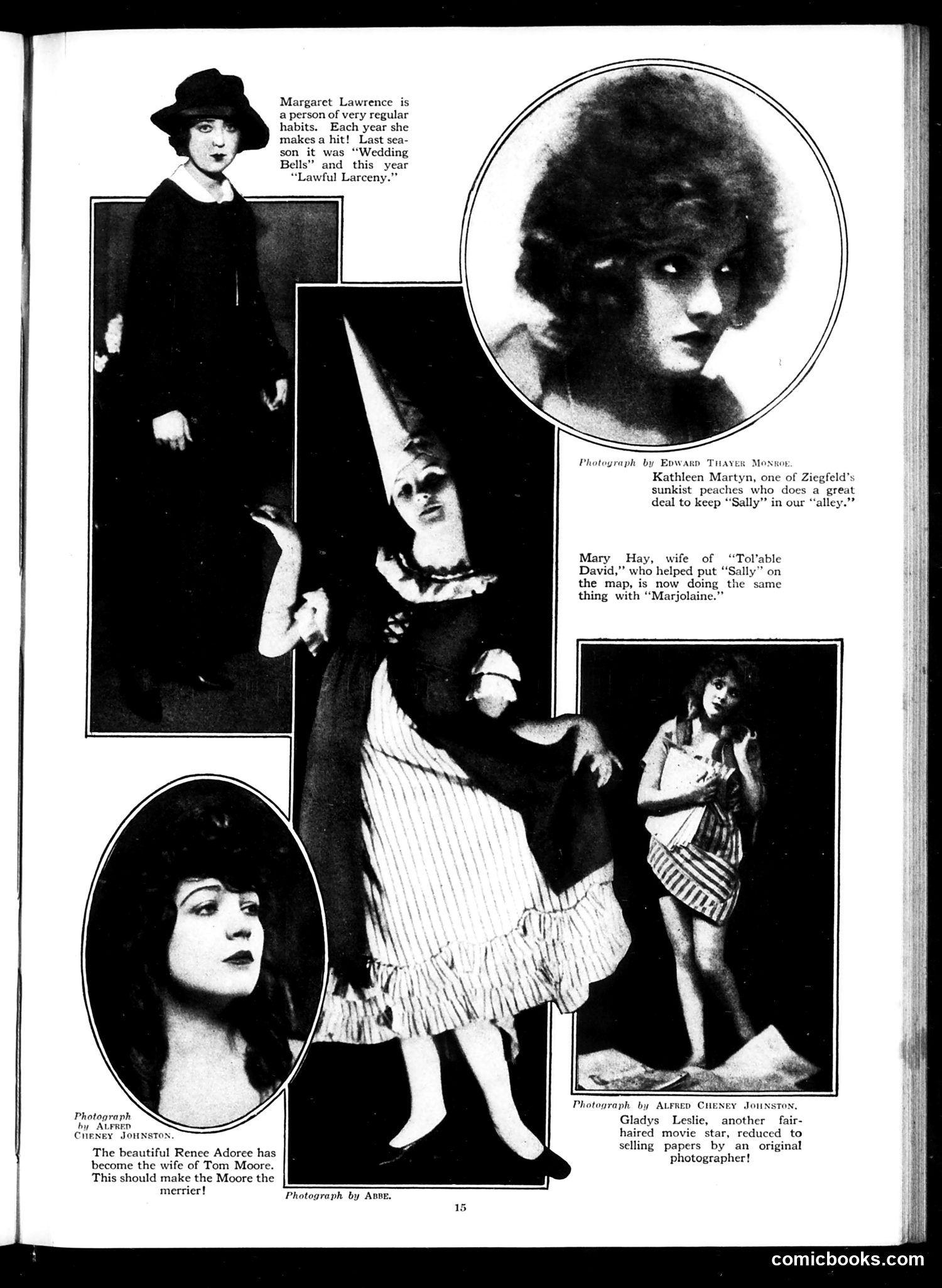
This page features **theatrical and film gossip** rather than political satire. It showcases five actresses popular in early 1920s stage and silent cinema, with brief commentary on their careers and personal lives. The "satire" is light social humor: Margaret Lawrence's reliable annual stage hits; a pun about actress Renee Adoree marrying actor Tom Moore ("make the Moore the merrier"); jokes about Ziegfeld Follies dancer Kathleen Martyn and actress Mary Hay boosting productions; and a gag about Gladys Leslie being "reduced to selling papers"—likely mock-disapproving commentary on a actress's publicity stunt or photograph. The credited photographers (Edward Thayer Monroe, Alfred Cheney Johnston, Abbe) suggest these were professional promotion images. This represents **entertainment journalism disguised as satire**—Judge mining celebrity culture for modest laughs rather than offering sharp political commentary.
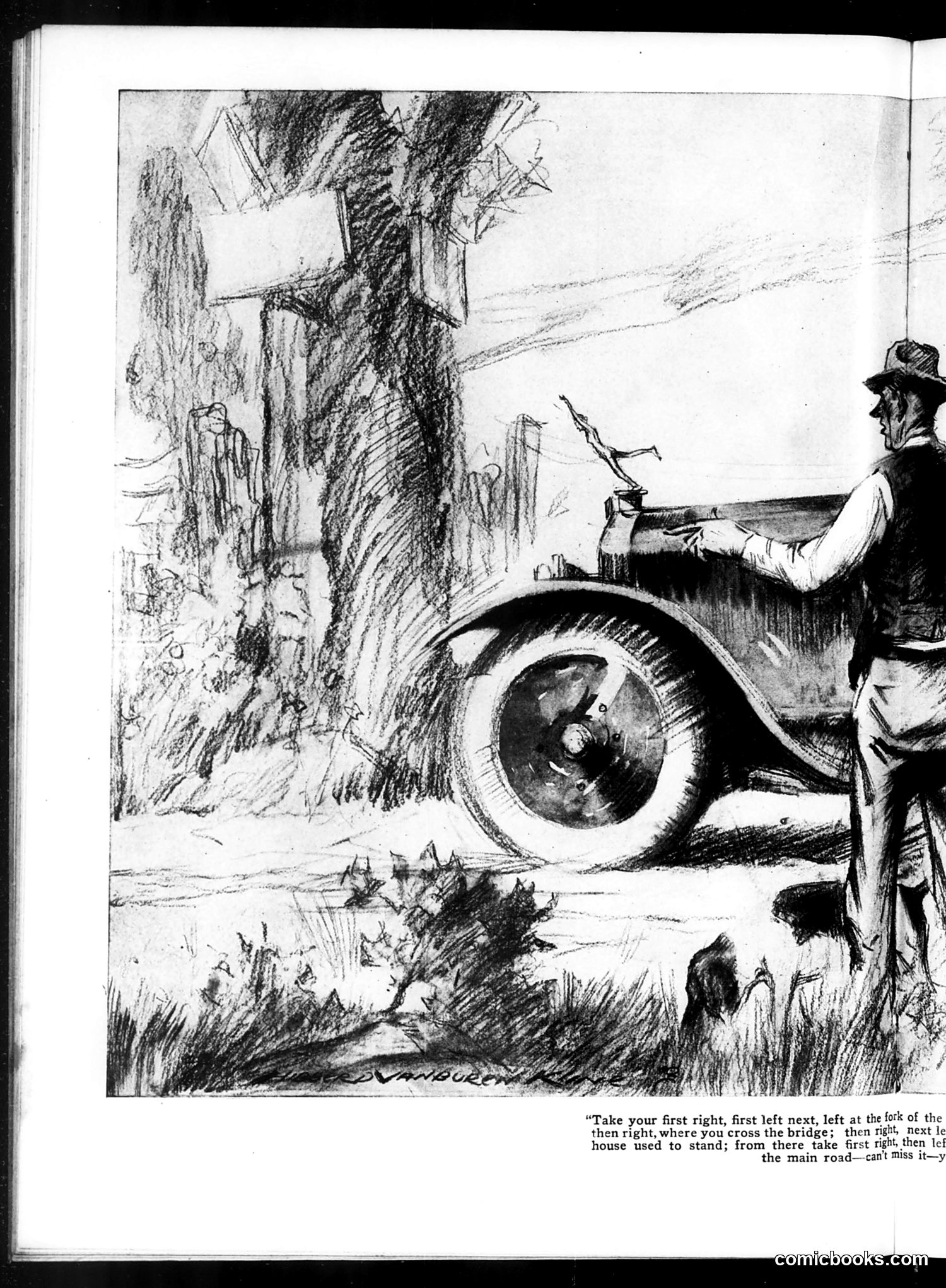
This cartoon satirizes confusing or unhelpful driving directions. A man in a car asks for directions to a location, and receives absurdly complicated instructions involving multiple turns, landmarks (a bridge, a former house location), and contradictory guidance that concludes with the dismissive phrase "can't miss it." The humor targets the universal frustration of receiving overly complex verbal directions—particularly relevant in the early automotive era before GPS or standardized road signs. The "can't miss it" conclusion is ironic, as the convoluted directions practically guarantee the driver *will* get lost. The cartoon mocks both the person giving unhelpful directions and the common human tendency to offer complicated, landmark-based navigation rather than clear, simple routes.
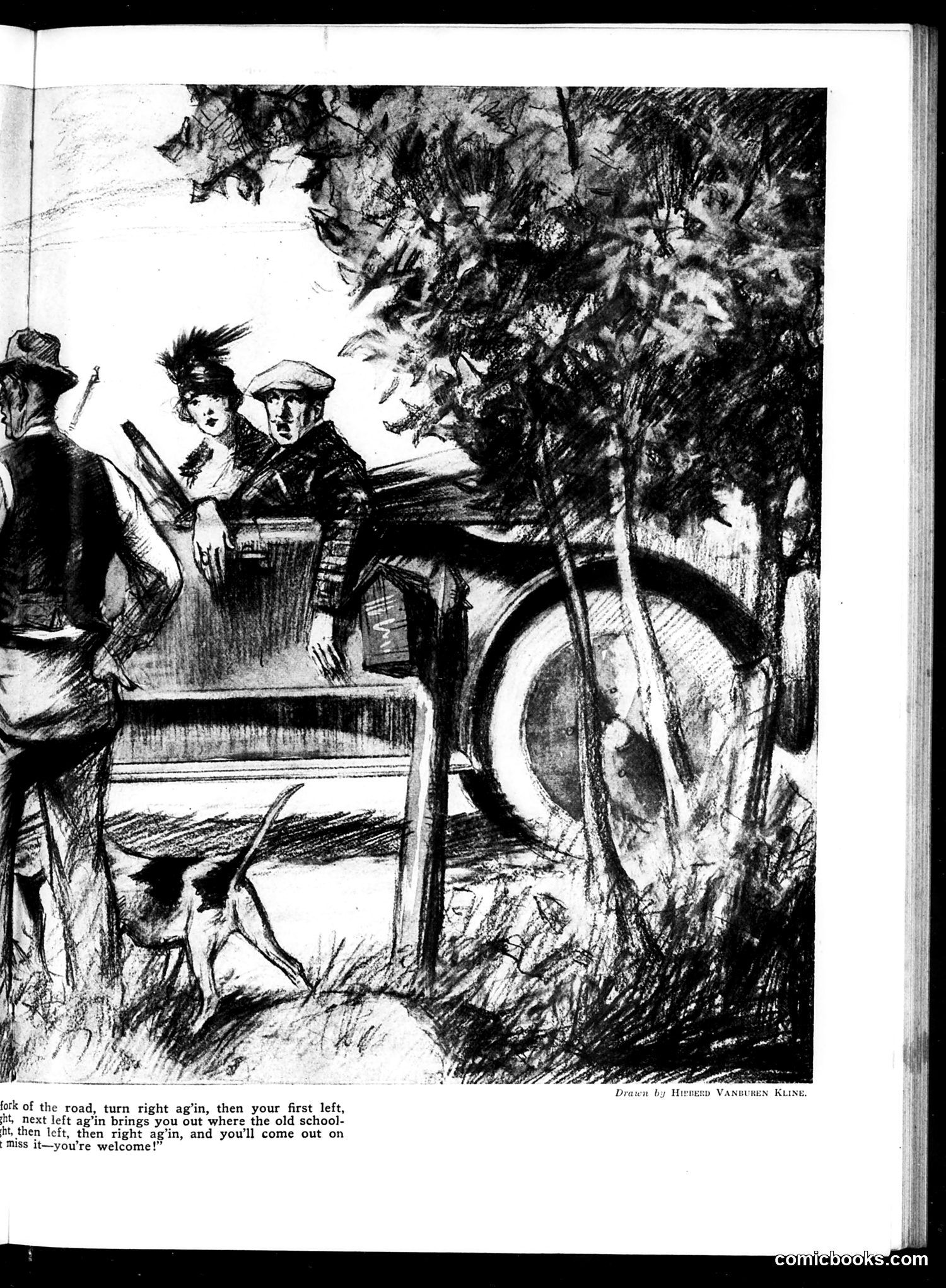
This illustration depicts a rural scene where someone is giving confusing directions to visitors in an automobile. The humor targets the difficulty of navigating country roads using verbal instructions—a genuine frustration of the early automobile era. The speaker offers contradictory turns ("right ag'in, then your first left...then left, then right ag'in"), creating an absurdly complicated path that circles back on itself. The casual confidence of the directions-giver ("you're welcome!") contrasts with their obvious unhelpfulness. This satirizes rural hospitality combined with the bewilderment of early motorists trying to travel beyond established roads. The cartoon likely resonated with *Judge*'s urban readership as commentary on the clash between automobile culture and rural America's poor infrastructure and navigation challenges.
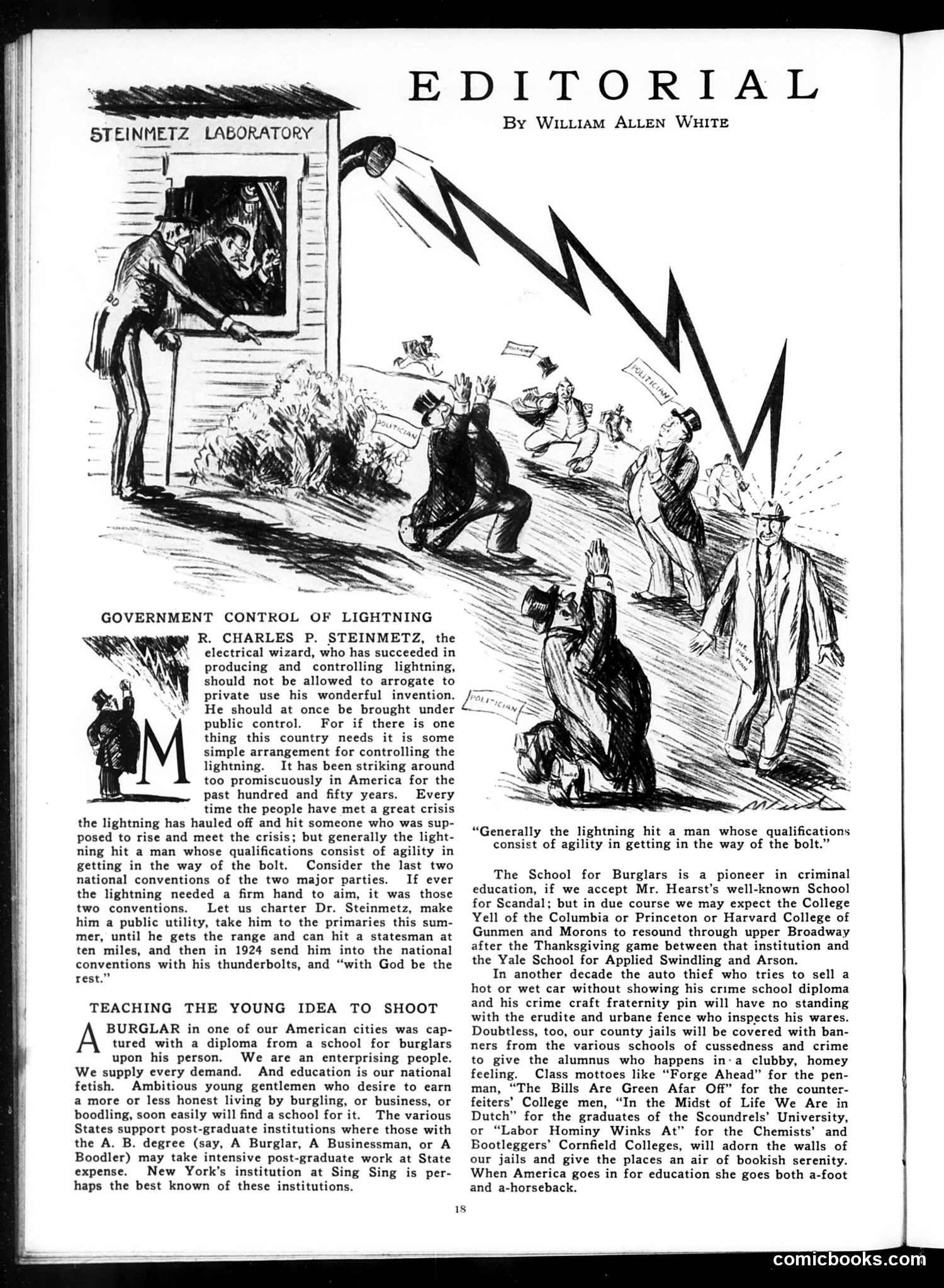
This page contains two satirical editorials by William Allen White critiquing American institutions and governance. **"Government Control of Lightning"** mocks both Thomas Edison's rival Charles P. Steinmetz (the "electrical wizard" who conducted lightning experiments) and political incompetence. White sarcastically suggests the government should commandeer Steinmetz's lightning-control technology to strike down corrupt politicians at party conventions—a dark joke implying that "lightning" (divine providence or chance) keeps hitting the wrong people at critical moments. The cartoon shows lightning bolts striking fleeing figures, likely representing bungling politicians. **"Teaching the Young Idea to Shoot"** satirizes America's institutional approach to crime and vice. White mocks the notion that criminals deserve formal "education" comparable to legitimate professions, drawing parallels between burglary schools and university systems. He extends the joke absurdly—imagining criminal fraternities, college mottos, and prison banners—to expose society's hypocrisy in criminalizing behavior while simultaneously enabling it through corrupt systems like Sing Sing prison. Both pieces use exaggeration to critique American institutional failure and moral inconsistency.
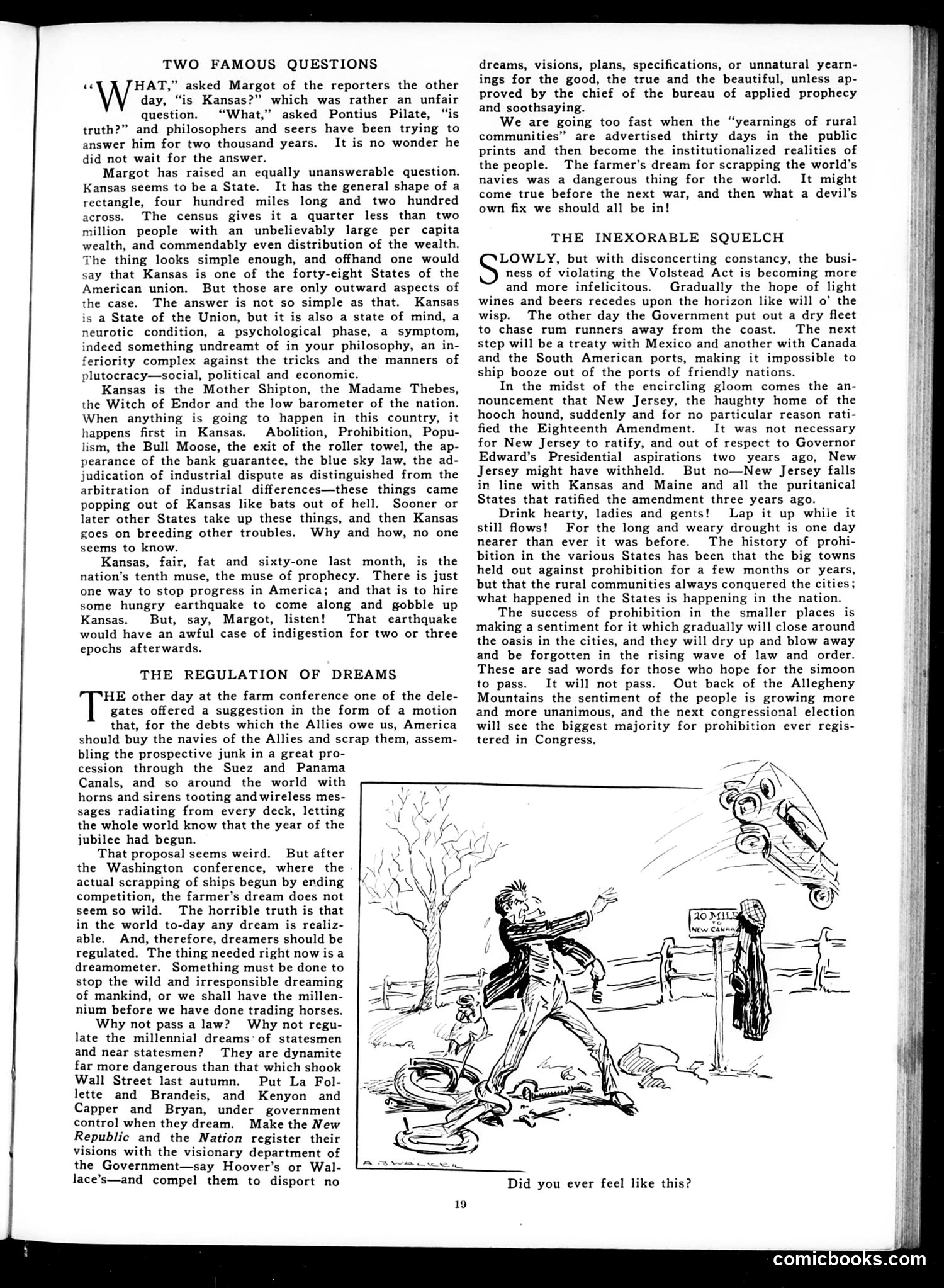
This Judge magazine page contains two satirical essays mocking contemporary American politics. **"Two Famous Questions"** compares asking "What is Kansas?" to Pontius Pilate's question about truth—both unanswerable. The author describes Kansas as a "state of mind" and "neurotic condition," claiming it's a prophetic barometer for the nation's radical movements: Abolition, Prohibition, Populism, the Bull Moose Party, and labor reforms all originated there. Kansas is portrayed as America's "muse of prophecy"—a harbinger of coming troubles. **"The Regulation of Dreams"** satirizes progressive politicians' grand schemes, likely referencing the 1921 Washington Naval Conference where nations agreed to scrap warships. The author mockingly suggests that idealistic dreamers like La Follette, Brandeis, Kenyon, Capper, and Bryan should be government-regulated to prevent dangerous "millennial dreams" from destabilizing society. The cartoon shows a man overwhelmed by impossible schemes. Both pieces lampoon progressive reformers and Kansas's reputation for radical political movements.
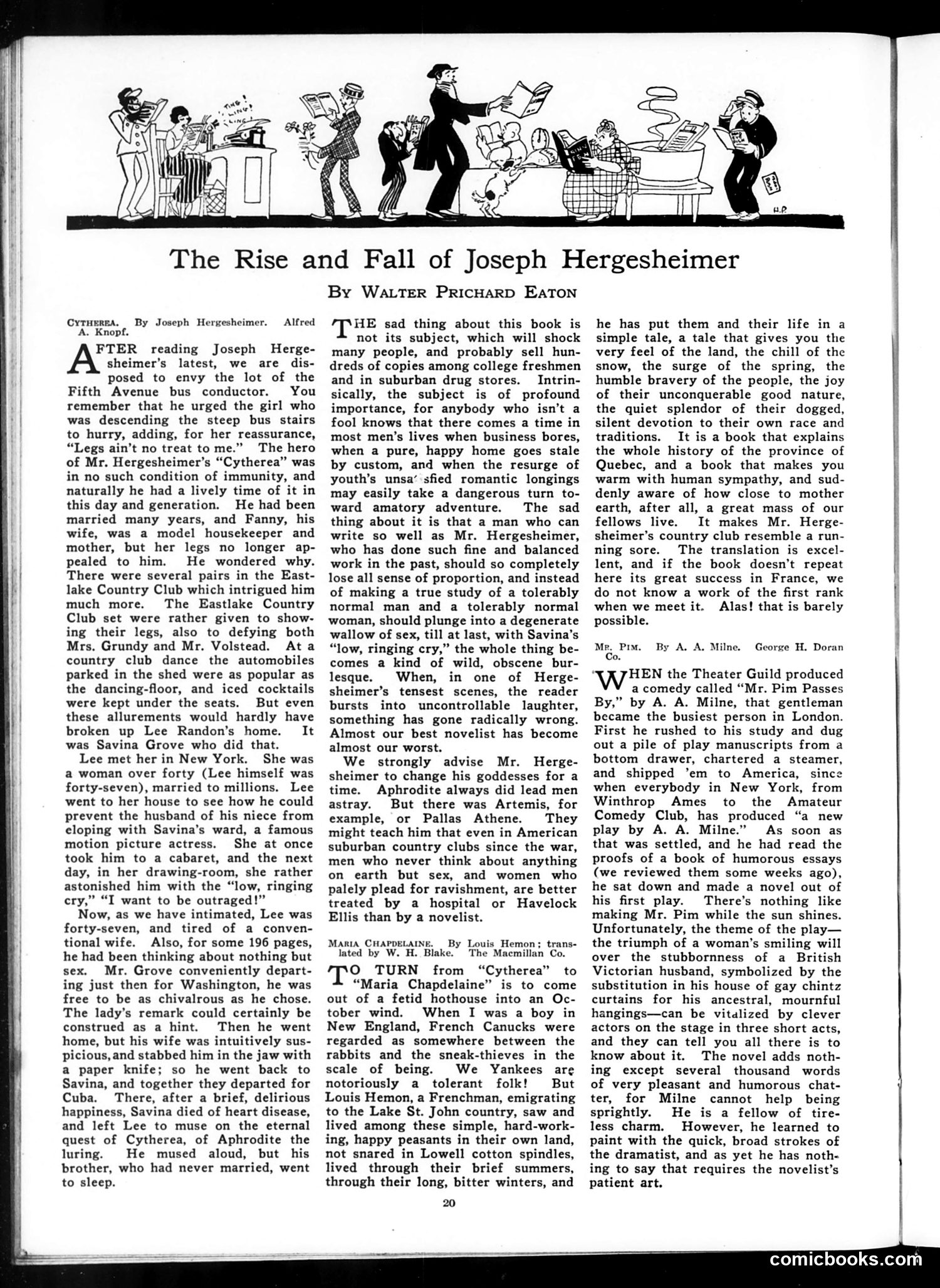
This is a literary review by Walter Prichard Eaton of novelist Joseph Hergesheimer's book *Cytherea*. The top illustration depicts the chaotic domestic and social consequences of the novel's plot. The review criticizes Hergesheimer for abandoning his earlier literary skill to write what amounts to sexual melodrama. The protagonist abandons his wife for a wealthy older woman (Savina) after meeting her in New York nightlife. The reviewer acknowledges that male midlife restlessness is a legitimate subject, but argues Hergesheimer has reduced it to "degenerate wallow of sex"—so exaggerated it becomes unintentionally comic rather than serious art. The review references "Mr. Grundy and Mr. Volstead," evoking Victorian propriety and Prohibition-era hypocrisy. The cartoon shows the book's chaos: marital breakdown, infidelity, and social disorder. Eaton suggests Hergesheimer trade the goddess Aphrodite (sexual desire) for Artemis (chastity/restraint), lamenting that "almost our best novelist has become almost our worst."
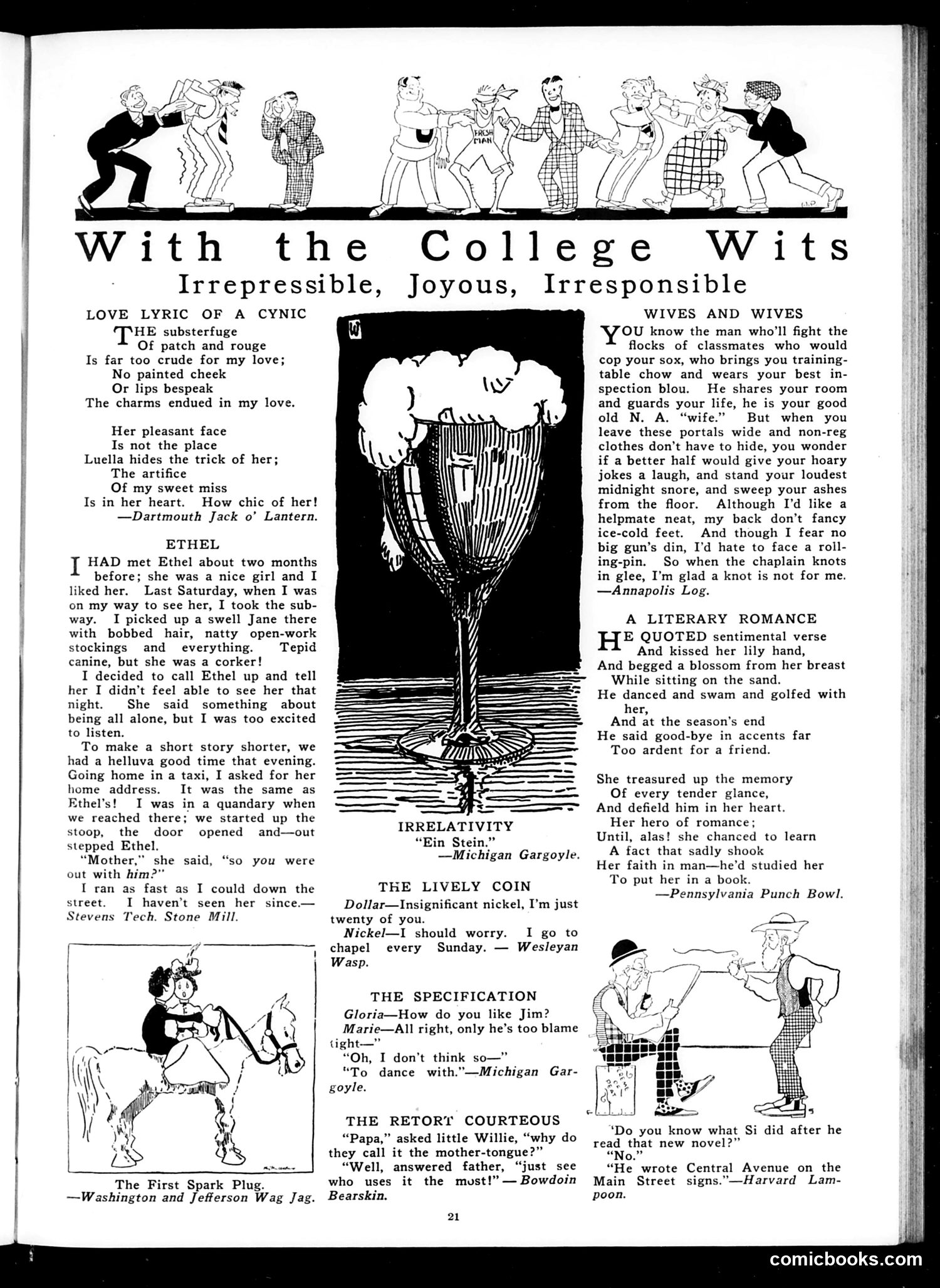
This page collects humorous short stories and jokes from college humor magazines, typical of Judge's "College Wits" feature showcasing witty undergraduate submissions. **Key Content:** The main narrative "Ethel" depicts a young man who abandons his girlfriend to pursue an attractive woman on the subway—only to discover she's Ethel's mother, resulting in embarrassing exposure. **Social Context:** The humor reflects 1920s college dating norms: casual infidelity, the shock of "bobbed hair" (modern women), and the comedic comeuppance of male irresponsibility. The "A Literary Romance" satirizes pretentious courtship behavior and artistic exploitation. **Other Items:** Brief jokes about college life (dancing, chapel, money, language) submitted by various universities. These reflect era-specific concerns: wealth distinctions ("tight" = stingy), institutional religion, and gender dynamics. The overall tone treats romance and relationships as material for cynical, slapstick humor typical of 1920s college culture.
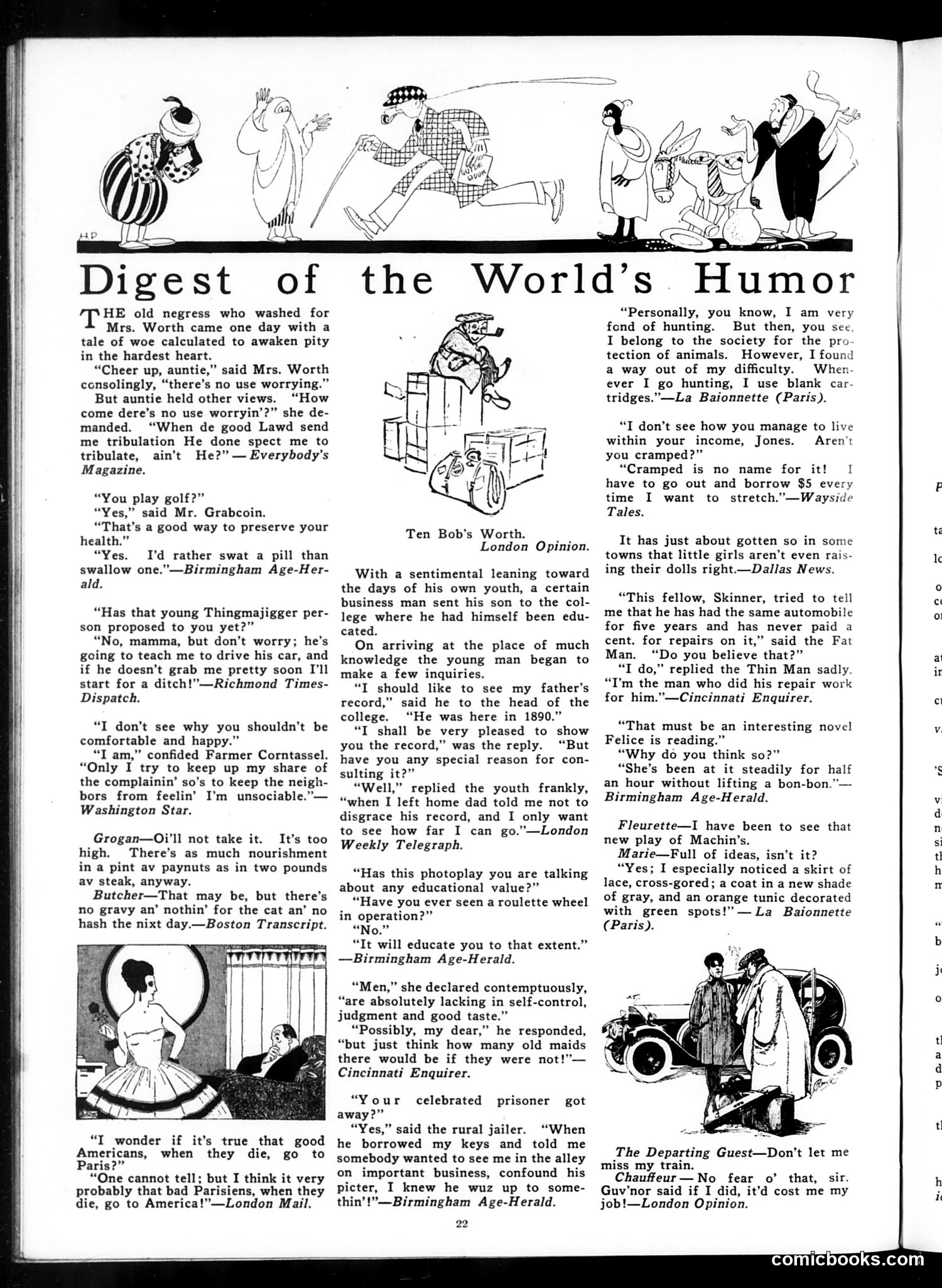
This page collects short jokes and quips from various sources, organized as a "humor digest." The cartoons at the top illustrate the comedic theme with exaggerated character types engaged in absurd situations. The content reflects early-20th-century American attitudes and concerns: - **Class/wealth humor**: Golf as a rich man's pursuit; financial struggles of the working class - **Gender dynamics**: Women pursuing marriage and driving cars (contemporary novelties); men lacking self-control - **Racial stereotypes**: The opening piece features offensive dialect humor about a Black washerwoman—typical of the era's casual racism - **Automobiles**: New technology generating both fascination and anxiety (reckless driving) - **Educational cynicism**: A college student expects to surpass his father's academic record The sourcing from international publications (*La Baionnette*, *London Opinion*) shows Judge's aspirations as a cosmopolitan satirical magazine. The humor relies on wordplay, social observation, and gentle mockery of modern life rather than sharp political critique.
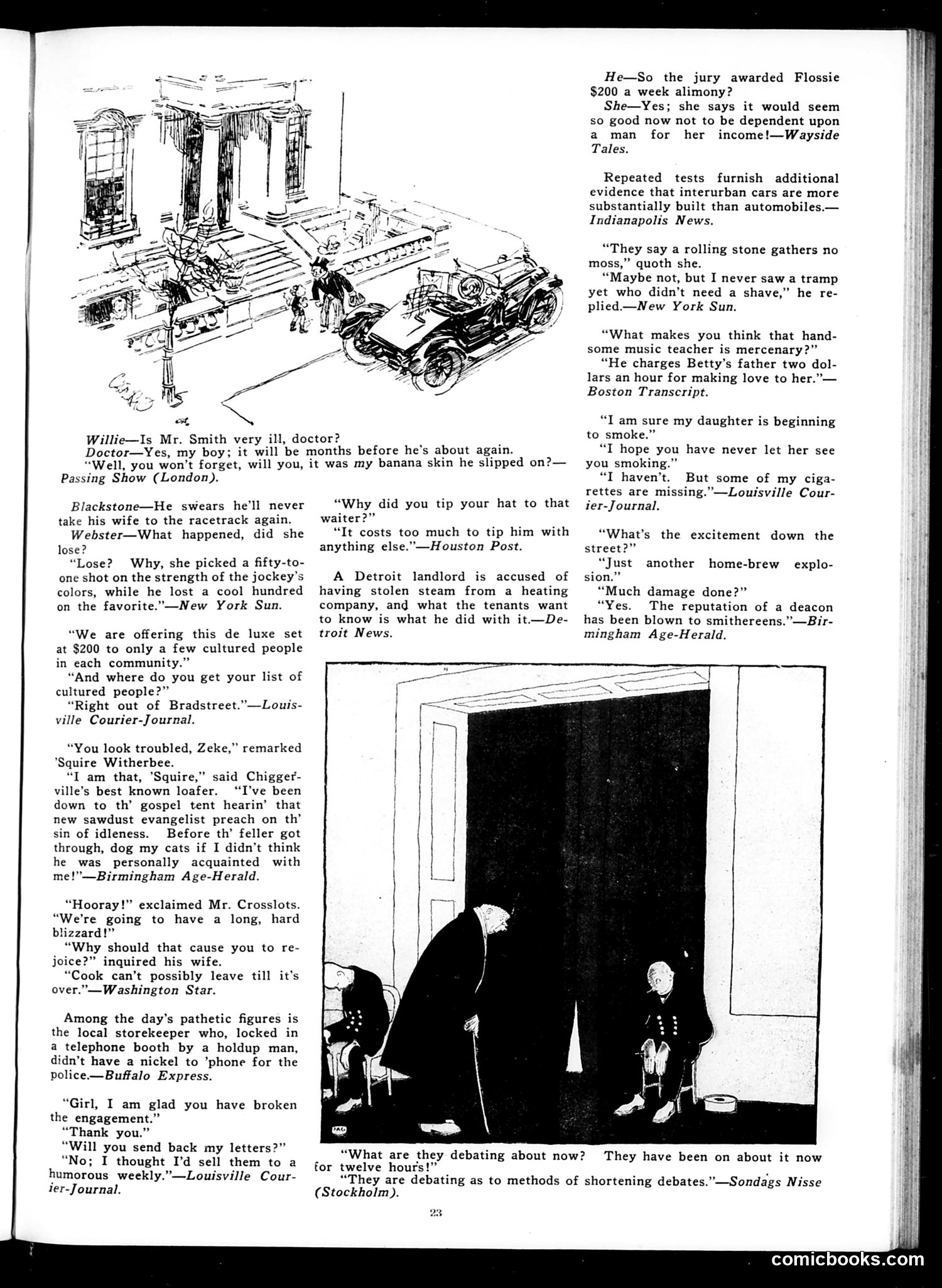
This page from Judge contains a collection of brief humorous anecdotes and one cartoon, all satirizing early 20th-century American social foibles. **The cartoon** (lower right) depicts two figures in silhouette debating endlessly—a visual joke about parliamentary inefficiency, sourced from a Stockholm publication. **The jokes target various targets:** - **Marital discord**: wives losing money at the racetrack; husbands dreading servants leaving during blizzards - **Class pretension**: marketing "luxury" goods to people from Bradstreet's credit list (implying the supposedly "cultured" are actually just the wealthy/creditworthy) - **Hypocrisy**: an evangelist preaching against idleness to a self-identified loafer; a deacon's reputation destroyed by home-brew explosion - **Economic absurdity**: a landlord stealing steam; someone tipping a waiter with a hat to avoid paying cash - **Prohibition-era humor**: "home-brew explosion" references illegal alcohol production The recurring theme is gap between appearance and reality—what people claim versus what they do, revealing middle-class anxieties about social status, morality, and changing economic conditions.
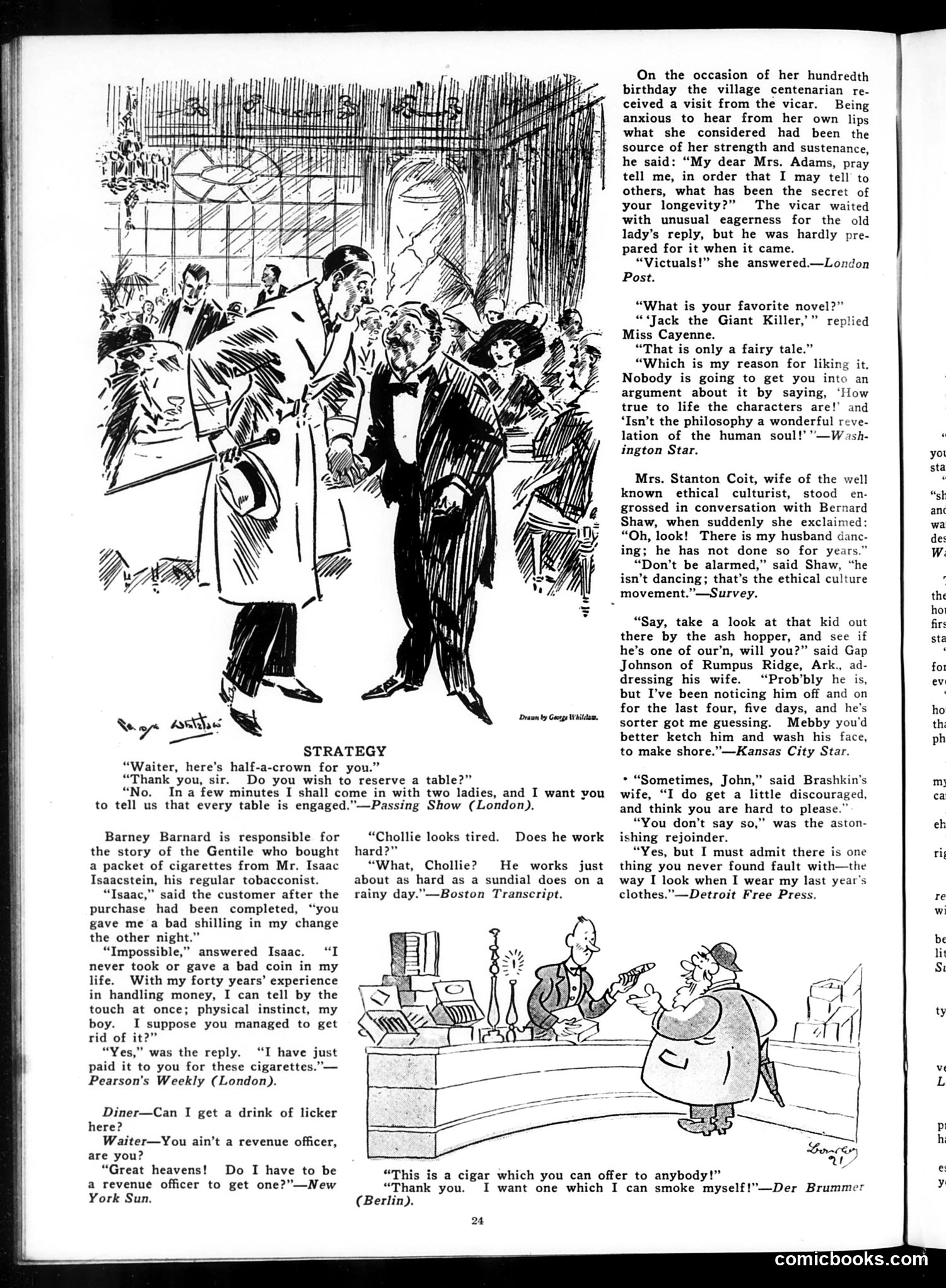
This page contains several short humorous anecdotes and two cartoons satirizing early 20th-century social customs and human nature. **The "Strategy" cartoon** (top) depicts a man bribing a waiter to claim all tables are full, enabling him to appear popular by arriving with two ladies. The joke mocks social pretense and the lengths people go to impress others. **The lower cartoon** shows a cigar vendor offering inferior cigars to customers while keeping better ones for himself—satirizing commercial dishonesty and hypocrisy. The accompanying text jokes target various targets: Jewish merchants stereotyped as shrewd; class-conscious dinner etiquette; a centenarian's simple wisdom (attributed to "victuals"); Bernard Shaw (the famous playwright, suggesting intellectualism); and marital discord. Most reflect period anxieties about **authenticity versus social performance**, **commercial fraud**, and **class pretension**. The humor relies heavily on ethnic and gender stereotypes common to early Judge content.
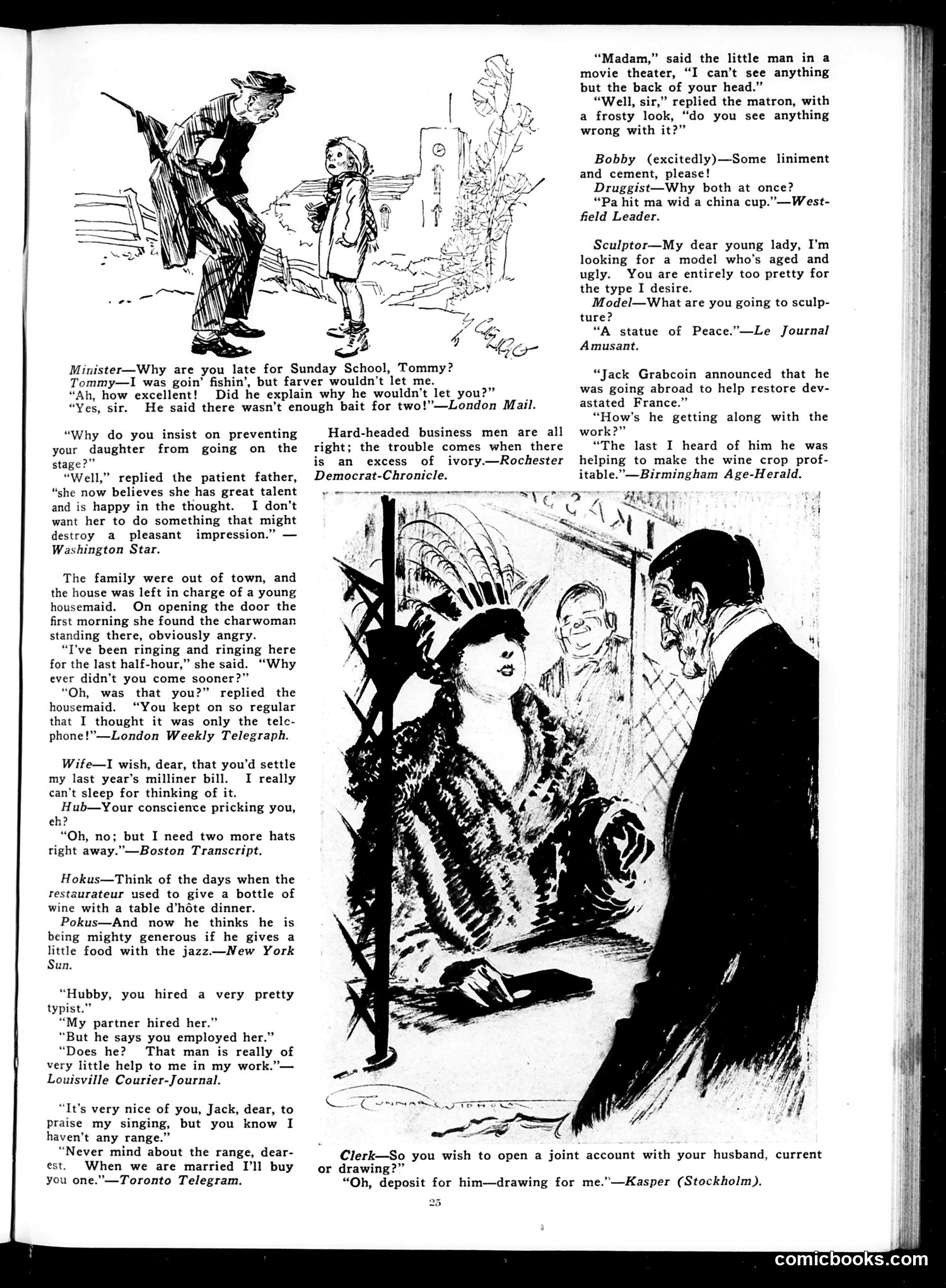
This page collects short humorous anecdotes and jokes typical of early 20th-century American humor. Key themes include: **Marriage & Gender**: Multiple jokes about wives' spending habits (milliner bills, hats) and husbands' financial frustrations—reflecting period anxieties about women's consumer culture and marital finances. **Class & Labor**: A joke about a "pretty typist" reflects workplace dynamics and potential impropriety of attractive female employees in business settings. **WWI Reference**: A joke mentions "Jack Grabcoin" going to "help restore devastated France" but actually profiting from wine—satirizing war profiteering and questionable patriotism during/after WWI. **Theater & Performance**: A father prevents his daughter from pursuing stage acting, fearing she'll discover she lacks actual talent—mocking amateur theatrical aspirations. The cartoons and text target common social pretensions: false talent, marital discord over money, workplace flirtation, and wartime opportunism. The humor relies on recognizing these as universal domestic and social frustrations of the era.
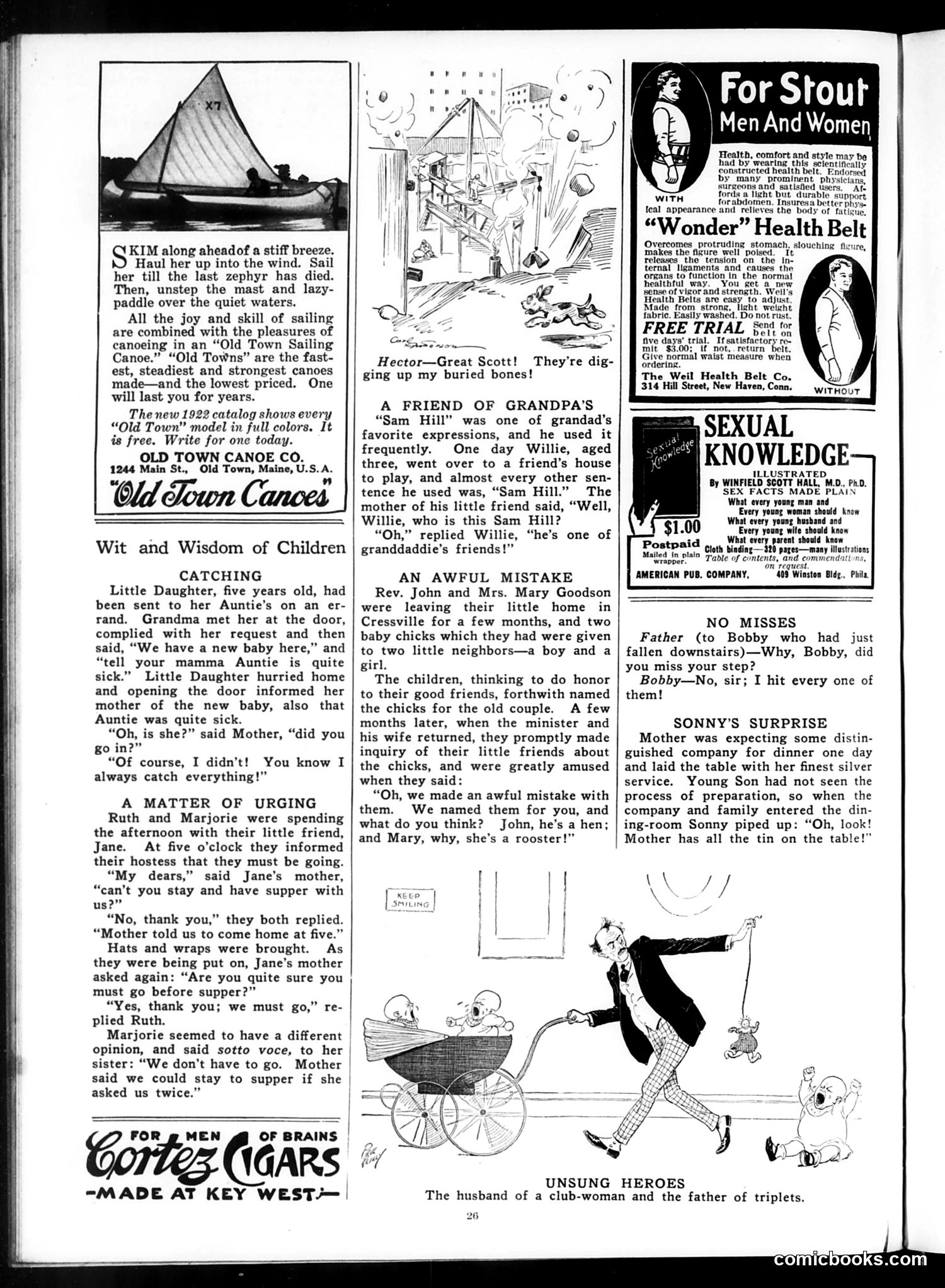
This is primarily a **humor and advertising page** from Judge magazine's "Wit and Wisdom of Children" section, containing several short anecdotes about children's innocent misunderstandings: **Main Content**: Four brief humorous stories exploiting children's literal-mindedness and misinterpretations—a girl who "always catches everything" (misunderstanding illness), children testing parental obedience rules, a boy confusing his grandfather's friend "Sam Hill" with an actual person, and children unknowingly naming baby chicks after a reverend couple, only to discover gender mismatches. **Advertisements**: The page includes product ads for Old Town Canoes, Wonder Health Belt (a corset-like garment for women), a sexual knowledge book, and Cortez Cigars. The health belt ad reflects period anxieties about women's figures and posture. **Satirical Point**: These anecdotes gently mock both children's logical naïveté and, implicitly, adult society's arbitrary conventions around propriety, obedience, and social expectations. The humor depends on readers recognizing how children's direct interpretations expose the absurdity of adult rules.
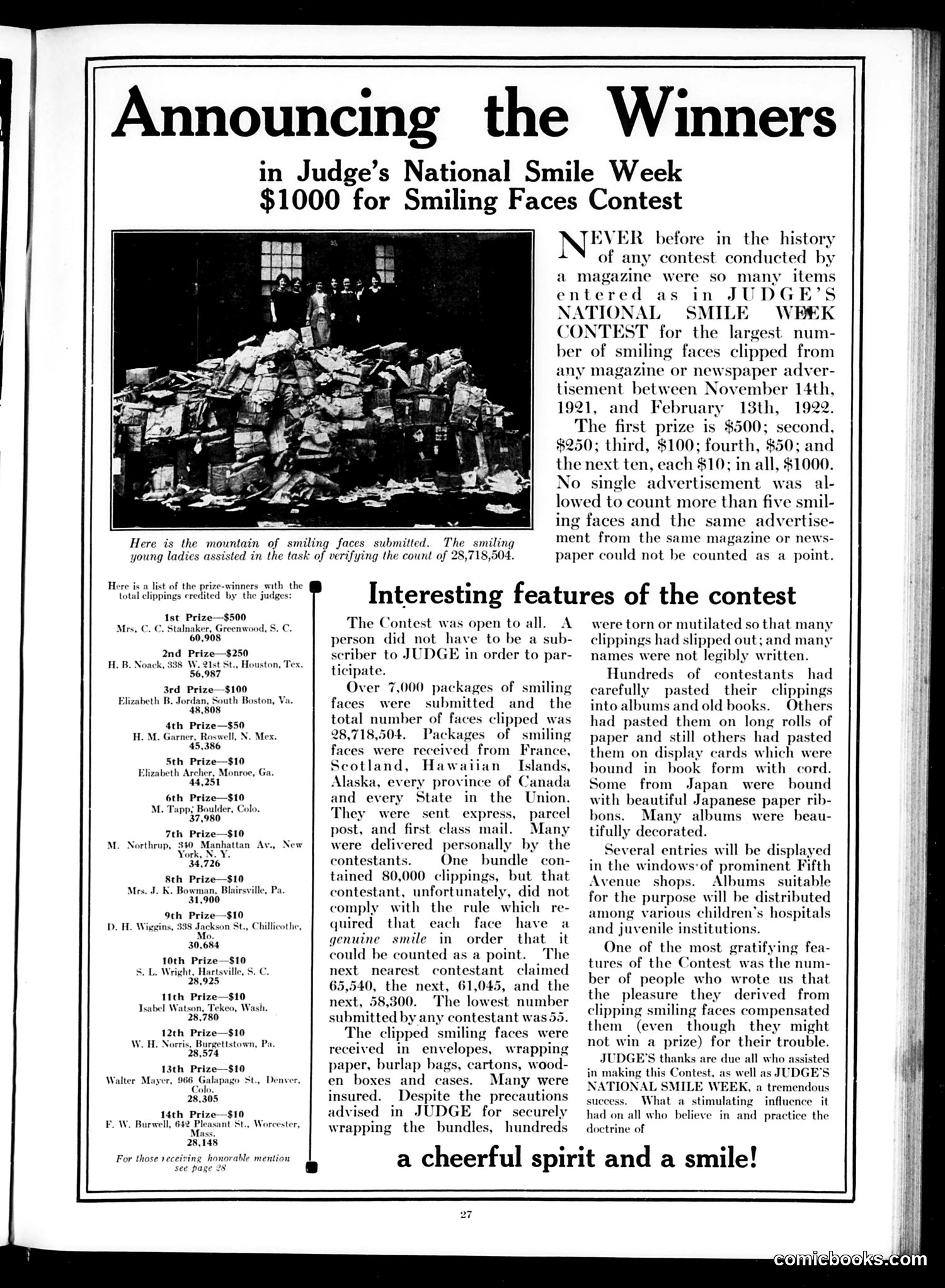
This is primarily a *results announcement* rather than a cartoon or satirical content. Judge magazine ran a 1921-1922 contest asking readers to clip smiling faces from advertisements. The page announces winners and describes the contest's scope: over 7,000 entries, nearly 29 million clipped faces submitted from six continents. The central image shows a literal "mountain" of clippings—a photograph of the physical pile of submissions, with staff members standing atop it. This demonstrates the contest's massive, almost absurd scale, which itself serves as light humor. The contest reflects 1920s American culture: magazines engaged readers through participatory contests, and the emphasis on "smiling faces" and cheerfulness aligned with post-WWI optimism and advertising's growing reliance on aspirational imagery. The page essentially celebrates both Judge's reach and the earnest engagement of ordinary Americans in this unusual collecting enterprise.
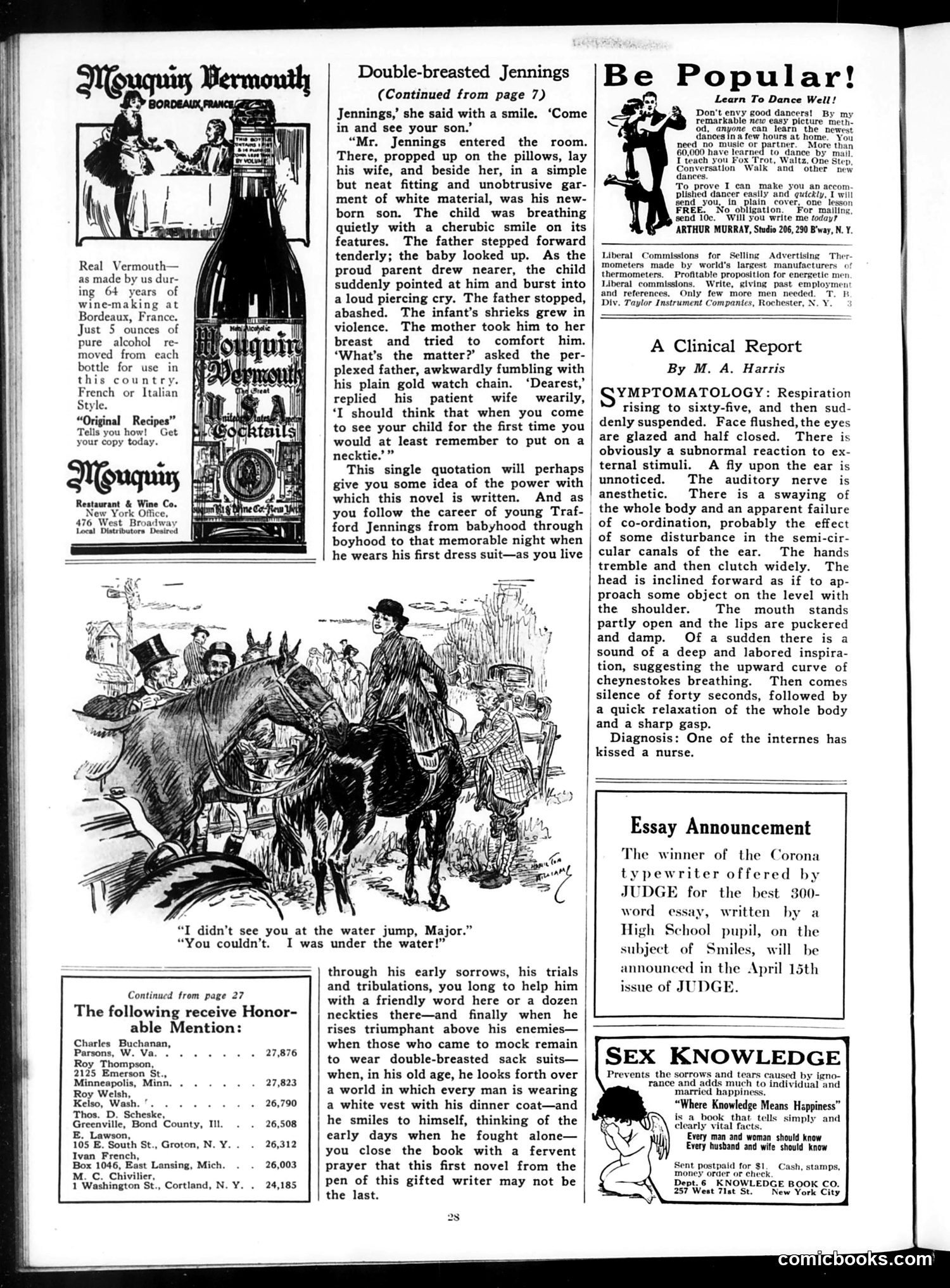
This page primarily contains **literary serialization and advertising** rather than political satire. The main narrative, "Double-breasted Jennings" (continued from previous page), is a humorous domestic story about a newborn who cries at his father—the joke being the infant rejects him because he's not wearing a necktie. The story promises to follow the character through life's struggles, with recurring emphasis on formal dress codes and social propriety. The cartoon at bottom shows two men on horseback at a water jump; one claims he didn't see the other there because "I was under the water"—a visual gag about falling during the jump. The page also features: - A **Moquin Vermouth advertisement** (emphasizing French authenticity) - Honor roll listings (appears to be contest winners) - Dance instruction ads - A "Clinical Report" (likely humorous medical content) The satire here is **gentle, domestic humor** rather than political commentary—poking fun at social conventions around dress and parenting rather than addressing contemporary political issues.
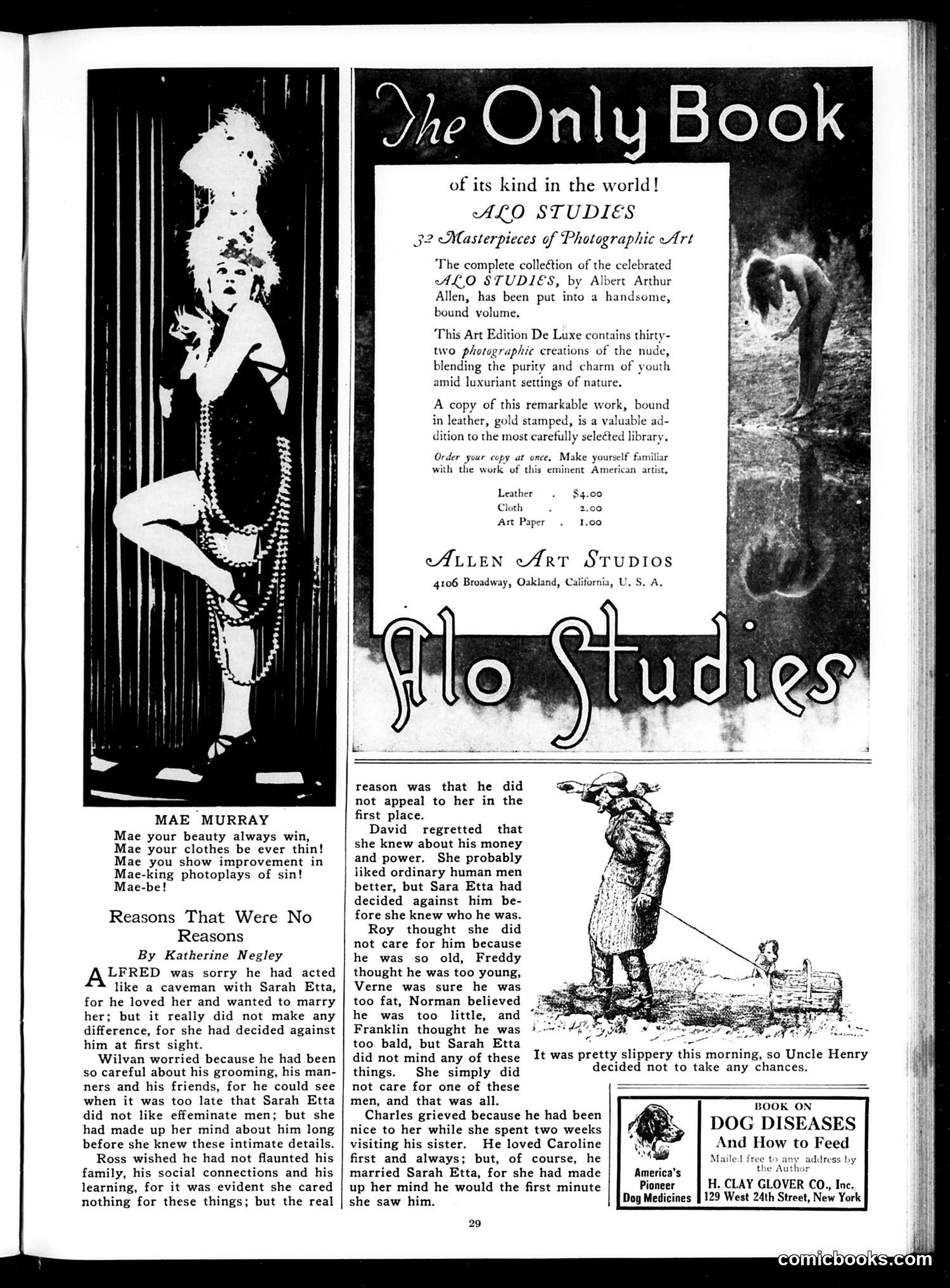
This is a **Judge magazine page** mixing advertising with a humorous short story. The main content is Katherine Negley's satirical story "Reasons That Were No Reasons," which mocks men's contradictory anxieties about courtship. Multiple suitors—Alfred, Wilvan, Ross, Roy, Freddy, Verne, Norman, Franklin, Charles—each **obsess over different reasons why Sarah Etta rejected them**: one worries he was too rich/powerful, another too fastidious, another too boastful. But the joke's punchline is simple: **she simply didn't like them. Period.** The satire exposes male vanity and self-centered thinking—men assume rejection stems from something *they* did wrong, when often romantic attraction simply doesn't exist. It's a critique of misogyny dressed as humor: men think their self-improvement matters, but women's basic preferences are irrelevant to the story. The page also includes advertisements for "Alo Studies" (art photography of nudes) and dog medicines—typical of Judge's mixed commercial content. The Mae Murray photo/caption is unrelated celebrity promotion.
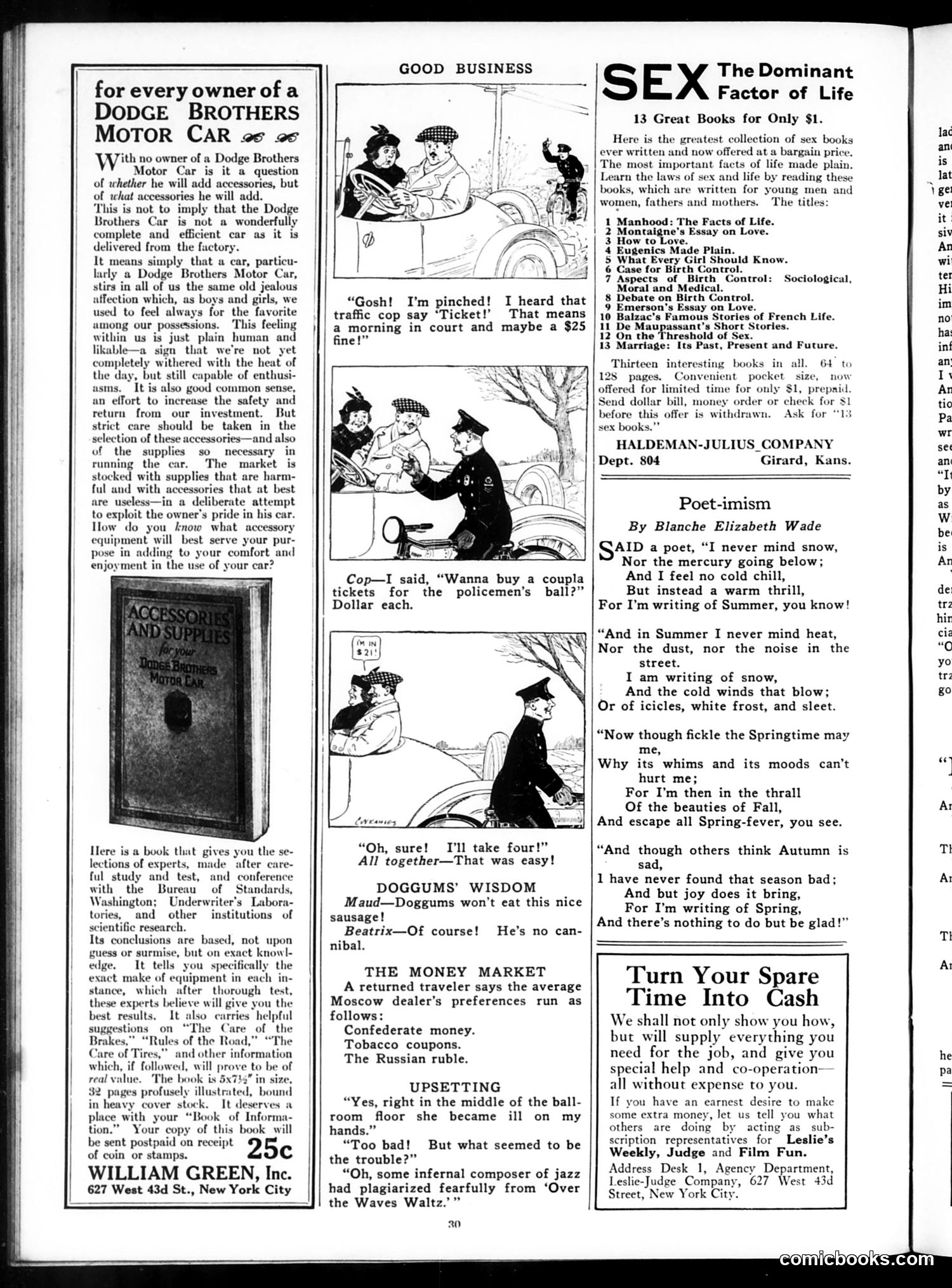
This page contains several distinct satirical sections from *Judge* magazine: **"Good Business" cartoon**: A motorist is stopped by a traffic cop and thinks he's getting ticketed for a traffic violation (facing a $25 fine). The joke's punch line: the cop is actually selling raffle tickets for a policemen's ball at a dollar each. The satire targets police corruption—suggesting officers abuse their authority to hustle citizens for money under the guise of official business. **Other jokes** mock trivial social concerns: a dog refusing sausage (cannibalism joke), Moscow's economic collapse (Confederate money and tobacco coupons preferred over the ruble—reflecting post-revolutionary Russian instability), and a woman fainting at a jazz composition plagiarizing "Over the Waves." **Advertisements** dominate the page: Dodge Brothers automobiles, a book on car maintenance, and prominently, a mail-order collection of 13 "sex education" books for $1—typical of early-20th-century correspondence courses marketed to the curious or uninformed. The overall tone reflects 1920s-era anxieties about modernity, authority, and changing social values.
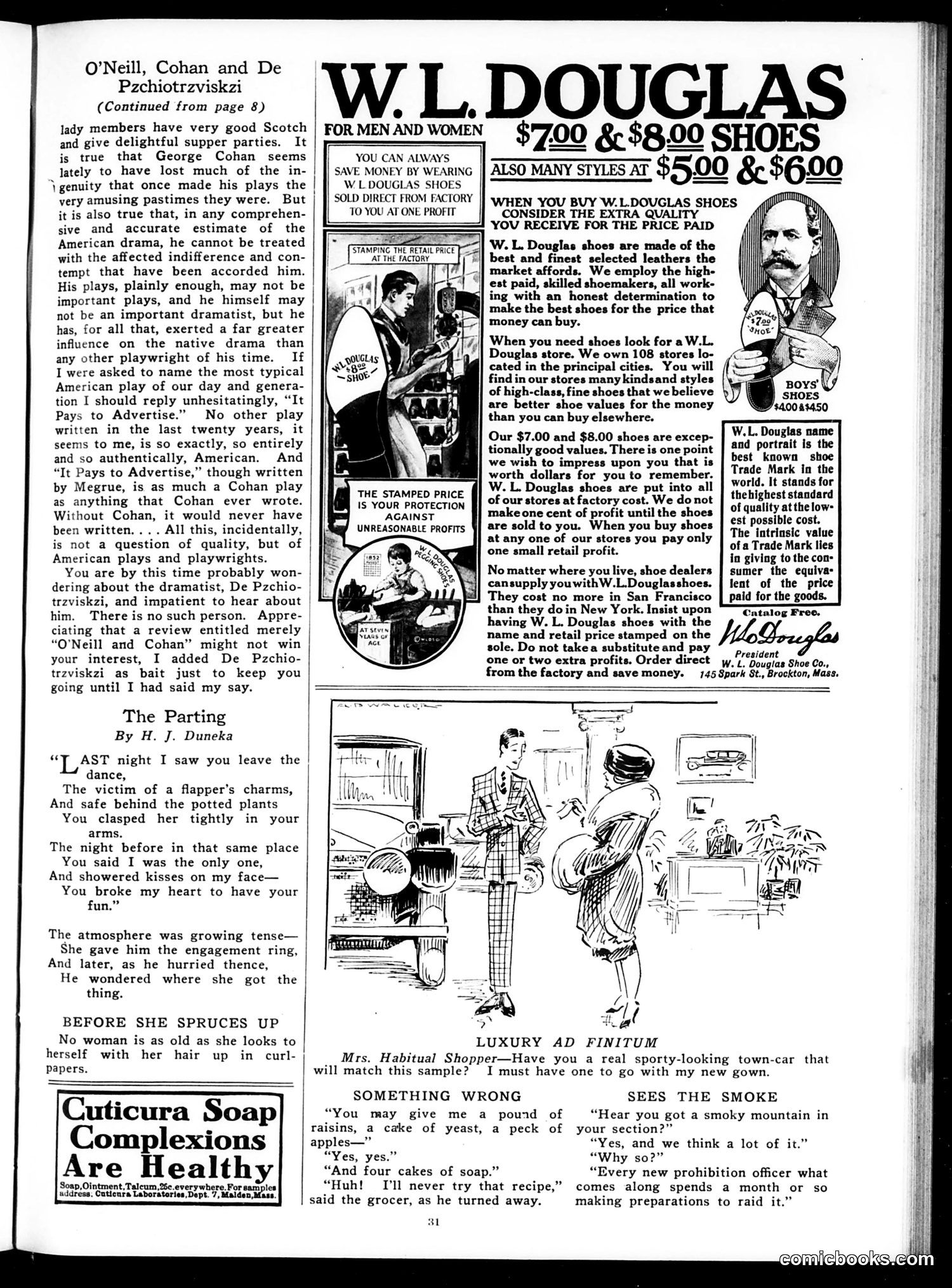
This page combines literary content with advertising. The main article continues a theater criticism piece about American playwrights O'Neill and Cohan, with a humorous reveal: the author invented a fake Polish-sounding name ("De Pzchiotrzviskzi") as clickbait to keep readers engaged—a tongue-in-cheek joke about editorial manipulation. "The Parting," a poem by H.J. Duneka, satirizes 1920s dating culture and "flappers" (young, modern women). It depicts a man two-timing women at a dance, receiving an engagement ring from one while claiming exclusive devotion to another—mocking both his duplicity and the era's changing courtship norms. The advertisements (W.L. Douglas shoes, Cuticura Soap) are period-typical. A small joke section includes domestic humor: a grocer's absurd recipe suggestion and a society woman's anxiety about finding a matching car for her new dress—mild satire of consumerism and upper-class concerns.
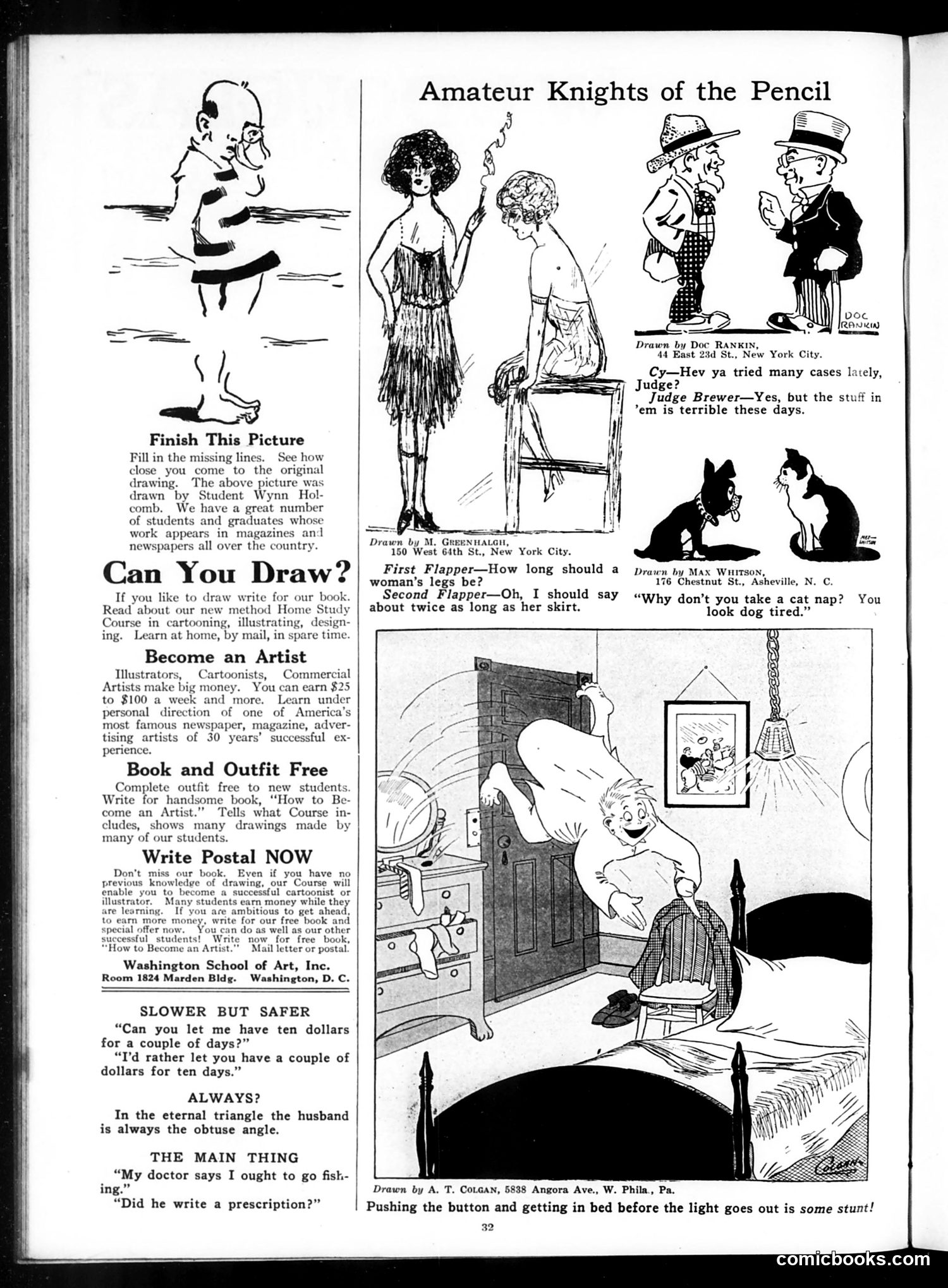
This page mixes advertisements with humor cartoons. The left side advertises the Washington School of Art's correspondence course, targeting aspiring cartoonists with promises of high earnings ($25-$100 weekly). The "Amateur Knights of the Pencil" section contains brief jokes: a judge complains modern court cases contain poor evidence; flappers discuss ideal leg length relative to skirt hemlines (referencing 1920s fashion); and a domestic joke about rushing to bed before an electric light switches off. The bottom cartoon depicts a woman struggling to flip a light switch and leap into bed before darkness—a "stunt" referencing the era's newfound electric lighting and the childish game of racing to bed before lights extinguish. These cartoons reflect 1920s concerns: modern technology (electricity), changing women's fashion (flappers, shorter skirts), and contemporary humor about domestic life and courtroom efficiency. The overall page blends instructional advertising with light social satire typical of Judge's satirical style.
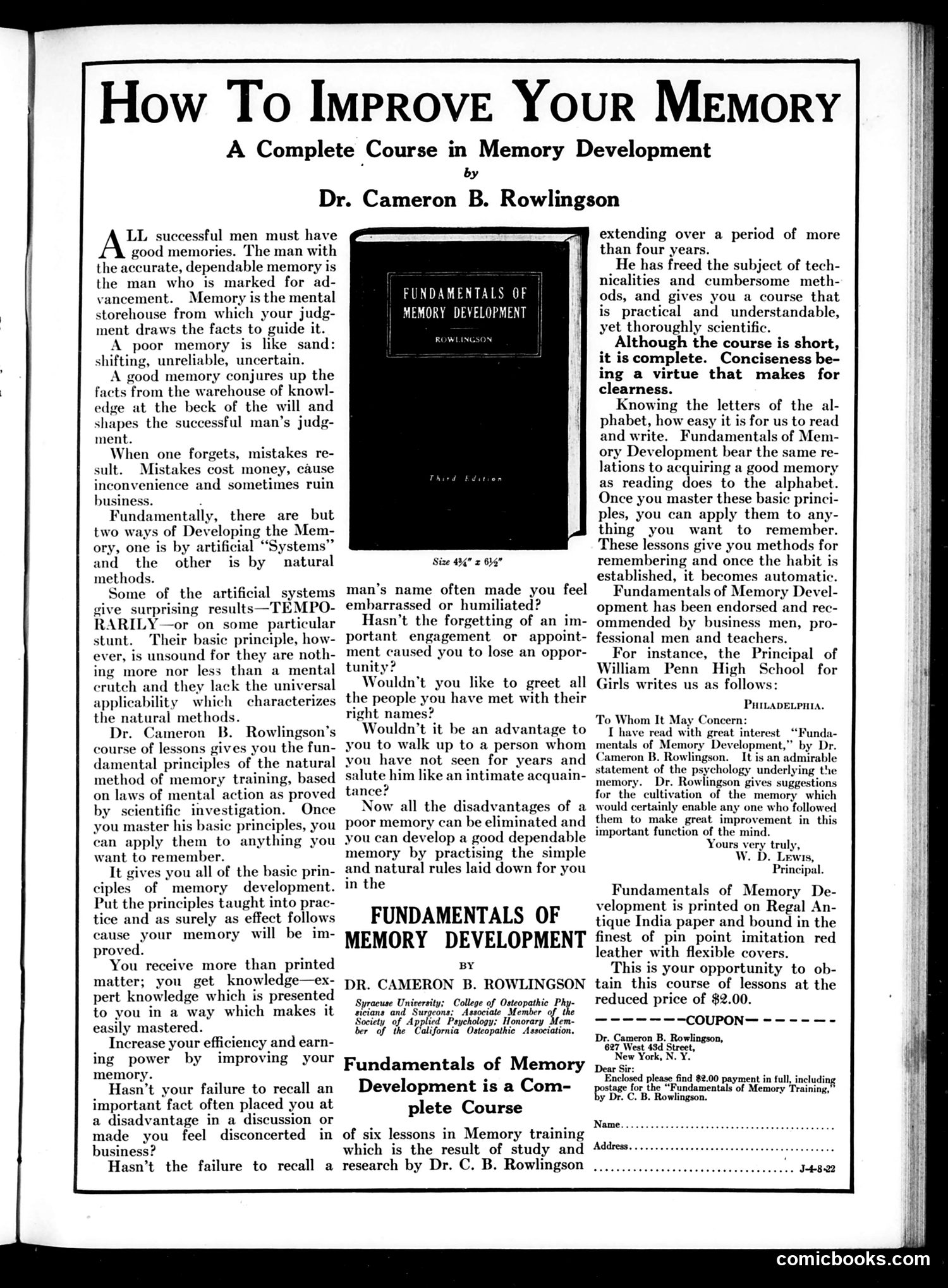
This page is primarily **advertising copy**, not satire or political commentary. It promotes Dr. Cameron B. Rowlingson's mail-order memory-improvement course, "Fundamentals of Memory Development." The content reflects early-20th-century self-help marketing: promises that improved memory will boost business success, social confidence, and earning power. The repeated rhetorical questions ("Hasn't your failure to recall...?") are classic advertising techniques designed to make readers feel inadequate, then offer salvation through purchase. The book image shown uses period typography and professional binding to suggest legitimacy. An endorsement letter from "W. D. Lewis, Principal" of William Penn High School (Philadelphia) adds credibility—a common marketing tactic. **For modern readers**: This represents the era's emergence of commercial self-improvement culture and psychological pseudoscience marketed as scientific fact. The promises ("develop a good dependable memory") remain familiar in today's productivity and self-help industries, though the approach seems quaintly earnest compared to modern advertising. There is **no political cartoon or satire** visible here.
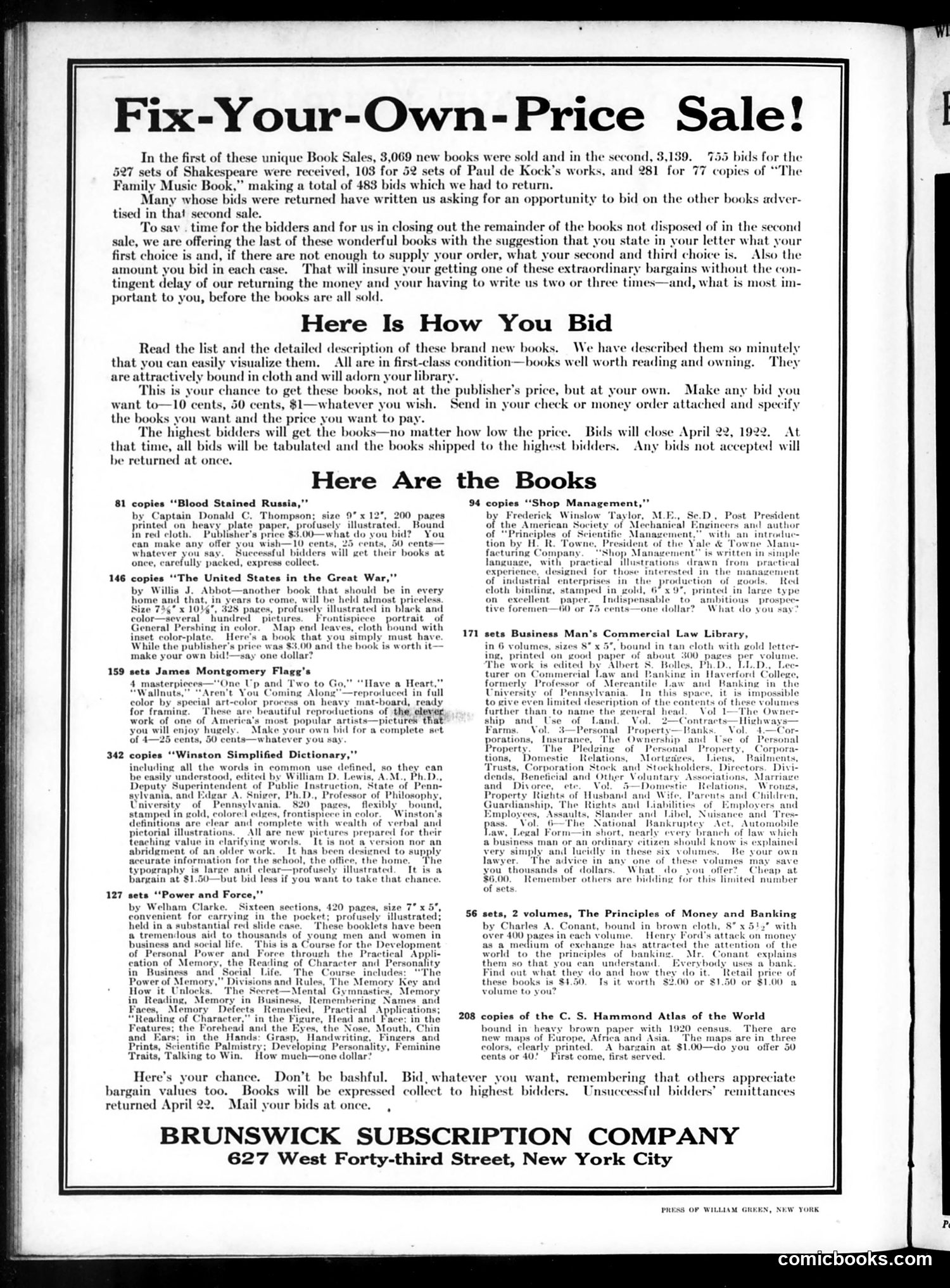
This is primarily a **book auction advertisement**, not a cartoon or satirical content. The page announces a "Fix-Your-Own-Price Sale" by the Brunswick Subscription Company (New York), where customers could bid whatever they wished for discounted books. **Key details:** - Previous auctions sold 3,069 books with hundreds of bids received - This sale offers books including Shakespeare sets, "The United States in the Great War" by Willis J. Abbott, and business/management texts - Bidding closes April 22, 1922 - Customers submit sealed bids; highest bidders receive books at their offered prices **The appeal:** This was a direct-mail marketing strategy targeting readers during the post-WWI period, offering classic literature and practical business books at competitive prices—essentially allowing customers to name their own price, a novel sales tactic for 1922. There is **no political cartoon or satire visible** on this page; it is straightforward commercial advertising.