
Judge, 1922-04-08 · page 9 of 36
Judge — April 8, 1922 — page 9: what you’re looking at
What you’re looking at
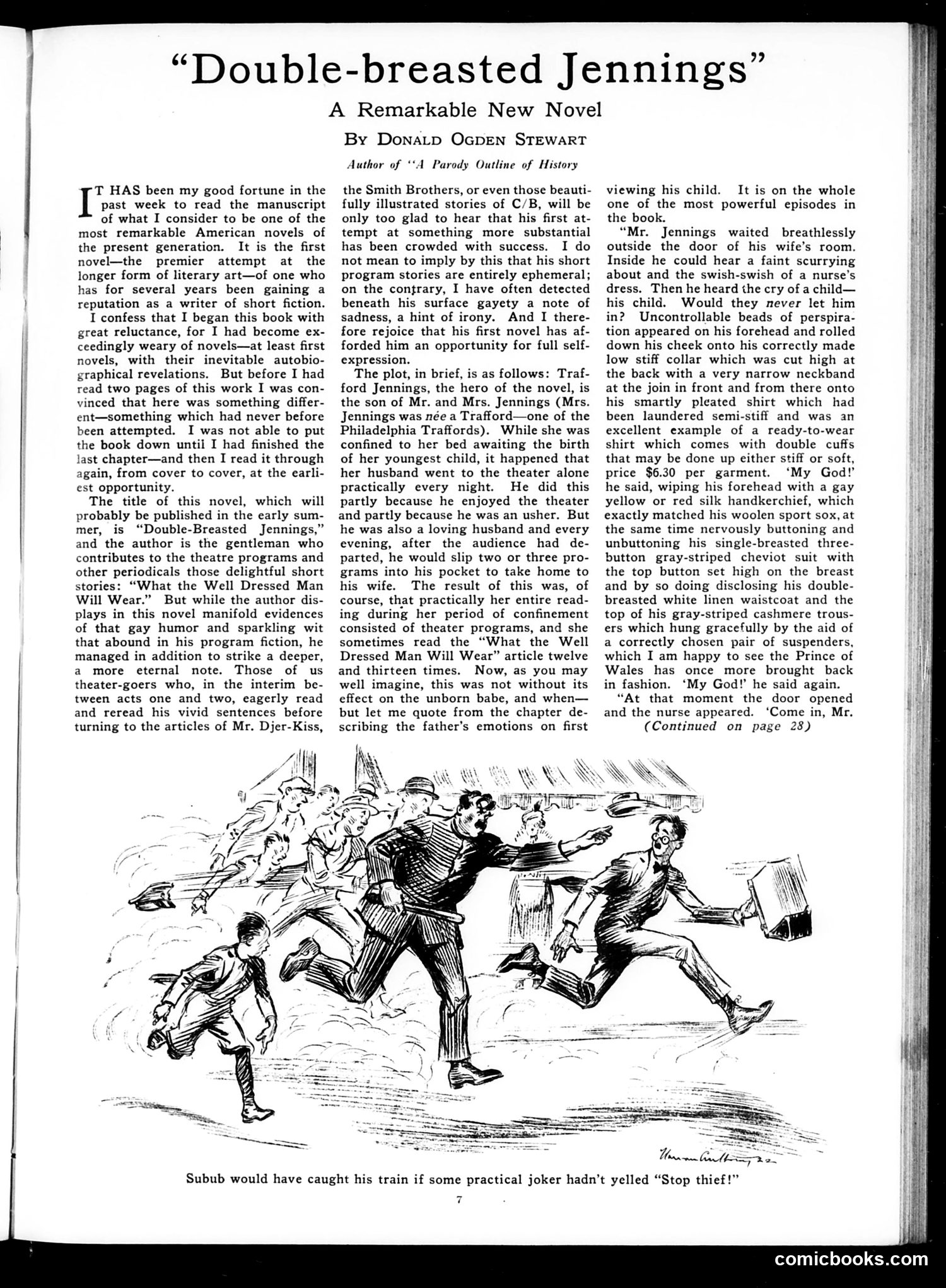
This page satirizes both literary pretension and fashion obsession in early 20th-century America. The text presents a fake "review" of a nonexistent novel called "Double-Breasted Jennings" by Donald Ogden Stewart (a real humorist and playwright). The satire works on multiple levels: it mocks overwrought literary criticism that treats trivial subjects seriously, and ridicules the idea that a child's entire personality could be shaped by a pregnant mother reading theater program fashion columns repeatedly. The absurd premise—that reading "What the Well Dressed Man Will Wear" articles would influence an unborn child—parodies both deterministic psychology and fashion industry self-importance. The cartoon below illustrates the ridiculous plot: a man in a double-breasted suit causes chaos by yelling "Stop thief!" The visual joke reinforces how trivial the novel's central concern (fashionable clothing) truly is, despite the overwrought critical praise above.
📄 Transcribed text from this page (OCR, searchable)
Machine-transcribed from the original scan — historical spelling and the odd misread are preserved.
“Double-breasted Jennings” T HAS been my good fortune in the I past week to read the manuscript of what I consider to be one of the most remarkable American novels of the present generation. It is the first novel—the premier attempt at the longer form of literary art—of one who has for several years been gaining a reputation as a writer of short fiction. I confess that I began this book with great reluctance, for I had become ex- ceedingly weary of novels—at least first novels, with their inevitable autobio- graphical revelations. But before I had read two pages of this work I was con- vinced that here was something differ- ent—something which had never before been attempted. I was not able to put the book down until I had finished the last chapter—and then I read it through again, from cover to cover, at the earli- est opportunity. The title of this novel, which will probably be published in the early sum- mer, is “Double-Breasted Jennings,” and the author is the gentleman who contributes to the theatre programs and other periodicals those delightful short stories: “What the Well Dressed Man Will Wear.” But while the author dis- plays in this novel manifold evidences of that gay humor and sparkling wit that abound in his program fiction, he managed in addition to strike a deeper, a more eternal note. Those of us theater-goers who, in the interim be- tween acts one and two, eagerly read and reread his vivid sentences before turning to the articles of Mr. Djer-Kiss, A Remarkable New Novel By Donatp OGDEN STEWART Author of “A Parody Outline of History the Smith Brothers, or even those beauti- fully illustrated stories of C/B, will be only too glad to hear that his first at- tempt at something more substantial has been crowded with success. I do not mean to imply by this that his short program stories are entirely ephemeral; on the confrary, I have often detected beneath his surface gayety a note of sadness, a hint of irony. And I there- fore rejoice that his first novel has af- forded him an opportunity for full self- expression. The plot, in brief, is as follows: Traf- ford Jennings, the hero of the novel, is the son of Mr. and Mrs. Jennings (Mrs. Jennings was née a Trafford—one of the Philadelphia Traffords). While she was confined to her bed awaiting the birth of her youngest child, it happened that her husband went to the theater alone practically every night. He did this partly because he enjoyed the theater and partly because he was an usher. But he was also a loving husband and every evening, after the audience had de- parted, he would slip two or three pro- grams into his pocket to take home to his wife. The result of this was, of course, that practically her entire read- ing during her period of confinement consisted of theater programs, and she sometimes read the “What the Well Dressed Man Will Wear” article twelve and thirteen times. Now, as you may well imagine, this was not without its effect on the unborn babe, and when— but let me quote from the chapter de- scribing the father’s emotions on first viewing his child. It is on the whole one of the most powerful episodes in the book. “Mr. Jennings waited breathlessly outside the door of his wife’s room. Inside he could hear a faint scurrying about and the swish-swish of a nurse’s dress. Then he heard the cry of a child— his child. Would they never let him in? Uncontrollable beads of perspira- tion appeared on his forehead and rolled down his cheek onto his correctly made low stiff collar which was cut high at the back with a very narrow neckband at the join in front and from there onto his smartly pleated shirt which had been laundered semi-stiff and was an excellent example of a ready-to-wear shirt which comes with double cuffs that may be done up either stiff or soft, price $6.30 per garment. ‘My God!’ he said, wiping his forehead with a gay yellow or red silk handkerchief, which exactly matched his woolen sport sox, at the same time nervously buttoning and unbuttoning his single-breasted three- button gray-striped cheviot suit with the top button set high on the breast and by so doing disclosing his double- breasted white linen waistcoat and the top of his gray-striped cashmere trous- ers which hung gracefully by the aid of a correctly chosen pair of suspenders, which I am happy to see the Prince of Wales has once more brought back in fashion. ‘My God!’ he said again. “At that moment the door opened and the nurse appeared. ‘Come in, Mr. (Continued on page 28) \ \ ore Wren bah 2. Subub would have caught his train if some practical joker hadn’t yelled “Stop thief!” comicbooks.com