
Judge, 1922-04-08 · page 13 of 36
Judge — April 8, 1922 — page 13: what you’re looking at
What you’re looking at
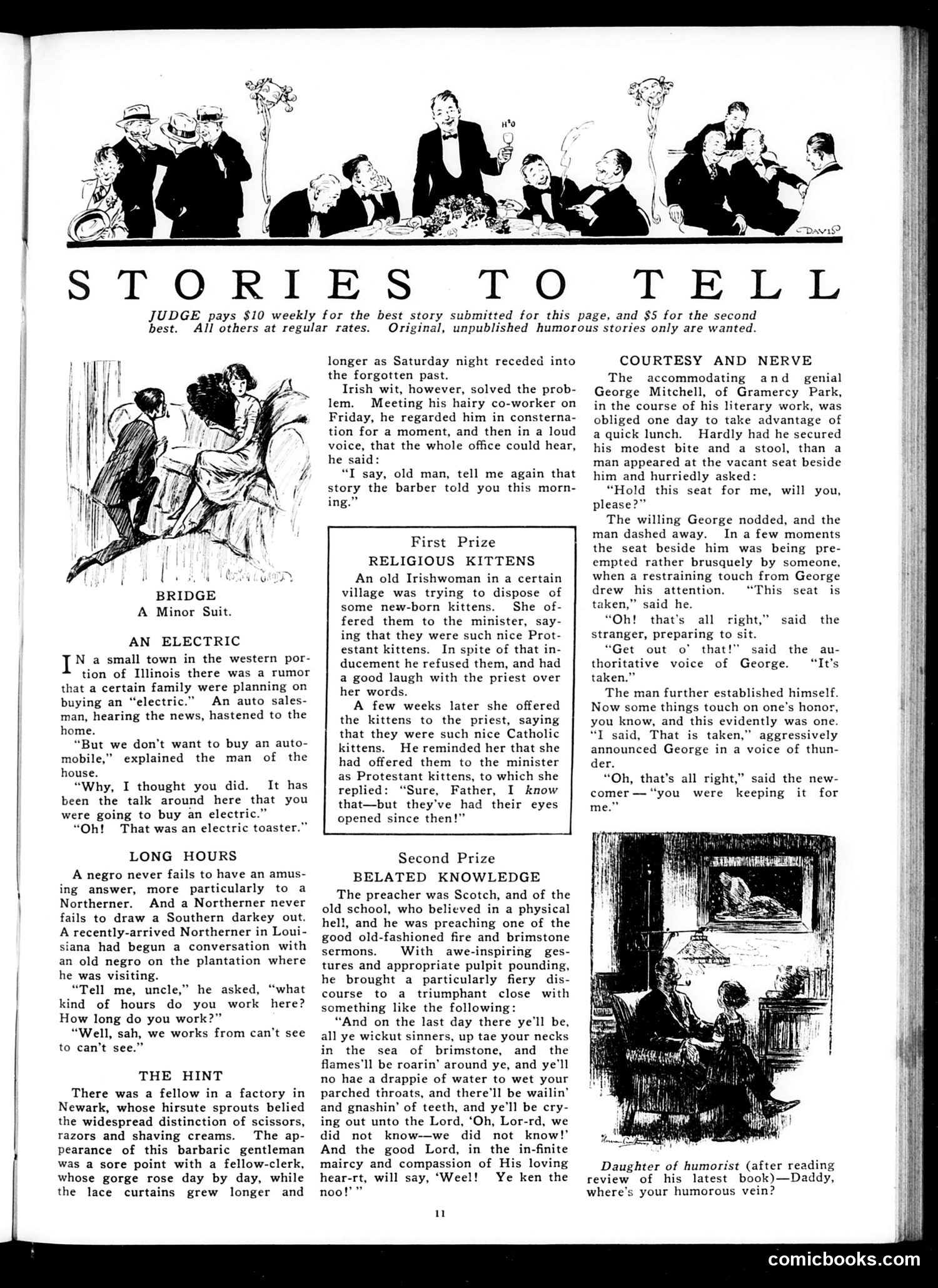
This page presents humorous anecdotes submitted to Judge's "Stories to Tell" contest, offering cash prizes for readers' contributions. The cartoons and stories satirize American social attitudes of the early 20th century. Key content includes ethnic and racial stereotypes typical of the era: an Irish woman's wordplay about kittens converting from "Protestant" to "Catholic," a Scottish preacher's dialect-heavy sermon, and a "darkey" joke featuring racist labor exploitation imagery ("works from can't see to can't see"—sunrise to sunset). A story about mistaking an "electric toaster" for an automobile pokes fun at rural ignorance of modern technology. The cartoon header depicts well-dressed men at what appears to be a formal dinner, suggesting stories of upper-class social situations. These pieces represent Judge's approach: satirizing working-class and rural Americans while reinforcing period prejudices as "amusing" material for educated readers. The content reflects now-offensive comedic conventions acceptable to contemporary audiences.
📄 Transcribed text from this page (OCR, searchable)
Machine-transcribed from the original scan — historical spelling and the odd misread are preserved.
S TORI ES TO TEL JUDGE pays $10 weekly for the best story submitted for this page, and $5 for the second best. BRIDGE A Minor Suit. AN ELECTRIC N a small town in the western por- tion of Illinois there was a rumor that a certain family were planning on buying an “electric.” An auto sales- man, hearing the news, hastened to the home. “But we don’t want to buy an auto- mobile,” explained the man of the house. “Why, I thought you did. It has been the talk around here that you were going to buy an electric.” “Oh! That was an electric toaster.” LONG HOURS A negro never fails to have an amus- ing answer, more particularly to a Northerner. And a Northerner never fails to draw a Southern darkey out. A recently-arrived Northerner in Loui- siana had begun a conversation with an old negro on the plantation where he was visiting. “Tell me, uncle,” kind of hours do you work How long do you work?” “Well, sah, we works from can’t see to can’t see.” he asked, “what here? THE HINT There was a fellow in a factory in Newark, whose hirsute sprouts belied the widespread distinction of scissors, razors and shaving creams. The ap- pearance of this barbaric gentleman was a sore point with a fellow-clerk, whose gorge rose day by day, while the lace curtains grew longer and All others at regular rates. longer as Saturday night receded into the forgotten past. Irish wit, however, solved the prob- lem. Meeting his hairy co-worker on Friday, he regarded him in consterna- tion for a moment, and then in a loud voice, that the whole office could hear, he said: “I say, old man, tell me again that story the barber told you this morn- ing.” First Prize RELIGIOUS KITTENS An old Irishwoman in a certain village was trying to dispose of some new-born kittens. She of- fered them to the minister, say- ing that they were such nice Prot- estant kittens. In spite of that in- ducement he refused them, and had a good laugh with the priest over her words. A few weeks later she offered the kittens to the priest, saying that they were such nice Catholic kittens. He reminded her that she had offered them to the minister as Protestant kittens, to which she replied: “Sure, Father, I know that—but they've had their eyes opened since then!” Second Prize BELATED KNOWLEDGE The preacher was Scotch, and of the old school, who believed in a physical hell, and he was preaching one of the good old-fashioned fire and brimstone sermons. With awe-inspiring ges- tures and appropriate pulpit pounding, he brought a particularly fiery dis- course to a triumphant close with something like the following: “And on the last day there ye'll be, all ye wickut sinners, up tae your necks in the sea of brimstone, and the flames'll be roarin’ around ye, and ye'll no hae a drappie of water to wet your parched throats, and there'll be wailin’ and gnashin’ of teeth, and ye'll be cry- ing out unto the Lord, ‘Oh, Lor-rd, we did not know-—-we did not know!’ And the good Lord, in the in-finite maircy and compassion of His loving hear-rt, will say, ‘Weel! Ye ken the noo!’ Original, unpublished humorous stories only are wanted. COURTESY AND NERVE The accommodating and _ genial George Mitchell, of Gramercy Park, in the course of his literary work, was obliged one day to take advantage of a quick lunch. Hardly had he secured his modest bite and a stool, than a man appeared at the vacant seat beside him and hurriedly asked: “Hold this seat for me, will you, please?” The willing George nodded, and the man dashed away. In a few moments the seat beside him was being pre- empted rather brusquely by someone, when a restraining touch from George drew his attention. “This seat is taken,” said he. “Oh! that’s all right,” said the stranger, preparing to sit. “Get out o’ that!” said thoritative voice of George. taken.” The man further established himself. Now some things touch on one’s honor, you know, and this evidently was one. “I said, That is taken,” aggressively announced George in a voice of thun- der. “Oh, that’s all right,” said the new- comer — “you were keeping it for me.” the au- “It's Daughter of humorist (after reading review of his latest book)—Daddy, where’s your humorous vein? comicbooks.com