
Judge, 1922-04-08 · page 22 of 36
Judge — April 8, 1922 — page 22: what you’re looking at
What you’re looking at
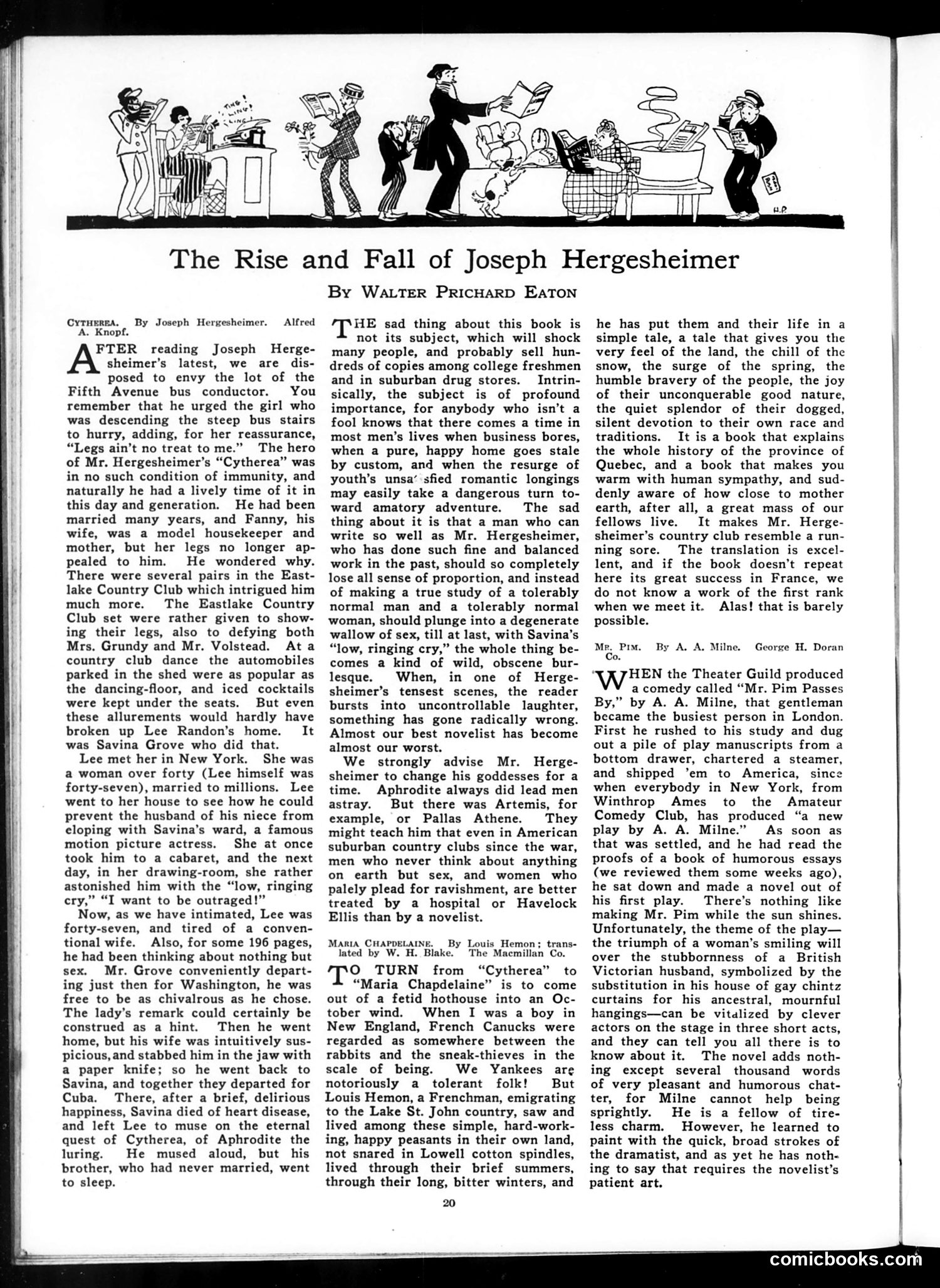
This is a literary review by Walter Prichard Eaton of novelist Joseph Hergesheimer's book *Cytherea*. The top illustration depicts the chaotic domestic and social consequences of the novel's plot. The review criticizes Hergesheimer for abandoning his earlier literary skill to write what amounts to sexual melodrama. The protagonist abandons his wife for a wealthy older woman (Savina) after meeting her in New York nightlife. The reviewer acknowledges that male midlife restlessness is a legitimate subject, but argues Hergesheimer has reduced it to "degenerate wallow of sex"—so exaggerated it becomes unintentionally comic rather than serious art. The review references "Mr. Grundy and Mr. Volstead," evoking Victorian propriety and Prohibition-era hypocrisy. The cartoon shows the book's chaos: marital breakdown, infidelity, and social disorder. Eaton suggests Hergesheimer trade the goddess Aphrodite (sexual desire) for Artemis (chastity/restraint), lamenting that "almost our best novelist has become almost our worst."
📄 Transcribed text from this page (OCR, searchable)
Machine-transcribed from the original scan — historical spelling and the odd misread are preserved.
Cyruerea. By Joseph Hergesheimer. Alfred ‘A. Knopf. FTER reading Joseph Herge- sheimer’s latest, we are dis- posed to envy the lot of the Fifth Avenue bus conductor. You remember that he urged the girl who was descending the steep bus stairs to hurry, adding, for her reassurance, “Legs ain’t no treat tome.” The hero of Mr. Hergesheimer’s “Cytherea” was in no such condition of immunity, and naturally he had a lively time of it in this day and generation. He had been married many years, and Fanny, his wife, was a model housekeeper and mother, but her legs no longer ap- pealed to him. He wondered why. There were several pairs in the East- lake Country Club which intrigued him much more. The Eastlake Country Club set were rather given to show- ing their legs, also to defying both Mrs. Grundy and Mr. Volstead. At a country club dance the automobiles parked in the shed were as popular as the dancing-floor, and iced cocktails were kept under the seats. But even these allurements would hardly have broken up Lee Randon’s home. It was Savina Grove who did that. Lee met her in New York. She was a woman over forty (Lee himself was forty-seven), married to millions. Lee went to her house to see how he could prevent the husband of his niece from eloping with Savina’s ward, a famous motion picture actress. She at once took him to a cabaret, and the next day, in her drawing-room, she rather astonished him with the “low, ringing cry,” “I want to be outraged!” Now, as we have intimated, Lee was forty-seven, and tired of a conven- tional wife. Also, for some 196 pages, he had been thinking about nothing but sex. Mr. Grove conveniently depart- ing just then for Washington, he was free to be as chivalrous as he chose. The lady’s remark could certainly be construed as a hint. Then he went home, but his wife was intuitively sus- picious, and stabbed him in the jaw with a paper knife; so he went back to Savina, and together they departed for Cuba. There, after a brief, delirious happiness, Savina died of heart disease, and left Lee to muse on the eternal quest of Cytherea, of Aphrodite the luring. He mused aloud, but his brother, who had never married, went to sleep. The Rise and Fall of Joseph Hergesheimer By WALTER PRICHARD EaTON if eat sad thing about this book is not its subject, which will shock many people, and probably sell hun- dreds of copies among college freshmen and in suburban drug stores. Intrin- sically, the subject is of profound importance, for anybody who isn’t a fool knows that there comes a time in most men’s lives when business bores, when a pure, happy home goes stale by custom, and when the resurge of youth’s unsa’ sfied romantic longings may easily take a dangerous turn to- ward amatory adventure. The sad thing about it is that a man who can write so well as Mr. Hergesheimer, who has done such fine and balanced work in the past, should so completely lose all sense of proportion, and instead of making a true study of a tolerably normal man and a tolerably normal woman, should plunge into a degenerate wallow of sex, till at last, with Savina’s “low, ringing cry,” the whole thing be- comes a kind of wild, obscene bur- lesque. When, in one of Herge- sheimer’s tensest scenes, the reader bursts into uncontrollable laughter, something has gone radically wrong. Almost our best novelist has become almost our worst. We strongly advise Mr. Herge- sheimer to change his goddesses for a time. Aphrodite always did lead men astray. But there was Artemis, for example, or Pallas Athene. They might teach him that even in American suburban country clubs since the war, men who never think about anything on earth but sex, and women who palely plead for ravishment, are better treated by a hospital or Havelock Ellis than by a novelist. MARIA CHAPDELAINE. By Louis Hemon; trans- lated by W. H. Blake. The Macmillan Co. O TURN from “Cytherea” to “Maria Chapdelaine” is to come out of a fetid hothouse into an Oc- tober wind. When I was a boy in New England, French Canucks were regarded as somewhere between the rabbits and the sneak-thieves in the scale of being. We Yankees are notoriously a tolerant folk! But Louis Hemon, a Frenchman, emigrating to the Lake St. John country, saw and lived among these simple, hard-work- ing, happy peasants in their own land, not snared in Lowell cotton spindles, lived through their brief summers, through their long, bitter winters, and 20 he has put them and their life in a simple tale, a tale that gives you the very feel of the land, the chill of the snow, the surge of the spring, the humble bravery of the people, the joy of their unconquerable good nature, the quiet splendor of their dogged, silent devotion to their own race and traditions. It is a book that explains the whole history of the province of Quebec, and a book that makes you warm with human sympathy, and sud- denly aware of how close to mother earth, after all, a great mass of our fellows live. It makes Mr. Herge- sheimer’s country club resemble a run- ning sore. The translation is excel- lent, and if the book doesn’t repeat here its great success in France, we do not know a work of the first rank when we meet it. Alas! that is barely possible. Mz, Pi. By A. A. Milne. George H. Doran 0. WHEN the Theater Guild produced a comedy called “Mr. Pim Passes By,” by A. A. Milne, that gentleman became the busiest person in London. First he rushed to his study and dug out a pile of play manuscripts from a bottom drawer, chartered a steamer, and shipped ’em to America, since when everybody in New York, from Winthrop Ames to the Amateur Comedy Club, has produced “a new play by A. A. Milne.” As soon as that was settled, and he had read the proofs of a book of humorous essays (we reviewed them some weeks ago), he sat down and made a novel out of his first play. There’s nothing like making Mr. Pim while the sun shines. Unfortunately, the theme of the play— the triumph of a woman’s smiling will over the stubbornness of a British Victorian husband, symbolized by the substitution in his house of gay chintz curtains for his ancestral, mournful hangings—can be vitalized by clever actors on the stage in three short acts, and they can tell you all there is to know about it. The novel adds noth- ing except several thousand words of very pleasant and humorous chat- ter, for Milne cannot help being sprightly. He is a fellow of tire- less charm. However, he learned to paint with the quick, broad strokes of the dramatist, and as yet he has noth- ing to say that requires the novelist’s patient art. comicbooks.com