
Judge, 1922-04-08 · page 21 of 36
Judge — April 8, 1922 — page 21: what you’re looking at
What you’re looking at
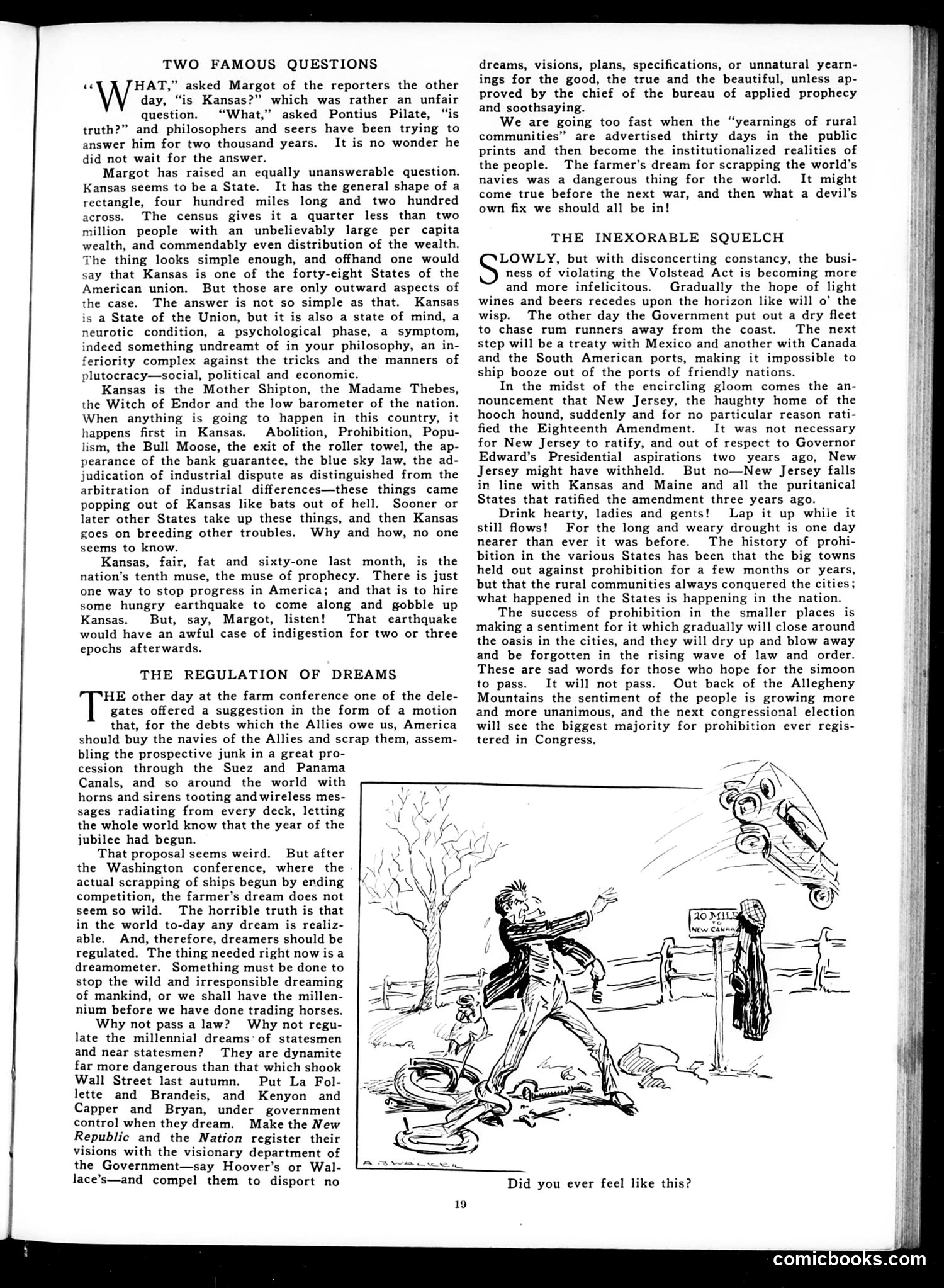
This Judge magazine page contains two satirical essays mocking contemporary American politics. **"Two Famous Questions"** compares asking "What is Kansas?" to Pontius Pilate's question about truth—both unanswerable. The author describes Kansas as a "state of mind" and "neurotic condition," claiming it's a prophetic barometer for the nation's radical movements: Abolition, Prohibition, Populism, the Bull Moose Party, and labor reforms all originated there. Kansas is portrayed as America's "muse of prophecy"—a harbinger of coming troubles. **"The Regulation of Dreams"** satirizes progressive politicians' grand schemes, likely referencing the 1921 Washington Naval Conference where nations agreed to scrap warships. The author mockingly suggests that idealistic dreamers like La Follette, Brandeis, Kenyon, Capper, and Bryan should be government-regulated to prevent dangerous "millennial dreams" from destabilizing society. The cartoon shows a man overwhelmed by impossible schemes. Both pieces lampoon progressive reformers and Kansas's reputation for radical political movements.
📄 Transcribed text from this page (OCR, searchable)
Machine-transcribed from the original scan — historical spelling and the odd misread are preserved.
TWO FAMOUS QUESTIONS “e HAT,” asked Margot of the reporters the other day, “is Kansas?” which was rather an unfair question. “What,” asked Pontius Pilate, “is truth?” and philosophers and seers have been trying to answer him for two thousand years. It is no wonder he did not wait for the answer. Margot has raised an equally unanswerable question. Kansas seems to be a State. It has the general shape of a rectangle, four hundred miles long and two hundred across. The census gives it a quarter less than two million people with an unbelievably large per capita wealth, and commendably even distribution of the wealth. The thing looks simple enough, and offhand one would say that Kansas is one of the forty-eight States of the American union. But those are only outward aspects of the case. The answer is not so simple as that. Kansas is a State of the Union, but it is also a state of mind, a neurotic condition, a psychological phase, a symptom, indeed something undreamt of in your philosophy, an in- feriority complex against the tricks and the manners of plutocracy—social, political and economic. Kansas is the Mother Shipton, the Madame Thebes, the Witch of Endor and the low barometer of the nation. When anything is going to happen in this country, it happens first in Kansas. Abolition, Prohibition, Popu- lism, the Bull Moose, the exit of the roller towel, the ap- pearance of the bank guarantee, the blue sky law, the ad- judication of industrial dispute as distinguished from the arbitration of industrial differences—these things came popping out of Kansas like bats out of hell. Sooner or later other States take up these things, and then Kansas goes on breeding other troubles. Why and how, no one seems to know. Kansas, fair, fat and sixty-one last month, is the nation’s tenth muse, the muse of prophecy. There is just one way to stop progress in America; and that is to hire some hungry earthquake to come along and gobble up Kansas. But, say, Margot, listen! That earthquake would have an awful case of indigestion for two or three epochs afterwards. THE REGULATION OF DREAMS 'HE other day at the farm conference one of the dele- gates offered a suggestion in the form of a motion that, for the debts which the Allies owe us, America should buy the navies of the Allies and scrap them, assem- bling the prospective junk in a great pro- cession through the Suez and Panama Canals, and so around the world with horns and sirens tooting and wireless mes- sages radiating from every deck, letting the whole world know that the year of the jubilee had begun. That proposal seems weird. But after the Washington conference, where the actual scrapping of ships begun by ending competition, the farmer's dream does not seem so wild. The horrible truth is that in the world to-day any dream is realiz- able. And, therefore, dreamers should be regulated. The thing needed right now is a dreamometer. Something must be done to stop the wild and irresponsible dreaming of mankind, or we shall have the millen- nium before we have done trading horses. Why not pass a law? Why not regu- late the millennial dreams: of statesmen and near statesmen? They are dynamite far more dangerous than that which shook Wall Street last autumn. Put La Fol- lette and Brandeis, and Kenyon and Capper and Bryan, under government control when they dream. Make the New Republic and the Nation register their visions with the visionary department of the Government—say Hoover’s or Wal- lace’s—and compel them to disport no AR e cee dreams, visions, plans, specifications, or unnatural yearn- ings for the good, the true and the beautiful, unless ap- proved by the chief of the bureau of applied prophecy and soothsaying. We are going too fast when the “yearnings of rural communities” are advertised thirty days in the public prints and then become the institutionalized realities of the people. The farmer’s dream for scrapping the world’s navies was a dangerous thing for the world. It might come true before the next war, and then what a devil's own fix we should all be in! THE INEXORABLE SQUELCH LOWLY, but with disconcerting constancy, the busi- ness of violating the Volstead Act is becoming more and more infelicitous. Gradually the hope of light wines and beers recedes upon the horizon like will o’ the wisp. The other day the Government put out a dry fleet to chase rum runners away from the coast. The next step will be a treaty with Mexico and another with Canada and the South American ports, making it impossible to ship booze out of the ports of friendly nations. In the midst of the encircling gloom comes the an- nouncement that New Jersey, the haughty home of the hooch hound, suddenly and for no particular reason rati- fied the Eighteenth Amendment. It was not necessary for New Jersey to ratify, and out of respect to Governor Edward’s Presidential aspirations two years ago, New Jersey might have withheld. But no—New Jersey falls in line with Kansas and Maine and all the puritanical States that ratified the amendment three years ago. Drink hearty, ladies and gents! Lap it up while it still flows! For the long and weary drought is one day nearer than ever it was before. The history of prohi- bition in the various States has been that the big towns held out against prohibition for a few months or years, but that the rural communities always conquered the cities; what happened in the States is happening in the nation. The success of prohibition in the smaller places is making a sentiment for it which gradually will close around the oasis in the cities, and they will dry up and blow away and be forgotten in the rising wave of law and order. These are sad words for those who hope for the simoon to pass. It will not pass. Out back of the Allegheny Mountains the sentiment of the people is growing more and more unanimous, and the next congressional election will see the biggest majority for prohibition ever regis- tered in Congress. Did you ever feel like this? it ‘ i i i} comicbooks.com