
Judge, 1922-04-08 · page 16 of 36
Judge — April 8, 1922 — page 16: what you’re looking at
What you’re looking at
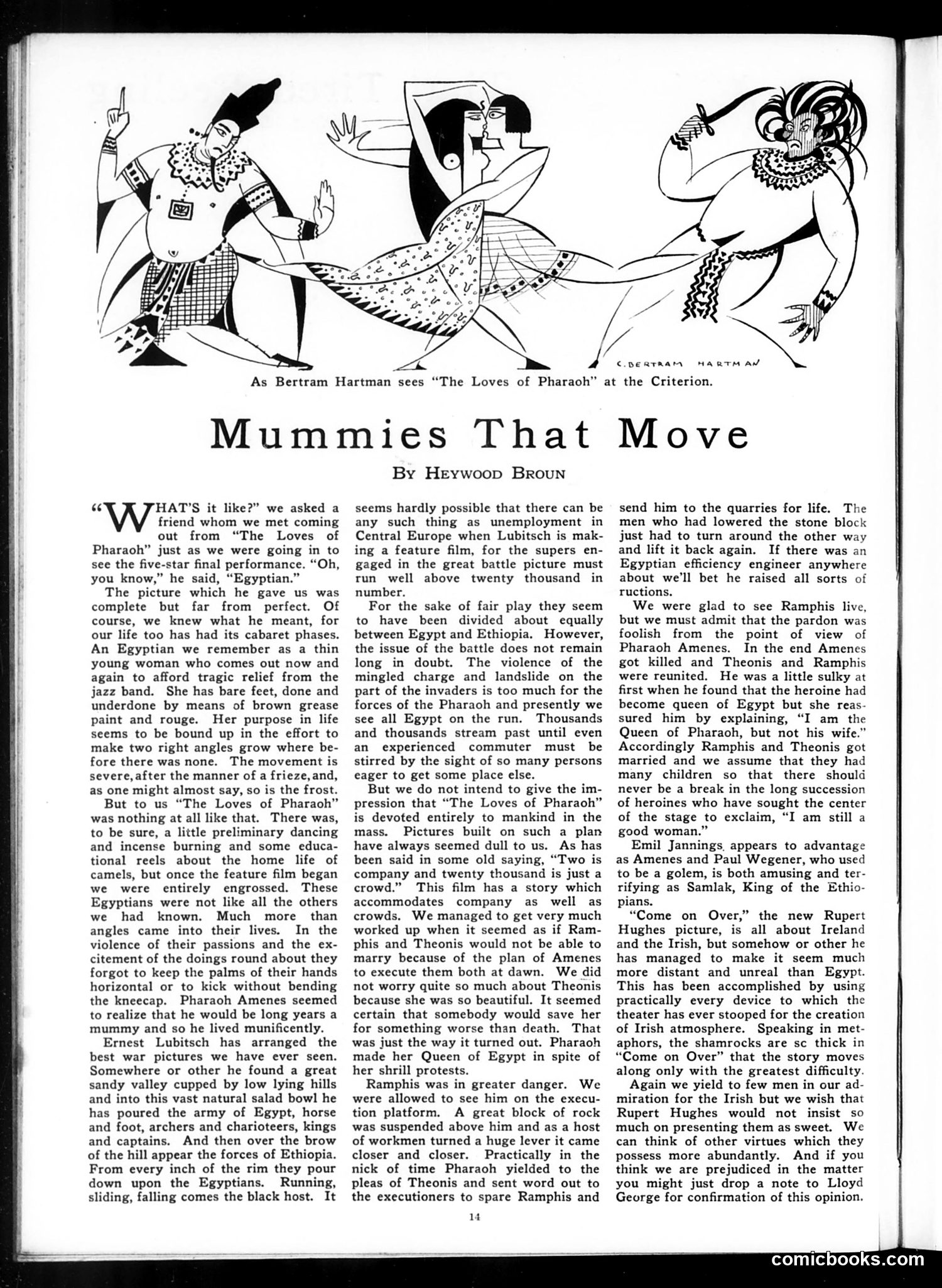
This is a film review by Heywood Broun of Ernst Lubitsch's *The Loves of Pharaoh*, a silent epic. The cartoon at top shows Bertram Hartman's satirical impression of the film's stylized "Egyptian" aesthetic—exaggerated poses and theatrical gestures typical of both stage "Egyptian" dancers and silent cinema. Broun praises Lubitsch's ambitious battle sequences (featuring thousands of extras) while gently mocking the film's melodramatic plot about Pharaoh Amenes preventing lovers Ramphis and Theonis from marrying. He contrasts this with traditional "Egyptian" stage entertainment—thin dancers in minimal costumes performing rigid, geometric movements meant to evoke ancient aesthetics. The review is largely positive, celebrating the film's spectacle and emotional intensity while noting its narrative simplicity. The satire targets not the film itself but rather contemporary expectations of what "Egyptian" entertainment should look like.
📄 Transcribed text from this page (OCR, searchable)
Machine-transcribed from the original scan — historical spelling and the odd misread are preserved.
he Ad C.peRTAAM HA RTM AY As Bertram Hartman sees “The Loves of Pharaoh” at the Criterion. Mummies That Move HAT’S it like?” we asked a friend whom we met coming out from “The Loves of Pharaoh” just as we were going in to see the five-star final performance. “Oh, you know,” he said, “Egyptian.” The picture which he gave us was complete but far from perfect. Of course, we knew what he meant, for our life too has had its cabaret phases. An Egyptian we remember as a thin young woman who comes out now and again to afford tragic relief from the jazz band. She has bare feet, done and underdone by means of brown grease paint and rouge. Her purpose in life seems to be bound up in the effort to make two right angles grow where be- fore there was none. The movement is severe, after the manner of a frieze, and, as one might almost say, so is the frost. But to us “The Loves of Pharaoh” was nothing at all like that. There was, to be sure, a little preliminary dancing and incense burning and some educa- tional reels about the home life of camels, but once the feature film began we were entirely engrossed. These Egyptians were not like all the others we had known. Much more than angles came into their lives. In the violence of their passions and the ex- citement of the doings round about they forgot to keep the palms of their hands horizontal or to kick without bending the kneecap. Pharaoh Amenes seemed to realize that he would be long years a mummy and so he lived munificently. Ernest Lubitsch has arranged the best war pictures we have ever seen. Somewhere or other he found a great sandy valley cupped by low lying hills and into this vast natural salad bowl he has poured the army of Egypt, horse and foot, archers and charioteers, kings and captains. And then over the brow of the hill appear the forces of Ethiopia. From every inch of the rim they pour down upon the Egyptians. Running, sliding, falling comes the black host. It By Heywoop Broun seems hardly possible that there can be any such thing as unemployment in Central Europe when Lubitsch is mak- ing a feature film, for the supers en- gaged in the great battle picture must run well above twenty thousand in number. For the sake of fair play they seem to have been divided about equally between Egypt and Ethiopia. However, the issue of the battle does not remain long in doubt. The violence of the mingled charge and landslide on the part of the invaders is too much for the forces of the Pharaoh and presently we see all Egypt on the run. Thousands and thousands stream past until even an experienced commuter must be stirred by the sight of so many persons eager to get some place else. But we do not intend to give the im- pression that “The Loves of Pharaoh” is devoted entirely to mankind in the mass. Pictures built on such a plan have always seemed dull to us. As has been said in some old saying, “Two is company and twenty thousand is just a crowd.” This film has a story which accommodates company as well as crowds. We managed to get very much worked up when it seemed as if Ram- phis and Theonis would not be able to marry because of the plan of Amenes to execute them both at dawn. We did not worry quite so much about Theonis because she was so beautiful. It seemed certain that somebody would save her for something worse than death. That was just the way it turned out. Pharaoh made her Queen of Egypt in spite of her shrill protests. Ramphis was in greater danger. We were allowed to see him on the execu- tion platform. A great block of rock was suspended above him and as a host of workmen turned a huge lever it came closer and closer. Practically in the nick of time Pharaoh yielded to the pleas of Theonis and sent word out to the executioners to spare Ramphis and 14 send him to the quarries for life. The men who had lowered the stone block just had to turn around the other way and lift it back again. If there was an Egyptian efficiency engineer anywhere about we'll bet he raised all sorts of ructions. We were glad to see Ramphis live, but we must admit that the pardon was foolish from the point of view of Pharaoh Amenes. In the end Amenes got killed and Theonis and Ramphis were reunited. He was a little sulky at first when he found that the heroine had become queen of Egypt but she reas- sured him by explaining, “I am the Queen of Pharaoh, but not his wife.” Accordingly Ramphis and Theonis got married and we assume that they had many children so that there should never be a break in the long succession of heroines who have sought the center of the stage to exclaim, “I am still a good woman.” Emil Jannings, appears to advantage as Amenes and Paul Wegener, who used to be a golem, is both amusing and ter- rifying as Samlak, King of the Ethio- pians. “Come on Over,” the new Rupert Hughes picture, is all about Ireland and the Irish, but somehow or other he has managed to make it seem much more distant and unreal than Egypt. This has been accomplished by using practically every device to which the theater has ever stooped for the creation of Irish atmosphere. Speaking in met- aphors, the shamrocks are sc thick in “Come on Over” that the story moves along only with the greatest difficulty. Again we yield to few men in our ad- miration for the Irish but we wish that Rupert Hughes would not insist so much on presenting them as sweet. We can think of other virtues which they possess more abundantly. And if you think we are prejudiced in the matter you might just drop a note to Lloyd George for confirmation of this opinion. comicbooks.com