
Judge, 1922-04-08 · page 6 of 36
Judge — April 8, 1922 — page 6: what you’re looking at
What you’re looking at
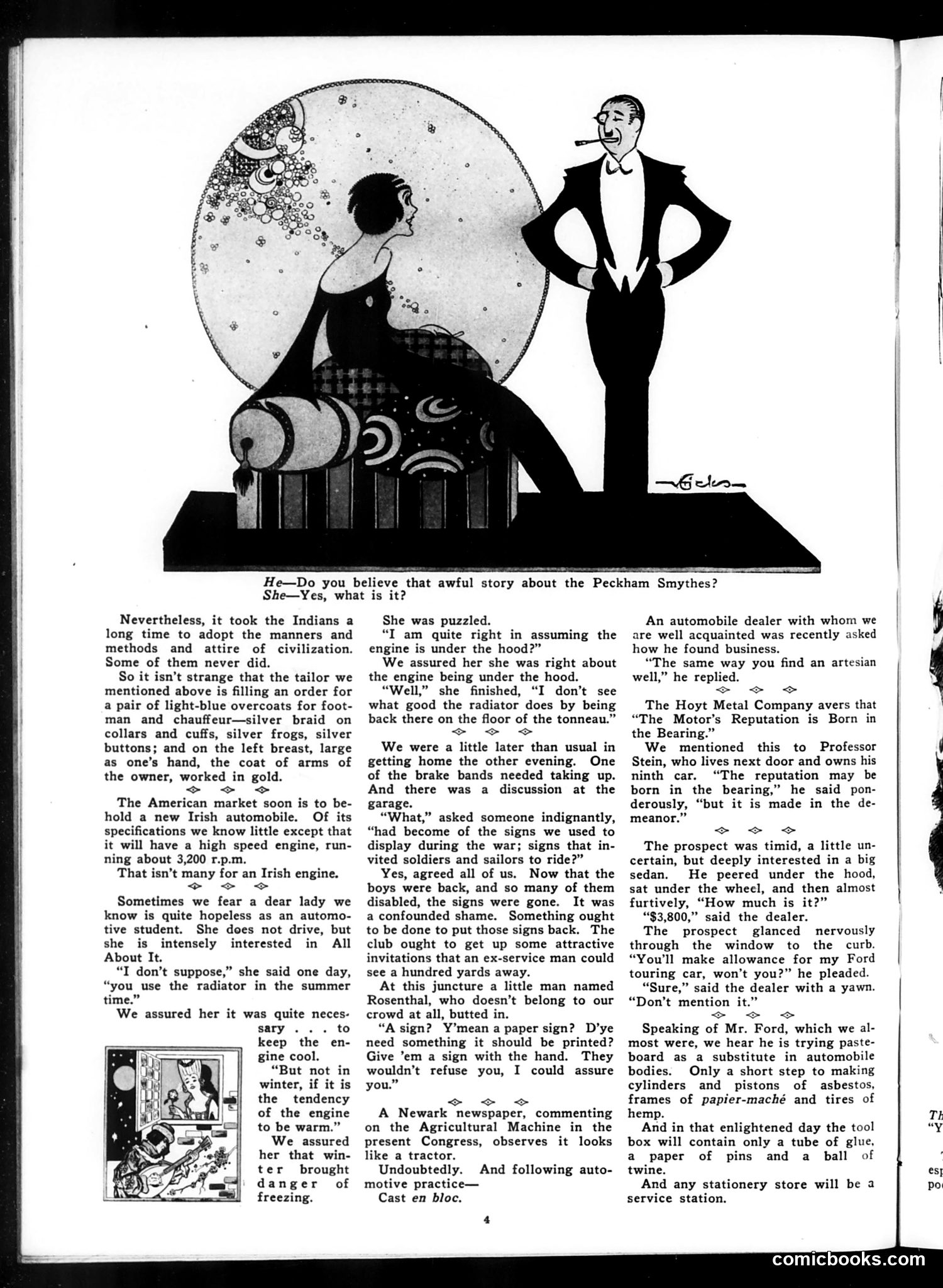
The top cartoon depicts a woman seated on ornate furniture admiring a large decorative moon, while a man in formal attire stands nearby smoking. The caption reveals their conversation about the "Peckham Smythes" — an apparently scandalous social story. The surrounding text discusses Irish automobiles, women drivers, and automotive accessories. One anecdote mocks a woman who doesn't drive but is "intensely interested in all About It," asking about using the radiator in summer. Another story features a car salesman negotiating with a prospect over a Ford touring car. The satire targets early 20th-century automotive culture, gender assumptions about driving, and social pretension among the wealthy classes. The cartoon likely comments on gossip and societal vanity among the elite.
📄 Transcribed text from this page (OCR, searchable)
Machine-transcribed from the original scan — historical spelling and the odd misread are preserved.
Nevertheless, it took the Indians a long time to adopt the manners and methods and attire of civilization. Some of them never did. So it isn’t strange that the tailor we mentioned above is filling an order for a pair of light-blue overcoats for foot- man and chauffeur—silver braid on collars and cuffs, silver frogs, silver buttons; and on the left breast, large as one’s hand, the coat of arms of the owner, worked in gold. > s- S> The American market soon is to be- hold a new Irish automobile. Of its specifications we know little except that it will have a high speed engine, run- ning about 3,200 r.p.m. That isn’t many for an Irish engine. > > Sometimes we fear a dear lady we know is quite hopeless as an automo- tive student. She does not drive, but she is intensely interested in All About It. “I don’t suppose,” she said one day, “you use the radiator in the summer time.” We assured her it was quite neces- sary... to keep the en- gine cool. “But not in winter, if it is the tendency of the engine to be warm.” We assured her that win- ter brought danger of freezing. He—Do you believe that awful story about the Peckha: She—Yes, what is it? She was puzzled. “I am quite right in assuming the engine is under the hood?” We assured her she was right about the engine being under the hood. “Well,” she finished, “I don’t see what good the radiator does by being back there on the floor of the tonneau.” o> o> > We were a little later than usual in getting home the other evening. One of the brake bands needed taking up. And there was a discussion at the garage. “What,” asked someone indignantly, “had become of the signs we used to display during the war; signs that in- vited soldiers and sailors to ride?” Yes, agreed all of us. Now that the boys were back, and so many of them disabled, the signs were gone. It was a confounded shame. Something ought to be done to put those signs back. The club ought to get up some attractive invitations that an ex-service man could see a hundred yards away. At this juncture a little man named Rosenthal, who doesn’t belong to our crowd at all, butted in. “A sign? Y’mean a paper sign? D’ye need something it should be printed? Give ’em a sign with the hand. They wouldn’t refuse you, I could assure you.” os > A Newark newspaper, commenting on the Agricultural Machine in the present Congress, observes it looks like a tractor. Undoubtedly. motive practice— Cast en bloc. And following auto- m Smythes? An automobile dealer with whom we are well acquainted was recently asked how he found business. “The same way you find an artesian well,” he replied. o> so > The Hoyt Metal Company avers that “The Motor’s Reputation is Born in the Bearing.” We mentioned this to Professor Stein, who lives next door and owns his ninth car. “The reputation may be born in the bearing,” he said pon- derously, “but it is made in the de- meanor.” oso > The prospect was timid, a little un- certain, but deeply interested in a big sedan. He peered under the hood, sat under the wheel, and then almost furtively, “How much is it?” “$3,800,” said the dealer. The prospect glanced nervously through the window to the curb. “You'll make allowance for my Ford touring car, won’t you?” he pleaded. “Sure,” said the dealer with a yawn. “Don’t mention it.” > > > Speaking of Mr. Ford, which we al- most were, we hear he is trying paste- board as a substitute in automobile bodies. Only a short step to making cylinders and pistons of asbestos, frames of papier-maché and tires of hemp. And in that enlightened day the tool box will contain only a tube of glue, a paper of pins and a ball of twine. And any stationery store will be a service station. comicbooks.com