
A complete issue · 36 pages · 1921
Judge — November 12, 1921
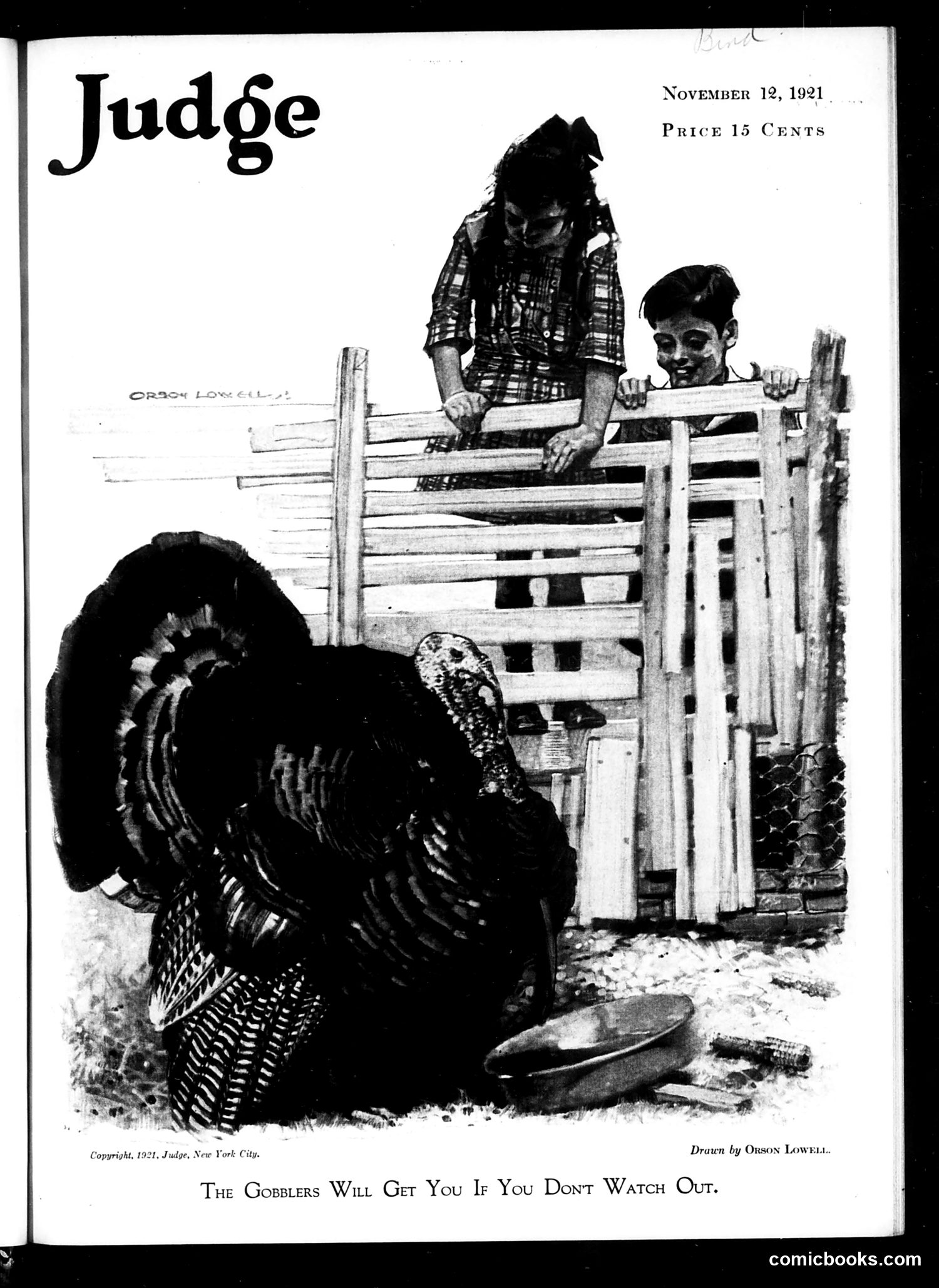
This illustration by Orson Lowell depicts a cautionary scene about theft or burglary. Two children peer from a wooden gate while a turkey (a "gobbler," playing on the term's double meaning) appears in the foreground, suggesting a farmyard setting. The caption "The Gobblers Will Get You If You Don't Watch Out" is a playful threat warning of consequences for inattention or negligence. The phrase mimics the structure of traditional cautionary tales meant to scare children into behaving properly. Here, the "gobblers" likely represent either actual turkeys (a theft risk on farms) or serve as a humorous metaphor for thieves or opportunists who prey on the careless. The joke warns vigilance is necessary to protect property and livestock.
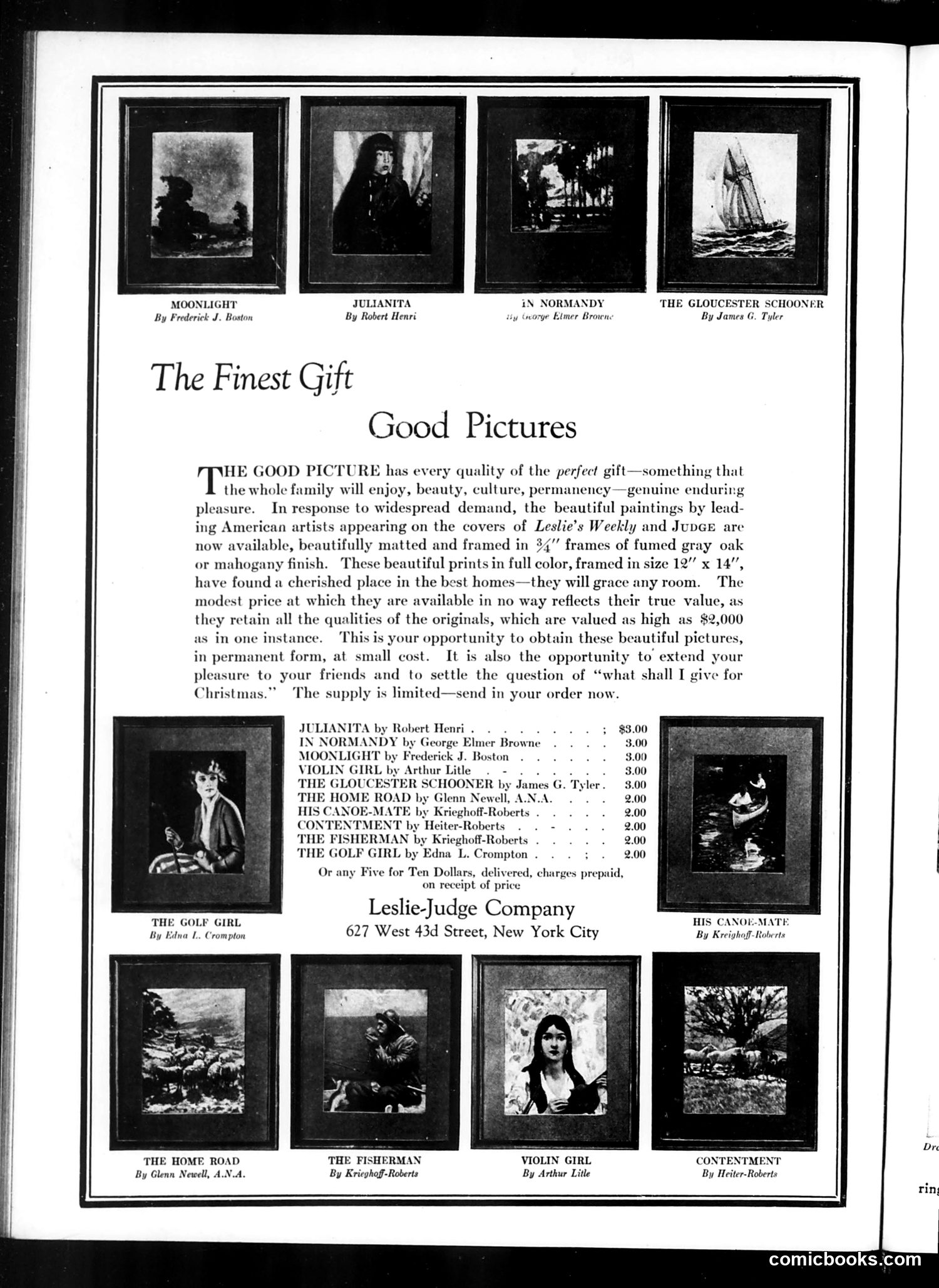
This page is **primarily an advertisement**, not editorial satire. It promotes "Good Pictures" — framed art prints from the Leslie-Judge Company available for purchase. The ad emphasizes that these are reproductions of paintings by "leading American artists" previously featured on *Leslie's Weekly* and *Judge* magazine covers. Priced affordably ($2.00-$3.00 each, or five for ten dollars), the paintings are marketed as ideal gifts combining "beauty, culture, permanence." The reproduced artworks shown depict conventional subjects: portraits, maritime scenes, domestic moments, and landscapes. There is **no political satire or social commentary** present — this is straightforward commercial promotion leveraging the prestige of *Judge* magazine's artistic associations to sell home décor to middle-class readers seeking affordable culture.
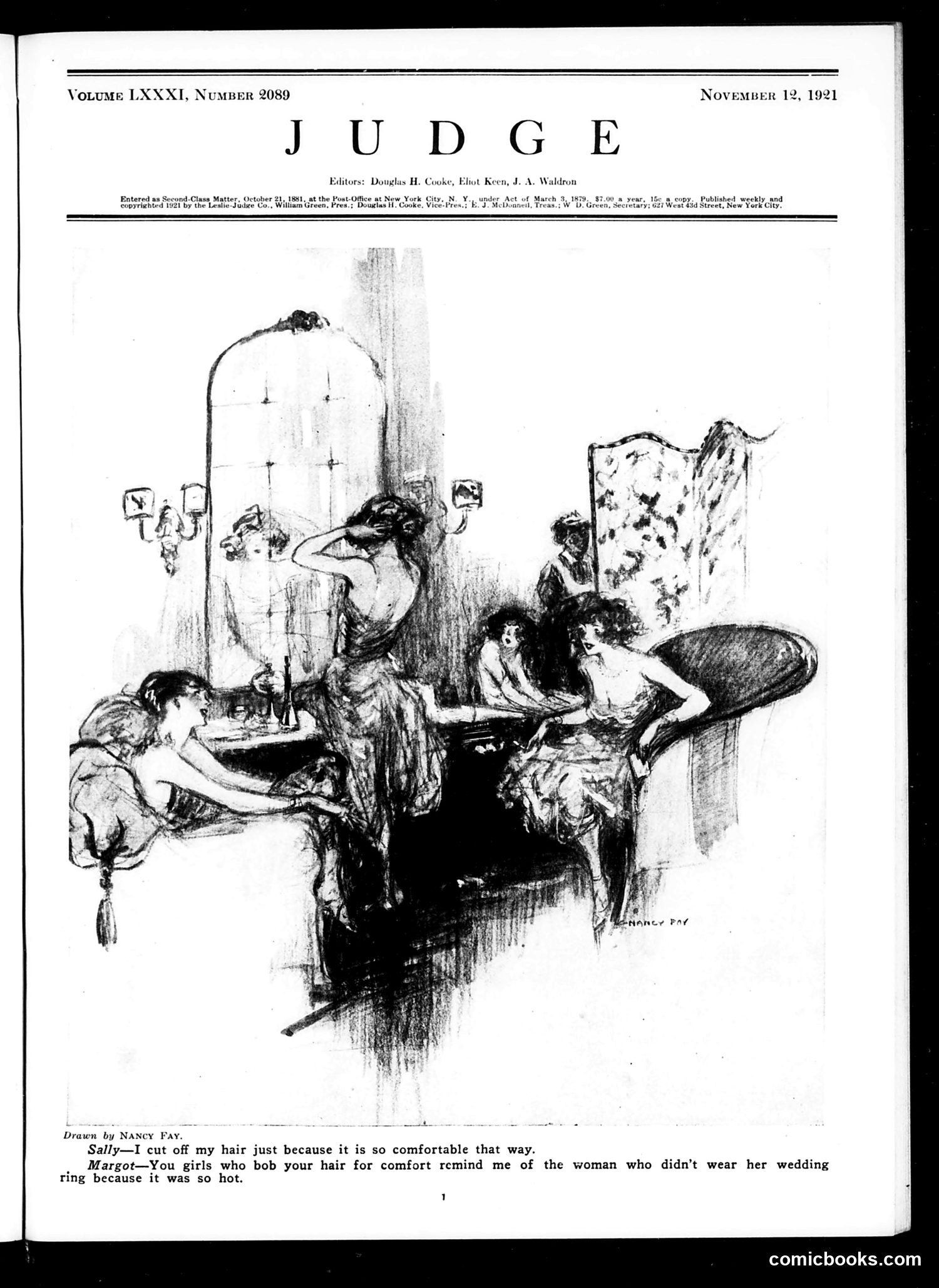
This is a single-panel cartoon by Nancy Fay depicting a beauty salon scene. Two women are discussing haircuts: **Sally** has cut her hair short because it's comfortable in that way. **Margot** responds by reminding Sally of a woman who didn't wear her wedding ring because it was too hot. The joke satirizes women who adopt practical or comfortable styles while ignoring social conventions. In 1921, the "bob" haircut was controversial—a symbol of modern, independent "flapper" women rejecting Victorian femininity. Margot's comment equates removing a wedding ring (abandoning marital status) with cutting hair, suggesting both represent abandoning proper feminine identity for mere comfort. The cartoon mocks this casual disregard for traditional expectations.
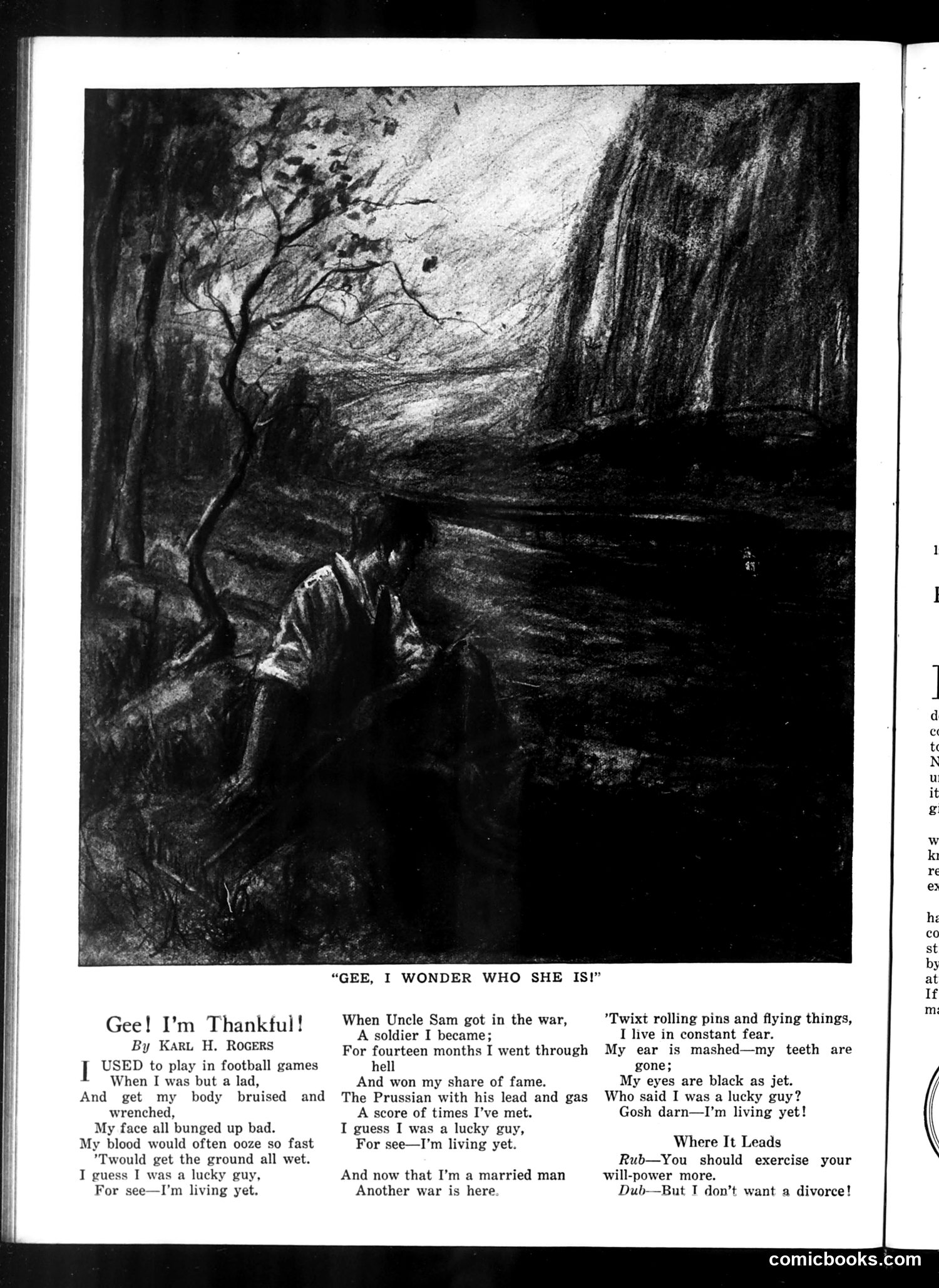
This page from *Judge* magazine features a poem by Karl H. Rogers titled "Gee! I'm Thankful!" The illustration depicts a soldier in a dark, forested setting gazing at a ghostly female figure in the moonlight—likely representing a sweetheart or wife left behind. The poem's theme is ironic gratitude: the narrator, wounded in WWI combat against the Prussians, survives and marries. However, he now faces "another war" on the home front—domestic marital conflict. The satirical point mocks the contrast between surviving actual warfare and enduring marriage troubles, suggesting married life poses equal or greater hardship than combat. The accompanying "Where It Leads" section plays on this domestic discord theme, referencing divorce.
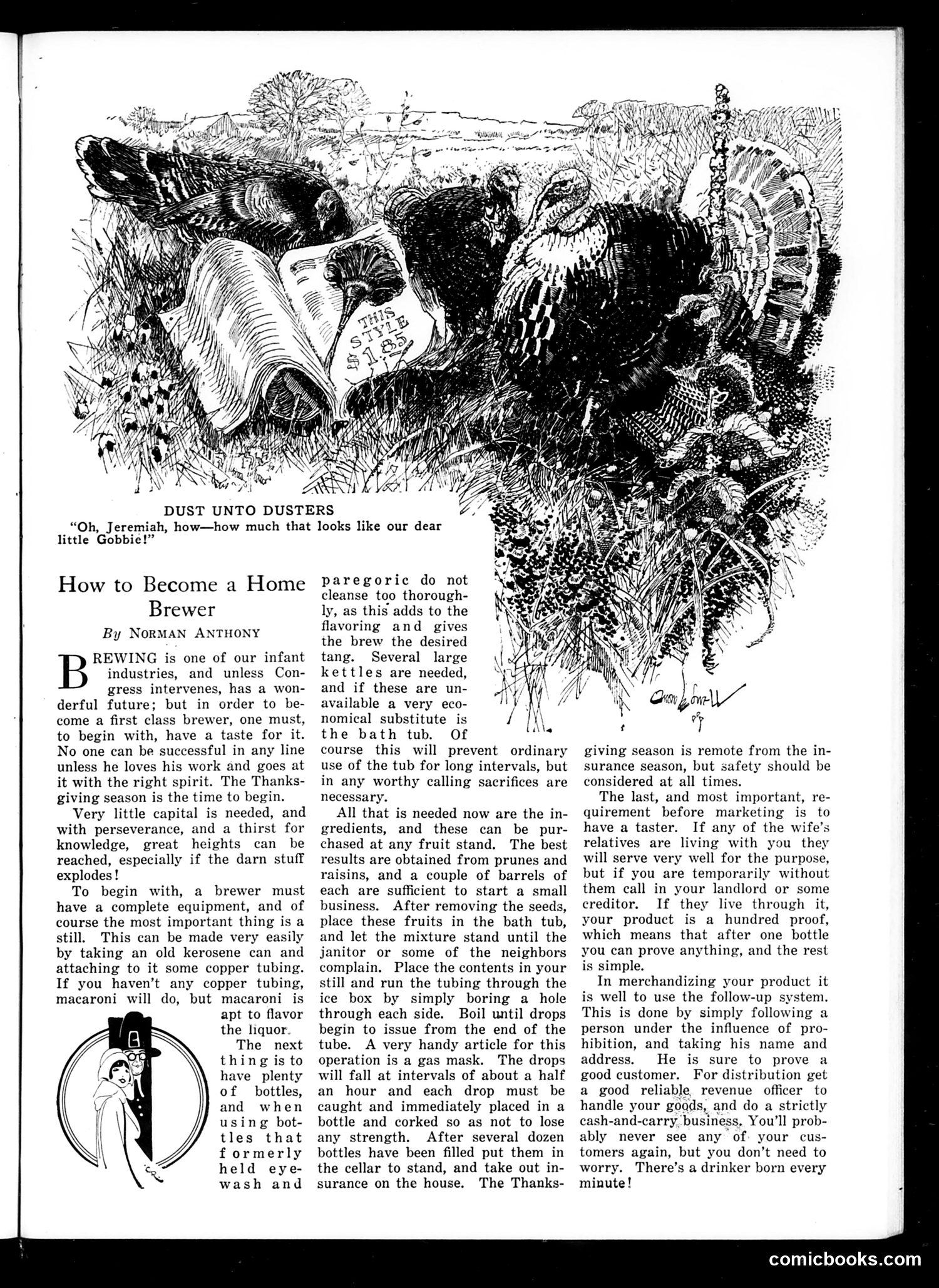
The page contains an article titled "How to Become a Home Brewer" by Norman Anthony, accompanied by a humorous illustration titled "Dust Unto Dusters." **The Cartoon**: The sketch shows two turkeys or large birds in grass, with one saying to the other: "Oh, Jeremiah, how—how much that looks like our dear little Gobbie!" The joke appears to reference Prohibition era humor—the birds are presumably discussing something that resembles a dead turkey, possibly implying confusion about poultry during a time when home brewing and alcohol production were illegal. **The Article**: It's a tongue-in-cheek instructional piece about illegal home brewing during Prohibition (when alcohol production was banned in the U.S.). The satire mocks the process of making beer at home using basic equipment and fruits, while offering practical details that would help readers circumvent alcohol laws. Together, the page satirizes Americans' efforts to produce alcohol illegally during Prohibition.
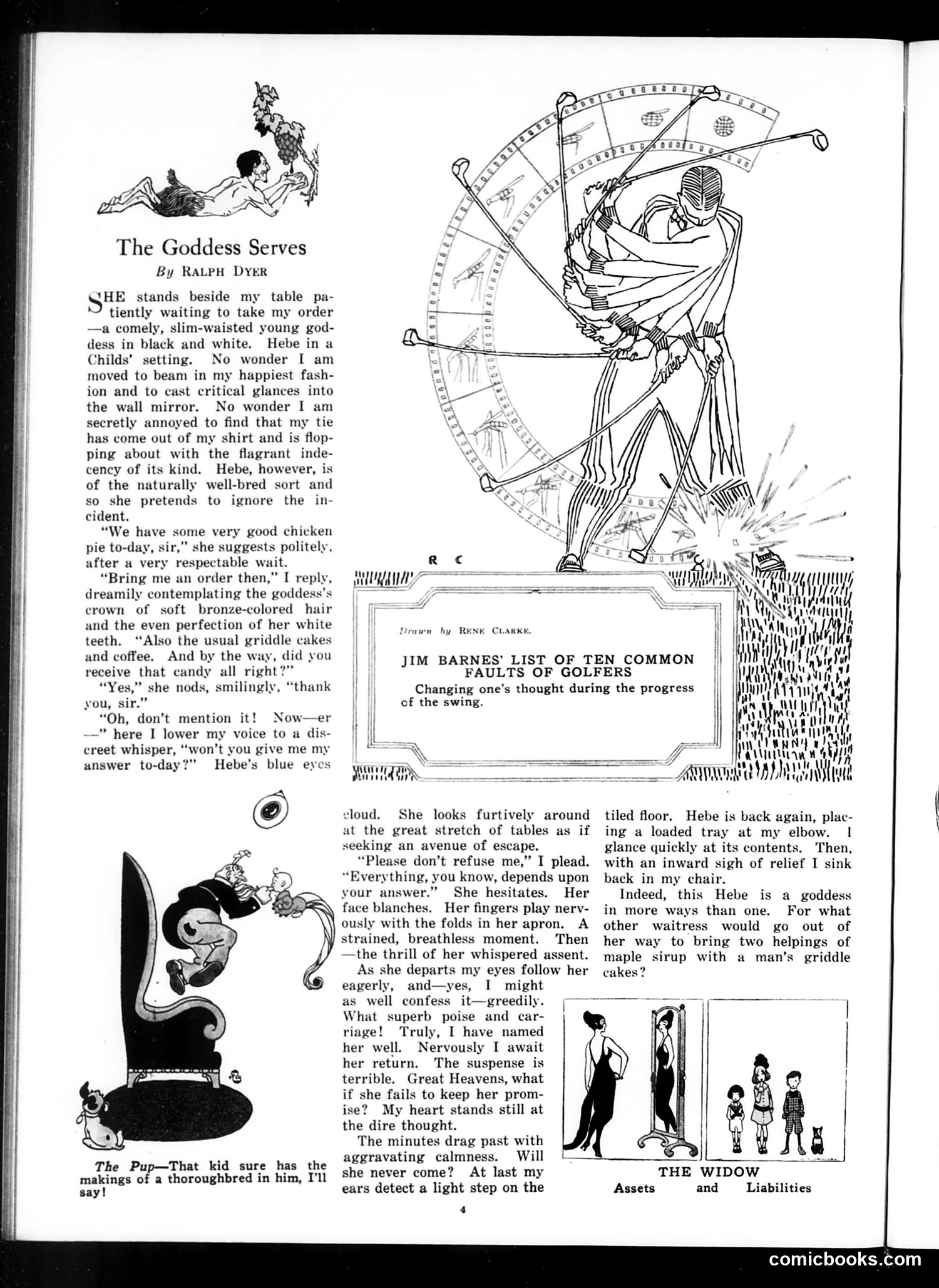
This page contains three distinct pieces: 1. **"The Goddess Serves"** by Ralph Dyer: A humorous short story about a restaurant patron's irritation with an overly fashionable waitress whose shirt keeps escaping from her skirt. The satire targets both the waitress's vanity and the narrator's critical pretension. 2. **"Jim Barnes' List of Ten Common Faults of Golfers"**: An illustrated guide (drawn by René Clarke) depicting golf swing errors. This appears educational rather than satirical. 3. **"The Pup"** and **"The Widow and Liabilities"**: Brief cartoon vignettes about dogs and family situations. The overall page mixes social comedy with practical advice, typical of Judge's content mixing satire with lifestyle humor aimed at early 20th-century middle-class readers.
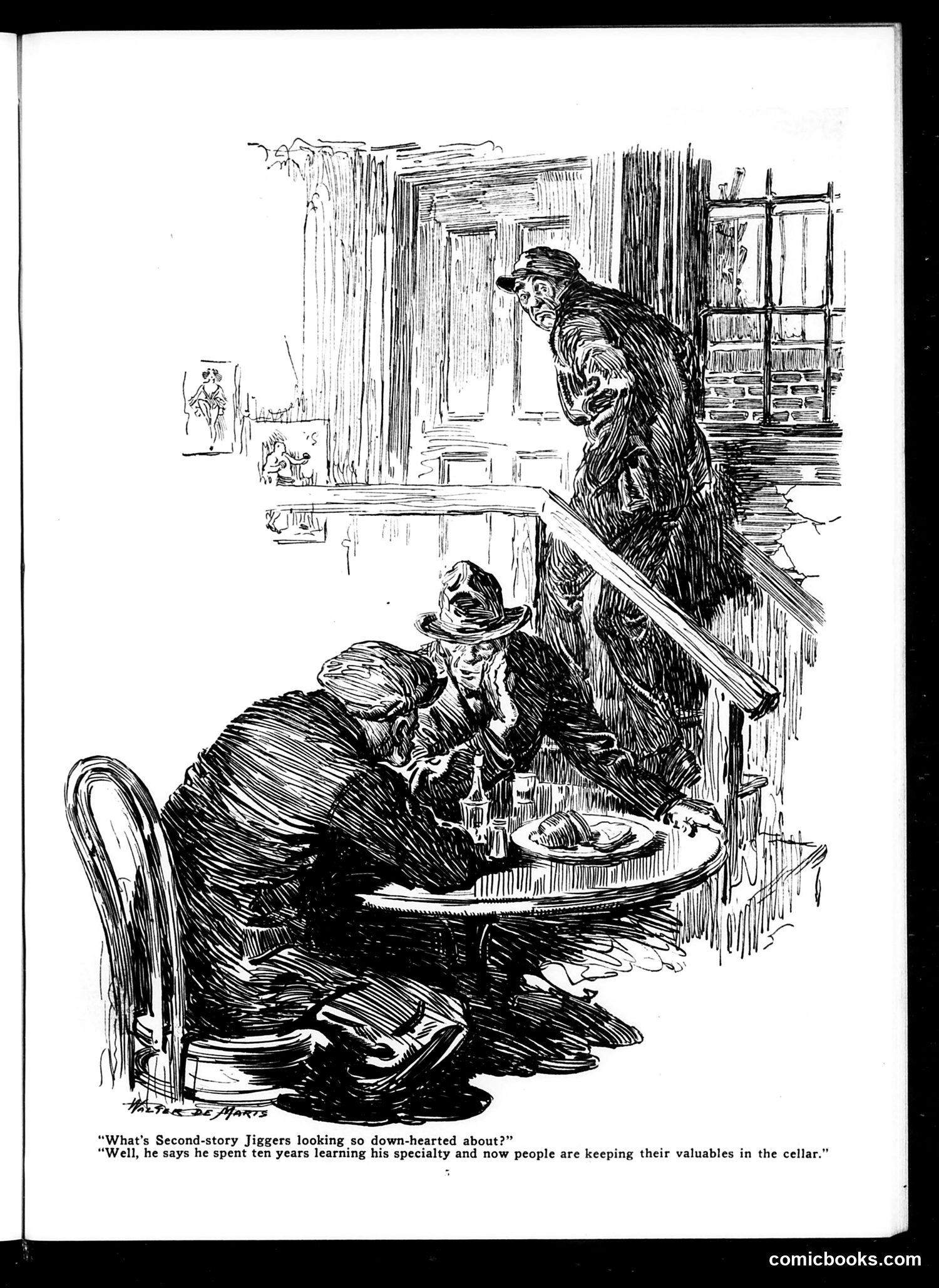
This cartoon satirizes a burglar's complaint about changing theft prevention methods. "Second-story Jiggers" is a burglar specializing in upper-floor break-ins (a "second-story job" was criminal slang for such robberies). The joke mocks his professional obsolescence: he spent a decade mastering his craft—breaking into second-story windows—only to find homeowners have adapted by moving valuables to basement storage, rendering his expertise useless. The satire targets both the burglar's misplaced sense of injured pride and, implicitly, society's ongoing arms race between criminals and self-protection measures. It's a darkly humorous commentary on how criminal "specialization" becomes worthless when targets evolve their defenses. The cartoon assumes readers understood burglar slang and contemporary urban crime concerns.
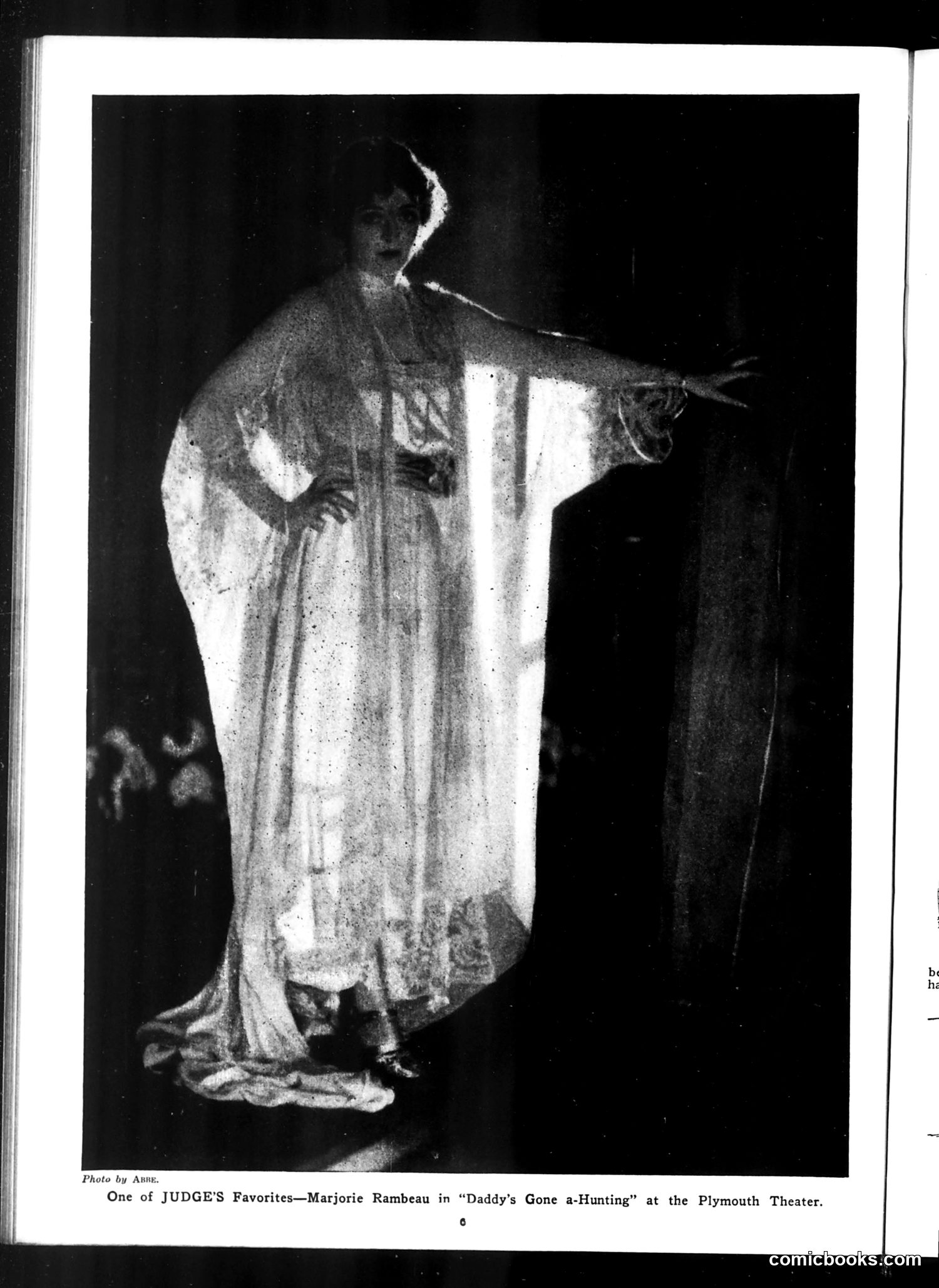
This page features a theatrical photograph rather than a political cartoon. It shows actress Marjorie Rambeau in a scene from the play "Daddy's Gone a-Hunting" at the Plymouth Theater. The image captures her in an elegant, flowing white gown photographed against a dark background in a dramatic pose typical of early 20th-century stage photography. The caption identifies her as "One of JUDGE's Favorites," suggesting the magazine's editors admired her work. This appears to be entertainment coverage rather than satirical commentary—Judge magazine regularly featured theatrical reviews and celebrity photographs alongside its political cartoons. The photograph itself is credited to photographer Anne.
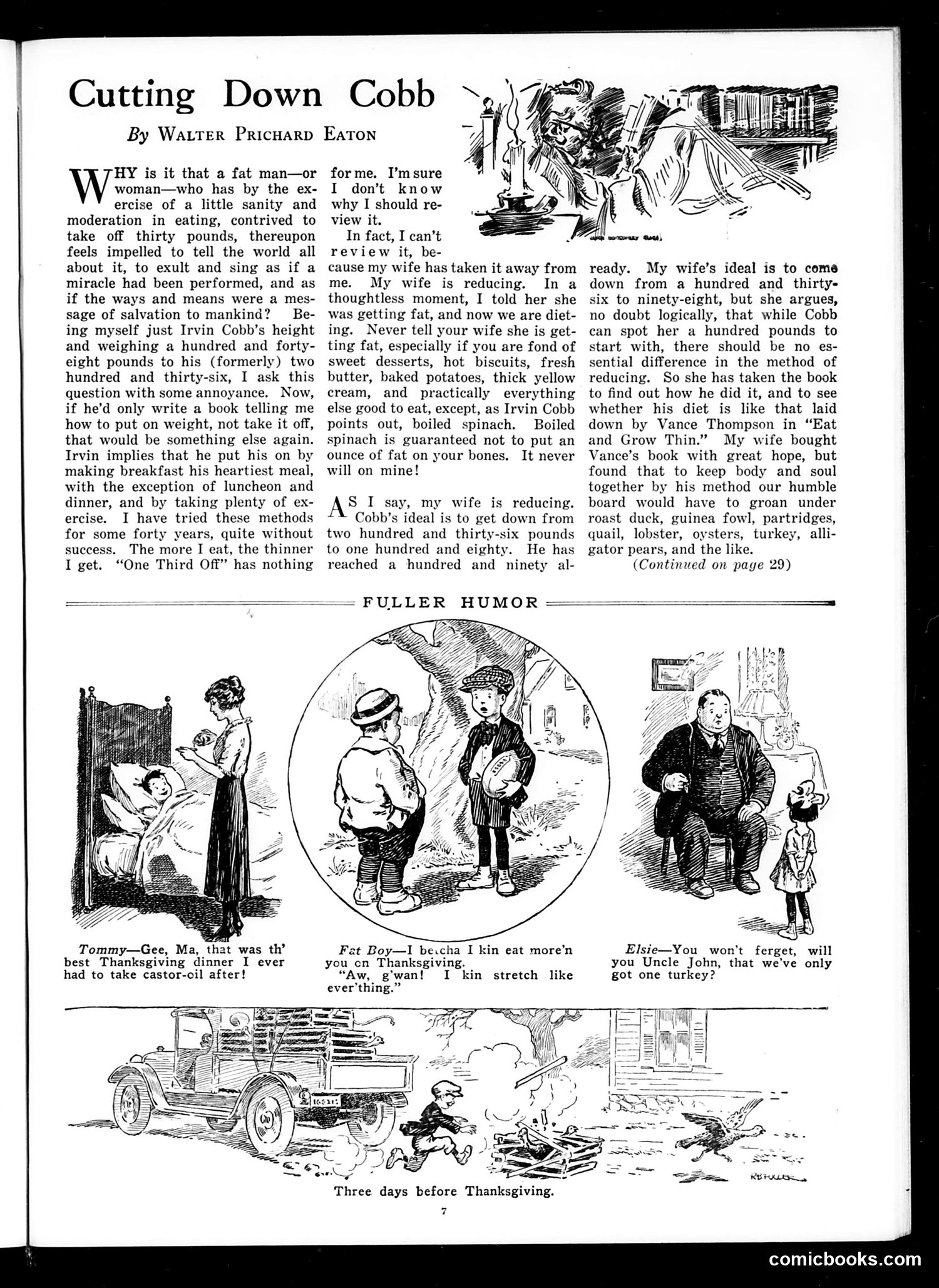
This article satirizes the popular dieting craze sparked by Irvin Cobb's weight-loss book "One Third Off." Cobb, a well-known humorist and writer, had famously reduced from 236 to 190 pounds, and the author (Walter Prichard Eaton) mocks the self-righteous evangelism with which Cobb and others promote their dietary success. The piece's humor centers on the author's complaint that thin people like himself can't gain weight despite eating constantly, while his wife now obsessively follows Cobb's (and Vance Thompson's competing diet book) methods, eliminating desserts and fatty foods from their household. The accompanying "Fuller Humor" cartoons humorously show the domestic consequences: children's exaggerated eating boasts at Thanksgiving, and a girl worried their single turkey won't suffice for Uncle John's visit—reflecting the food scarcity concerns of the pre-1920s period when these diet books were sensation publishing events.
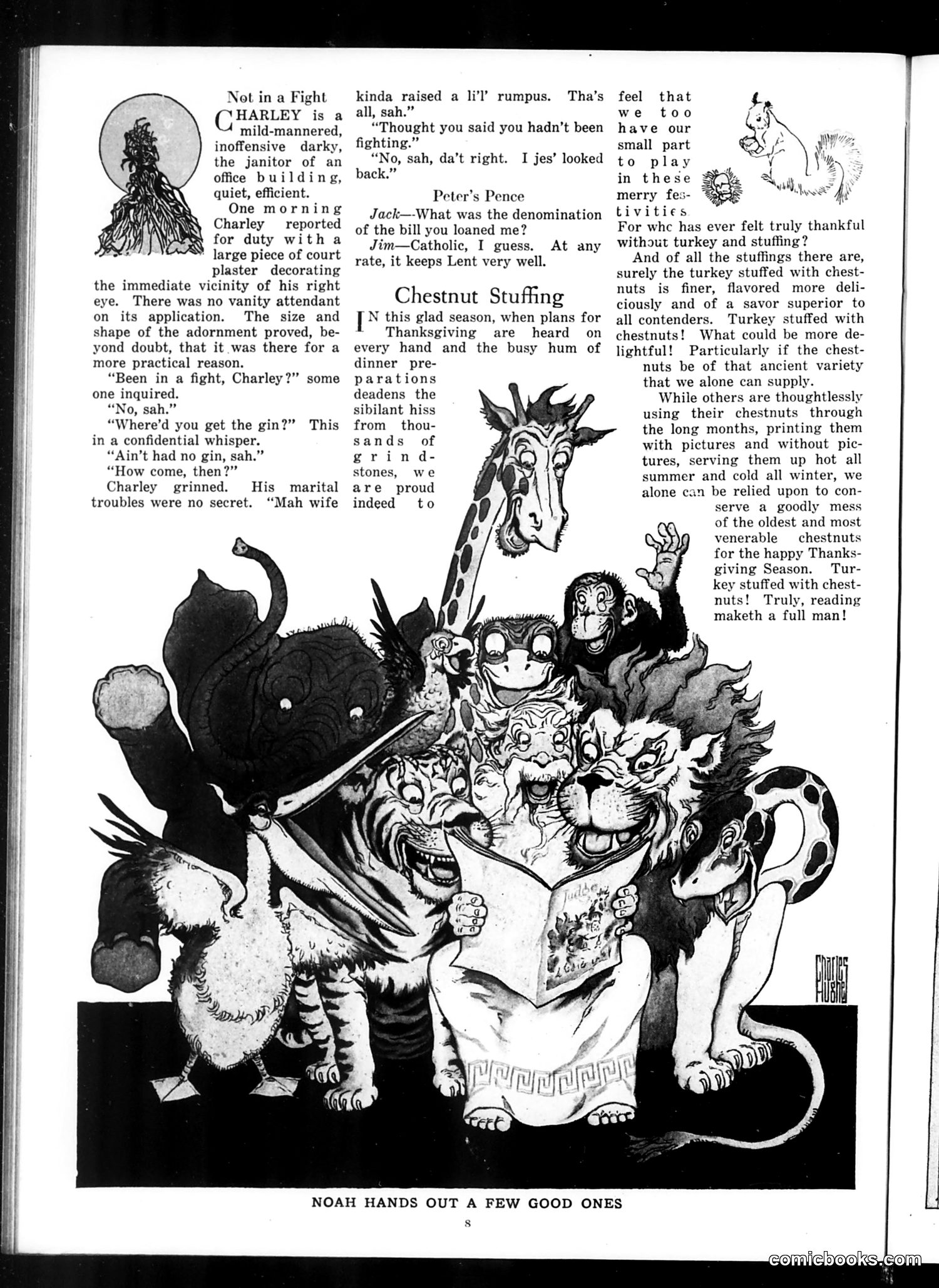
This Judge magazine page contains three satirical items: **"Not in a Fight"**: A racist dialect joke about Charley, a Black office janitor with a black eye. The humor relies on crude stereotypes and minstrelsy conventions—the punchline plays on the distinction between "fighting" and domestic violence from his wife, with phonetic dialect spelling ("Mah wife," "sah," "da't") meant to demean. **"Peter's Pence"**: A brief religious joke. "Peter's Pence" refers to papal donations; the humor suggests a borrowed bill is "Catholic" because it "keeps Lent"—a reference to Catholic fasting practices, implying the money won't be spent/used during Lent. **"Chestnut Stuffing"**: An advertisement disguised as editorial content, promoting chestnuts for Thanksgiving turkey stuffing. The term "chestnut" also means an old, tired joke—creating meta-humor by calling old jokes "chestnuts" while advertising actual chestnuts. The large cartoon at bottom ("Noah Hands Out a Few Good Ones") appears to illustrate these jokes with fantastical animal characters, though its specific reference remains unclear without additional context.
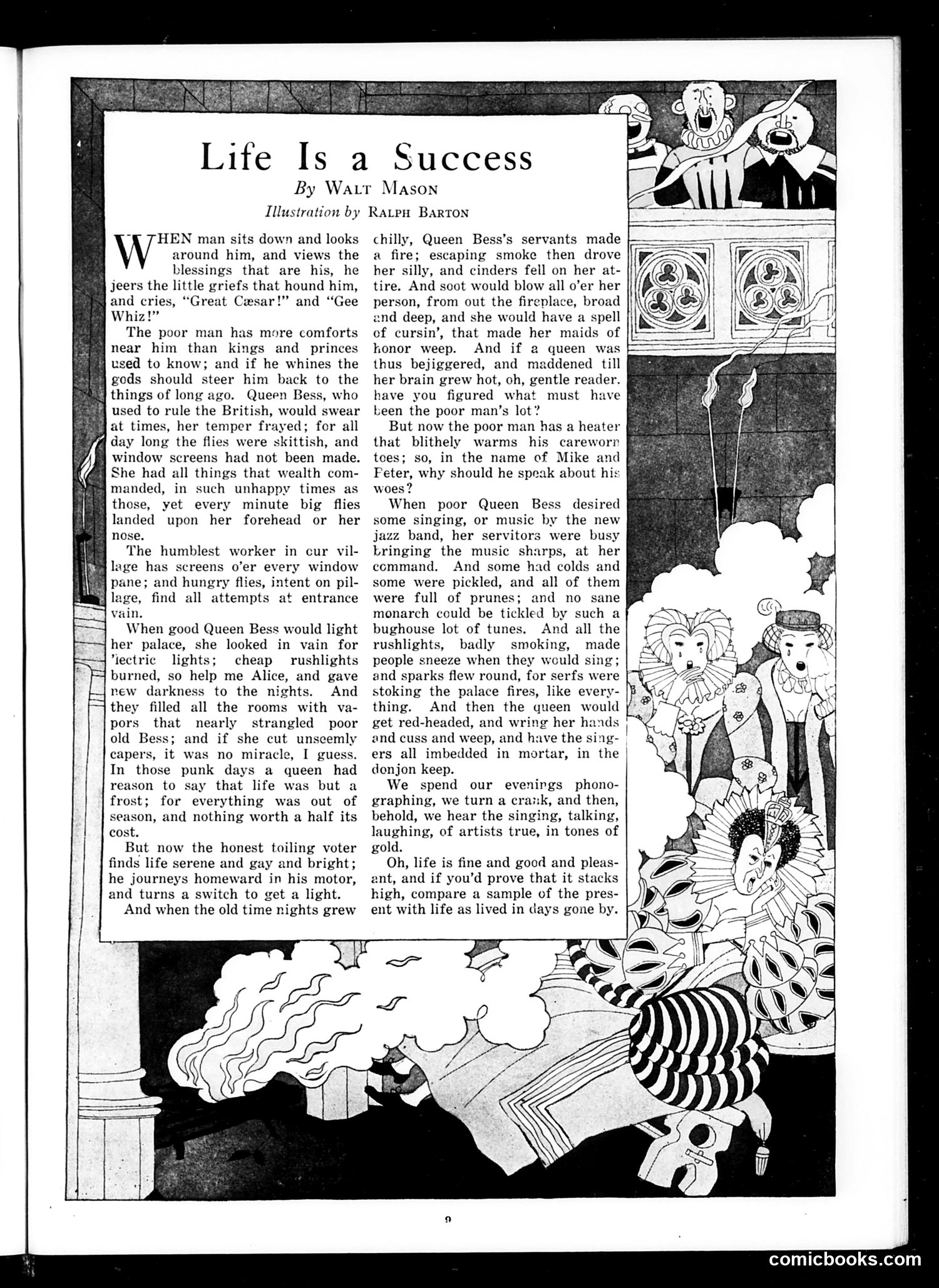
This is a humorous essay-illustration hybrid arguing that modern life (early 20th century) represents genuine progress. The author contrasts the *actual* hardships of historical royalty—specifically **Queen Elizabeth I**—with contemporary working-class comfort. The satire's premise: Queen Bess endured flies, smoky fires, unreliable servants, poor musicians, and primitive lighting, yet complained constantly. By this logic, a modern "honest toiling voter" enjoys electric lights, screened windows, heating, phonographs, and automobiles—genuine luxuries kings once lacked—so he has *no right* to complain about his lot. The underlying message is pro-capitalist and anti-labor-complaint: technological progress has democratized comfort so thoroughly that workers' grievances seem ungrateful. It's a defense of the status quo through historical comparison, suggesting discontent is illogical given modern amenities. The illustrations by Ralph Barton show the contrast between Elizabeth's frustrated court and contemporary leisure activities.
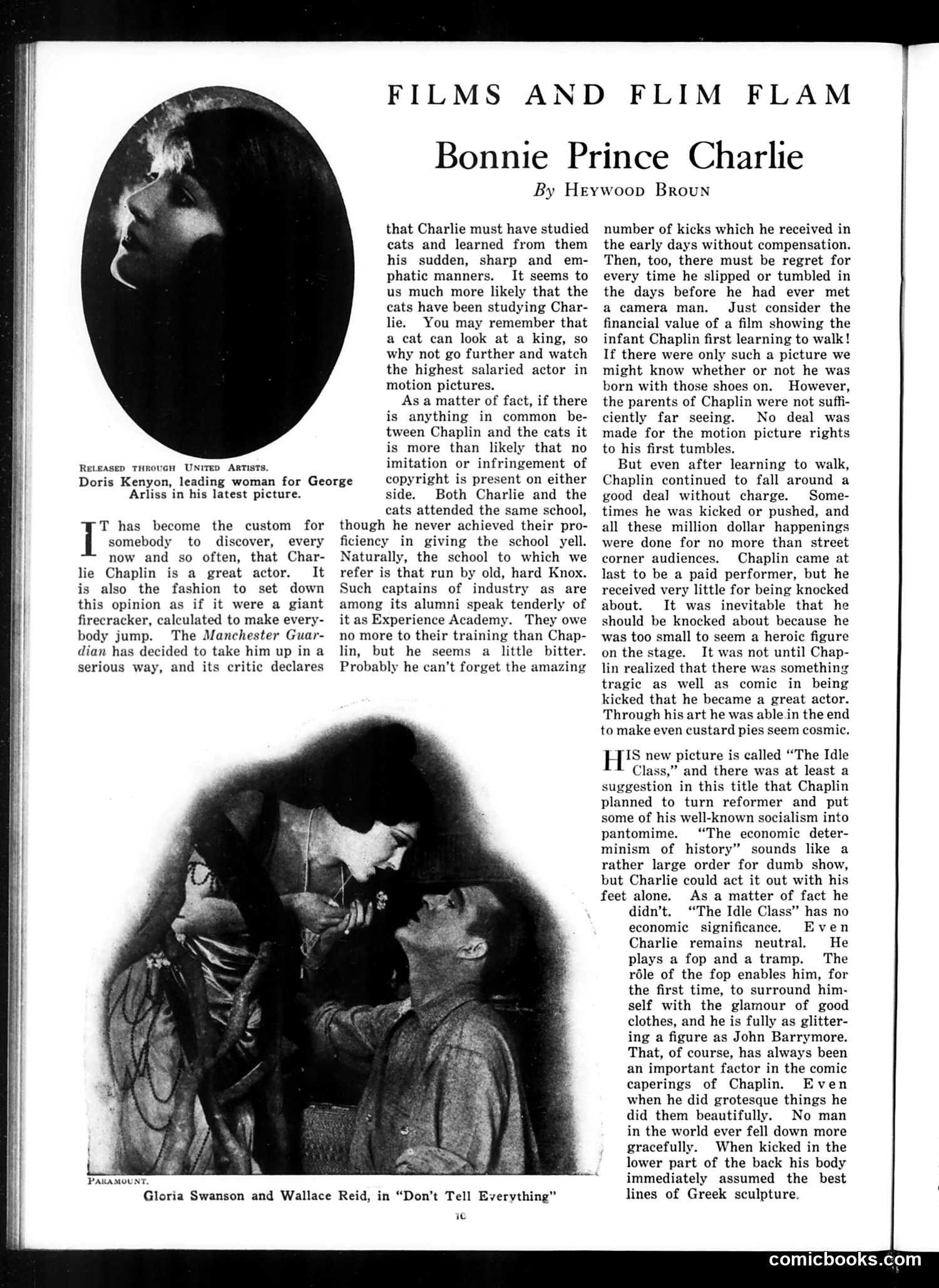
This article by Heywood Broun defends Charlie Chaplin against recent critical praise, specifically addressing a Manchester Guardian piece claiming Chaplin learned his mannerisms from cats. Broun argues the reverse is more likely true. The piece celebrates Chaplin's rise from street performer to serious artist. It notes his early years involved unpaid falls and kicks—later becoming financially valuable through film. Broun argues Chaplin became great by recognizing the tragic dimension of physical comedy, transforming custard pies into something "cosmic." Regarding Chaplin's new film "The Idle Class," Broun notes it lacks the socialist reformism the title might suggest. Instead, Chaplin plays a fop and tramp, allowing him to display elegant movement alongside his trademark graceful pratfalls—his essential artistic gift. The page includes photographs of other silent film stars (Doris Kenyon, Gloria Swanson, Wallace Reid), positioning Chaplin among Hollywood's elite.
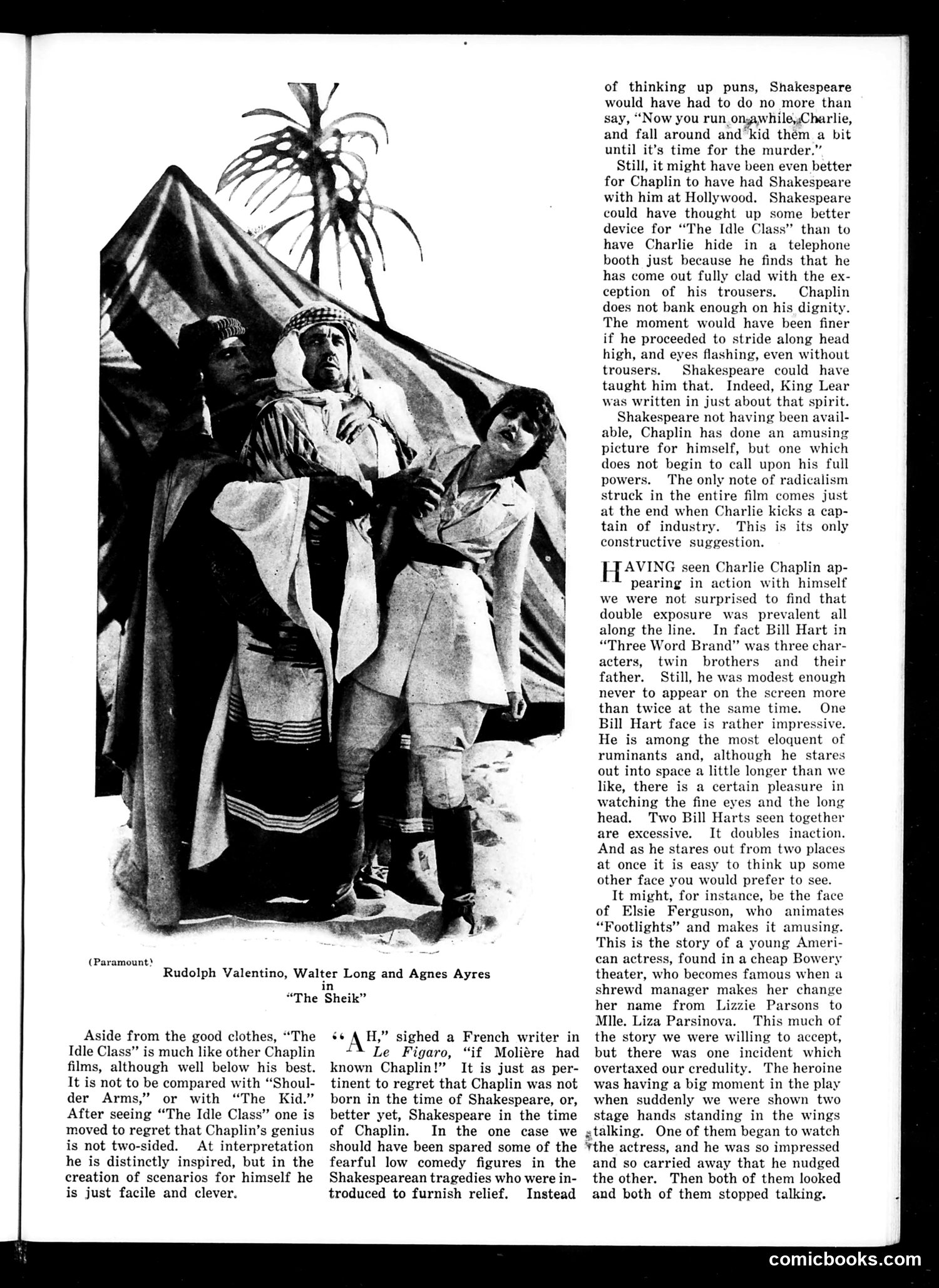
This page reviews three silent films. The main image shows a scene from *The Sheik* (Paramount, starring Rudolph Valentino, Walter Long, and Agnes Ayres)—depicting the exotic, dramatic aesthetic typical of 1920s "sheik" movies that captivated audiences. The text critiques Charlie Chaplin's *The Idle Class*, arguing his creative genius doesn't match his acting talent. The reviewer humorously wishes Shakespeare had collaborated with Chaplin in Hollywood, or vice versa. The satire suggests Chaplin wastes his gifts on trivial scenarios (hiding without trousers) rather than dignified drama. The review also discusses Bill Hart's *Three Word Brand* and Elsie Ferguson's *Footlights*, noting Hart's overuse of double-exposure appears indulgent, while Ferguson's film contains an unbelievable moment where stage hands become distracted watching an actress perform. The tone is sophisticated film criticism with comedic flourishes typical of *Judge* magazine's educated readership.
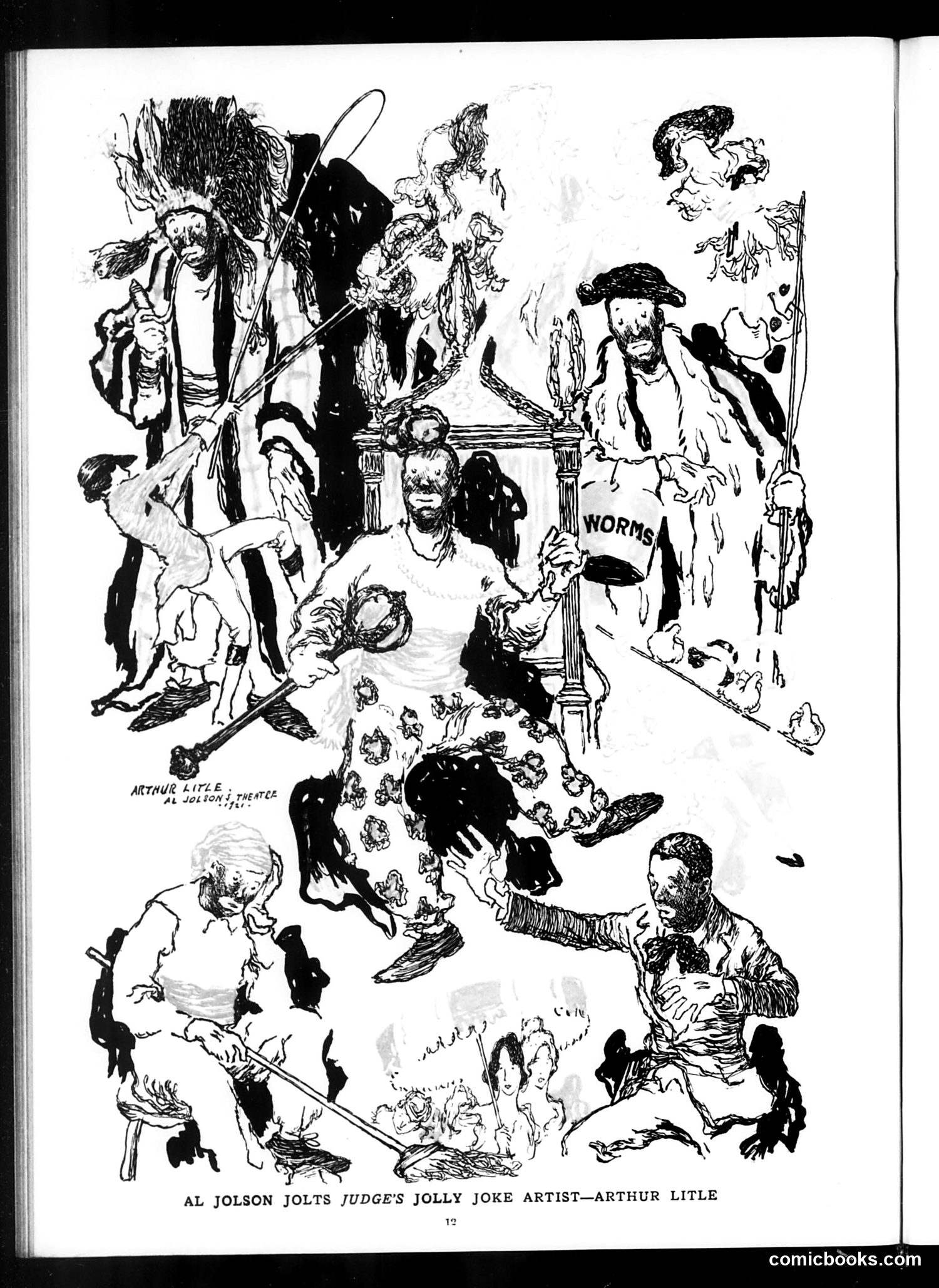
This is a humorous illustration by cartoonist Arthur Little depicting **Al Jolson**, the famous entertainer of the Jazz Age era. The sketch shows Jolson surrounded by various caricatured figures in exaggerated poses—some appearing to be judges, performers, or audience members reacting with animated gestures. The satire likely plays on Jolson's notorious reputation for physical comedy and energetic performances. The title's wordplay ("Jolts," "Jolly," "Jokes") suggests the piece is celebrating or parodying his vigorous, over-the-top stage presence and how he "jolted" or energized audiences and critics alike. The chaotic composition with multiple figures reflects Jolson's theatrical chaos and manic stage energy that defined his entertainment style during this period.
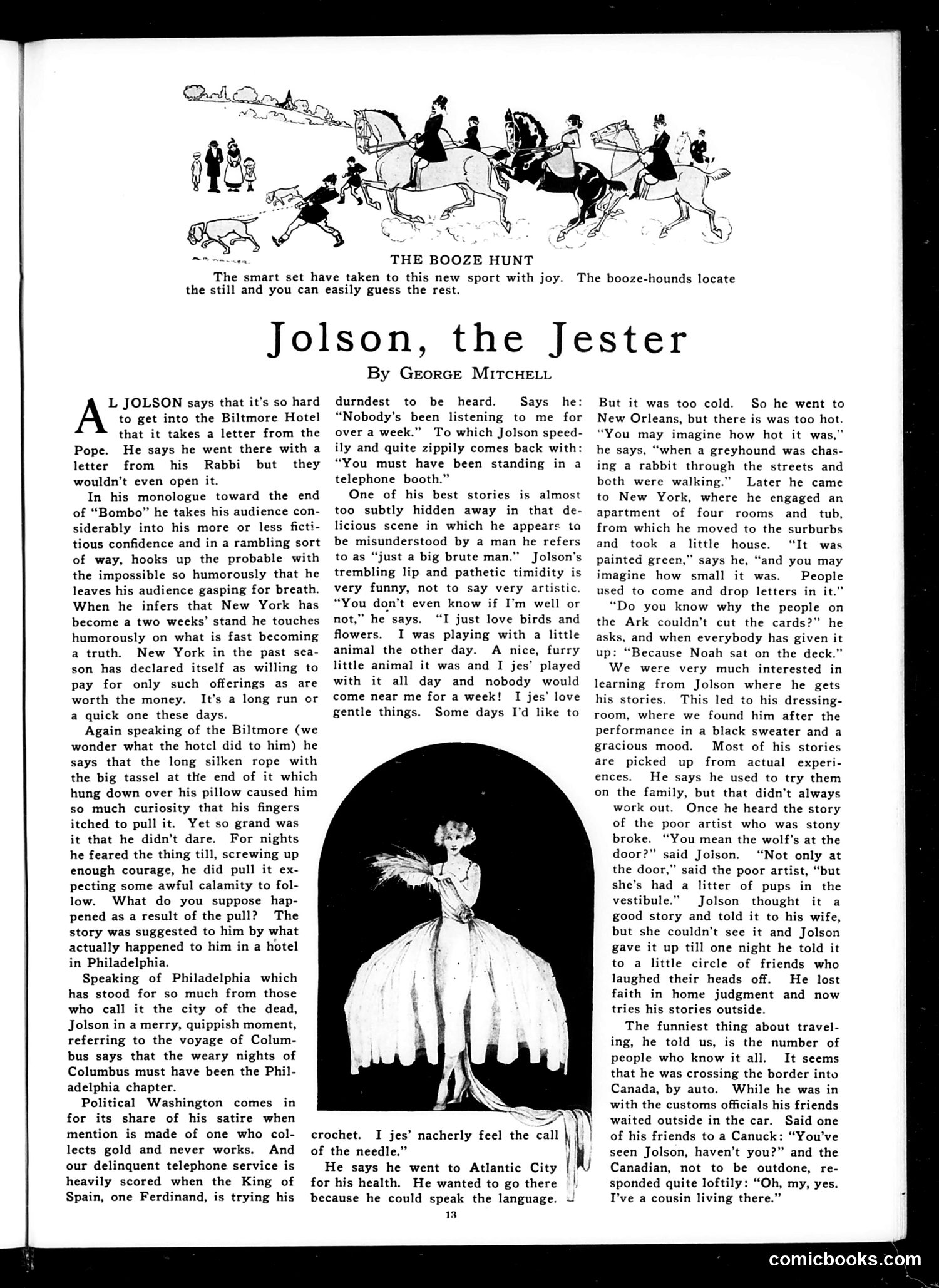
This page features a profile of **Al Jolson**, the famous entertainer, written by George Mitchell. The article humorously recounts Jolson's anecdotes and jokes from his stage performances, particularly from his show "Bombo." The satire targets various subjects through Jolson's comedy: - **Washington politics**: mocking those who "collect gold and never work" - **Telephone service**: critiqued as unreliable - **Philadelphia**: joked about as a dead, boring city - **New York theater**: observed as now only supporting worthwhile productions (a reflection of 1920s economic conditions) - **High-end hotels**: poking fun at luxury and pretension The illustration at top shows "The Booze Hunt"—a satirical reference to **Prohibition**, depicting wealthy socialites searching for illegal alcohol ("stills"), treating it as fashionable sport. Jolson emerges as a clever, self-deprecating performer whose humor blends the ridiculous with social observation.
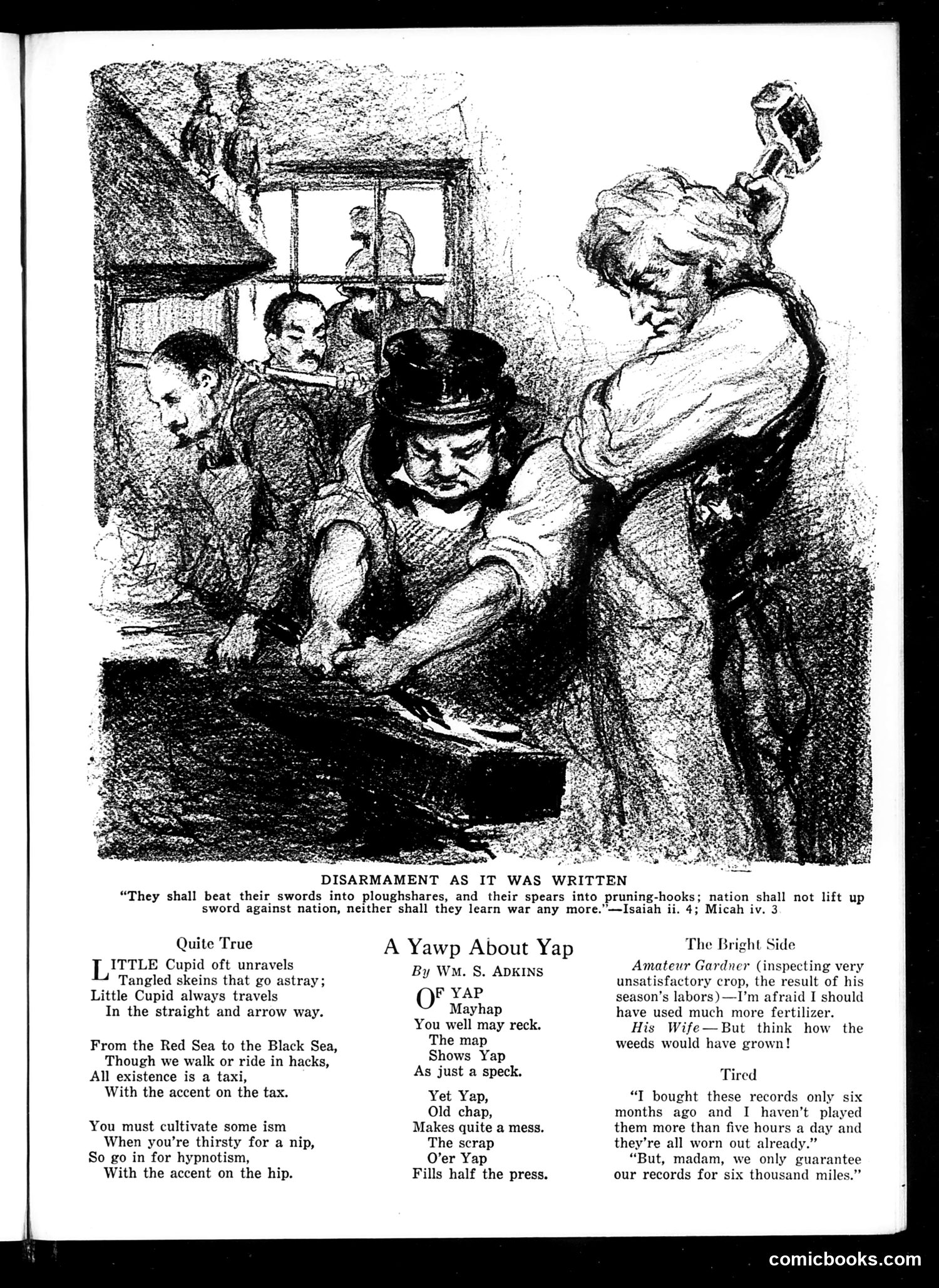
**The Main Cartoon:** The top illustration depicts "Disarmament As It Was Written," showing officials or politicians attempting to enforce the Biblical promise that nations will "beat their swords into ploughshares" (Isaiah 2:4). The satire suggests that despite noble peace rhetoric, actual disarmament remains difficult or impossible—the cartoon implies governments aren't genuinely pursuing peace. **"A Yawp About Yap":** This poem mocks disproportionate media coverage of disputes over Yap, a small Pacific island (shown as "just a speck" on maps). The satire critiques how newspapers sensationalize minor geopolitical squabbles, filling "half the press" with coverage of trivial matters. **Humor pieces below** include light satirical commentary on modern life: consumer complaints about record durability, gardening failures blamed on insufficient fertilizer, and jokes about taxation and social customs. The page reflects post-WWI American skepticism about peace negotiations and media sensationalism.
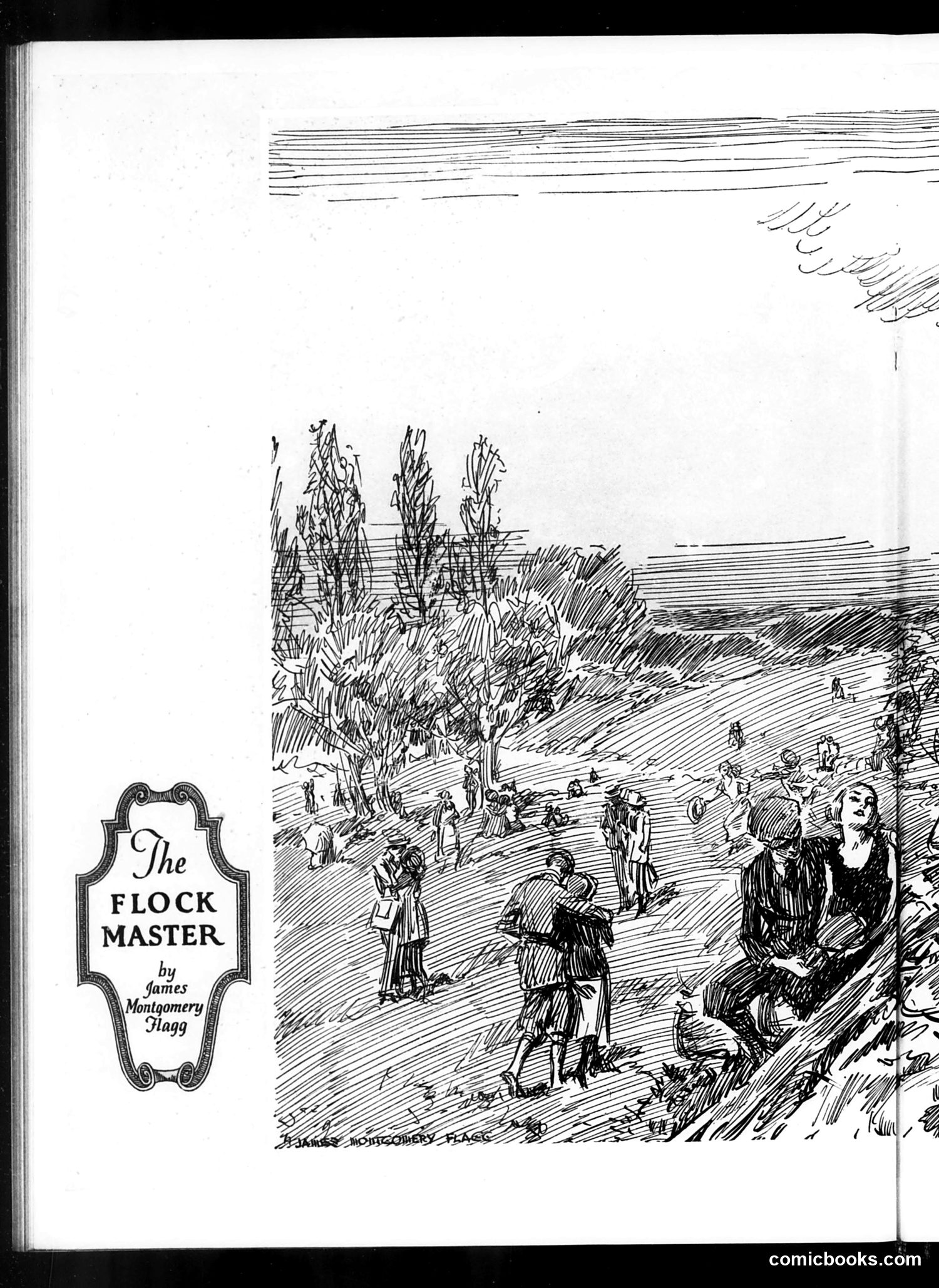
This is a title page for a serialized story by renowned illustrator James Montgomery Flagg. The illustration depicts a pastoral scene with numerous figures scattered across a hillside landscape with trees. The composition suggests a shepherd or authority figure managing a group of people—likely the "flock" referenced in the title. Without additional context from the story itself, the specific satirical meaning is unclear. However, Flagg's work often critiqued social hierarchies and group dynamics. The title's metaphor of people as a "flock" to be "mastered" may satirize conformity, blind obedience to authority, or herd mentality in society. The leisurely, somewhat disorganized gathering could suggest commentary on how crowds behave when "managed" by a central figure.
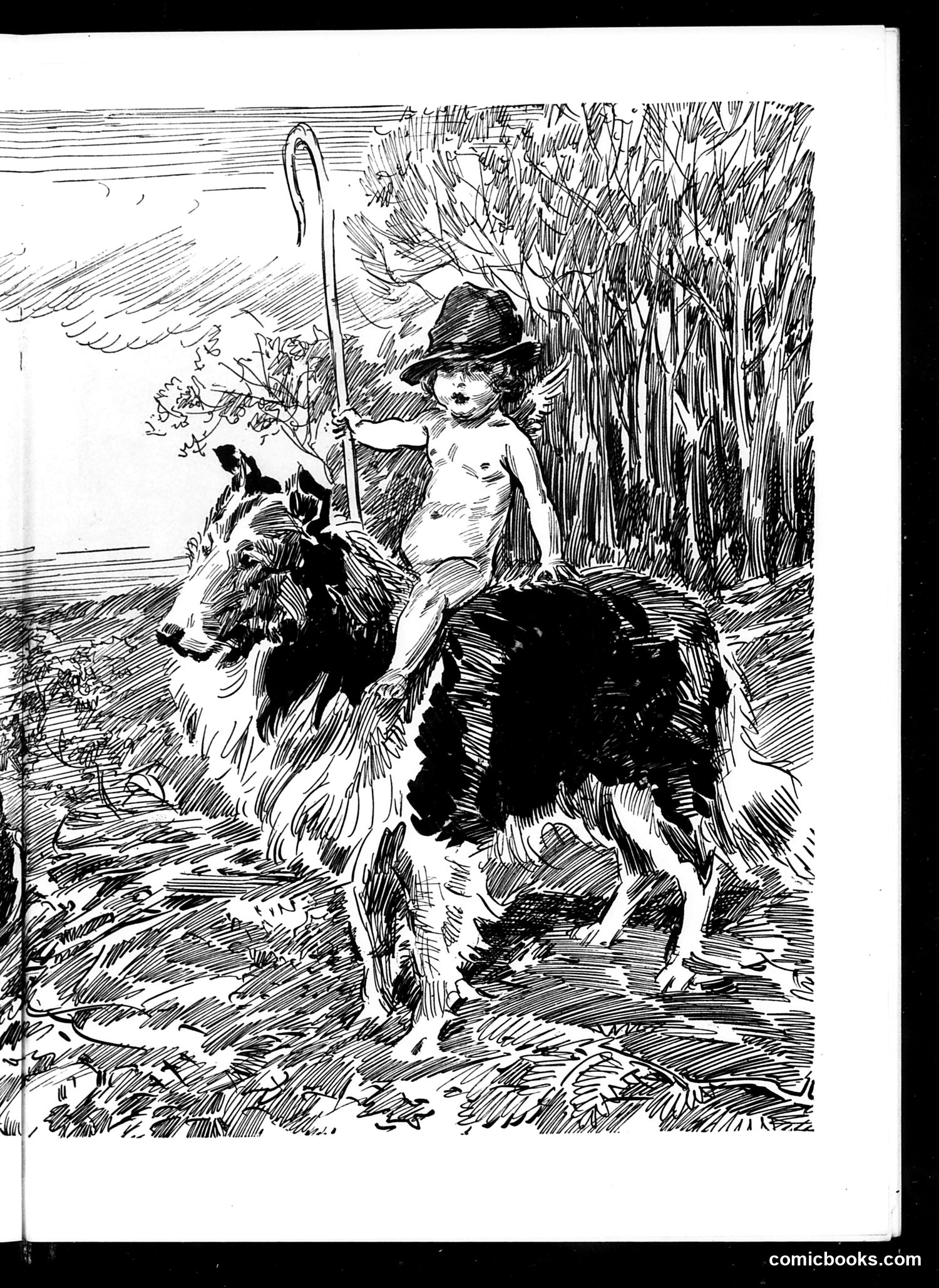
I can see this is a pen-and-ink illustration from *Judge* magazine showing a nude or partially nude cherub-like child figure wearing a hat and holding a fishing rod, sitting on what appears to be a large dog or similar animal near water and reeds. However, the OCR text provided is largely illegible and contains only formatting characters and website information—no actual article text or caption that would explain the cartoon's satirical meaning, political references, or intended joke. Without visible caption text or publication details (date, title, author), I cannot reliably identify what specific social or political commentary this illustration makes. To properly explain its significance to a modern reader, I would need the accompanying text that *Judge* would have provided.
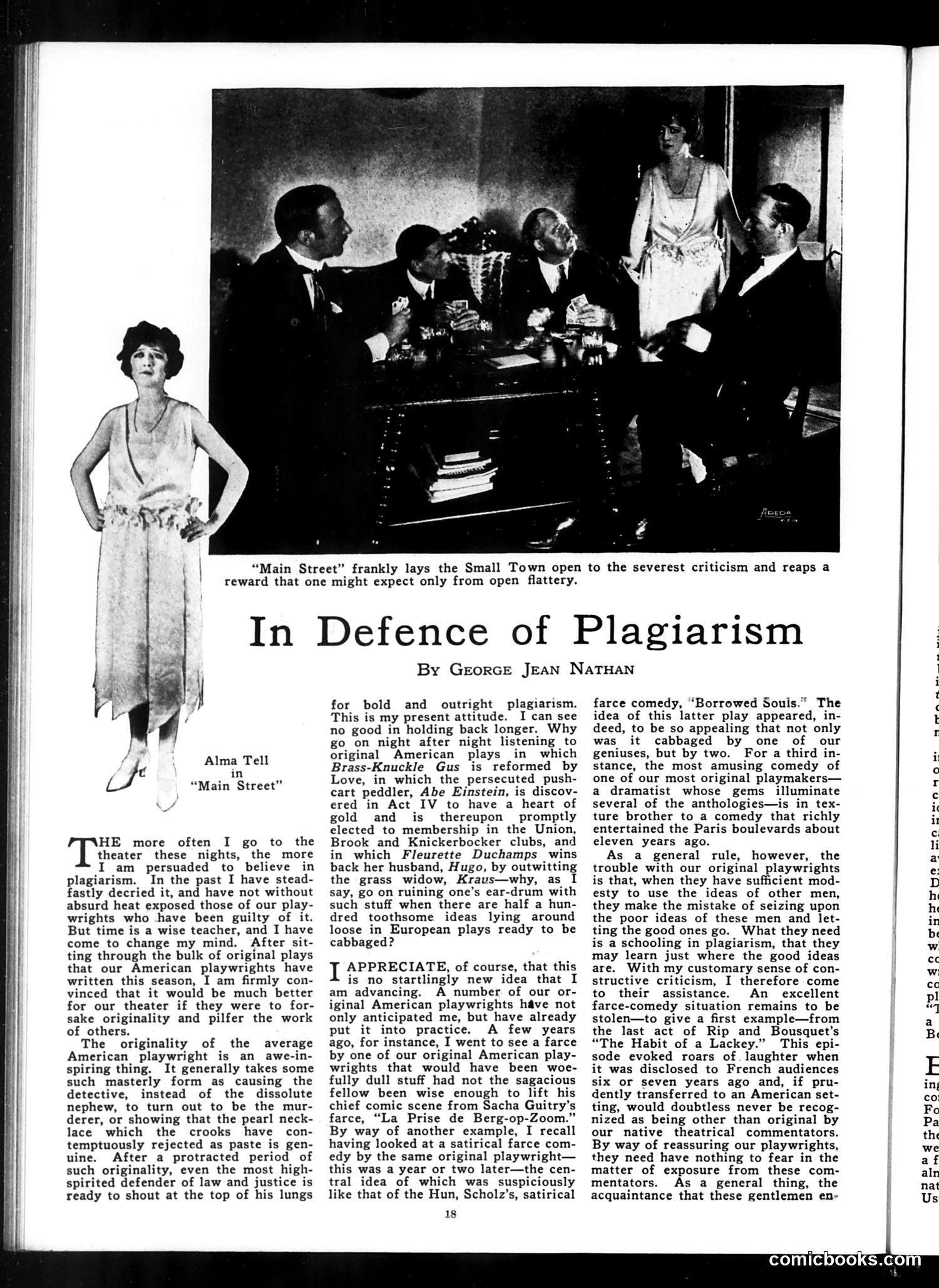
This article by George Jean Nathan sarcastically **defends theatrical plagiarism** against American playwrights' poor original work. The accompanying photo shows a scene from "Main Street" (adapted from Sinclair Lewis's novel), starring actress Alma Tell. Nathan's argument: American playwrights produce predictably bad "original" plays—reforming gangsters named "Brass-Knuckle Gus," Jewish peddlers discovering hearts of gold and joining exclusive clubs, grass widows winning back husbands through wit. He cites specific examples of American playwrights actually stealing from successful European farces (Sacha Guitry, Scholz) and argues they should continue this practice **but steal better ideas**. The satire mocks both American theatrical mediocrity and the hypocrisy of praising originality while rewarding derivative work. It's essentially saying: plagiarize if you must, but at least plagiarize from quality sources, not from each other's failures.
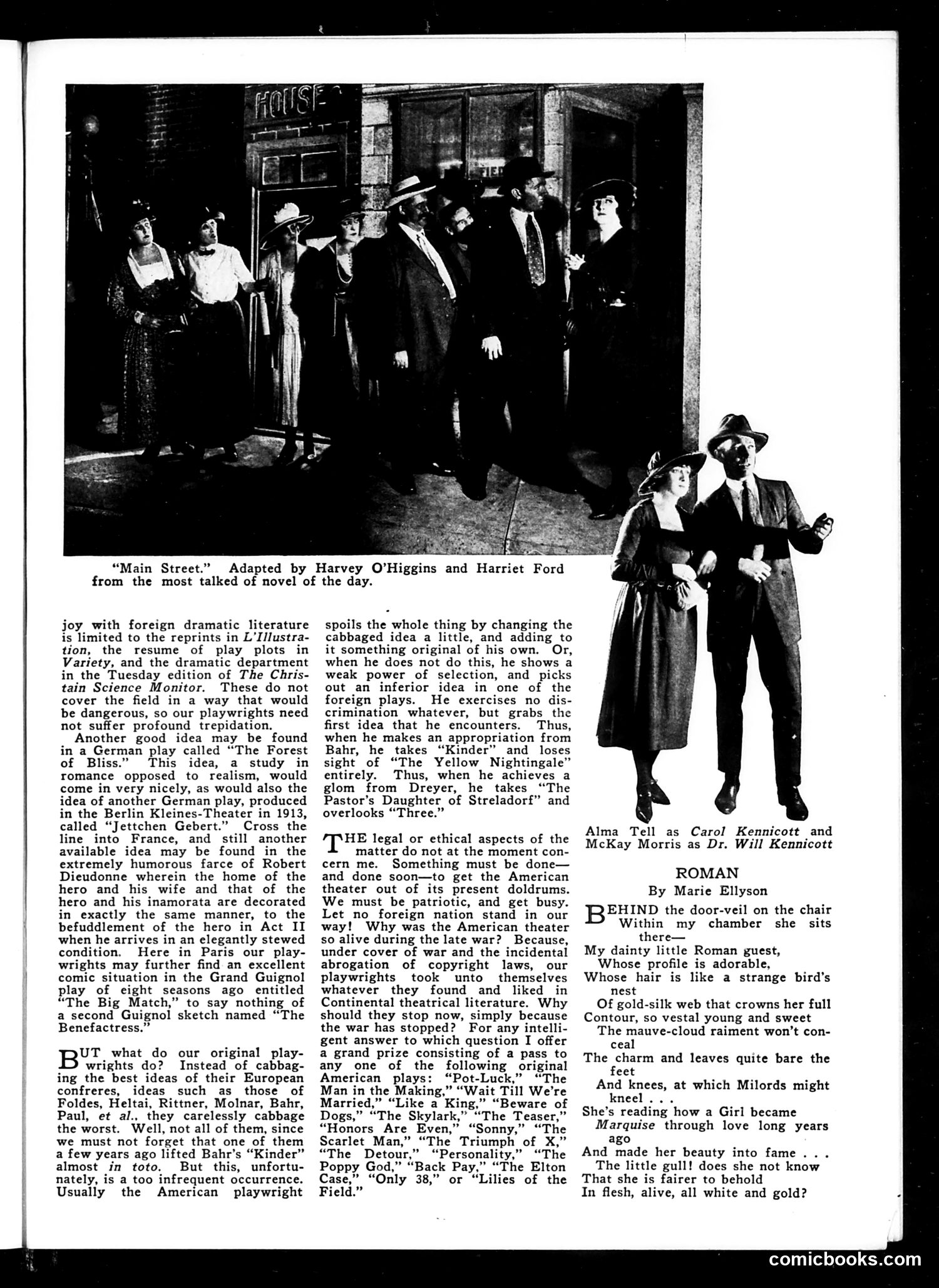
This page discusses American playwrights' practice of adapting foreign plays—what the author calls "cabbagging" (stealing). The upper text sarcastically argues that playwrights should continue appropriating European dramatic works, especially since copyright laws were suspended during WWI, allowing them free access to Continental theater. The image shows a scene from "Main Street," adapted from Sinclair Lewis's famous 1920 novel, which critiques small-town American conformity. The photograph depicts a street scene with formally dressed figures gathered outside a "House" establishment. The author's point: American playwrights lack originality and discrimination, selecting inferior foreign plays rather than quality ones. He sardonically suggests they should continue stealing ideas since it temporarily revitalized American theater during wartime. The irony targets both the playwrights' laziness and Americans' cultural dependence on European sources—a debate about artistic authenticity and national cultural identity relevant in the 1920s.
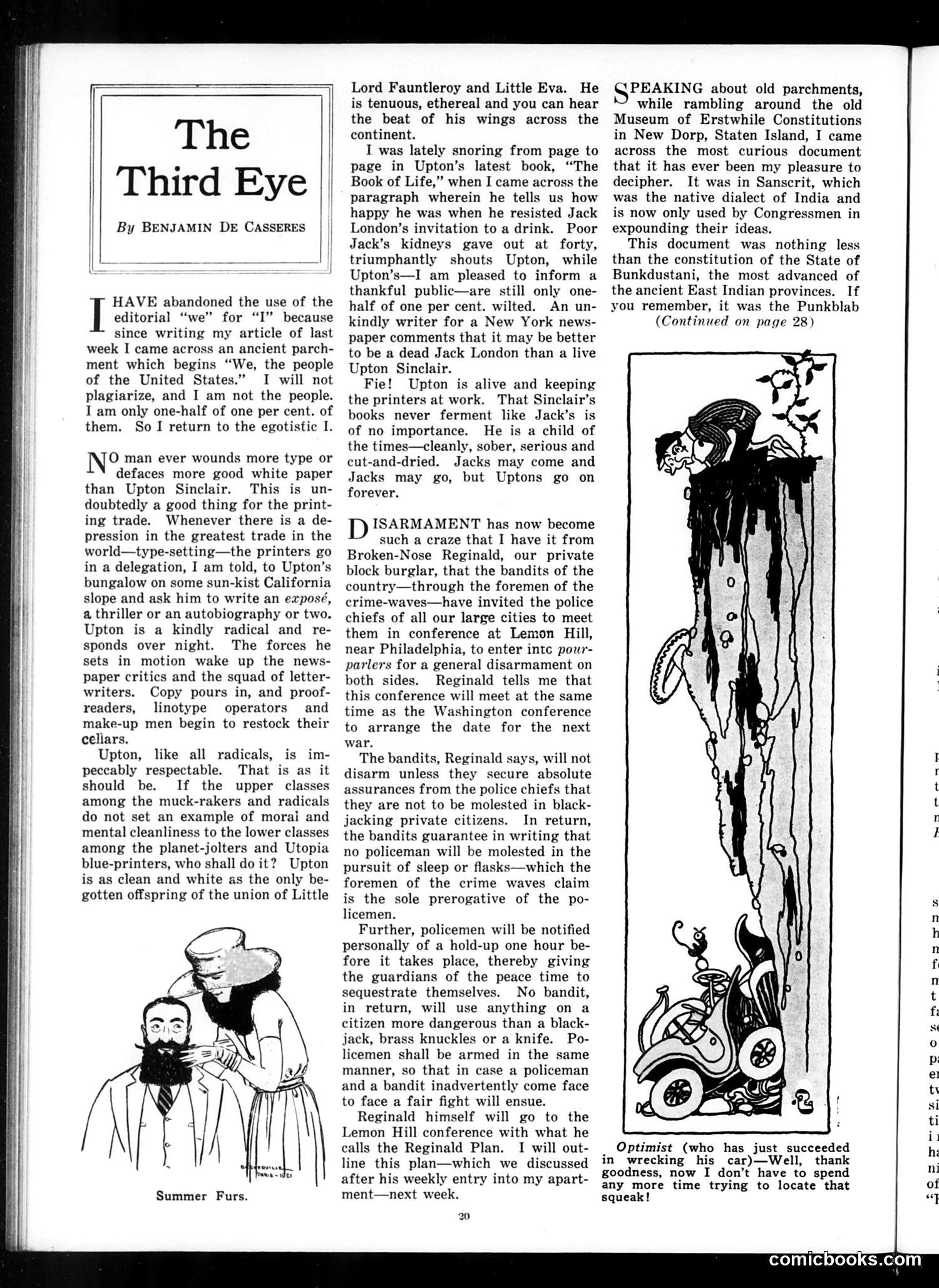
This page contains two distinct satirical pieces: **"The Third Eye" essay** mocks radical muckraker **Upton Sinclair**, praising his prolific writing while subtly ridiculing his self-righteousness. The author contrasts Sinclair's pristine moral posturing with **Jack London**, who died at 40 from alcohol-related illness. Sinclair boasts his kidneys remain "only one-half of one per cent. wilted"—a jab at his sanctimonious superiority. The "Lord Fauntleroy and Little Eva" comparison depicts Sinclair as an ethereal, overly refined radical. **The "Reginald Plan" satire** mocks disarmament conferences (likely referencing post-WWI peace efforts) by imagining bandits and police negotiating a "general disarmament" treaty at Lemon Hill, Pennsylvania. The absurdist humor: criminals demand immunity from arrest in exchange for limiting violence to blackjacks and brass knuckles. It satirizes the era's optimistic but seemingly naive disarmament negotiations as equally foolish—criminals and cops can no more peacefully coexist than nations can. Both pieces employ hyperbolic wit to critique Progressive-era idealism.
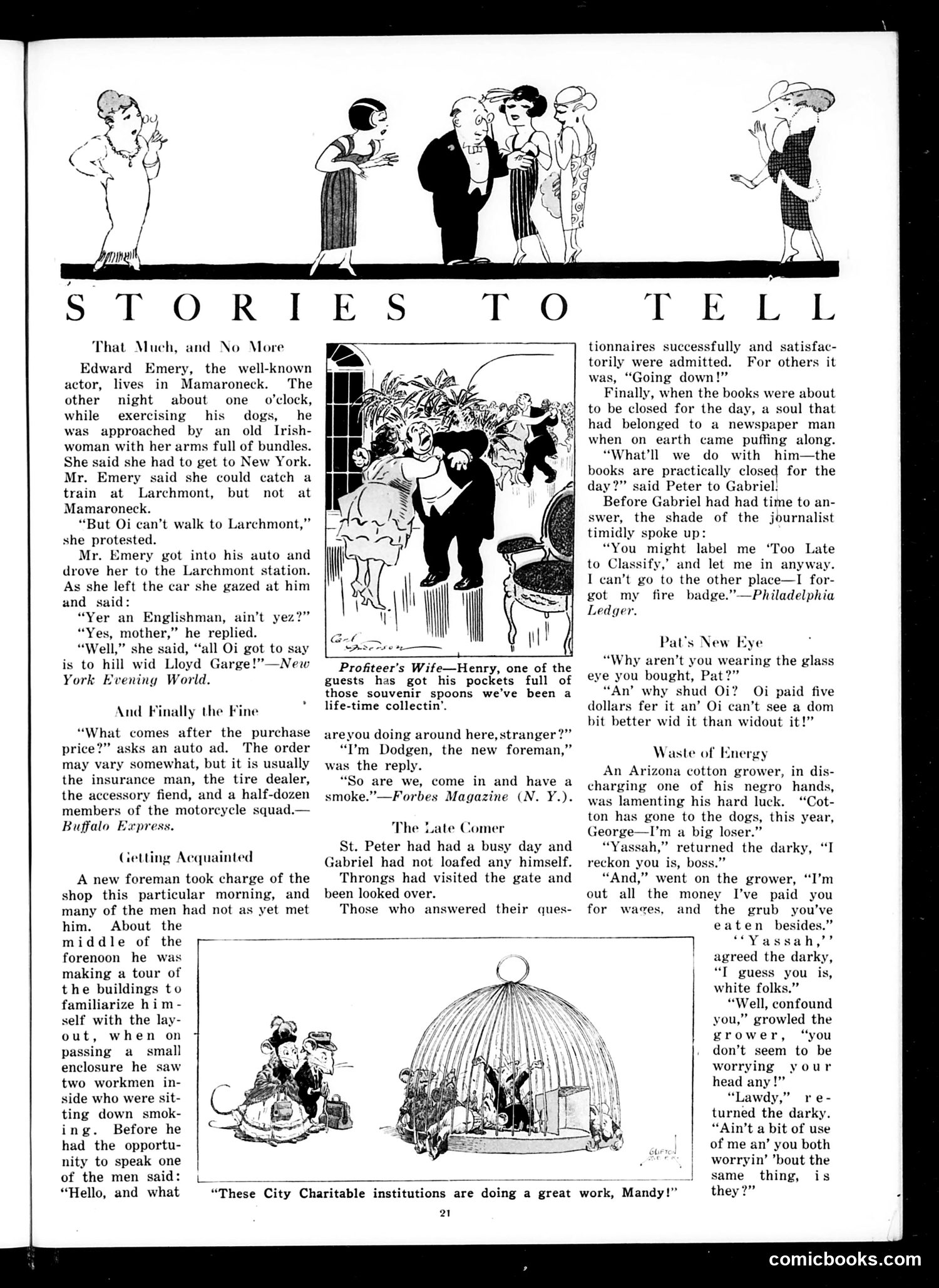
This page collects several short humorous anecdotes typical of early 20th-century American humor magazines. **Key content:** - **"That Much, and No More"**: Actor Edward Emery helps an Irish woman, who repays his kindness by insulting Lloyd George (British Prime Minister), assuming he's English. The joke plays on Irish-British animosity and quick ethnic assumptions. - **Auto industry satire**: Mocks hidden costs of car ownership beyond purchase price—insurance, tires, accessories, and traffic fines ("motorcycle squad"). - **"The Late Comer"**: A deceased journalist arrives at heaven's gates after closing time, joking he should be labeled "Too Late to Classify" and referencing his missing "fire badge"—likely satirizing journalists' reputation for dishonesty or hell-worthiness. - **"Pat's New Eye"**: Irish character finds his purchased glass eye provides no actual improvement, mocking both Irish frugality and false solutions. - **Cotton grower story**: Features racial stereotypes common to the era, with a Black worker's logical rebuttal to his employer's complaint. The page exemplifies period humor relying heavily on ethnic caricatures and class-based jokes.
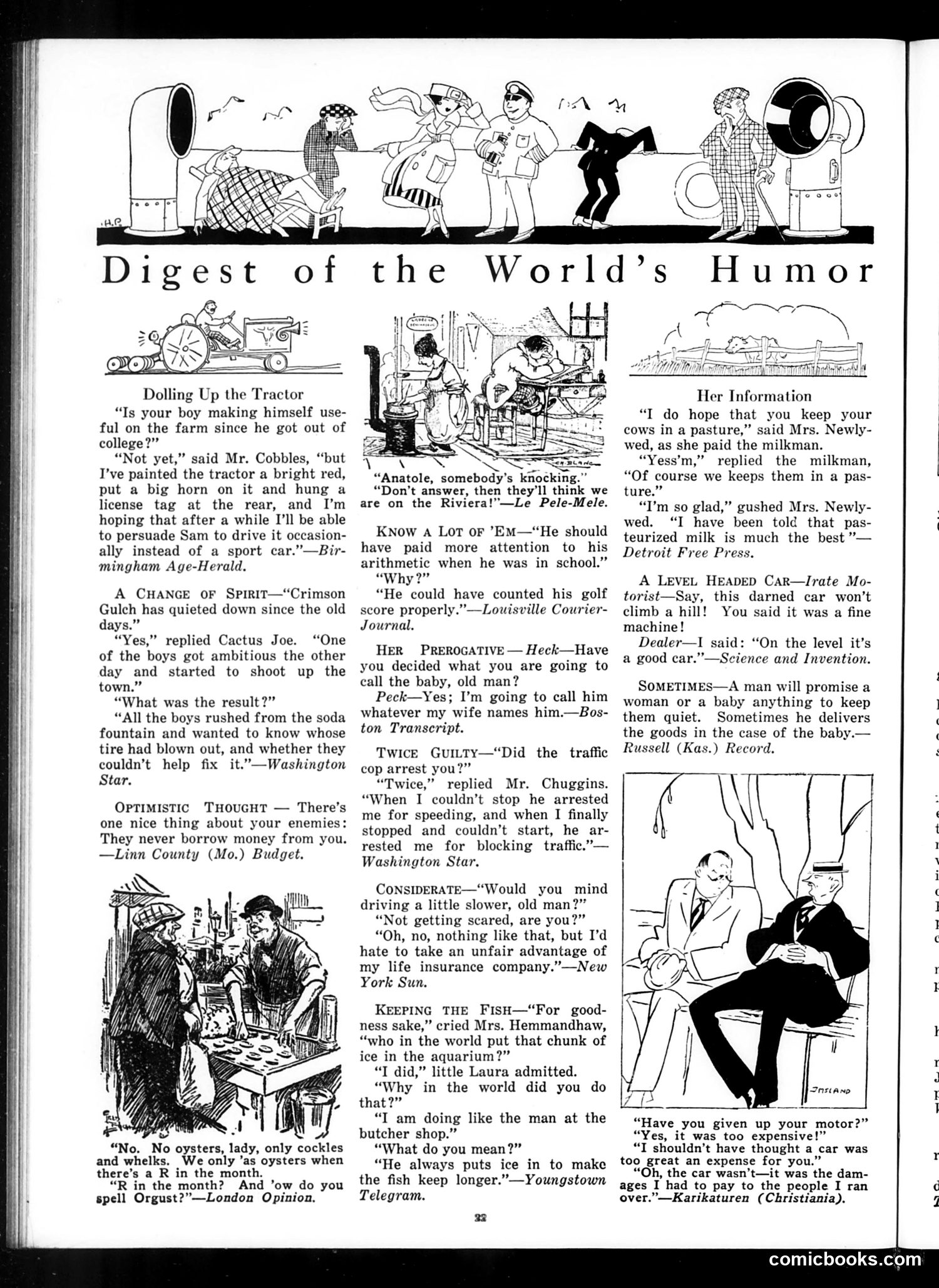
This is a humor digest page featuring short jokes and anecdotes from various sources, reflecting early 20th-century American and international satirical sensibilities. **Key themes:** - **Rural/urban divide**: "Dolling Up the Tractor" jokes about a college boy preferring a "sport car" to farm work—mocking generational disconnect and modernization anxieties. - **Automobile culture**: Multiple jokes about cars, traffic cops, and motorists reflect the disruptive novelty of automobiles in society. - **Gender roles**: "Her Prerogative" and "Her Information" stereotypes wives as decision-makers and the "newly-wed" as ignorant about domestic matters. - **Class humor**: Oyster-eating protocols, insurance worries, and servant interactions appear throughout. - **Innocent humor**: "Keeping the Fish" depicts a child's logic error—putting ice in an aquarium to preserve fish like butcher's meat. The page captures period anxieties about technology, modernization, and changing social structures through gentle, observational comedy.
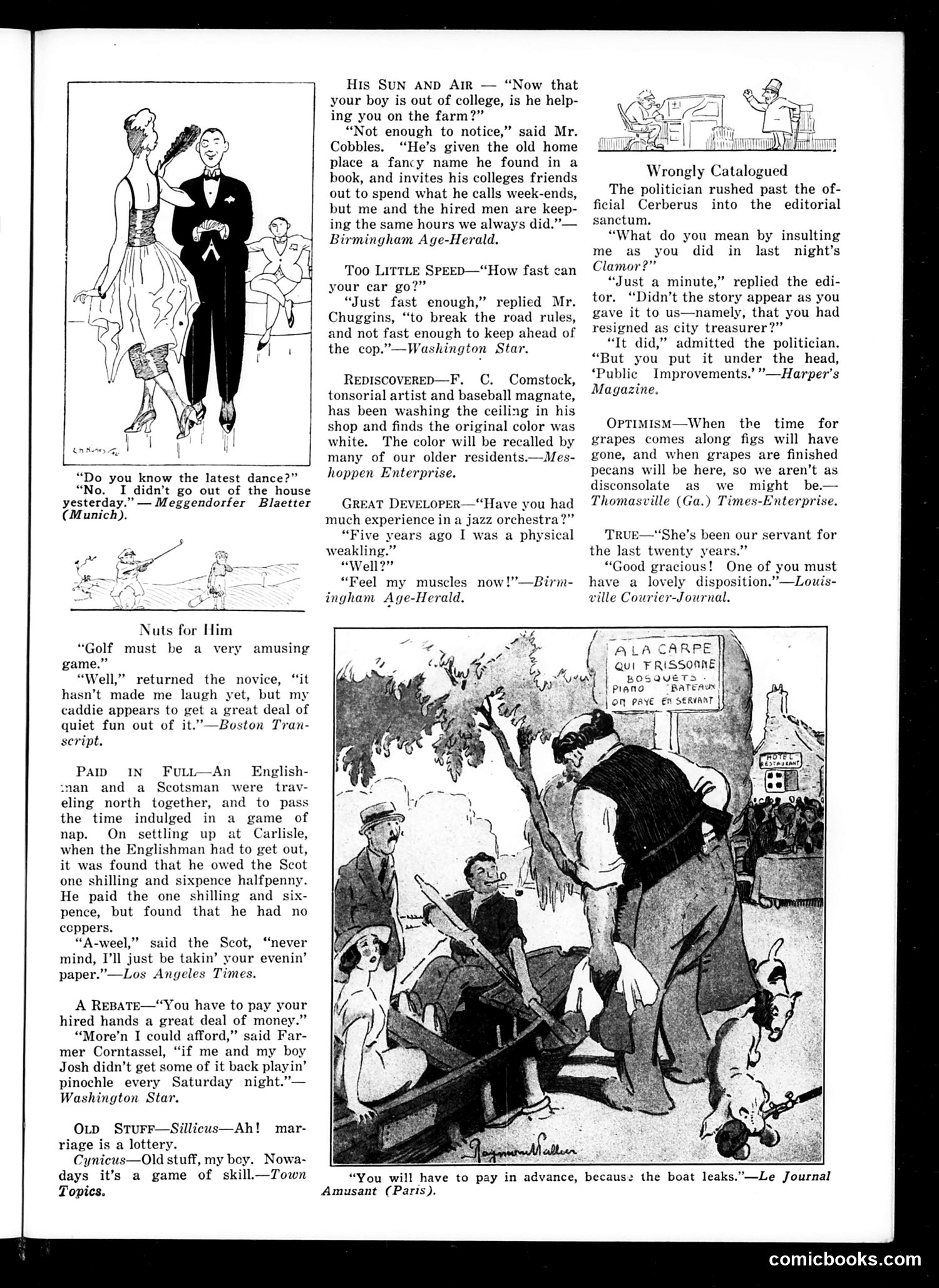
This page collects brief humorous anecdotes from various American and European newspapers, arranged as a humor digest typical of Judge's format. **Key satires include:** - **"His Sun and Air"**: Mocks wealthy college graduates who return to their family farms with pretentious airs, renaming the property with fancy names and hosting "week-ends" for college friends while contributing little actual labor. - **"Too Little Speed"**: A joke about automobiles fast enough to violate traffic laws but not fast enough to outrun police—reflecting early 20th-century frustration with new motor vehicle regulations. - **"Wrongly Catalogued"**: A politician is embarrassed when his resignation gets filed under "Public Improvements," implying his departure actually improves the city. - **The cartoons** feature social commentary on marriage-as-skill, golf, and maritime travel. Most items satirize class pretension, new technologies (cars, jazz), and human nature generally rather than targeting specific political figures or events.
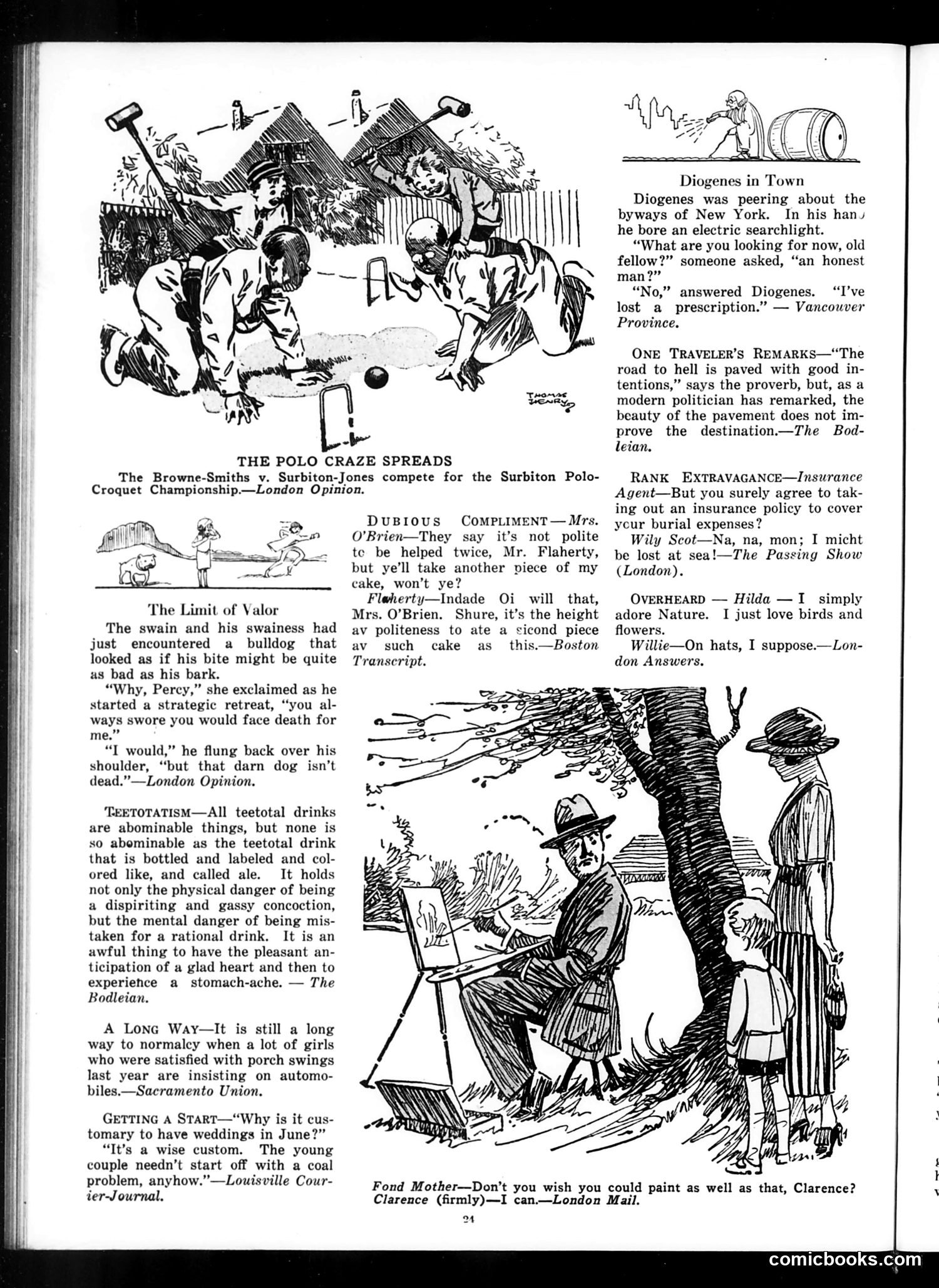
This page contains multiple short jokes and cartoons typical of early 20th-century American satirical magazines. **"The Polo Craze Spreads"** mocks the wealthy's obsession with fashionable sports—here, middle-class people attempting polo-croquet, suggesting the trend has become ridiculous and widespread among those imitating the upper class. **"The Limit of Valor"** jokes about romantic pretense: a man claiming he'd "face death" for his girlfriend abandons her when encountering a bulldog, admitting the dog isn't actually dead—cowardly logic that undercuts masculine bravado. Other brief items satirize social conventions: teetotalers drinking non-alcoholic "ale" and being fooled; young women demanding automobiles after previously accepting porch swings (mocking changing expectations); and the irony of politicians paving roads to hell with good intentions. **"Diogenes in Town"** references the ancient Greek philosopher searching for an honest man, updated to modern New York where the character has lost a prescription instead—suggesting modern dishonesty or absurdity replaces philosophical concerns. The humor relies on observational comedy about class, courtship, and social change.
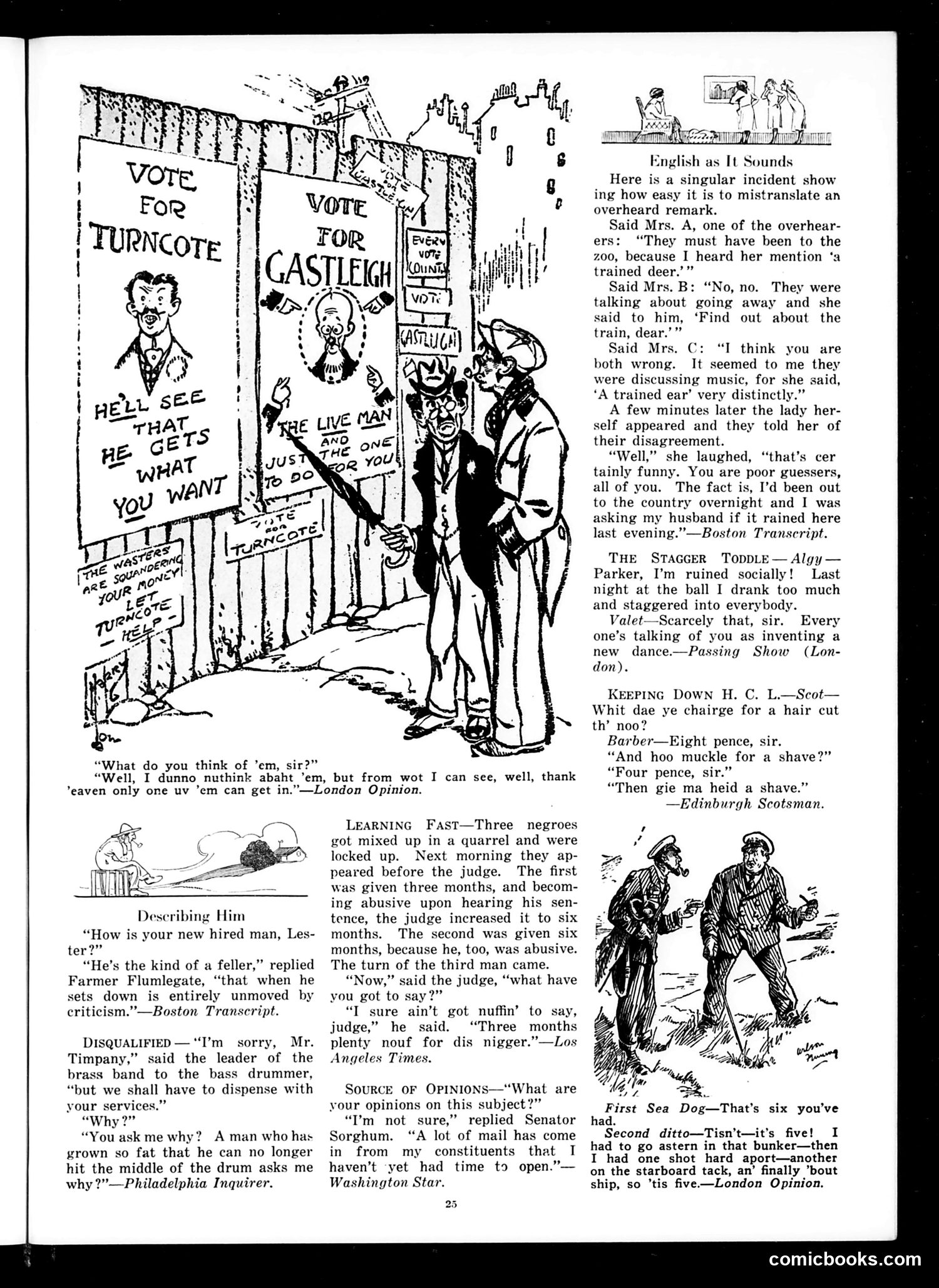
This page from *Judge* contains multiple brief satirical anecdotes rather than a single political cartoon. The main cartoon depicts a British election scene (likely early 20th century) with two candidates—Turncote and Castleigh—competing for votes, with posters promising voters will "get what you want." The satire mocks political flip-flopping and empty campaign promises. The remaining content consists of short humor pieces: - **"English as It Sounds"**: satirizes mishearing—three women misinterpret "it rained here" as "trained deer," "train, dear," and "trained ear" - **"Describing Him"**: jokes about an unflappable farmhand - **"Disqualified"**: mocks an overly-fat drummer who can't hit his drum - **"Learning Fast"**: stereotypical racial humor about Black defendants - **"Source of Opinions"**: lampoons a senator who bases opinions on unopened constituent mail - **Various brief quips**: on Scottish bargaining, naval counting, and social dancing The page reflects *Judge*'s satirical approach to contemporary politics, social customs, and class commentary typical of early 20th-century American humor magazines.
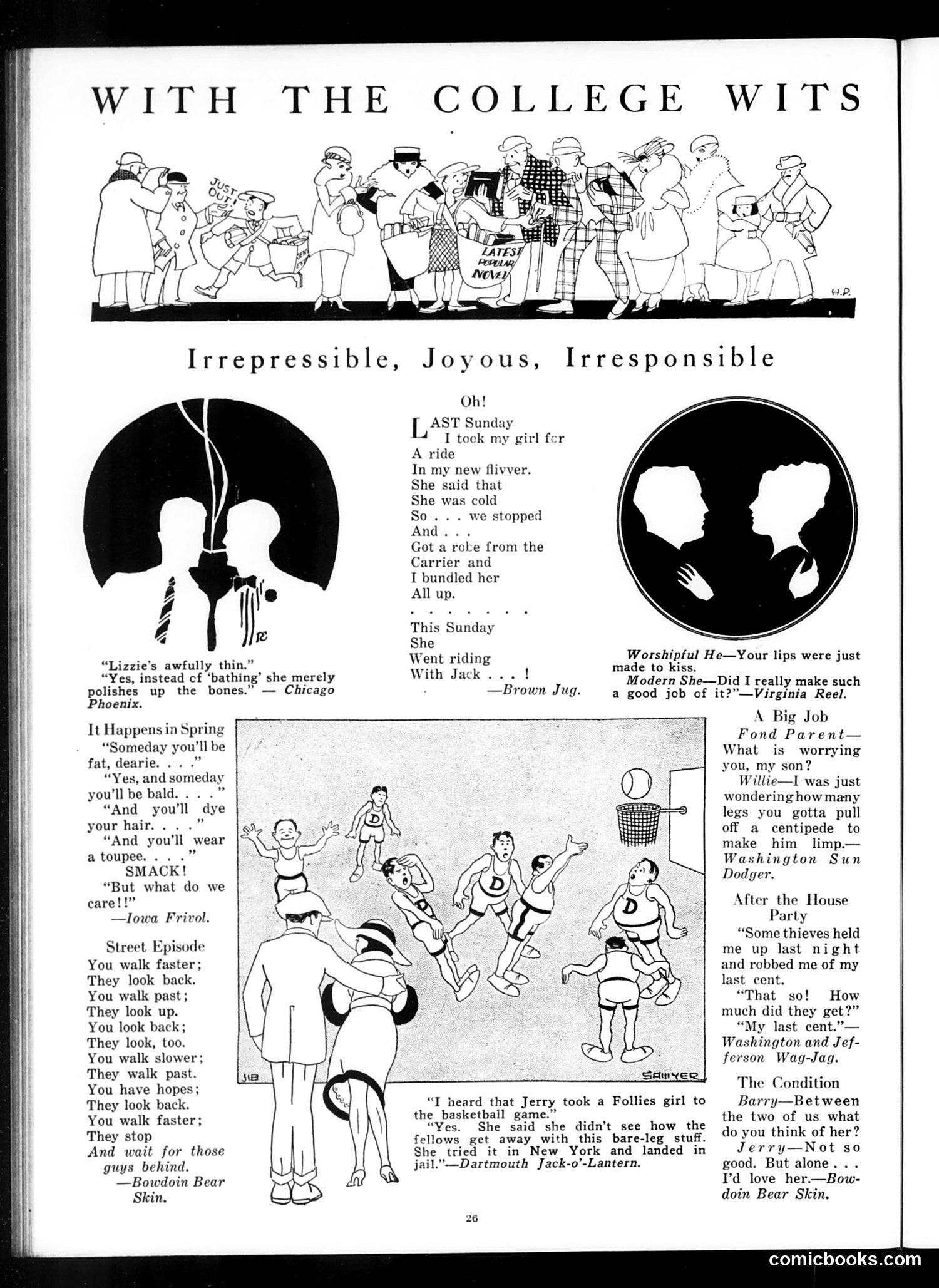
This page collects humor from college newspapers circa the 1920s, reflecting period attitudes about courtship, women's bodies, and social behavior. The top section mocks the "modern girl": one joke jokes about a woman being skeletal ("polishes up the bones"), while another criticizes a girl who goes joyriding in a "flivver" (Model T Ford) and accepts coats from boys. The satire treats women's independence and dating behavior as ridiculous. The basketball game joke references "bare-leg stuff"—likely referring to women wearing shorter skirts or athletic wear, considered scandalous. The centipede joke and others are simply absurdist humor typical of college publications. The overall tone treats young women's changing social freedoms with mockery, while the college-boy perspective dominates. This reflects 1920s anxiety about women's shifting roles during the Jazz Age, when flappers and dating culture challenged Victorian norms.
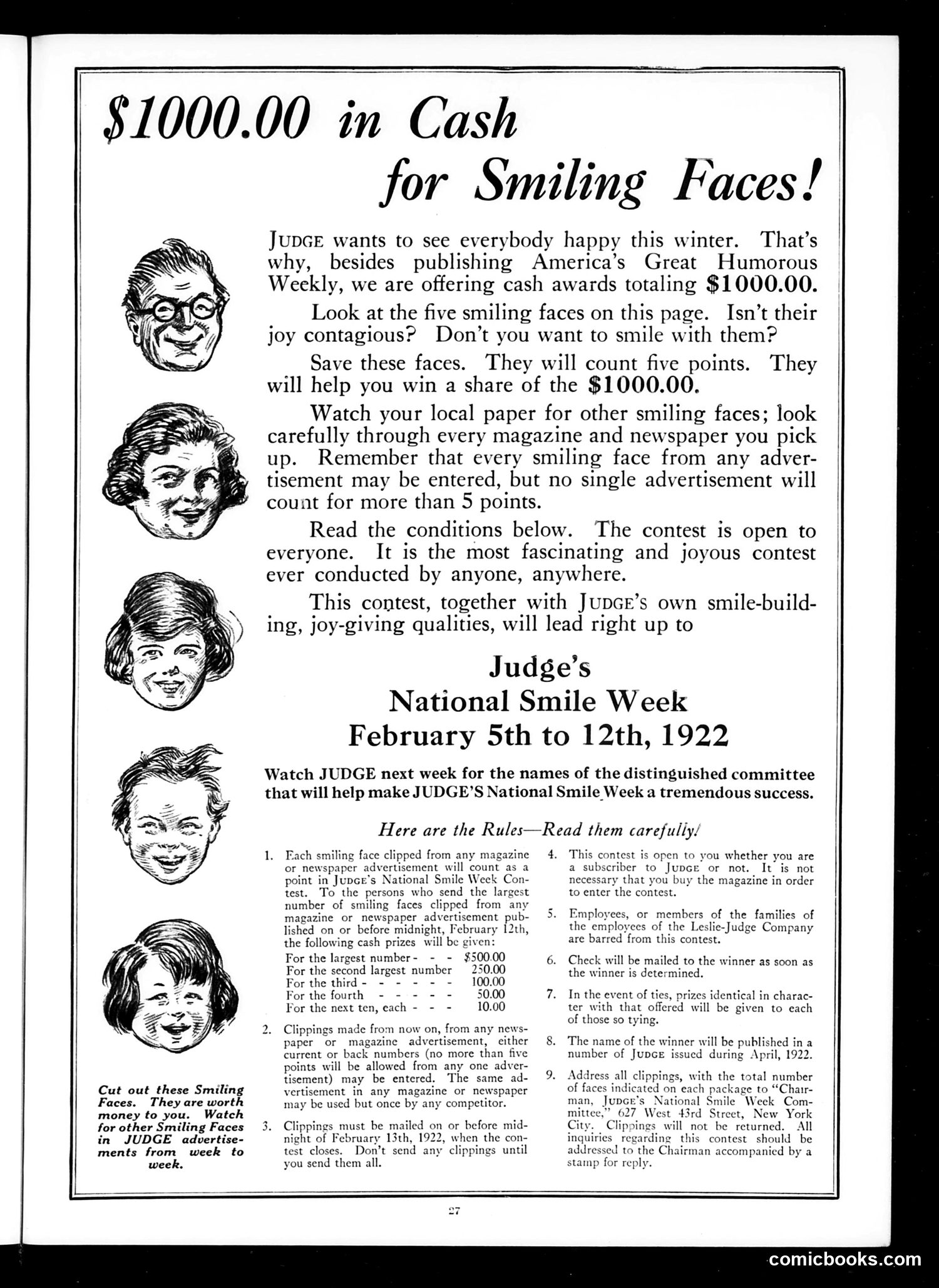
This is a **promotional contest advertisement**, not a cartoon or satire. Judge magazine is running a "National Smile Week" contest (February 5-12, 1922) offering $1,000 in cash prizes to readers who clip smiling faces from advertisements in newspapers and magazines. The five illustrated smiling faces on the page are generic examples—not caricatures of specific people—meant to show contestants what to look for. The contest asks readers to collect these clipped faces, with prizes ranging from $500 for the most clippings down to $10 for the tenth-most. This reflects early 20th-century magazine promotion tactics: Judge uses a cheerful, participatory game to boost readership and engagement during winter months. The emphasis on "joy" and "happiness" is purely marketing language to make the contest sound appealing and wholesome—a common advertising strategy of the era.
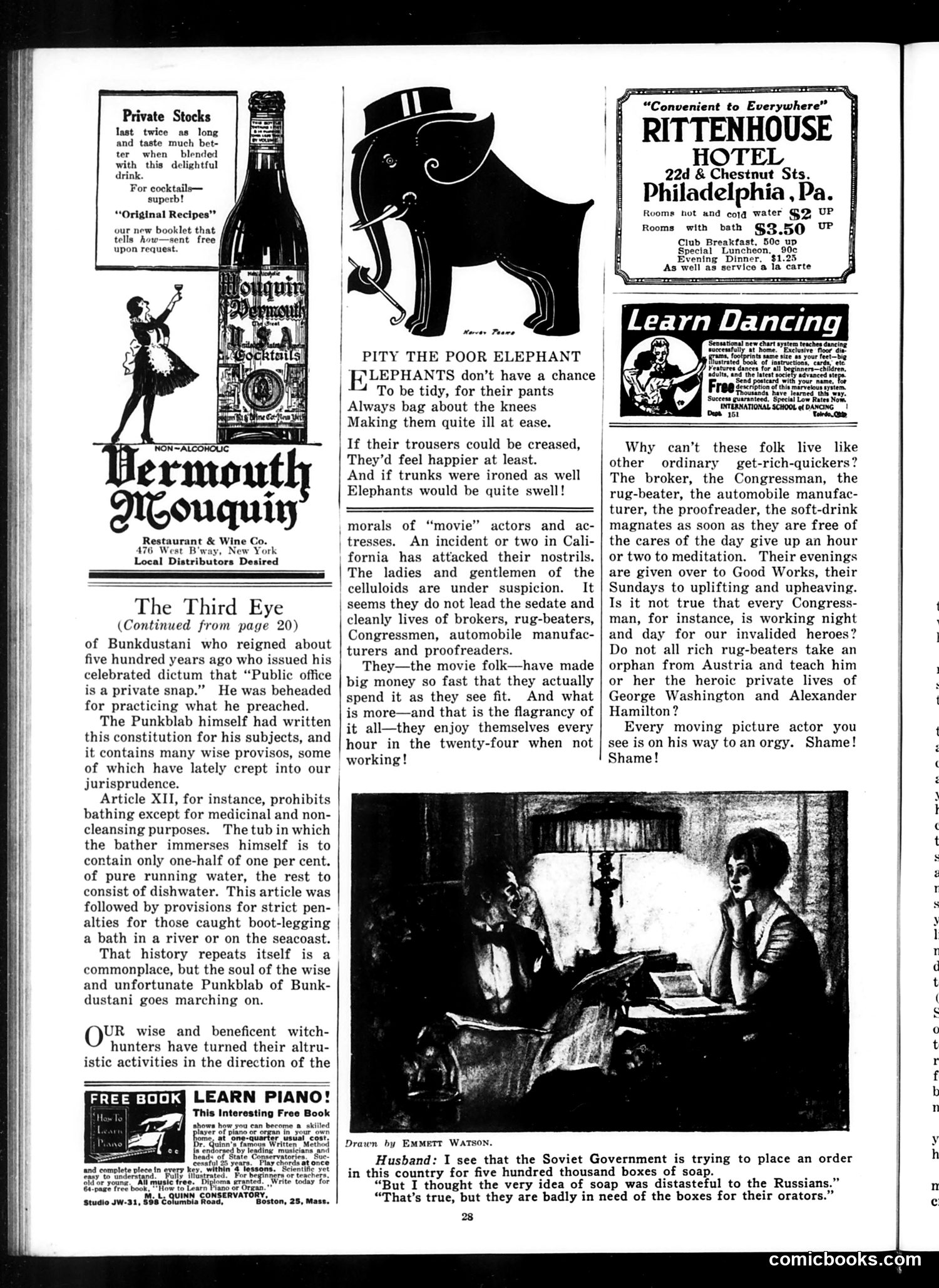
This page contains two distinct satirical pieces. The elephant cartoon is a lighthearted visual joke: elephants' loose, baggy pants and unironed trunks make them uncomfortable—a purely absurdist humor piece with no deeper meaning. The accompanying text, however, offers biting social criticism. Judge's editors mock the moral outrage directed at movie actors and actresses, whose scandals had recently made headlines in California. The satire inverts expectations: while ordinary citizens (brokers, congressmen, manufacturers, proofreaders) are praised for spending evenings in "meditation" and "good works," the editors sarcastically ask why movie stars shouldn't enjoy themselves during their free time. The piece attacks bourgeois hypocrisy and moral posturing—wealthy, respectable citizens condemn actors for enjoying fast money and leisure, while secretly envying their freedom. The final rhetorical question about congressmen working night and day is heavily sarcastic.
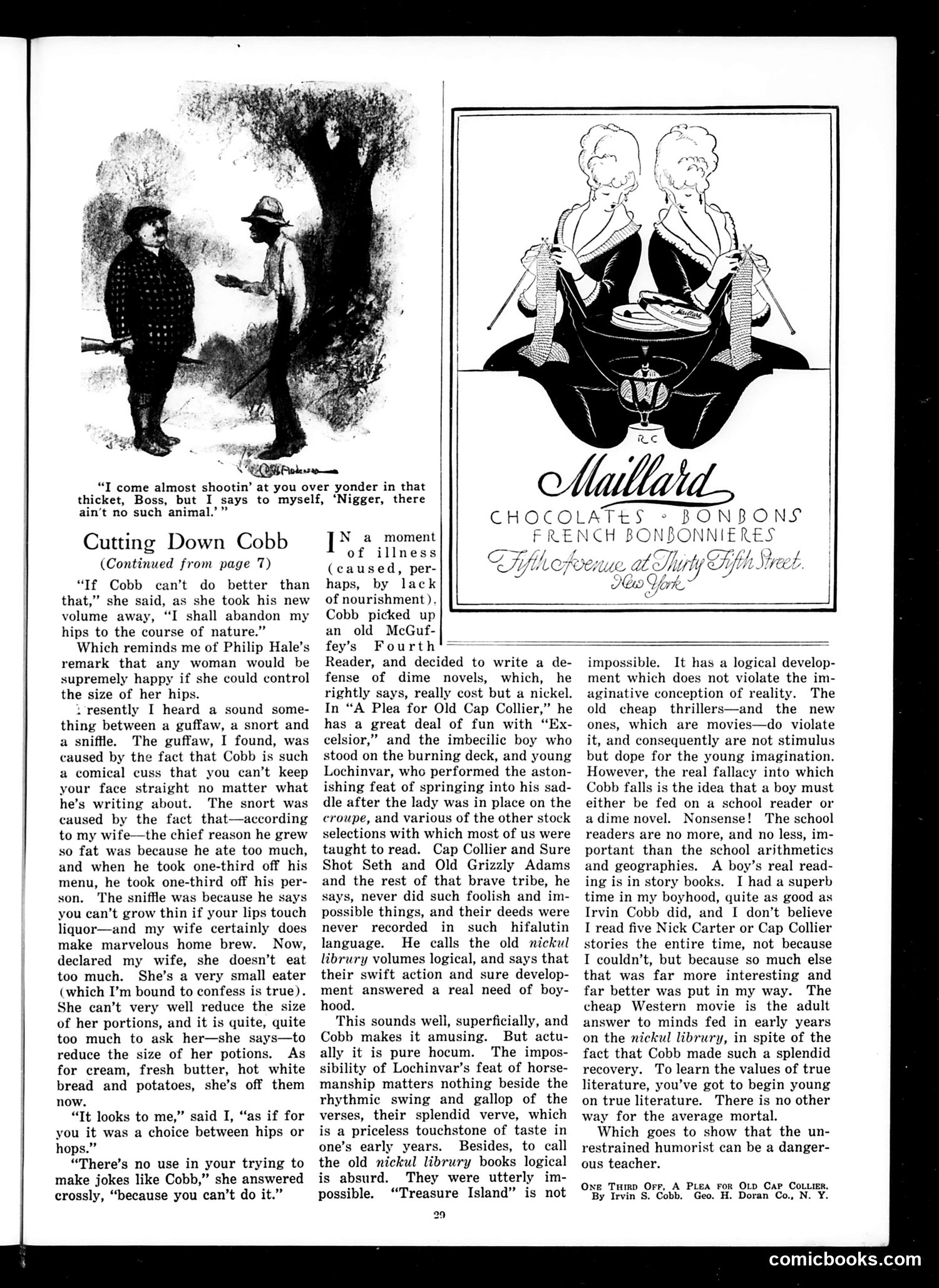
**Top Left Cartoon**: This is a racist caricature depicting a Black person in dialect, using a slur. The "joke" relies on a dehumanizing stereotype common to early 20th-century American humor—presenting Black individuals as intellectually simple or unable to recognize reality. Judge magazine regularly published such content reflecting the casual racism of that era. **Top Right Advertisement**: Maillard Chocolates and French Bonbons advertisement featuring two women in elegant dress, representing luxury goods marketed to wealthy consumers. **Main Article**: A literary criticism piece where the author defends dime novels (cheap serialized fiction) against elite dismissal, using humorist Irvin S. Cobb's recent essay as a springboard. The author argues dime novels served real developmental needs for boys, despite their logical implausibilities, and criticizes those who pit "school readers" against imaginative literature. The personal anecdotes about his wife's weight and diet appear designed for comedic effect typical of Judge's satirical approach. The page demonstrates Judge's mix of social satire, advertising, and period-appropriate (but deeply offensive) racial humor.
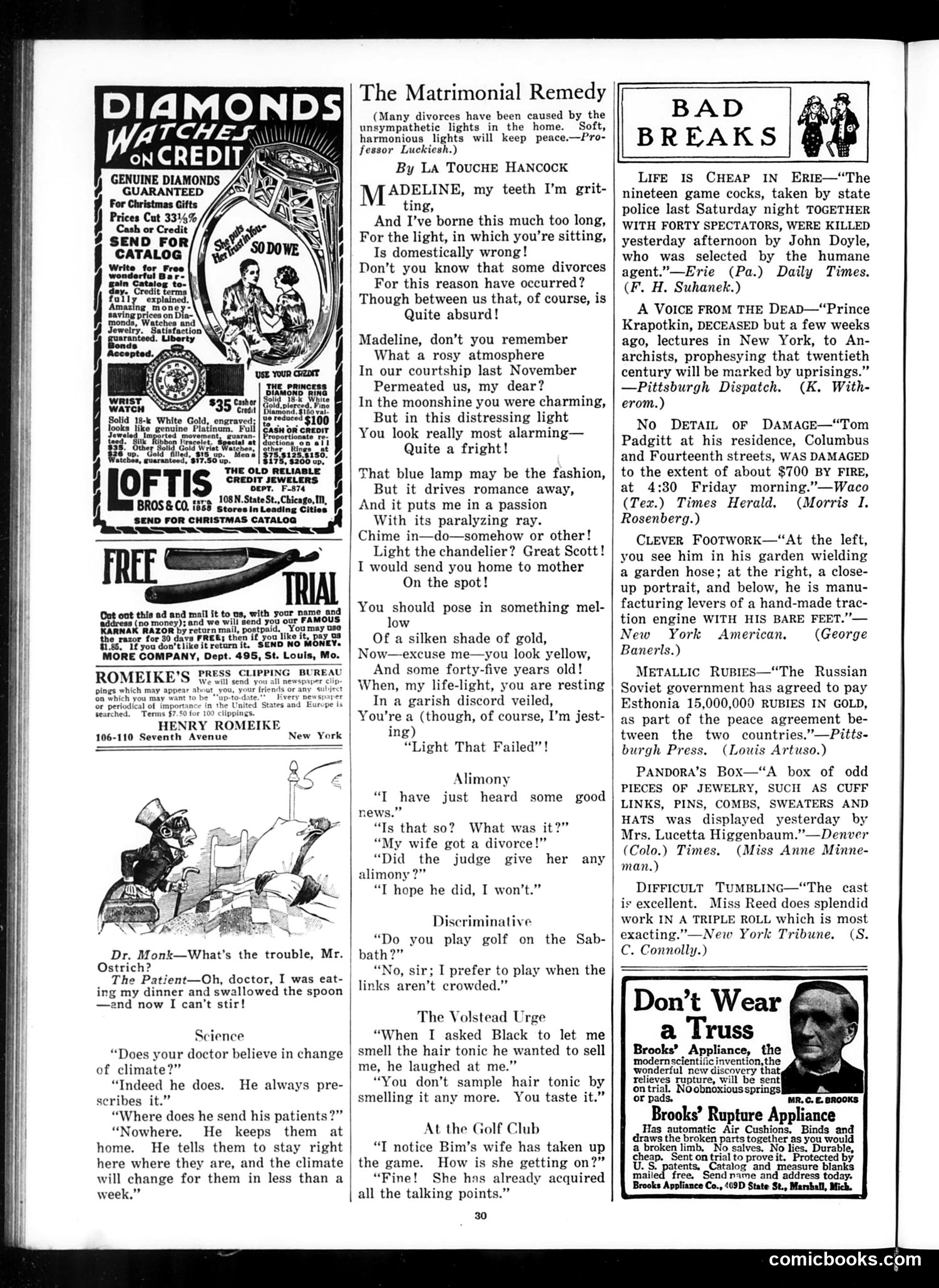
This page is primarily **advertisements and humor columns** typical of Judge's satirical format. The main prose piece, "The Matrimonial Remedy," satirizes the **modern obsession with home lighting as a marriage solution**. A husband complains that his wife looks unattractive under harsh electric "blue lamps," blaming modern lighting for divorces. The satire mocks both contemporary scientific claims about how environment affects relationships and husbands' superficial complaints—the "absurd" excuse that unflattering light explains marital discord. The poem's reference to "Light That Failed" (Kipling) adds literary mockery. The **Bad Breaks** section collects darkly ironic newspaper excerpts: cocks being killed by those selected to protect them; a deceased man somehow lecturing; property damage described as mere damage. These highlight absurdities and contradictions in news reporting. The humor pieces address 1920s concerns: Prohibition (the Volstead Urge reference), divorce and alimony, and leisure activities (golf). The ads sell diamonds, watches, and razors "on credit"—reflecting post-WWI consumer capitalism.
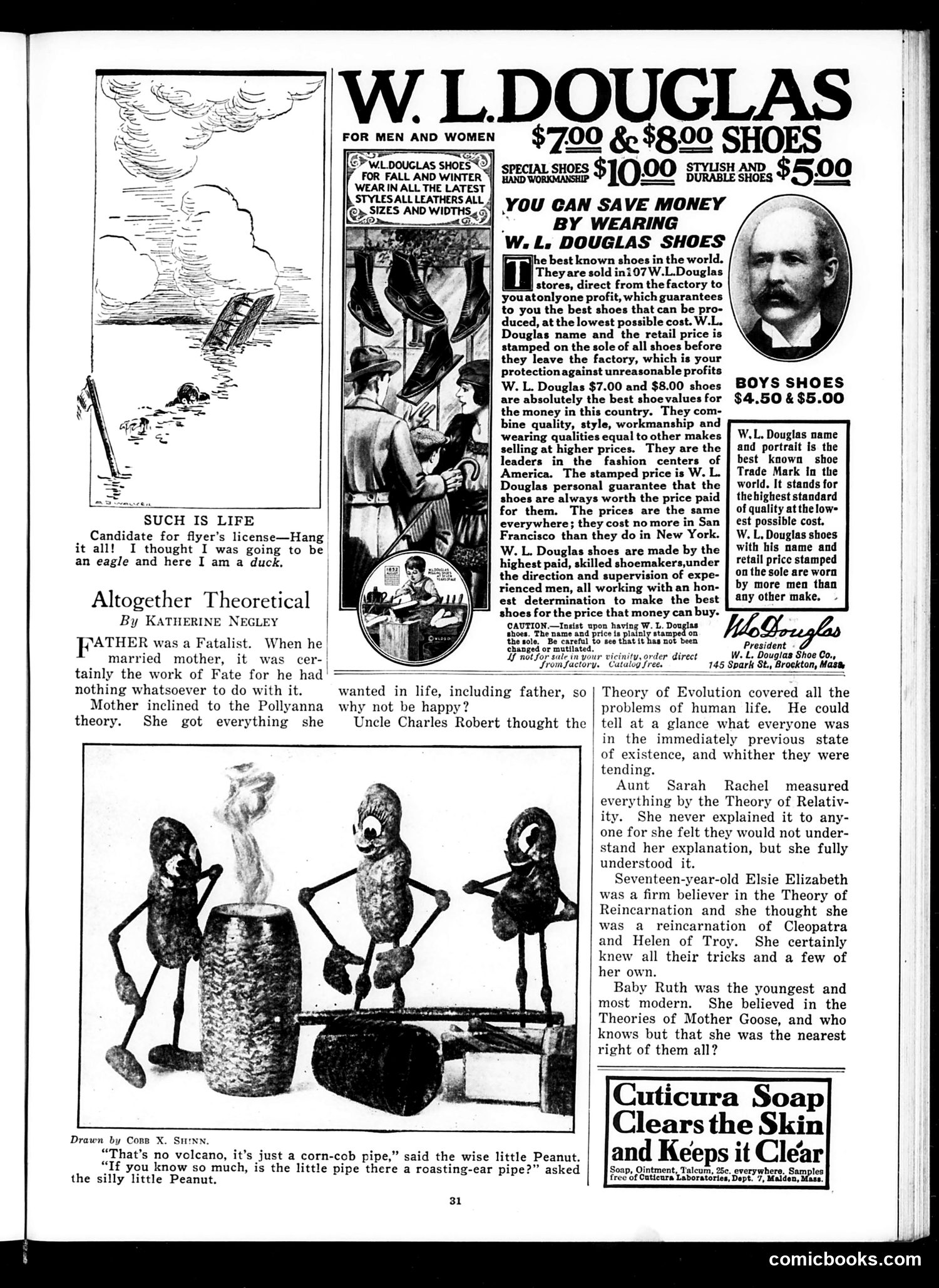
This page mixes satirical content with advertising. The main cartoon, "Such Is Life," depicts a duck lamenting it wanted to be an eagle—a simple commentary on disappointed ambitions. The story "Altogether Theoretical" by Katherine Negley satirizes intellectual pretension. It presents a family where each member clings to a different abstract theory (Fatalism, Pollyanna optimism, Evolution, Relativity, Reincarnation, and Mother Goose) to explain life. The joke: they're all ridiculous, with baby Ruth's belief in nursery rhymes implied as potentially *most* sensible. It mocks how educated people use grand theories to avoid genuine understanding or agency. Below is a second cartoon by Cobb X. Shinn featuring anthropomorphic peanuts debating whether a corn-cob pipe is a "roasting-ear pipe"—whimsical nonsense humor typical of the era. The page is dominated by W.L. Douglas shoe advertising, standard for period magazines.
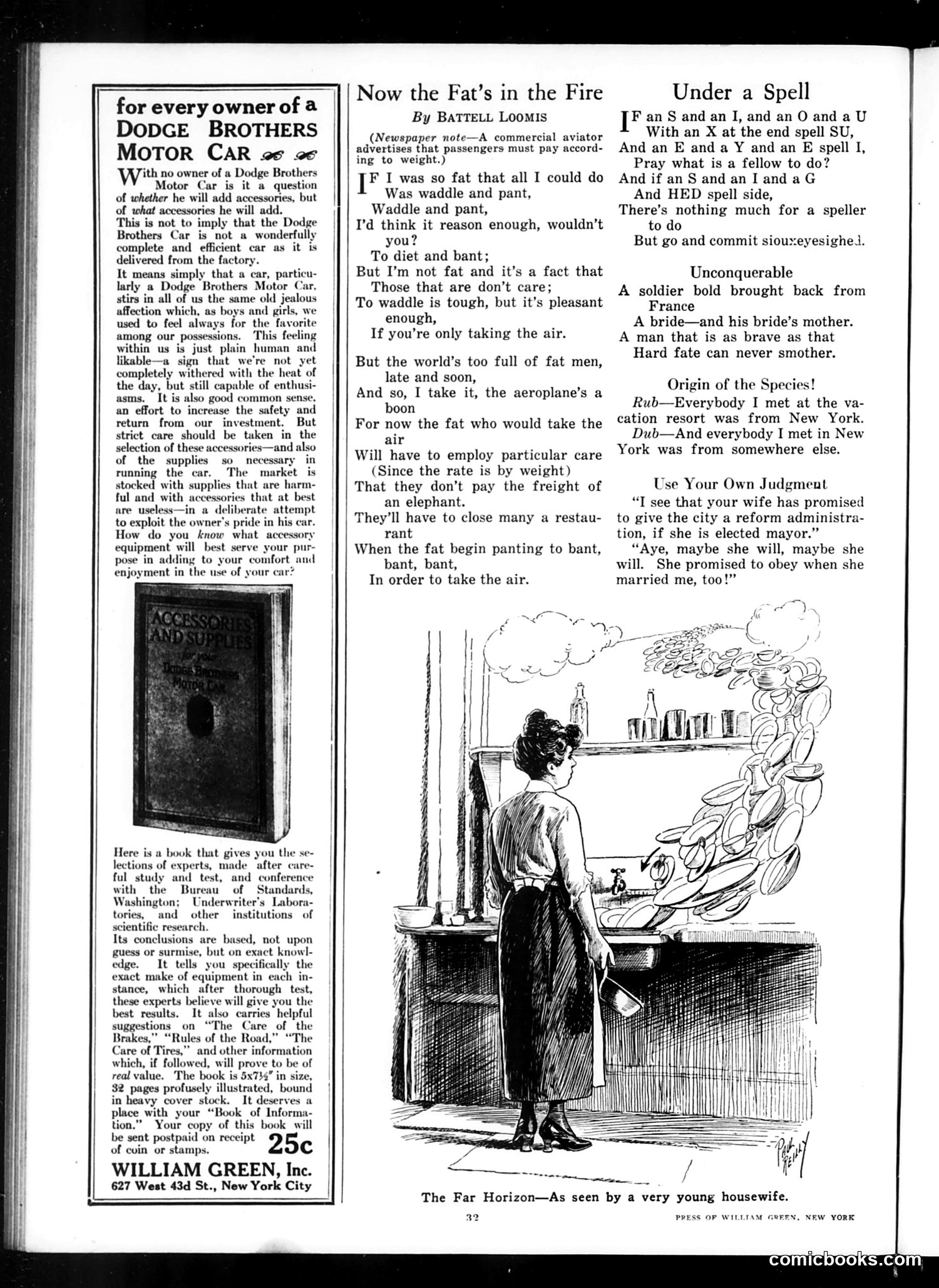
This page contains several pieces of light humor typical of Judge magazine's satirical style. The main cartoon depicts a young housewife gazing out a window at an idealized cityscape, captioned "The Far Horizon—As seen by a very young housewife." The satire mocks newlywed women's romantic but naive expectations of married life and city living. Other brief comic pieces include: **"Now the Fat's in the Fire"** — A humorous poem about commercial aviation charging passengers by weight. It jokes that overweight people will be forced to diet if they want to fly, potentially closing restaurants. **"Under a Spell"** — A spelling puzzle poking fun at English language irregularities. **"Unconquerable"** and **"Origin of the Species"** — Very short jokes about soldiers and vacation travel. **"Use Your Own Judgment"** — A domestic humor piece where a wife promises municipal reform if elected mayor, paralleling her broken promise to "obey" in marriage vows—satirizing both women in politics and marital dynamics. The page also contains a Dodge Brothers Motor Car accessory advertisement, typical of Judge's mixed editorial and advertising content.
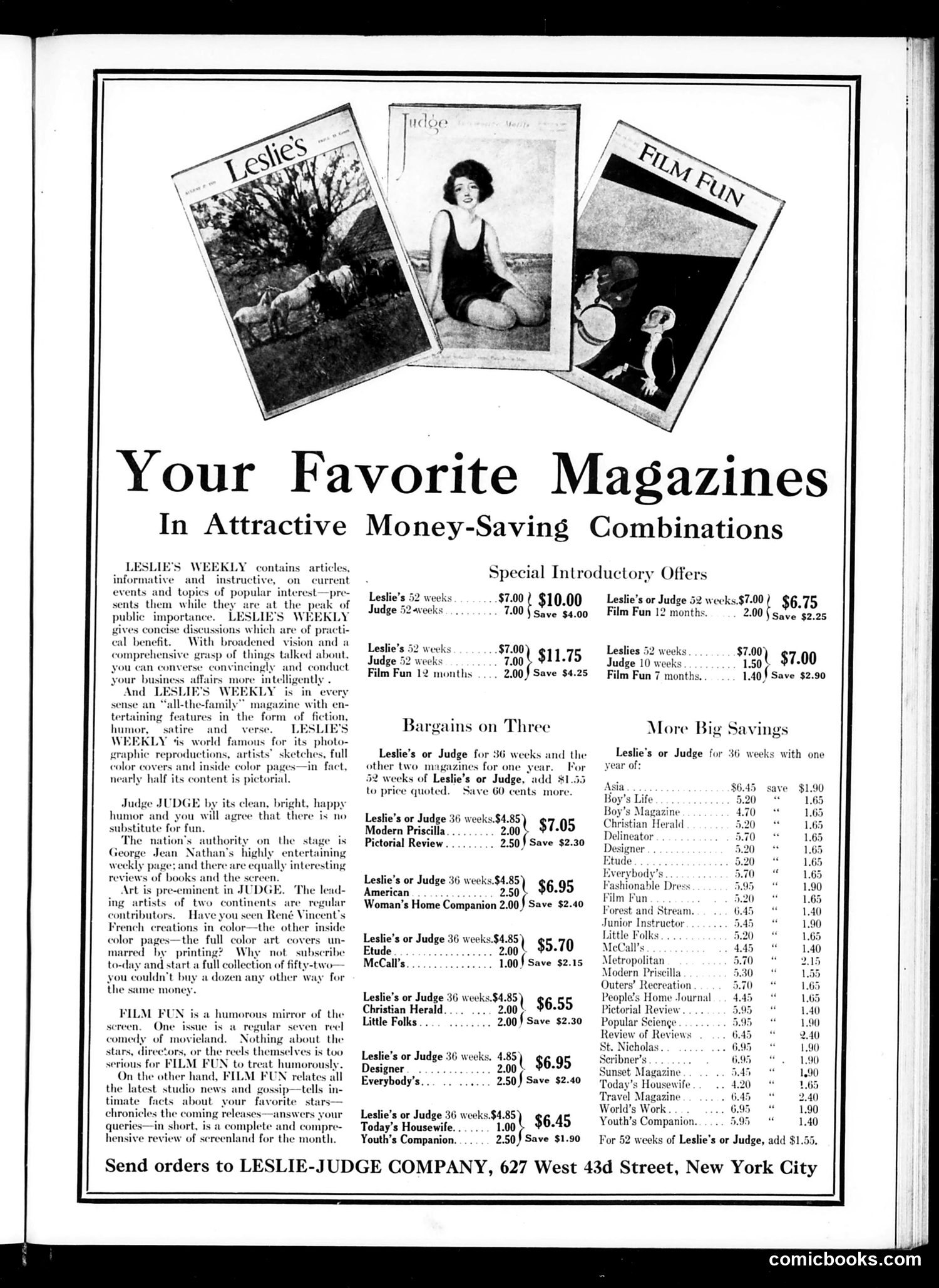
This is a **subscription advertisement**, not a cartoon or satirical content page. It promotes magazine bundle deals from Leslie-Judge Company (circa early 20th century). The page advertises four periodicals: - **Leslie's Weekly**: a news/current events magazine - **Judge**: a humor and satire publication ("clean, bright, happy humor") - **Film Fun**: a comedy/movie industry magazine - **Modern Priscilla, Pictorial Review**, etc.: lifestyle and home magazines The three photographs at the top show cover examples from these publications. The layout emphasizes **money-saving combinations**—readers could subscribe to multiple magazines at discounted rates rather than individually. **Historical context**: This reflects early 1900s magazine culture when subscriptions were a primary entertainment medium before radio/TV. The advertisements list dozens of competing magazines available (McCall's, Good Housekeeping, Scribner's, etc.), indicating a thriving print magazine industry. There is **no political satire or cartoon humor on this page**—it's purely commercial.
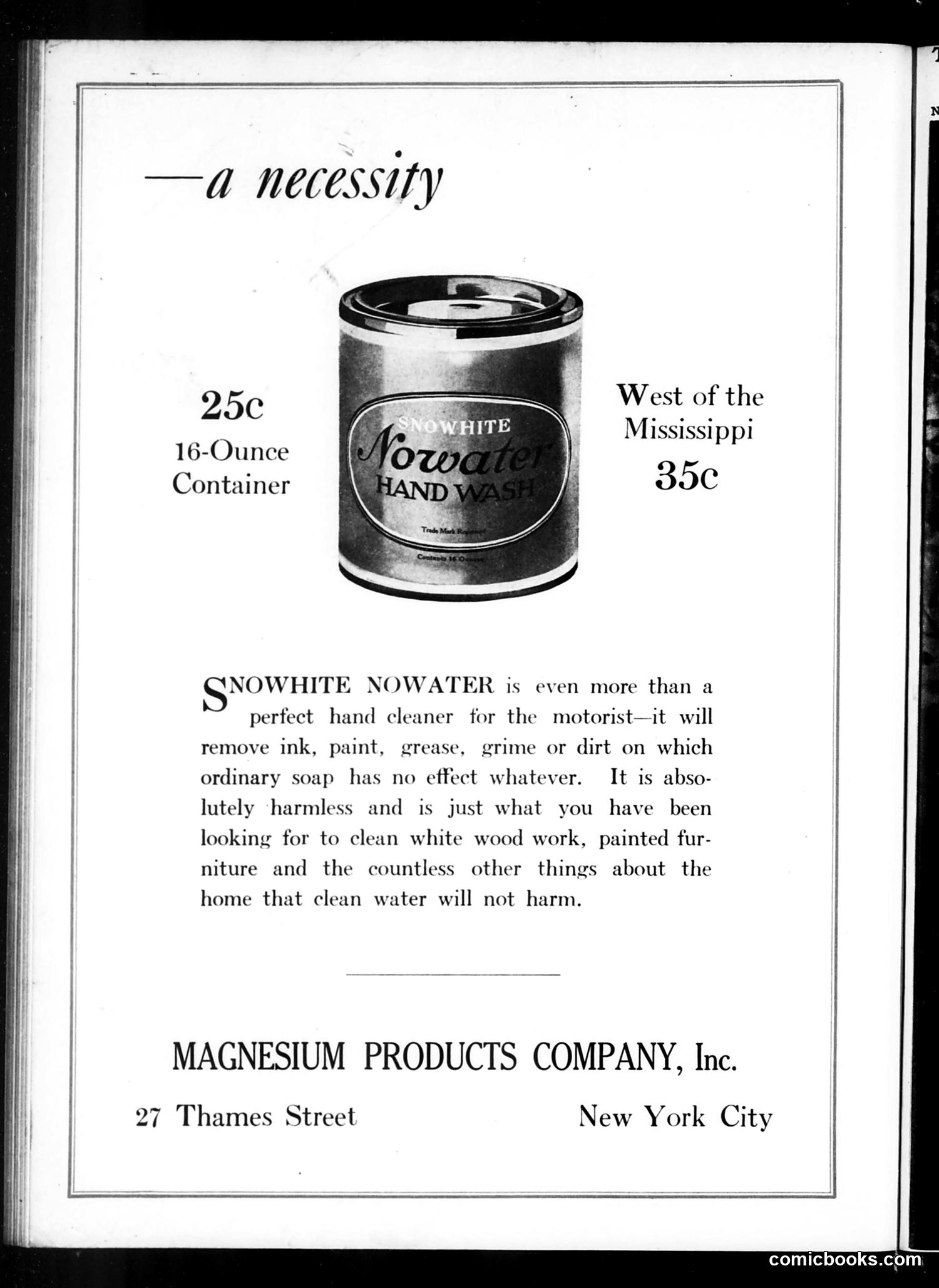
This is a **product advertisement, not a cartoon or satire**. It promotes "Snowhite Nowater," a hand-cleaning product made by Magnesium Products Company (New York City). The ad emphasizes the product's versatility—it removes ink, paint, grease, and grime that ordinary soap cannot, while remaining "absolutely harmless." It's marketed to motorists and for household cleaning of wood, painted furniture, and similar surfaces. The pricing shows regional variation: 25¢ for a 16-ounce container east of the Mississippi River, 35¢ west. This reflects real distribution and cost differences of the era. There is no political satire or caricature present—this is simply a full-page commercial advertisement typical of Judge magazine's revenue model.