
Judge, 1921-11-12 · page 9 of 36
Judge — November 12, 1921 — page 9: what you’re looking at
What you’re looking at
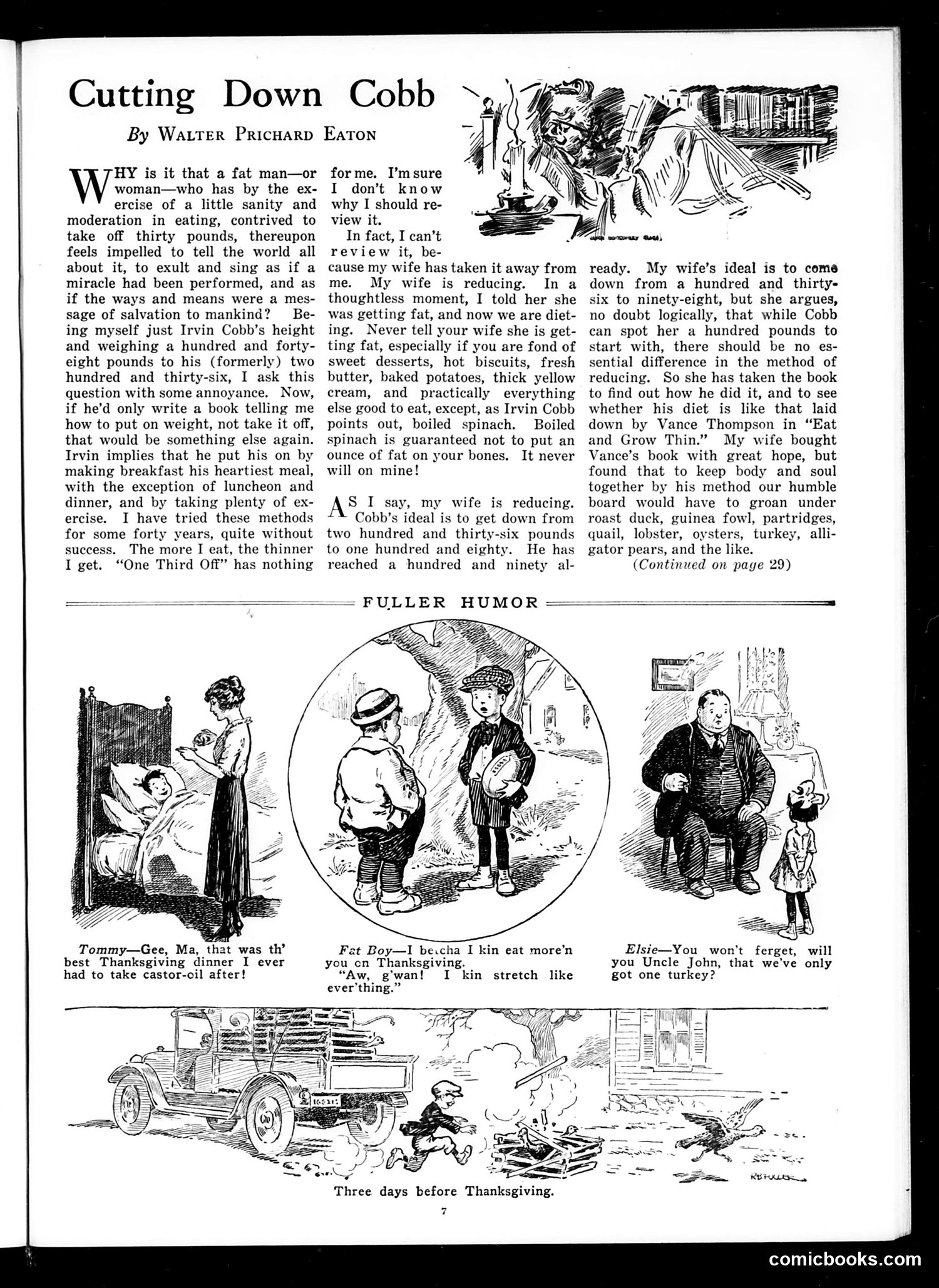
This article satirizes the popular dieting craze sparked by Irvin Cobb's weight-loss book "One Third Off." Cobb, a well-known humorist and writer, had famously reduced from 236 to 190 pounds, and the author (Walter Prichard Eaton) mocks the self-righteous evangelism with which Cobb and others promote their dietary success. The piece's humor centers on the author's complaint that thin people like himself can't gain weight despite eating constantly, while his wife now obsessively follows Cobb's (and Vance Thompson's competing diet book) methods, eliminating desserts and fatty foods from their household. The accompanying "Fuller Humor" cartoons humorously show the domestic consequences: children's exaggerated eating boasts at Thanksgiving, and a girl worried their single turkey won't suffice for Uncle John's visit—reflecting the food scarcity concerns of the pre-1920s period when these diet books were sensation publishing events.
📄 Transcribed text from this page (OCR, searchable)
Machine-transcribed from the original scan — historical spelling and the odd misread are preserved.
Cutting Down Cobb ~ > By Wa rer Pricwarp Eaton W pBe is it that a fat man—or woman—who has by the ex- ercise of a little sanity and moderation in eating, contrived to take off thirty pounds, thereupon feels impelled to tell the world all about it, to exult and sing as if a miracle had been performed, and as if the ways and means were a mes- sage of salvation to mankind? Be- ing myself just Irvin Cobb’s height and weighing a hundred and forty- eight pounds to his (formerly) two hundred and thirty-six, I ask this question with some annoyance. Now, if he’d only write a book telling me how to put on weight, not take it off, that would be something else again. Irvin implies that he put his on by making breakfast his heartiest meal, with the exception of luncheon and dinner, and by taking plenty of ex- ercise. I have tried these methods for some forty years, quite without success. The more I eat, the thinner I get. “One Third Off” has nothing Tommy—Gee, Ma, that was th’ best Thanksgiving dinner I ever had to take castor-oil after! forme. I’msure I don’t know why I should re- view it. In fact, I can’t review it, be- cause my wife has taken it away from me. My wife is reducing. In a thoughtless moment, I told her she was getting fat, and now we are diet- ing. Never tell your wife she is get- ting fat, especially if you are fond of sweet desserts, hot biscuits, fresh butter, baked potatoes, thick yellow cream, and practically everything else good to eat, except, as Irvin Cobb points out, boiled spinach. Boiled spinach is guaranteed not to put an ounce of fat on your bones. It never will on mine! AS I say, my wife is reducing. Cobb’s ideal is to get down from two hundred and thirty-six pounds to one hundred and eighty. He has reached a hundred and ninety al- ready. My wife’s ideal is to come down from a hundred and thirty six to ninety-eight, but she argues, no doubt logically, that while Cobb can spot her a hundred pounds to start with, there should be no es- sential difference in the method of reducing. So she has taken the book to find out how he did it, and to see whether his diet is like that laid down by Vance Thompson in “Eat and Grow Thin.” My wife bought Vance’s book with great hope, but found that to keep body and soul together by his method our humble board would have to groan under roast duck, guinea fowl, partridges, quail, lobster, oysters, turkey, alli- gator pears, and the like. (Continued on page 29) Fat Boy—I be.cha I kin eat more’n you cn Thanksgiving. “Aw, a” I kin stretch like Elsie—You won't ferget, will you Uncle John, that we've only got one turkey? comicbooks.com