
Judge, 1921-11-12 · page 20 of 36
Judge — November 12, 1921 — page 20: what you’re looking at
What you’re looking at
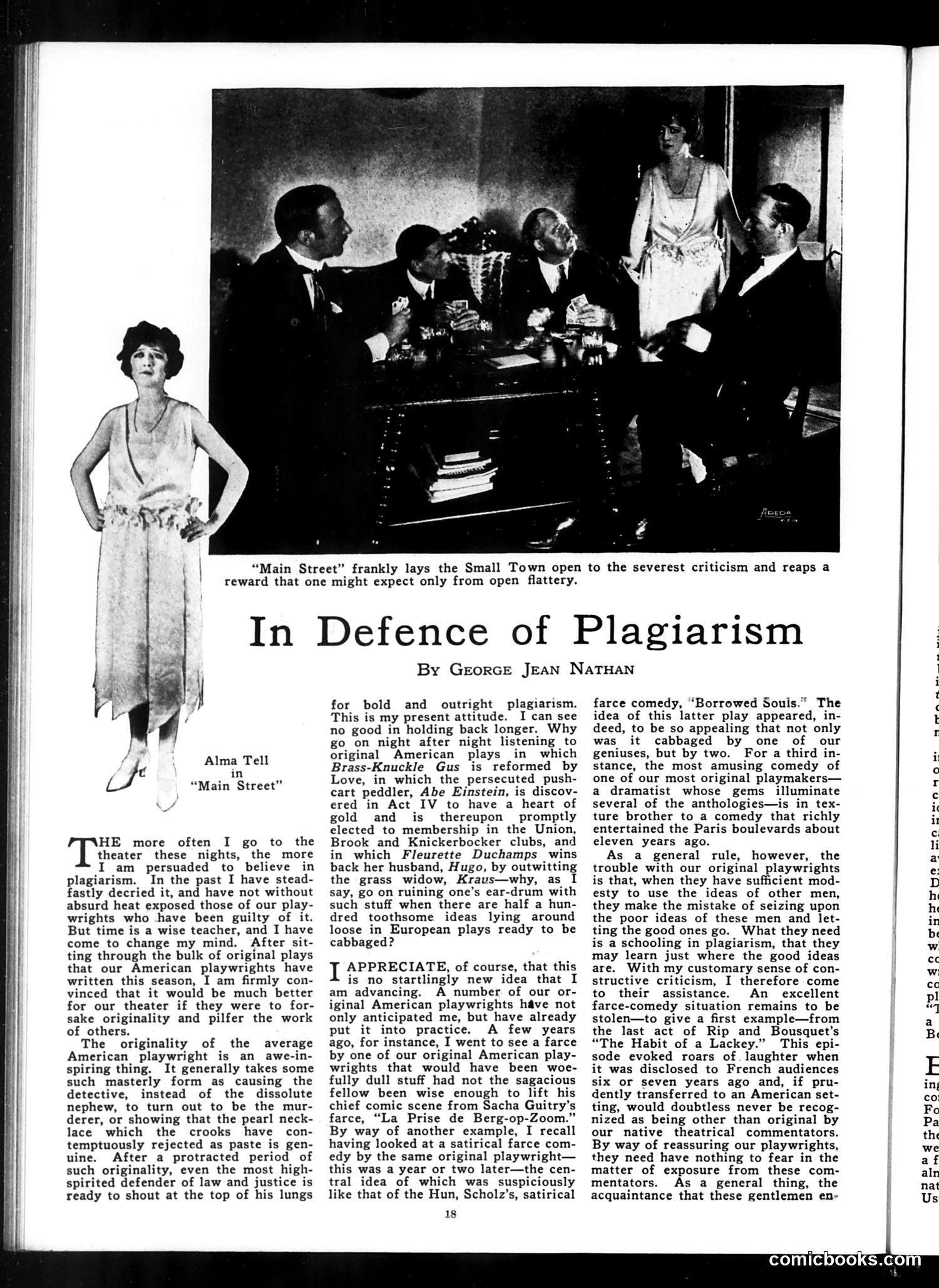
This article by George Jean Nathan sarcastically **defends theatrical plagiarism** against American playwrights' poor original work. The accompanying photo shows a scene from "Main Street" (adapted from Sinclair Lewis's novel), starring actress Alma Tell. Nathan's argument: American playwrights produce predictably bad "original" plays—reforming gangsters named "Brass-Knuckle Gus," Jewish peddlers discovering hearts of gold and joining exclusive clubs, grass widows winning back husbands through wit. He cites specific examples of American playwrights actually stealing from successful European farces (Sacha Guitry, Scholz) and argues they should continue this practice **but steal better ideas**. The satire mocks both American theatrical mediocrity and the hypocrisy of praising originality while rewarding derivative work. It's essentially saying: plagiarize if you must, but at least plagiarize from quality sources, not from each other's failures.
📄 Transcribed text from this page (OCR, searchable)
Machine-transcribed from the original scan — historical spelling and the odd misread are preserved.
“Main Street” frankly lays the Small Town open to the severest criticism and reaps a reward that one might expect only from open flattery. In Defence of Plagiarism Alma Tell in “Main Street” HE more often I go to the theater these nights, the more am persuaded to believe in plagiarism. In the past I have stead- fastly decried it, and have not without absurd heat exposed those of our play- wrights who have been guilty of it. But time is a wise teacher, and I have come to change my mind. After sit- ting through the bulk of original plays that our American playwrights have written this season, I am firmly con- vinced that it would be much better for our theater if they were to for- sake originality and pilfer the work of others. The originality of the average American playwright is an awe-in- spiring thing. It generally takes some such masterly form as causing the detective, instead of the dissolute nephew, to turn out to be the mur- derer, or showing that the pearl neck- lace which the crooks have con- temptuously rejected as paste is gen- uine. After a protracted period of such originality, even the most high- spirited defender of law and justice is ready to shout at the top of his lungs By Georce Jean NaTHan for bold and outright plagiarism. This is my present attitude. I can see no good in holding back longer. Why go on night after night listening to original American plays in which Brass-Knuckle Gus is reformed by Love, in which the persecuted push- cart peddler, Abe Einstein, is discov- ered in Act IV to have a heart of gold and is thereupon promptly elected to membership in the Union, Brook and Knickerbocker clubs, and in which Fleurette Duchamps wins back her husband, Hugo, by outwitting the grass widow, Kravs—why, as say, go on ruining one’s ear-drum with such stuff when there are half a hun- dred toothsome ideas lying around loose in European plays ready to be cabbaged? I APPRECIATE, of course, that this is no startlingly new idea that I am advancing. A number of our or- iginal American playwrights have not only anticipated me, but have already put it into practice. A few years ago, for instance, I went to see a farce by one of our original American play- wrights that would have been woe- fully dull stuff had not the sagacious fellow been wise enough to lift his chief comic scene from Sacha Guitry’s farce, “La Prise de Berg-op-Zoom.” By way of another example, I recall having looked at a satirical farce com- edy by the same original playwright— this was a year or two later—the cen- tral idea of which was suspiciously like that of the Hun, Scholz’s, satirical 18 farce comedy, “Borrowed Souis.* The idea of this latter play appeared, in- deed, to be so appealing that not only was it cabbaged by one of our geniuses, but by two. For a third in- stance, the most amusing comedy of one of our most original playmakers— a dramatist whose gems illuminate several of the anthologies—is in tex- ture brother to a comedy that richly entertained the Paris boulevards about eleven years ago. As a general rule, however, the trouble with our original playwrights is that, when they have sufficient mod- esty to use the ideas of other men, they make the mistake of seizing upon the poor ideas of these men and let- ting the good ones go. What they need is a schooling in plagiarism, that they may learn just where the good ideas are. With my customary sense of con- structive criticism, I therefore come to their assistance. An excellent farce-comedy situation remains to be stolen—to give a first example—from the last act of Rip and Bousquet’s “The Habit of a Lackey.” This epi- sode evoked roars of. laughter when it was disclosed to French audiences six or seven years ago and, if pru- dently transferred to an American set- ting, would doubtless never be recog- nized as being other than original by our native theatrical commentators. By way of reassuring our playwrights, they need have nothing to fear in the matter of exposure from these com- mentators. As a general thing, the acquaintance that these gentlemen en- iii oanam