
Judge, 1921-11-12 · page 12 of 36
Judge — November 12, 1921 — page 12: what you’re looking at
What you’re looking at
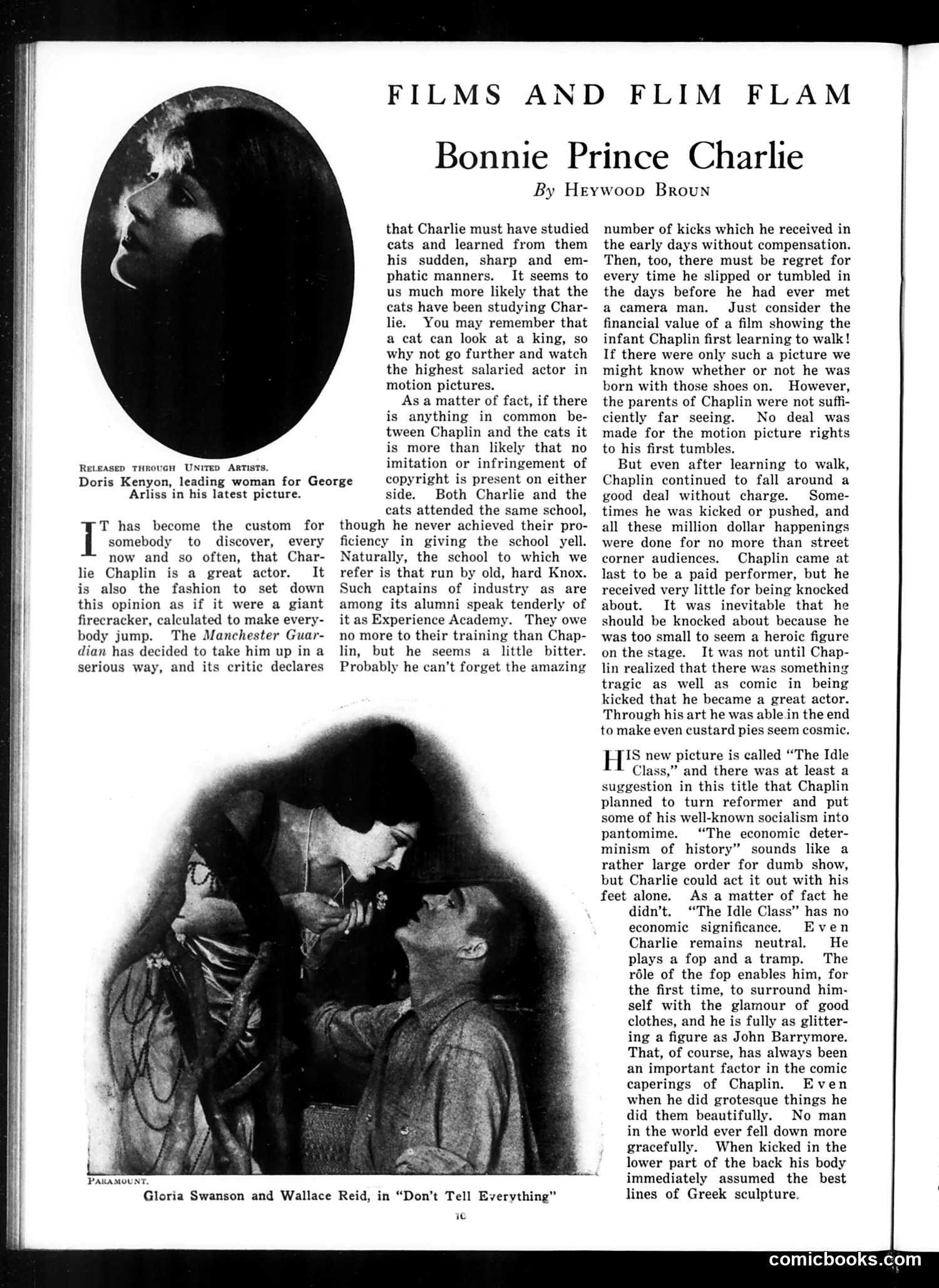
This article by Heywood Broun defends Charlie Chaplin against recent critical praise, specifically addressing a Manchester Guardian piece claiming Chaplin learned his mannerisms from cats. Broun argues the reverse is more likely true. The piece celebrates Chaplin's rise from street performer to serious artist. It notes his early years involved unpaid falls and kicks—later becoming financially valuable through film. Broun argues Chaplin became great by recognizing the tragic dimension of physical comedy, transforming custard pies into something "cosmic." Regarding Chaplin's new film "The Idle Class," Broun notes it lacks the socialist reformism the title might suggest. Instead, Chaplin plays a fop and tramp, allowing him to display elegant movement alongside his trademark graceful pratfalls—his essential artistic gift. The page includes photographs of other silent film stars (Doris Kenyon, Gloria Swanson, Wallace Reid), positioning Chaplin among Hollywood's elite.
📄 Transcribed text from this page (OCR, searchable)
Machine-transcribed from the original scan — historical spelling and the odd misread are preserved.
RELEASED THROUGH UNITED ARTISTS. Doris Kenyon, leading woman for George Arliss in his latest picture. somebody to discover, every now and so often, that Char- lie Chaplin is a great actor. It is also the fashion to set down this opinion as if it were a giant firecracker, calculated to make every- body jump. The Manchester Guar- dian has decided to take him up in a serious way, and its critic declares 1 has become the custom for PARAMOUNT. Gloria Swanson and Wallace Reid, in “Don’t Tell Everything” FILMS AND FLIM FLAM Bonnie Prince Charlie By Heywoop Broun that Charlie must have studied cats and learned from them his sudden, sharp and em- phatic manners. It seems to us much more likely that the cats have been studying Char- lie. You may remember that a cat can look at a king, so why not go further and watch the highest salaried actor in motion pictures. As a matter of fact, if there is anything in common be- tween Chaplin and the cats it is more than likely that no imitation or infringement of copyright is present on either side. Both Charlie and the cats attended the same school, though he never achieved their pro- ficiency in giving the school yell. Naturally, the school to which we refer is that run by old, hard Knox. Such captains of industry as are among its alumni speak tenderly of it as Experience Academy. They owe no more to their training than Chap- lin, but he seems a little bitter. Probably he can’t forget the amazing ie number of kicks which he received in the early days without compensation. Then, too, there must be regret for every time he slipped or tumbled in the days before he had ever met a camera man. Just consider the financial value of a film showing the infant Chaplin first learning to walk! If there were only such a picture we might know whether or not he was born with those shoes on. However, the parents of Chaplin were not suffi- ciently far seeing. No deal was made for the motion picture rights to his first tumbles. But even after learning to walk, Chaplin continued to fall around a good deal without charge. Some- times he was kicked or pushed, and all these million dollar happenings were done for no more than street corner audiences. Chaplin came at last to be a paid performer, but he received very little for being knocked about. It was inevitable that he should be knocked about because he was too small to seem a heroic figure on the stage. It was not until Chap- lin realized that there was something tragic as well as comic in being kicked that he became a great actor. Through his art he was able.in the end to make even custard pies seem cosmic. H's new picture is called “The Idle Class,” and there was at least a suggestion in this title that Chaplin planned to turn reformer and put some of his well-known socialism into pantomime. “The economic deter- minism of history” sounds like a rather large order for dumb show, but Charlie could act it out with his feet alone. As a matter of fact he didn’t. “The Idle Class” has no economic significance. Even Charlie remains neutral. He plays a fop and a tramp. The réle of the fop enables him, for the first time, to surround him- self with the glamour of good clothes, and he is fully as glitter- ing a figure as John Barrymore. That, of course, has always been an important factor in the comic caperings of Chaplin. Even when he did grotesque things he did them beautifully. No man in the world ever fell down more gracefully. When kicked in the lower part of the back his body immediately assumed the best lines of Greek sculpture. comicbooks.com