
Judge, 1921-11-12 · page 22 of 36
Judge — November 12, 1921 — page 22: what you’re looking at
What you’re looking at
This page contains two distinct satirical pieces: **"The Third Eye" essay** mocks radical muckraker **Upton Sinclair**, praising his prolific writing while subtly ridiculing his self-righteousness. The author contrasts Sinclair's pristine moral posturing with **Jack London**, who died at 40 from alcohol-related illness. Sinclair boasts his kidneys remain "only one-half of one per cent. wilted"—a jab at his sanctimonious superiority. The "Lord Fauntleroy and Little Eva" comparison depicts Sinclair as an ethereal, overly refined radical. **The "Reginald Plan" satire** mocks disarmament conferences (likely referencing post-WWI peace efforts) by imagining bandits and police negotiating a "general disarmament" treaty at Lemon Hill, Pennsylvania. The absurdist humor: criminals demand immunity from arrest in exchange for limiting violence to blackjacks and brass knuckles. It satirizes the era's optimistic but seemingly naive disarmament negotiations as equally foolish—criminals and cops can no more peacefully coexist than nations can. Both pieces employ hyperbolic wit to critique Progressive-era idealism.
📄 Transcribed text from this page (OCR, searchable)
Machine-transcribed from the original scan — historical spelling and the odd misread are preserved.
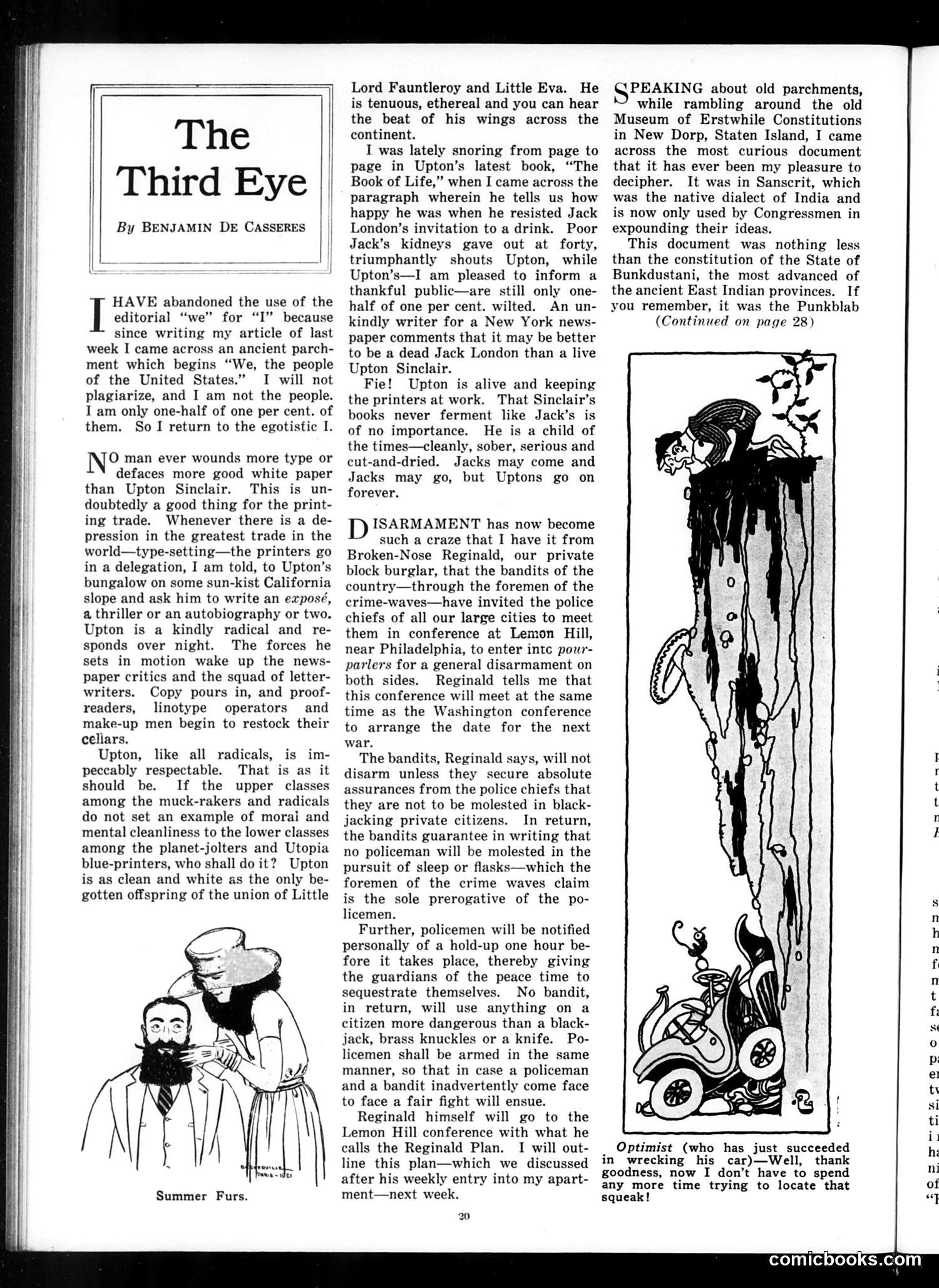
The editorial ‘‘we” for “I” because since writing my article of last week I came across an ancient parch- ment which begins “We, the people of the United States.” I will not plagiarize, and I am not the people. I am only one-half of one per cent. of them. So I return to the egotistic I. I HAVE abandoned the use of the N° man ever wounds more type or defaces more good white paper than Upton Sinclair. This is un- doubtedly a good thing for the print- ing trade. Whenever there is a de- pression in the greatest trade in the world—type-setting—the printers go in a delegation, I am told, to Upton’s bungalow on some sun-kist California slope and ask him to write an exposé, a thriller or an autobiography or two. Upton is a kindly radical and re- sponds over night. The forces he sets in motion wake up the news- paper critics and the squad of letter- writers. Copy pours in, and proof- readers, linotype operators and make-up men begin to restock their cellars. Upton, like all radicals, is im- peccably respectable. That is as it should be. If the upper classes among the muck-rakers and radicals do not set an example of morai and mental cleanliness to the lower classes among the planet-jolters and Utopia blue-printers, who shall do it?) Upton is as clean and white as the only be- gotten offspring of the union of Little Summer Furs. Lord Fauntleroy and Little Eva. He is tenuous, ethereal and you can hear the beat of his wings across the continent. I was lately snoring from page to page in Upton’s latest book, “The Book of Life,” when I came across the paragraph wherein he tells us how happy he was when he resisted Jack London’s invitation to a drink. Poor Jack’s kidneys gave out at forty, triumphantly shouts Upton, while Upton’s—I am pleased to inform a thankful public—are still only one- half of one per cent. wilted. An un- kindly writer for a New York news- paper comments that it may be better to be a dead Jack London than a live Upton Sinclair. Fie! Upton is alive and keeping the printers at work. That Sinclair’s books never ferment like Jack’s is of no importance. He is a child of the times—cleanly, sober, serious and cut-and-dried. Jacks may come and Jacks may go, but Uptons go on forever. D ISARMAMENT has now become such a craze that I have it from Broken-Nose Reginald, our private block burglar, that the bandits of the country—through the foremen of the crime-waves—have invited the police chiefs of all our large cities to meet them in conference at Lemon Hill, near Philadelphia, to enter intc pour- parlers for a general disarmament on both sides. Reginald tells me that this conference will meet at the same time as the Washington conference to arrange the date for the next war. The bandits, Reginald says, will not disarm unless they secure absolute assurances from the police chiefs that they are not to be molested in black- jacking private citizens. In return, the bandits guarantee in writing that no policeman will be molested in the pursuit of sleep or flasks—which the foremen of the crime waves claim is the sole prerogative of the po- licemen. Further, policemen will be notified personally of a hold-up one hour be- fore it takes place, thereby giving the guardians of the peace time to sequestrate themselves. No bandit, in return, will use anything on a citizen more dangerous than a black- jack, brass knuckles or a knife. Po- licemen shall be armed in the same manner, so that in case a policeman and a bandit inadvertently come face to face a fair fight will ensue. Reginald himself will go to the Lemon Hill conference with what he calls the Reginald Plan. I will out- line this plan—which we discussed after his weekly entry into my apart- ment—next week. 2 GPEAKING about old parchments, while rambling around the old Museum of Erstwhile Constitutions in New Dorp, Staten Island, I came across the most curious document that it has ever been my pleasure to decipher. It was in Sanscrit, which was the native dialect of India and is now only used by Congressmen in expounding their ideas. This document was nothing less than the constitution of the State of Bunkdustani, the most advanced of the ancient East Indian provinces. If you remember, it was the Punkblab (Continued on page 28) _ Optimist (who has just succeeded in wrecking his car)—Well, thank goodness, now I don’t have to spend any more time trying to locate that squeak! comicbooks.com ce a Si aes oo seoes ene ho