
Judge, 1921-11-12 · page 21 of 36
Judge — November 12, 1921 — page 21: what you’re looking at
What you’re looking at
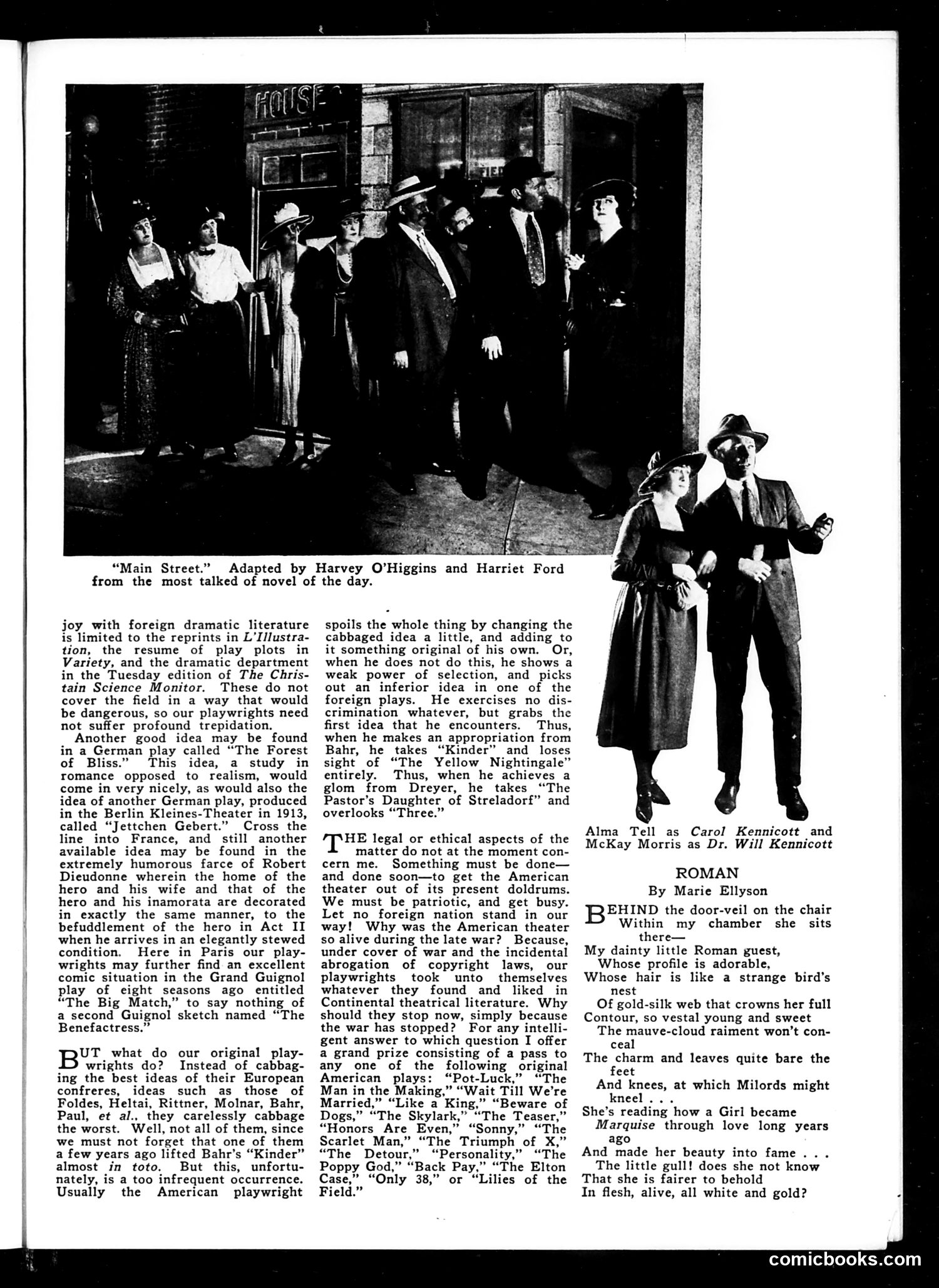
This page discusses American playwrights' practice of adapting foreign plays—what the author calls "cabbagging" (stealing). The upper text sarcastically argues that playwrights should continue appropriating European dramatic works, especially since copyright laws were suspended during WWI, allowing them free access to Continental theater. The image shows a scene from "Main Street," adapted from Sinclair Lewis's famous 1920 novel, which critiques small-town American conformity. The photograph depicts a street scene with formally dressed figures gathered outside a "House" establishment. The author's point: American playwrights lack originality and discrimination, selecting inferior foreign plays rather than quality ones. He sardonically suggests they should continue stealing ideas since it temporarily revitalized American theater during wartime. The irony targets both the playwrights' laziness and Americans' cultural dependence on European sources—a debate about artistic authenticity and national cultural identity relevant in the 1920s.
📄 Transcribed text from this page (OCR, searchable)
Machine-transcribed from the original scan — historical spelling and the odd misread are preserved.
“Main Street.” Adapted by Harvey O'Higgins and Harriet Ford from the most talked of novel of the day. joy with foreign dramatic literature is limited to the reprints in L’I/lustra- tion, the resume of play plots in Variety, and the dramatic department in the Tuesday edition of The Chris- tain Science Monitor. These do not cover the field in a way that would be dangerous, so our playwrights need not suffer profound trepidation. Another good idea may be found in a German play called “The Forest of Bliss.” This idea, a study in romance opposed to realism, would come in very nicely, as would also the idea of another German play, produced in the Berlin Kleines-Theater in 1913, called “Jettchen Gebert.” Cross the line into France, and still another available idea may be found in the extremely humorous farce of Robert Dieudonne wherein the home of the hero and his wife and that of the hero and his inamorata are decorated in exactly the same manner, to the befuddlement of the hero in Act II when he arrives in an elegantly stewed condition. Here in Paris our play- wrights may further find an excellent comic situation in the Grand Guignol play of eight seasons ago entitled “The Big Match,” to say nothing of a second Guignol sketch named “The Benefactress.” Bur what do our original play- wrights do? Instead of cabbag- ing the best ideas of their European confreres, ideas such as those of Foldes, Heltai, Rittner, Molnar, Bahr, Paul, et al., they carelessly cabbage the worst. Well, not all of them, since we must not forget that one of them a few years ago lifted Bahr’s “Kinder” almost in toto. But this, unfortu- nately, is a too infrequent occurrence. Usually the American playwright spoils the whole thing by changing the cabbaged idea a little, and adding to it something original of his own. Or, when he does not do this, he shows a weak power of selection, and picks out an inferior idea in one of the foreign plays. He exercises no dis- crimination whatever, but grabs the first idea that he encounters. Thus, when he makes an appropriation from Bahr, he takes “Kinder” and loses sight of “The Yellow Nightingale” entirely. Thus, when he achieves a glom from Dreyer, he takes “The Pastor’s Daughter of Streladorf” and overlooks “Three.” ‘THE legal or ethical aspects of the matter do not at the moment con- cern me. Something must be done— and done soon—to get the American theater out of its present doldrums. We must be patriotic, and get busy. Let no foreign nation stand in our way! Why was the American theater so alive during the late war? Because, under cover of war and the incidental abrogation of copyright laws, our playwrights took unto themselves whatever they found and liked in Continental theatrical literature. Why should they stop now, simply because the war has stopped? For any intelli- gent answer to which question I offer a grand prize consisting of a pass to any one of the following original American plays: “Pot-Luck,” “The Man in the Making,” “Wait Till We're Married,” “Like a King,” “Beware of Dogs,” “The Skylark,” “The Teaser,” “Honors Are Even,” “Sonny,” “The Scarlet Man,” “The Triumph of X,” “The Detour,” “Person: “ Poppy God,” “Back Pay,” Case,” “Only 38,” or “Lilies of the Field.” Alma Tell as Carol Kennicott and McKay Morris as Dr. Will Kennicott ROMAN By Marie Ellyson EHIND the door-veil on the chair Within my chamber she sits there— My dainty little Roman guest, Whose profile is adorable, Whose hair is like a strange bird’s nest Of gold-silk web that crowns her full Contour, so vestal young and sweet The mauve-cloud raiment won’t con- ceal The chat and leaves quite bare the eet And knees, at which Milords might kneel She’s reading how a Girl became Marquise through love long years ago And made her beauty into fame... The little gull! does she not know That she is fairer to behold In flesh, alive, all white and gold? comicbooks.com