
Judge, 1921-11-12 · page 13 of 36
Judge — November 12, 1921 — page 13: what you’re looking at
What you’re looking at
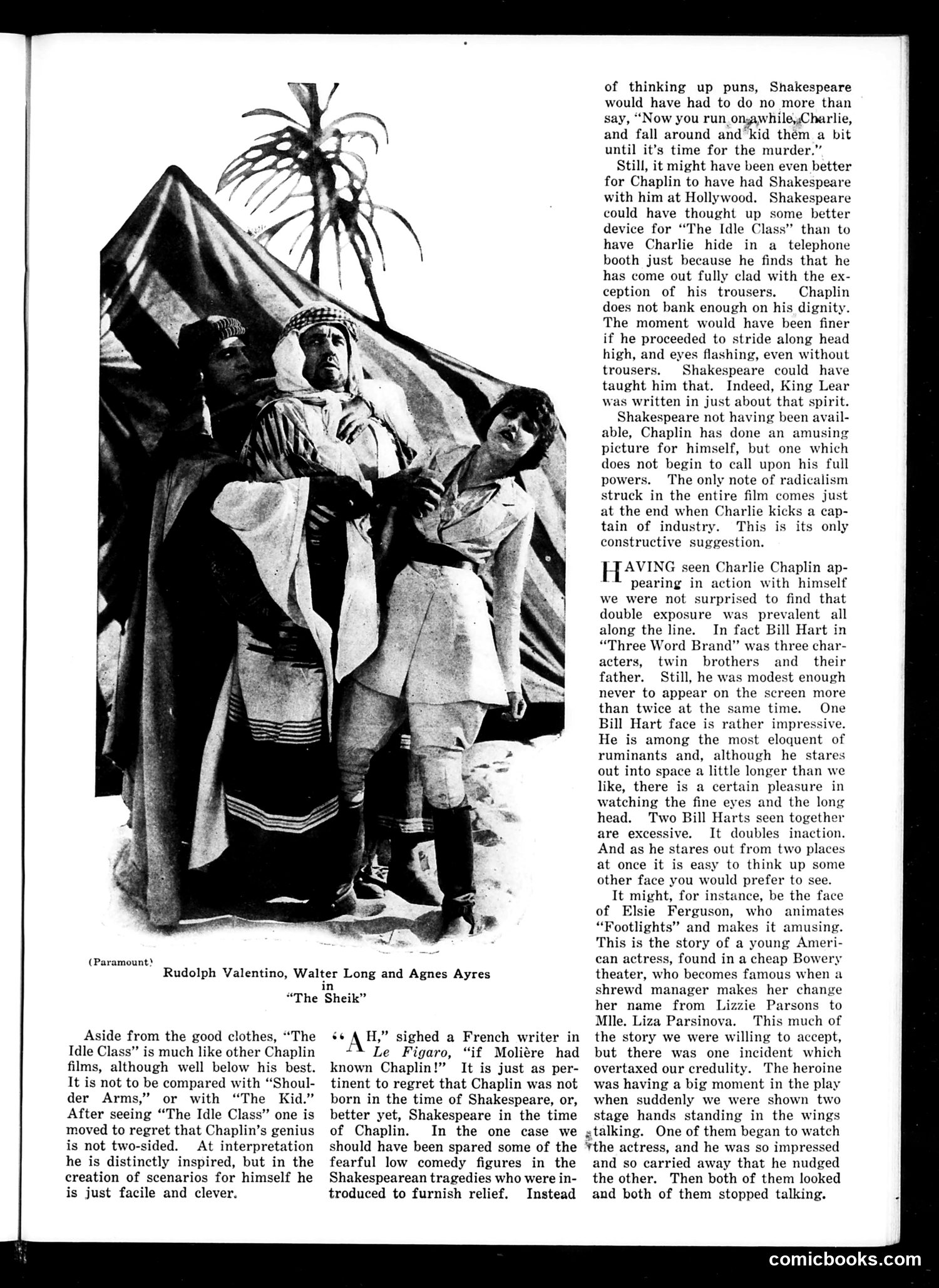
This page reviews three silent films. The main image shows a scene from *The Sheik* (Paramount, starring Rudolph Valentino, Walter Long, and Agnes Ayres)—depicting the exotic, dramatic aesthetic typical of 1920s "sheik" movies that captivated audiences. The text critiques Charlie Chaplin's *The Idle Class*, arguing his creative genius doesn't match his acting talent. The reviewer humorously wishes Shakespeare had collaborated with Chaplin in Hollywood, or vice versa. The satire suggests Chaplin wastes his gifts on trivial scenarios (hiding without trousers) rather than dignified drama. The review also discusses Bill Hart's *Three Word Brand* and Elsie Ferguson's *Footlights*, noting Hart's overuse of double-exposure appears indulgent, while Ferguson's film contains an unbelievable moment where stage hands become distracted watching an actress perform. The tone is sophisticated film criticism with comedic flourishes typical of *Judge* magazine's educated readership.
📄 Transcribed text from this page (OCR, searchable)
Machine-transcribed from the original scan — historical spelling and the odd misread are preserved.
(Paramount) Rudolph Valentino, Walter Long and Agnes Ayres in “The Sheik” Aside from the good clothes, “The Idle Class” is much like other Chaplin films, although well below his best. It is not to be compared with “Shoul- der Arms,” or with “The Kid.” After seeing “The Idle Class” one is moved to regret that Chaplin’s genius is not two-sided. At interpretation he is distinctly inspired, but in the creation of scenarios for himself he is just facile and clever. «+ 4 H,” sighed a French writer in ** Le Figaro, “if Moliére had known Chaplin!” It is just as per- tinent to regret that Chaplin was not born in the time of Shakespeare, or, better yet, Shakespeare in the time of Chaplin. In the one case we should have been spared some of the fearful low comedy figures in the Shakespearean tragedies who were in- troduced to furnish relief. Instead of thinking up puns, Shakespeare would have had to do no more than say, “Now you run on,awhile,,Charlie, and fall around and*kid them a bit until it’s time for the murder.” Still, it might have been even better for Chaplin to have had Shakespeare with him at Hollywood. Shakespeare could have thought up some better device for “The Idle Class” than to have Charlie hide in a telephone booth just because he finds that he has come out fully clad with the ex- ception of his trousers. Chaplin does not bank enough on his dignity. The moment would have been finer if he proceeded to stride along head high, and eyes flashing, even without trousers. Shakespeare could have taught him that. Indeed, King Lear was written in just about that spirit. Shakespeare not having been avail- able, Chaplin has done an amusing picture for himself, but one which does not begin to call upon h powers. The only note of radi struck in the entire film comes just at the end when Charlie kicks a cap- tain of industry. This is its only constructive suggestion. HAVING seen Charlie Chaplin ap- pearing in action with himself we were not surprised to find that double exposure was prevalent all along the line. In fact Bill Hart in “Three Word Brand” was three char- acters, twin brothers and_ their father. Still, he was modest enough never to appear on the screen more than twice at the same time. One Bill Hart face is rather impressive. He is among the most eloquent of ruminants and, although he stares out into space a little longer than we like, there is a certain pleasure in watching the fine and the long head. Two Bill Har' een together are excessive. It doubles inaction. And as he stares out from two places at once it is easy to think up some other face you would prefer to see. It might, for instance, be the face of Elsie Ferguson, who animates “Footlights” and makes it amusing. This is the story of a young Ameri- can actress, found in a cheap Bowery theater, who becomes famous when a shrewd manager makes her change her name from Lizzie Parsons to Mlle. Liza Parsinova. This much of the story we were willing to accept, but there was one incident which overtaxed our credulity. The heroine was having a big moment in the play when suddenly we were shown two stage hands standing in the wings stalking. One of them began to watch ‘¥the actress, and he was so impressed and so carried away that he nudged the other. Then both of them looked and both of them stopped talking. comicbooks.com