
A complete issue · 36 pages · 1921
Judge — September 17, 1921
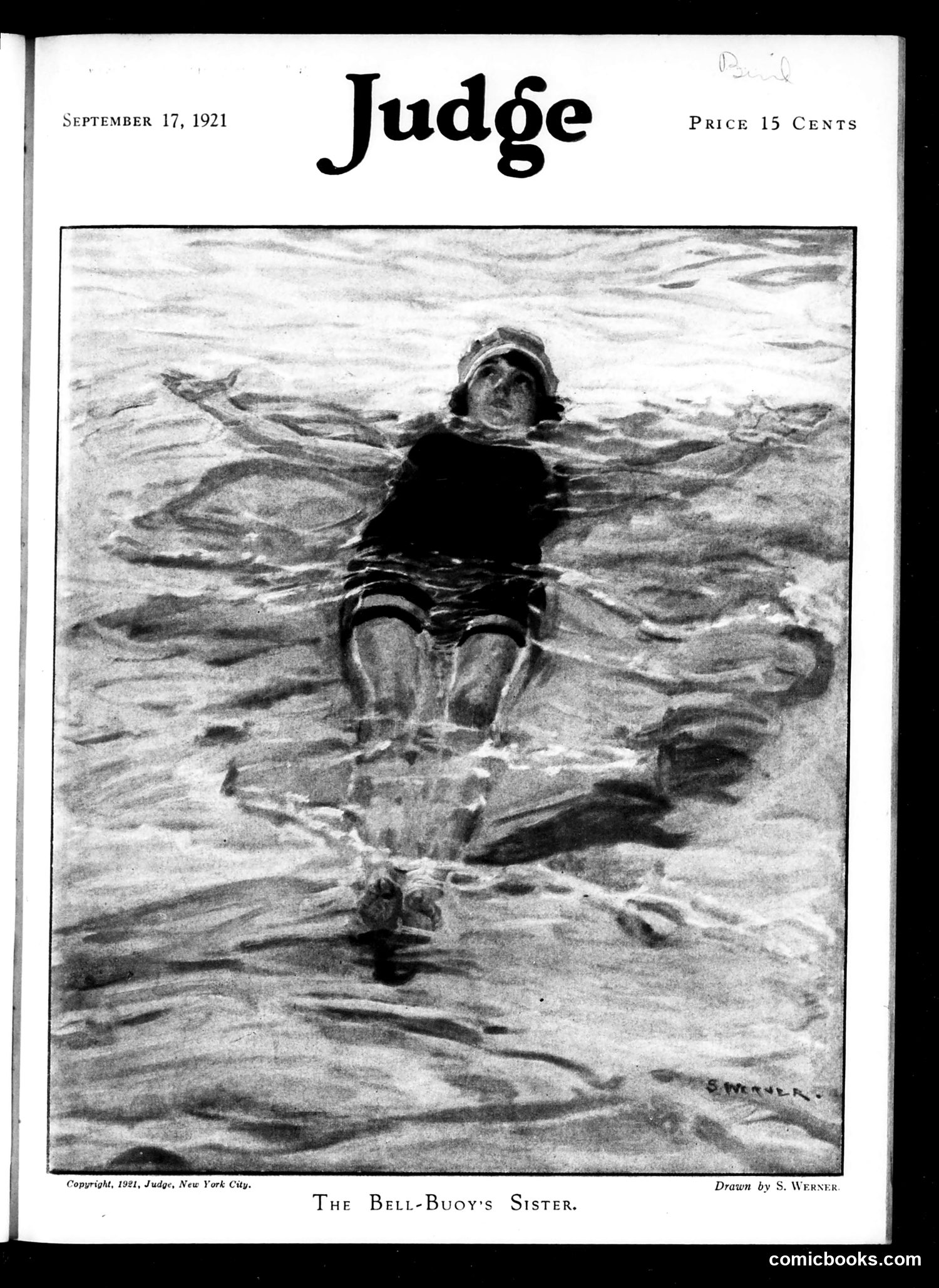
This cartoon from Judge (September 17, 1921) shows a woman floating in water wearing a swimming cap and striped bathing suit. The title "The Bell-Buoy's Sister" is a visual pun: the woman functions like a buoy—a floating marker used in navigation—bobbing in the water with her head above the surface, similar to how a bell-buoy warns ships of hazards. The cartoon likely satirizes the popularity of swimming and beach culture among women in the early 1920s, or possibly comments on women's increased public visibility and independence during this era. The humor derives from the clever analogy between the woman as a human "buoy" and actual maritime navigation equipment. The artistic style is credited to S. Werner.
This page is primarily **advertising content**, not satire or political commentary. It promotes Leslie's Weekly magazine for September 17th, 1921. The headline "Two Miles High With the Mail!" references the **U.S. Air Mail Service**, highlighting a contemporary achievement: pilots flying mail routes across mountains, deserts, and valleys. Arthur Ruhl's article "Hurdling the Sierras" describes the westernmost leg of the Coast-to-Coast route. The page lists other Leslie's features: articles about Mascagni (composer), South America, a short story, and baseball content. **Bottom text** indicates this is from Judge magazine, September 17, 1921, Volume CXXXI, Number 3381. The page serves as a promotional cross-reference between competing publications. There is **no visible political cartoon** on this page.
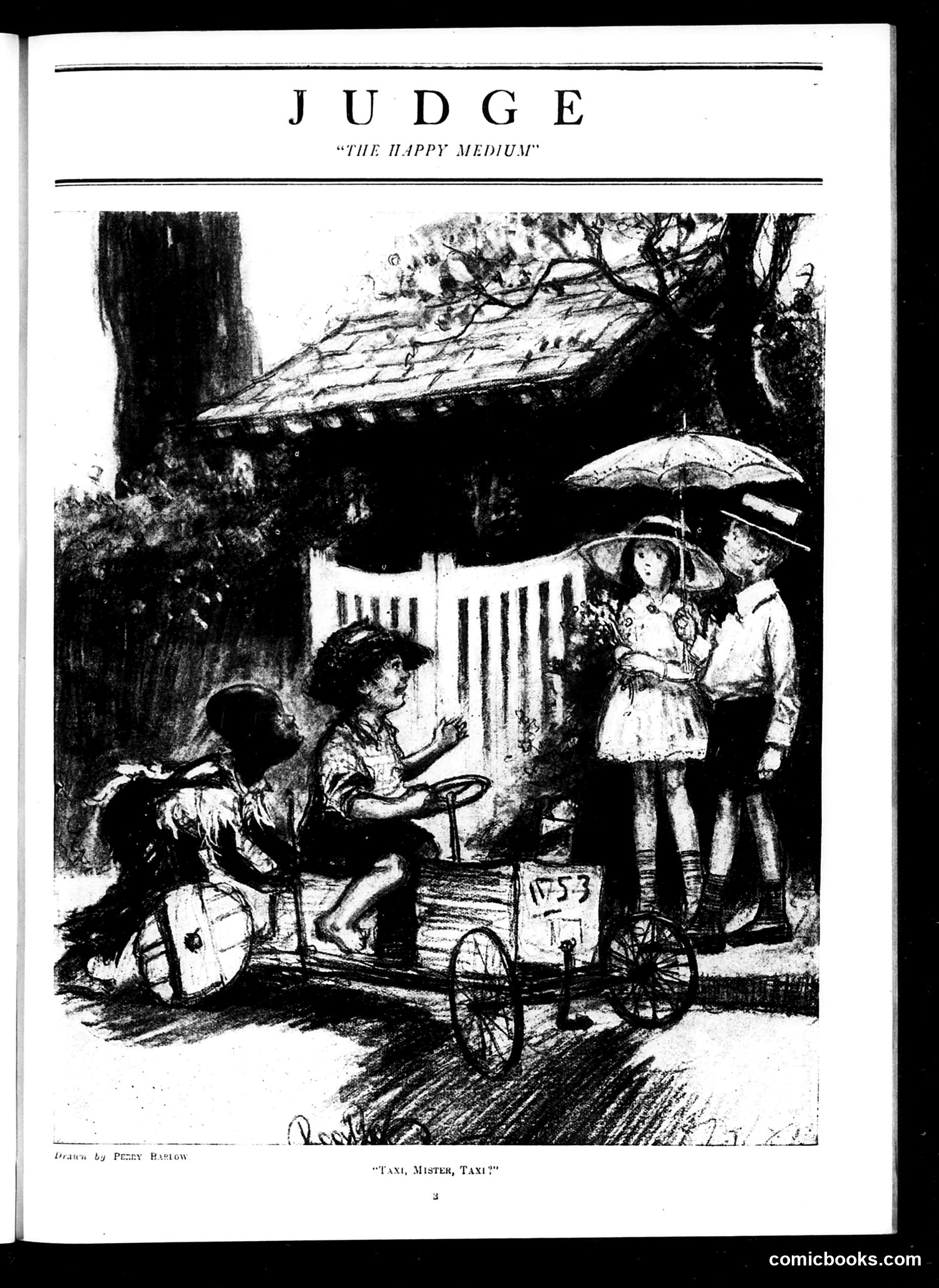
This cartoon by Penny Barlow depicts children operating a makeshift taxi service using a small wheeled cart or wagon. The caption "TAXI, MISTER, TAXI?" suggests the children are soliciting adult customers. The satire appears to target child labor and entrepreneurship during a period when such practices were common. The "happy medium" subtitle implies commentary on finding a compromise or middle ground—possibly satirizing how society tolerated children performing adult economic roles. The formal dress of the adults and children suggests this is middle-class commerce rather than street poverty, which may sharpen the cartoon's critique: that even respectable families allowed children to engage in work typically reserved for adults. The umbrellas and gate suggest a genteel residential setting, making the incongruity more pointed.
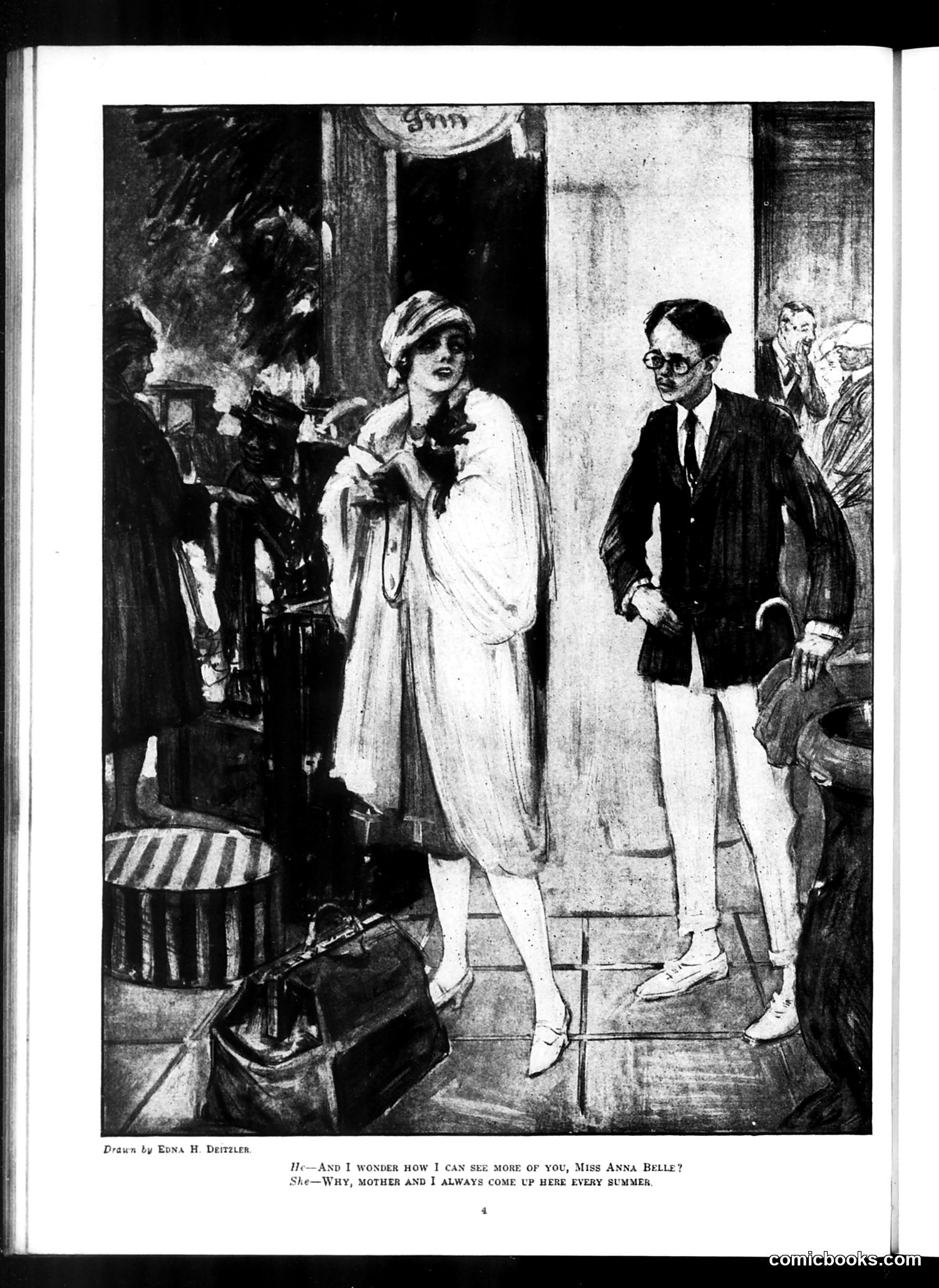
This illustration from *Judge* magazine depicts a scene at what appears to be a seaside resort or hotel entrance. A well-dressed man in glasses and formal attire speaks to a fashionably dressed woman wearing a cloche hat and light coat—typical 1920s styling. The dialogue reveals a social commentary: the man expresses surprise at seeing the woman frequently ("I wonder how I can see more of you"), and she responds that she and her mother visit every summer. The satire appears to target **social mobility and seasonal leisure patterns** among the wealthy during the Jazz Age—specifically, the predictability of the upper classes' summer vacation habits. The drawing is credited to Enid H. Detzler. Without additional context about specific current events, the precise satirical target remains somewhat unclear, though it likely mocks conventional courtship rituals or social pretension.
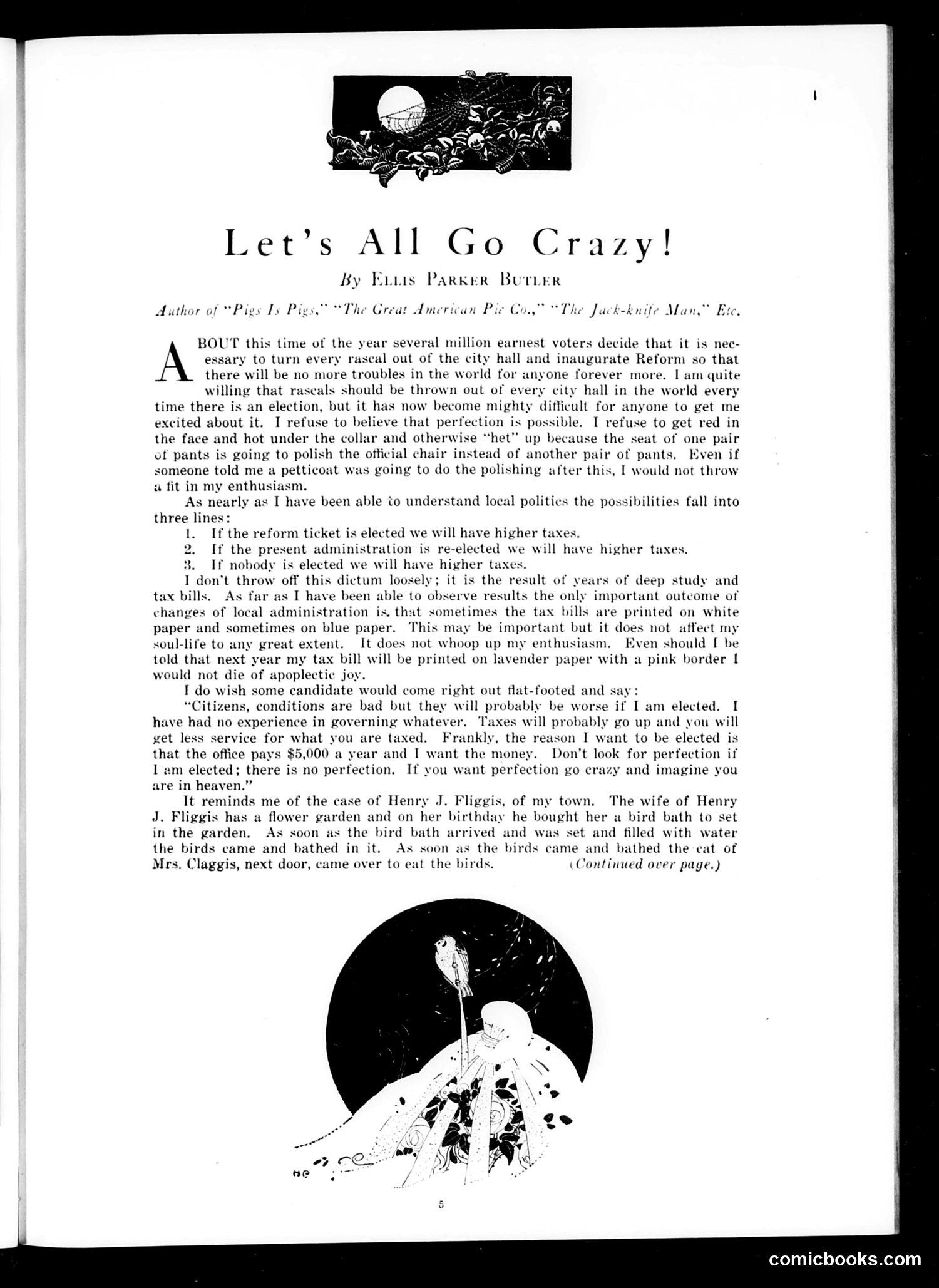
This satirical essay mocks idealistic political reform movements of the early 20th century. Butler argues cynically that regardless of which candidate or party voters elect—reform ticket, incumbent administration, or anyone else—taxes will rise and government service will remain poor. The satire targets the naive optimism of reform advocates who believe electing "honest" candidates will fix systemic problems. Butler's anecdote about Henry J. Fliggis's bird bath illustrates the point: good intentions produce unintended negative consequences (Mrs. Claggis's cat eats the birds). The essay suggests that expecting government perfection is equally futile—hence "go crazy and imagine you are in heaven." The humor lies in Butler's blunt admission that politicians seek office for salary ("$5,000 a year"), not public service.
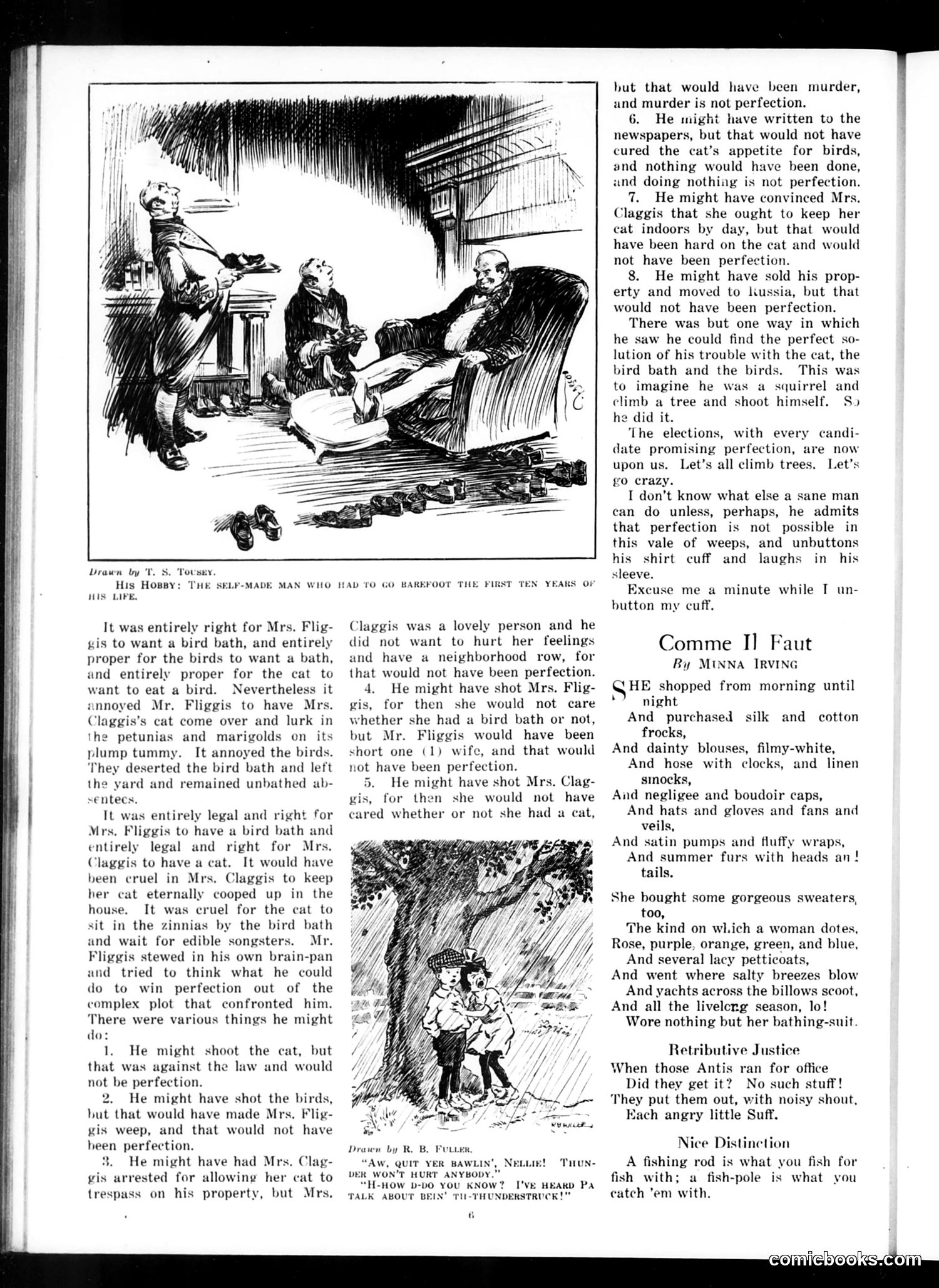
This page contains two distinct pieces: **Top cartoon** ("The Hobby"): Shows a man shooting himself while two others watch. The caption explains he sought "perfection" by eliminating neighborhood nuisances—a cat that hunted birds and a neighbor's cat. The satire mocks someone who became so obsessed with achieving the "perfect solution" to minor problems that he resorted to suicide. It's social commentary on perfectionism and extremism taken to absurd, fatal lengths. **Bottom section**: Poem "Comme Il Faut" satirizing women's excessive shopping habits, followed by political commentary on Anti candidates for office and a humorous definition distinguishing fishing rods from fish-poles. The overall page targets pretension, obsessiveness, and consumer excess—typical Judge magazine satirical targets of the era.
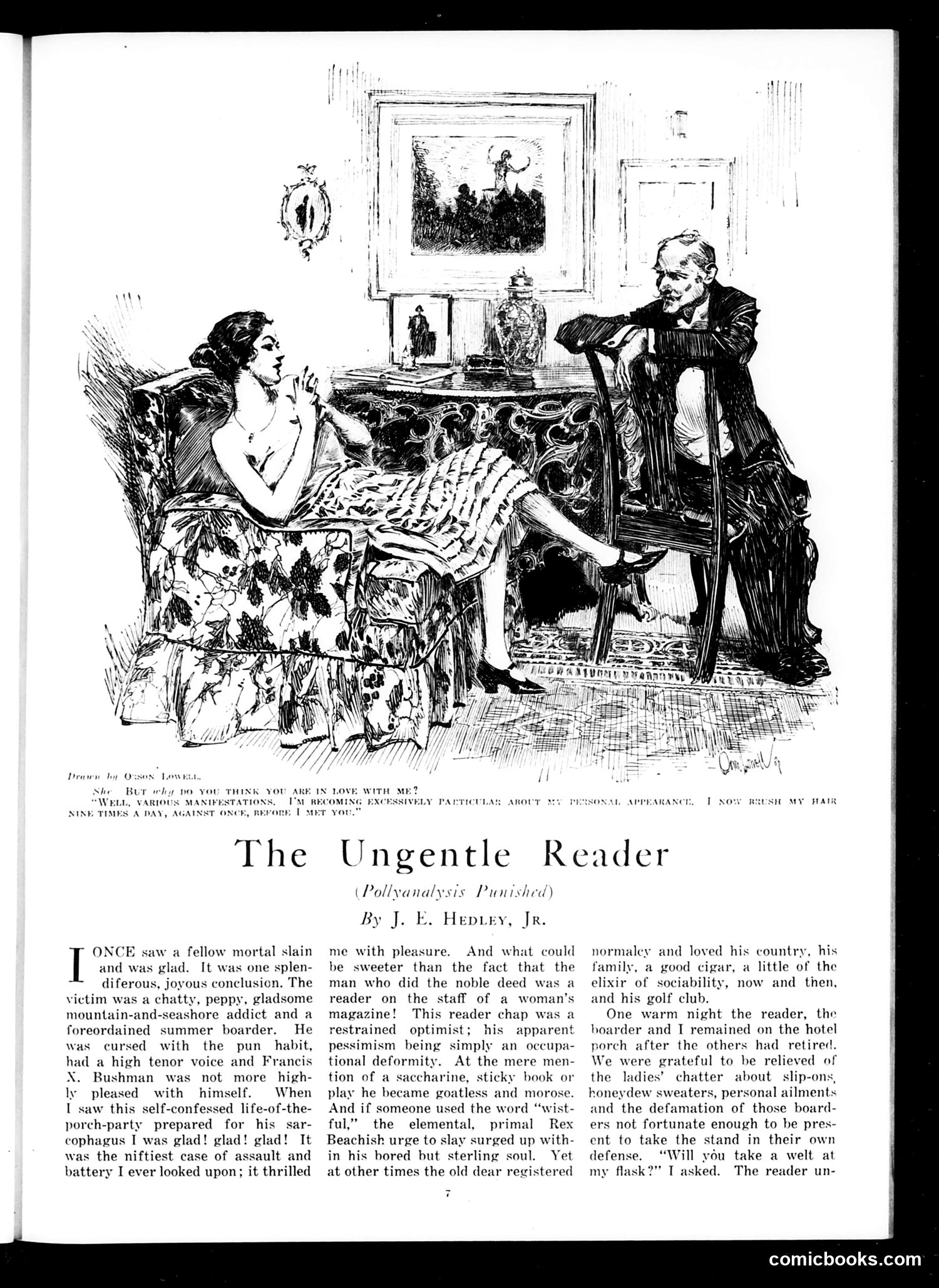
This satirical story mocks the sentimentality of "Pollyanna" literature and those who promote relentless optimism. The cartoon shows a woman (likely a magazine reader or writer) confronting a man about his excessive cheerfulness—she brushes her hair nine times daily to manage her frustration with him. The narrative celebrates a magazine reader who murders an annoyingly cheerful "summer boarder" character—a chatty optimist addicted to puns and self-satisfied behavior. The humor inverts expectations: the killer is presented as justified and even noble because his victim embodied saccharine positivity. The satire targets early-20th-century "Pollyanna" culture—the forced optimism movement—by suggesting such relentless cheerfulness deserves violent punishment. The story frames the killer as a restrained realist opposing manufactured happiness, making the point that aggressive positivity can be genuinely maddening and socially destructive rather than virtuous. The piece is bitter social commentary on American optimism culture.
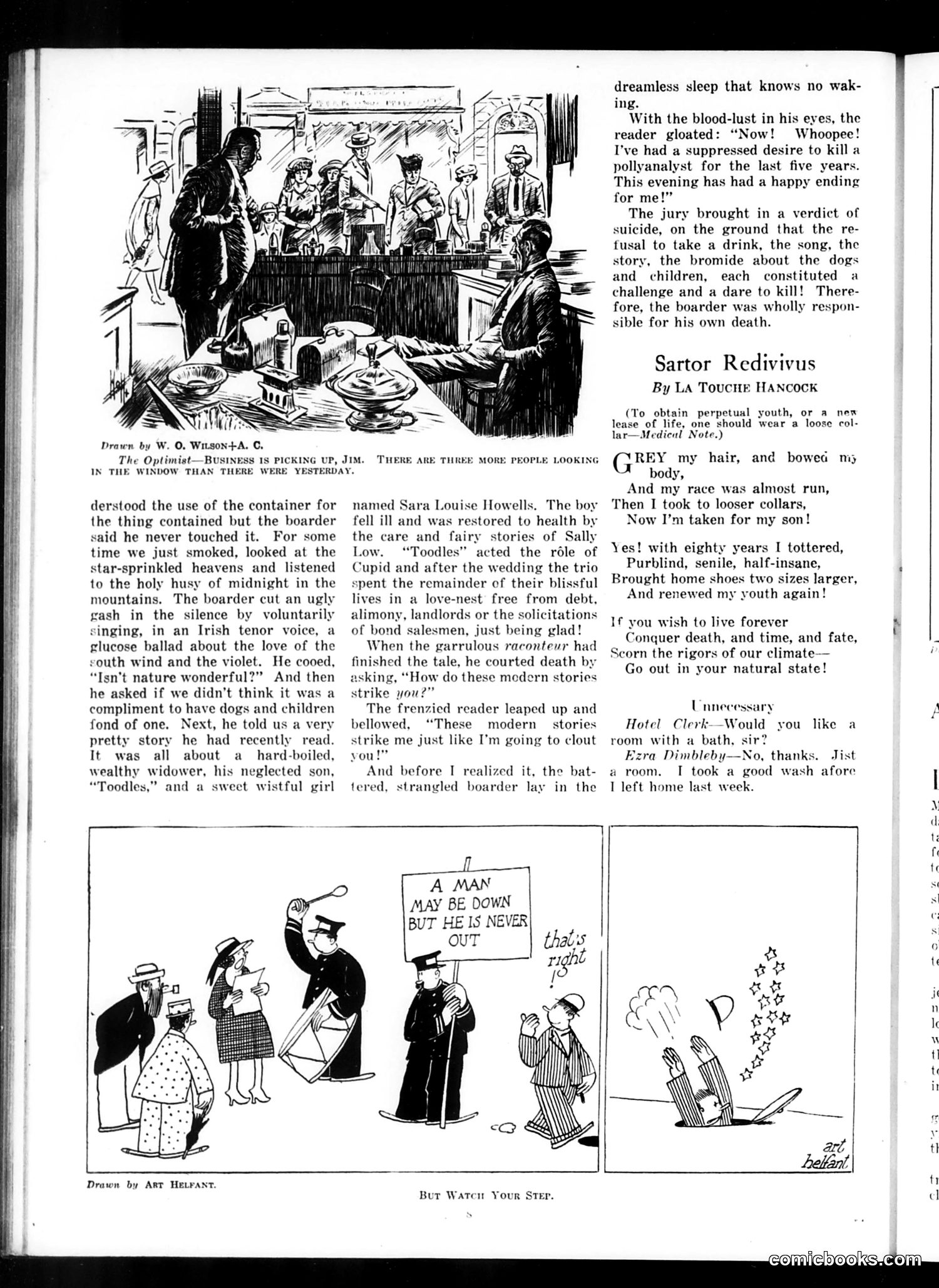
**Main Story ("The Optimist"):** A satirical narrative mocking sentimental sentimentality and optimistic literature. A verbose boarder tells increasingly saccharine stories—about nature's beauty, a reconciliation between a wealthy widower and his neglected son—that so irritate a fellow lodger that he violently attacks him. A jury bizarrely rules the boarder responsible for his own death, finding his boring storytelling and platitudes constituted sufficient provocation. The satire targets twee, moralizing fiction popular in the era and the naïve optimism it represented. **"Sartor Redivivus" Poem:** A humorous piece about regaining youth through wearing loose collars instead of restrictive formal neckwear—poking fun at both fashion constraints and dubious health claims. **Bottom Cartoons:** Art Helfant's "But Watch Your Step" depicts the aphorism "A man may be down but he is never out," showing a figure knocked down but recovering—an encouragement about resilience, though the "watch your step" caption suggests ironic warning.
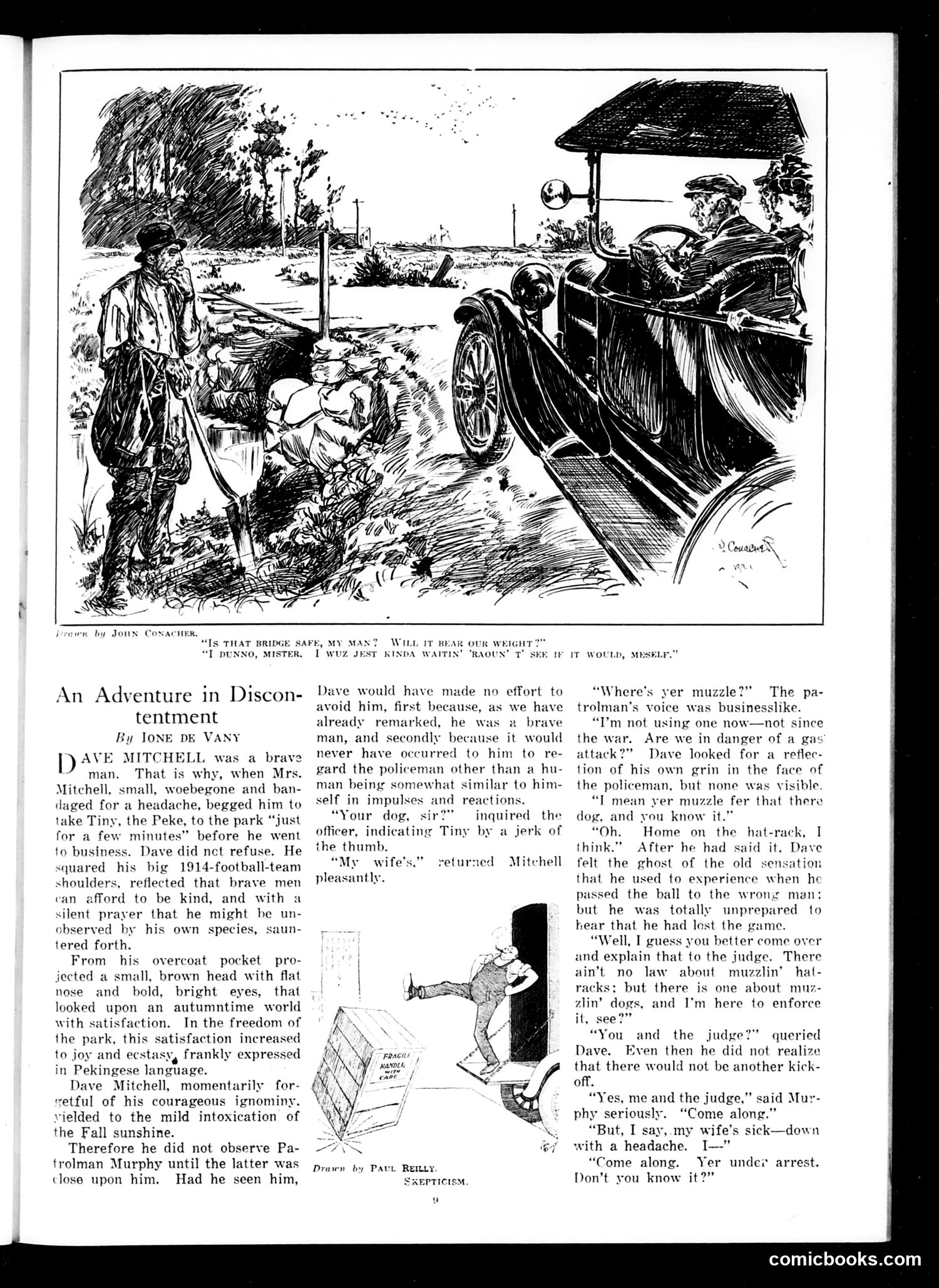
This story satirizes rigid bureaucracy and the clash between reasonable men and officious minor officials. Dave Mitchell, a brave and kind man, takes his wife's Pekingese dog to the park. He encounters Patrolman Murphy, who demands the dog wear a muzzle as required by law. Dave, unprepared for literal enforcement, makes a flippant joke about leaving the muzzle "on the hat-rack at home." Rather than exercise discretion or humor, Murphy arrests Dave and insists he answer to a judge. The satire targets the petty authoritarianism of low-ranking officials who rigidly enforce rules without judgment or mercy—even when circumstances (Dave's sick wife waiting at home) might warrant leniency. The story mocks how bureaucratic power corrupts even minor functionaries into unfeeling martinets.
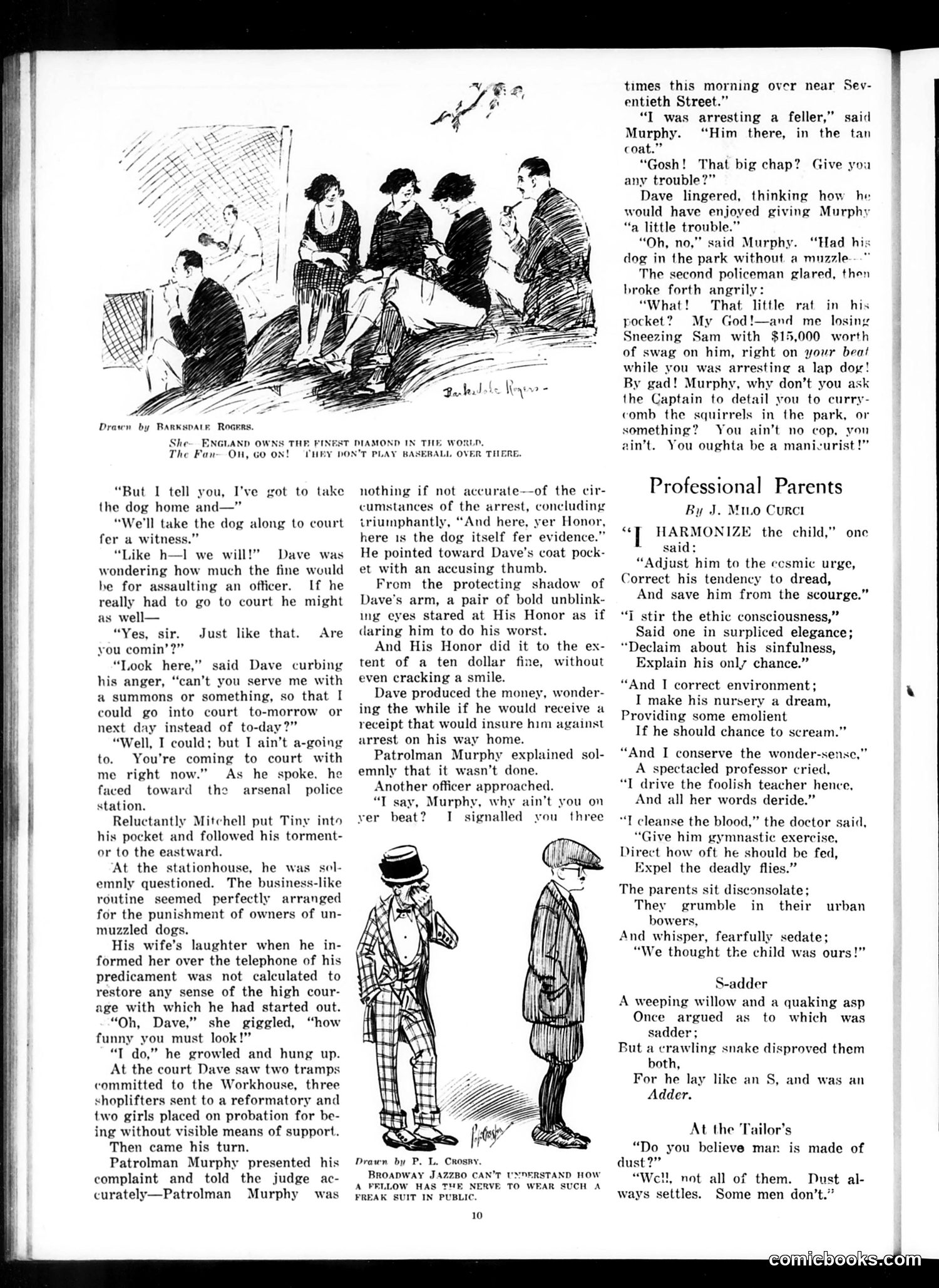
This page contains two distinct pieces of satire: **Main Cartoon (top)**: A man is arrested by Patrolman Murphy for having an unmuzzled dog in the park. The satire mocks bureaucratic over-enforcement: Murphy arrests Dave over a tiny lapdog while another officer angrily reveals Murphy ignored a major crime—a burglar ("Sneezing Sam") carrying $15,000 in stolen goods escaped on his beat. The second officer sarcastically suggests Murphy should be a manicurist instead of a cop. The joke: petty law enforcement prioritizes trivial violations while serious crimes go unaddressed. **Secondary Cartoon (bottom)**: Shows a fashionably-dressed man in an unconventional suit. The caption mocks a "Broadway Jazzbo" (jazz-era urban sophisticate) who can't understand how someone wears such an outlandish outfit publicly—satirizing 1920s fashion pretension and social conformity. **Article**: "Professional Parents" is satirical verse mocking competing child-rearing philosophies (psychological adjustment, religious instruction, environmental design, etc.), showing how parents obsess over theories while missing simple truths.
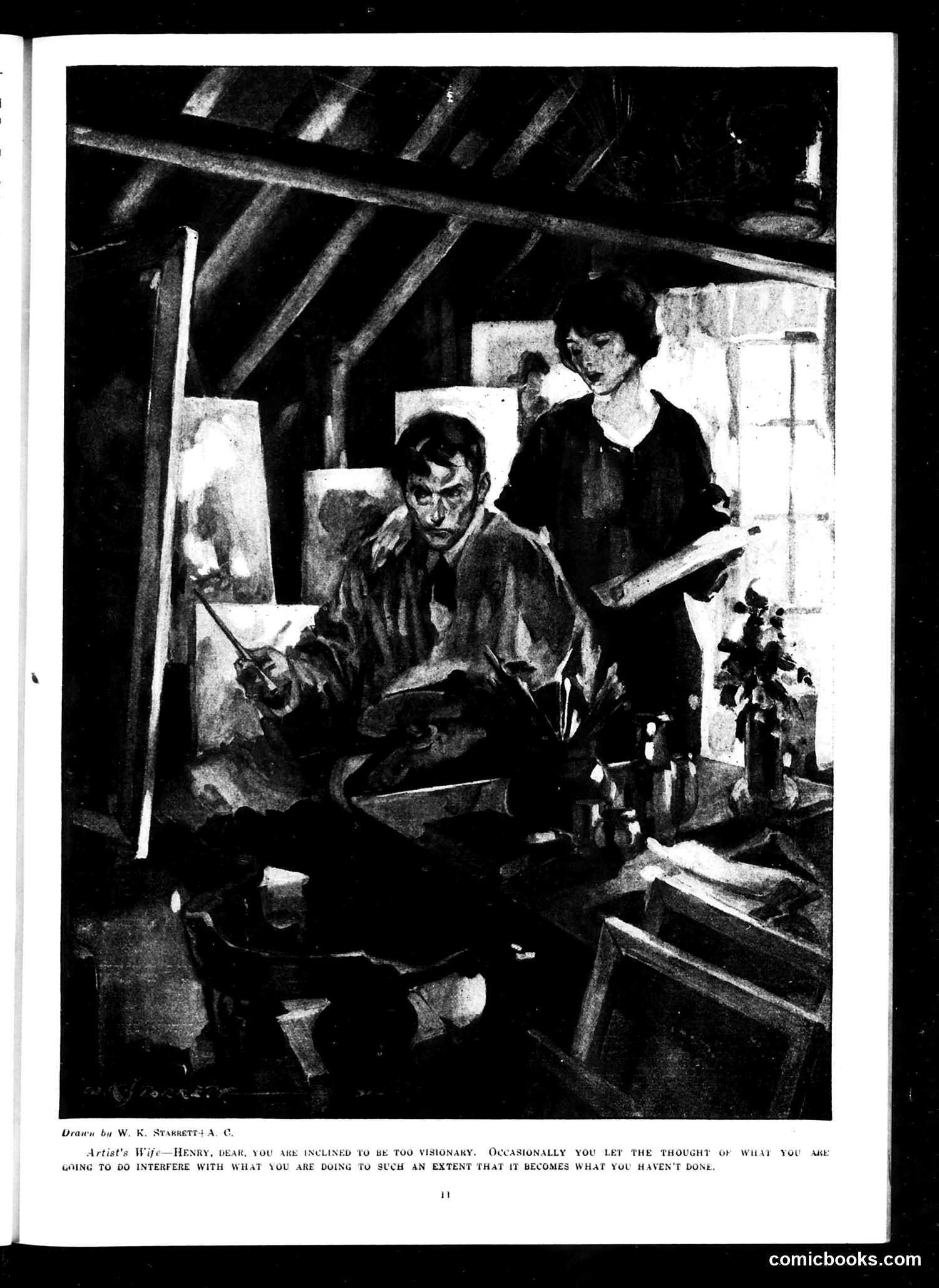
This illustration depicts a domestic scene in an artist's studio. The caption presents marital advice from a wife to her husband (Henry), criticizing his tendency toward excessive visionary thinking that interferes with actual productivity. The satire targets the stereotype of the impractical artist—someone so absorbed in future ambitions and grand ideas that he fails to complete present work. The wife's complaint, rendered in witty paradox ("what you haven't done"), suggests that artistic dreaming becomes an excuse for laziness or incompetence. This reflects early 20th-century middle-class anxieties about bohemian lifestyles and artistic pretension, positioning practicality and completed work as superior to imaginative ambition. The cartoon mocks both idealistic artists and their enablers.
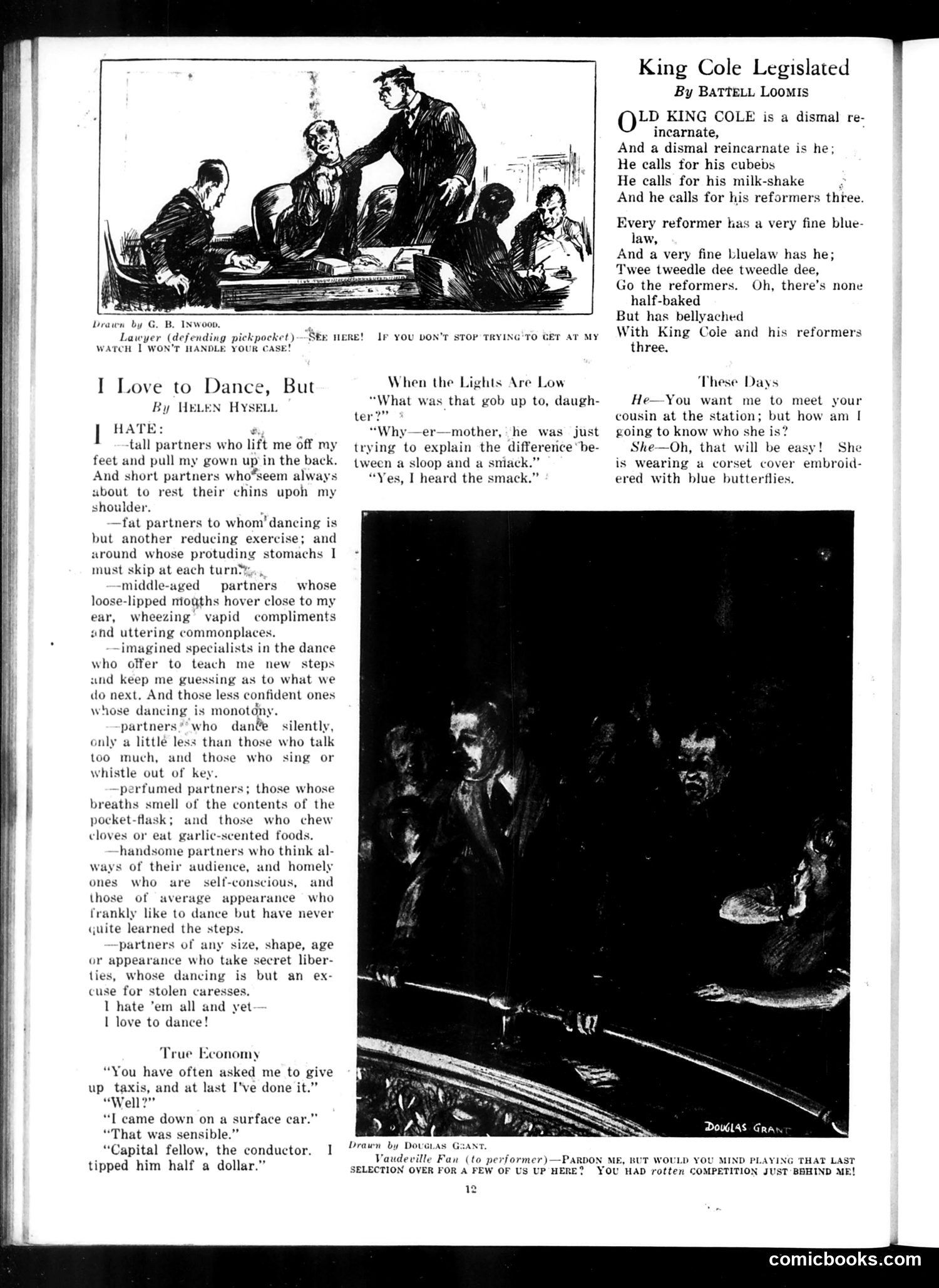
The page contains several satirical pieces typical of early 20th-century American humor: **Top cartoon:** A lawyer defends a pickpocket by claiming the victim won't press charges because he won't "handle the case"—a crude pun on the pickpocket's profession. **"I Love to Dance, But"**: Hysell's humorous essay catalogs annoyances with various dance partners—tall ones, short ones, fat ones, middle-aged ones, etc. It's social satire mocking the forced politeness of ballroom dancing and the variety of disagreeable partners one must endure despite enjoying the activity itself. **"King Cole Legislated"**: A parody of the nursery rhyme applying it to reformers. It satirizes Progressive Era reform movements as repetitive and numerous, suggesting reformers are producing endless "blue laws" (morality legislation) in tiresome fashion. **Other brief humorous items** include jokes about miscommunication between mother and daughter ("the smack" being mistaken for physical contact), and a vaudeville heckler complaint. The overall tone reflects pre-WWI American satire targeting dance culture, reform politics, and social awkwardness.
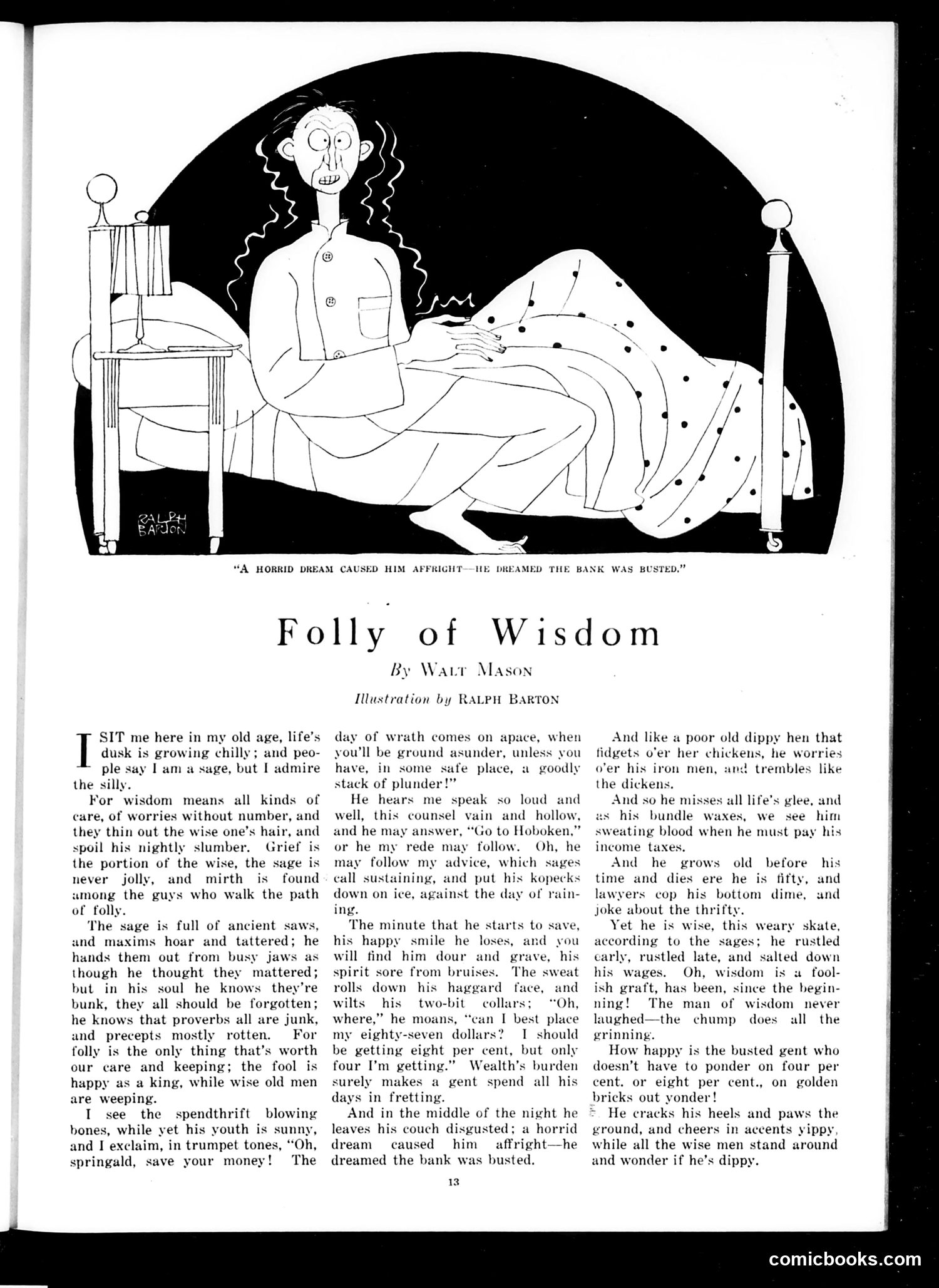
This illustrated essay satirizes conventional financial wisdom. The cartoon depicts a man experiencing a nightmare about bank failure—visualizing the anxiety that comes with trying to save money responsibly. Mason's essay argues that pursuing financial security through careful saving actually destroys happiness. The "wise" man who saves obsessively worries constantly about interest rates, taxes, and bank failures, becomes haggard and miserable, and dies without enjoying life. Meanwhile, the "fool" who spends freely lives happily, cracks jokes, and enjoys himself. The satire mocks the era's conventional morality around thrift and self-denial. Mason inverses the typical wisdom: he claims the carefree spender is actually wiser because he experiences joy, while the prudent saver becomes a neurotic wreck—"wise" only by society's hollow standards. This reflects early 20th-century skepticism toward the Protestant work ethic and delayed gratification ideology.
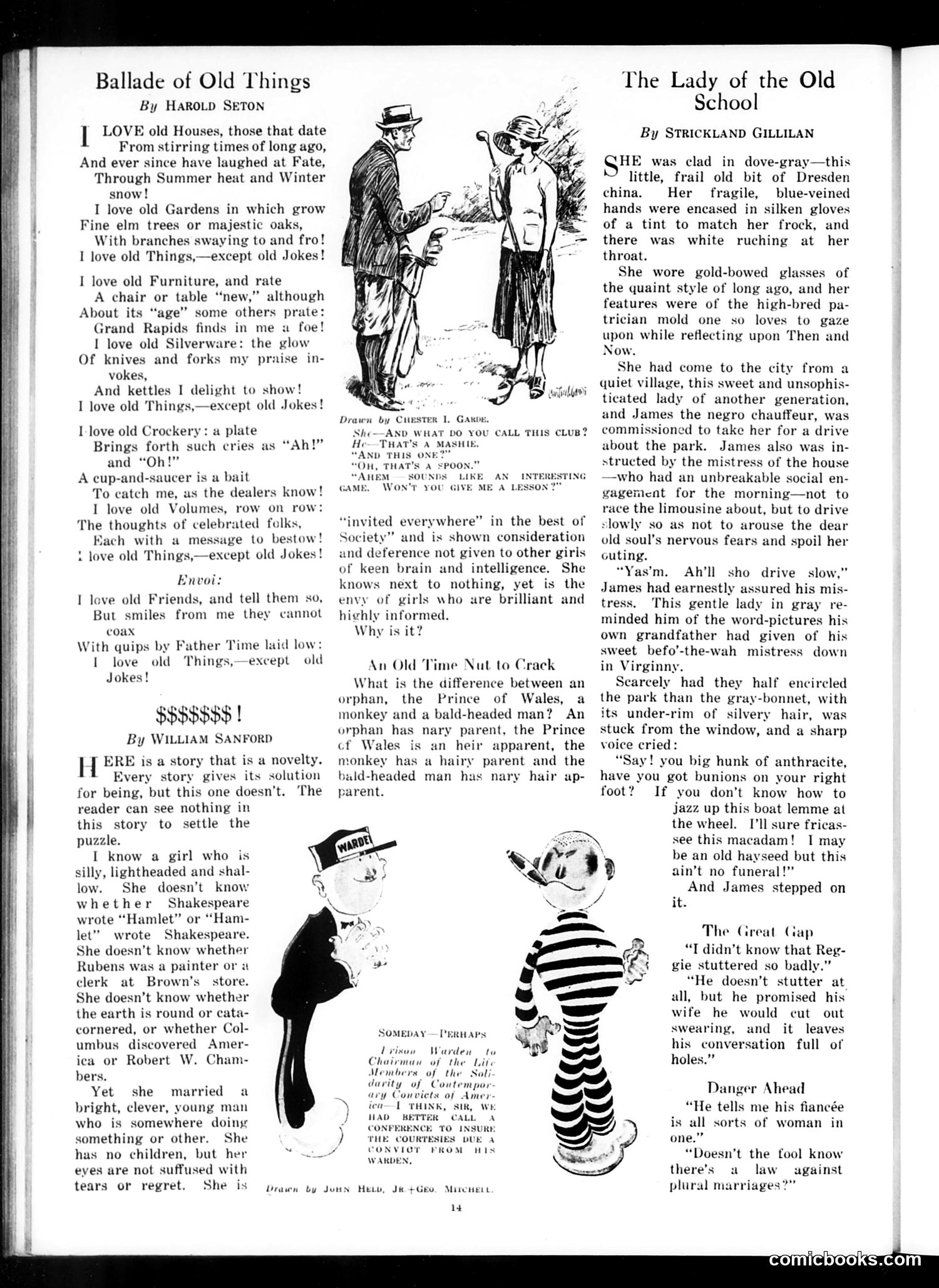
This Judge magazine page contains three pieces of satirical content: **"Ballade of Old Things"** (left): A poem celebrating antiques and vintage items, with the repeated refrain that the author loves old things "except old jokes"—meaning he dislikes tired, worn-out humor. The satire is self-referential: Judge is acknowledging that repeating the same jokes becomes tedious. **"A Novelty Story" (center)**: Satirizes vapid, unintelligent women in high society. The premise: a woman who knows nothing about literature, history, or science is nonetheless popular and invited everywhere, while brilliant women are envied but excluded. The satire criticizes society's shallow values and preference for pretty, docile women over educated ones. **"The Lady of the Old School"** (right): Describes an elderly, refined woman from a previous generation being driven through the park by a Black chauffeur named James. It gently satirizes old-fashioned gentility and social anxieties, contrasting her nervous, delicate sensibilities with the modern pace of urban life. The cartoons employ period stereotypes and reflect early 20th-century attitudes toward gender, class, and race.
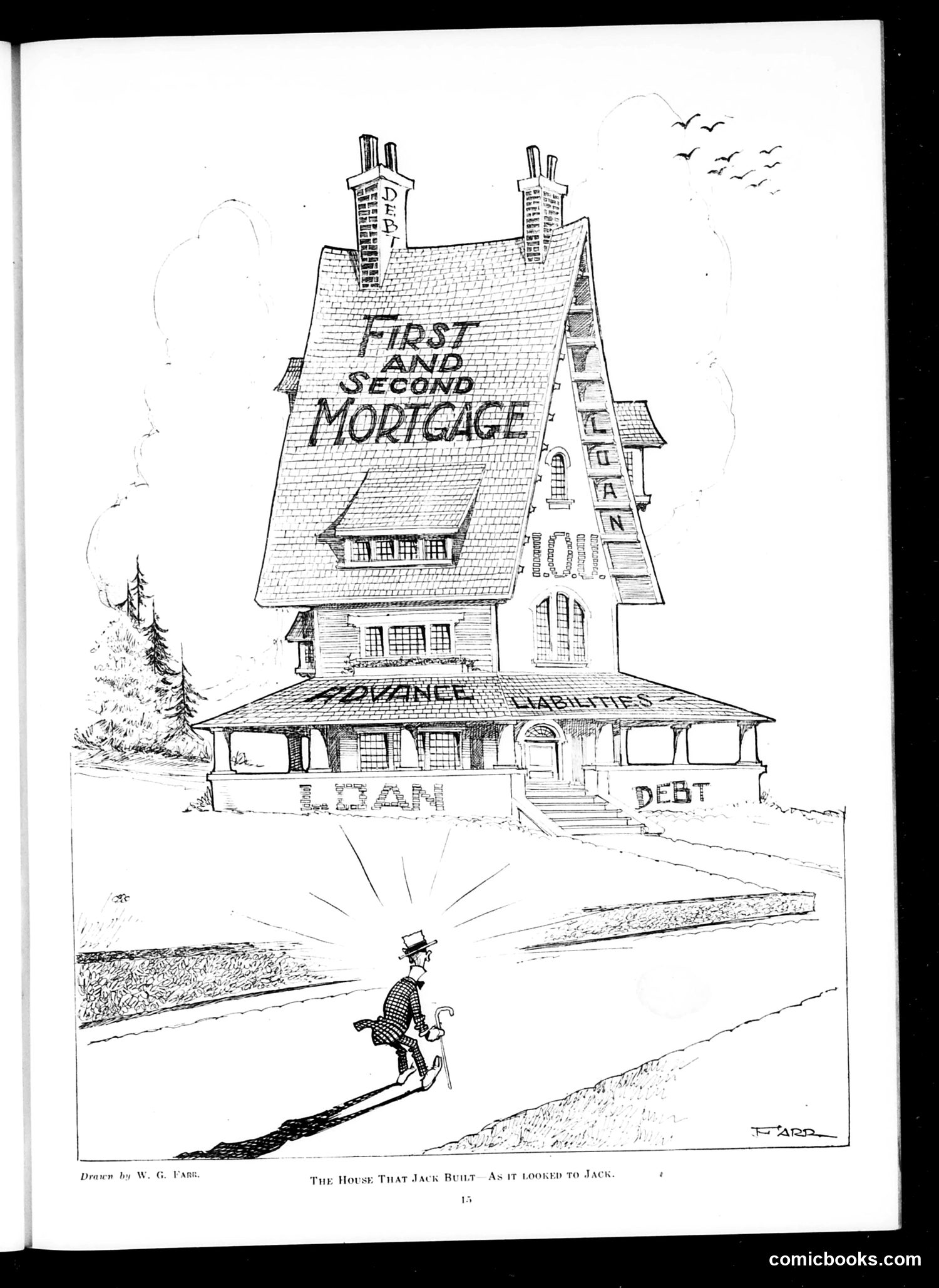
This political cartoon by W.G. Farr uses the nursery rhyme "The House That Jack Built" as a satirical framework. The illustration shows a rickety, top-heavy house literally labeled with financial burdens: "FIRST AND SECOND MORTGAGE," "LIABILITIES," "DEBT," and "LAND" supporting it all. A small figure (Jack) approaches the unstable structure, which appears ready to collapse. The satire critiques how ordinary homeowners like "Jack" are weighed down by layered financial obligations—mortgages stacked upon mortgages, liabilities, and debt—creating an unsustainable housing situation. This appears to comment on speculative real estate practices or housing market instability of the era, warning that properties are built on financially precarious foundations that ordinary people cannot afford to maintain.
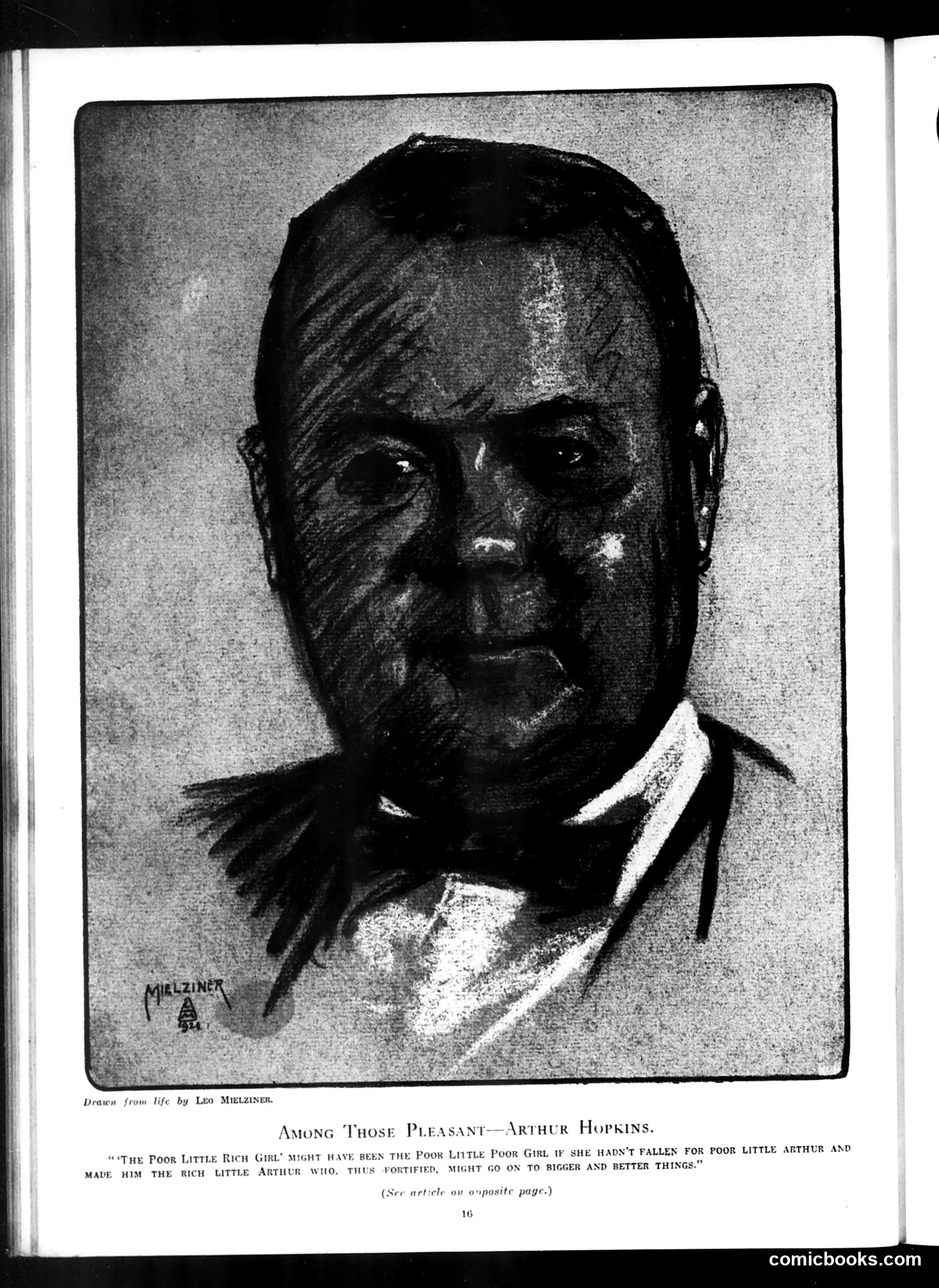
This is a portrait sketch by Leo Mielziner of Arthur Hopkins, likely a theatrical or social figure of the era. The accompanying caption appears to be satirical commentary on a romantic narrative: a wealthy young woman ("Poor Little Rich Girl") who might have pursued greater ambitions, instead fell in love with "poor little Arthur" and married him, thereby enriching him and enabling his success. The satire targets the tendency of privileged women to sacrifice their own potential by marrying men of lesser means, essentially subsidizing male ambition with inherited wealth. The caption's ironic tone—calling her choice "pleasant"—undercuts the romantic narrative by highlighting how women's agency and resources were redirected toward male advancement. The reference to an article on the opposite page suggests this accompanied a longer piece in Judge magazine about Hopkins and this social dynamic.
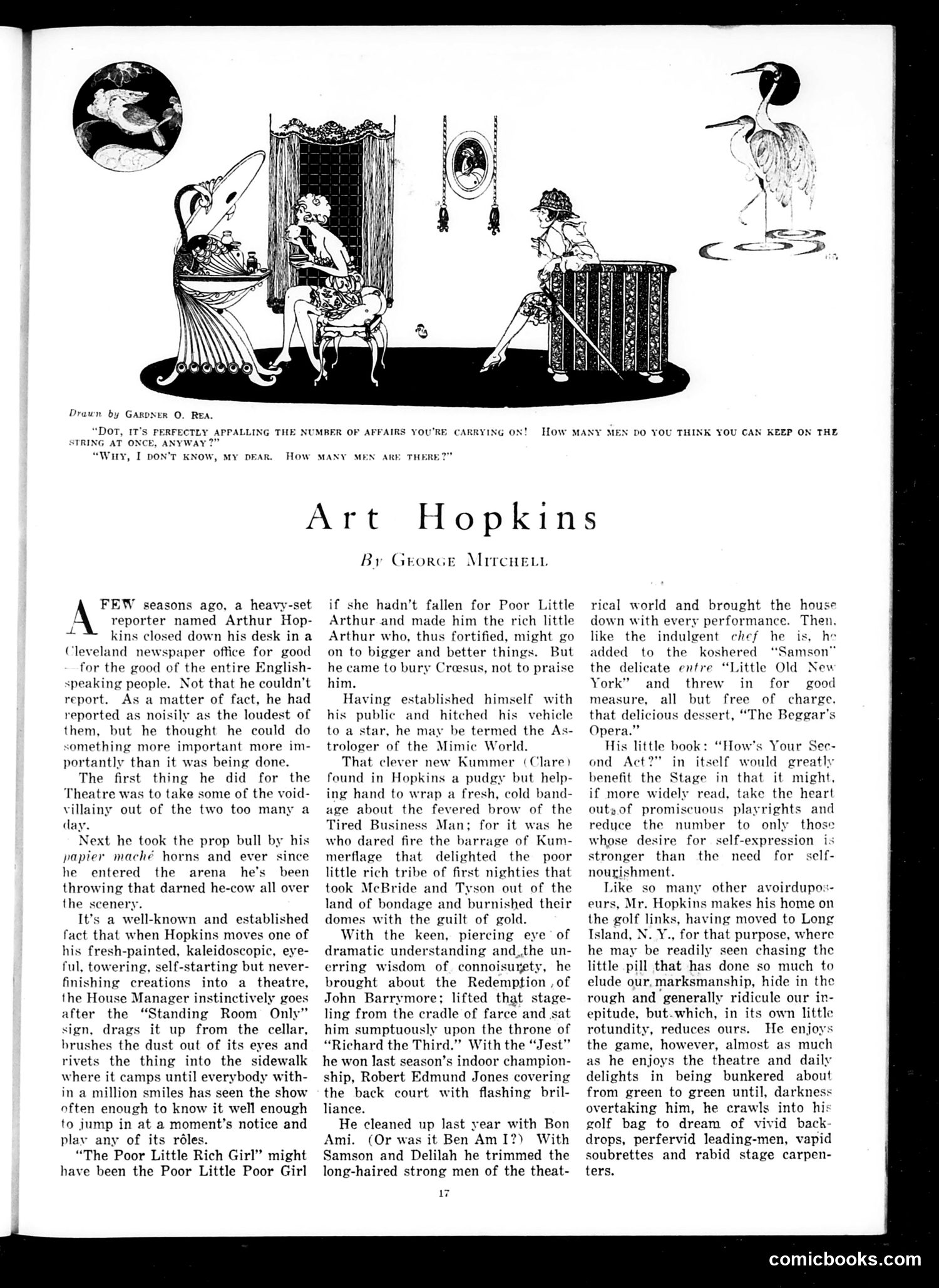
The cartoon at top, drawn by Gardner O. Rea, depicts a society woman being questioned about her numerous romantic affairs. A man asks how many men she's "carrying on" with simultaneously, and she replies she doesn't know—essentially admitting to casual infidelity. The joke satirizes the loose morality and romantic entanglements of wealthy society women, a common target of Judge magazine's humor about the upper classes. The article below is a profile of Art Hopkins, a theatrical producer/director who left newspaper work to reshape American theater. The text celebrates his innovative stage productions, his discovery of John Barrymore, and his work on plays like "The Poor Little Rich Girl" and "Samson and Delilah." Hopkins is portrayed as a theatrical visionary who elevated theatrical standards. The piece concludes by noting he now lives on Long Island pursuing golf—typical of wealthy New York society figures of the era.
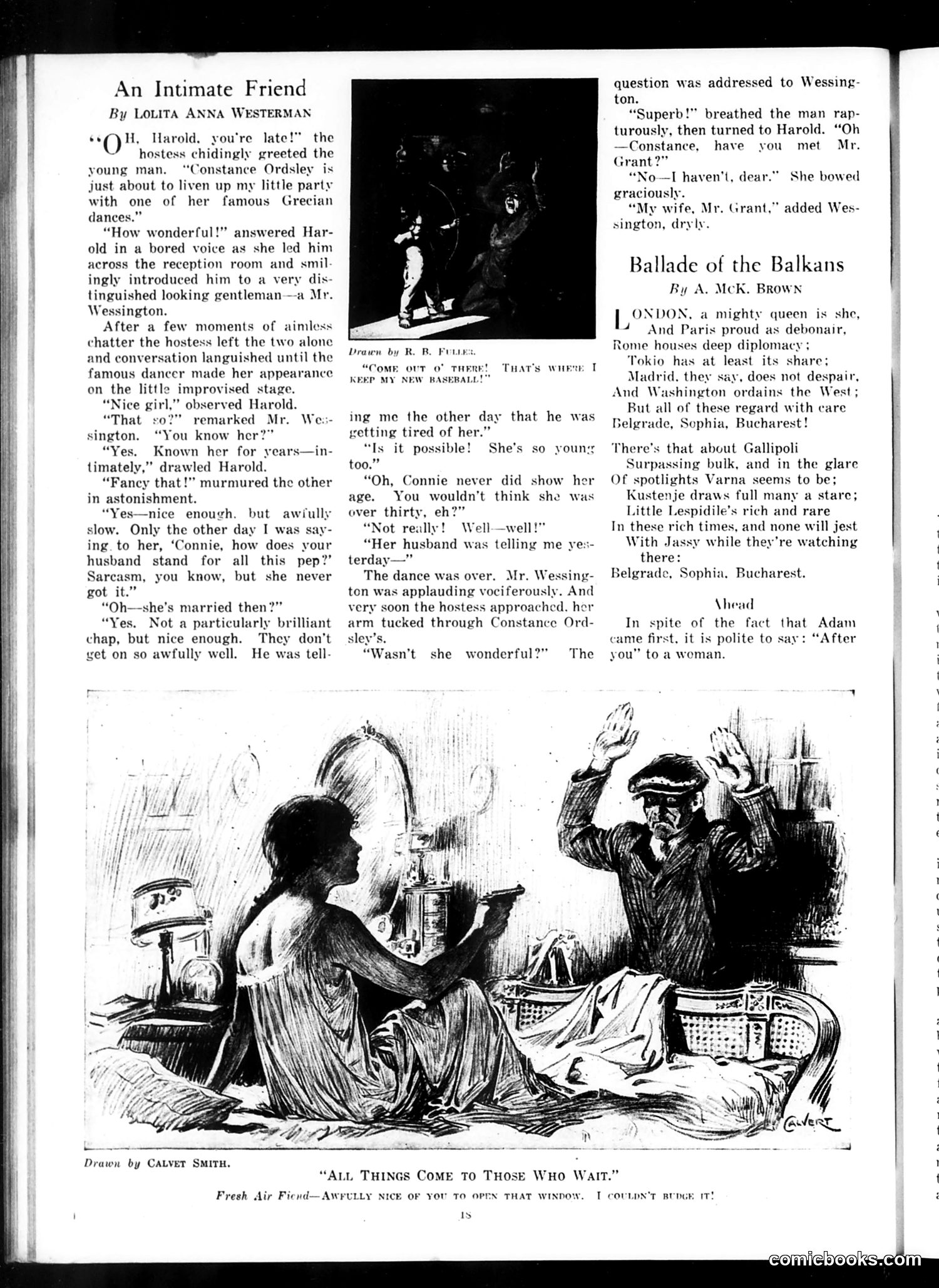
This page contains two satirical pieces: **"An Intimate Friend"** (top): A short story mocking male social pretension. Harold boasts to stranger Mr. Wessington about his intimate knowledge of dancer Constance Ordsley, casually dropping derogatory details about her age and marriage. The punchline reveals Wessington is actually Constance's husband—Harold's gossip has backfired spectacularly. The satire targets men who perform superiority through false familiarity and loose talk. **"Ballade of the Balkans"** (right): A poem about European diplomatic attention focused on Balkan cities (Belgrade, Sophia/Sofia, Bucharest, Gallipoli, Varna) during a period of geopolitical tension. The verse suggests these minor Balkan locations command disproportionate international concern—likely referencing early 20th-century Balkan instability and great-power competition. **Bottom cartoon**: Shows a woman frustrated trying to open a window while a man outside (labeled "Fresh Air Fiend") stubbornly resists, satirizing obsessive health-fad advocates.
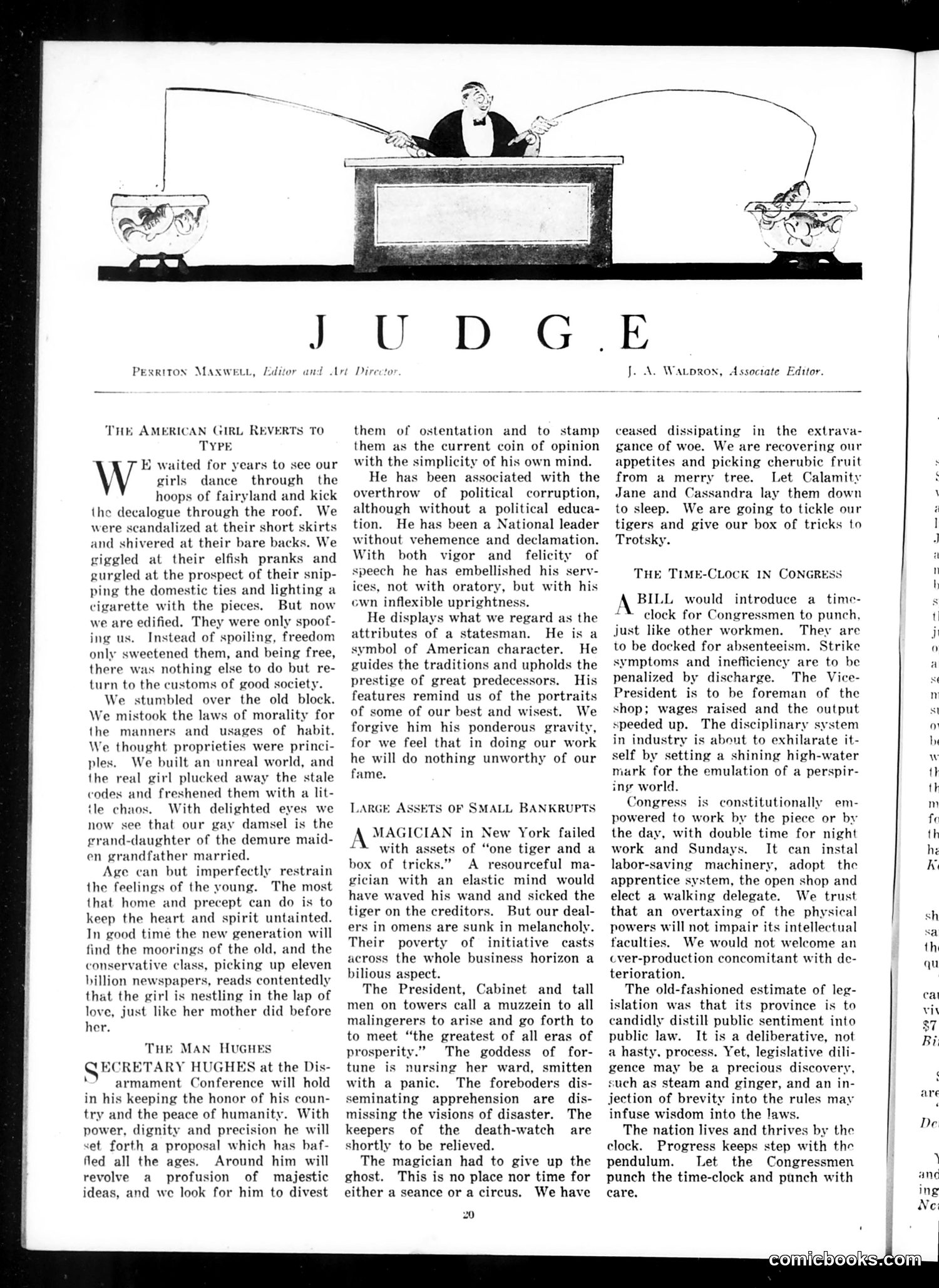
This page from *Judge* contains editorial commentary rather than traditional political cartoons. The masthead illustration shows a judge presiding over a courtroom—a visual pun on the magazine's name. The main articles satirize American society circa the early 1920s: **"The American Girl Reverts to Type"** mocks earlier moral panic about young women's liberation. The writer ironically praises girls for abandoning radical behavior (short skirts, smoking, rejecting domestic life) and returning to traditional propriety—suggesting the "flapper rebellion" was merely youthful theatrics. **"The Man Hughes"** praises Secretary of State Charles Evans Hughes, apparently in connection with a disarmament conference, portraying him as a dignified statesman embodying American virtues. **"Large Assets of Small Bankrupts"** sarcastically notes a failed magician's worthless assets, using this to comment on post-war economic pessimism and urging confidence in American prosperity. The overall tone reflects 1920s-era conservative social commentary mixed with cautious economic optimism.
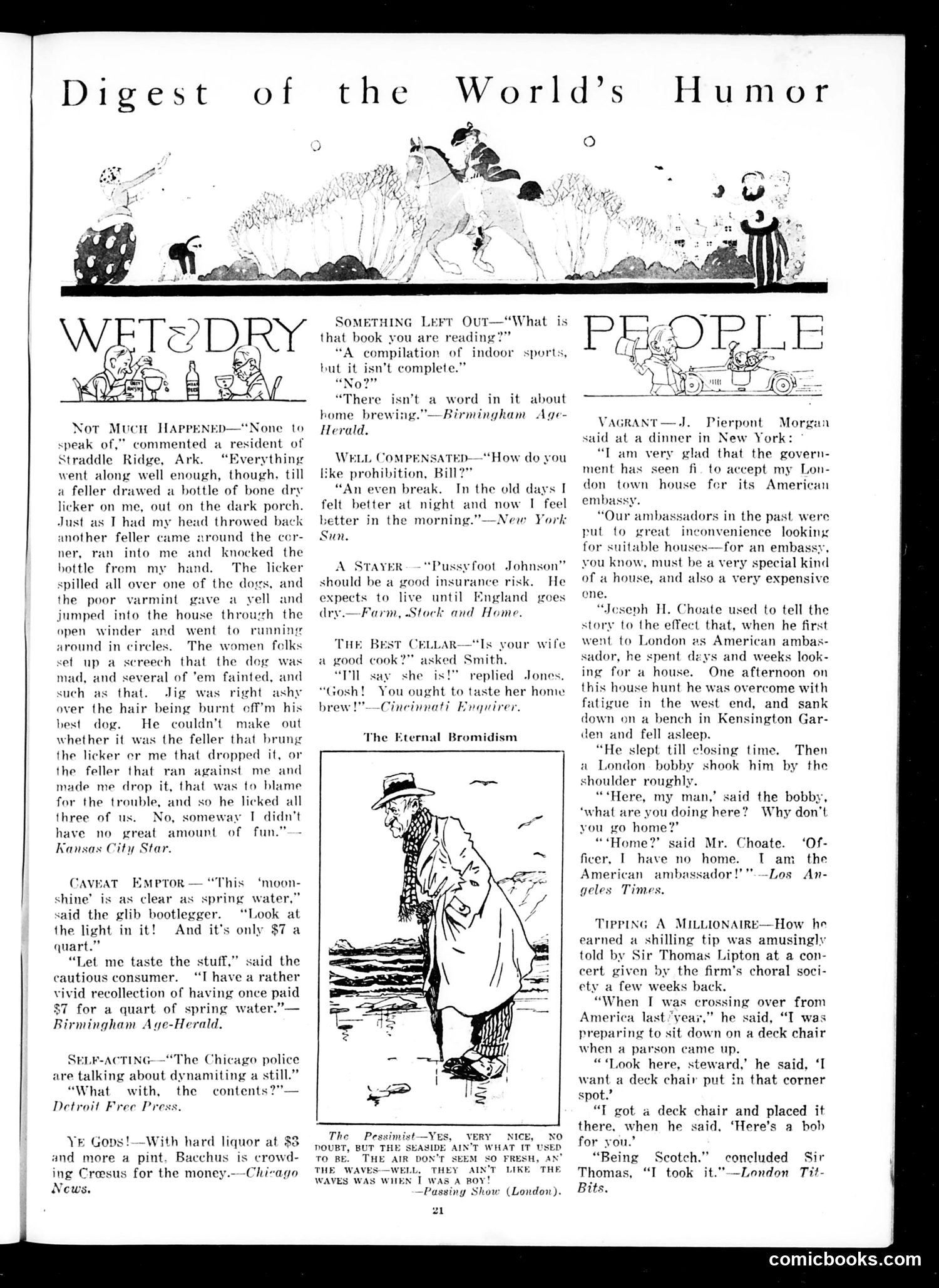
This page is a humor digest collecting jokes from various American and British publications about **Prohibition**—the era when alcohol was legally banned in the U.S. (1920-1933). The jokes mock: - **Bootleggers** selling dangerous homemade "moonshine" whiskey at inflated prices - **Home brewing** persisting illegally despite the law - **Prohibition's enforcement** (Chicago police dynamiting stills) - **Its ineffectiveness** (people still drinking, just secretly) Key references include "Pussyfoot Johnson" (a real Prohibition activist), and a story about J. Pierpont Morgan donating his London townhouse as the American embassy—with an anecdote about diplomat Joseph H. Choate searching for housing in London while serving as ambassador. The humor reflects contemporary frustration with Prohibition's unpopularity and the widespread, barely-concealed drinking culture that persisted throughout the 1920s. The cartoons satirize both the law's futility and the black market it created.
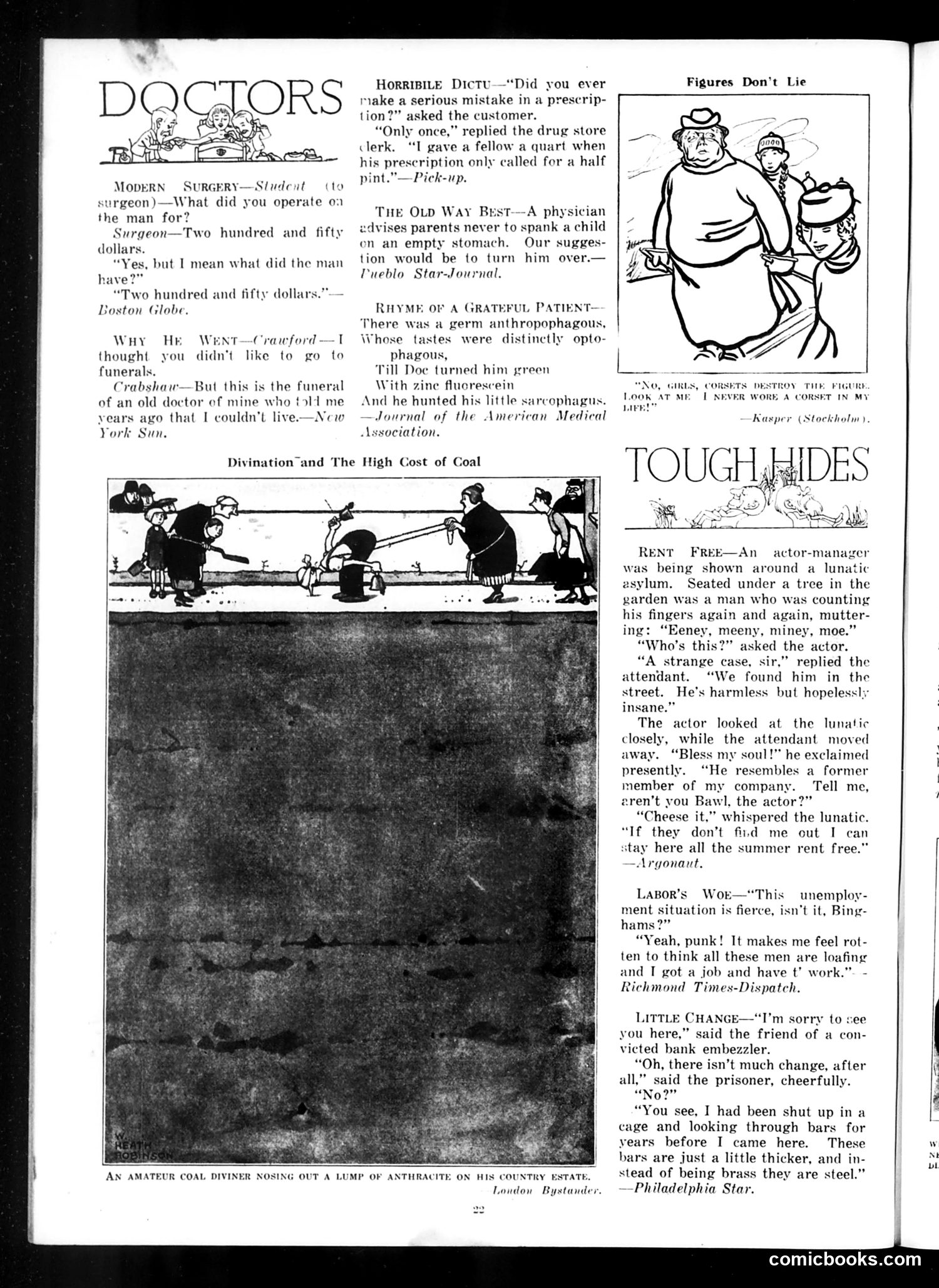
This page contains multiple satirical anecdotes and illustrations mocking medical practice and social conditions of the era. **Medical Satire:** The "Modern Surgery" joke critiques doctors' focus on fees over patient welfare—the surgeon operates "for" $250, not for any medical condition. "Horrible Dictu" mocks a pharmacist's dangerous mistake (dispensing a quart instead of half-pint). These pieces reflect early 20th-century public distrust of medical professionalism and competence. **"Divination and The High Cost of Coal":** The cartoon depicts a man "divining" for coal on his estate using a dowsing-rod technique, sarcastically suggesting coal is so scarce and expensive that wealthy people must resort to pseudoscientific divination to find fuel—a commentary on coal shortages or high prices affecting even the affluent. **"Tough Hides":** Various anecdotes about deception and survival: an actor feigning insanity to avoid paying rent, an unemployed man's bitter irony about being "free" from jail bars, and a bank embezzler philosophically noting prison conditions resemble his previous life's constraints. These mock social hypocrisy and economic hardship.
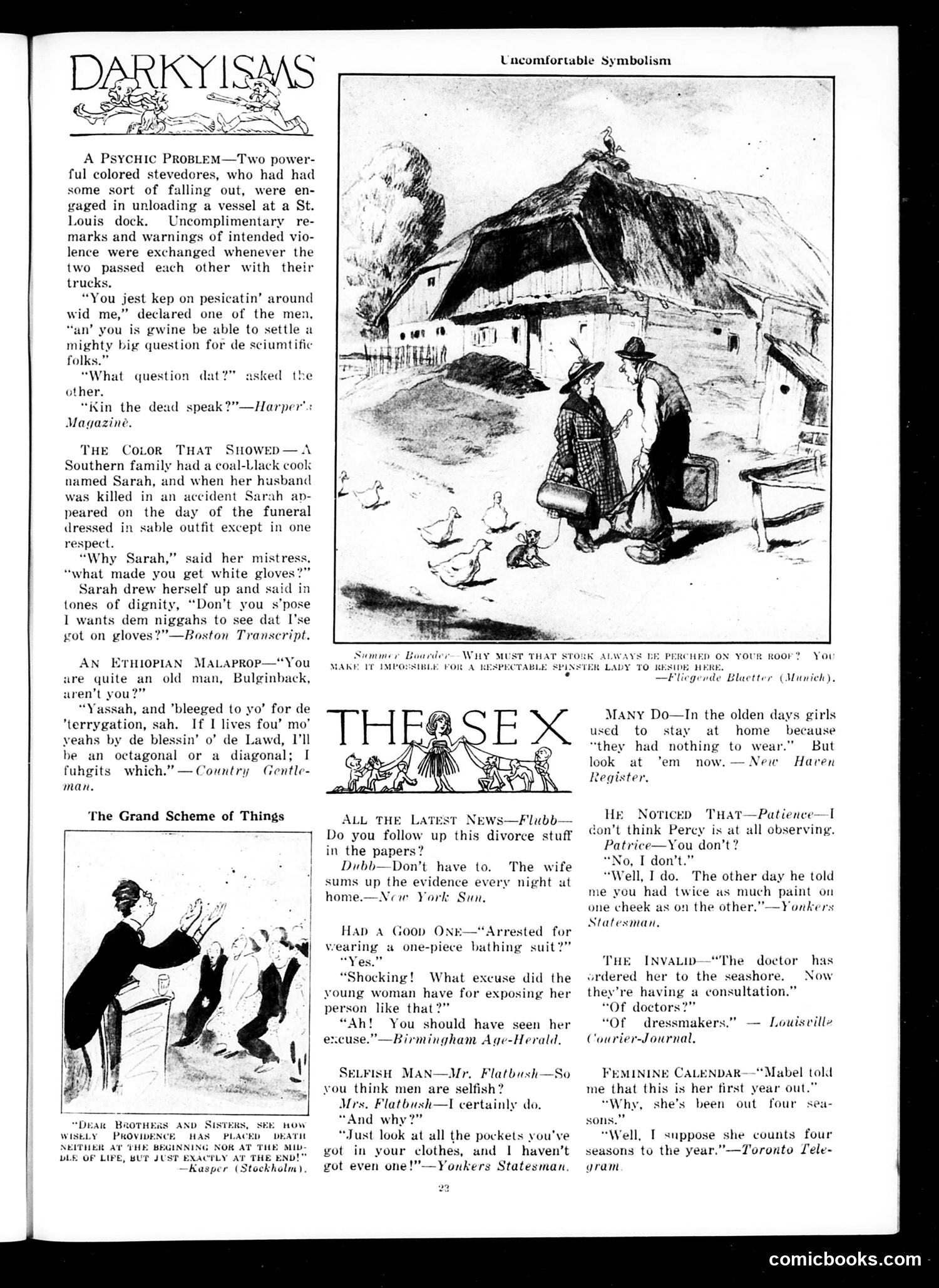
This page from *Judge* contains several short humorous anecdotes stereotyping African Americans, reflecting early 20th-century satirical conventions of the era. **"A Psychic Problem"** presents two Black stevedores debating whether the dead can speak—framed as a "scientific question" to mock their presumed lack of education. **"The Color That Showed"** depicts a Black cook named Sarah wearing white gloves to a funeral to display status to other Black people, satirizing perceived vanity and social climbing. **"An Ethiopian Malaprop"** features an elderly Black man confusing "octagonal" with "diagonal," ridiculing speech patterns. **"The Grand Scheme of Things"** (illustrated) shows a figure arranging papers, likely mocking social pretension. The remaining items are unrelated gender humor about bathing suits, divorce, and female vanity. These pieces exemplify period racist humor typical of early 20th-century American magazines, using dialect, malapropisms, and stereotypes as comedic devices that modern readers should recognize as offensive historical artifacts.
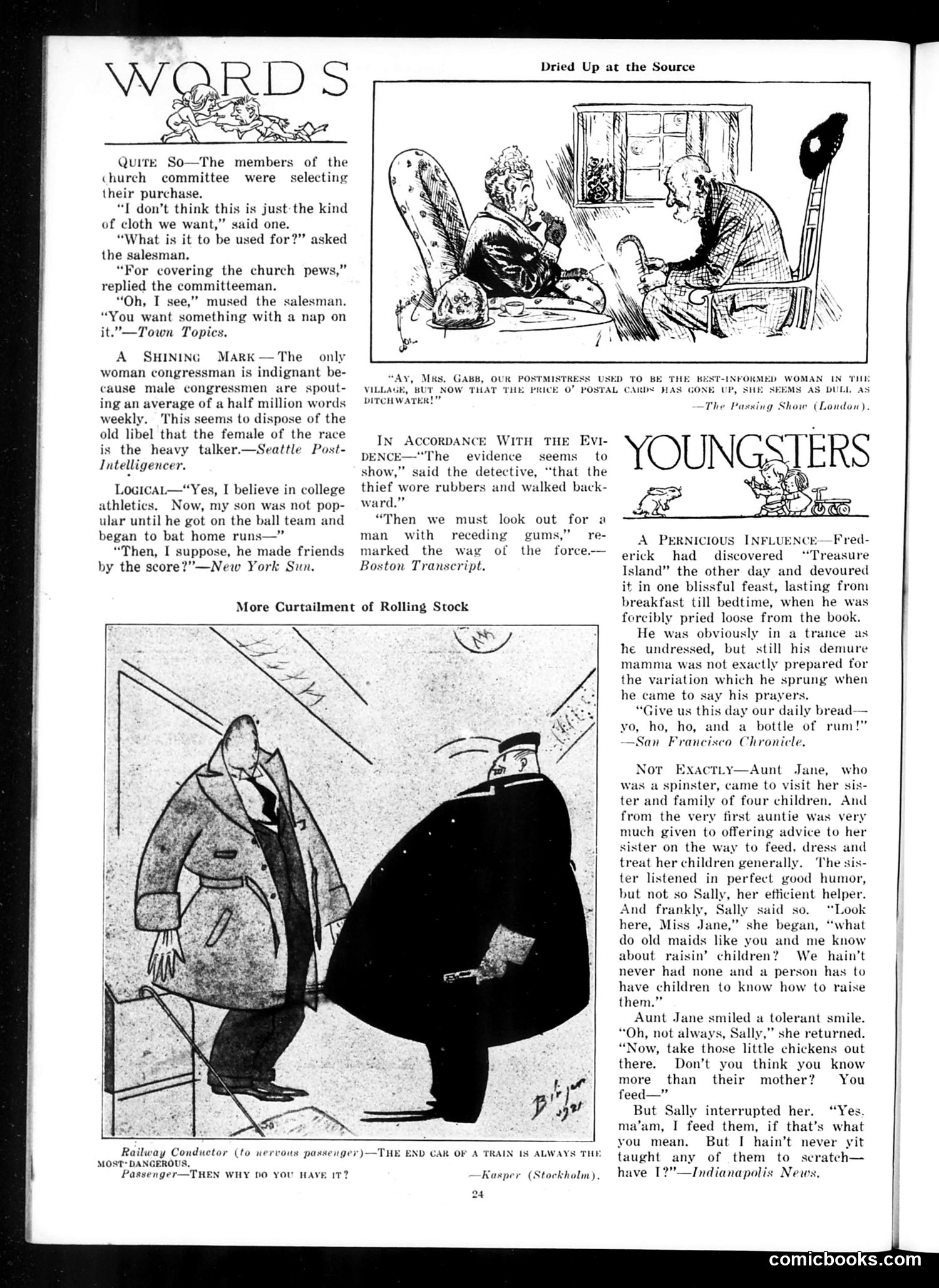
This is a collection of brief satirical items from an early 20th-century humor magazine. The page mocks contemporary social observations: **"Quite So"** jokes about church committee members wanting fabric "with a nap"—a pun on textile terminology that the salesman exploits. **"A Shining Mark"** references the single female congressman (likely Jeannette Rankin, elected 1916), sarcastically noting that male congressmen speak 500,000 words weekly, undermining the stereotype that women are "heavy talkers." **"More Curtailment of Rolling Stock"** shows a conductor admitting trains' end cars are dangerous, yet passengers still ride them—absurdist humor. **The "Youngsters" section** includes humor about a child corrupted by *Treasure Island*, inserting pirate language ("yo, ho, ho, and a bottle of rum") into prayers, and Sally the servant defending her childcare knowledge against unsolicited advice from unmarried Aunt Jane. The satire targets pretension, gender stereotypes, and absurd logic typical of Judge's social commentary.
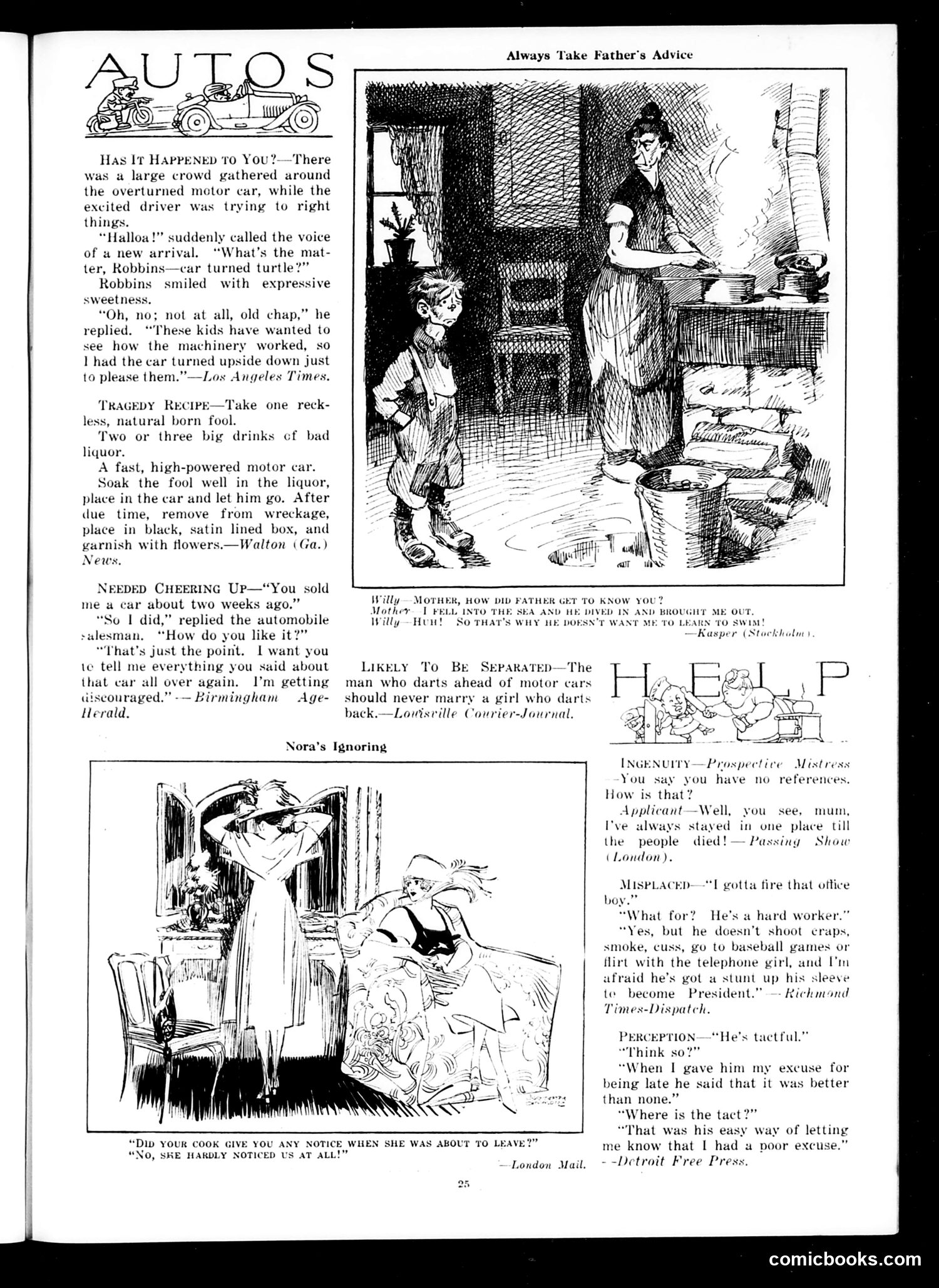
This page contains early-1900s automotive humor reflecting anxieties about the then-revolutionary motor car. The jokes mock reckless drivers and automobile dangers: **"Has It Happened to You?"** satirizes dangerous driving and parental negligence—a father flips his car upside-down to entertain children, treating a serious accident risk casually. **"Tragedy Recipe"** darkly catalogs how drunk driving kills: fool + liquor + fast car = death, buried in a fancy coffin. This reflects genuine public concern about automobile fatalities. **"Needed Cheering Up"** jokes about buyer's remorse on an expensive, unreliable purchase—cars were luxury items prone to breaking down. **"Always Take Father's Advice"** (top right cartoon) shows a child nearly drowning because his father won't teach him to swim, fearing water. The irony: father himself survived water. **"Likely to Be Separated"** warns against marrying reckless drivers. The overall tone treats automobiles as dangerous novelties operated by foolish men, reflecting genuine early-automotive-era safety concerns before modern traffic laws existed.
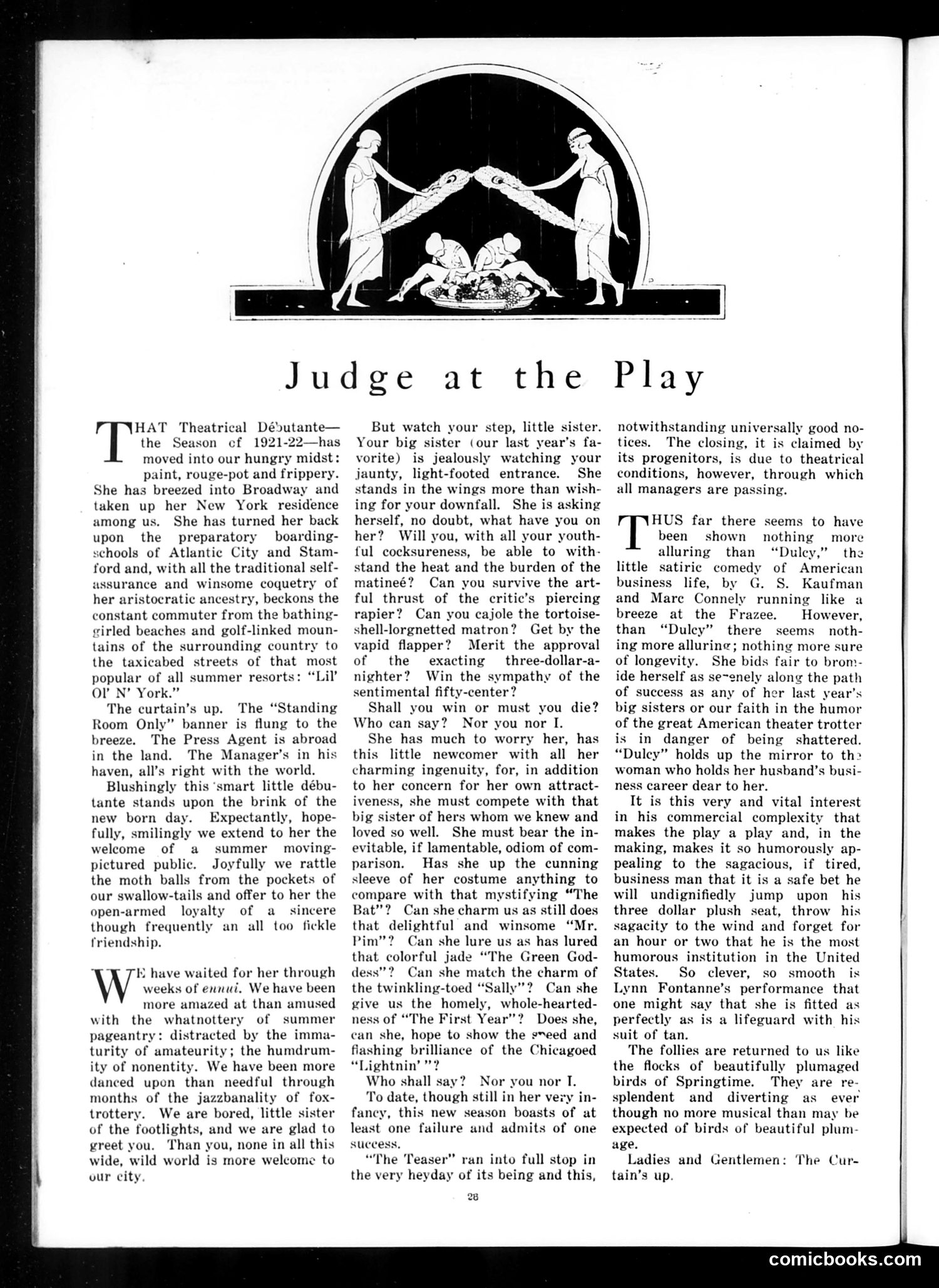
This article reviews the 1921-22 Broadway theater season as a "theatrical debutante"—a newcomer competing against established hits. The piece uses extended metaphor: the new season is an anxious young woman entering society, watched jealously by "her big sister" (last year's favorite productions). The author asks whether this newcomer can survive critics' scrutiny and compete with recent Broadway successes: "The Bat," "Mr. Pim," "The Green Goddess," "Sally" (the "twinkling-toed" reference), "The First Year," and "Lightnin'"—all actual popular plays of the period. The headpiece illustration depicts two figures and cherubs, representing theatrical judgment or drama itself. The article discusses two specific shows: "The Teaser" (which closed despite good reviews due to theatrical conditions) and praises "Duley," a satirical comedy by S. Kaufman and Marc Connelly. This reflects typical *Judge* theater criticism: witty, gossipy commentary on Broadway's competitive landscape during the Jazz Age.
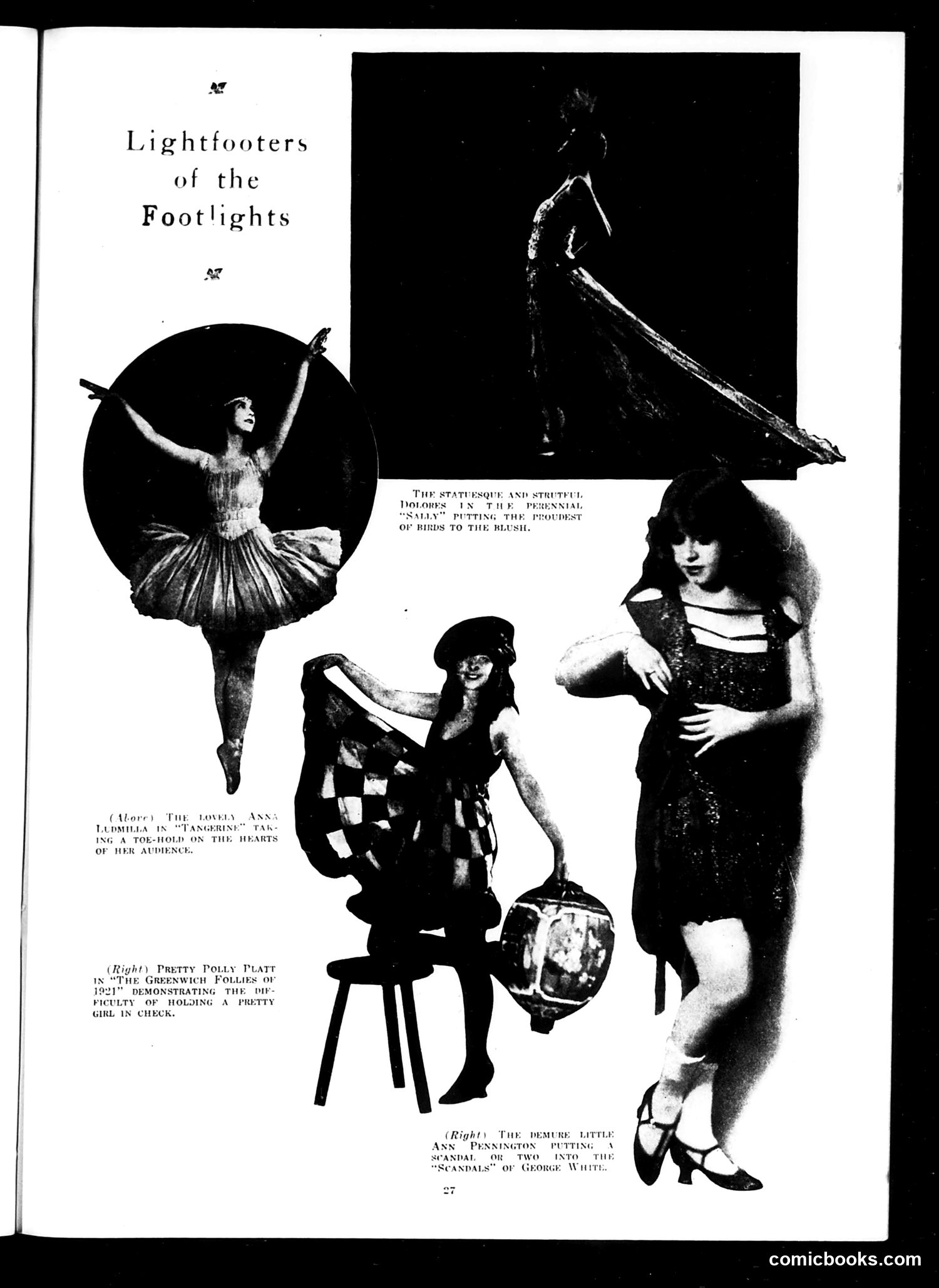
This page celebrates Broadway performers of the early 1920s, specifically dancers and actresses from popular musical revues. The photographs showcase: **Ann Ludmilla** in "Tangerine," performing a dramatic leap with raised arms. **Polly Platt** from the "Follies of 1921," depicted handling a male admirer—the caption jokes about the difficulty of "holding a pretty girl in check." **Ann Pennington**, noted for appearing in George White's "Scandals," shown in a playful pose. The satire mocks the era's theatrical conventions: the exaggerated physicality of dancers, their sex appeal as commercial product, and the comedic tension between performers' stage personas and audience desire. The page treats Broadway's "lightfooters" as objects of fascination and humor—celebrating their artistry while winking at their role in entertaining (and tantalizing) audiences during the Jazz Age.
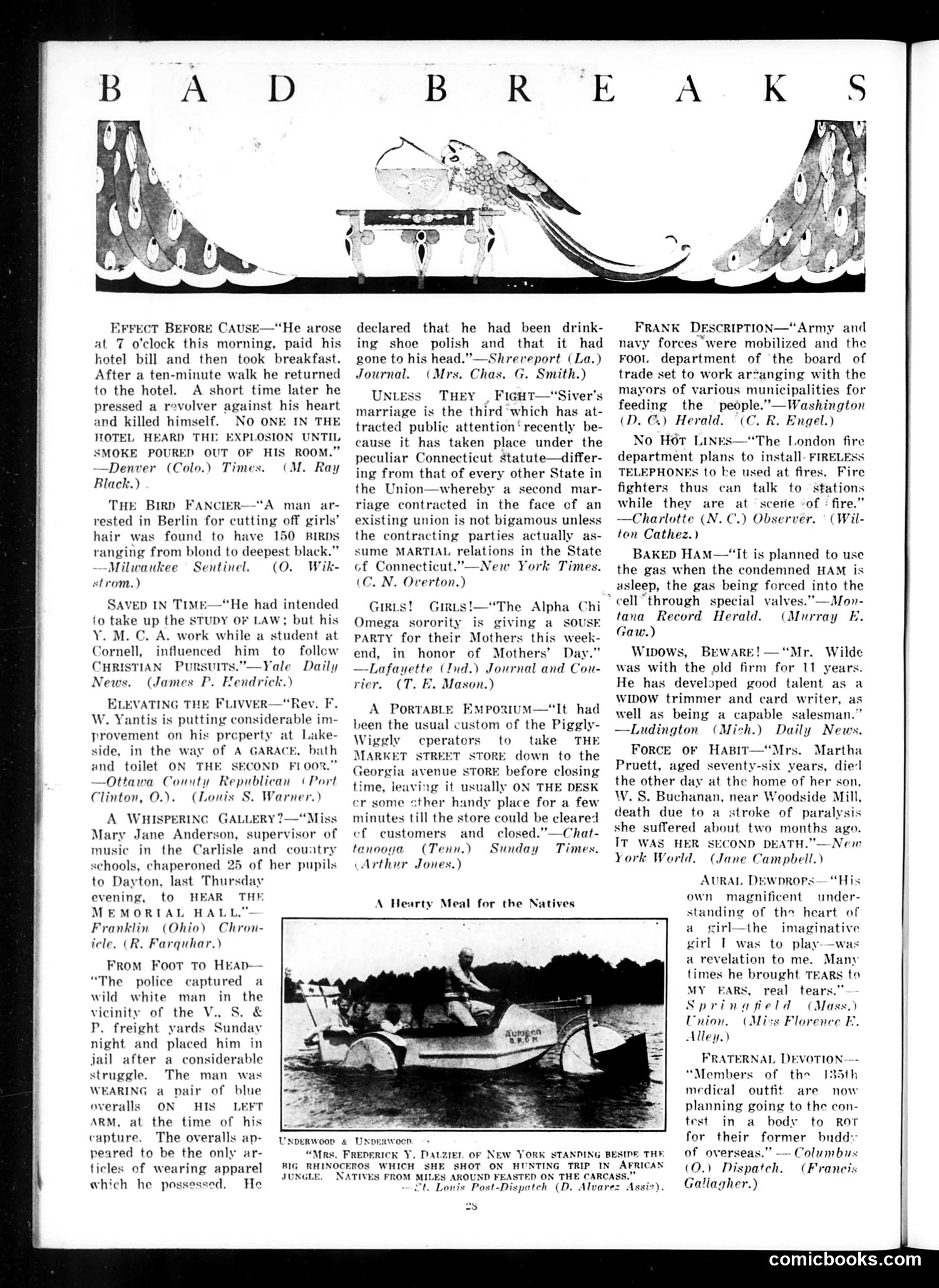
This page from Judge presents humorous "short takes" on absurd news items—a recurring satirical feature. The format ridicules real newspaper excerpts by highlighting their unintentional comedy. The main cartoon depicts **a white hunter posing beside a dead rhinoceros in Africa**. The caption sarcastically labels it "A Hearty Meal for the Natives," mocking both the hunter's trophy-hunting vanity and the crude racial stereotyping common in the era. The implication—that a massive rhinoceros would constitute native sustenance—is deliberately obtuse, satirizing colonial attitudes and safari culture. The surrounding text items mock contemporary news for their absurdity: a man arrested for cutting girls' hair while collecting it by color; Connecticut's peculiar marriage loophole; a sorority's "souse party" for mothers; and a fire department adopting "fireless telephones." Judge's satire here targets journalistic reporting of the genuinely bizarre, while also lampooning early 20th-century social conventions and racial attitudes through exaggeration.
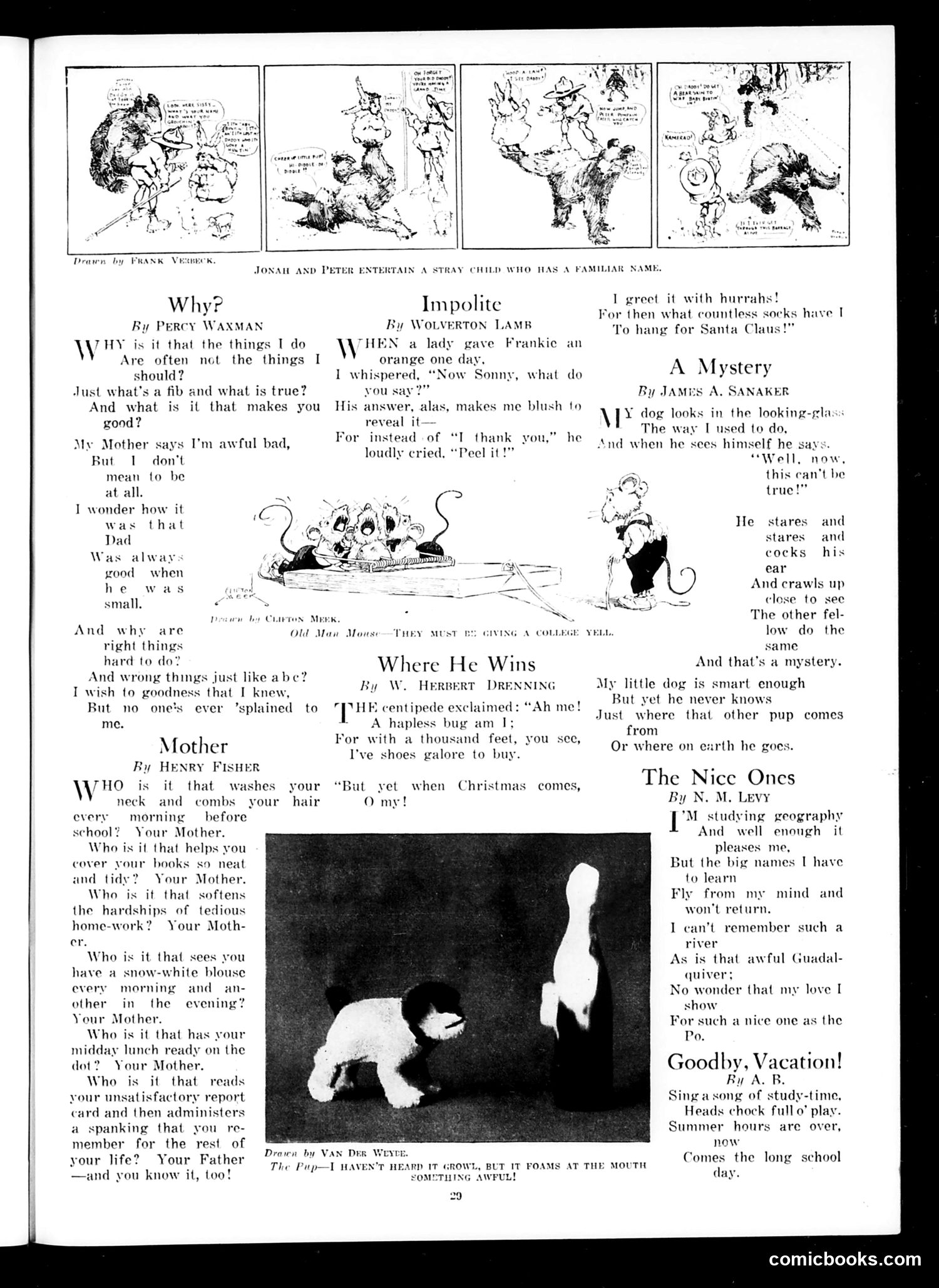
This page contains lighthearted children's poetry and humor typical of early 20th-century American magazines. The content addresses childhood experiences and moral lessons: **"Why?" and "Mother"** explore children's confusion about right and wrong behavior, and celebrate maternal care—common sentimental themes of the era. **"Impolite"** jokes about a child named Frankie who rudely demands an orange be peeled rather than politely thanking the giver. **"A Mystery"** humorously describes a dog's confused reaction to seeing his reflection, unable to understand it's himself. **"Where He Wins"** features a centipede lamenting having to buy shoes for a thousand feet, and a dog puzzled by another dog's existence. **"The Nice Ones"** and **"Goodby, Vacation!"** are school-themed verses about geography studies and summer's end. The four cartoon panels at top (by Frank Verheck) show children named Jonah and Peter entertaining a stray child with a familiar name—likely a play on the biblical reference or a common name. The content is sentimental, moralistic, and aimed at juvenile readers—standard Judge fare from this period.
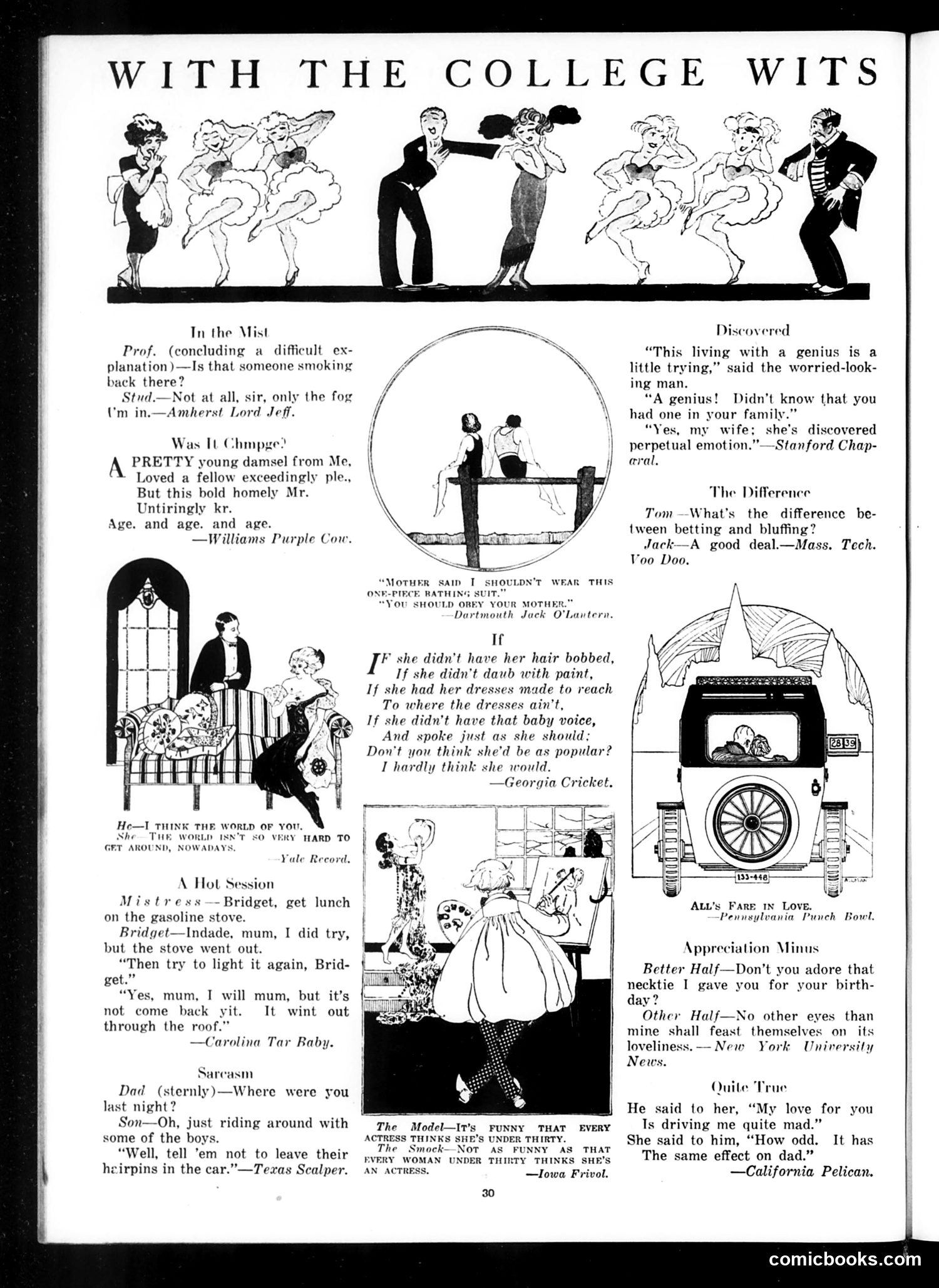
This page collects humorous quips and cartoons from college humor publications, satirizing 1920s youth culture and social changes. **Key targets:** - **Modern women's fashion**: Multiple jokes mock bobbed hair, short dresses, heavy makeup, and one-piece bathing suits as scandalous departures from propriety. The "Model" cartoon suggests all actresses under thirty adopt these styles. - **Flapper behavior**: References to "baby voices," perpetual emotion, and casual dating mock the new independence and affectations of young women. - **Generational gaps**: Jokes about parents disapproving of their children's behavior (the bathing suit, leaving hairpins in cars) reflect anxiety over changing social norms. - **College life absurdities**: Domestic mishaps (a gasoline stove fire) and student obliviousness (smoking in class appears as fog). The satire is gentle, poking fun at youth rather than condemning it—typical of collegiate humor magazines of the era.
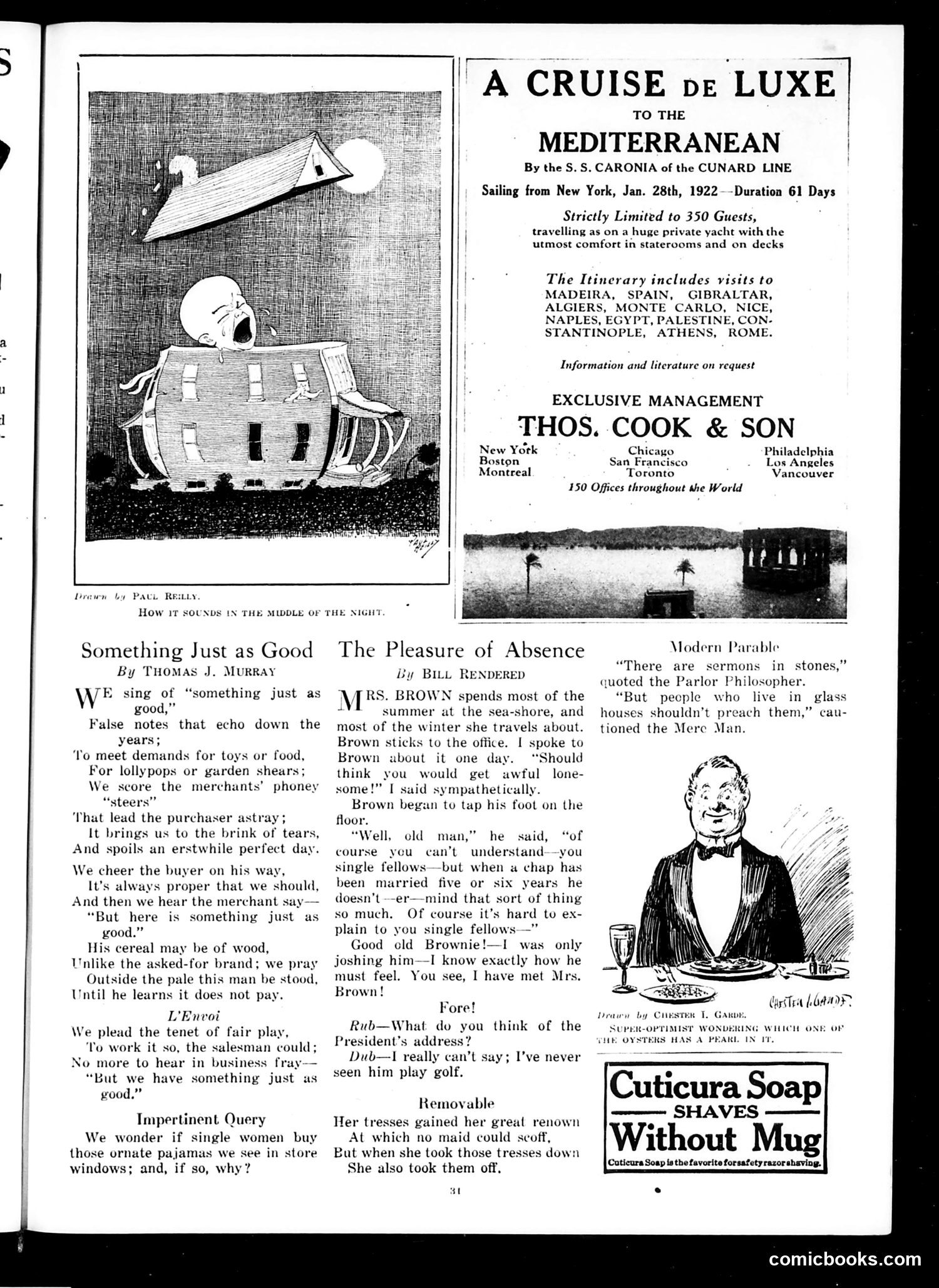
This is primarily a **advertisements and humor page** from Judge, circa 1922. The main content includes: **Large Cartoon** (top left): A surreal illustration by Paul Reilly titled "How It Sounds in the Middle of the Night"—depicting an anthropomorphic ship with a face, likely satirizing the luxury cruise industry's grandiose marketing. **Humorous Articles**: Multiple short pieces mock everyday American commerce and relationships: - "Something Just as Good" lampoons deceptive sales tactics where merchants substitute inferior products - "The Pleasure of Absence" jokes about married men enjoying their wives' constant travel—a dig at marital dissatisfaction - Brief jokes about golf and the President (likely Harding, given the 1922 date) **Advertisements**: Prominently feature a luxury Mediterranean cruise on the S.S. Caronia and Cuticura Soap. The page's satire targets **consumer fraud, marketing dishonesty, and domestic discontent**—reflecting post-WWI American anxieties about modern commerce and marriage. The humor assumes readers would recognize these social frustrations as relatable.
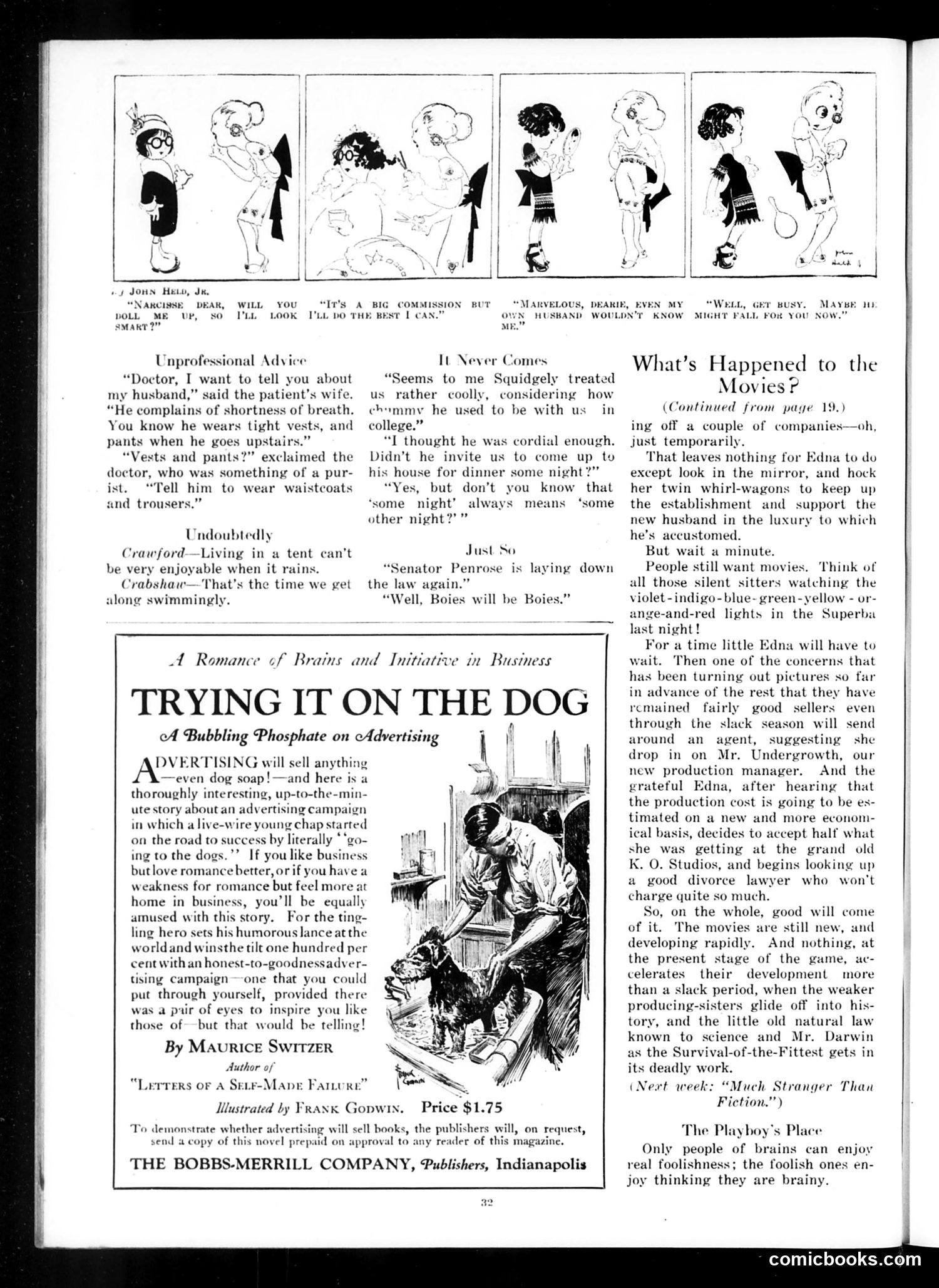
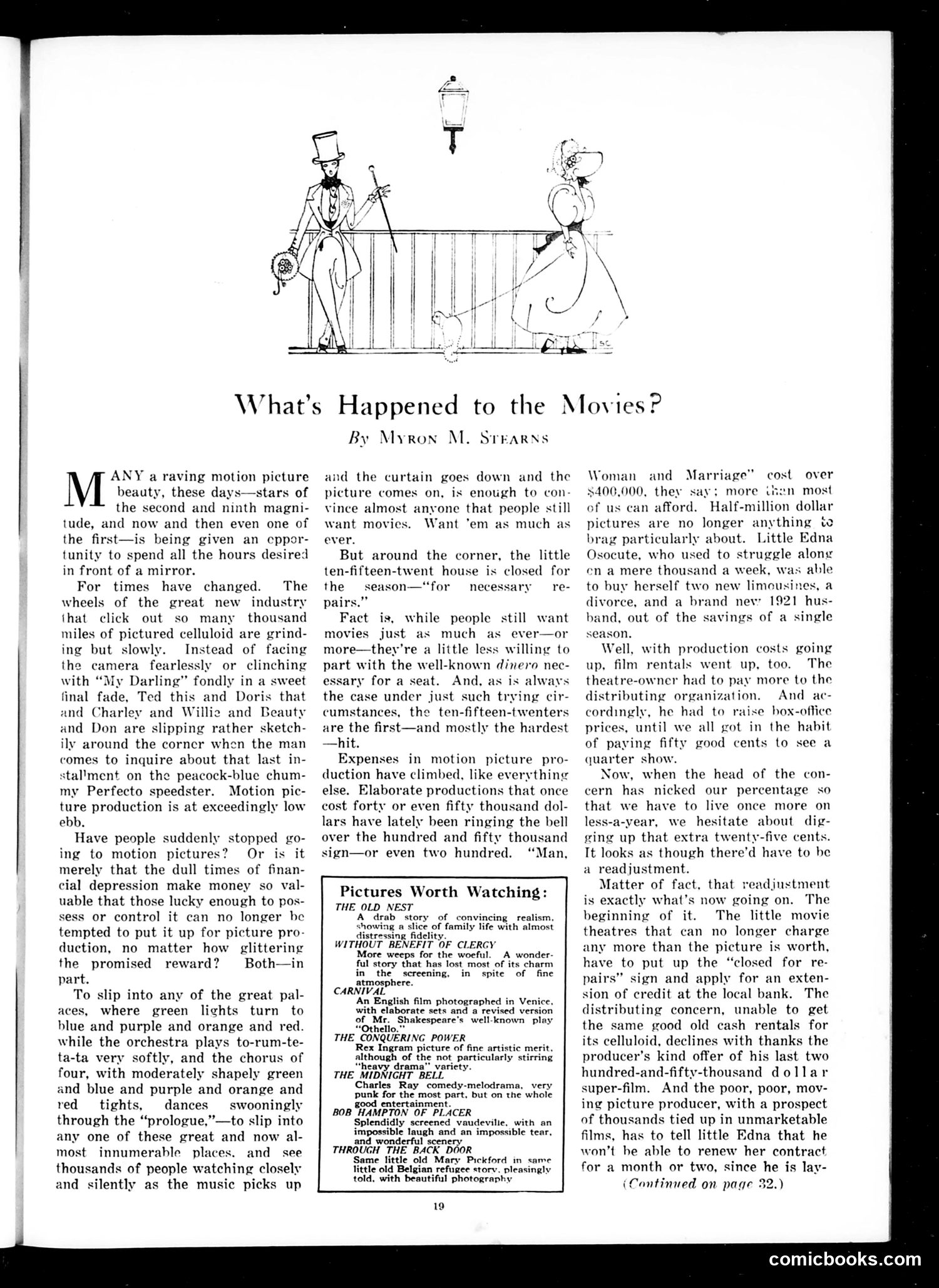
The top cartoon by John Held Jr. depicts flapper fashion culture of the 1920s—young women in short dresses and bobbed hair requesting to be "dolled up" to look fashionable. The humor lies in the contrast between their desire to look "smart" (fashionable) and their somewhat undignified poses. The middle section contains light humor pieces mocking professional pretension (a doctor correcting "vests and pants" to "waistcoats and trousers") and absurd logic (finding rain enjoyable while tent-camping). The main feature advertises Maurice Switzer's novel "Trying It On the Dog"—an advertising-industry romance where a young businessman succeeds through honest marketing. The "dog" idiom refers to testing something risky or unreliable. The right column discusses the movie industry's instability, suggesting studios were consolidating and struggling during this period (likely early 1920s), forcing actresses to accept lower wages or seek divorce lawyers. Overall, the page satirizes consumerism, business pretension, and the volatile entertainment industry.
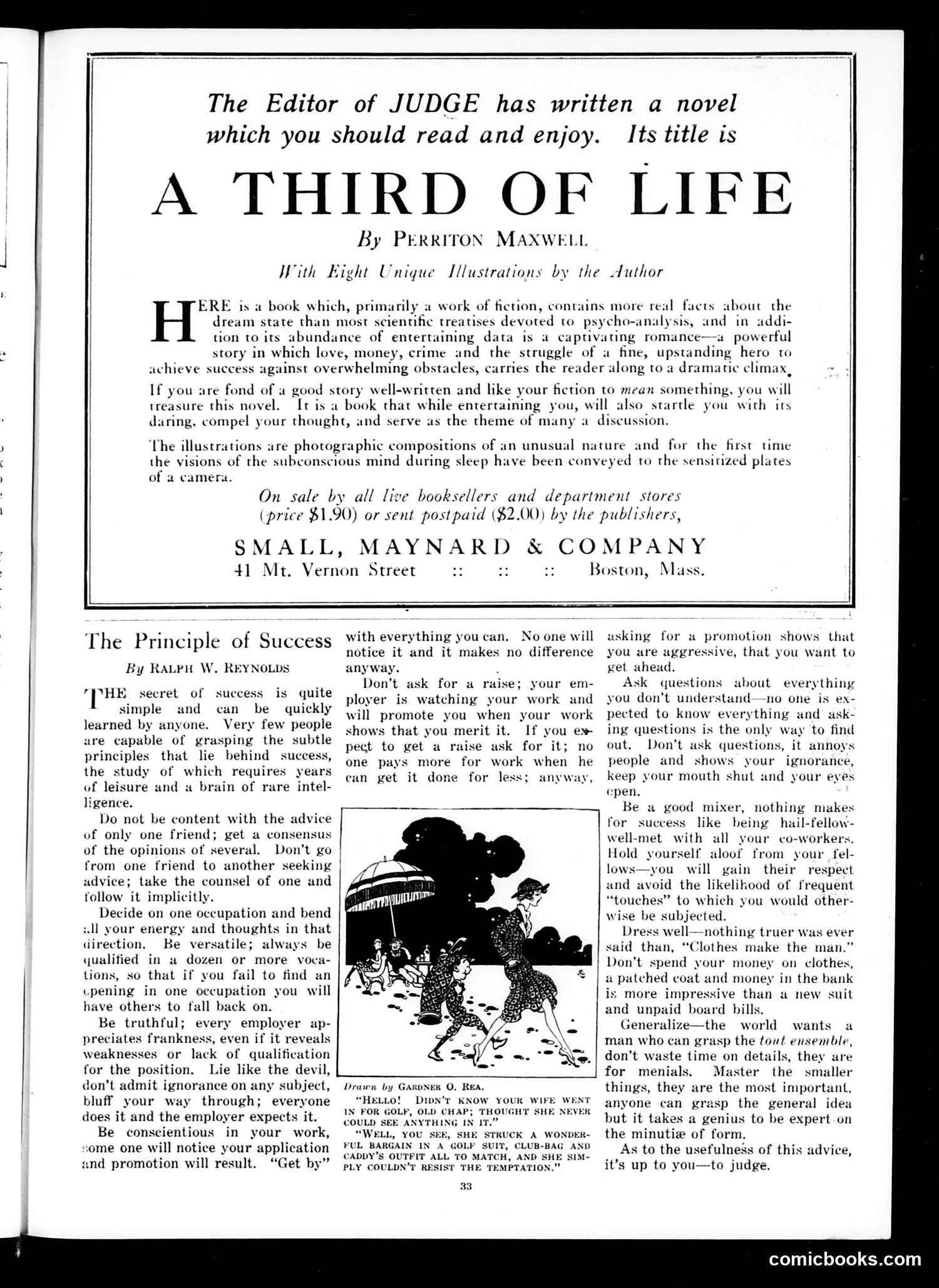
This page combines a book advertisement with satirical advice columns typical of Judge magazine's humor. **The Advertisement** promotes "A Third of Life" by Perriton Maxwell, describing it as a novel about dreams and psychoanalysis with unusual "photographic compositions" of subconscious visions—apparently an early experimental technique. **"The Principle of Success"** is pure satire. The column presents contradictory advice: work hard but "get by"; be truthful but "lie like the devil"; don't ask for raises but ask for them; ask questions but stay silent; dress well but wear patched coats. This exposes the hypocrisy of career advice—the gap between what society preaches and what actually works in business. **The cartoon** (by Gardner O. Rea) shows a man explaining his wife's golf outing to a friend, claiming she "never could get anything in it"—the double entendre being both golf and infidelity, typical of Judge's risqué humor for male readers.
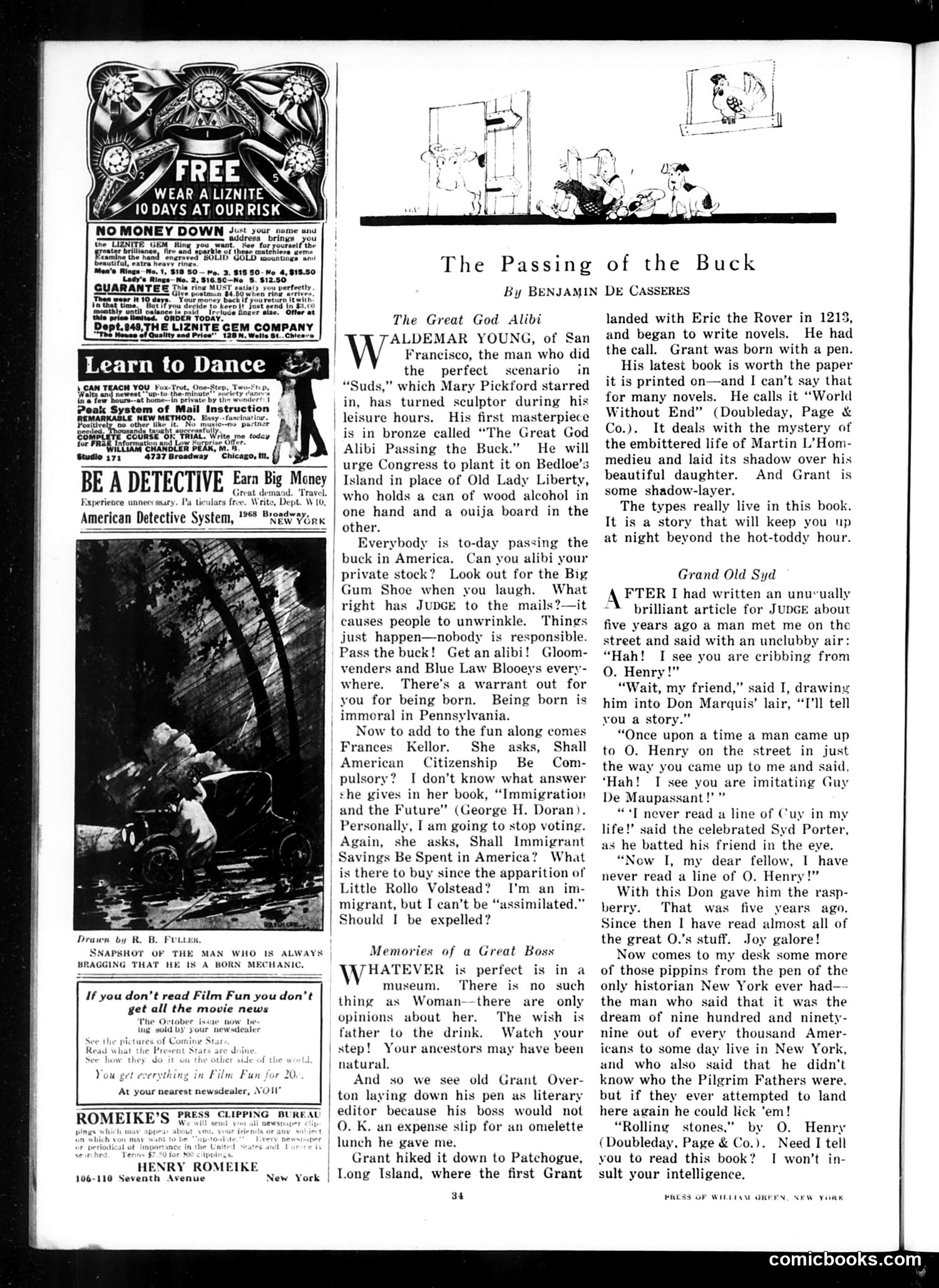
This page contains literary reviews and advertisements rather than political cartoons. The main article, "The Passing of the Buck" by Benjamin De Casseres, is a satirical essay critiquing American society's tendency to avoid responsibility—using the phrase "pass the buck" literally and figuratively. The satire targets: - **General irresponsibility**: People evading blame for everything from personal conduct to birth itself - **Prohibition-era hypocrisy**: References to "wood alcohol" and "Blue Law Blooeys" mock enforced morality - **Immigration debate**: Frances Kellor's questions about mandatory citizenship and immigrant spending habits are presented skeptically - **Bureaucratic absurdity**: Grant Overton's boss refusing to approve an omelette expense slip The surrounding content includes book reviews praising literary figures like O. Henry and Grant Overton, plus vintage advertisements for detective courses and dance lessons. The page reflects 1920s concerns about social conformity, immigrant assimilation, and government regulation.

This is not a cartoon but a **government advertisement** promoting Treasury Savings Certificates as safe investments. The ad responds to **$500 million in fraudulent stock market manipulations** from the previous year (the text doesn't specify which year, but this likely references early 20th-century scandals). Rather than satirizing something, *Judge* magazine is running what appears to be a public service message. The pitch is straightforward: instead of risky stock schemes that bilk ordinary investors, Americans should buy government certificates offering 4% interest, compounded quarterly. These require no investigation and carry zero risk—the government guarantees return of principal plus interest. A specific example highlights the appeal: a trustee bought sixteen $1,000 certificates for sixteen estate beneficiaries precisely *because* they're "absolutely SAFE." The subtle wordplay in the headline ("no loss to 'Write Off'") suggests investors tired of claiming fraudulent losses on their taxes should choose government bonds instead.
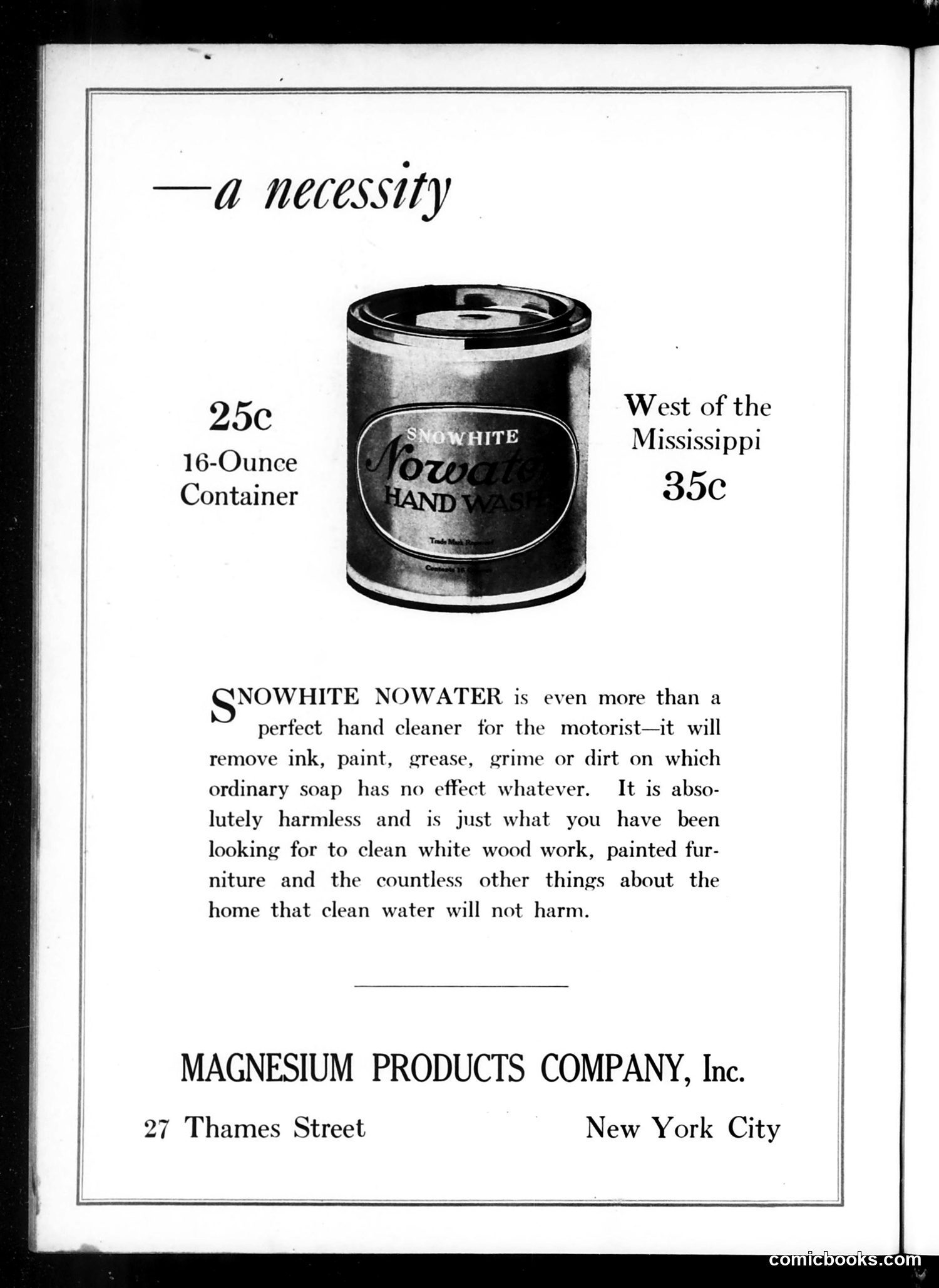
This is a **product advertisement**, not a political cartoon. It promotes "Snowhite Nowater," a hand cleaner manufactured by Magnesium Products Company in New York City. The ad highlights the product's utility for motorists and general household cleaning, claiming it removes substances—ink, paint, grease, grime—that ordinary soap cannot. It emphasizes the product is "absolutely harmless" and suitable for delicate surfaces like white woodwork and painted furniture. Pricing varies by region: 25¢ for a 16-ounce container east of the Mississippi River; 35¢ west of it, likely reflecting shipping costs. There is no satire, caricature, or political commentary present. This is straightforward commercial advertising from Judge magazine's pages.