
Judge, 1921-09-17 · page 26 of 36
Judge — September 17, 1921 — page 26: what you’re looking at
What you’re looking at
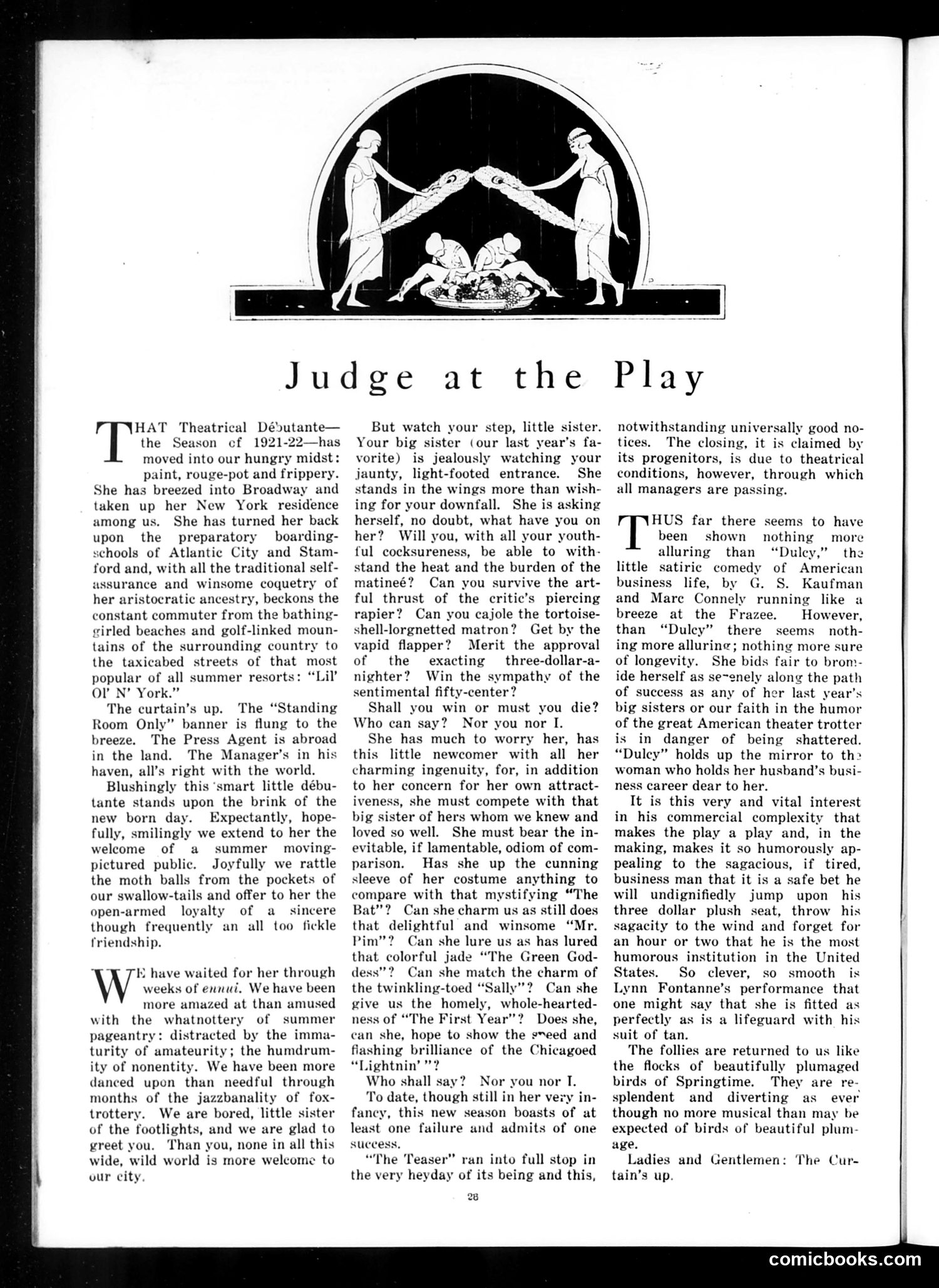
This article reviews the 1921-22 Broadway theater season as a "theatrical debutante"—a newcomer competing against established hits. The piece uses extended metaphor: the new season is an anxious young woman entering society, watched jealously by "her big sister" (last year's favorite productions). The author asks whether this newcomer can survive critics' scrutiny and compete with recent Broadway successes: "The Bat," "Mr. Pim," "The Green Goddess," "Sally" (the "twinkling-toed" reference), "The First Year," and "Lightnin'"—all actual popular plays of the period. The headpiece illustration depicts two figures and cherubs, representing theatrical judgment or drama itself. The article discusses two specific shows: "The Teaser" (which closed despite good reviews due to theatrical conditions) and praises "Duley," a satirical comedy by S. Kaufman and Marc Connelly. This reflects typical *Judge* theater criticism: witty, gossipy commentary on Broadway's competitive landscape during the Jazz Age.
📄 Transcribed text from this page (OCR, searchable)
Machine-transcribed from the original scan — historical spelling and the odd misread are preserved.
Judge at the Play HAT Theatrical Déodutante— the Season ef 1921-22—has moved into our hungry mids' paint, rouge-pot and frippery. She has breezed into Broadway and taken up her New York residence among us. She has turned her back upon the preparatory boarding- schools of Atlantic City and Stam- ford and, with all the traditional self- assurance and winsome coquetry of her aristocratic ancestry, beckons the constant commuter from the bathing- girled beaches and golf-linked moun- tains of the surrounding country to the taxicabed streets of that most popular of all summer resorts: “Lil’ Or N’ Yor The curtain’s up. The “Standing Room Only” banner is flung to the breeze. The Press Agent is abroad in the land. The Manager’s in his haven, all’s right with the world. Blushingly this ‘smart little débu- tante stands upon the brink of the new born day. Expectantly, hope- fully, smilingly we extend to her the welcome of a summer moving- pictured public. Joyfully we rattle the moth balls from the pockets of our swallow-tails and offer to her the open-armed loyalty of a sincere though frequently an all too fickle friendship. .e ly have waited for her through W weeks of ennui. We have been more amazed at than amused with the whatnottery of summer pageantry: distracted by the imma- turity of amateurity; the humdrum- ity of nonentity. We have been more danced upon than needful through months of the jazzbanality of fox- trottery. We are bored, little sister of the footlights, and we are glad to greet you. Than you, none in all this wide, wild world is more welcome to our city But watch your step, little s Your big sister (our last year’s fa- vorite) is jealously watching your jaunty, light-footed entrance. She tands in the wings more than wish- ing for your downfall. She is asking herself, no doubt, what have you on her? Will you, with all your youth- ful cocksurene be able to with- stand the heat and the burden of the matineé? Can you survive the art- ful thrust of the critic’s piercing rapier? Can you cajole the tortoise- shell-lorgnetted matron? Get by the vapid flapper? Merit the approval of the exacting three-dollar-a- nighter? Win the sympathy of the sentimental fifty-center? Shall you win or must you die? Who can say? Nor you nor I. She has much to worry her, has this little newcomer with all her charming ingenuity, for, in addition to her concern for her own attract- iven she must compete with that big sister of hers whom we knew and loved so well. She must bear the in- evitable, if lamentable, odiom of com- parison. Has she up the cunning sleeve of her costume anything to compare with that mystifying “The Bat”? Can she charm us as still does that delightful and winsome “Mr. Pim”? Can she lure us as has lured that colorful jade “The Green God- dess”? Can she match the charm of the twinkling-toed “Sal Can she give us the homely, whole-hearted- ness of “The First Year’? Does she, can she, hope to show the gveed and hing brilliance of the Chicagoed “Lightnin’ ’? Who shall say? Nor you nor I To date, though still in her v fancy, this new season boasts of at least one failure and admits of one success. “The Teaser” ran into full stop in the very heyday of its being and this, 26 notwithstanding universally good no- tices. The closing, it is claimed by its progenitors, is due to theatrical conditions, however, through which all managers are p: ng. HUS far there seems to have been shown nothing more alluring than “Duley,” the little satiric comedy of American business life, by G. S. Kaufman and Mare Connely running like a breeze at the Frazee. However, than “Duley” there seems noth- ing more alluring; nothing more sure of longevity. She bids fair to brom- ide herself ~enely along the path of suc any of her last year’s big sisters or our faith in the humor of the great American theater trotter is in danger of being shattered. “Duley” holds up the mirror to th? woman who holds her husband’s busi- ness career dear to her. It is this very and vital interest in his commercial complexity that makes the play a play and, in the making, makes it so humorously ap- pealing to the sagacious, if tired, business man that it is a safe bet he will undignifiedly jump upon his three dollar plush seat, throw his sagacity to the wind and forget for an hour or two that he is the most humorous institution in the United States. So clever, so smooth is Lynn Fontanne’s performance that one might y that she is fitted as perfectl. a lifeguard with his suit of tan. The follies are returned to us like the flocks of beautifully plumaged birds of Springtime. They are re- splendent and diverting as ever though no more musical than may be expected of birds of beautiful plum- age. Ladies and Gentlemen: The Cur- tain’s up. comicbooks.com