
Judge, 1921-09-17 · page 19 of 36
Judge — September 17, 1921 — page 19: what you’re looking at
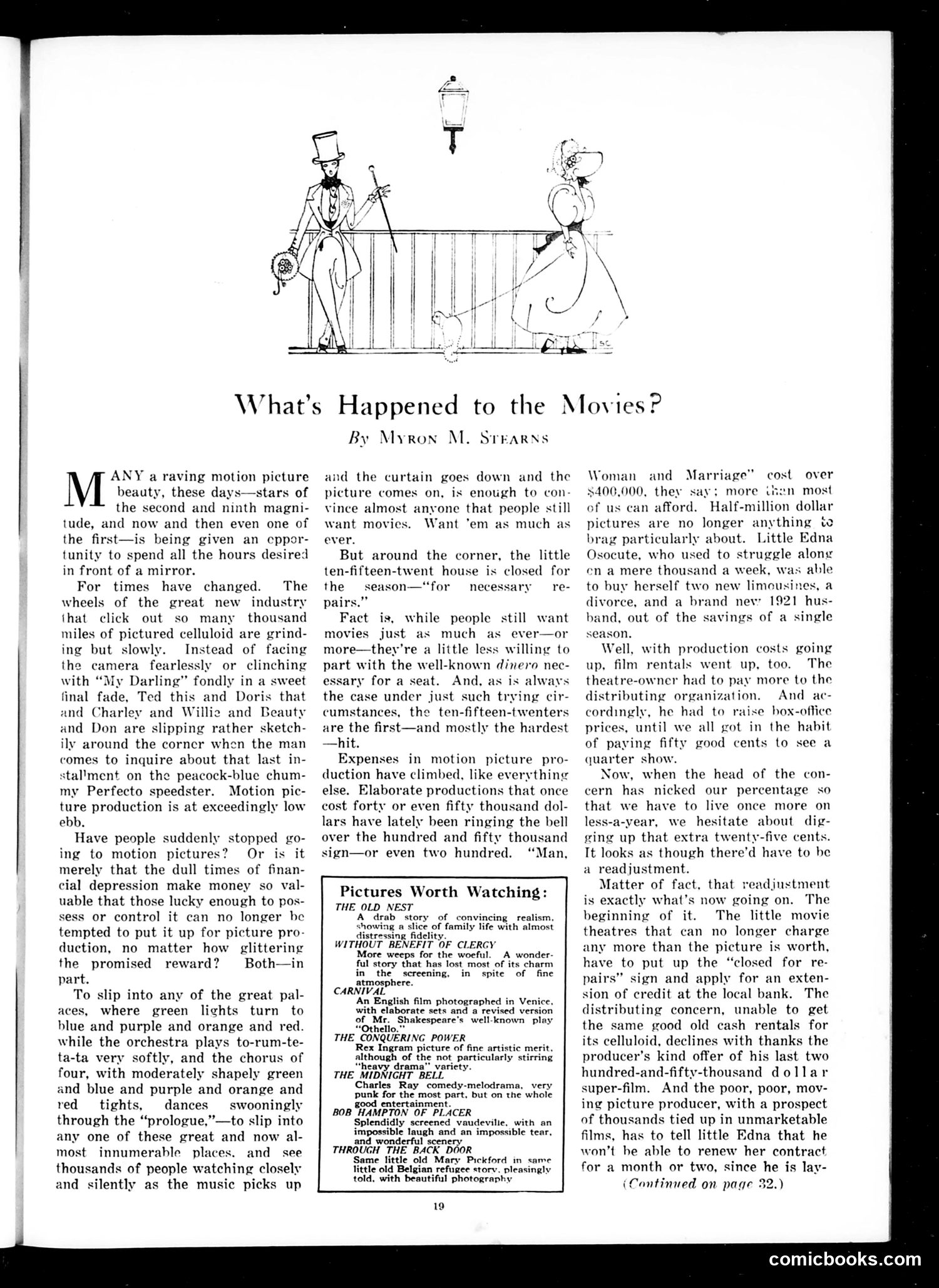
A restored page from Judge, 1921-09-17. Page through the whole issue in the reader above.
📄 Transcribed text from this page (OCR, searchable)
Machine-transcribed from the original scan — historical spelling and the odd misread are preserved.
What’s Happened to the ANY a raving motion picture M beauty, these days—stars of the second and ninth magni- tude, and now and then even one of the first—is being given an cppor- tunity to spend all the hours desired in front of a mirror. For times have changed. The wheels of the great new industry that click out so many thousand miles of pictured celluloid are grind- ing but slowly. Instead of facing the camera fearlessly or clinching with “My Darling” fondly in a sweet final fade, Ted this and Doris that and Charley and Willie and Beauty and Don are slipping rather sketch- ily around the corner when the man comes to inquire about that last in- stallment on the peacock-blue chum- my Perfecto speedster. Motion pic- ture production is at exceedingly low ebb. Have people suddenly stopped £0- ing to motion pictures? merely that the dull times of finan- cial depression make money so val- uable that those lucky enough to pos- sess or control it can no longer be tempted to put it up for picture pro- duction, no matter how glittering the promised reward? Both—in part. To slip into any of the great pal- aces, where green lights turn to blue and purple and orange and red. while the orchestra plays to-rum-te- ta-ta very softly, and the chorus of four, with moderately shapely green and blue and purple and orange and red tights, dances swooningly through the “prologue,”—to slip into any one of these great and now al- most innumerable places. and see thousands of people watching closely and silently as the music picks up By Myron M. Stearns and the curtain goes down and the picture comes on, is enough to con vince almost anyone that people still want movies. Want ‘em as much as ever. But around the corner, ten-fifteen-twent house i the little closed for the season—‘for necessary — re- pairs.” Fact is, while people still want movies just as much as ever—or more—they’re a little less willing to part with the well-known dinero nec- essary for a seat. And, as is always the case under just such trying cir- cumstances, the ten-fifteen-twenters are the first—and mostly the hardest —hit. Expen: in motion picture pro- duction have climbed, like everything else. Elaborate productions that once cost forty or even fifty thousand dol- lars have lately been ringing the bell over the hundred and fifty thousand sign—or even two hundred. ‘Man, Pictures Worth Watching: THE OLD NEST A drab story of convincing realism, showing a slice Ne family life with almost distressing fidelit: WITHOUT BENEFIT OF CLERGY More weeps for the woef ful story that has lost. mo: in the screening, in atmosphere. CARNIVAL An English film photographed in Venice, with elaborate sets and a revised version of Mr. Shakespeare's well-known play A wonder- of its charm spite of fine THE CONQUERING POWER Rex Ingram picture of fine artistic merit. although, of the not particularly stirring drama” variety. THE MIDNIGHT BELL Charles Ray comedy-melodrama, very punk for the most part, but on the whole ood entertainment BoB HAMPTON OF PLACER Splendidly screened vaudevilie, with an impossible laugh and an impossible tear, and wonderful scenery THROUGH THE BACK DOOR Same little old Mary Pickford in same little old Belgian refugee storv. pleasingly told, with beautiful photography Movies? Woman and Marriage” cost over 3406,000, they say; more Ui2n most of us can afford. Half-million dollar pictures are no longer anything to brag particularly about. Little Edna Osocute, who used to struggle along cna mere thousand a week, was able to buy herself two new limousines, a divorce, and a brand new 1921 hus- band, out of the savings of a single season. Well, with production costs going up, film rentals went up, too. The theatre-owner had to pay more to the distributing organization. And ac- cordingly, he had to raise box-office prices, until we all got in the habit of paying fifty good cents to see a quarter show. Now, when the head of the con- cern has nicked our percentage so that we have to live once more on less-a-vyear, we hesitate about dig- ging up that extra twenty-five cents. It looks as though there'd have to be a readjustment. Matter of fact, that readjustment is exactly what’s now going on. The beginning of it. The little movie theatres that can no longer charge any more than the picture is worth, have to put up the “closed for re- pairs” sign and apply for an exten- sion of credit at the local bank. The distributing concern, unable to get the same good old cash rentals for its celluloid, declines with thanks the producer’s kind offer of his last two hundred-and-fiftv-thousand dollar super-film. And the poor, poor, mov- ing picture producer, with a prospect of thousands tied up in unmarketable films, has to tell little Edna that he won't be able to renew her contract for a month or two, since he is lay- (Continued on page 32.) comicbooks.com