
A complete issue · 34 pages · 1921
Judge — August 6, 1921
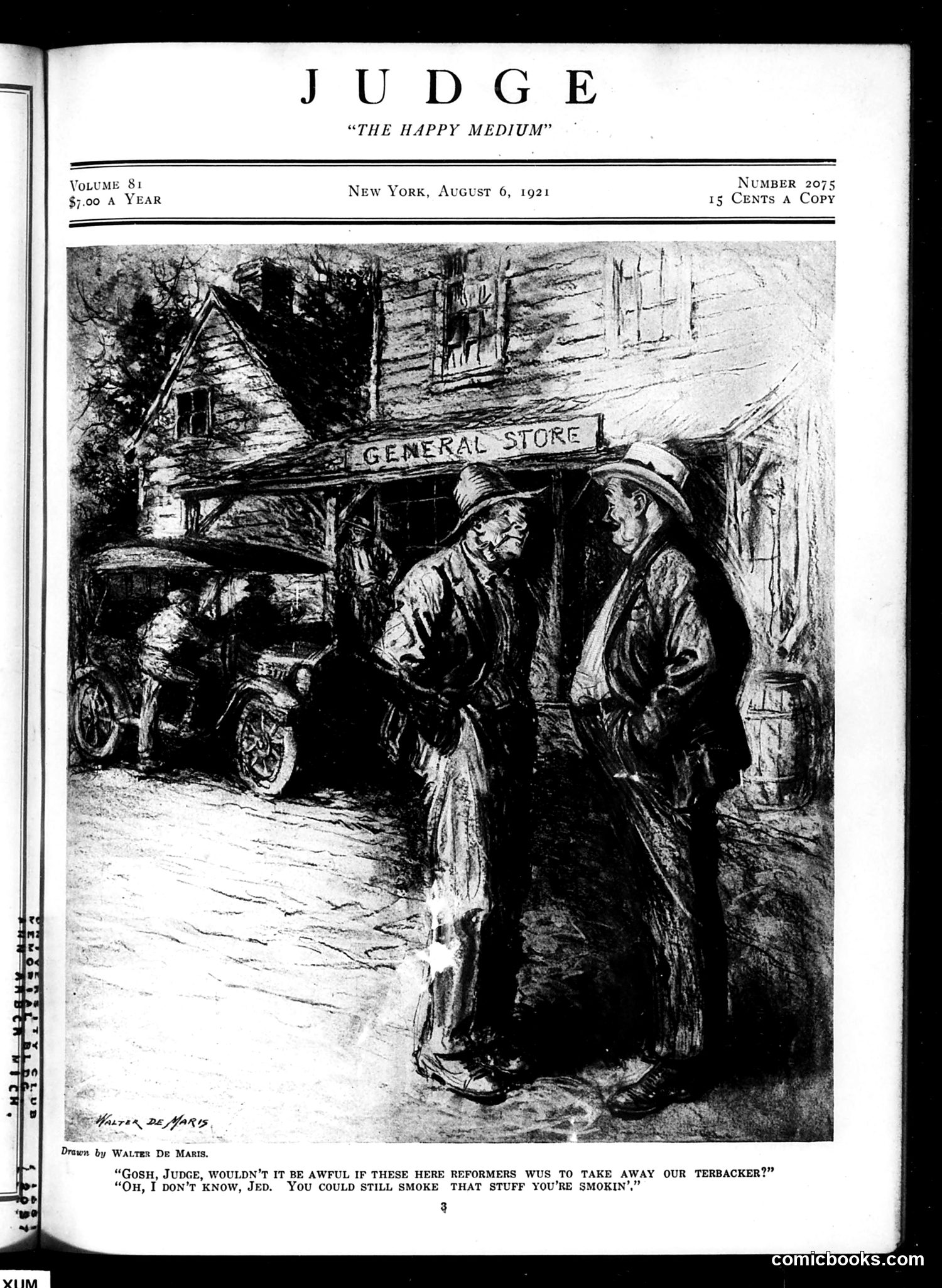
This political cartoon by Walter de Mare depicts two men conversing outside a general store in rural America. One appears to be a judge or official (referenced in the dialogue), while the other is a common citizen. The dialogue concerns "reformers" who wish to confiscate tobacco ("terracker"—likely referring to chewing tobacco or a regional variant). The citizen's response—that reformers could "still smoke that stuff you're smokin'"—is sarcastic commentary on Prohibition and temperance movements of the early 1920s. The cartoon satirizes the hypocrisy of reform movements: reformers ban citizens' pleasures while indulging their own vices. It reflects public frustration with overreaching moral legislation during the Prohibition era.
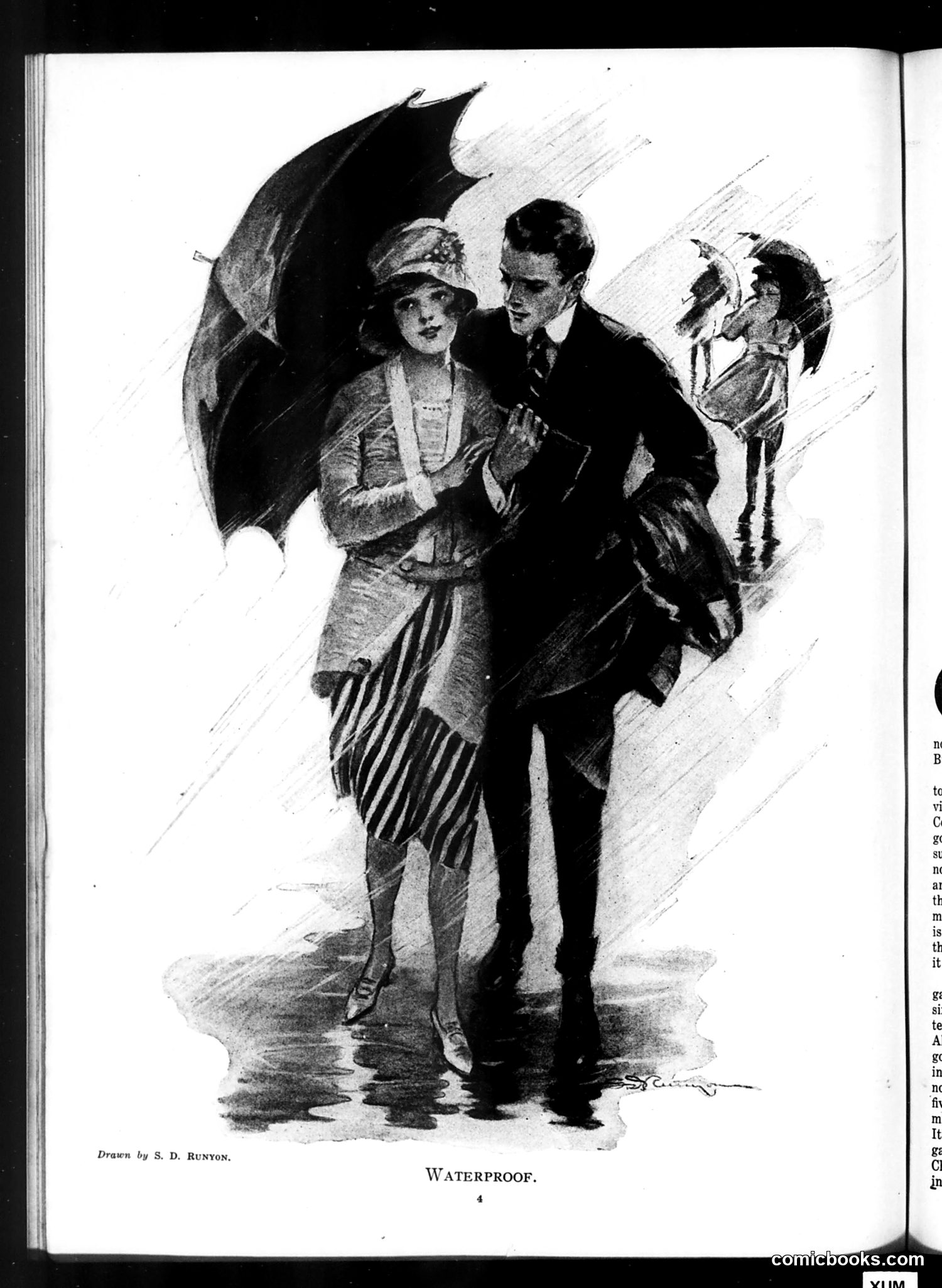
This cartoon by S. D. Runyon depicts a well-dressed couple sheltering under an umbrella in the rain, with two other figures visible behind them. The title "Waterproof" appears to be a visual pun playing on the umbrella's function. The satire likely comments on social pretense or protection—possibly about maintaining appearances or status during difficult circumstances. The couple's formal attire and composed demeanor while walking in rain suggests they're "weathering" social or economic challenges without appearing affected. Without additional context from Judge magazine's publication date or surrounding articles, the specific political or social reference remains unclear, though the cartoon likely addressed contemporary concerns about class, propriety, or resilience among the urban middle or upper class that Judge's readers would have recognized.
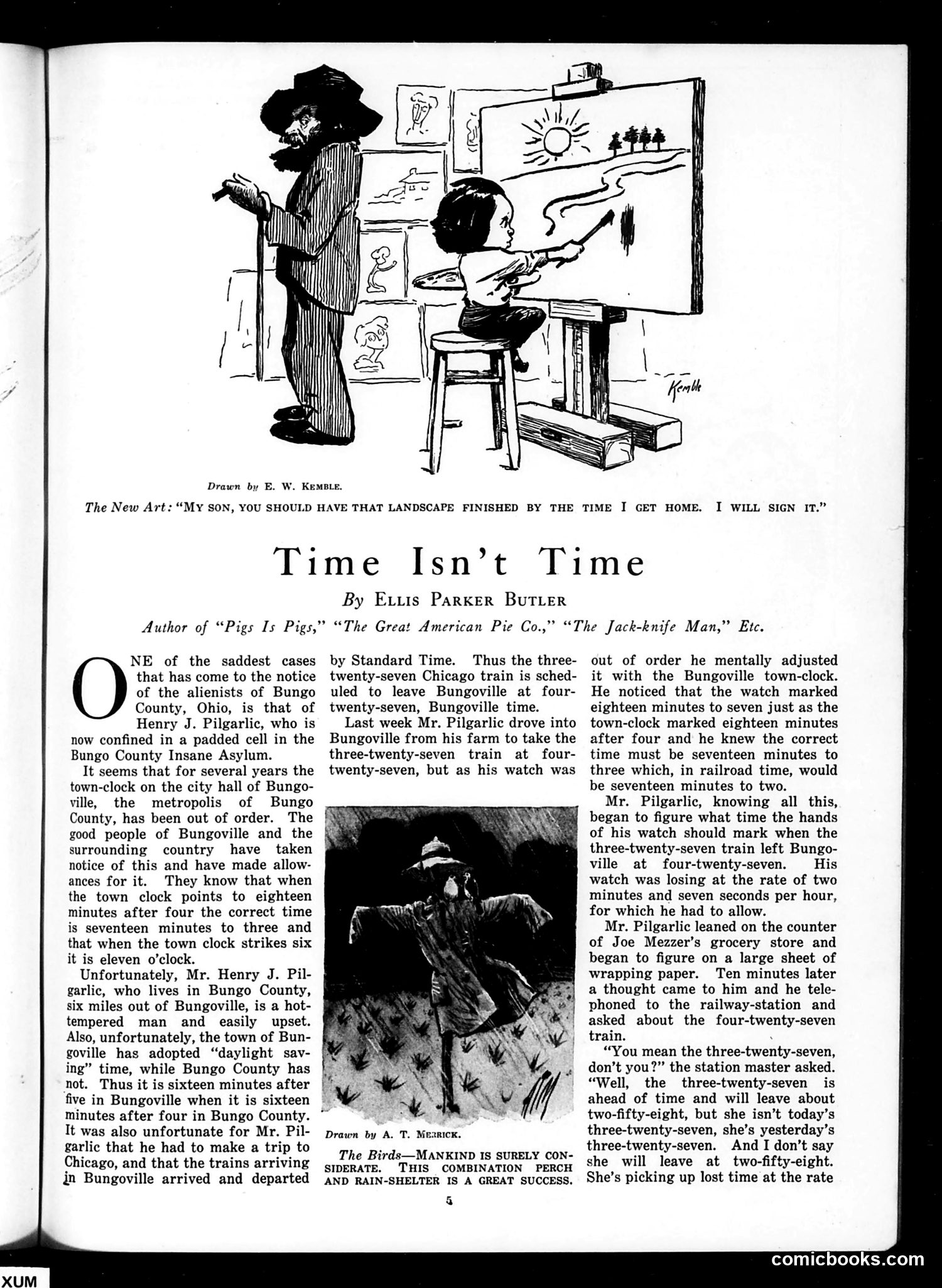
The top cartoon satirizes modern art instruction. An exasperated father watches his young son paint a landscape, saying he should finish it by the time he gets home so he can sign it—implying the father will take credit for the child's work. This mocks both parental vanity and the absurdity of modern art's subjective standards, suggesting that with minimal effort and adult "authority," any crude painting becomes legitimate art worthy of a signature. The accompanying story concerns Henry Pilgarlic of Bungo County, Ohio, who experiences confusion from conflicting town and railroad time standards—a genuine problem from the pre-standardized time era. His watch loses time, creating scheduling chaos. The satire reflects real frustrations Americans faced before Standard Time's universal adoption, mocking both bureaucratic inefficiency and individual confusion.
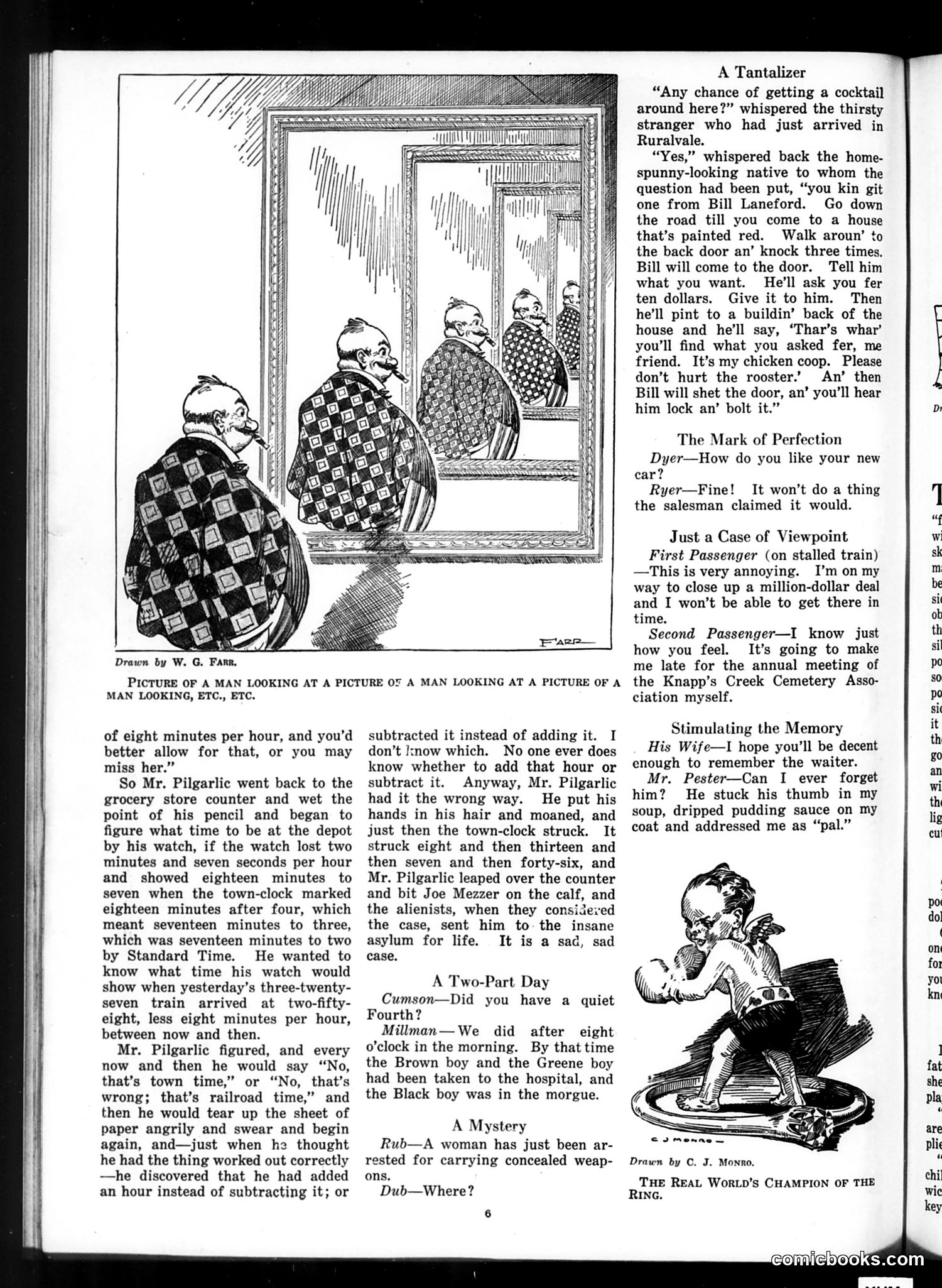
The main cartoon, drawn by W.C. Farb, depicts a man viewing a framed picture of a man viewing a picture of a man—a visual joke about infinite regression or recursive imagery. The humor lies in the absurdist concept of nested perspectives with no clear endpoint. The adjacent text sections are brief comedic anecdotes rather than political satire. "A Tantalizer" describes obtaining illegal alcohol (Prohibition-era humor). "The Mark of Perfection" mocks false advertising. "Just a Case of Viewpoint" presents conflicting perspectives on train delays. Other items include domestic humor and vignettes about memory and mystery. This page contains primarily social/domestic satire reflecting 1920s concerns (Prohibition, consumer deception, marital life) rather than partisan political commentary.
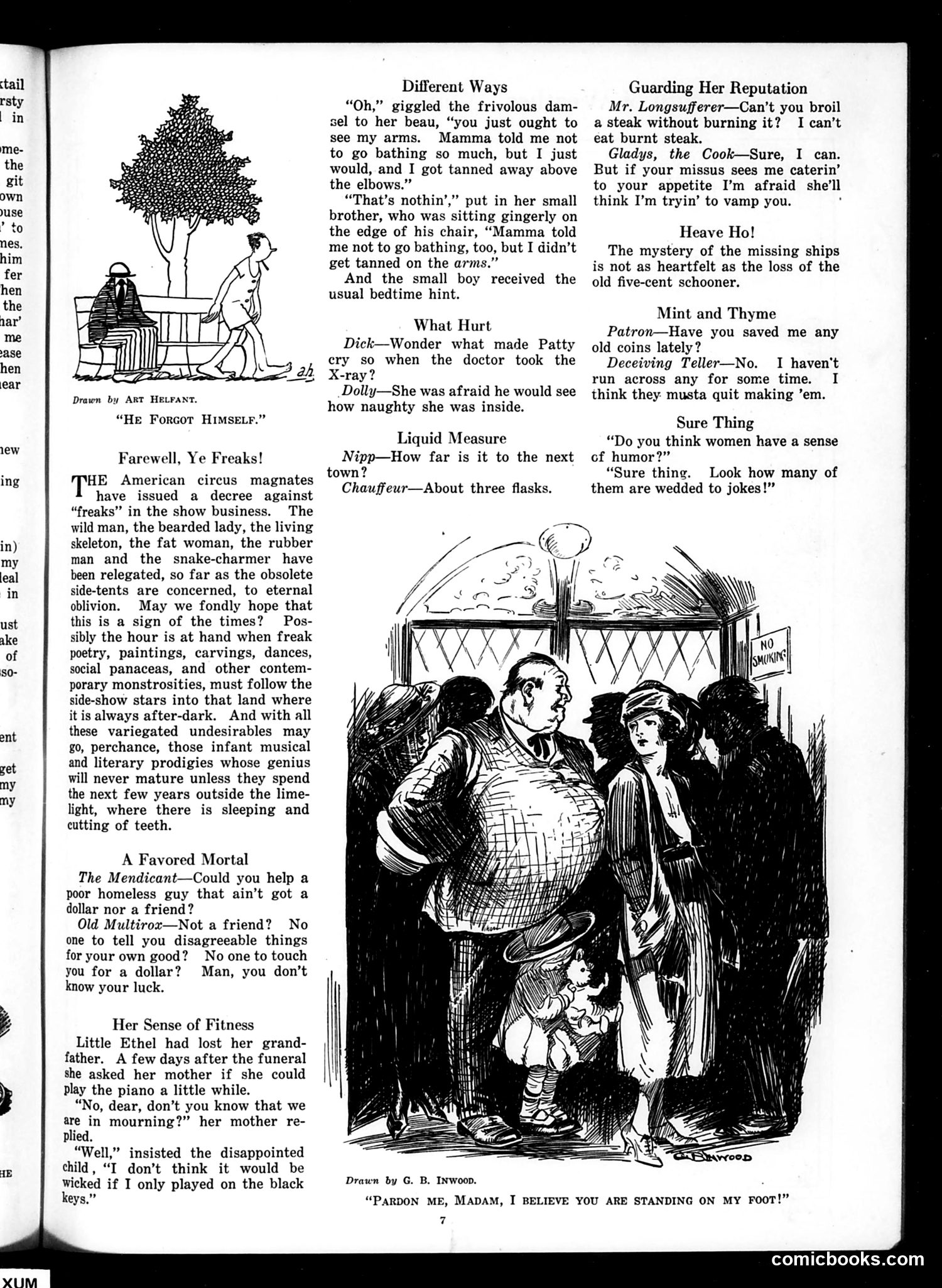
This page contains various short humorous sketches and jokes typical of early 20th-century satirical humor. The main cartoon (bottom) by G.B. Iswood depicts a woman stepping on a well-dressed man's foot in a crowded space, with her apologetic caption: "Pardon me, Madam, I believe you are standing on my foot!" The surrounding text includes brief comic dialogues on everyday situations—a woman questioning a doctor's X-ray recommendation, discussion of circus "freaks," a child asking to play piano during mourning, and a beggar's bad luck. These represent gentle social satire mocking middle-class etiquette, medical pretension, and changing entertainment standards. No specific political figures or events are referenced. The humor relies on irony and social observation rather than topical commentary.
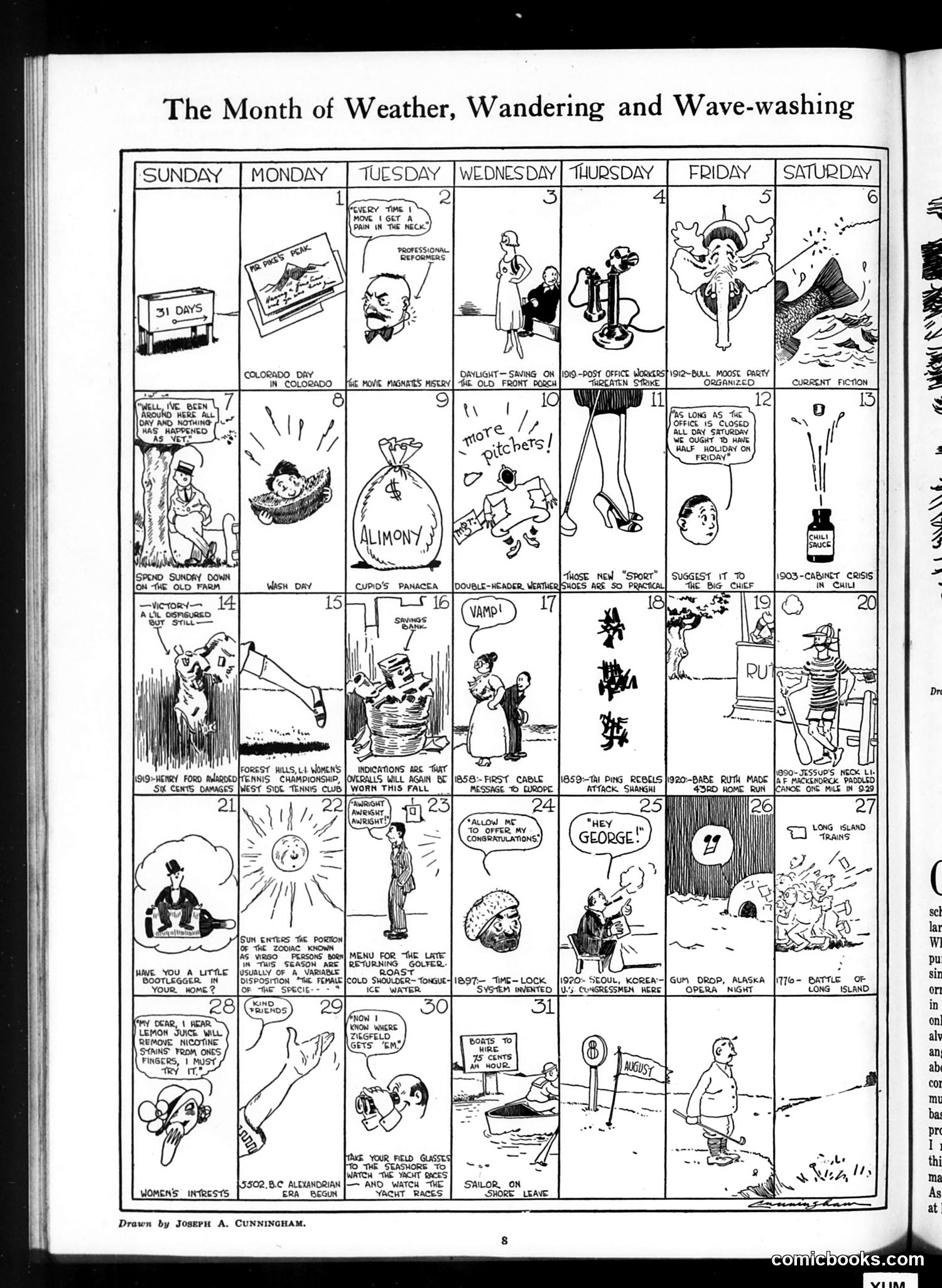
This is a daily calendar comic strip by Joseph A. Cunningham spanning an entire month. Each panel contains a brief gag depicting everyday situations and observations—weather phenomena, domestic life, social awkwardness, and physical misadventures. The humor relies on visual slapstick and wordplay rather than political commentary. Examples include: a man caught in wind, someone dealing with an "alimony" debt, weather disasters, and various embarrassing social encounters. The strip appears designed for general entertainment rather than satire of specific public figures or events. The title itself is playful, grouping "weather, wandering and wave-washing" as the month's defining themes—capturing the unpredictable nature of daily life through light, observational comedy typical of Judge magazine's satirical-but-accessible style.
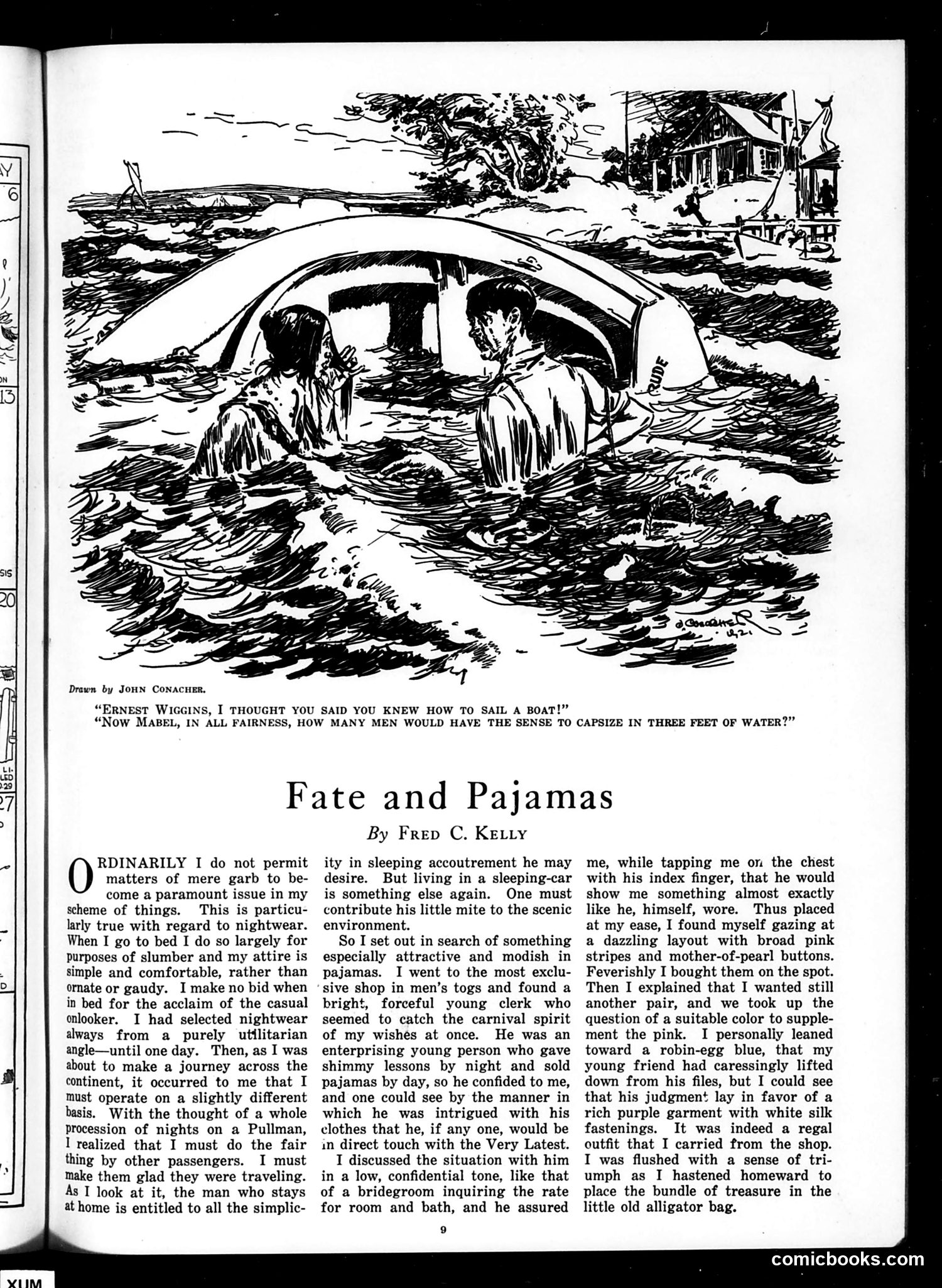
The page contains two separate pieces: **The Cartoon** (top): A domestic humor sketch by John Conacher showing a couple in a capsized boat. Ernest Wiggins defends his boating incompetence by sarcastically claiming that most men wouldn't even have the "sense" to capsize in shallow water—implying deliberate foolishness. It's gentle marital comedy playing on the trope of the incompetent husband and exasperated wife. **"Fate and Pajamas"** (bottom): An humorous short story by Fred C. Kelly about a man buying flashy pajamas (pink-striped with mother-of-pearl buttons, purple silk) for a cross-country train trip. The joke is his overthinking—he feels obligated to wear stylish sleepwear in a Pullman car to entertain fellow passengers, consulting a shop clerk with excessive seriousness. It satirizes masculine vanity and the absurdity of worrying about appearance even while sleeping. Both pieces represent typical *Judge* magazine humor: light domestic satire and gentle mockery of everyday social pretensions among middle-class Americans.
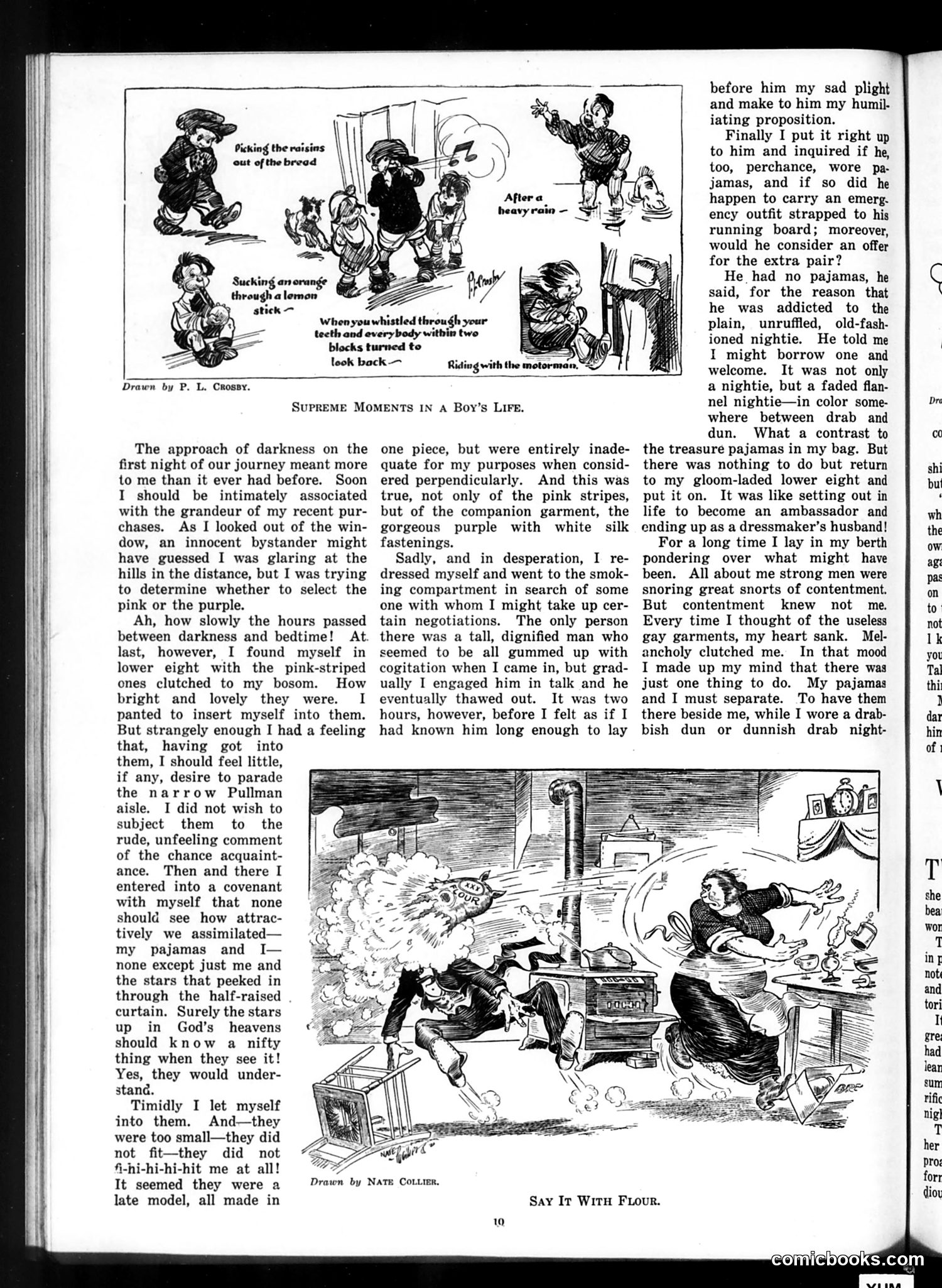
This page contains two humorous narratives with illustrations about male vanity and domestic mishap. **"Supreme Moments in a Boy's Life"** (drawn by P.L. Crosby, top) satirizes a young man's excitement over purchasing stylish new pajamas—pink-striped and purple with silk fastenings—for a Pullman train journey. The joke: they don't fit. Mortified at parading them publicly, he confides in a motorman, only to discover the man wears plain old nightshirts. Desperate, he borrows a drab nightie from the motorman and must abandon his prized pajamas—described as setting out "to become an ambassador and ending up as a dressmaker's husband." **"Say It With Flour"** (drawn by Nate Collier, bottom) depicts slapstick domestic chaos, apparently showing children or people covered in flour during some kitchen mishap. Both pieces are light humor reflecting early 20th-century middle-class concerns with appearance, embarrassment, and domestic life.
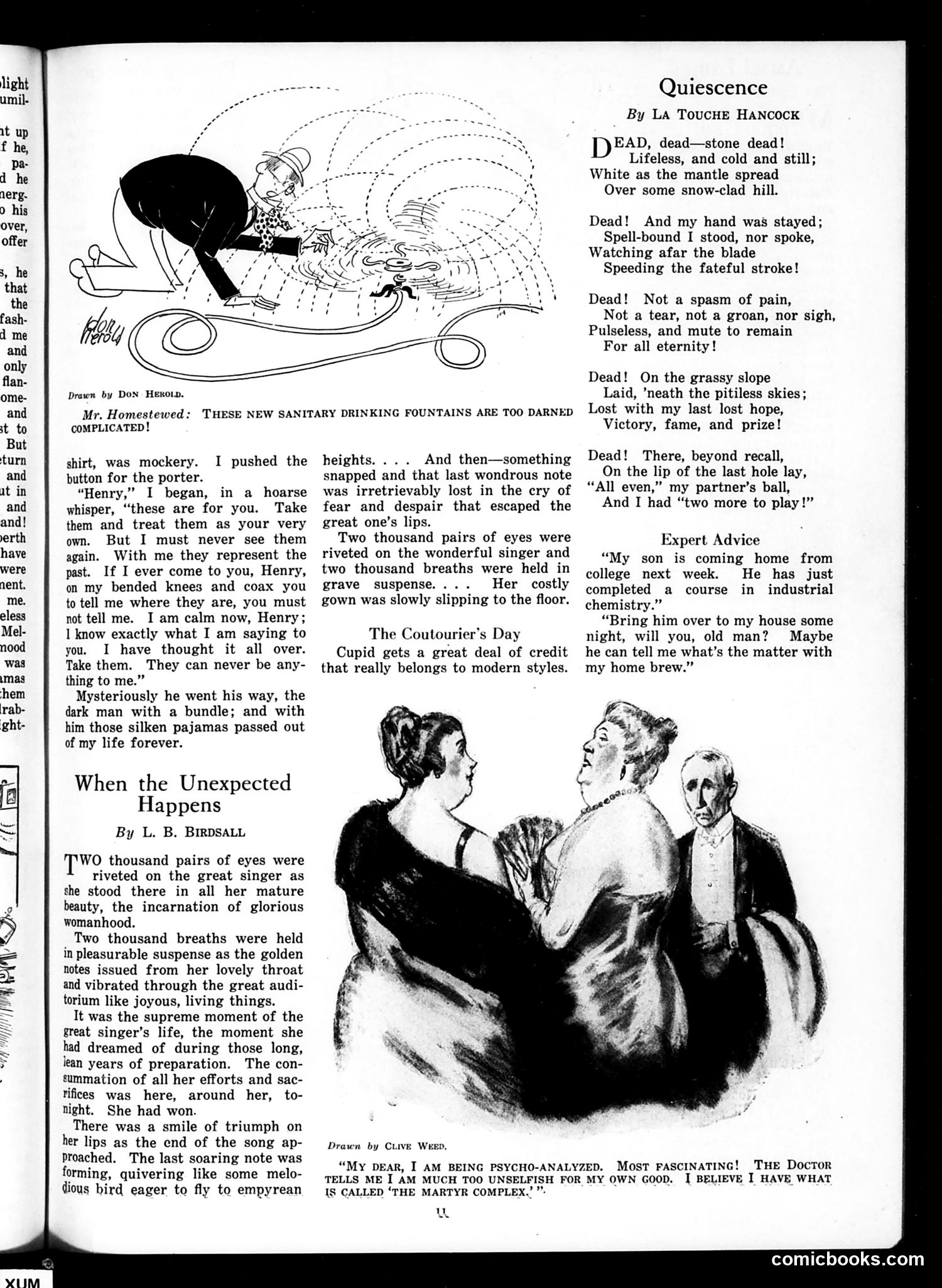
**Top Cartoon ("Mr. Homestewed"):** Don Herold satirizes overly complicated modern conveniences—specifically new public drinking fountains. A man struggles awkwardly with the apparatus while his companion mocks the needless complexity, capturing early-20th-century frustration with technology that was supposed to simplify life. **"Quiescence" Poem:** La Touche Hancock's verse ironically treats a golfer's lost match as tragic death. The elaborate dramatic language about mortality, fate, and lost glory culminates in the reveal: the speaker lost a golf game by two strokes. It's humorous deflation—treating trivial sporting disappointment with overwrought poetic tragedy. **"The Coutourier's Day" Cartoon:** Clive Weed depicts an opera singer's triumphant moment interrupted when her expensive gown slips down mid-performance. The joke: modern fashion's role in romantic/social success is so crucial that wardrobe failure eclipses even artistic achievement. The caption suggests fashion designers ("cupids") deserve credit for matchmaking that people attribute to Cupid. **Bottom Cartoon:** A woman undergoing psychoanalysis claims the "martyr complex"—self-diagnosis of excessive selflessness—while actually seeking validation for her vanity.
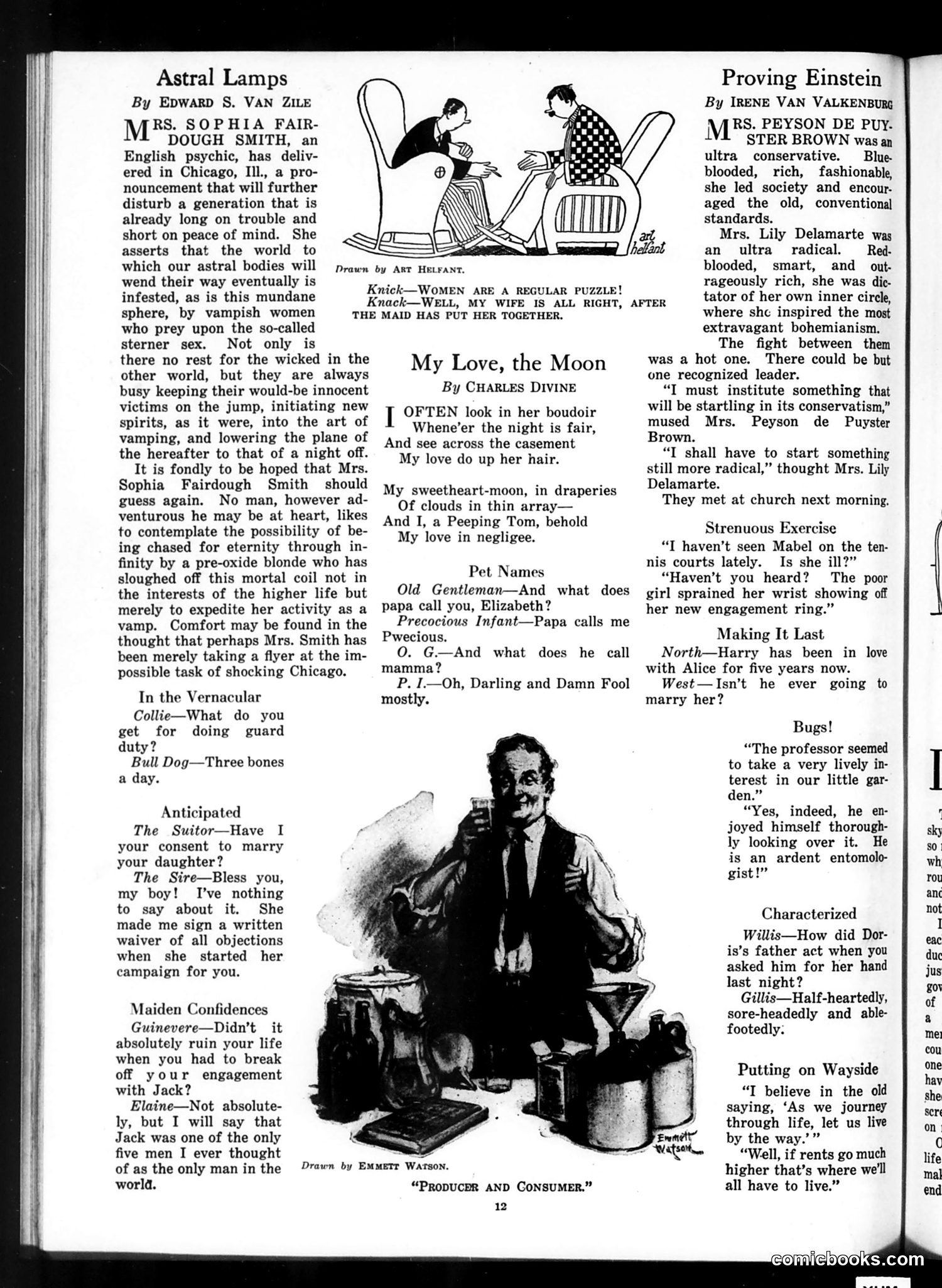
This page contains several satirical pieces typical of early 20th-century American humor: **"Astral Lamps"** mocks English psychic Sophia Fairdough Smith's lecture in Chicago claiming that the afterlife contains "vampish women" who seduce men. The satire ridicules both spiritualism and anxieties about aggressive female sexuality—the notion that even death won't escape men from predatory women reflects period misogyny dressed as cosmic horror. **"My Love, the Moon"** and related brief pieces satirize romantic clichés and marital dynamics. The "Peeping Tom" poem mocks sentimental verse, while the dialogue jokes portray women as vain (doing hair endlessly) and marriages as containing resentment ("Darling and Damn Fool"). **"Proving Einstein"** appears to use Einstein's theories (likely relativity/competing forces) as a metaphor for two wealthy society women—one ultraconservative, one radical—locked in competition for social leadership. The humor targets spiritualism, female vanity, marital discord, and class pretension—typical Judge magazine concerns from this era.
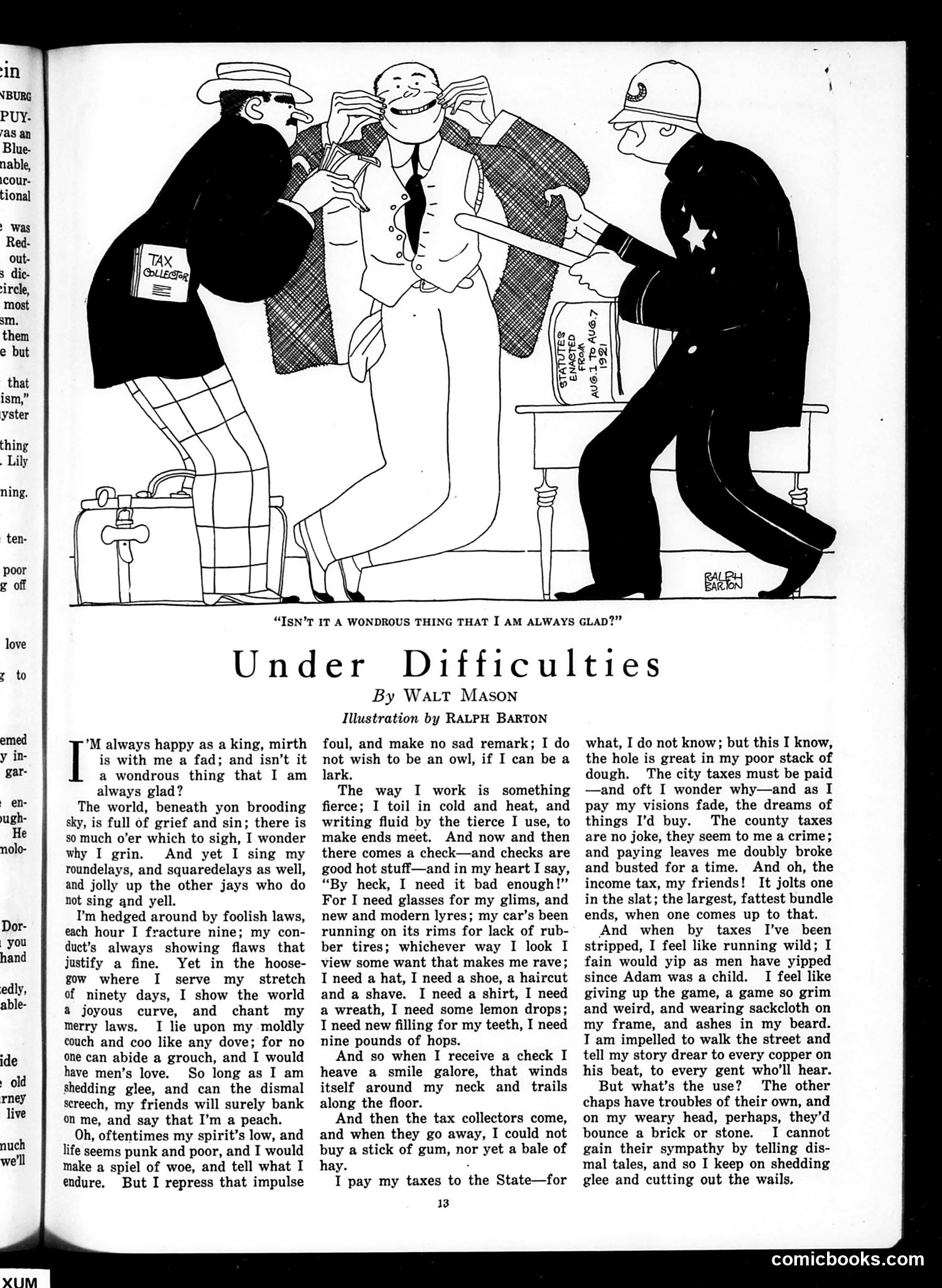
The cartoon illustrates Walt Mason's poem about maintaining cheerfulness despite financial hardship. The central figure is a perpetually smiling man being squeezed by three authority figures representing different tax collectors—labeled figures holding "TAX COLLECTOR" documents and what appears to be a state/government seal. The satire targets the post-WWI tax burden crushing ordinary workers. Mason's narrator claims to remain cheerful despite: inadequate wages, broken possessions, mounting debts, and—most pointfully—cascading taxes (city, county, state, and income tax). Each tax collector metaphorically extracts money, leaving him "doubly broke." The cartoon's title question—"Isn't it a wondrous thing that I am always glad?"—is ironic commentary on the impossible expectation that citizens maintain optimism while government systematically impoverishes them. The illustration's visual humor shows the protagonist literally compressed between tax authorities, unable to escape, yet supposedly smiling through it all. This reflects 1920s frustration with expanding government taxation.
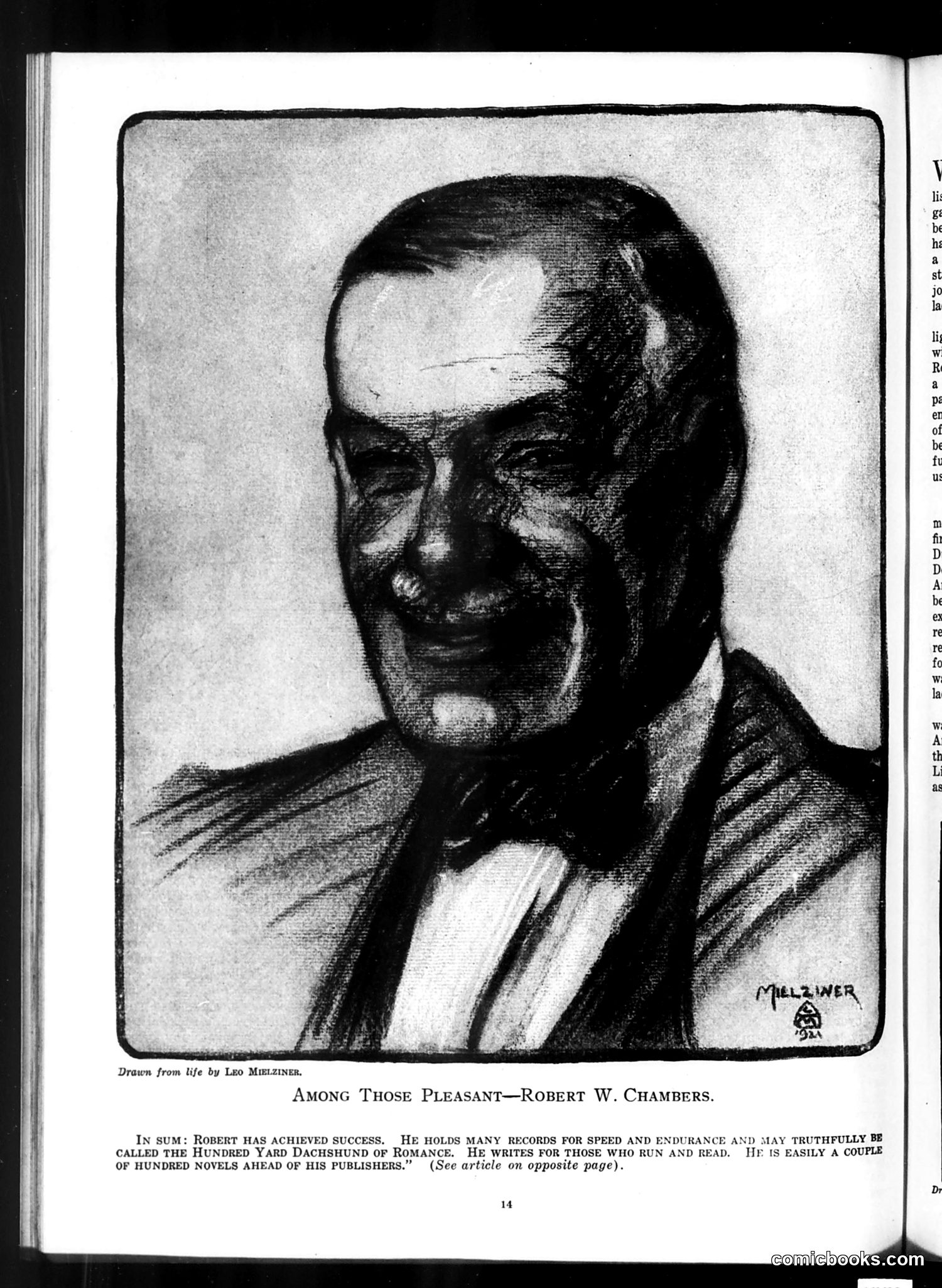
This is a portrait page from *Judge* magazine featuring Robert W. Chambers, a prolific American author. The sketch by Leo Mielziner presents Chambers in formal attire with a distinctive beard. The accompanying text satirizes Chambers' extraordinary productivity, humorously dubbing him the "Hundred Yard Dachshund of Romance"—a playful insult suggesting he writes prolifically but perhaps without depth. The satire mocks his rapid output, claiming he's "a couple of hundred novels ahead of his publishers," implying he writes faster than publishers can release his work. This targets early-20th-century romance and adventure fiction writers known for churning out numerous books to satisfy popular demand. The tone is tongue-in-cheek admiration mixed with gentle mockery of his commercial success and industrial-scale productivity.
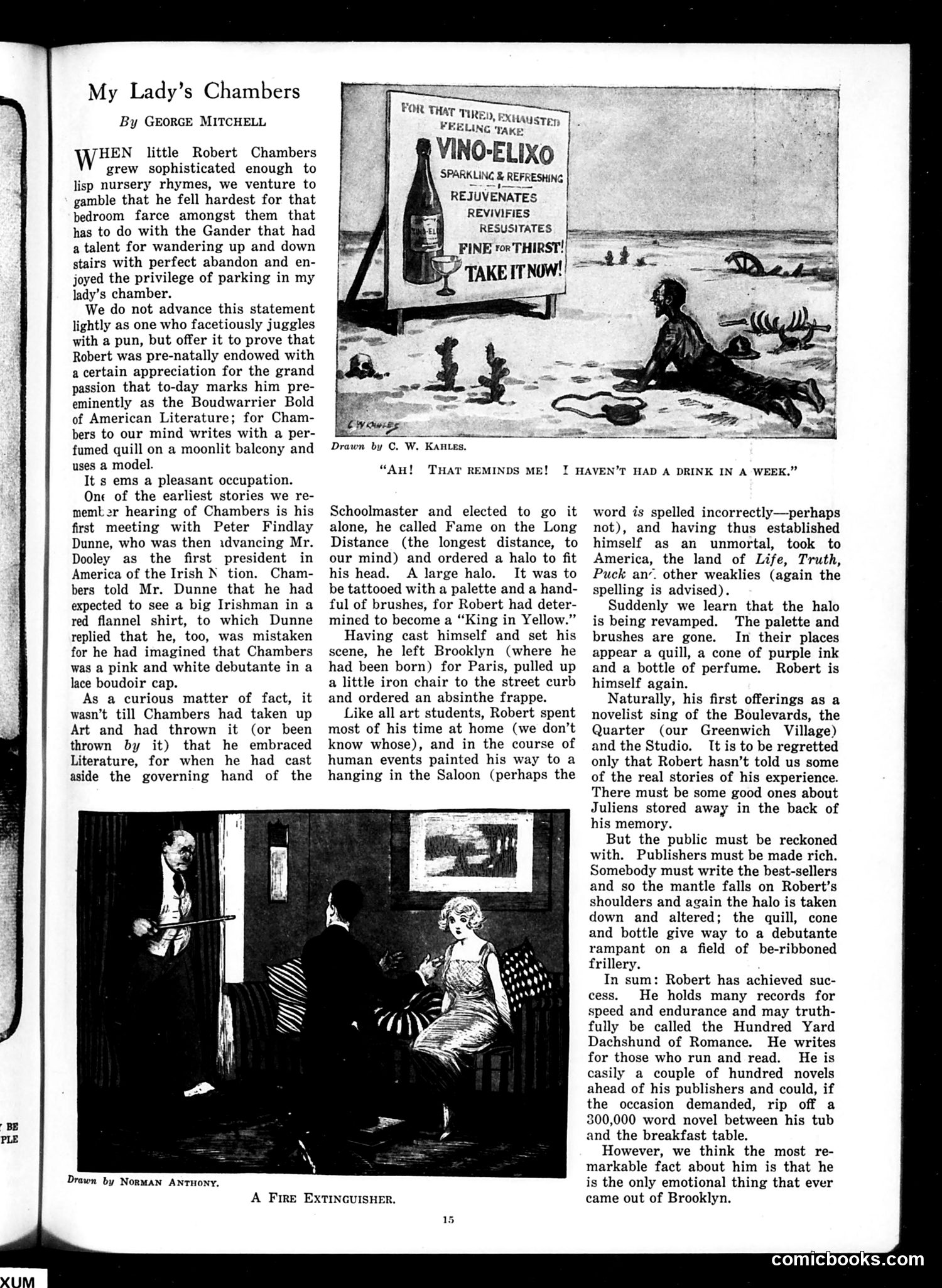
This is a satirical profile of **Robert Chambers**, a prolific American novelist known for romantic fiction set in bohemian Paris and Greenwich Village. The article mocks his literary persona and prolific output. **The satire targets:** - Chambers's affected romantic image: he adopted an "artistic" identity (painter, bohemian) before becoming a novelist, adopting theatrical poses (the "halo," perfumed quill) to construct his author brand - His mass-production of novels: he's called the "Hundred Yard Dachshund of Romance" for churning out hundreds of books ahead of his publishers' schedules - The gap between his artistic pretensions and commercial reality: his quill and ink are replaced by whatever sells to mass audiences (debutante romance) **The cartoons illustrate:** The top cartoon advertises Vino-Elixo on a beach—likely mocking Chambers's romanticized aestheticism. The bottom ("A Fire Extinguisher") shows a woman confronting a man in a bedroom—a visual pun on his bedroom-farce literary specialty and "My Lady's Chambers." The satire is friendly mockery of a successful but artistically compromised popular writer.
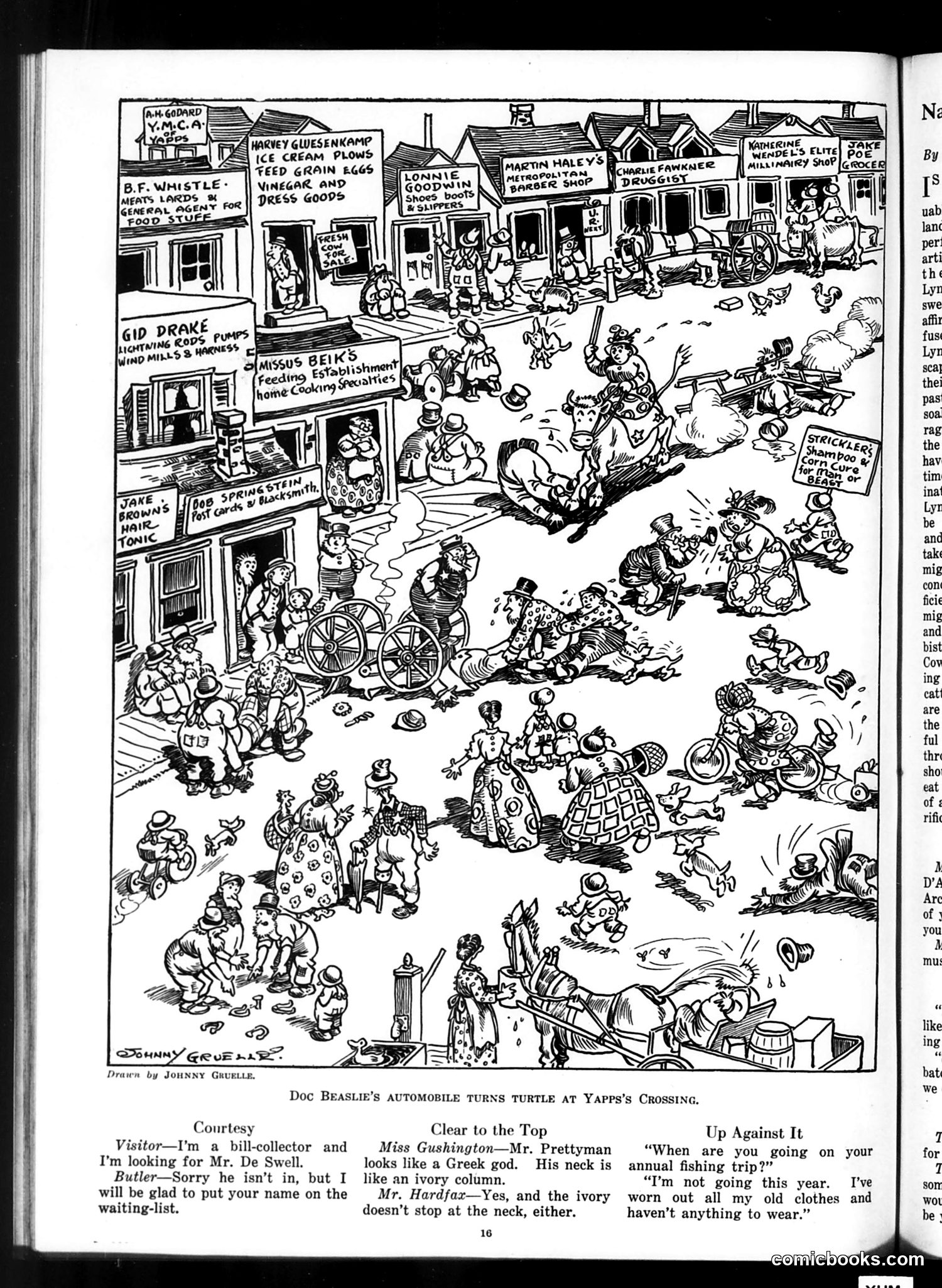
This is a crowded, chaotic street scene by Johnny Gruelle depicting an automobile accident where "Doc Beaslie's" vehicle has overturned. The comic illustrates early 1900s urban life, showing storefronts (butcher, ice cream, barber shop, druggist) and numerous townspeople reacting to the vehicular mishap. The three jokes below the cartoon reflect period social satire: one mocks debt avoidance through the "waiting-list" excuse; another uses "Greek god" and "ivory column" as sexually suggestive humor about a man's appearance; the third jokes about Depression-era financial hardship, where a man cannot afford new fishing clothes and must skip his annual trip. The satire targets social pretense, financial instability, and the automobile's disruptive impact on traditional urban life.
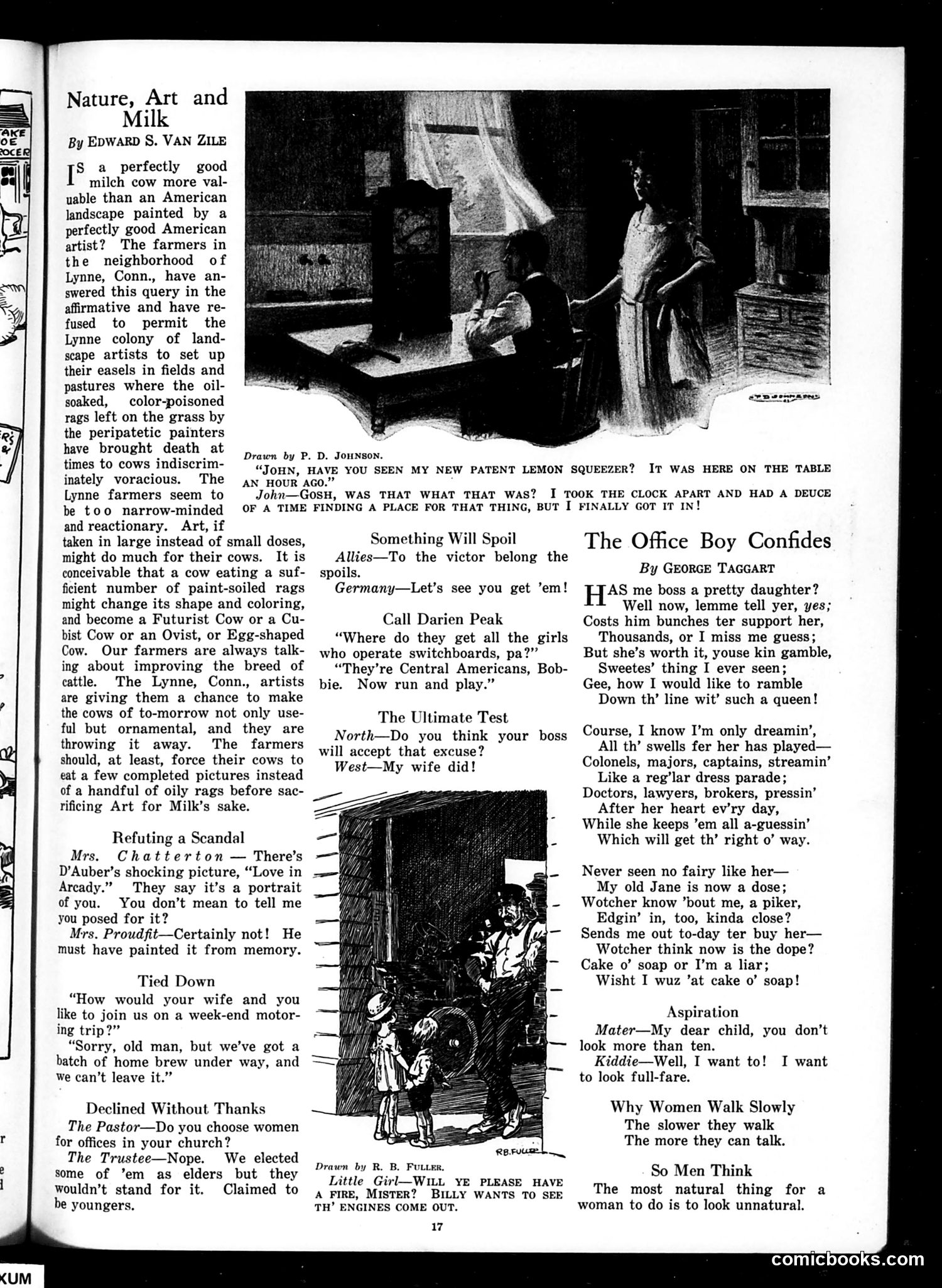
This Judge magazine page contains several satirical pieces mocking early 20th-century American life: **"Nature, Art and Milk"** satirizes rural narrow-mindedness. Connecticut farmers rejected landscape painters using their fields because paint-soaked rags allegedly poisoned cows. The author sarcastically suggests farmers should embrace this, imagining cows transformed into "Futurist" or "Cubist" art through consuming paintings—mocking both avant-garde art movements and farmer conservatism. **The cartoons** offer brief social humor: a husband's confusion over a "patent lemon squeezer," wartime Allied-German rivalry over "spoils," workplace excuses, church gender politics, and domestic situations. **"The Office Boy Confides"** uses working-class dialect to humorously depict an infatuated young employee daydreaming about his boss's attractive daughter while acknowledging his hopelessness against wealthy suitors. The page reflects period attitudes toward modernism, gender, class, and rural-urban cultural divides typical of Judge's satirical targeting of American social pretensions and contradictions.
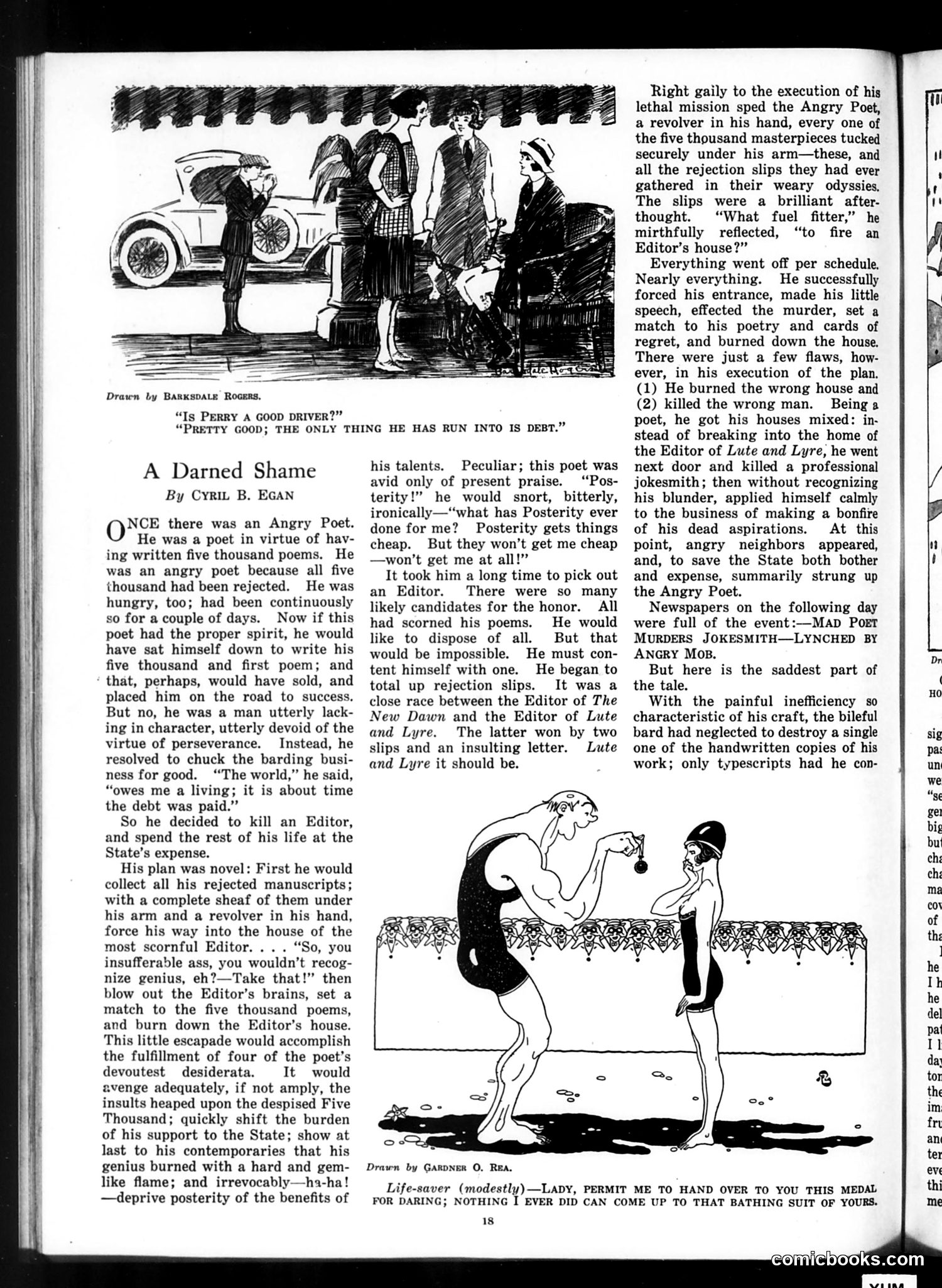
This story mocks an impoverished, persistently rejected poet whose bitterness metastasizes into murderous fantasy. After 5,000 rejection slips, he plots to kill a magazine editor—specifically the editor of *Lute and Lyre*—by forcing his way in with his rejected manuscripts and a revolver, then burning the editor's house with his poems as kindling. The satire's dark humor lies in the execution's farcical failure: the angry poet attacks the *wrong house* and kills a "professional jokesmith" (likely a rival humorist or cartoonist) instead. Neighbors lynch him before authorities can intervene. The piece satirizes both artistic entitlement—the poet's belief society "owes" him success—and the publishing world's cruelty toward struggling writers. The top cartoon, captioned about "Perry" running into debt, appears thematically related: commentary on poor financial judgment. The overall message: bitterness and delusion are dangerous, but incompetence often prevents actual harm.
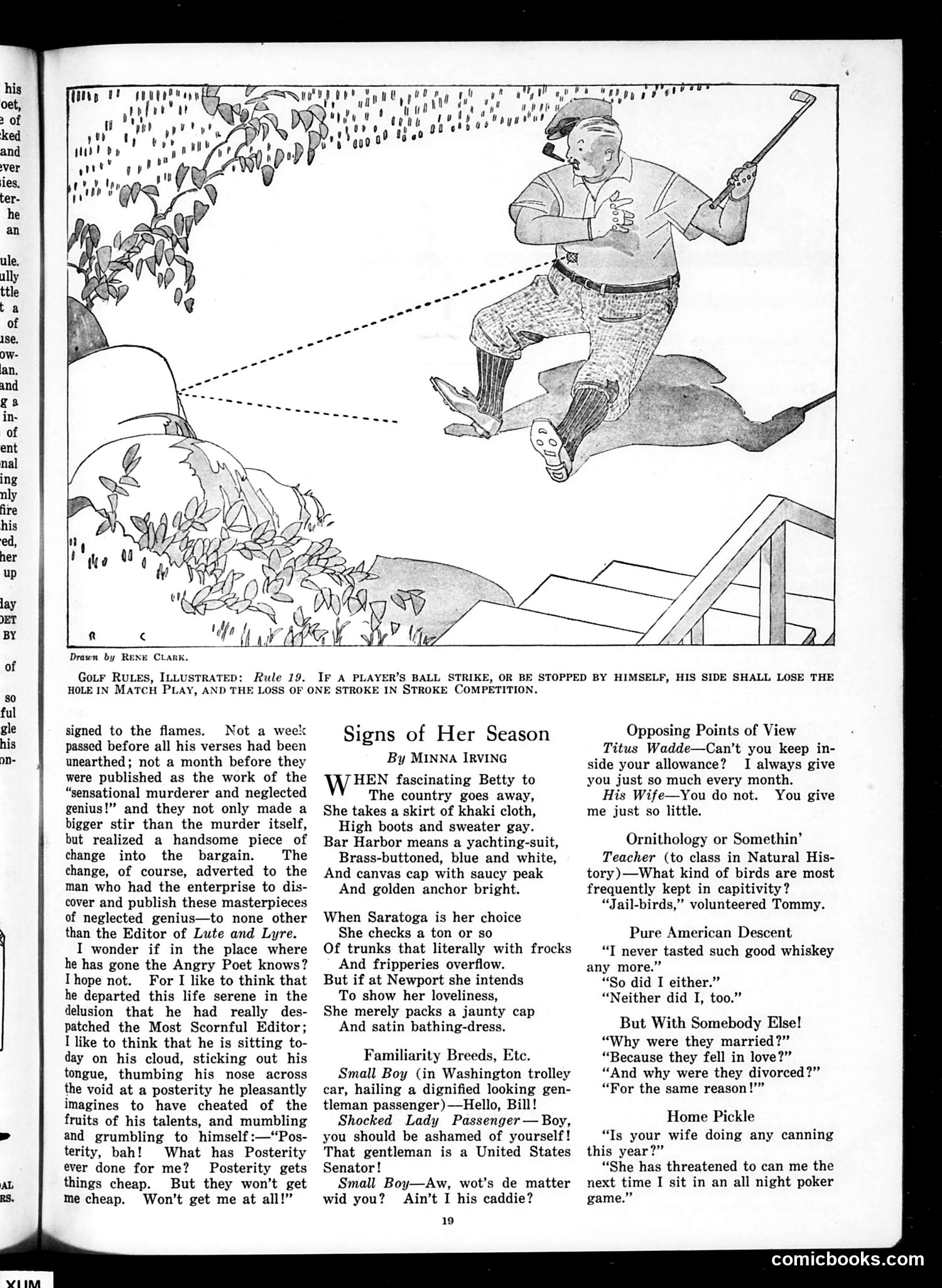
This page from *Judge* magazine contains multiple unrelated humor pieces typical of early 20th-century satirical publications. **Main Cartoon (top):** Illustrates golf Rule 19, showing a golfer striking his ball while standing on what appears to be a beaver or muskrat. The visual joke depicts the literal interpretation of golf rules—a humorous way to explain that a player loses a stroke if their ball is stopped by themselves or their equipment. **Text Pieces:** The page includes several short satirical articles and joke exchanges: - "Signs of Her Season" mocks wealthy women's elaborate seasonal wardrobes and travel habits - Multiple brief comedic dialogues about marital disputes (wives' allowances, canning threats), class encounters (a boy familiarly addressing a U.S. Senator as his golf caddie), and other domestic situations The humor relies on wordplay, social observation about wealth and gender roles, and simple comedic scenarios. Nothing here references specific political events—it's general-interest satire about contemporary social customs and relationships.
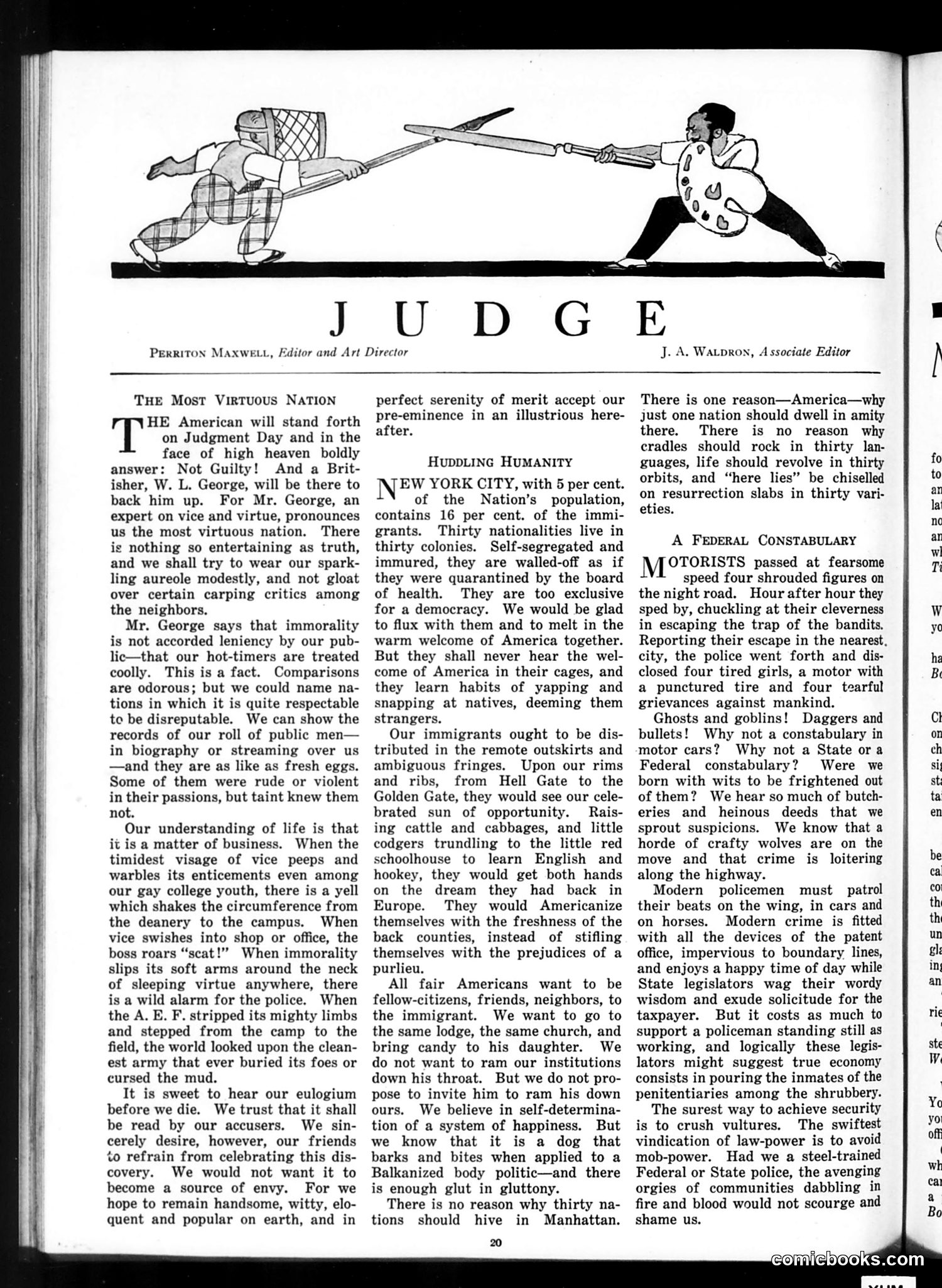
The top illustration depicts two figures in a stylized duel or confrontation: one wearing a checkered suit and goggles (left) faces another in formal attire with a painter's palette (right). They wield long implements like fencing swords or artistic tools. This appears to satirize a creative or intellectual competition—likely between different artistic or cultural perspectives. The contrasting dress and tools suggest opposing ideologies or professions engaged in combat. The accompanying editorial "The Most Virtuous Nation" ironically praises American morality while subtly mocking national self-righteousness. The piece uses elevated, grandiose language to celebrate American virtue, then shifts to critique immigrants clustering in ethnic enclaves in New York City, arguing they should be dispersed to rural areas to "Americanize" themselves rather than maintain separate communities. The satire targets both American smugness about virtue and anxieties about immigration and assimilation—suggesting that preaching about democracy while segregating immigrant populations is hypocritical. The cartoon likely complements this tension between stated American ideals and actual practice.
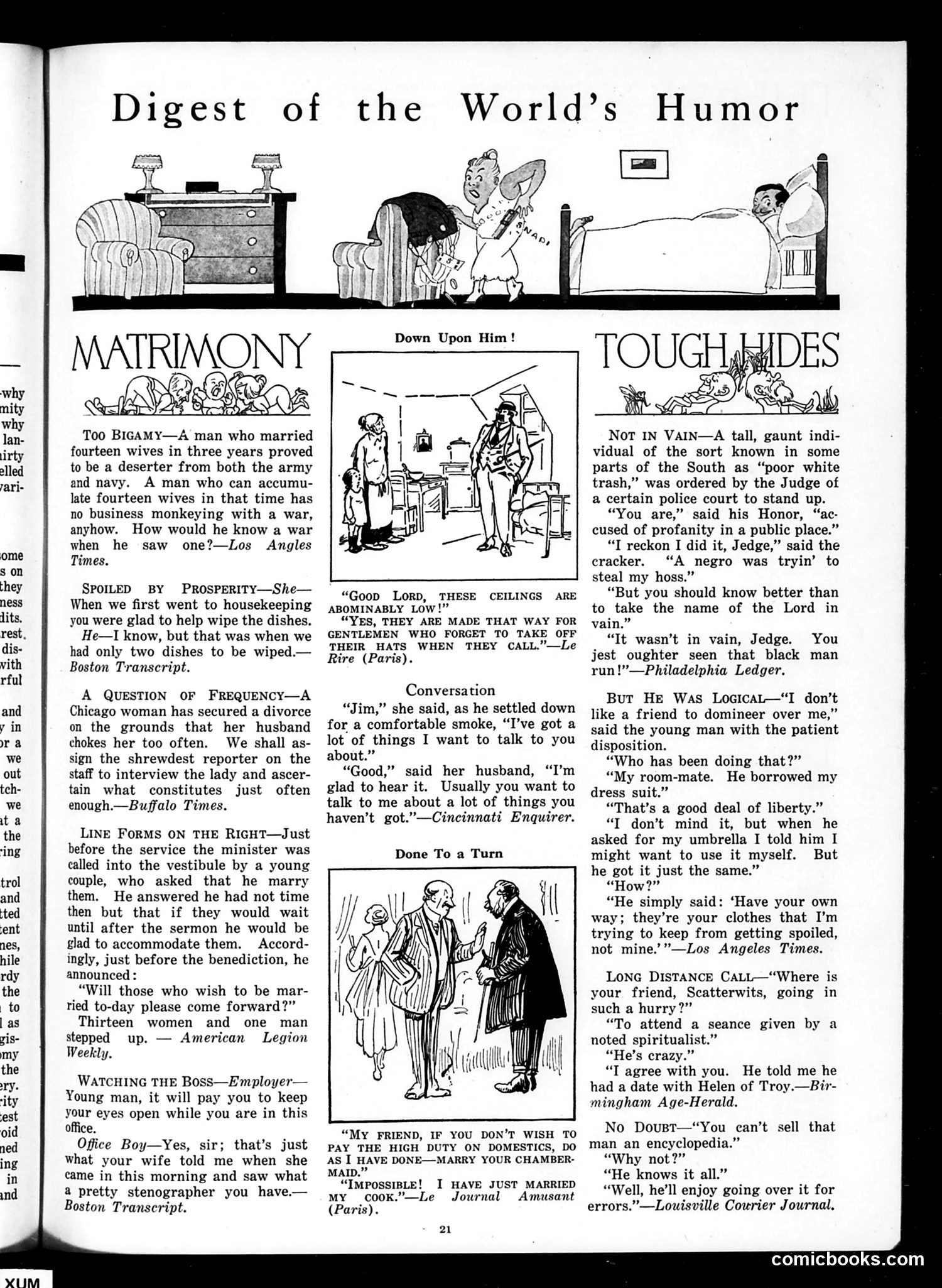
This page collects brief humorous anecdotes from various newspapers and magazines, organized under thematic headers. The satire targets everyday social situations and domestic life rather than specific political figures. **Key themes:** - **Marriage and divorce**: Multiple jokes mock marital discord, infidelity, and spousal behavior ("Too Bigamy," "Spoiled by Prosperity") - **Class and labor**: References to servants, chambermaids, stenographers, and office dynamics reflect early 20th-century employer-employee hierarchies - **Racial attitudes**: The "Not in Vain" anecdote contains period-typical derogatory language toward Black Americans, presented without critique - **Gender dynamics**: Women are portrayed as nagging, materialistic, or manipulative The humor relies on stereotypes about marriage difficulties, class differences, and racial caricature that would be considered offensive today. The page represents mainstream American satirical journalism of its era, reflecting contemporary prejudices normalized in popular publications.
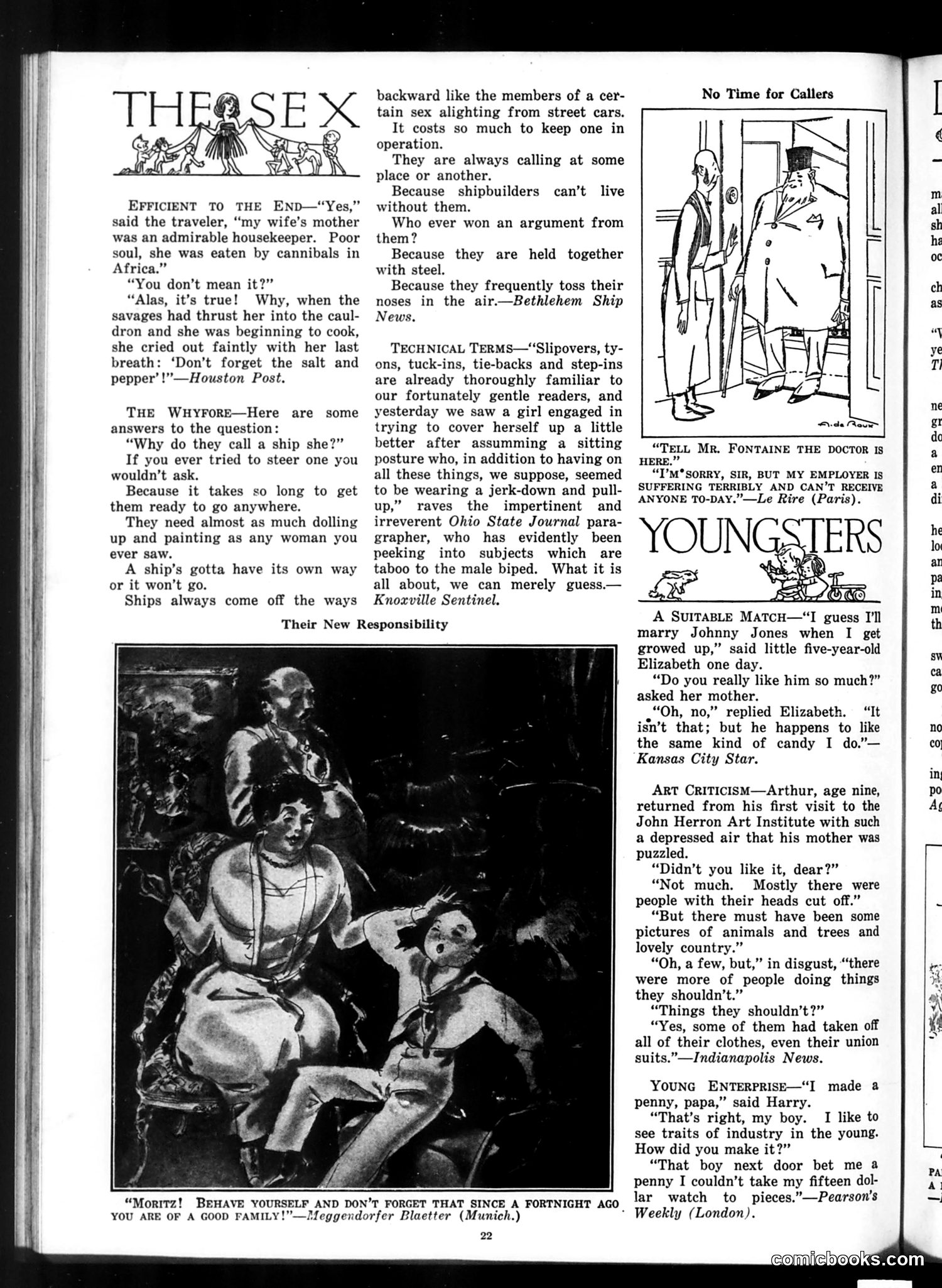
This page contains several short humor pieces typical of Judge's satirical style: **"Efficient to the End"** mocks a woman's domestic obsession through exaggeration—even facing cannibals, she maintains housekeeping standards. **"The Whyfore"** uses sexist stereotypes about women to explain why ships are called "she"—they're expensive, unreliable, require constant maintenance, and can't be argued with. This reflects early 20th-century attitudes treating women and ships as similarly troublesome. **"Technical Terms"** pokes fun at fashionable women's undergarments and silhouettes, sarcastically suggesting men shouldn't understand female fashion. **The cartoon "Their New Responsibility"** (Munich source) appears to show a woman disciplining a child, likely commentary on post-WWI changes in family structure or women's authority. **"Youngsters"** section contains gentle jokes about children's logic—a girl's marriage prospects based on candy preference, a boy's art criticism focused on nudity, another's entrepreneurial scheme backfiring. The overall tone reflects upper-class magazine humor: mildly transgressive but fundamentally conservative about gender and social propriety.
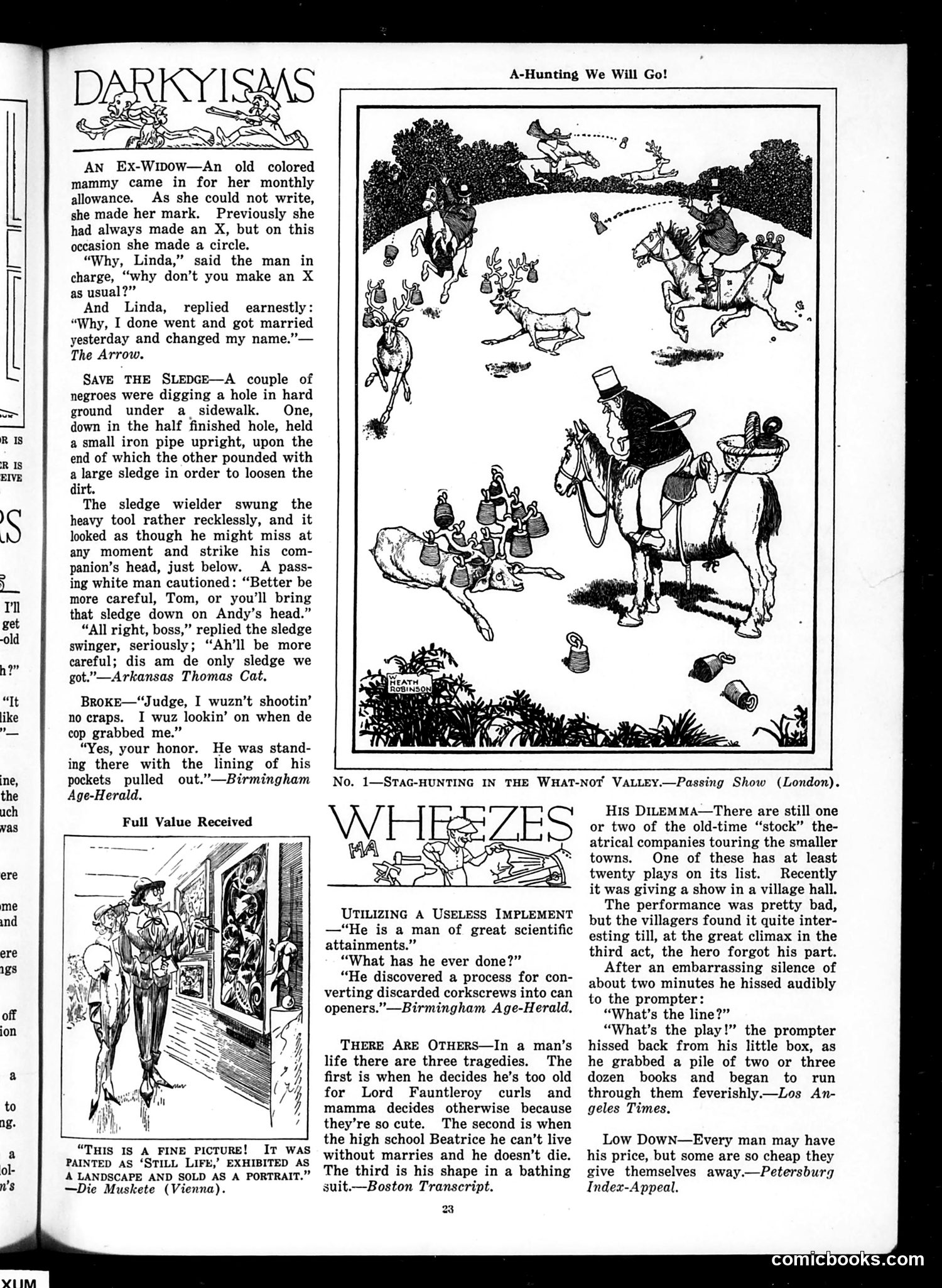
This page contains brief satirical jokes and anecdotes rather than political cartoons. The content reflects early 20th-century American humor, much of which relies on racist stereotypes now offensive and unacceptable. **Key items:** - **"An Ex-Widow"**: Jokes about an illiterate Black woman who marks documents with an X, then a circle after marrying—satirizing both illiteracy and name changes in marriage. - **"Save the Sledge"**: A crude stereotype joke about two Black laborers, emphasizing concern for equipment over worker safety. - **"Broke"**: A joke about a Black man arrested during gambling, using dialect humor. - **"Full Value Received"**: An illustration-accompanied joke about a painting exhibited under multiple false classifications—commenting on art world deception. - **"Wheezes" section**: Various other brief jokes about theatrical productions, marriage, and social pretension. The page exemplifies Judge's reliance on ethnic stereotyping and working-class ridicule as humor sources typical of that era.
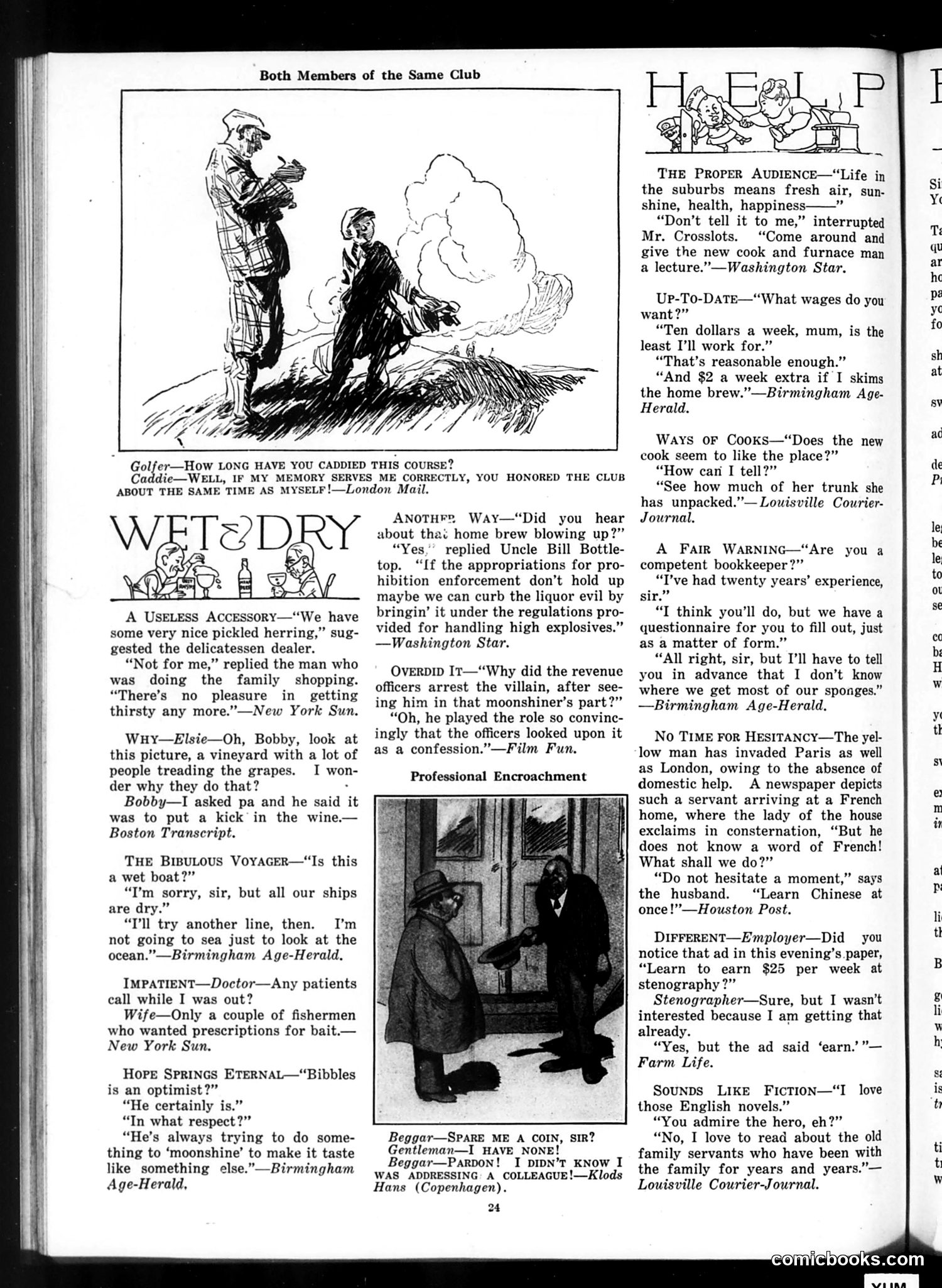
This page from Judge magazine consists of short humorous anecdotes satirizing American life during Prohibition (alcohol ban). The central theme: people's creative attempts to circumvent liquor laws. The "Both Members of the Same Club" cartoon shows a golfer and caddie with reversed social roles—the caddie implies the golfer is a recent club member, suggesting class mobility or ironic social commentary. Most jokes mock Prohibition enforcement and homemade alcohol ("moonshine," "home brew"). Examples include: - A man who won't buy pickled herring because it no longer makes him thirsty (alcohol ban removes the need) - Uncle Bill Bottle-top joking that explosives regulations might replace alcohol enforcement - A servant demanding extra pay for "skimming the home brew" The "Professional Encroachment" cartoon depicts a beggar addressing a gentleman, then apologizing—revealing the gentleman is also a beggar ("colleague"), satirizing economic hardship. Other jokes address labor shortages, domestic servants' wages, and wartime upheavals (Chinese workers in Paris). The humor relies on readers' familiarity with Prohibition-era culture and economic anxiety of the period.
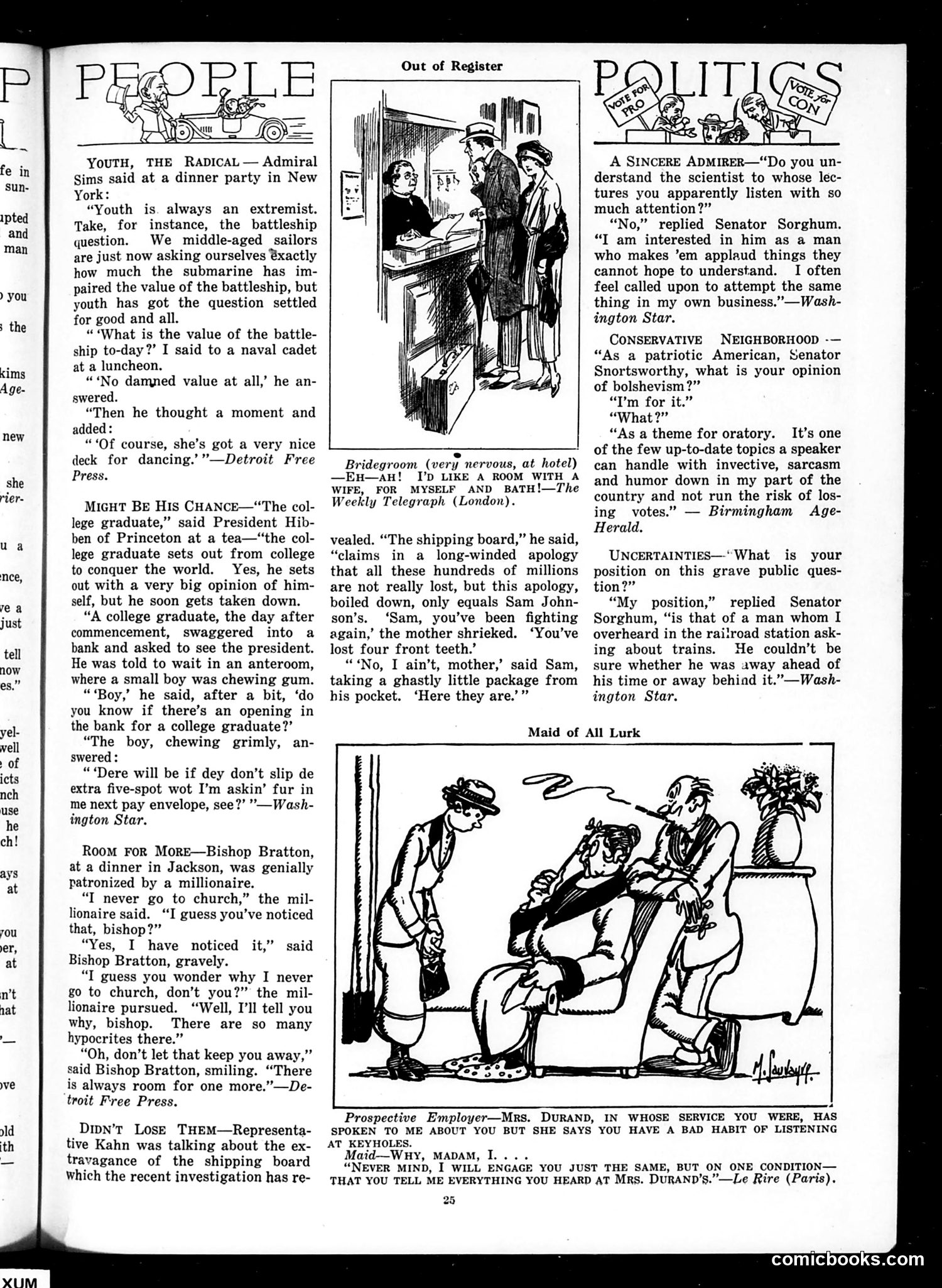
This page contains satirical anecdotes mocking American public figures and social pretensions circa World War I era. **Key satires:** 1. **"Youth, the Radical"** — Admiral Sims critiques young naval officers' absolutism about battleships' obsolescence versus older officers' nuanced debate. The joke: youth settles complex military strategy instantly, then adds "nice deck for dancing." 2. **"Might Be His Chance"** — A college graduate's post-graduation confidence is deflated when a street urchin demands a bribe, suggesting overconfidence meets reality. 3. **"Room for More"** — Bishop Bratton's witty comeback to a millionaire claiming he won't attend church due to hypocrites: the bishop replies there's "always room for one more"—implying the millionaire himself is a hypocrite. 4. **Political figures** (Senators Sorghum/Snortsworthy) are portrayed as opportunistic: one admits feigning understanding of science; another exploits "bolshevism" as safe oratory fodder. The cartoon illustrates a nervous bridegroom's verbal gaffe at a hotel desk.
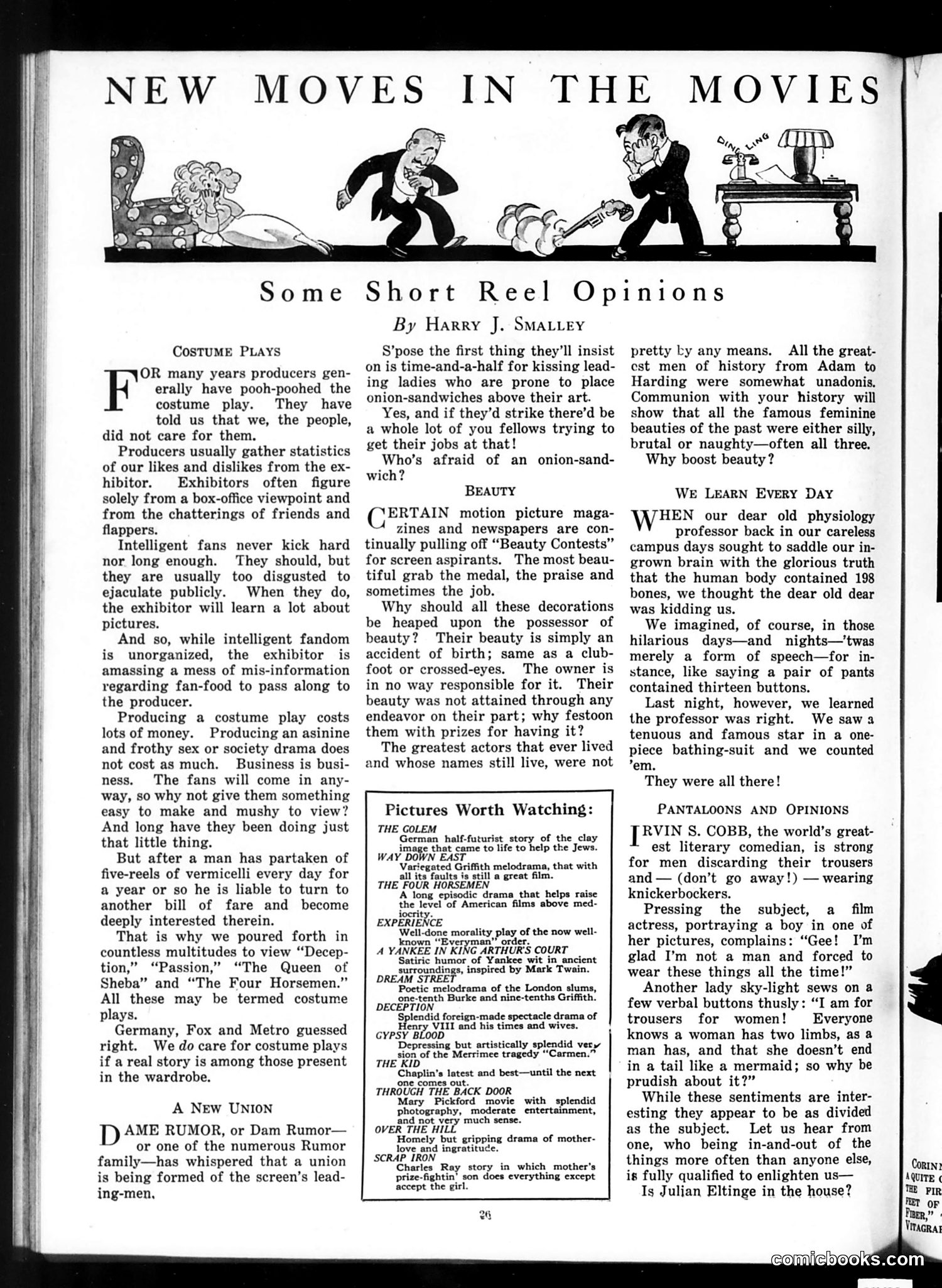
This page satirizes early 1920s film industry practices through columnist Harry J. Smalley's commentary on three topics: **Costume Plays**: Smalley criticizes film producers for dismissing historical dramas as unpopular, then notes audiences actually flocked to recent spectacles like "The Four Horsemen" and "Passion." The satire targets studio executives ignoring audience demand in favor of cheaper, shallow entertainment—they misjudge public taste by relying on exhibitors and gossip rather than organized fan feedback. **Actor Union**: A brief joke about male screen leads forming a union, demanding extra pay for kissing actresses who eat onion sandwiches—mocking both labor organizing and leading men's vanity. **Beauty Contests**: Smalley attacks movie magazines' "beauty contests" for film aspirants, arguing beauty is mere accident of birth undeserving of prizes, unlike true acting talent. This critiques the industry's reduction of women to physical appearance rather than skill. The cartoon header (showing exaggerated figures) visually reinforces the absurdity of these industry trends. The "Pictures Worth Watching" list provides contemporary film recommendations, validating his points about quality storytelling.
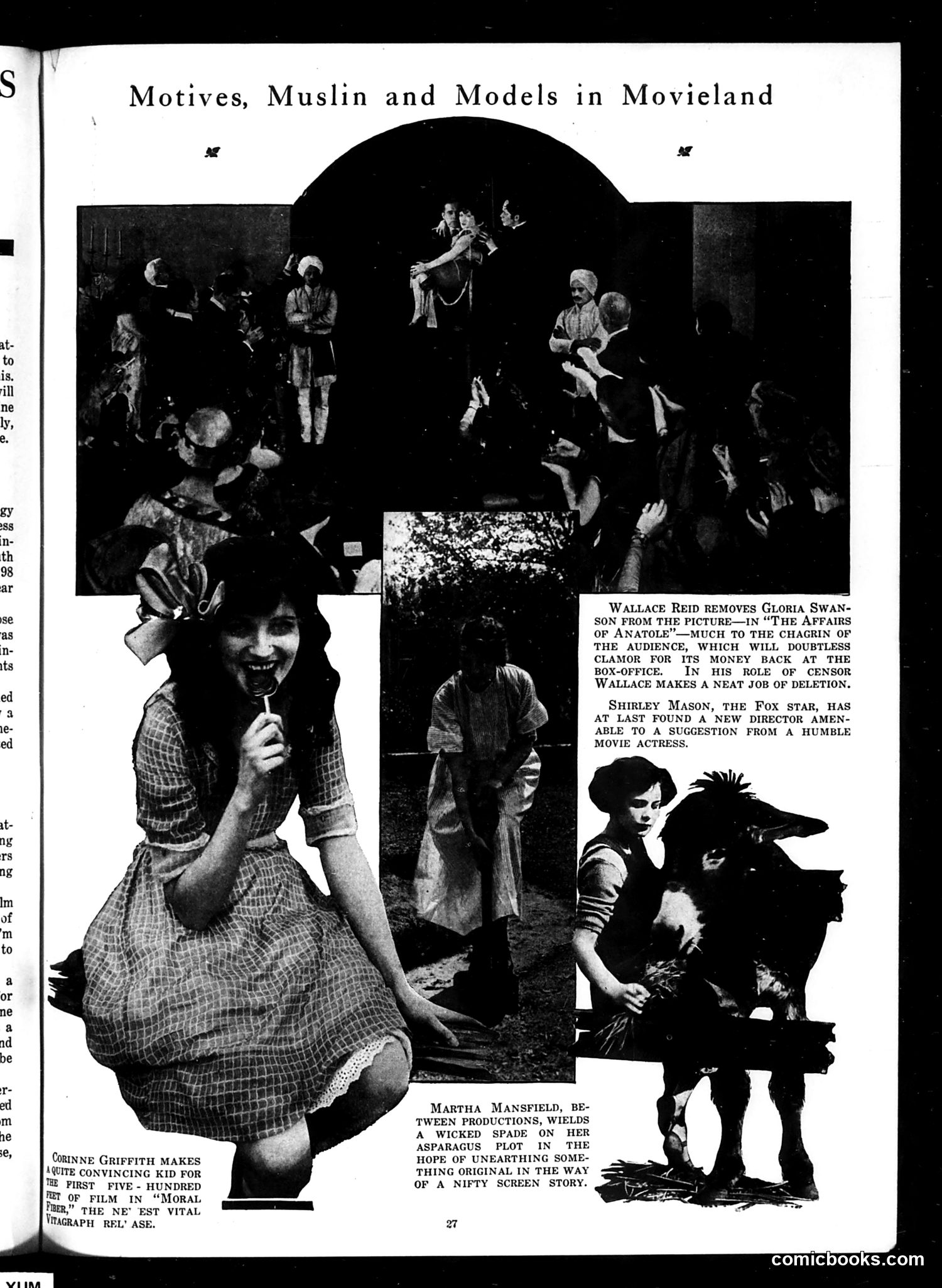
This page satirizes Hollywood filmmaking practices circa the early 1920s. It features three brief anecdotes about famous film actresses and directors: **Wallace Reid and Gloria Swanson**: The caption jokes that Reid removed Swanson from "The Affairs of Anatole," playing the role of "censor"—suggesting he had inappropriate editorial control, possibly implying romantic or power dynamics behind casting decisions. **Shirley Mason**: Sarcastically notes she found a director "amenable to a suggestion from a humble movie actress"—mocking that actresses had to manipulate directors to get their way rather than having legitimate creative input. **Corinne Griffith**: Quips about casting a child for her first 500 feet of film, with dark humor about struggling to find "original" material. The overall message critiques Hollywood's superficiality, the limited agency of actresses despite their fame, and the arbitrary decision-making of male directors and producers who controlled the industry.
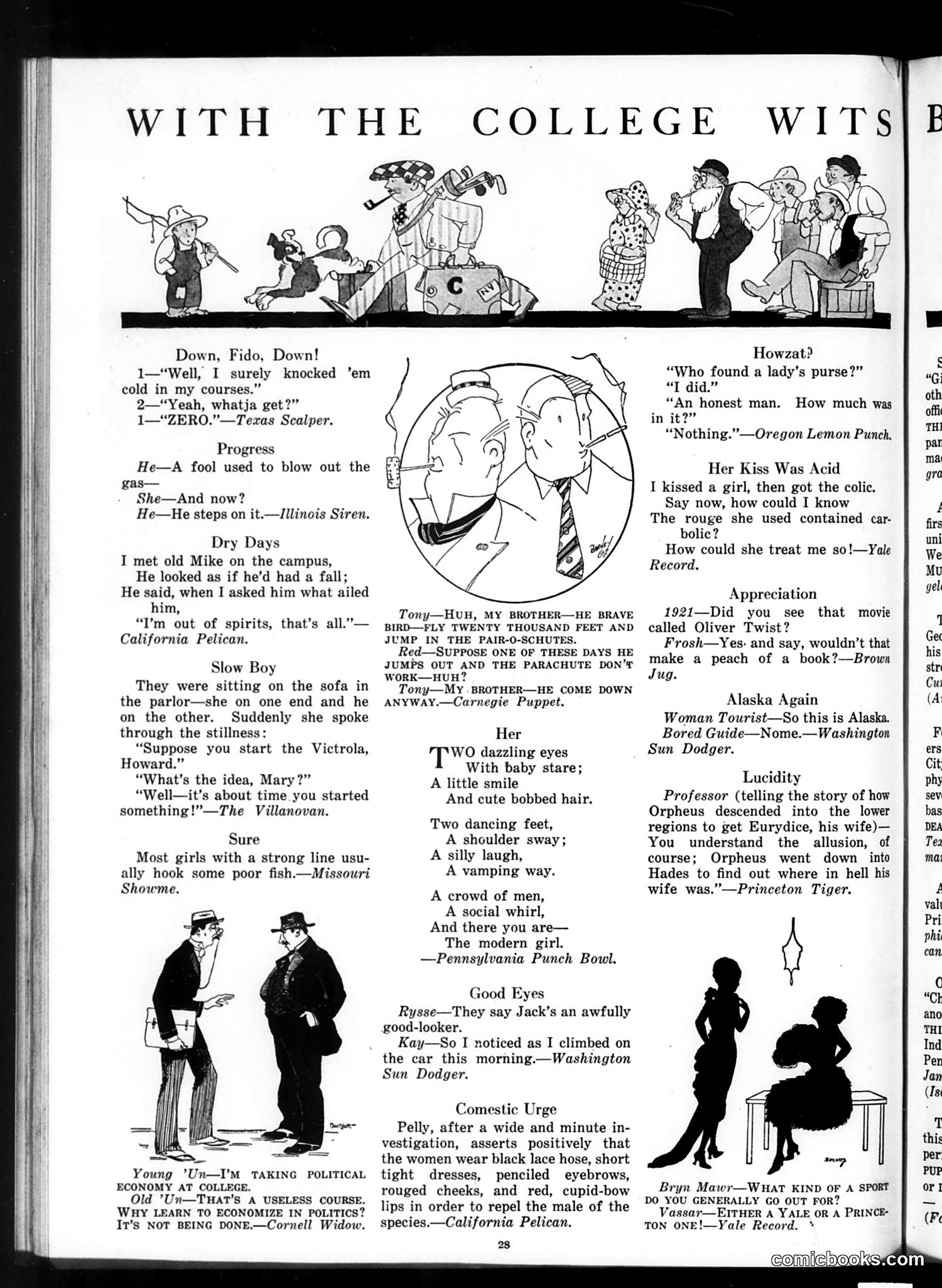
This page from Judge magazine collects college humor jokes and cartoons, mostly about student life and dating. The content reflects 1920s campus culture and social attitudes. **Key themes:** - **Academic mediocrity**: Students getting zeros despite claiming success; a joke about political economy being useless since politicians don't practice it. - **Dating/romance**: Multiple jokes about courting rituals—slow boyfriends, girls using flattery to "hook" men, and the "modern girl" with bobbed hair and makeup described as a social creature designed to attract men. - **Women's appearance**: A joke asserting women use cosmetics (black hose, short dresses, rouged cheeks, penciled eyebrows) to "repel" men—likely ironic commentary on contemporary fashion scandals. - **College types**: References to Vassar and Bryn Mawr girls dating Yale and Princeton men, reflecting elite college social hierarchies of the era. The humor is light, focused on generational behavior and courtship conventions of the Jazz Age college scene. The cartoons use simple silhouettes and line drawings typical of 1920s magazine illustration.
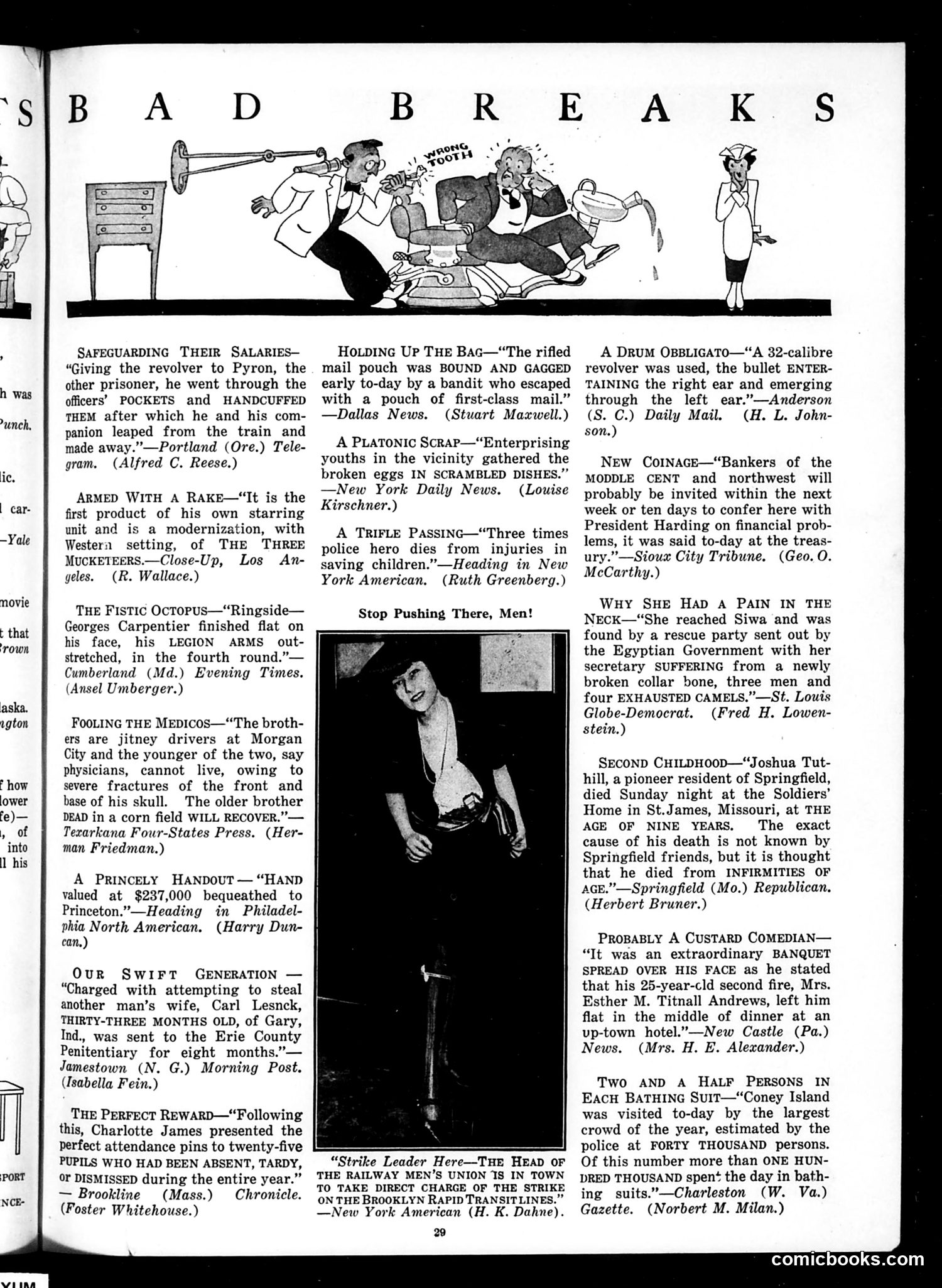
This Judge magazine page collects humorous newspaper headlines featuring absurd contradictions or ironic juxtapositions. The format satirizes how careless newspaper writing creates unintentional comedy. The top cartoon illustrates one example: officers supposedly "safeguarding their salaries" by giving a revolver to a prisoner, who then robs them—defeating the stated purpose entirely. Other entries mock similar logical failures: a boxer with "legion arms outstretched" while "flat on his face"; a dying man who "will recover"; perfect attendance awards given to chronically absent students; and a mail pouch that's "bound and gagged" (anthropomorphizing it absurdly). The page's central photograph shows a "strike leader," connecting to labor unrest of the early 1920s—a topical reference for the era. The satire targets newspapers' careless editing and headline writing, exposing how poor word choice or reporting creates unintentional absurdity. It's essentially early 20th-century media criticism through humor.
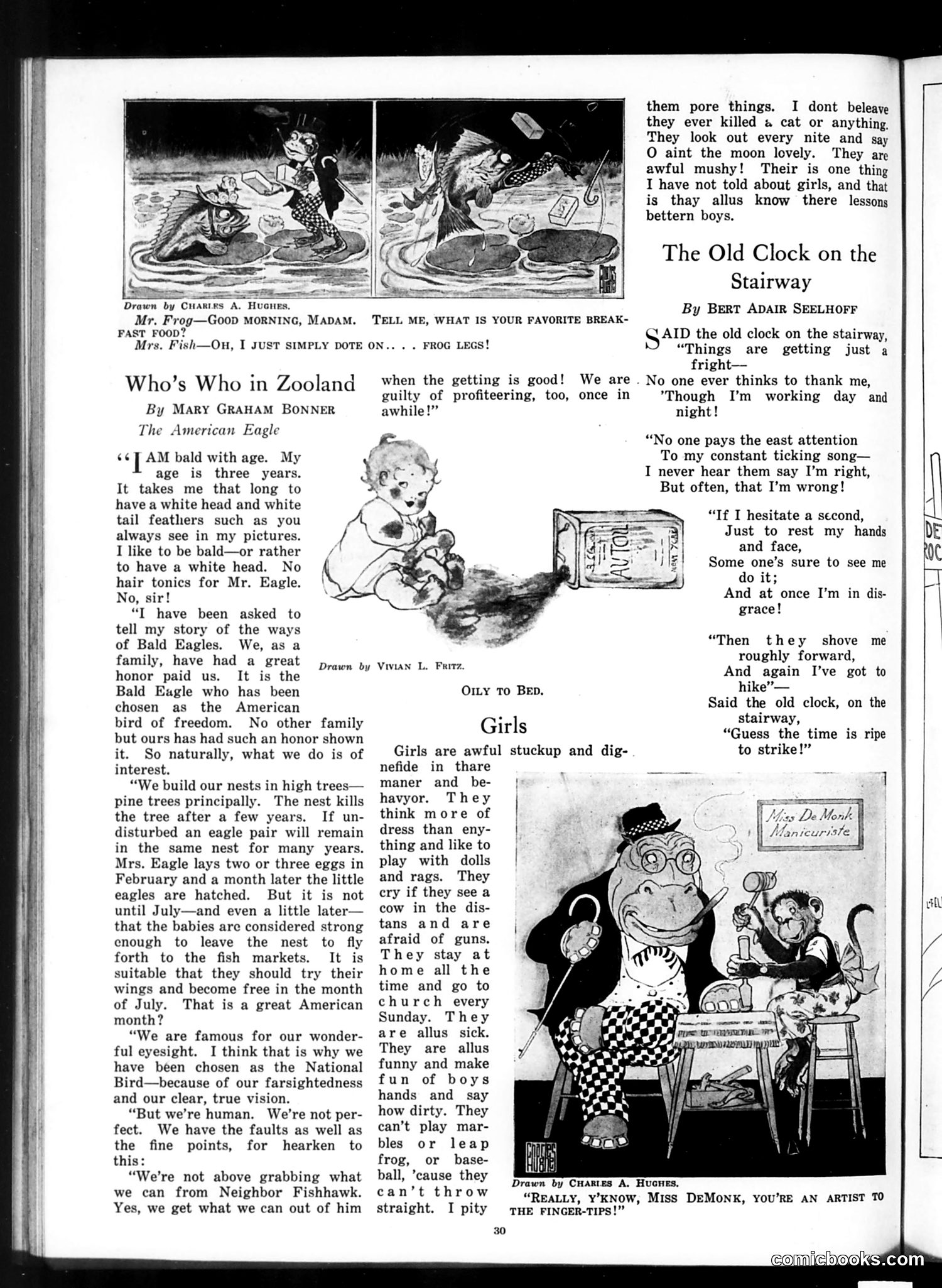
This page contains three distinct pieces of satirical humor typical of early 20th-century American magazines: **Top cartoon**: A frog asks a fish about her favorite breakfast, leading to the dark joke that she enjoys "frog legs"—a cannibalistic pun playing on dining preferences. **"Who's Who in Zooland"**: An anthropomorphized Bald Eagle describes eagle behavior while making social commentary. The eagle admits to stealing from the "Neighbor Fishhawk" and engaging in "profiteering"—likely satirizing American business practices and hypocrisy about national ideals. The eagle represents American freedom while behaving unethically. **"Girls" section**: Presented as a boy's disparaging account of girls' behavior and interests (fashion, romance, weakness), this piece satirizes gender stereotypes. The final revelation—that girls actually study better than boys—undermines the boy narrator's dismissive attitude, making the satire work against misogynistic prejudices. The page reflects Judge's mix of whimsy and social commentary aimed at educated readers.
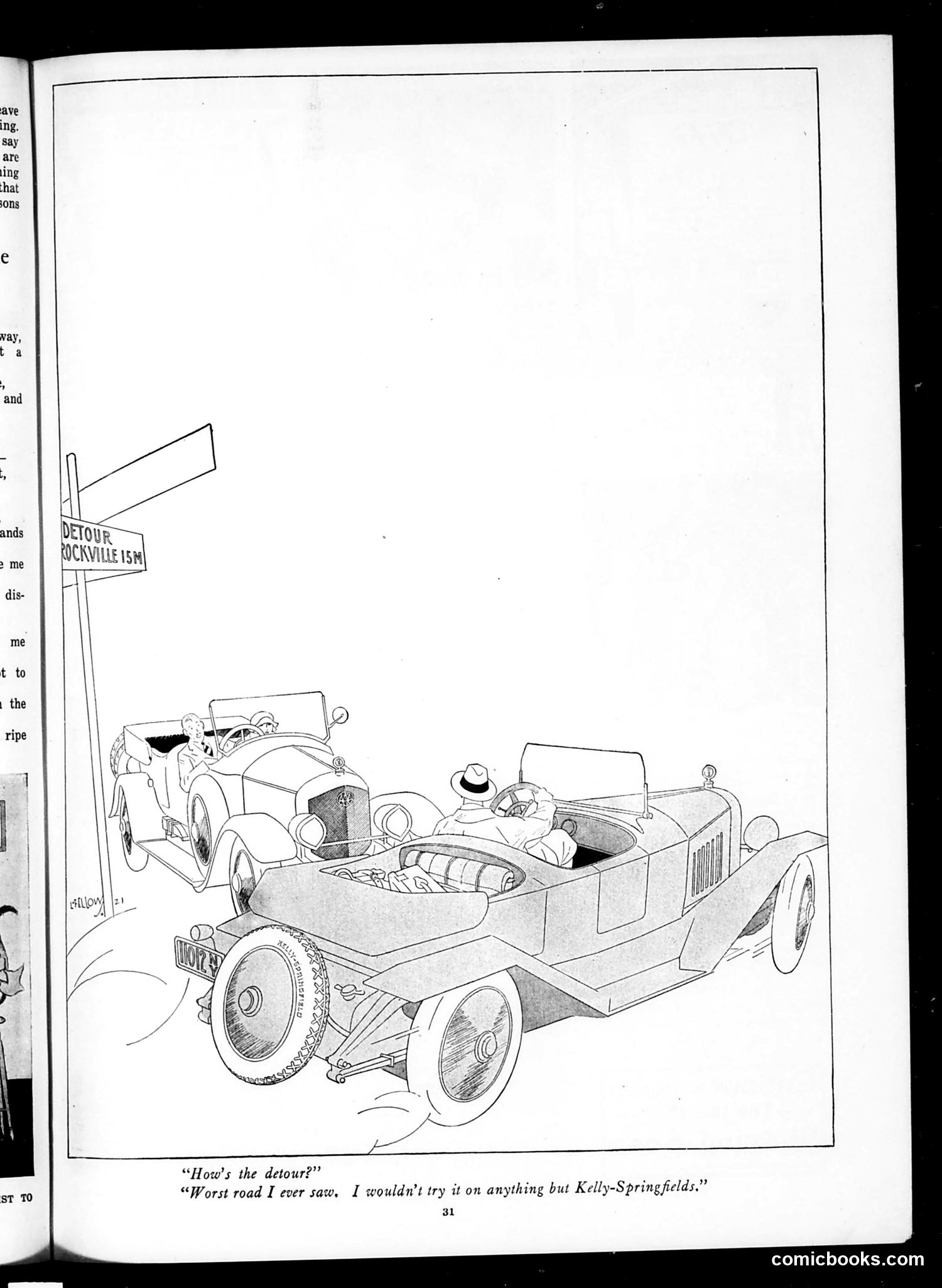
This is an advertisement disguised as humor. The cartoon depicts two early automobiles on a terrible road, with a "Detour Rockville 15M" sign visible. One driver complains about the road's condition, saying it's "the worst road I ever saw." The punchline promotes **Kelly-Springfield tires**, a real tire manufacturer. The joke suggests these tires are so durable they can handle even the worst roads—implying superior quality through exaggeration. This appears to be a **Judge magazine advertisement** from the early 1900s (based on the vehicle styles). The cartoon uses relatable frustration about road conditions and tire reliability as a selling point, a common advertising strategy of the era when automotive infrastructure was still primitive and tire durability was a genuine consumer concern.
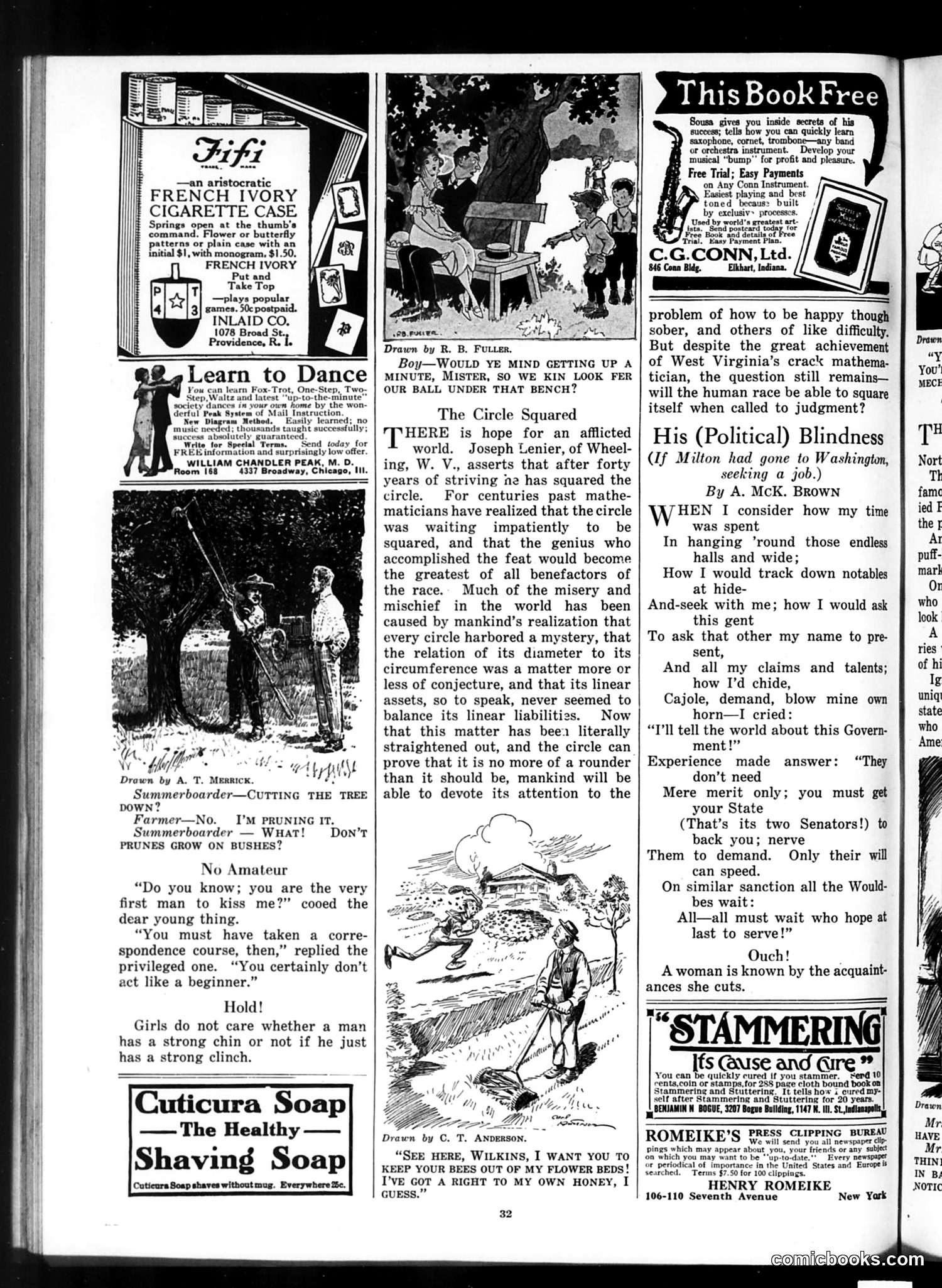
This page contains two pieces of satire: **"The Circle Squared"** mocks a West Virginia man's claimed mathematical achievement of "squaring the circle"—solving an ancient, impossible geometric problem. The satire suggests humanity wastes energy on unsolvable puzzles when real issues exist. The final jab asks whether mankind can "square itself when called to judgment?"—a moral critique wrapped in mathematical wordplay. **"His (Political) Blindness"** parodies Milton's "When I Consider How My Time Is Spent," imagining the blind poet seeking a government job in Washington. The poem satirizes American political patronage: merit means nothing; only having senators from your home state backing you matters. This criticizes the corrupt spoils system where political connections trump qualifications. The title's "blindness" works doubly—Milton's actual blindness and politicians' willful blindness to merit-based advancement. Both pieces mock contemporary American inefficiency and corruption through literary/intellectual references.
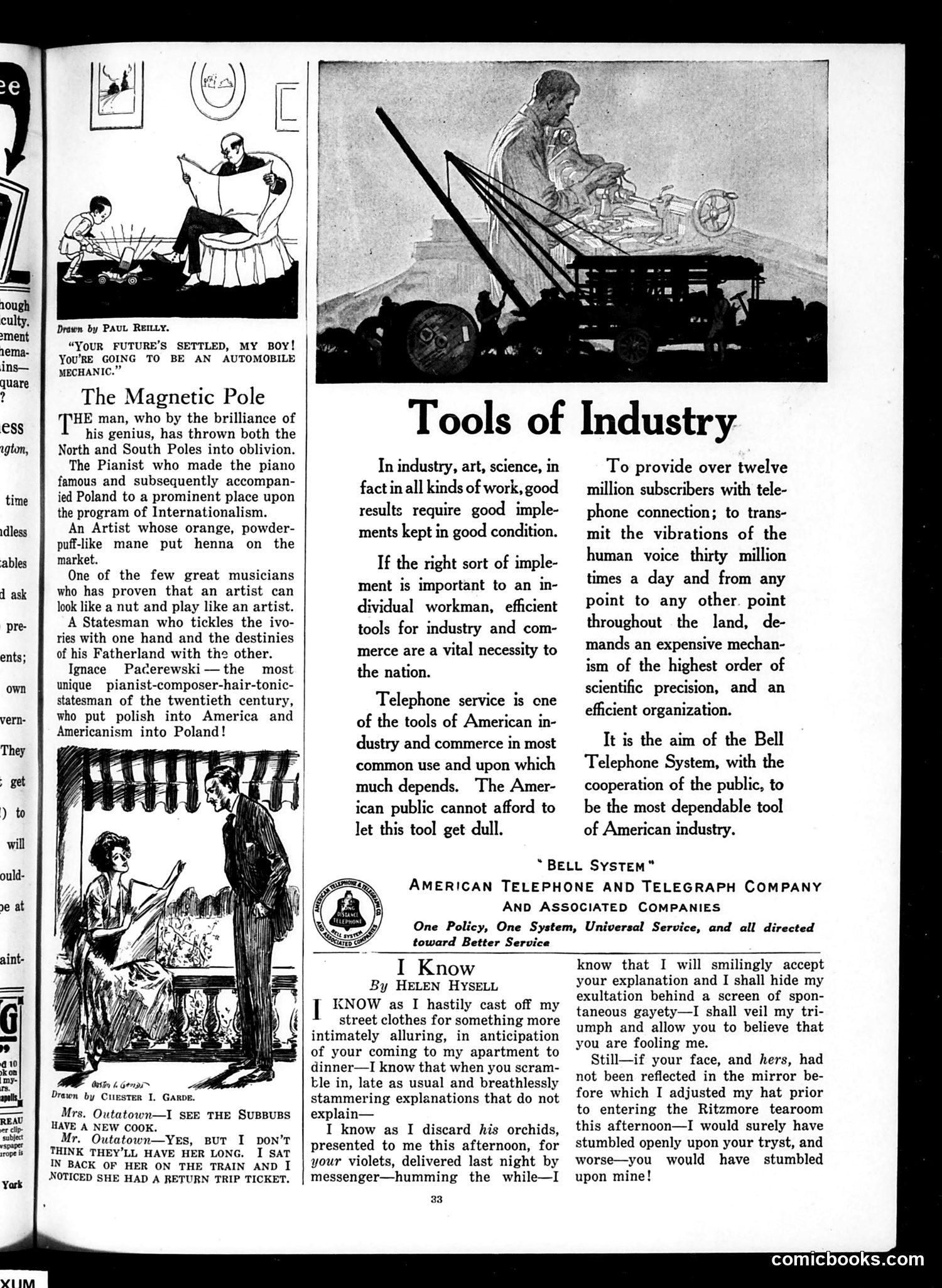
This page combines several distinct pieces: **Top Left – "The Magnetic Pole"**: A celebratory profile of Ignace Jan Paderewski, the renowned Polish pianist-composer-statesman. The text praises him as a multitalented figure who "put polish into America and Americanism into Poland"—a pun on his name and nationality. This reflects early 20th-century American enthusiasm for European cultural figures and Poland's post-WWI independence. **Top Right – Unnamed cartoon**: Depicts someone predicting a boy's future as an automobile mechanic, reflecting the era's fascination with industrial work and automobiles as symbols of modernity. **Center-Right – "Tools of Industry"**: A Bell Telephone System advertisement presenting telephone service as essential industrial infrastructure, emphasizing reliability and nationwide connectivity. **Bottom – "I Know" by Helen Hysell**: A satirical short story about a woman who discovers her boyfriend's infidelity through a mirror reflection at a tearoom, yet accepts his excuses while hiding her own affair—mocking romantic duplicity and double standards in relationships.
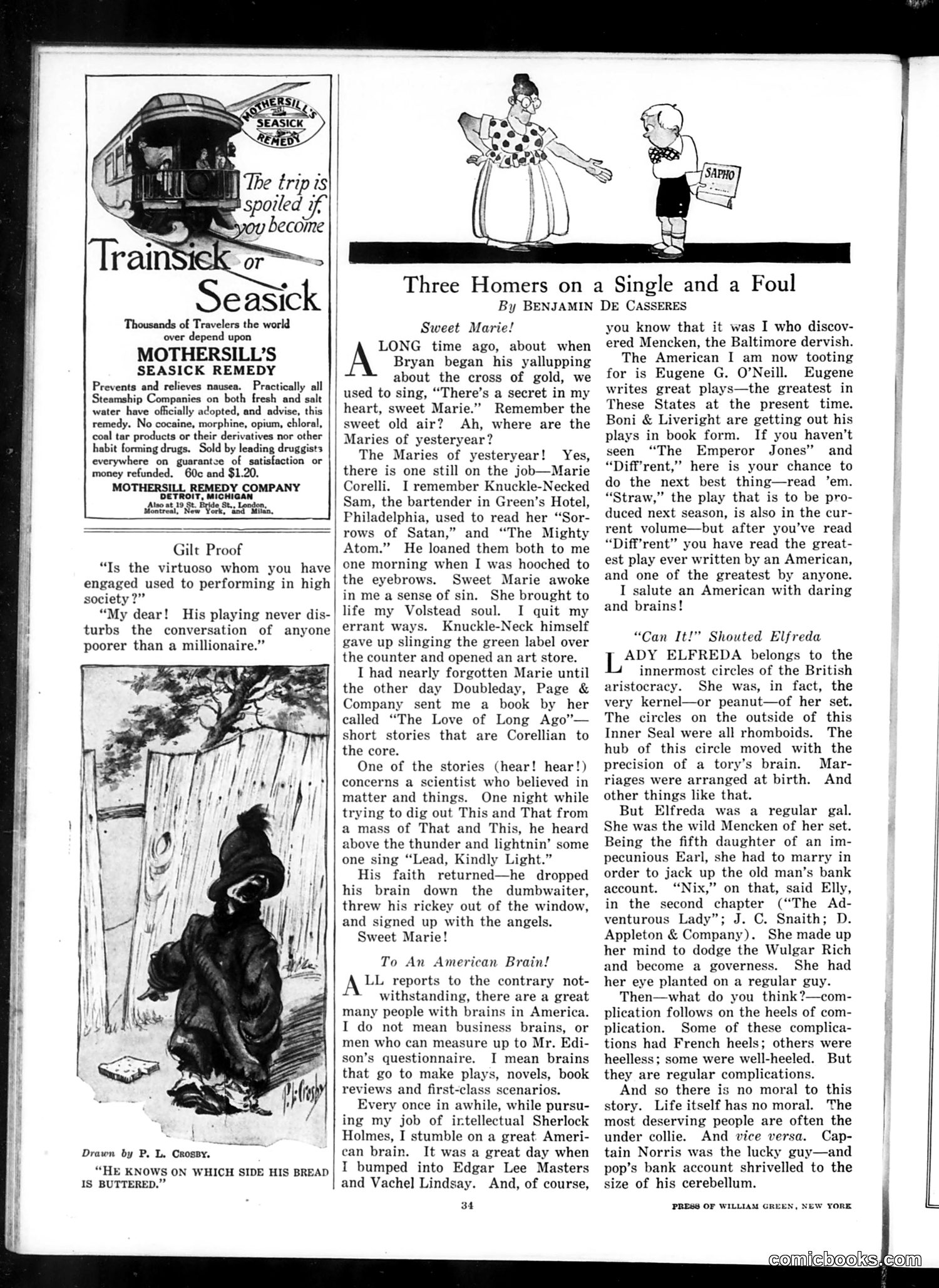
This page contains advertisements and literary commentary rather than political cartoons. The main content includes: **Advertisements:** Mothersill's Seasick Remedy (prominent left side) and a brief joke about a virtuoso musician who doesn't disturb even poor patrons' conversations. **Literary Essays:** Benjamin de Casseres discusses American writers and playwrights, praising Eugene G. O'Neill's plays ("The Emperor Jones," "Diff'rent," "Straw") as among the greatest works by an American. He also celebrates discovering H.L. Mencken and mentions Edgar Lee Masters and Vachel Lindsay as notable American talents. **Satirical Story:** "Can It! Shouted Elfreda" begins describing a British aristocratic woman from the innermost social circles. The page reflects early 1920s American literary culture, celebrating modernist playwrights and critics during a period of cultural flourishing. There's implicit nationalism in championing American artistic achievement against European traditions.
This page is a **Government Loan Organization advertisement**, not satirical content. It promotes Treasury Savings Securities to workers during what appears to be the World War I era (based on the "Uncle Sam's" reference and savings bond promotion common then). The "Wise Man Says" framing uses a parable about factory closures and unemployment to encourage regular savings habits. The implicit message: workers who save avoid financial hardship during economic downturns. The advertisement emphasizes that employers and the government will facilitate workplace savings associations, making it convenient for workers to purchase Treasury securities. This represents progressive-era messaging blending personal financial responsibility with patriotic investment in government bonds—likely part of a broader wartime financing campaign.
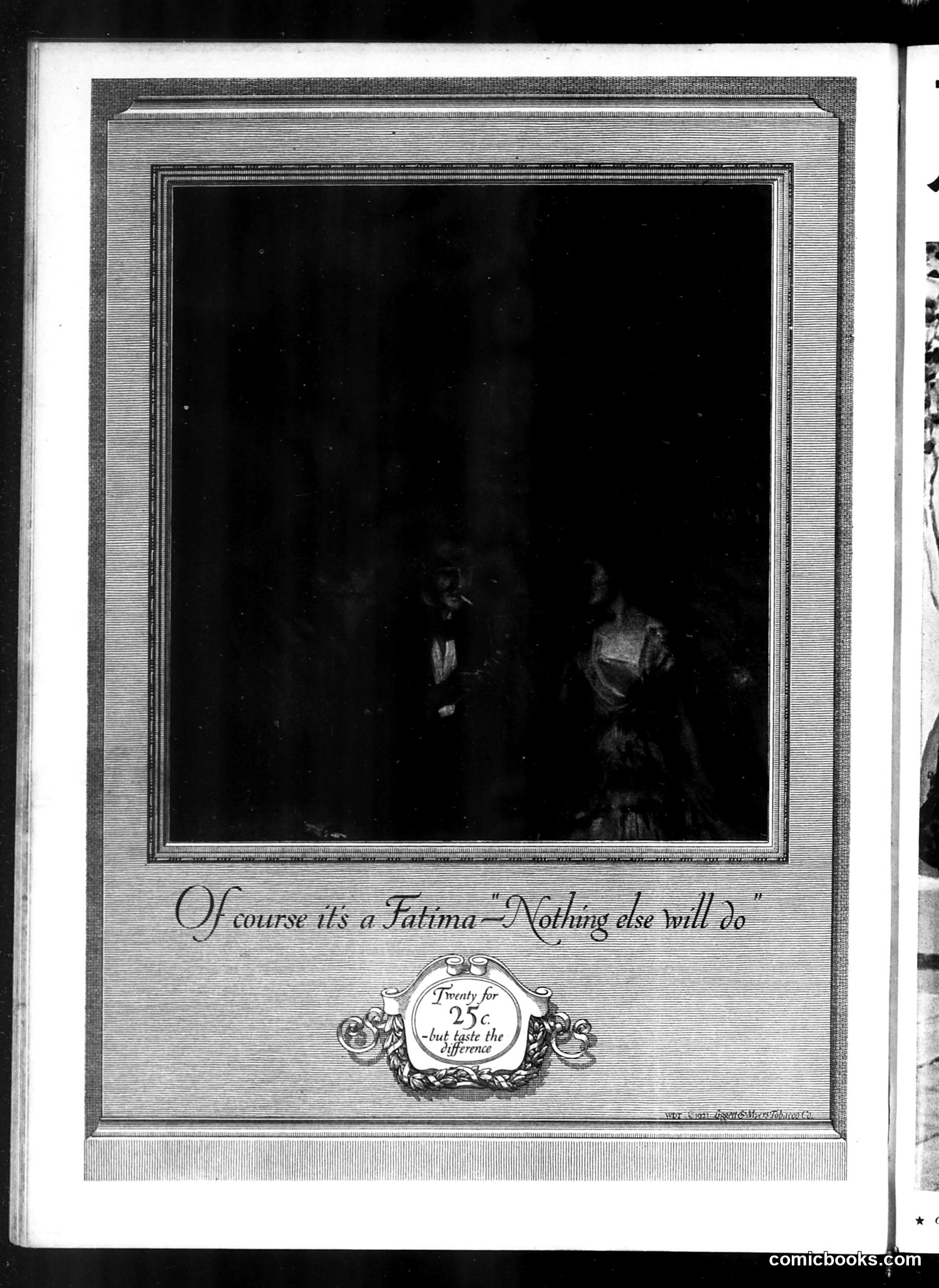
This appears to be a **Fatima cigarette advertisement** rather than political satire. The image shows two figures in what looks like a darkened interior scene (possibly a romantic or intimate setting, given the shadowy composition). The text reads: "Of course it's a Fatima—'Nothing else will do'" with pricing below: "Twenty for 25c—but taste the difference" **Context for modern readers:** This is early 20th-century tobacco advertising that relies on sophistication and exclusivity as selling points. The vague, artistically rendered scene suggests aspirational lifestyle marketing—the implication being that Fatima cigarettes are the choice of refined, discerning people. The phrase "nothing else will do" emphasizes brand loyalty through quality suggestion rather than explicit product claims. This represents how cigarettes were openly advertised in American publications during an era before health warnings or advertising restrictions existed.