
Judge, 1921-08-06 · page 18 of 34
Judge — August 6, 1921 — page 18: what you’re looking at
What you’re looking at
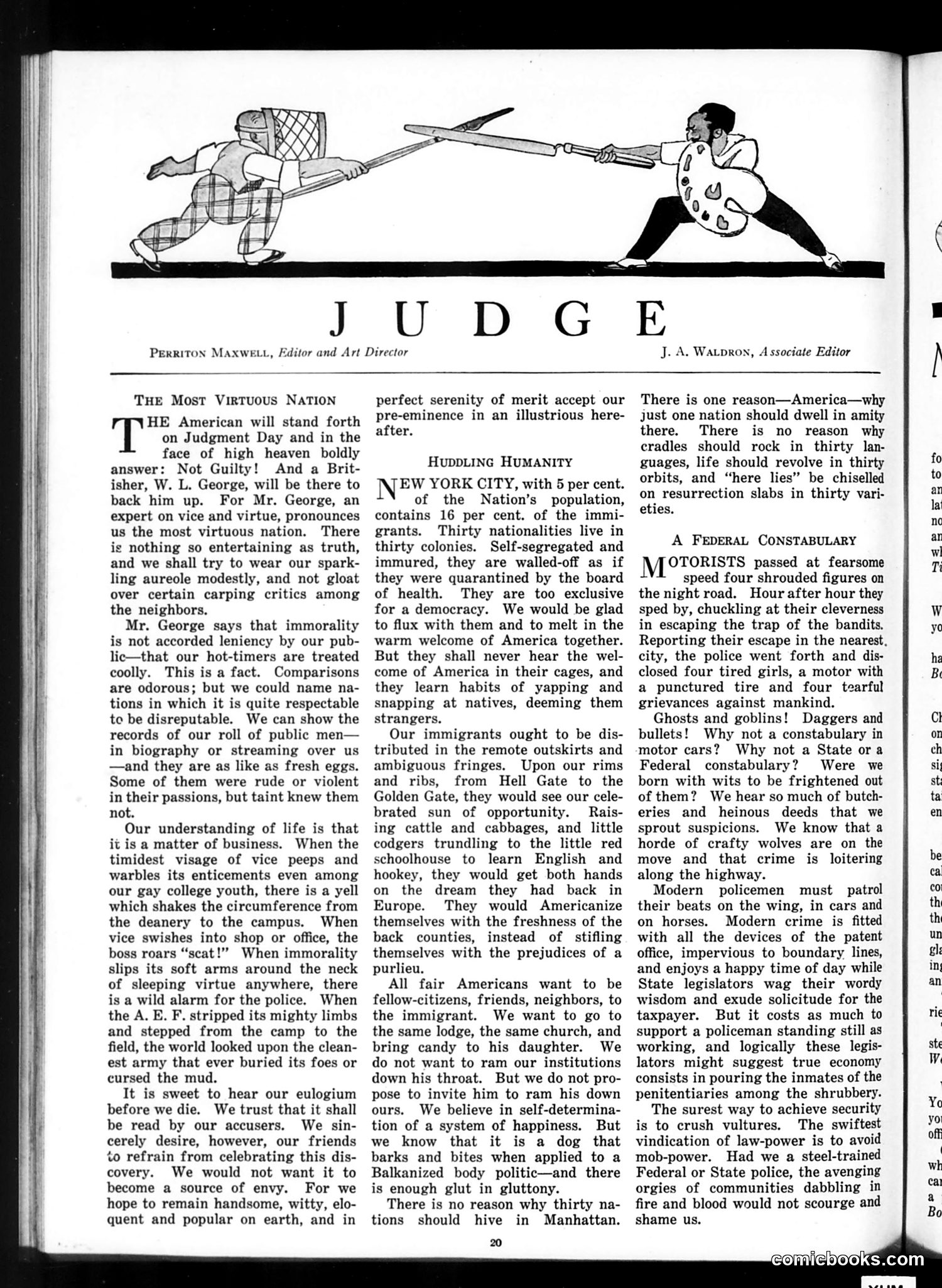
The top illustration depicts two figures in a stylized duel or confrontation: one wearing a checkered suit and goggles (left) faces another in formal attire with a painter's palette (right). They wield long implements like fencing swords or artistic tools. This appears to satirize a creative or intellectual competition—likely between different artistic or cultural perspectives. The contrasting dress and tools suggest opposing ideologies or professions engaged in combat. The accompanying editorial "The Most Virtuous Nation" ironically praises American morality while subtly mocking national self-righteousness. The piece uses elevated, grandiose language to celebrate American virtue, then shifts to critique immigrants clustering in ethnic enclaves in New York City, arguing they should be dispersed to rural areas to "Americanize" themselves rather than maintain separate communities. The satire targets both American smugness about virtue and anxieties about immigration and assimilation—suggesting that preaching about democracy while segregating immigrant populations is hypocritical. The cartoon likely complements this tension between stated American ideals and actual practice.
📄 Transcribed text from this page (OCR, searchable)
Machine-transcribed from the original scan — historical spelling and the odd misread are preserved.
PERRITON MAXWELL, Editor and Art Director J. A. Watpron, Associate Editor THE Most VirTUOUS NATION HE American will stand forth | on Judgment Day and in the face of high heaven boldly answer: Not Guilty! And a Brit- isher, W. L. George, will be there to back him up. For Mr. George, an expert on vice and virtue, pronounces us the most virtuous nation. There ig nothing so entertaining as truth, and we shall try to wear our spark- ling aureole modestly, and not gloat over certain carping critics among the neighbors. Mr. George says that immorality is not accorded leniency by our pub- lic—that our hot-timers are treated coolly. This is a fact. Comparisons are odorous; but we could name na- tions in which it is quite respectable te be disreputable. We can show the records of our roll of public men— in biography or streaming over us —and they are as like as fresh eggs. Some of them were rude or violent in their passions, but taint knew them not. Our understanding of life is that it is a matter of business. When the timidest visage of vice peeps and warbles its enticements even among our gay college youth, there is a yell which shakes the circumference from the deanery to the campus. When vice swishes into shop or office, the boss roars “scat!” When immorality slips its soft arms around the neck of sleeping virtue anywhere, there is a wild alarm for the police. When the A. E. F. stripped its mighty limbs and stepped from the camp to the field, the world looked upon the clean- est army that ever buried its foes or cursed the mud. It is sweet to hear our eulogium before we die. We trust that it shall be read by our accusers. We sin- cerely desire, however, our friends to refrain from celebrating this dis- covery. We would not want it to become a source of envy. For we hope to remain handsome, witty, elo- quent and popular on earth, and in perfect serenity of merit accept our pre-eminence in an illustrious here- after. HUDDLING HUMANITY NEW YORK CITY, with 5 per cent. of the Nation’s population, contains 16 per cent. of the immi- grants. Thirty nationalities live in thirty colonies. Self-segregated and immured, they are walled-off as if they were quarantined by the board of health. They are too exclusive for a democracy. We would be glad to flux with them and to melt in the warm welcome of America together. But they shall never hear the wel- come of America in their cages, and they learn habits of yapping and snapping at natives, deeming them strangers. Our immigrants ought to be dis- tributed in the remote outskirts and ambiguous fringes. Upon our rims and ribs, from Hell Gate to the Golden Gate, they would see our cele- brated sun of opportunity. Rais- ing cattle and cabbages, and little codgers trundling to the little red schoolhouse to learn English and hookey, they would get both hands on the dream they had back in Europe. They would Americanize themselves with the freshness of the back counties, instead of stifling themselves with the prejudices of a purlieu. All fair Americans want to be fellow-citizens, friends, neighbors, to the immigrant. We want to go to the same lodge, the same church, and bring candy to his daughter. We do not want to ram our institutions down his throat. But we do not pro- pose to invite him to ram his down ours. We believe in self-determina- tion of a system of happiness. But we know that it is a dog that barks and bites when applied to a Balkanized body politic—and there is enough glut in gluttony. There is no reason why thirty na- tions should hive in Manhattan. 20 There is one reason—America—why just one nation should dwell in amity there. There is no reason why cradles should rock in thirty lan- guages, life should revolve in thirty orbits, and “here lies” be chiselled on resurrection slabs in thirty vari- eties. A FEDERAL CONSTABULARY MOTORISTS passed at fearsome speed four shrouded figures on the night road. Hour after hour they sped by, chuckling at their cleverness in escaping the trap of the bandits, Reporting their escape in the nearest. city, the police went forth and dis- closed four tired girls, a motor with a punctured tire and four tearful grievances against mankind. Ghosts and goblins! Daggers and bullets!’ Why not a constabulary in motor cars? Why not a State ora Federal constabulary? Were we born with wits to be frightened out of them? We hear so much of butch- eries and heinous deeds that we sprout suspicions. We know that a horde of crafty wolves are on the move and that crime is loitering along the highway. Modern policemen must patrol their beats on the wing, in cars and on horses. Modern crime is fitted with all the devices of the patent office, impervious to boundary. lines, and enjoys a happy time of day while State legislators wag their wordy wisdom and exude solicitude for the taxpayer. But it costs as much to support a policeman standing still as working, and logically these legis- lators might suggest true economy consists in pouring the inmates of the penitentiaries among the shrubbery. The surest way to achieve security is to crush vultures. The swiftest vindication of law-power is to avoid mob-power. Had we a steel-trained Federal or State police, the avenging orgies of communities dabbling in fire and blood would not scourge and shame us.