
Judge, 1921-08-06 · page 16 of 34
Judge — August 6, 1921 — page 16: what you’re looking at
What you’re looking at
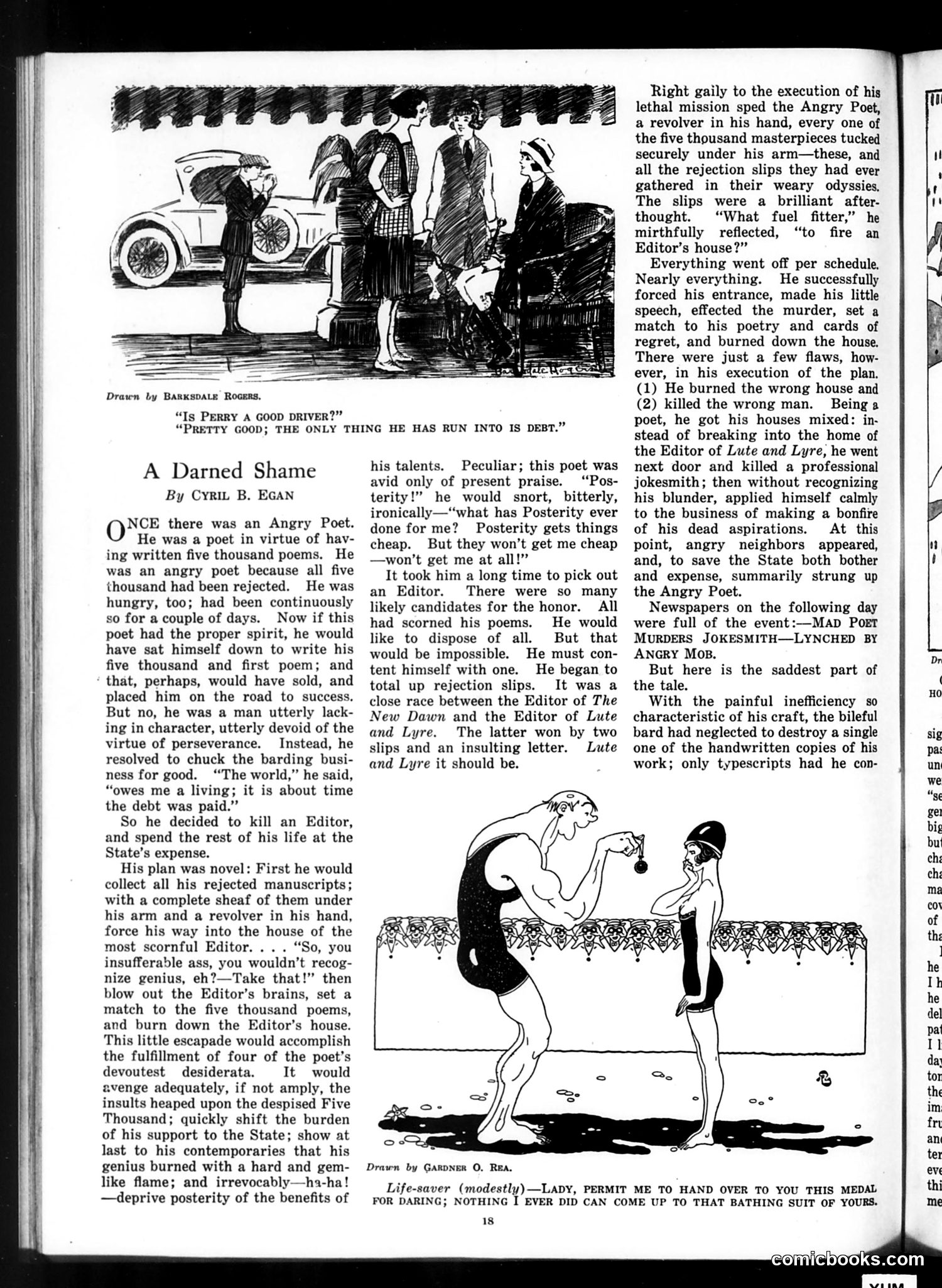
This story mocks an impoverished, persistently rejected poet whose bitterness metastasizes into murderous fantasy. After 5,000 rejection slips, he plots to kill a magazine editor—specifically the editor of *Lute and Lyre*—by forcing his way in with his rejected manuscripts and a revolver, then burning the editor's house with his poems as kindling. The satire's dark humor lies in the execution's farcical failure: the angry poet attacks the *wrong house* and kills a "professional jokesmith" (likely a rival humorist or cartoonist) instead. Neighbors lynch him before authorities can intervene. The piece satirizes both artistic entitlement—the poet's belief society "owes" him success—and the publishing world's cruelty toward struggling writers. The top cartoon, captioned about "Perry" running into debt, appears thematically related: commentary on poor financial judgment. The overall message: bitterness and delusion are dangerous, but incompetence often prevents actual harm.
📄 Transcribed text from this page (OCR, searchable)
Machine-transcribed from the original scan — historical spelling and the odd misread are preserved.
Drawn by BARKSDALE Rogers, “Is PERRY A GOOD DRIVER?” “PRETTY GOOD; THE ONLY THING HE HAS RUN INTO IS DEBT.” A Darned Shame By Cyrit B. EGAN ONCE there was an Angry Poet. He was a poet in virtue of hav- ing written five thousand poems. He was an angry poet because all five thousand had been rejected. He was hungry, too; had been continuously so for a couple of days. Now if this poet had the proper spirit, he would have sat himself down to write his five thousand and first poem; and that, perhaps, would have sold, and placed him on the road to success. But no, he was a man utterly lack- ing in character, utterly devoid of the virtue of perseverance. Instead, he resolved to chuck the barding busi- ness for good. “The world,” he said, “owes me a living; it is about time the debt was paid.” So he decided to kill an Editor, and spend the rest of his life at the State’s expense. His plan was novel: First he would collect all his rejected manuscripts; with a complete sheaf of them under his arm and a revolver in his hand, force his way into the house of the most scornful Editor... . “So, you insufferable ass, you wouldn’t recog- nize genius, eh?—Take that!” then blow out the Editor’s brains, set a match to the five thousand poems, and burn down the Editor’s house. This little escapade would accomplish the fulfillment of four of the poet’s devoutest desiderata. It would avenge adequately, if not amply, the insults heaped upon the despised Five Thousand; quickly shift the burden of his support to the State; show at last to his contemporaries that his genius burned with a hard and gem- like flame; and irrevocably—ha-ha! —deprive posterity of the benefits of his talents. Peculiar; this poet was avid only of present praise. ‘Pos- terity!” he would snort, bitterly, ironically—‘“what has Posterity ever done for me? Posterity gets things cheap. But they won’t get me cheap —won’t get me at all!” It took him a long time to pick out an Editor. There were so many likely candidates for the honor. All had scorned his poems. He would like to dispose of all. But that would be impossible. He must con- tent himself with one. He began to total up rejection slips. It was a close race between the Editor of The New Dawn and the Editor of Lute and Lyre. The latter won by two slips and an insulting letter. Lute and Lyre it should be. Right gaily to the execution of his lethal mission sped the Angry Poet, a revolver in his hand, every one of the five thousand masterpieces tucked securely under his arm—these, and all the rejection slips they had ever gathered in their weary odyssies, The slips were a brilliant after- thought. “What fuel fitter,” he mirthfully reflected, “to fire an Editor’s house?” Everything went off per schedule, Nearly everything. He successfully forced his entrance, made his little speech, effected the murder, set a match to his poetry and cards of regret, and burned down the house. There were just a few flaws, how- ever, in his execution of the plan. (1) He burned the wrong house and (2) killed the wrong man. Being a poet, he got his houses mixed: in- stead of breaking into the home of the Editor of Lute and Lyre, he went next door and killed a professional jokesmith; then without recognizing his blunder, applied himself calmly to the business of making a bonfire of his dead aspirations. At this point, angry neighbors appeared, and, to save the State both bother and expense, summarily strung up the Angry Poet. Newspapers on the following day were full of the event:—MAD Port MuRDERS JOKESMITH—LYNCHED BY ANGRY Mos. But here is the saddest part of the tale. With the painful inefficiency so characteristic of his craft, the bileful bard had neglected to destroy a single one of the handwritten copies of his work; only typescripts had he con- Drawn by GARDNER O. REA. Life-saver (modestly)—LADY, PERMIT ME TO HAND OVER TO YOU THIS MEDAL FOR DARING; NOTHING I EVER DID CAN COME UP TO THAT BATHING SUIT OF YOURS. 18 comicbooks.com <eaiaa