
Judge, 1921-08-06 · page 11 of 34
Judge — August 6, 1921 — page 11: what you’re looking at
What you’re looking at
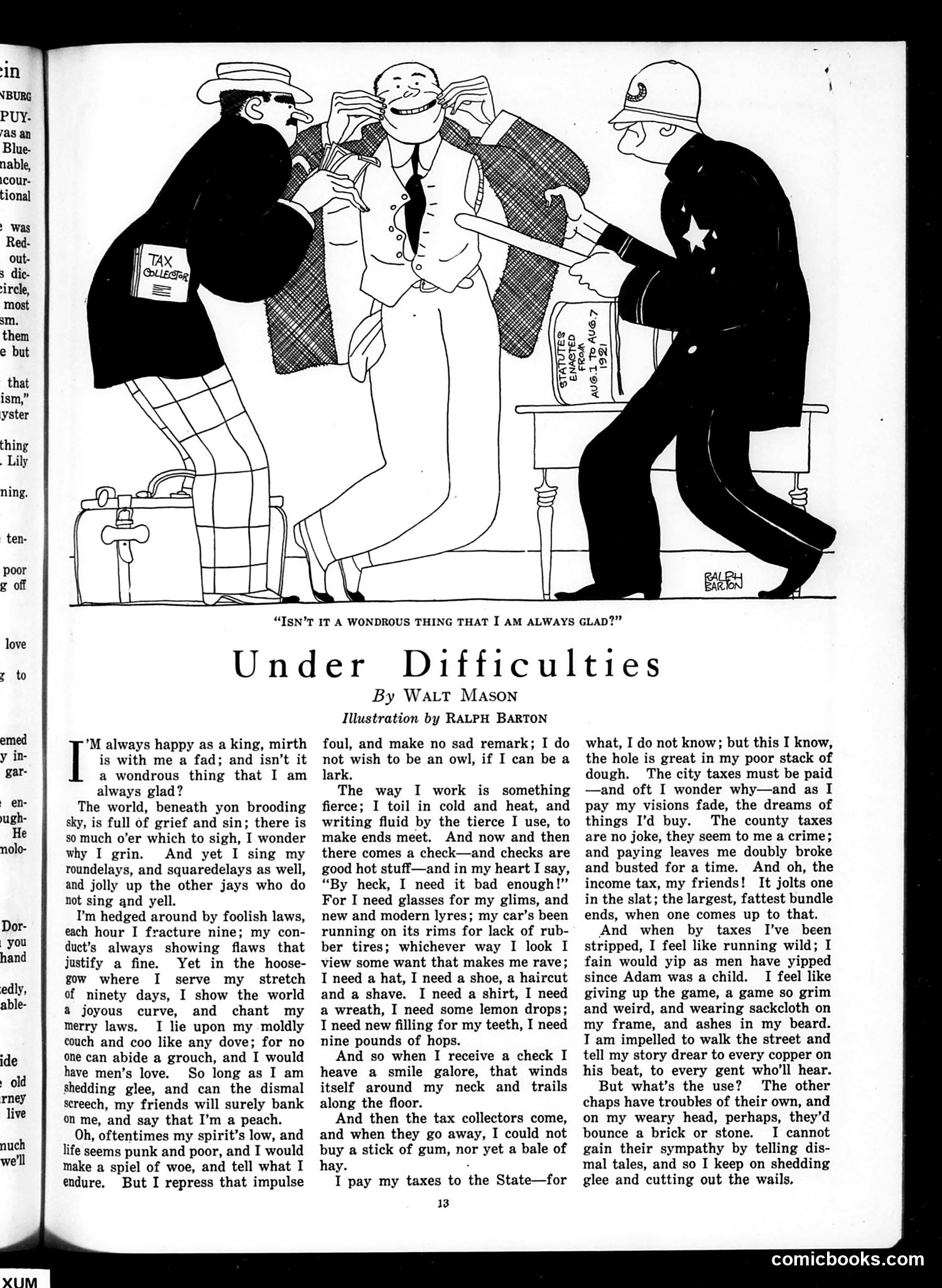
The cartoon illustrates Walt Mason's poem about maintaining cheerfulness despite financial hardship. The central figure is a perpetually smiling man being squeezed by three authority figures representing different tax collectors—labeled figures holding "TAX COLLECTOR" documents and what appears to be a state/government seal. The satire targets the post-WWI tax burden crushing ordinary workers. Mason's narrator claims to remain cheerful despite: inadequate wages, broken possessions, mounting debts, and—most pointfully—cascading taxes (city, county, state, and income tax). Each tax collector metaphorically extracts money, leaving him "doubly broke." The cartoon's title question—"Isn't it a wondrous thing that I am always glad?"—is ironic commentary on the impossible expectation that citizens maintain optimism while government systematically impoverishes them. The illustration's visual humor shows the protagonist literally compressed between tax authorities, unable to escape, yet supposedly smiling through it all. This reflects 1920s frustration with expanding government taxation.
📄 Transcribed text from this page (OCR, searchable)
Machine-transcribed from the original scan — historical spelling and the odd misread are preserved.
AUG.1 To AUG.7 1921 “ISN’T IT A WONDROUS THING THAT I AM ALWAYS GLAD?” Under is with me a fad; and isn’t it a wondrous thing that I am always glad? The world, beneath yon brooding sky, is full of grief and sin; there is so much o’er which to sigh, I wonder ik always happy as a king, mirth why I grin. And yet I sing my roundelays, and squaredelays as well, and jolly up the other jays who do not sing and yell. I’m hedged around by foolish laws, each hour I fracture nine; my con- duct’s always showing flaws that justify a fine. Yet in the hoose- gow where I serve my _ stretch of ninety days, I show the world &@ joyous curve, and chant my merry laws. I lie upon my moldly couch and coo like any dove; for no one can abide a grouch, and I would have men’s love. So long as I am shedding glee, and can the dismal screech, my friends will surely bank on me, and say that I’m a peach. Oh, oftentimes my spirit’s low, and life seems punk and poor, and I would make a spiel of woe, and tell what I endure, But I repress that impulse By Watt Mason Illustration by RALPH BARTON foul, and make no sad remark; I do not wish to be an owl, if I can be a lark. The way I work is something fierce; I toil in cold and heat, and writing fluid by the tierce I use, to make ends meet. And now and then there comes a check—and checks are good hot stuff—and in my heart I say, “By heck, I need it bad enough!” For I need glasses for my glims, and new and modern lyres; my car’s been running on its rims for lack of rub- ber tires; whichever way I look I view some want that makes me rave; I need a hat, I need a shoe, a haircut and a shave. I need a shirt, I need a wreath, I need some lemon drops; I need new filling for my teeth, I need nine pounds of hops. And so when I receive a check I heave a smile galore, that winds itself around my neck and trails along the floor. And then the tax collectors come, and when they go away, I could not buy a stick of gum, nor yet a bale of hay. : I pay my taxes to the State—for 13 Difficulties what, I do not know; but this I know, the hole is great in my poor stack of dough. The city taxes must be paid —and oft I wonder why—and as I pay my visions fade, the dreams of things I’d buy. The county taxes are no joke, they seem to me a crime; and paying leaves me doubly broke and busted for a time. And oh, the income tax, my friends! It jolts one in the slat; the largest, fattest bundle ends, when one comes up to that. And when by taxes I’ve been stripped, I feel like running wild; I fain would yip as men have yipped since Adam was a child. I feel like giving up the game, a game so grim and weird, and wearing sackcloth on my frame, and ashes in my beard. T am impelled to walk the street and tell my story drear to every copper on his beat, to every gent who'll hear. But what’s the use? The other chaps have troubles of their own, and on my weary head, perhaps, they’d bounce a brick or stone. I cannot gain their sympathy by telling dis- mal tales, and so I keep on shedding glee and cutting out the wails, comicbooks.com