
Judge, 1921-08-06 · page 20 of 34
Judge — August 6, 1921 — page 20: what you’re looking at
What you’re looking at
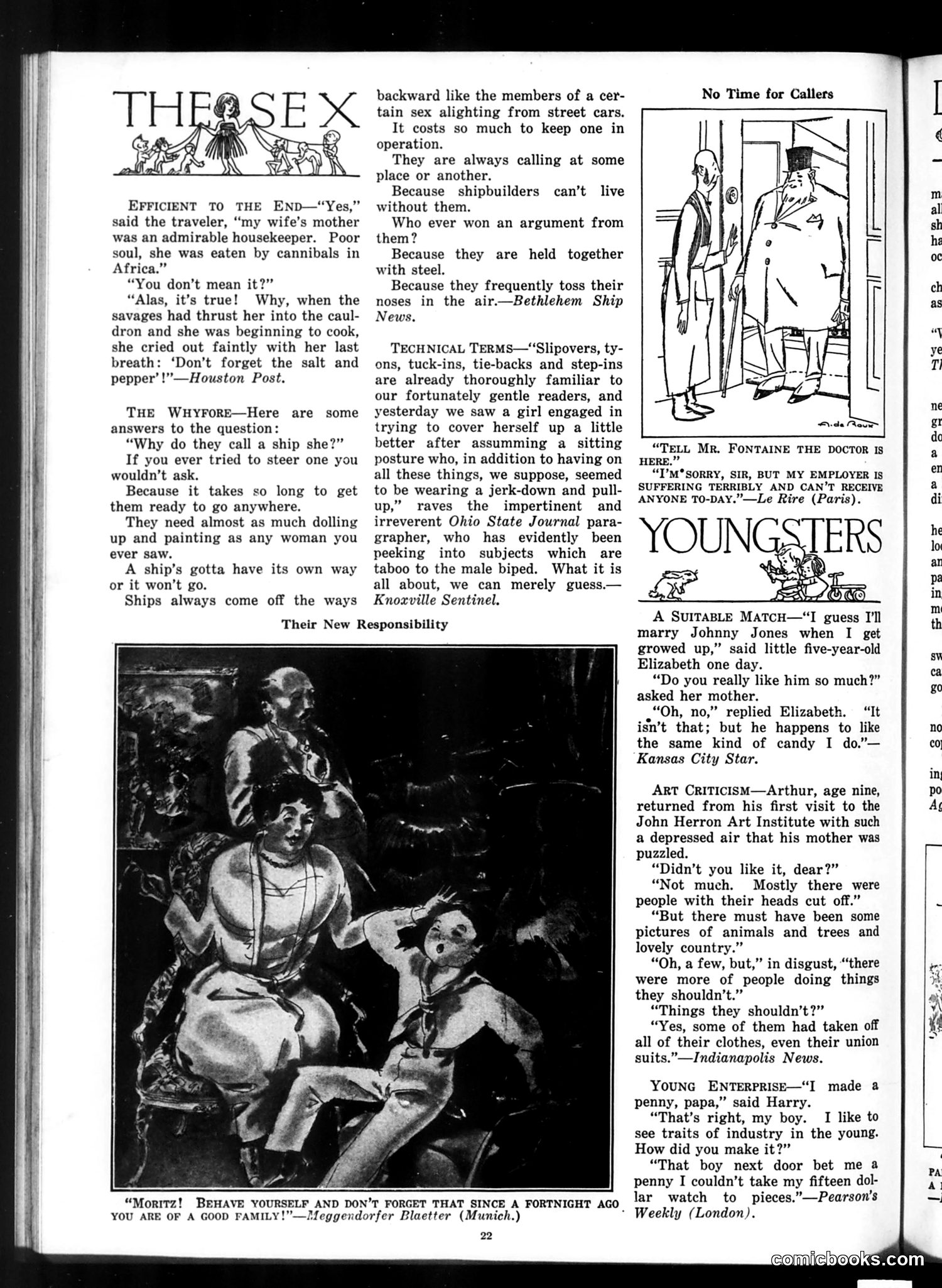
This page contains several short humor pieces typical of Judge's satirical style: **"Efficient to the End"** mocks a woman's domestic obsession through exaggeration—even facing cannibals, she maintains housekeeping standards. **"The Whyfore"** uses sexist stereotypes about women to explain why ships are called "she"—they're expensive, unreliable, require constant maintenance, and can't be argued with. This reflects early 20th-century attitudes treating women and ships as similarly troublesome. **"Technical Terms"** pokes fun at fashionable women's undergarments and silhouettes, sarcastically suggesting men shouldn't understand female fashion. **The cartoon "Their New Responsibility"** (Munich source) appears to show a woman disciplining a child, likely commentary on post-WWI changes in family structure or women's authority. **"Youngsters"** section contains gentle jokes about children's logic—a girl's marriage prospects based on candy preference, a boy's art criticism focused on nudity, another's entrepreneurial scheme backfiring. The overall tone reflects upper-class magazine humor: mildly transgressive but fundamentally conservative about gender and social propriety.
📄 Transcribed text from this page (OCR, searchable)
Machine-transcribed from the original scan — historical spelling and the odd misread are preserved.
EFFICIENT TO THE END—“Yes,’ said the traveler, “my wife’s mother was an admirable housekeeper. Poor soul, she was eaten by cannibals in Africa.” “You don’t mean it?” “Alas, it’s true! Why, when the savages had thrust her into the caul- dron and she was beginning to cook, she cried out faintly with her last breath: ‘Don’t forget the salt and pepper’ !”—Houston Post. THE WHyYFORE—Here are some answers to the question: “Why do they call a ship she?” If you ever tried to steer one you wouldn’t ask. Because it takes so long to get them ready to go anywhere. They need almost as much dolling up and painting as any woman you ever saw. A ship’s gotta have its own way or it won't go. Ships always come off the ways backward like the members of a cer- tain sex alighting from street cars. It costs so much to keep one in operation. They are always calling at some place or another. Because shipbuilders without them. Who ever won an argument from them? Because they are held together with steel. Because they frequently toss their noses in the air.—Bethlehem Ship News. can’t live TECHNICAL TERMS—‘‘Slipovers, ty- ons, tuck-ins, tie-backs and step-ins are already thoroughly familiar to our fortunately gentle readers, and yesterday we saw a girl engaged in trying to cover herself up a little better after assumming a sitting posture who, in addition to having on all these things, we suppose, seemed to be wearing a jerk-down and pull- up,” raves the impertinent and irreverent Ohio State Journal para- grapher, who has evidently been peeking into subjects which are taboo to the male biped. What it is all about, we can merely guess.— Knoxville Sentinel. Their New Responsibility “Moritz! BEHAVE YOURS! YOU ARE OF A GOOD FAMILY!” F AND DON’T FORGET THAT SINCE A FORTNIGHT AGO Meggendorfer Blaetter (Munich.) . 22 No Time for Callers “TELL MR. FONTAINE THE DOCTOR IS HERE.” “T’M*°SORRY, SIR, BUT MY EMPLOYER IS SUFFERING TERRIBLY AND CAN’T RECEIVE ANYONE TO-DAY.”—Le Rire (Paris). YOUNG, marry Johnny Jones when I get growed up,” said little five-year-old Elizabeth one day. “Do you really like him so much?” asked her mother. Oh, no,” replied Elizabeth. “It isn’t that; but he happens to like the same kind of candy I do.”— Kansas City Star. ART CRITICISM—Arthur, age nine, returned from his first visit to the John Herron Art Institute with such a depressed air that his mother was puzzled. “Didn’t you like it, dear?” “Not much. Mostly there were people with their heads cut off.” “But there must have been some pictures of animals and trees and lovely country.” “Oh, a few, but,” in disgust, “there were more of people doing things they shouldn’t.” “Things they shouldn’t?” “Yes, some of them had taken off all of their clothes, even their union suits.”—Indianapolis News. YOUNG ENTERPRISE—“I made @ penny, papa,” said Harry. “That’s right, my boy. I like to see traits of industry in the young. How did you make it?” “That boy next door bet me 4 penny I couldn’t take my fifteen dol- lar watch to pieces.”—Pearson’s Weekly (London).