
Judge, 1921-08-06 · page 32 of 34
Judge — August 6, 1921 — page 32: what you’re looking at
What you’re looking at
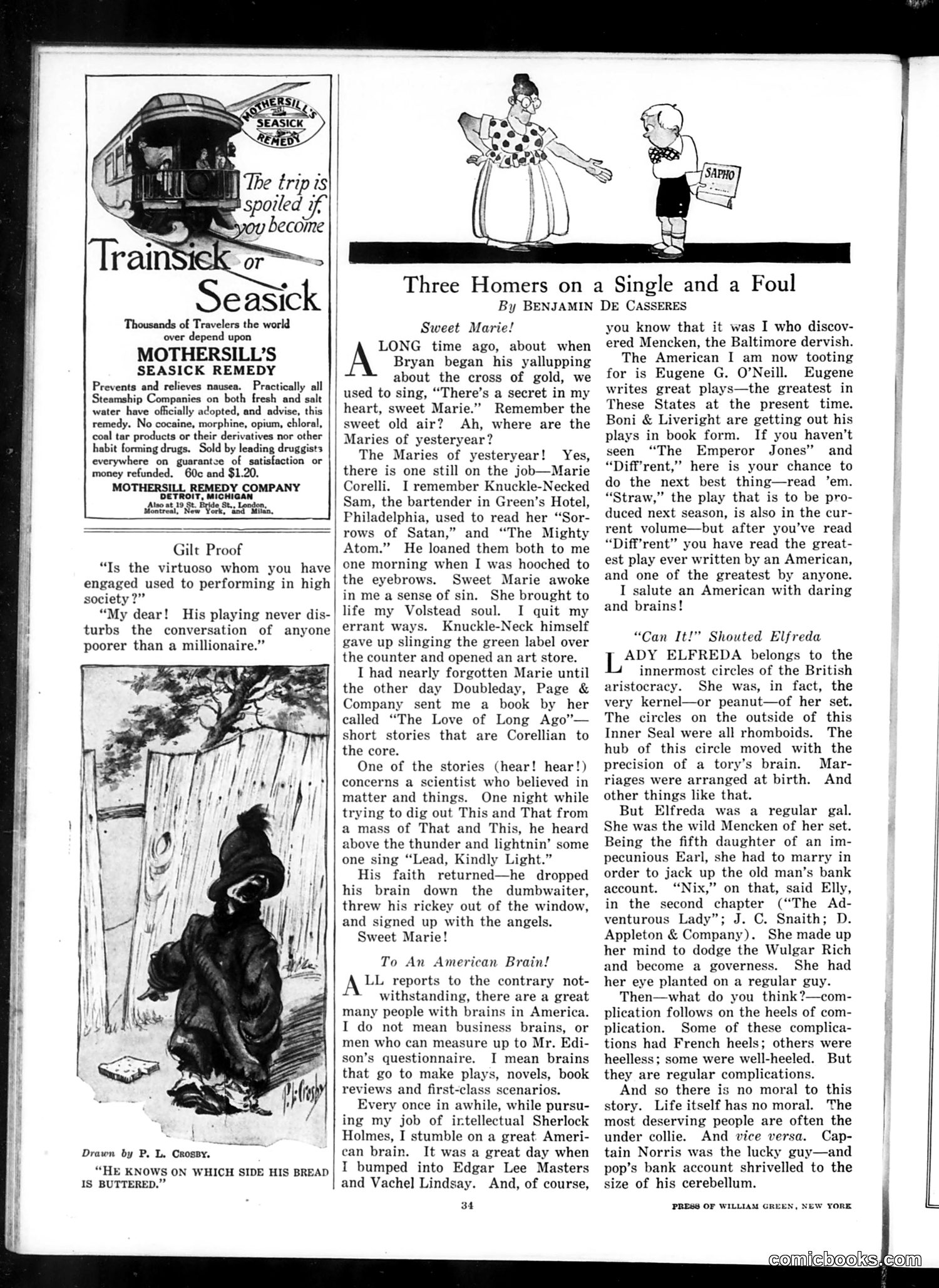
This page contains advertisements and literary commentary rather than political cartoons. The main content includes: **Advertisements:** Mothersill's Seasick Remedy (prominent left side) and a brief joke about a virtuoso musician who doesn't disturb even poor patrons' conversations. **Literary Essays:** Benjamin de Casseres discusses American writers and playwrights, praising Eugene G. O'Neill's plays ("The Emperor Jones," "Diff'rent," "Straw") as among the greatest works by an American. He also celebrates discovering H.L. Mencken and mentions Edgar Lee Masters and Vachel Lindsay as notable American talents. **Satirical Story:** "Can It! Shouted Elfreda" begins describing a British aristocratic woman from the innermost social circles. The page reflects early 1920s American literary culture, celebrating modernist playwrights and critics during a period of cultural flourishing. There's implicit nationalism in championing American artistic achievement against European traditions.
📄 Transcribed text from this page (OCR, searchable)
Machine-transcribed from the original scan — historical spelling and the odd misread are preserved.
a | dj iG MN) The pipe 1S ers SNOIed J Sd ~, eae, Ss aBick Thousands of Travelers the world over depend upon MOTHERSILL’S SEASICK REMEDY Prevents and relieves nausea. Practically all Steamship Companies on both fresh and salt water have officially adopted, and advise, this remedy. No cocaine, morphine, opium, chloral, coal tar products or their derivatives nor other habit forming drugs. Sold by leading druggists everywhere on guarantze of satisfaction or money refunded. 60c and $1.20. MOTHERSILL. REMEDY COMPANY DETROIT, MICHIGAN ao a , ooneresi, New Yorks dad Milca, Gilt Proof “Is the virtuoso whom you have} engaged used to performing in high| society ?” “My dear! His playing never dis- of anyone turbs the conversation poorer than a millionaire.” Drawn by P. L. Cxossy. — “HE KNOWS ON WHICH SIDE HIS BREAD IS BUTTERED.” Sweet Marie! LONG time ago, about when A Bryan began his yallupping about the cross of gold, we used to sing, “There’s a secret in my heart, sweet Marie.” Remember the sweet old air? Ah, where are the Maries of yesteryear? The Maries of yesteryear! Yes, there is one still on the job—Marie Corelli. I remember Knuckle-Necked Sam, the bartender in Green’s Hotel, Philadelphia, used to read her “Sor- rows of Satan,” and “The Mighty Atom.” He loaned them both to me one morning when I was hooched to the eyebrows. Sweet Marie awoke in me a sense of sin. She brought to life my Volstead soul. I quit my errant ways. Knuckle-Neck himself | gave up slinging the green label over the counter and opened an art store. I had nearly forgotten Marie until the other day Doubleday, Page & Company sent me a book by her called “The Love of Long Ago”’— short stories that are Corellian to the core. One of the stories (hear! hear!) concerns a scientist who believed in matter and things. One night while trying to dig out This and That from a mass of That and This, he heard above the thunder and lightnin’ some one sing “Lead, Kindly Light.” His faith returned—he dropped his brain down the dumbwaiter, threw his rickey out of the window, and signed up with the angels. Sweet Marie! To An American Brain! A UL reports to the contrary not- withstanding, there are a great many people with brains in America. I do not mean business brains, or men who can measure up to Mr. Edi- son’s questionnaire. I mean brains that go to make plays, novels, book reviews and first-class scenarios. Every once in awhile, while pursu- ing my job of intellectual Sherlock Holmes, I stumble on a great Ameri- can brain. It was a great day when I bumped into Edgar Lee Masters and Vachel Lindsay. And, of course, 34 Three Homers on a Single and a Foul By BENJAMIN DE CASSERES you know that it was I who discov- ered Mencken, the Baltimore dervish. The American I am now tooting for is Eugene G. O’Neill. Eugene writes great plays—the greatest in These States at the present time. Boni & Liveright are getting out his plays in book form. If you haven't seen “The Emperor Jones” and “Diff’rent,” here is your chance to do the next best thing—read ’em. “Straw,” the play that is to be pro- duced next season, is also in the cur- rent volume—but after you’ve read “Diff’rent” you have read the great- est play ever written by an American, and one of the greatest by anyone. I salute an American with daring and brains! “Can It!” Shouted Elfreda ADY ELFREDA belongs to the innermost circles of the British aristocracy. She was, in fact, the very kernel—or peanut—of her set. The circles on the outside of this Inner Seal were all rhomboids. The hub of this circle moved with the precision of a tory’s brain. Mar- riages were arranged at birth. And other things like that. But Elfreda was a regular gal. She was the wild Mencken of her set. Being the fifth daughter of an im- pecunious Earl, she had to marry in order to jack up the old man’s bank account. “Nix,” on that, said Elly, in the second chapter (“The Ad- venturous Lady”; J. C. Snaith; D. Appleton & Company). She made up her mind to dodge the Wulgar Rich and become a governess. She had her eye planted on a regular guy. Then—what do you think?—com- plication follows on the heels of com- plication. Some of these complica- tions had French heels; others were heelless; some were well-heeled. But they are regular complications. And so there is no moral to this story. Life itself has no moral. The most deserving people are often the | under collie. And vice versa. Cap- tain Norris was the lucky guy—and pop’s bank account shrivelled to the size of his cerebellum. PRESS OF WILLIAM GREEN, NEW YORE