
A complete issue · 32 pages · 1921
Judge — April 23, 1921
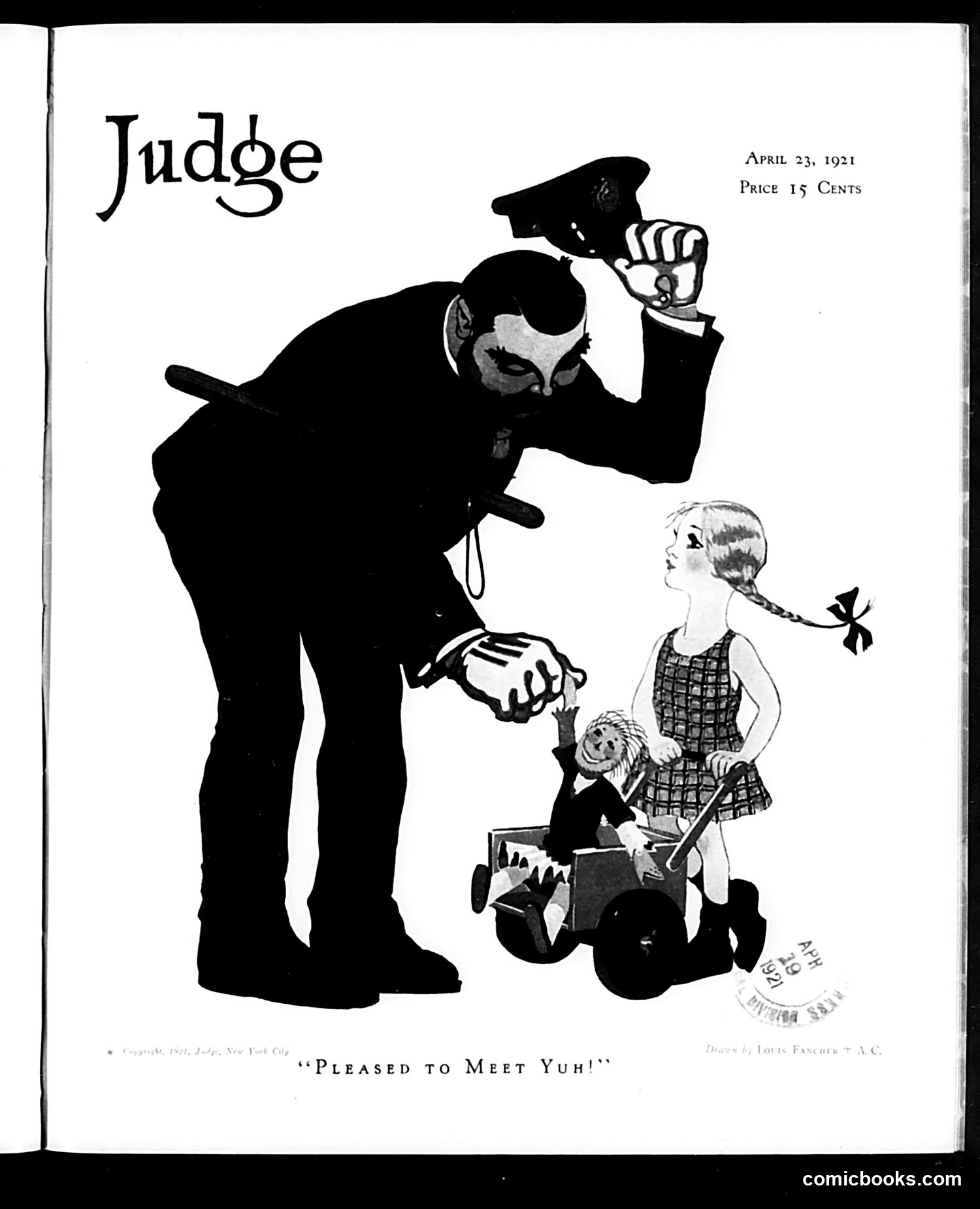
This Judge magazine cover from April 23, 1921 depicts a menacing, exaggerated figure in a mask and formal attire looming over two small children. The caption "Pleased to Meet Yuh!" suggests sinister intent masked by false politeness. The imagery appears to reference contemporary anxieties about dangerous strangers or criminal elements threatening innocent children—a common satirical theme of the era. The grotesque caricature and predatory posture convey the "stranger danger" concept visually. Without additional context from the magazine's interior, the specific political or social reference remains unclear, though it likely commented on crime, immigration fears, or public safety concerns prevalent in 1921 America. The drawing style is credited to Louis Fancher T.A.C.
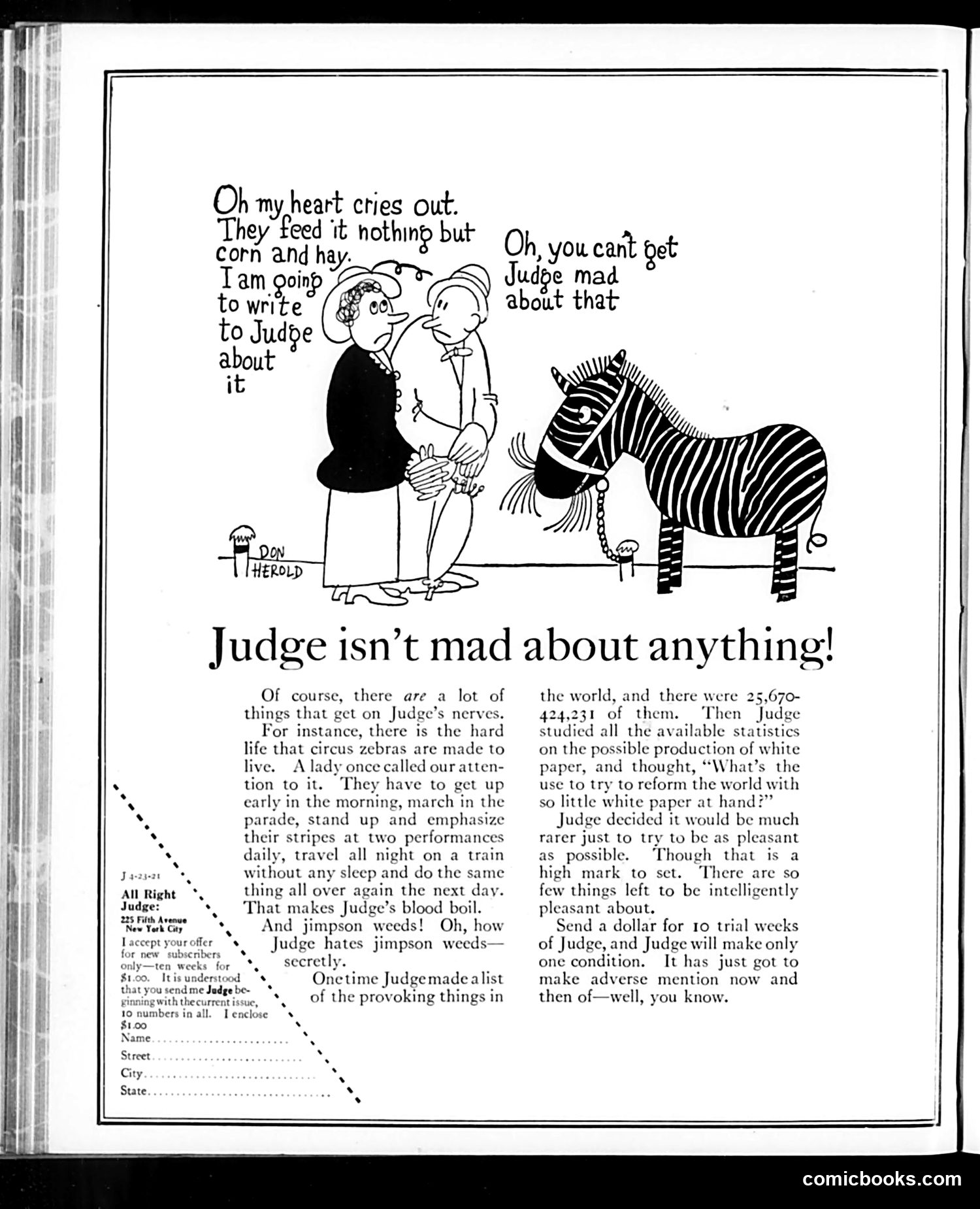
This cartoon satirizes **Judge magazine's editorial stance** of deliberate non-engagement. The illustration shows a woman complaining that her horse is fed only corn and hay, threatening to write Judge about it. A man responds that Judge won't get mad—suggesting the publication maintains an amused, detached tone rather than crusading anger. The accompanying text confirms this: Judge's editor decided it's "rarer just to try to be as pleasant as possible" rather than attempt world reform through satirical criticism. The piece mocks this calculated pleasantness as a deliberate editorial policy—presenting it as intellectual surrender disguised as good humor. This appears to be a **self-referential advertisement** promoting Judge's subscription through ironic self-deprecation about its own lack of moral outrage.
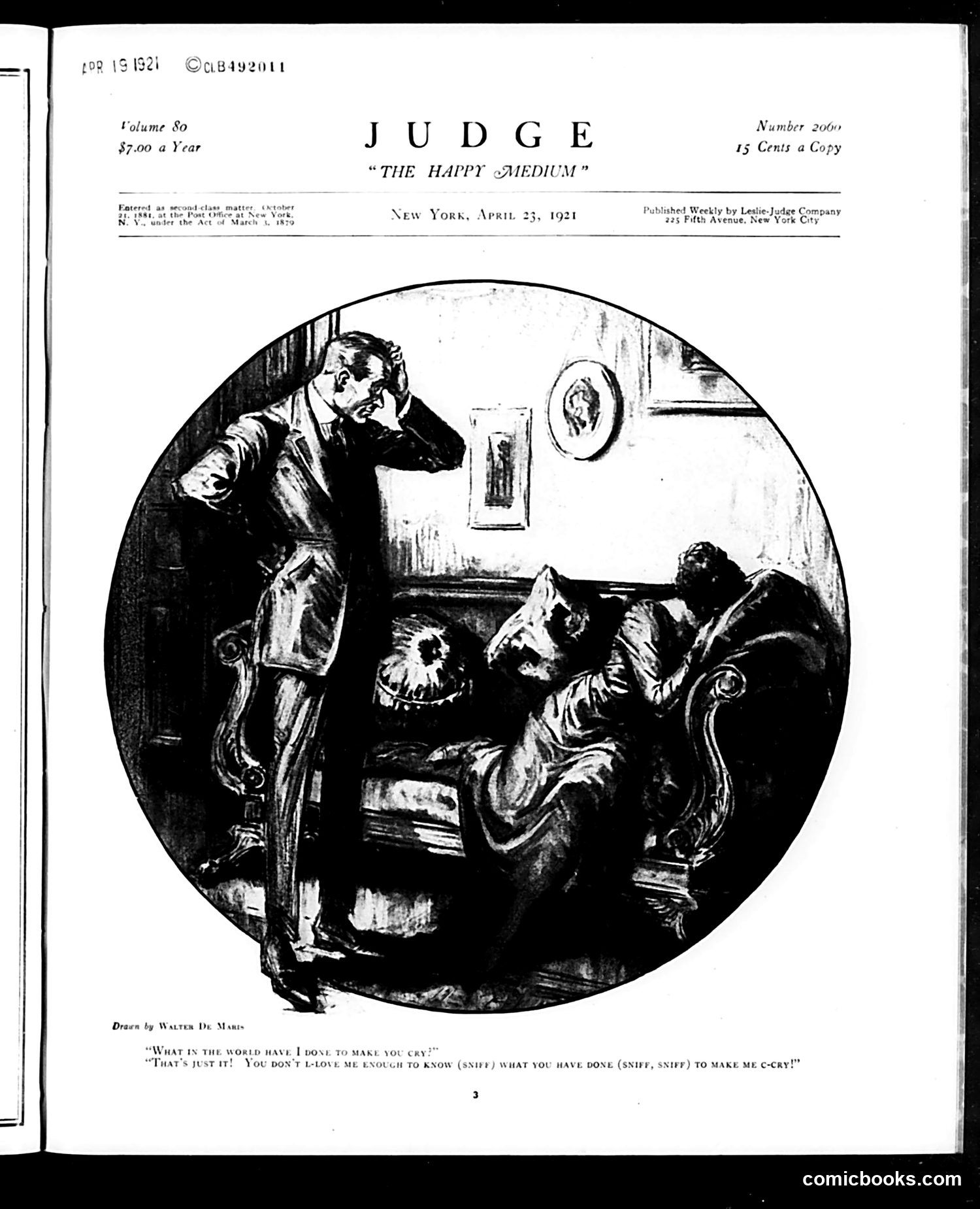
This satirical cartoon, drawn by Walter De Maris, depicts an emotional confrontation between a standing man (likely a husband) and seated figures (possibly a wife and another person). The dialogue suggests a domestic dispute over infidelity or betrayal—the standing man demands to know what his partner has done to make him cry, sarcastically noting that merely knowing about their wrongdoing isn't sufficient; he needs details to fully experience his emotional anguish. The satire targets the emotional manipulation and theatrical behavior common in domestic quarrels of the era. The circular framing and formal interior setting suggest this represents a typical middle-class domestic scene, with the cartoon mocking both the husband's histrionic demands for confession and the implicit wrongdoing itself. The humor relies on the absurdity of demanding detailed information about betrayal solely to intensify one's own suffering.
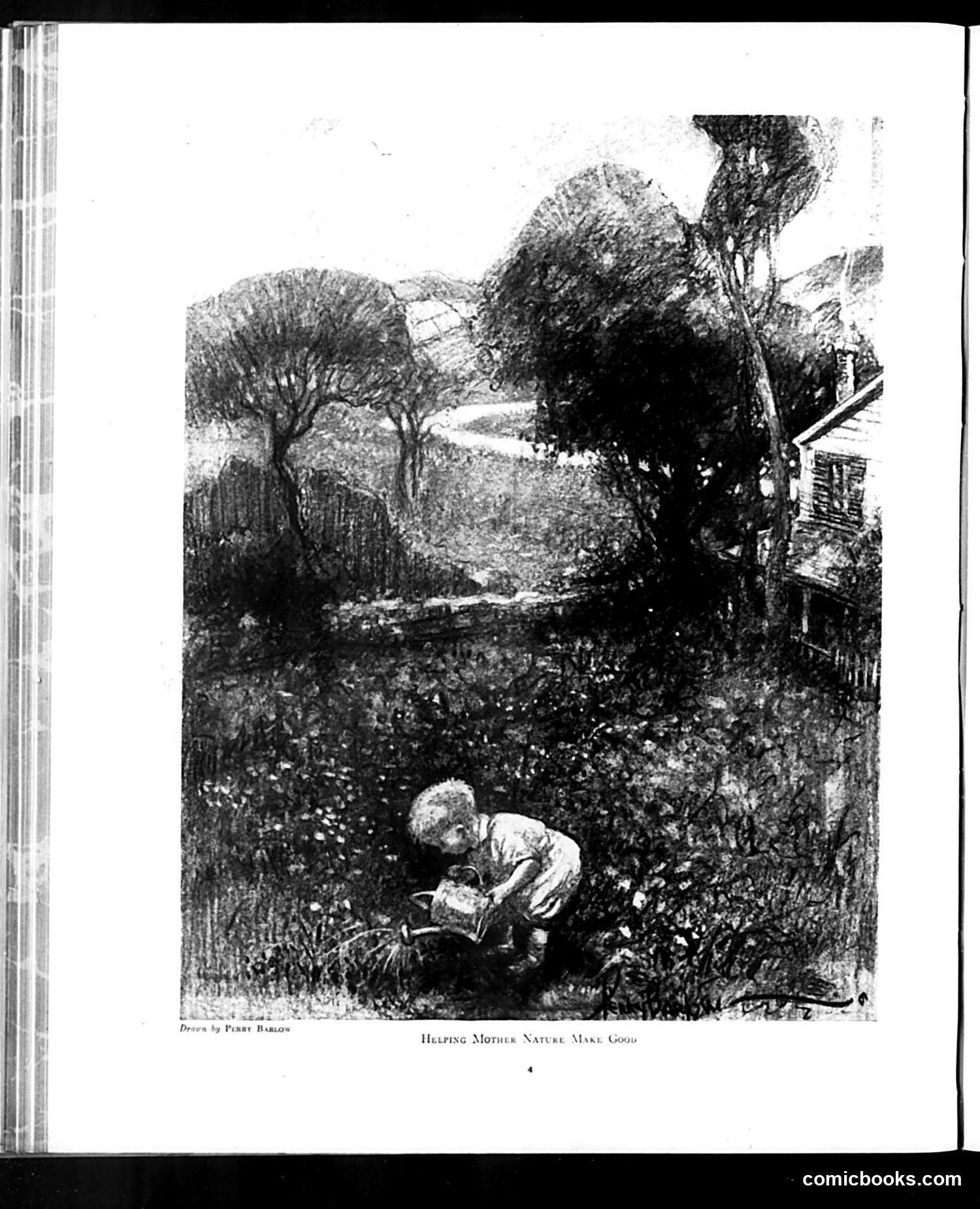
This illustration, drawn by Perry Barlow, depicts a child tending a garden with a watering can. The caption suggests an ironic commentary on environmental stewardship or agricultural improvement. The satire likely critiques either overly optimistic beliefs in human intervention improving nature, or conversely, praises modest individual efforts at cultivation. Given *Judge* magazine's satirical tradition, the humor probably lies in the disconnect between a child's small garden project and grand claims about "helping" nature operate effectively. The pastoral setting—with a cottage, trees, and cultivated landscape—emphasizes the domestic, manageable scale of this "help," which may undercut pretentious contemporary rhetoric about controlling or improving natural processes. Without additional context about the publication date, the precise target remains unclear.
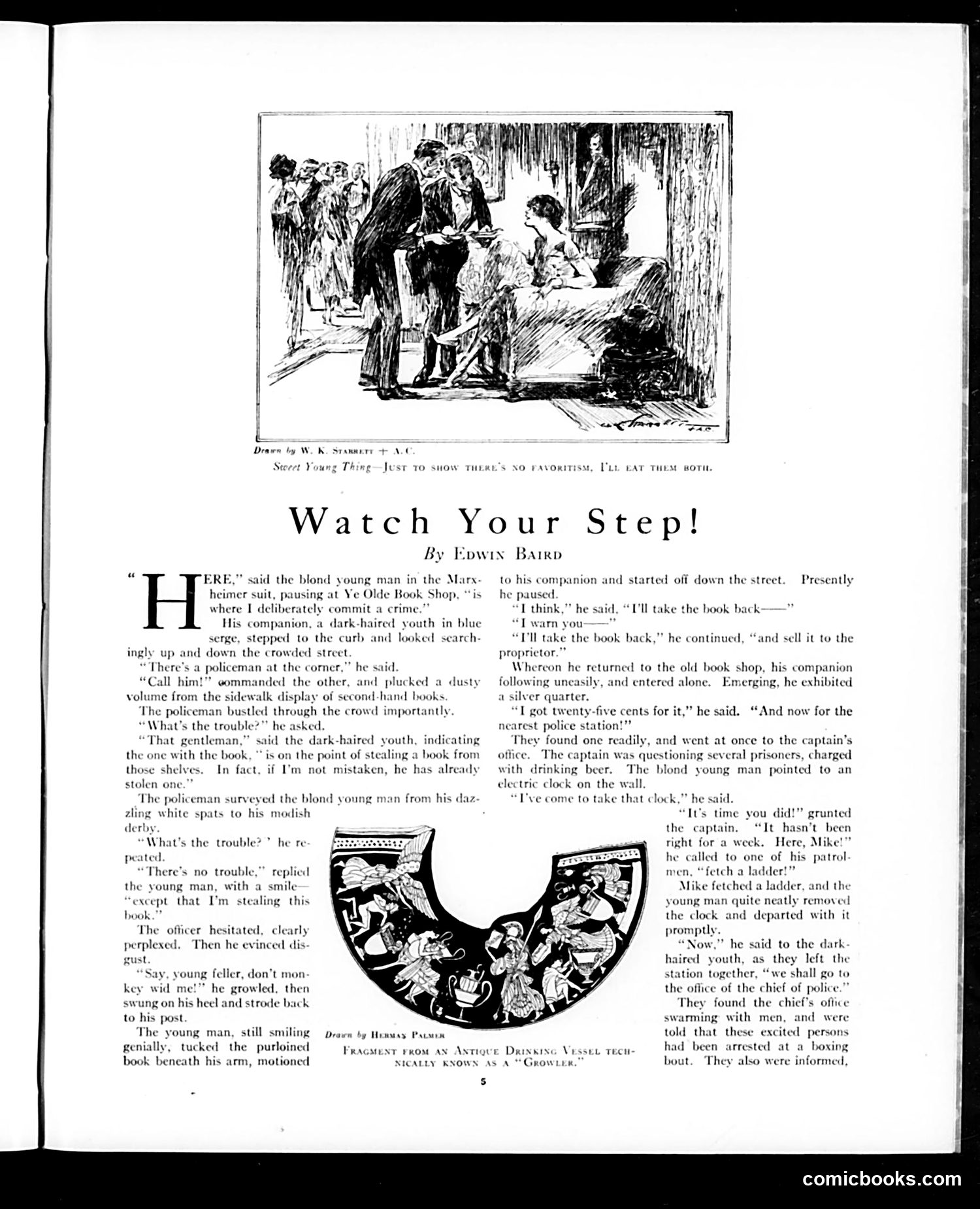
This page contains a short story by Edwin Baird rather than political satire. The narrative depicts two young men at an antiquarian bookshop—one attempting to steal a book while his companion watches nervously. When caught by a policeman, the thief confesses and is taken to the police station. The illustration shows the stolen book's interior decoration: "Fragment from an Antique Drinking Vessel technically known as a 'Growler.'" The story appears to be a morality tale about petty theft and its consequences, typical of Judge's lighter fare. The headpiece illustration by W.K. Stewart shows the scene of discovery. This is character-driven fiction rather than topical satire or political commentary.
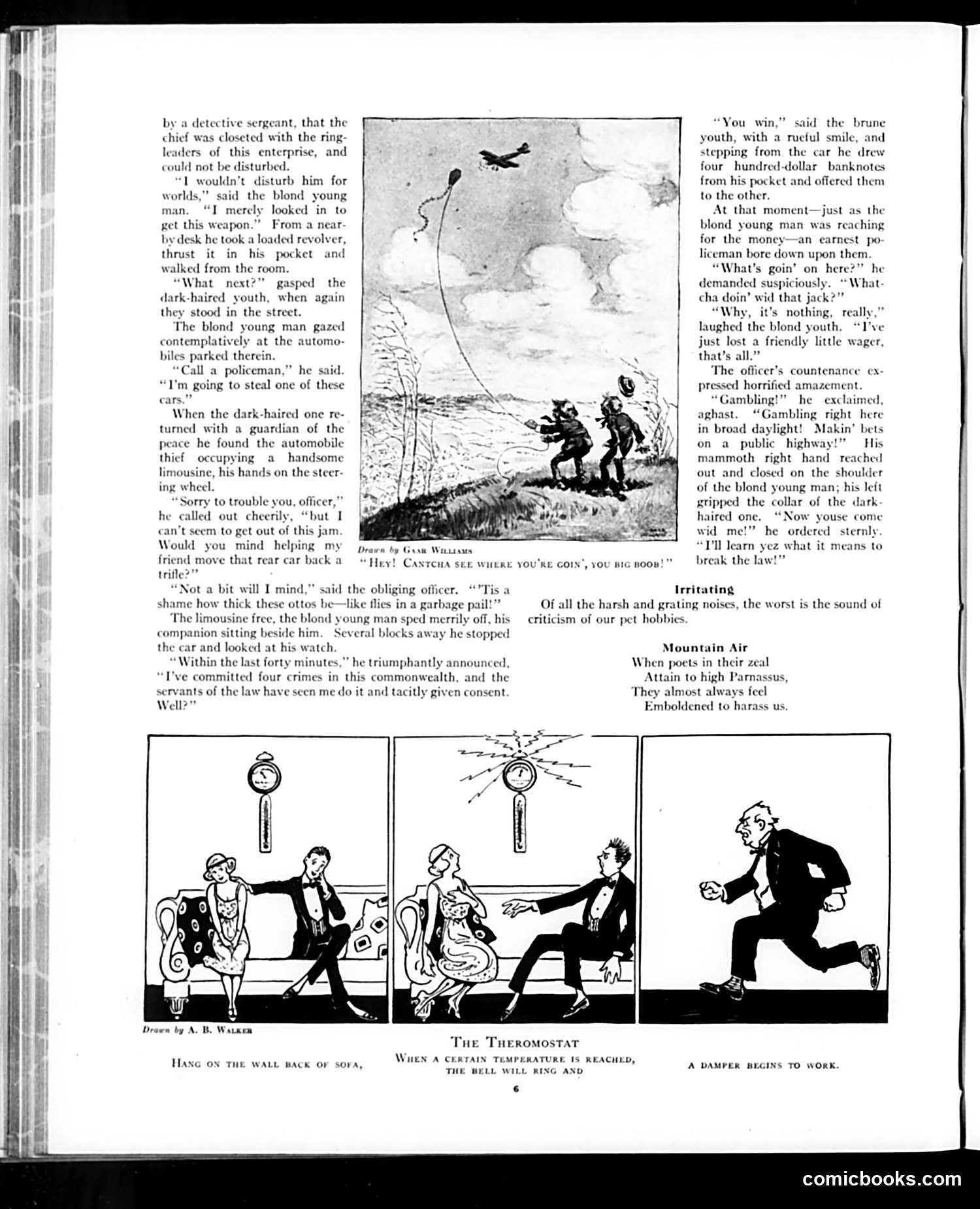
The page contains two distinct elements: **Upper section:** A serialized crime story with illustration by Grant Williams, depicting what appears to be a street crime or robbery scenario. The text references police involvement, stolen automobiles, and gambling debts—typical crime-fiction content of the era. **Lower section:** A three-panel humorous cartoon about a thermostat, drawn by A.B. Walker. The joke depicts the escalating chaos caused by a thermostat's temperature-triggered bell mechanism: first a couple on a sofa reacts calmly, then more frantically as the bell rings repeatedly, and finally a man flees in panic. This is a domestic humor piece mocking the newfangled technology and its disruptive effects on household life. Neither cartoon appears overtly political; both are general entertainment content typical of Judge magazine's mix of crime fiction and domestic satire.
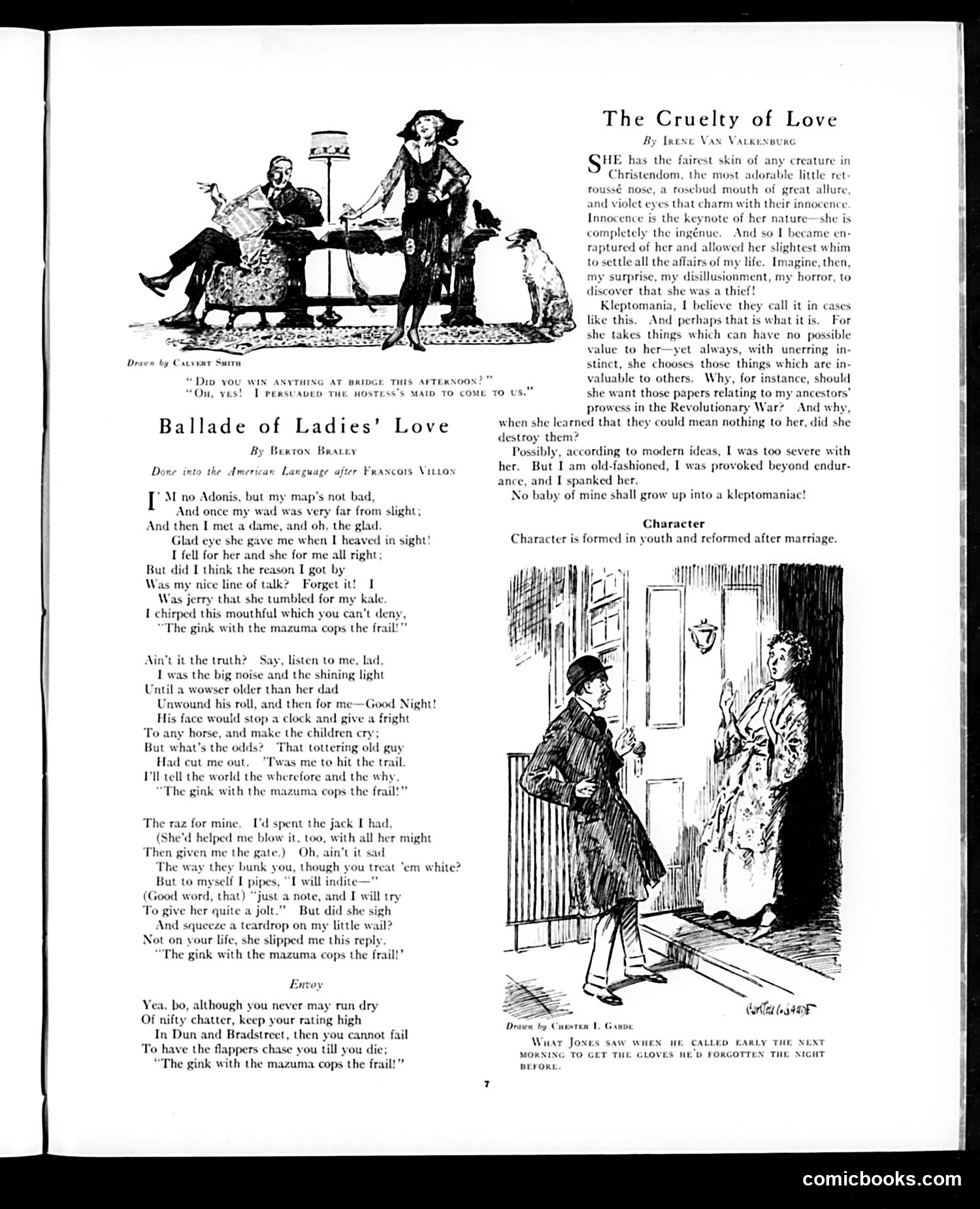
This page contains satirical commentary on courtship and character, typical of early 20th-century Judge magazine humor. **"Ballade of Ladies' Love"** is a poem mocking materialistic romance. The repeated refrain—"The gink with the mazuma cops the frail!"—translates roughly as "the guy with the money gets the girl." The narrator recounts losing his sweetheart to a wealthier, older rival, then being dumped when his money runs out. The satire targets both women's supposed mercenary nature and men's naive belief that charm or emotional appeals matter in courtship. "Mazuma" (slang for money) is the only currency that matters. **"The Cruelty of Love"** presents a contrasting narrative: a man infatuated with an innocent-seeming young woman discovers she's a kleptomaniac who steals his valuables—particularly his Revolutionary War documents—then destroys them. He spanks her for it. The accompanying illustration shows him confronting her about missing gloves. Both pieces reflect period attitudes: cynicism about female materialism and the acceptability of paternal corporal punishment as character-building discipline.
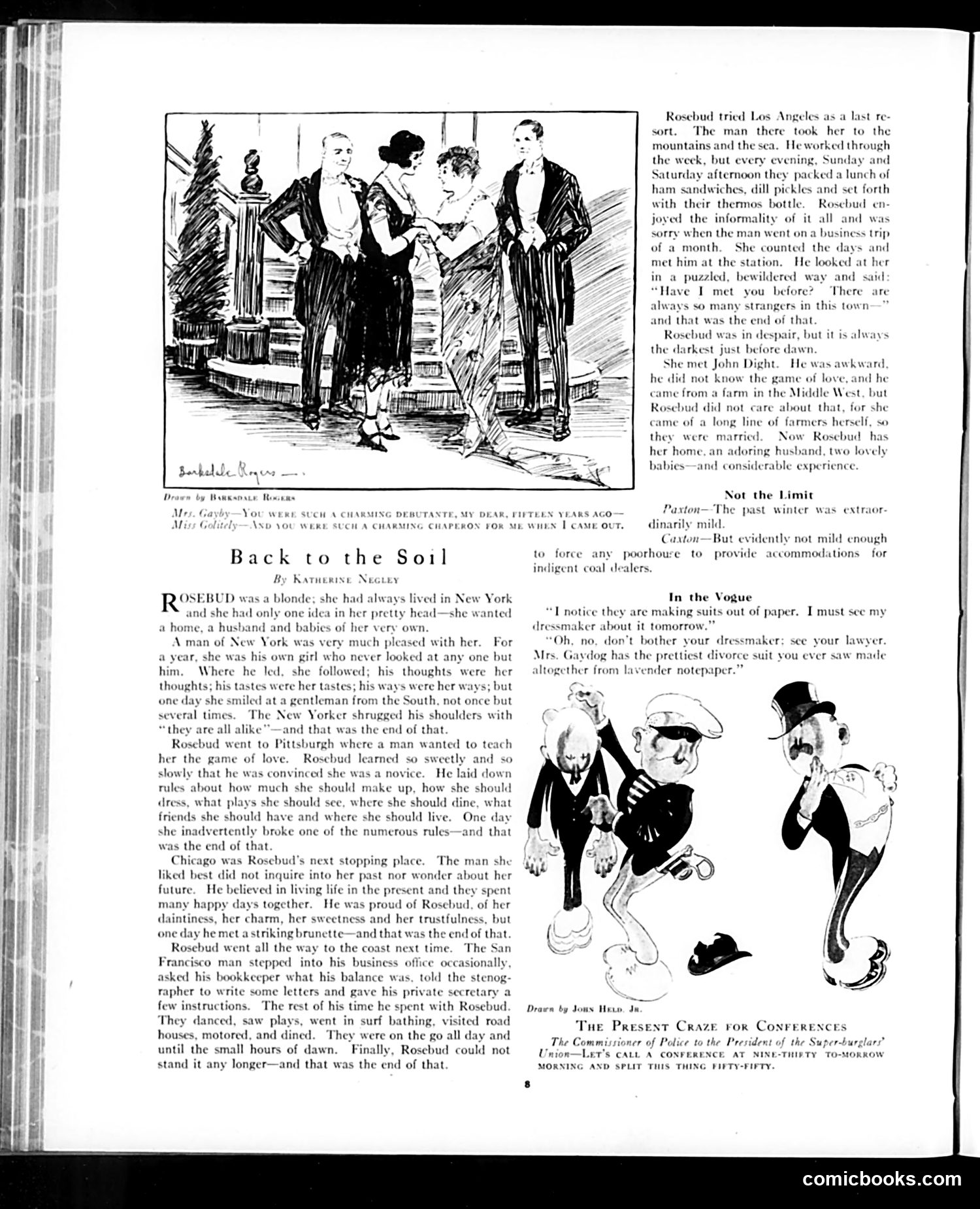
**The Main Story: "Back to the Soil"** This satirical narrative follows Rosebud, a naive young woman seeking marriage and domestic stability. The joke chronicles her romantic failures across American cities—New York, Pittsburgh, Chicago, and San Francisco—where each man abandons her when she inevitably disappoints him or he spots another woman. The satire targets early 20th-century gender expectations: Rosebud is portrayed as desirable precisely because she's obedient and malleable, yet this very passivity dooms her relationships. Only the unsophisticated farmer John Dight, from humble origins, accepts her unconditionally. The ironic title suggests returning to rural simplicity as the antidote to urban sophistication's failures. **The Cartoon and Sidebar Jokes** The illustration depicts fashionable society figures discussing past acquaintances. The sidebar humor mocks divorce culture among the wealthy—particularly Mrs. Gaydog's "prettiest divorce suit made from lavender notepaper," satirizing how casually the rich treat matrimonial dissolution. Overall, the page critiques both male fickleness and female dependence while suggesting that authentic happiness requires rejecting urban pretense.
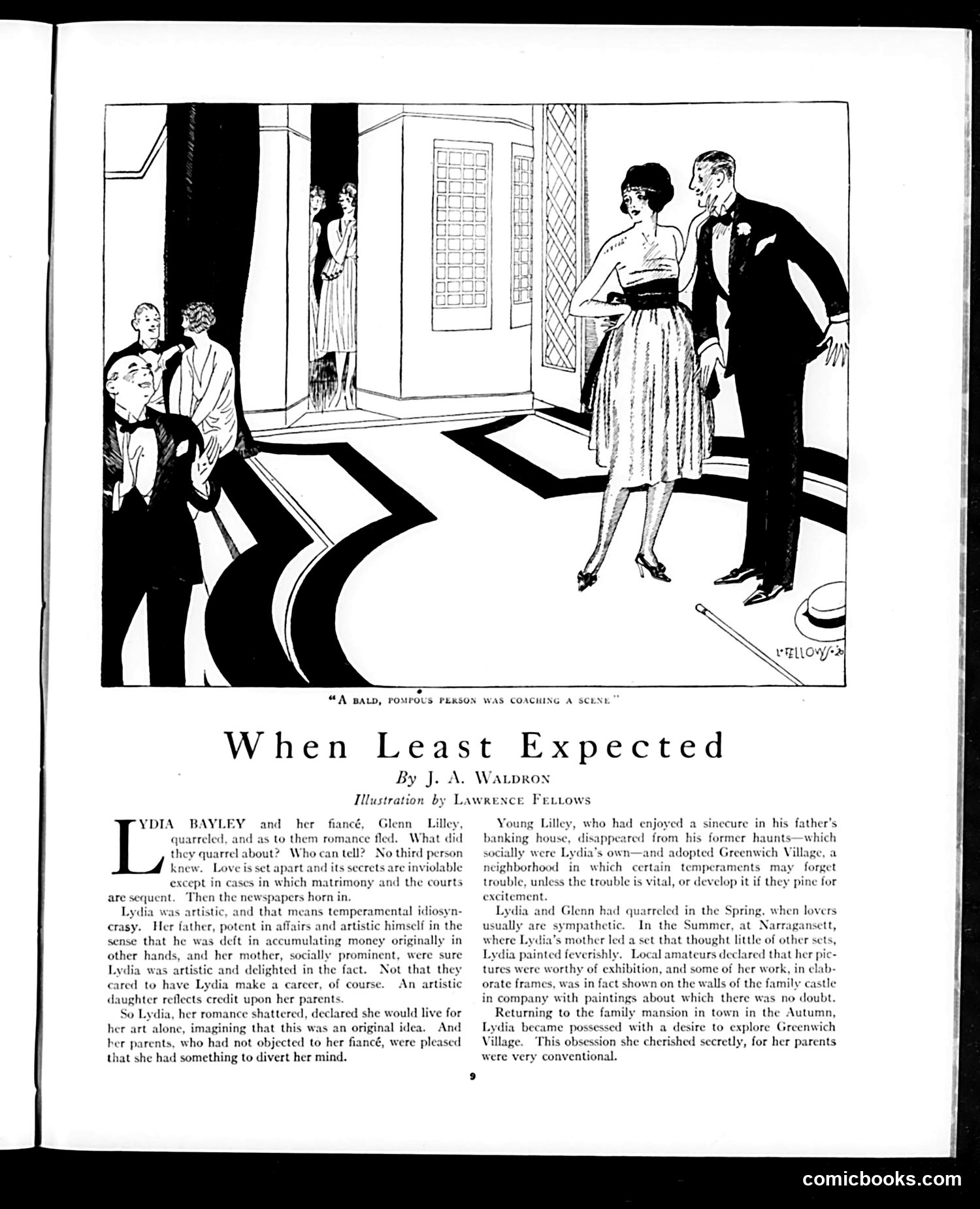
This is the opening page of a satirical short story, not a political cartoon. It mocks upper-class artistic pretension in 1920s America. **The Setup:** Lydia Bayley, a wealthy young woman from an established family, quarrels with her fiancé Glenn Lilley. She dramatically declares she'll live for art alone—an idea she imagines is original. Her parents, who view an "artistic daughter" as socially prestigious (though not a real career), approve. **The Satire:** The story ridicules how the idle rich perform bohemianism. Lydia "paints feverishly" at a summer resort, displaying her work in the family castle without serious merit. Glenn escapes to Greenwich Village (the actual bohemian neighborhood). The illustration shows their world of formal elegance—servants, stylish interiors—mocking the gap between their pretended artistic rebellion and their conventional, wealthy reality. The joke: their "artistic" identities are fashionable poses adopted by people too comfortable and privileged to genuinely sacrifice anything.
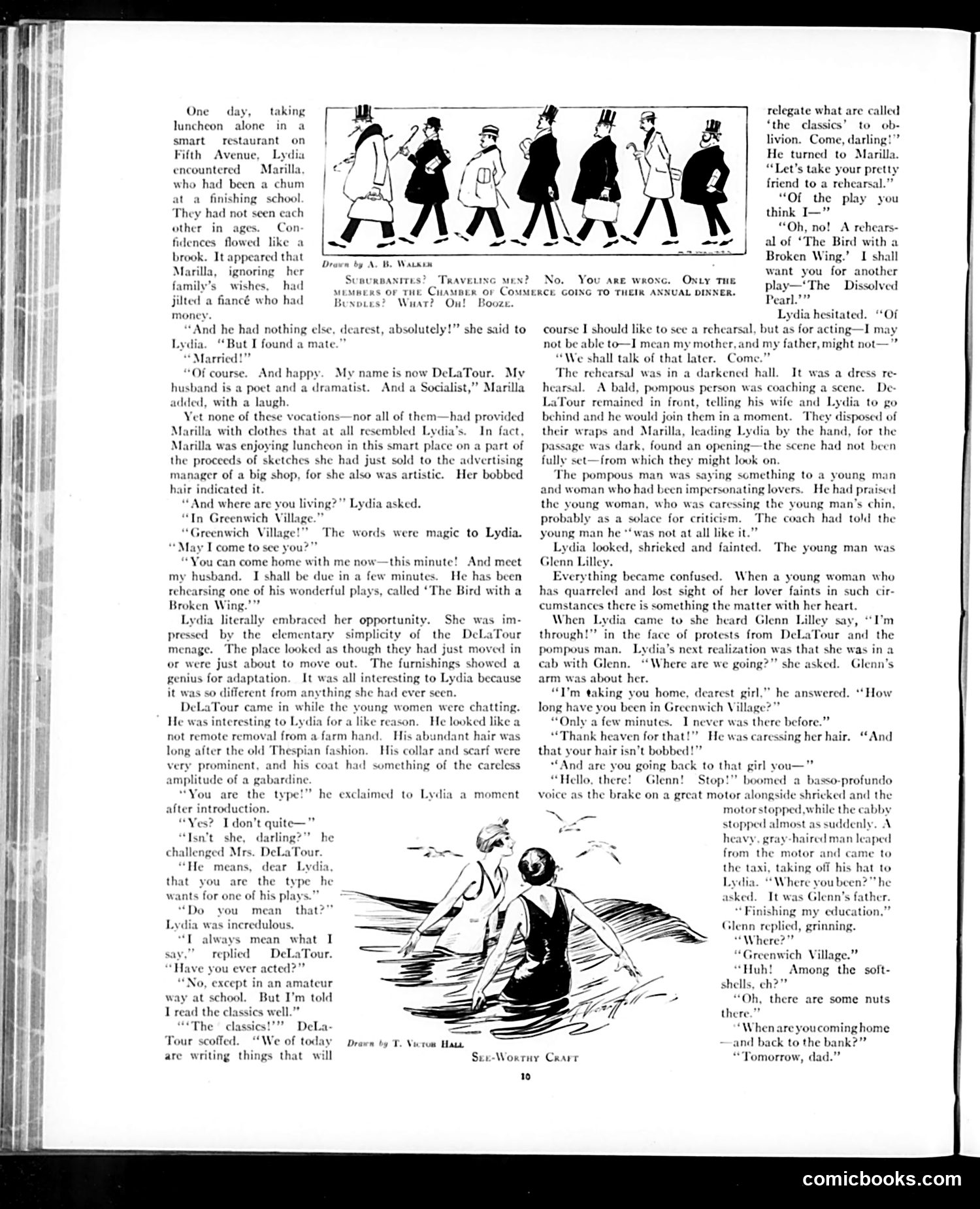
This satirical story mocks the affectations of 1920s Greenwich Village bohemians. Lydia, a wealthy Fifth Avenue woman, reunites with her old finishing-school friend Marilla, now living in Greenwich Village with her husband DeLaTour—a struggling playwright with pretentious socialist ideals and theatrical mannerisms (long hair, careless dress). DeLaTour epitomizes the satirized "artistic type": affected, grandiose, and dismissive of classical literature as outdated. He wants to cast Lydia in his play "The Bird with a Broken Wing," seeing her as fitting a particular social "type" rather than evaluating her actual talent. The cartoon accompanying the text (credited to T. Victor Hain) appears to depict a boating scene, though its specific satirical connection is unclear from the image alone. The piece ridicules both the pretension of struggling artists claiming socialist credentials while dependent on wealthy patrons' money, and the naïveté of society women enchanted by bohemian lifestyle aesthetics. "Sex-Worthy Craft" likely refers ironically to the calculated manipulation behind DeLaTour's artistic pronouncements.
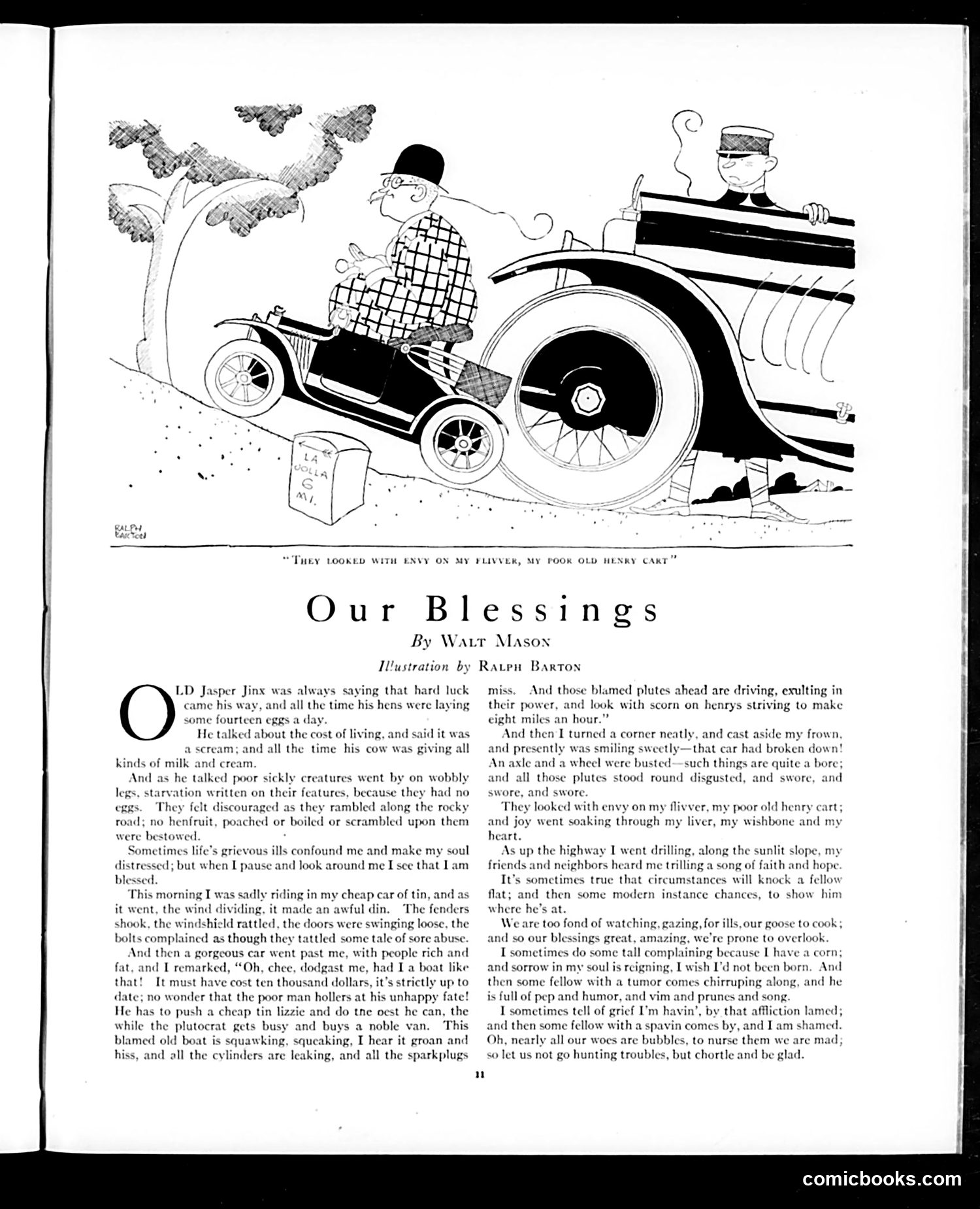
This is a humorous essay with accompanying cartoon, not a political cartoon per se. The piece satirizes American attitudes toward wealth and complaint during the early automotive age. **The Setup:** The protagonist encounters "Old Jasper Jinx," a chronically pessimistic man who constantly complains about hardship despite having abundant chickens and a productive cow. Later, the narrator himself envies a wealthy driver's fancy automobile while riding in his own cheap "tin lizzie" (Model T Ford). **The Satire:** When the fancy car breaks down and its occupants become frustrated, the narrator experiences schadenfreude—joy at the rich man's misfortune. The irony is pointed: both rich and poor complain, yet the narrator's "blessings" (his functioning flivver, his health) go unappreciated until he sees worse circumstances. **The Message:** Mason argues Americans are ungrateful, constantly fixating on what others possess rather than appreciating their own modest comforts. The cartoon visualizes this theme: the envious narrator in his jalopy versus the stranded plutocrat—a reversal of expected fortune.
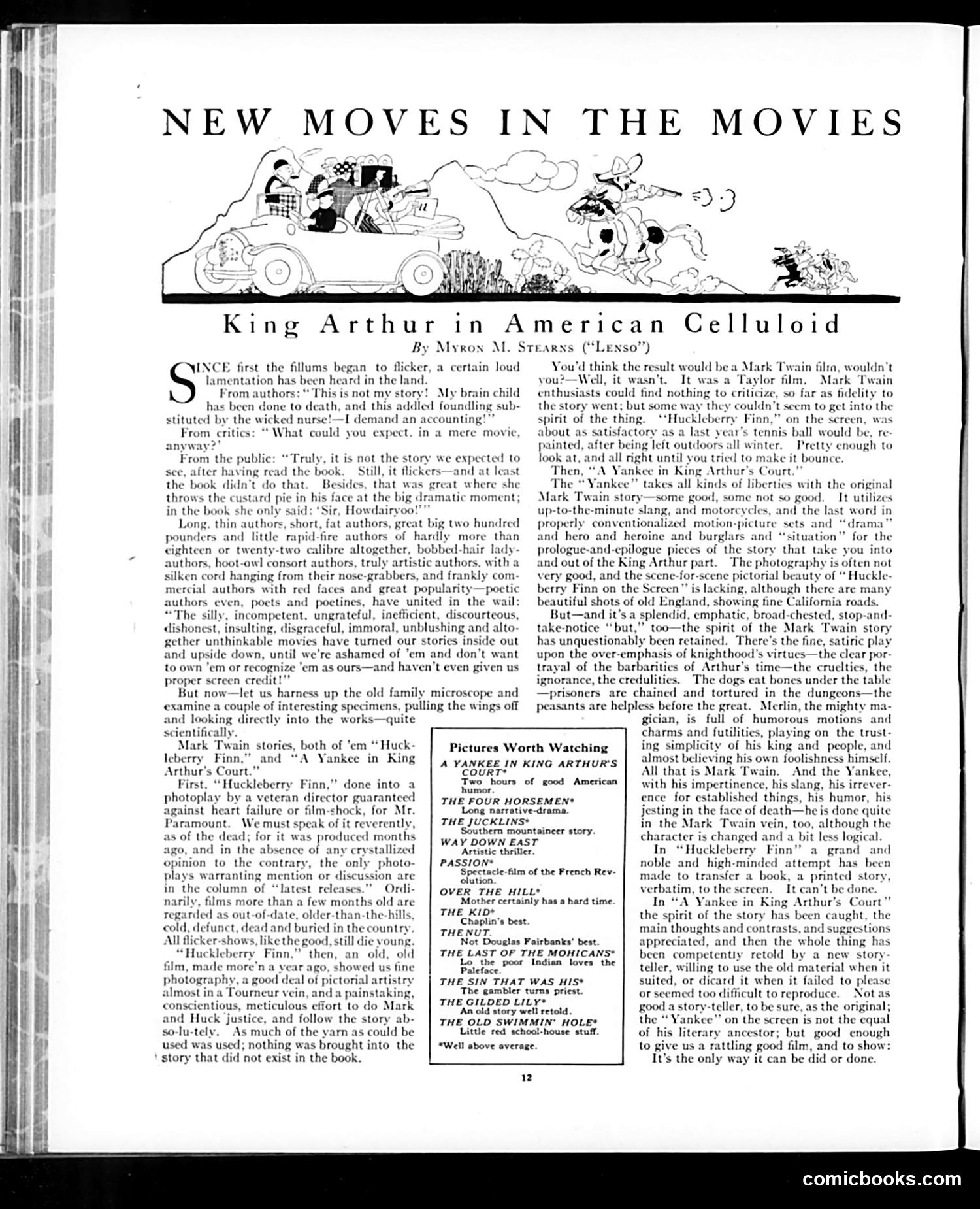
This article critiques film adaptations of Mark Twain's works, particularly "A Yankee in King Arthur's Court." The author (Myron Stearns, "Lenso") satirizes authors' complaints that Hollywood butchers their stories—adding custard pie slapstick where books had dignity, removing nuance for spectacle. The piece distinguishes between two Twain adaptations: "Huckleberry Finn" (praised for faithful adaptation) and "A Yankee in King Arthur's Court" (criticized as a "Taylor film"—likely referring to director Fred Taylor—rather than a Twain film). The satire targets the tension between literary source material and cinema's demand for visual comedy and action. Authors complain movies distort their work, yet the analysis reveals some adaptations succeed through fidelity while others prioritize entertainment spectacle over narrative integrity. The "Pictures Worth Watching" sidebar lists contemporary films as reference points for quality filmmaking.
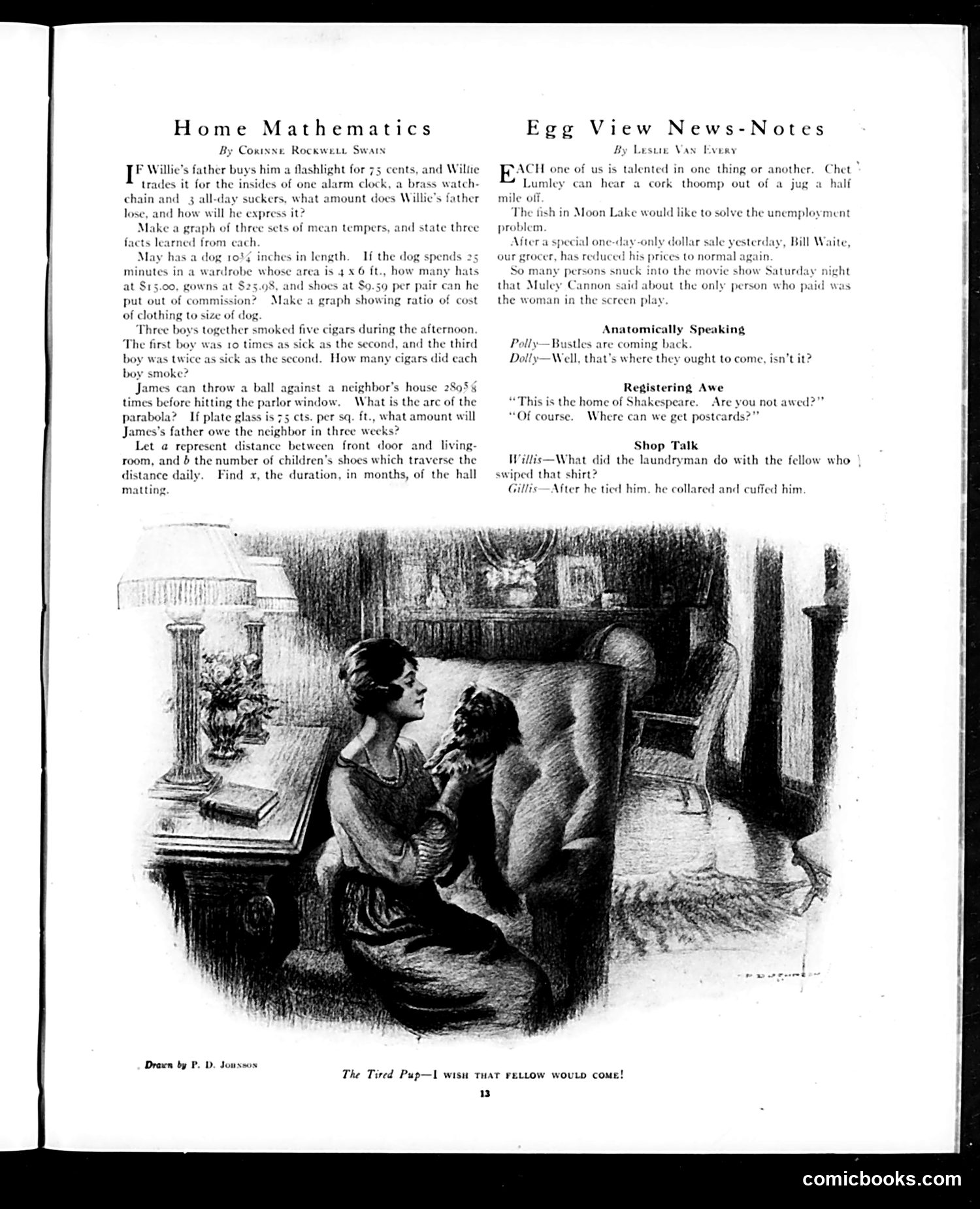
This page from *Judge* magazine contains a single cartoon titled "The Tired Pup—I Wish That Fellow Would Come!" drawn by P.D. Johnson. The image shows a weary dog lying on a living room floor while a woman sits nearby holding what appears to be a small puppy or toy. The joke likely plays on the dog's exhaustion and longing for the mailman or another regular visitor—a common trope in early 20th-century humor. The dog's tired expression suggests it has been worn out by the day's activities and ironically wishes for the person responsible for its fatigue to return, possibly for companionship or routine. The surrounding text includes math word problems and brief comic anecdotes typical of *Judge*'s humor format, focused on everyday domestic situations and wordplay rather than explicit political satire.
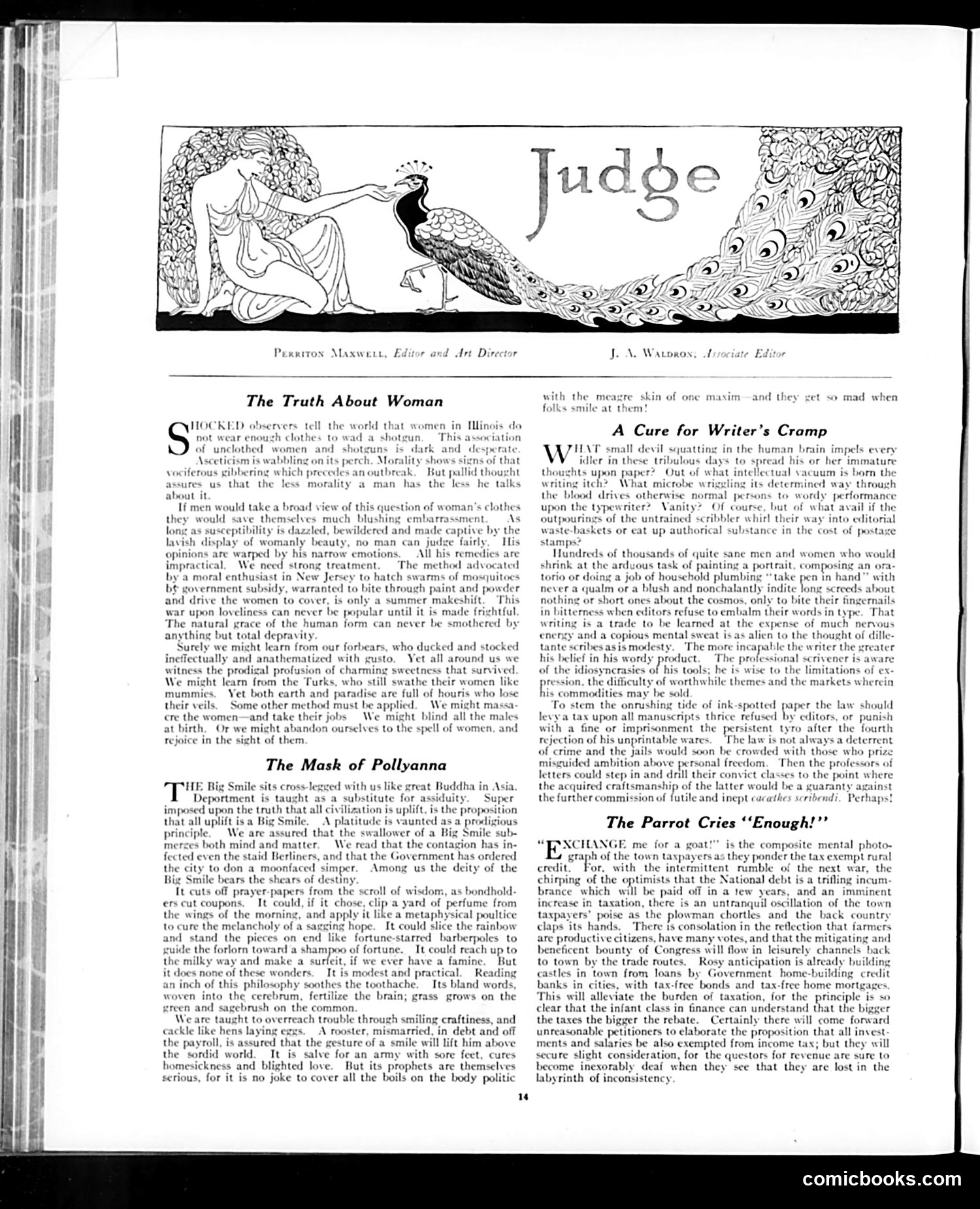
This page from Judge contains three satirical essays targeting early 20th-century American social attitudes. **"The Truth About Woman"** mocks moralistic crusaders (likely referencing a New Jersey reformer's actual proposal to release mosquitoes to drive women indoors) who blame women's clothing for moral decay. The piece sarcastically dismisses their "remedies" as impractical, defending women's right to display beauty. **"The Mask of Pollyanna"** attacks the era's obsession with forced optimism and the "Big Smile" philosophy—the toxic positivity movement of its time. It ridicules the belief that constant cheerfulness solves serious problems (poverty, heartbreak, illness), arguing this shallow positivity merely masks real suffering while those preaching it remain "serious." **"The Parrot Cries 'Enough!'"** (partially visible) appears to critique economic inequality and taxation policy. The header features a classical woman with a peacock, symbolizing beauty and display—fitting the women's clothing debate. These essays reflect Judge's role as sophisticated social criticism targeting hypocrisy and shallow moralizing in progressive-era America.
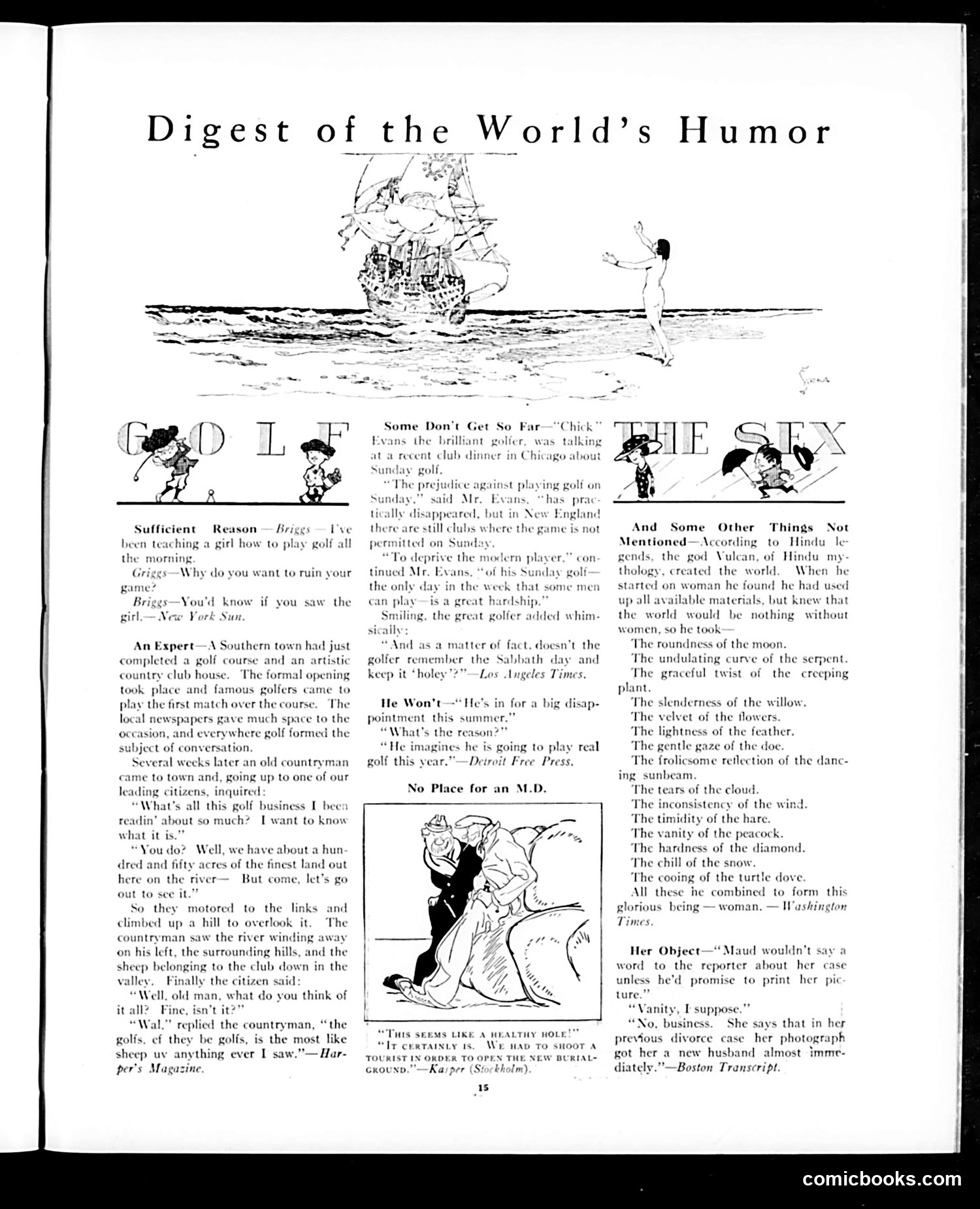
This page from *Judge* magazine contains several golf-themed humor pieces typical of early 20th-century satirical journalism. The main cartoons mock golf culture's rapid popularity. The opening illustration shows a woman playing golf near a ship, setting up the section "God Life" (likely "Golf Life"). The jokes reference: - **Sunday golf controversy**: Multiple pieces address religious objections to playing golf on Sundays, a genuine social debate of the era. Golfer "Chick" Evans allegedly defended the practice against accusations it violated the Sabbath. - **Golf snobbery**: One anecdote mocks a countryman's observation that golfers resemble sheep—suggesting golf appears absurd to outsiders unfamiliar with the sport's appeal. - **The "No Place for an M.D." cartoon**: Shows someone shooting a tourist to open a "burial ground," dark humor about crowded golf courses. The right column's list of nature's beauties concludes that women combine them all, a period-typical sentimental joke about femininity. The final item mocks a divorce plaintiff who used her photograph for publicity to attract a new husband—cynical commentary on women and remarriage.
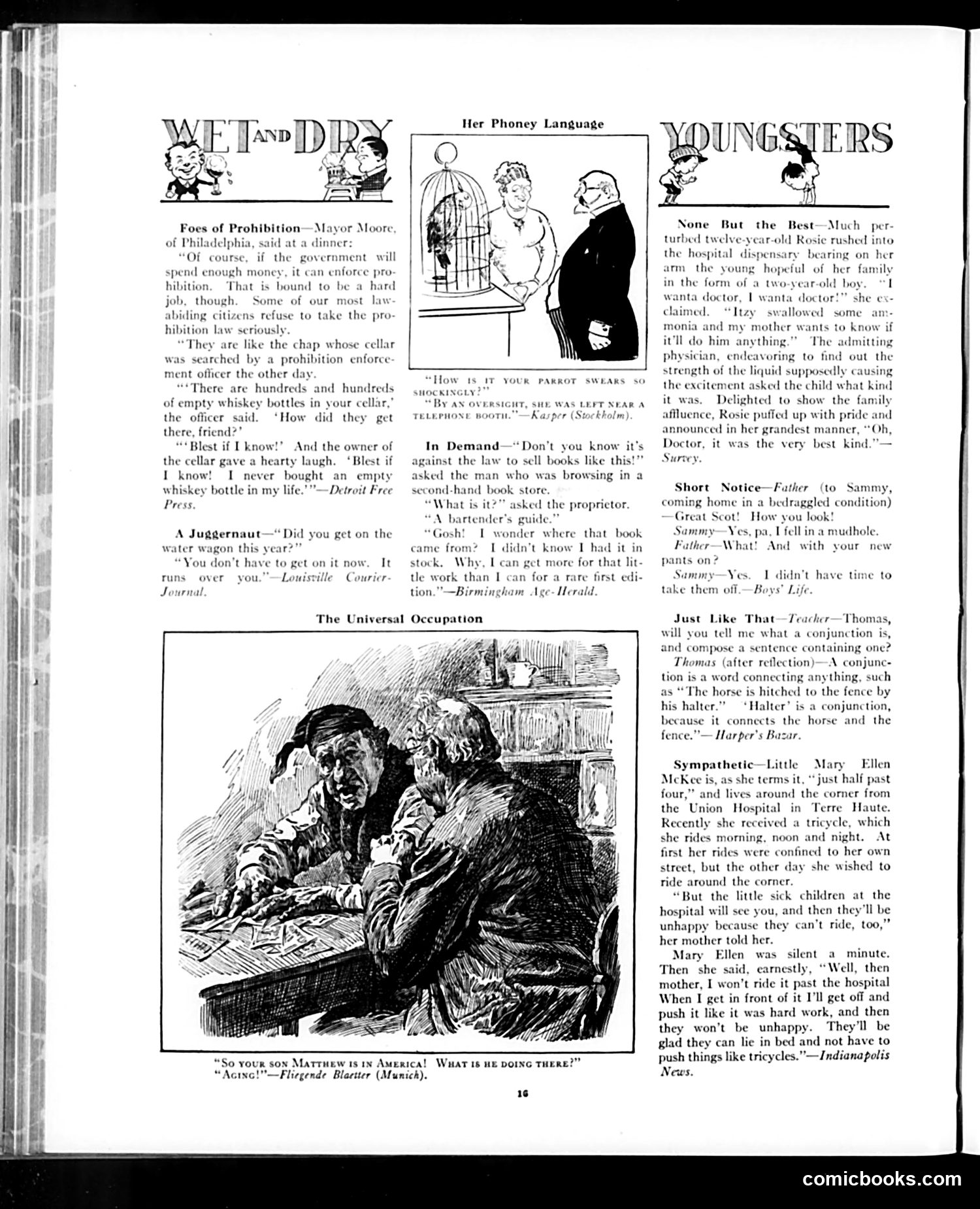
This page satirizes American social attitudes during Prohibition (1920-1933). The main cartoon, "The Universal Occupation," depicts two men gambling or playing cards—likely representing how ordinary citizens circumvented alcohol bans by engaging in illegal activities. The caption jokes that this is what Americans do everywhere. The surrounding anecdotes mock Prohibition enforcement's futility. Mayor Moore's story describes citizens openly hiding whiskey, treating prohibition as a joke. The "Water Wagon" quip suggests the law is unenforceable. "In Demand" shows a bookseller profiting from selling banned literature, indicating broader censorship concerns. The humor lies in portraying Prohibition as universally ignored and unenforced—citizens brazenly violate it while authorities struggle. These pieces suggest that despite government mandates, Americans refuse compliance, making enforcement impossible. The remaining items (about parrots, children) are unrelated humor filler typical of Judge's format.
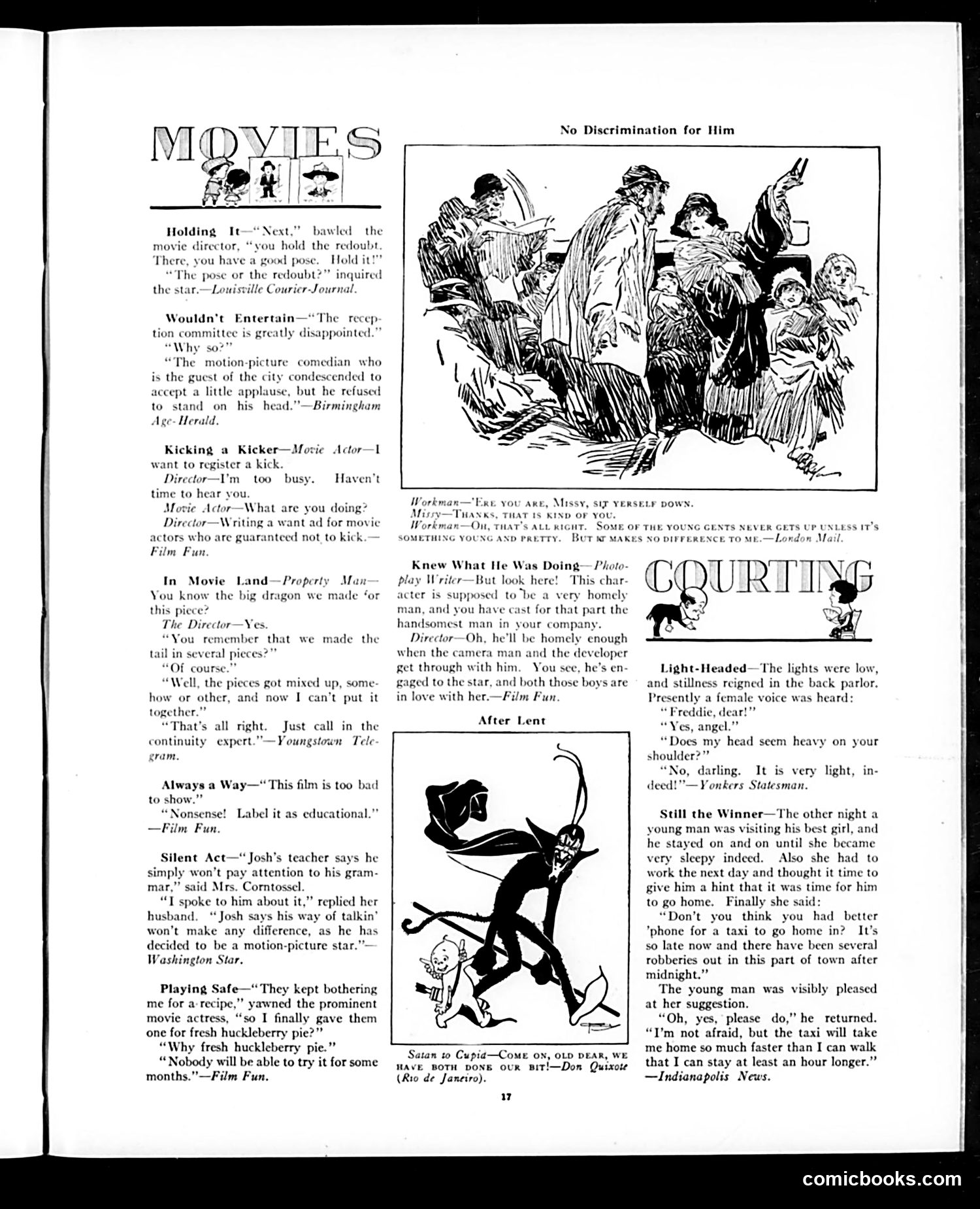
This page satirizes early film industry absurdities through short anecdotes and jokes. The humor targets: **Film production mishaps**: A director asks an actor to "hold the redoubt" (maintain a pose), prompting confusion about what's being held. Props get mixed up—dragon tail pieces can't be reassembled. A "continuity expert" is called to solve problems, mocking the chaos of early filmmaking. **Actor vanity and incompetence**: Comedians refuse to perform physical comedy (standing on their heads). An actor cast as "homely" is actually handsome, but the director assures he'll look bad after camera work and developer manipulation—implying technical limitations masked poor casting choices. **Exploitative industry practices**: One joke references an actress refusing to share recipes because the ingredient won't be available for months—satirizing how films were made far in advance. The cartoons mock early cinema's technical incompetence, ego conflicts, and the gap between script intention and filmed reality. The humor assumes readers were familiar with nascent film industry problems and absurdities.
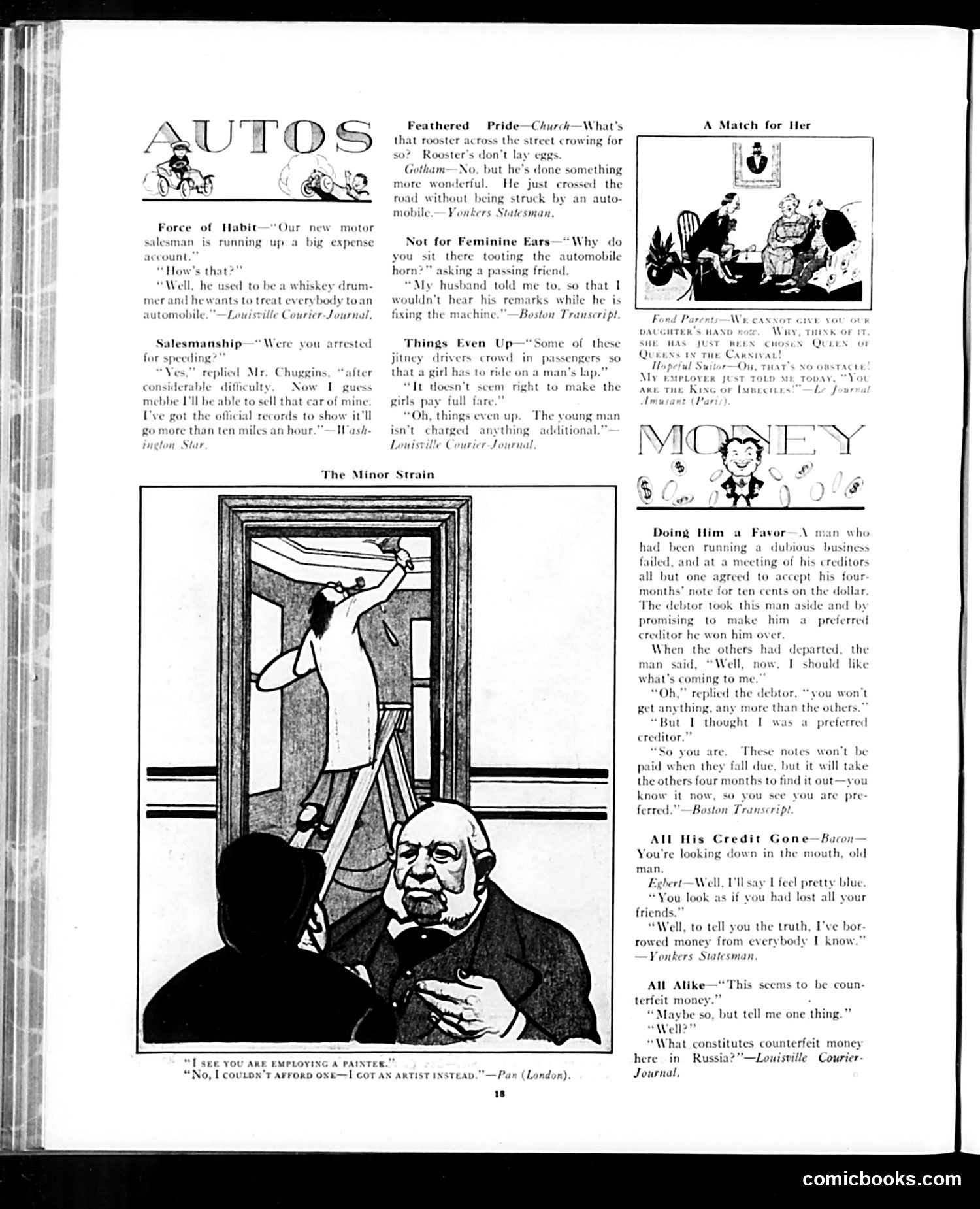
This page contains several short humor pieces typical of early 20th-century American satire: **"The Minor Strain"** (central cartoon): Shows an old man holding money while a young man stretches above him toward a window. The caption references employing a "painter" versus an "artist"—satirizing the pretension of calling oneself an artist while producing mediocre work. **Short jokes** address contemporary automobile culture ("Force of Habit," "Not for Feminine Ears," "Things Even Up"), mocking both salesmen's aggressive tactics and women's secondary status in a male-dominated society. **"Doing Him a Favor"** satirizes creditor meetings during business failures—a debtor promises one creditor preferential treatment, then reveals the "preference" is merely knowing sooner that payment won't arrive. **"All His Credit Gone"** and **"All Alike"** continue themes of debt and financial difficulty, with the Russia reference suggesting contemporary concerns about instability abroad. The humor targets salesmanship deception, automotive culture, gender dynamics, and financial failure—reflecting early 1900s urban anxieties.
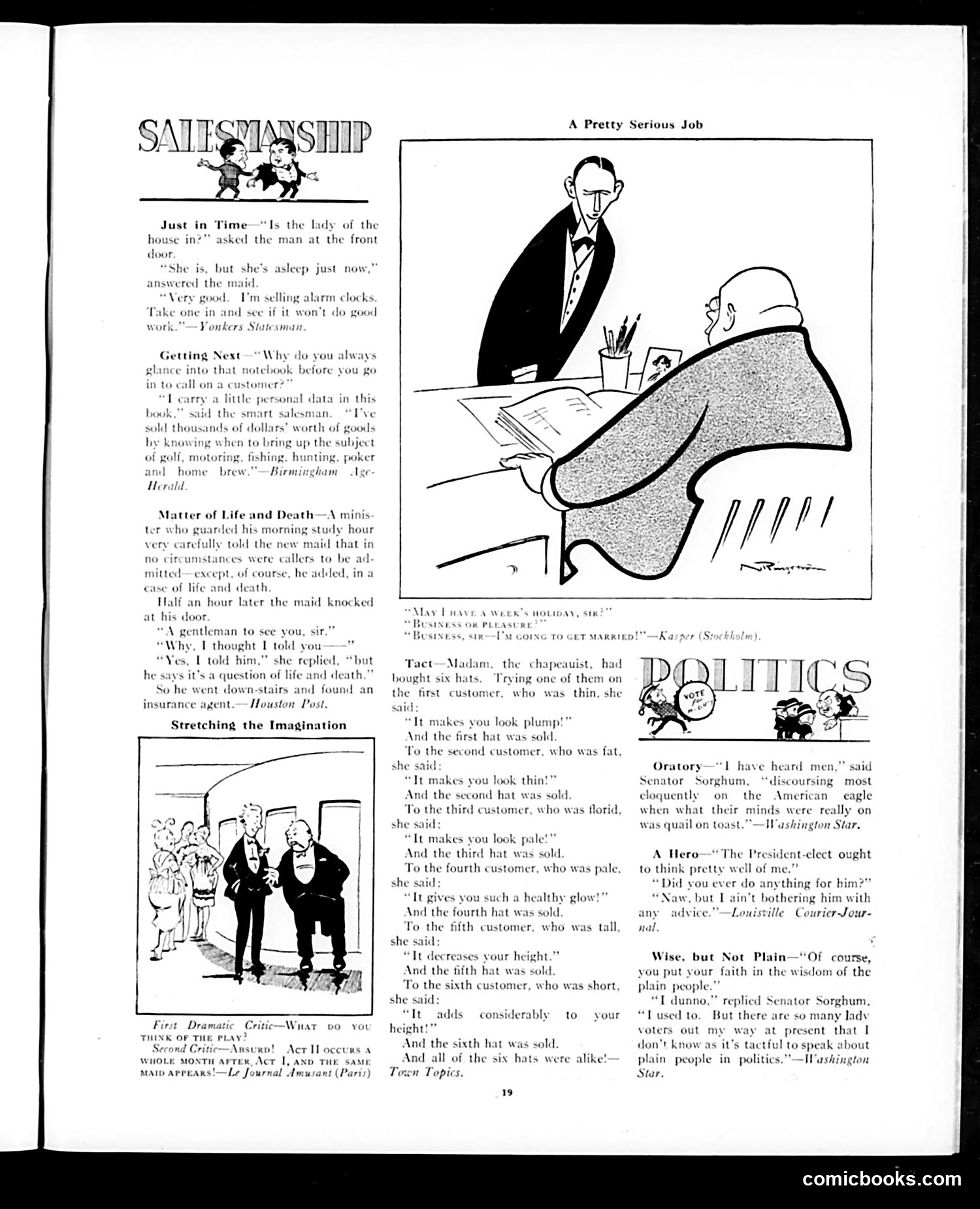
This page contains several short satirical pieces typical of early 20th-century American humor magazines: **"A Pretty Serious Job"** (main cartoon): Depicts a salesman pitching hats to customers. The satire mocks sales tactics—the salesman flatters each buyer with opposite compliments ("makes you look plump/thin/pale/healthy") despite selling identical hats. It's commentary on deceptive sales practices and consumer gullibility. **Political humor sections** reference Senator Sorghum (a recurring satirical character representing rural politicians). One piece mocks politicians' flowery speeches about patriotic symbols while their minds are on trivial matters. Another jokes about politicians becoming cautious around female voters—likely commentary on women's suffrage debates of the era. **Other brief anecdotes** mock insurance salesmen, overly cautious professionals, and theatrical critics. The overall tone satirizes American commercial culture, political hypocrisy, and social pretension—standard Judge magazine fare targeting the educated urban readership.
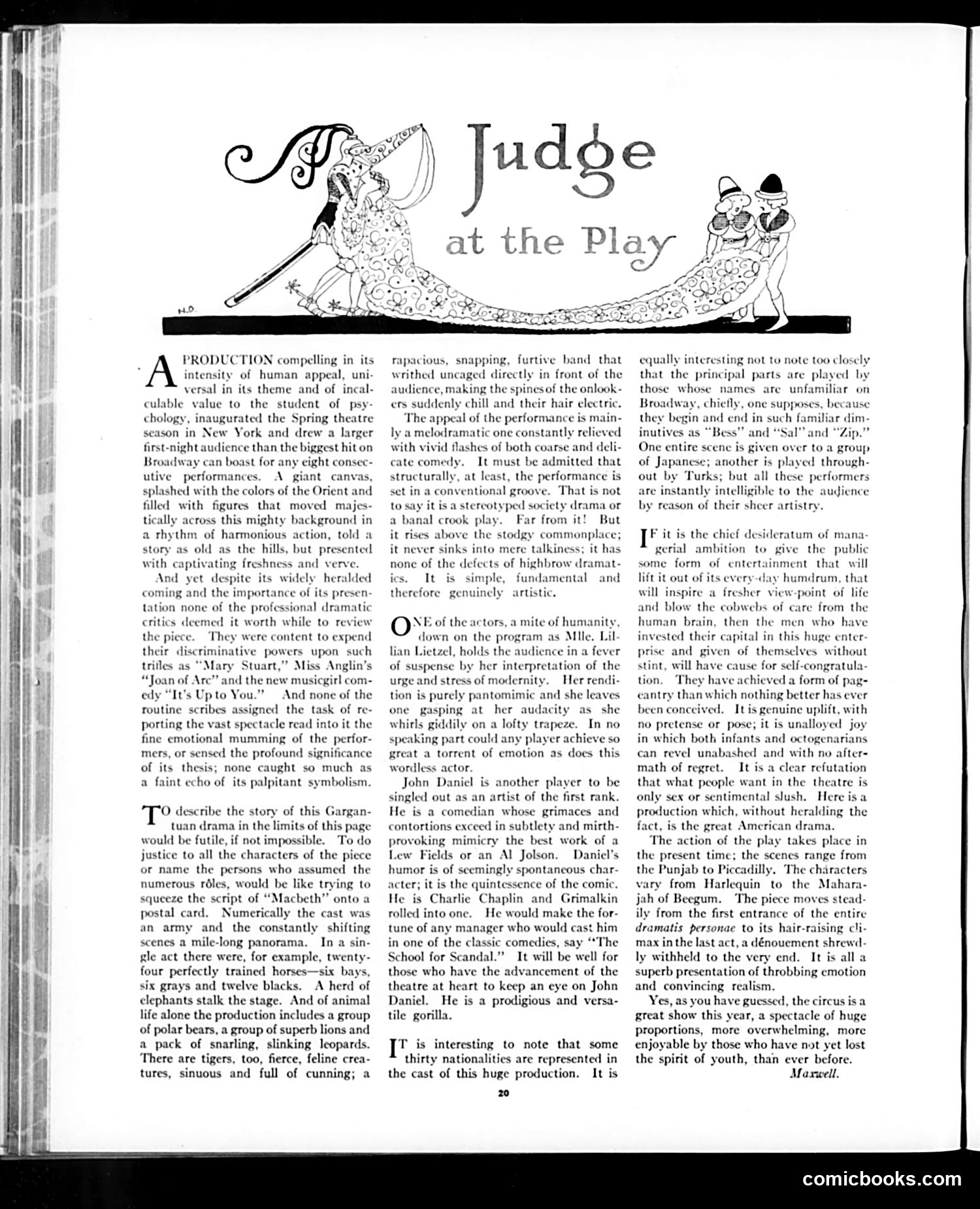
This page reviews a major theatrical production—likely *Macbeth* or a similar epic spectacle given the references to "thirty nationalities," massive animal acts (elephants, lions, leopards, tigers), and elaborate staging. The cartoon header depicts a judge character observing the theatrical extravaganza. The article criticizes New York's drama critics for ignoring this ambitious production while reviewing lesser "society dramas" like *Mary Stuart* and *Joan of Arc*. Judge argues the critics failed to recognize the show's artistic merit and emotional depth, particularly praising performer Lillian Lietzel's pantomime and John Daniel's comedic acting as comparable to Charlie Chaplin and Grimalkin. The satire targets critical snobbery: professional reviewers overlooked a genuinely innovative production to cover trivial commercial theater instead. The "judge" presumably represents the magazine itself, offering superior critical judgment.
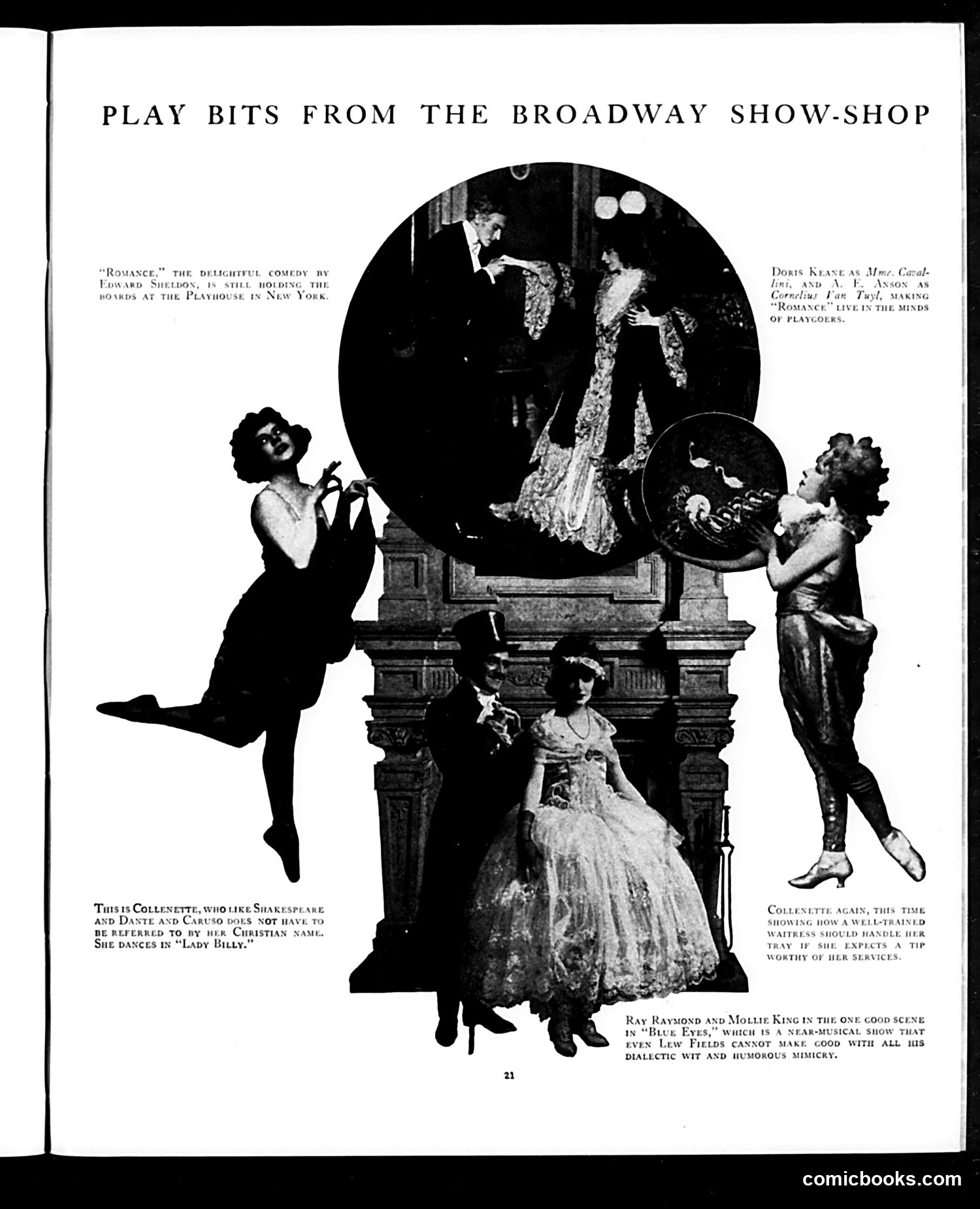
This page features theatrical commentary on contemporary Broadway productions. It highlights scenes from "Romance," a comedy by Edward Sheldon running at the Playhouse in New York, showcasing performers like Doris Keane and A.E. Anson. The satirical element mocks theatrical conventions: one caption jokes that a character named Collenette shouldn't be called by her Christian name (unlike Shakespeare or Dante), while another quips that a waitress character demonstrates proper tipping etiquette. A final jab at "Blue Eyes"—described as a "near-musical show"—suggests that even performer Lew Fields' wit and humor cannot salvage it. The overall tone is light mockery of Broadway's pretensions and formulaic productions of the era, typical of Judge's theatrical commentary for sophisticated readers.
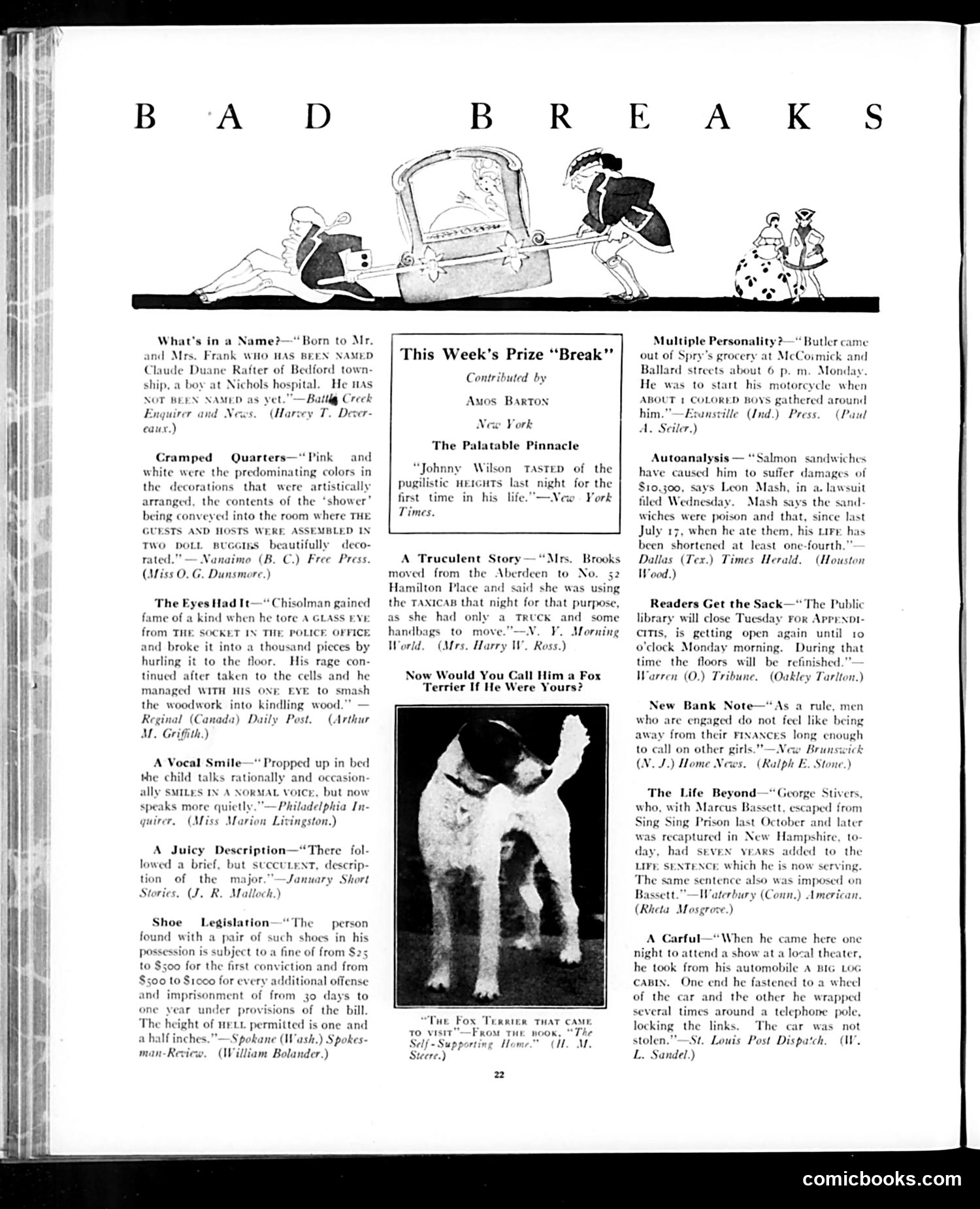
This page from *Judge* magazine features humorous short items culled from newspapers—a recurring feature highlighting absurd or unintentionally funny newspaper excerpts. The cartoon at top illustrates the concept: a man opens a car hood and discovers a baby inside, captioning the chaos of "breaks" (misfortunes or comic mishaps). The text items below mock newspaper reporting errors and bizarre stories. Examples include: - A hospital birth announcement that neglects to name the newborn - A baby shower held inside toy doll buggies due to cramped quarters - A man who smashed his glass eye in a rage - Absurd legal language about shoe possession penalties - A boxer tasting "pugilistic heights" (awkward phrasing) - A man who stole a log cabin from a car at a theater The satire targets both journalistic carelessness and the genuinely strange events newspapers reported. The humor relies on readers recognizing the unintentional comedy in these real newspaper clippings—the magazine's specialty was exposing American journalism's peculiarities and the odd incidents it covered.
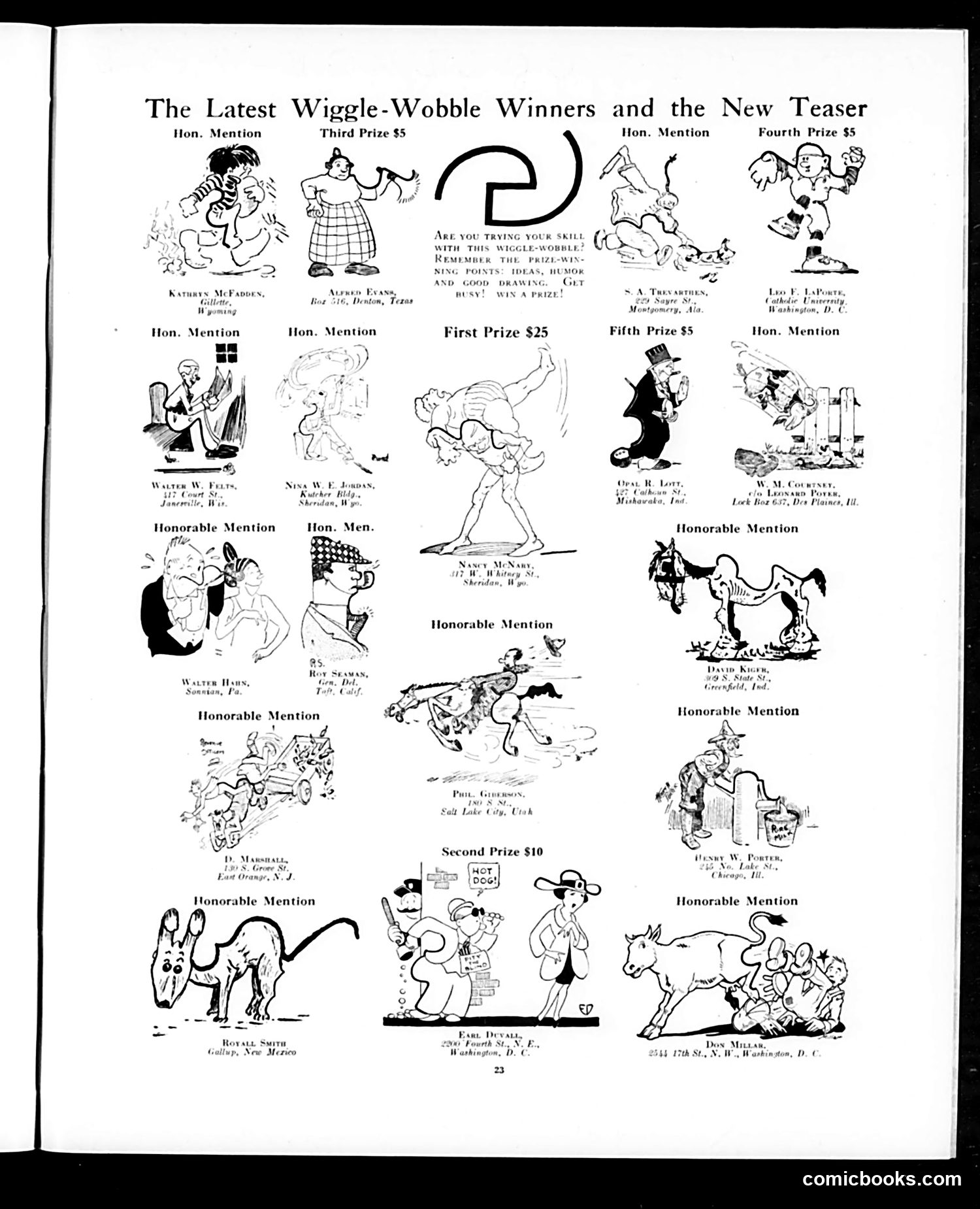
This page showcases results from Judge magazine's "Wiggle-Wobble" drawing contest—a competition inviting readers to submit humorous cartoons based on a specific visual prompt (the curved shape shown at top). The page displays winning entries and honorable mentions, each credited to named artists from across America. Prize amounts ($25 for first place down to $5 for fourth) incentivized participation. The contest explicitly judged submissions on "ideas, humor and good drawing." This represents a common early-20th-century magazine practice: leveraging reader participation for content while building audience engagement. The cartoons themselves—depicting everyday scenes with comedic exaggeration—reflect the visual humor style typical of Judge, which specialized in satirical and lighthearted social commentary rather than hard political critique. The page is essentially a results announcement combined with portfolio display of amateur and semi-professional cartoonists.
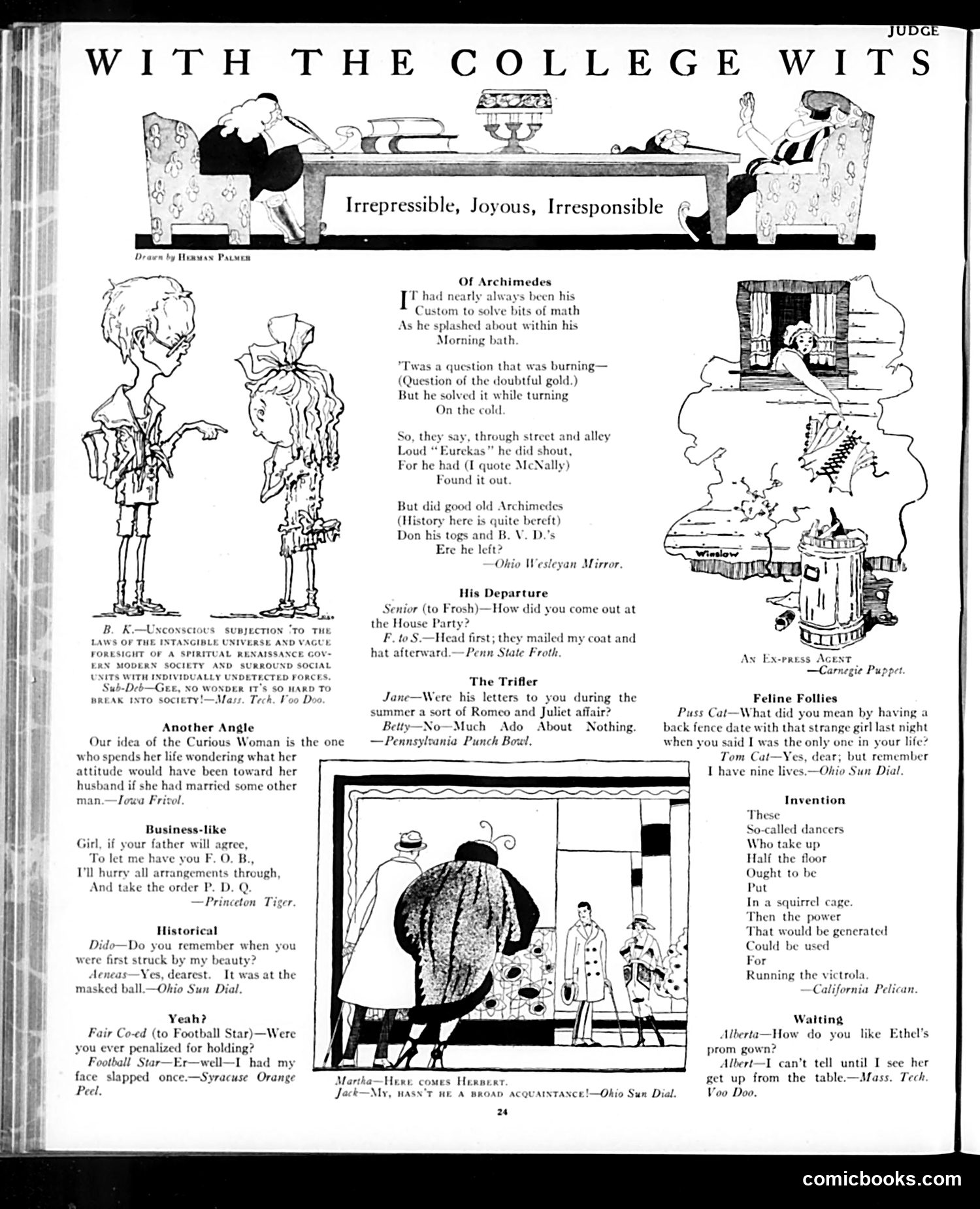
This page collects humorous short jokes and witticisms from various college newspapers, a common Judge feature. The content reflects early 20th-century college humor: sexually suggestive innuendo (the "back fence date" joke, the cat's "nine lives"), class anxieties (the lengthy parody of pseudo-intellectual pretension about breaking into society), and gentle mocking of romantic and social conventions. The Archimedes poem is straightforward classical allusion humor. Most other jokes target dating etiquette, gender relations, and social climbing—preoccupations of the college-bound. The illustration shows a woman in a coat at what appears to be a dance or party, presumably arriving in an undignified manner (head-first?), matching the "House Party" joke below. The satire assumes readers familiar with college social rituals and the anxieties surrounding them.
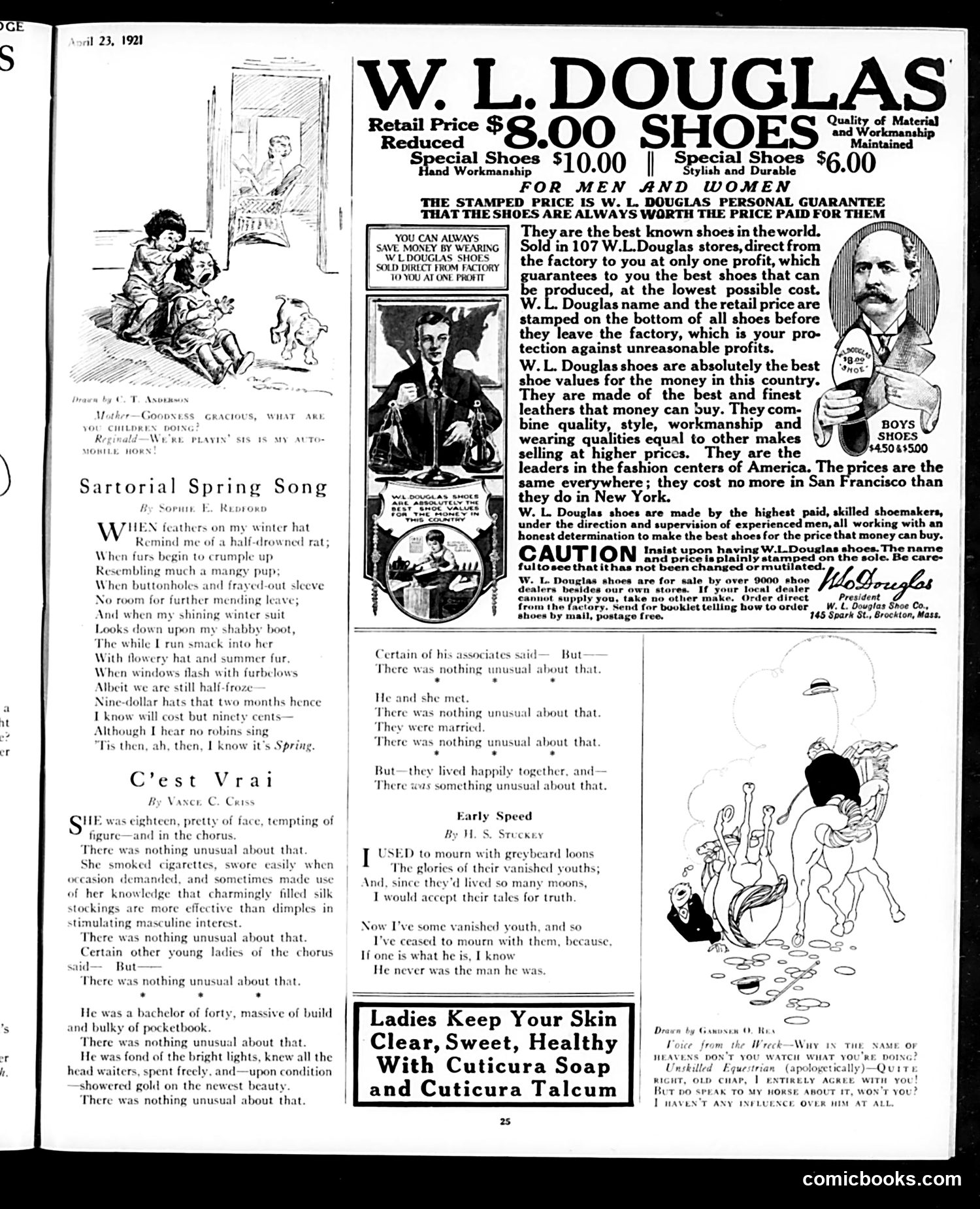
This page is primarily **commercial advertising** for W.L. Douglas shoes, a major American brand of the era. The large advertisement occupies most of the right side, emphasizing mass-production efficiency and value pricing ($8.00 retail, reduced from higher prices). The left side contains lighter entertainment content: a small cartoon showing children playing with a toy automobile (captioned as a "sartorial spring song"), and several short poems/stories with repetitive, tongue-in-cheek themes about unremarkable romance and aging. One poem mocks spring fashion's expense; another plays on the phrase "there was nothing unusual about that" to humorously build to unexpected punchlines about marriage and youth. The **Cuticura Soap advertisement** at the bottom represents typical period beauty marketing. The content reflects 1920s consumer culture, emphasizing standardized mass manufacturing, affordable ready-to-wear goods, and light domestic humor—typical of Judge's mix of satire and advertising during this era.
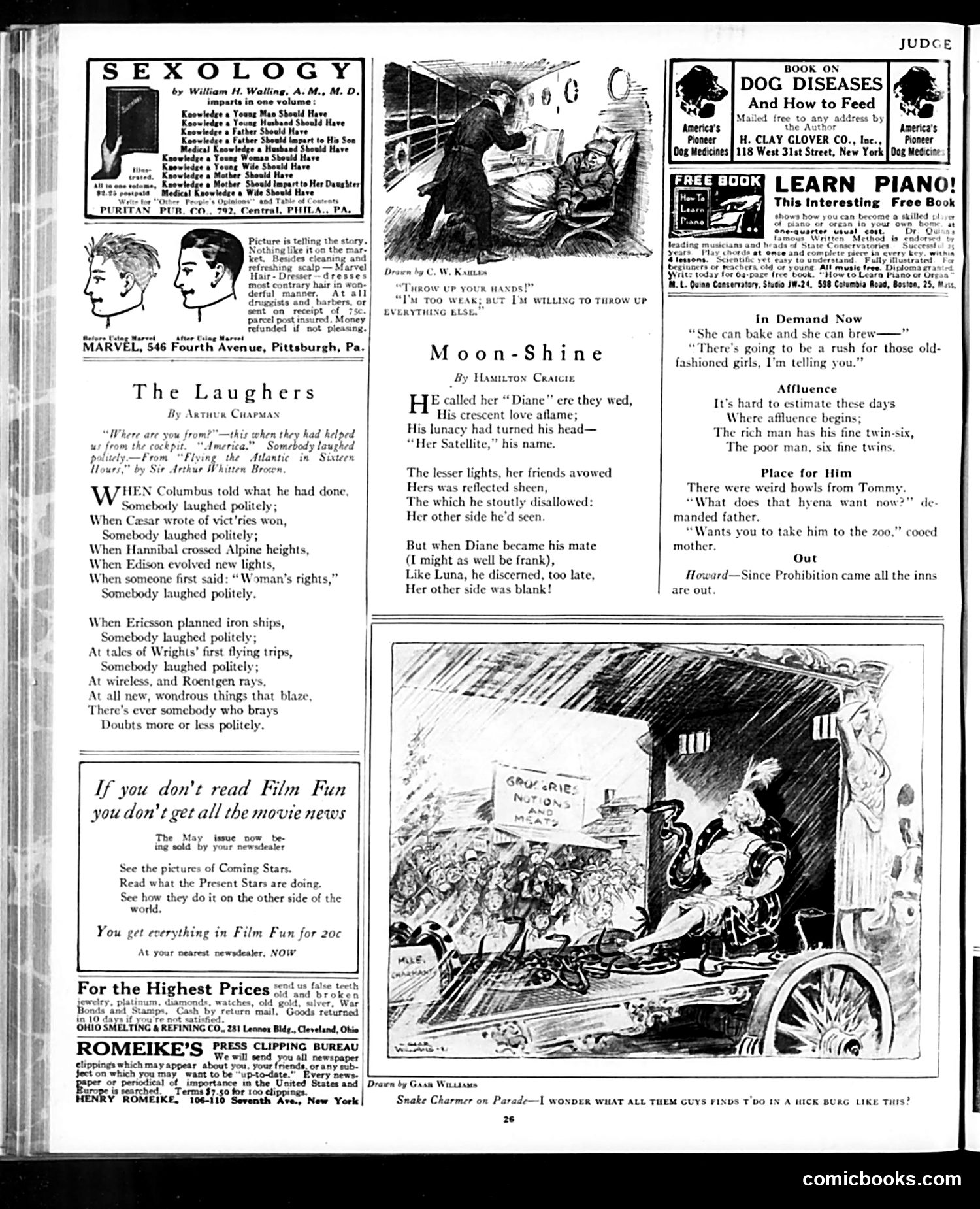
This page contains satirical poetry, advertisements, and comics typical of early 20th-century American humor. **"The Laughers"** by Arthur Chapman is a poem mocking humanity's tendency to dismiss innovation. It catalogs great historical achievements—Columbus, Caesar, Hannibal, Edison, woman's suffrage, iron ships, wireless, flight—noting that "somebody laughed politely" at each. The satire targets closed-minded skeptics who dismiss progress. **"Moon-Shine"** by Hamilton Craigie is a romantic joke. A man calls his girlfriend "Diane" (goddess of the moon); after marriage, he discovers she has a dark side—a pun playing on the moon's hidden face and marriage disillusionment. **The cartoon by Gaar Williams** shows a snake charmer performing for an amazed crowd in what appears to be a small town, captioned with rural condescension: wondering what entertainment such unsophisticated people find interesting. The remaining content consists largely of **period advertisements** (for sexology books, dog medicine, piano lessons, film magazines) typical of Judge's commercial pages.
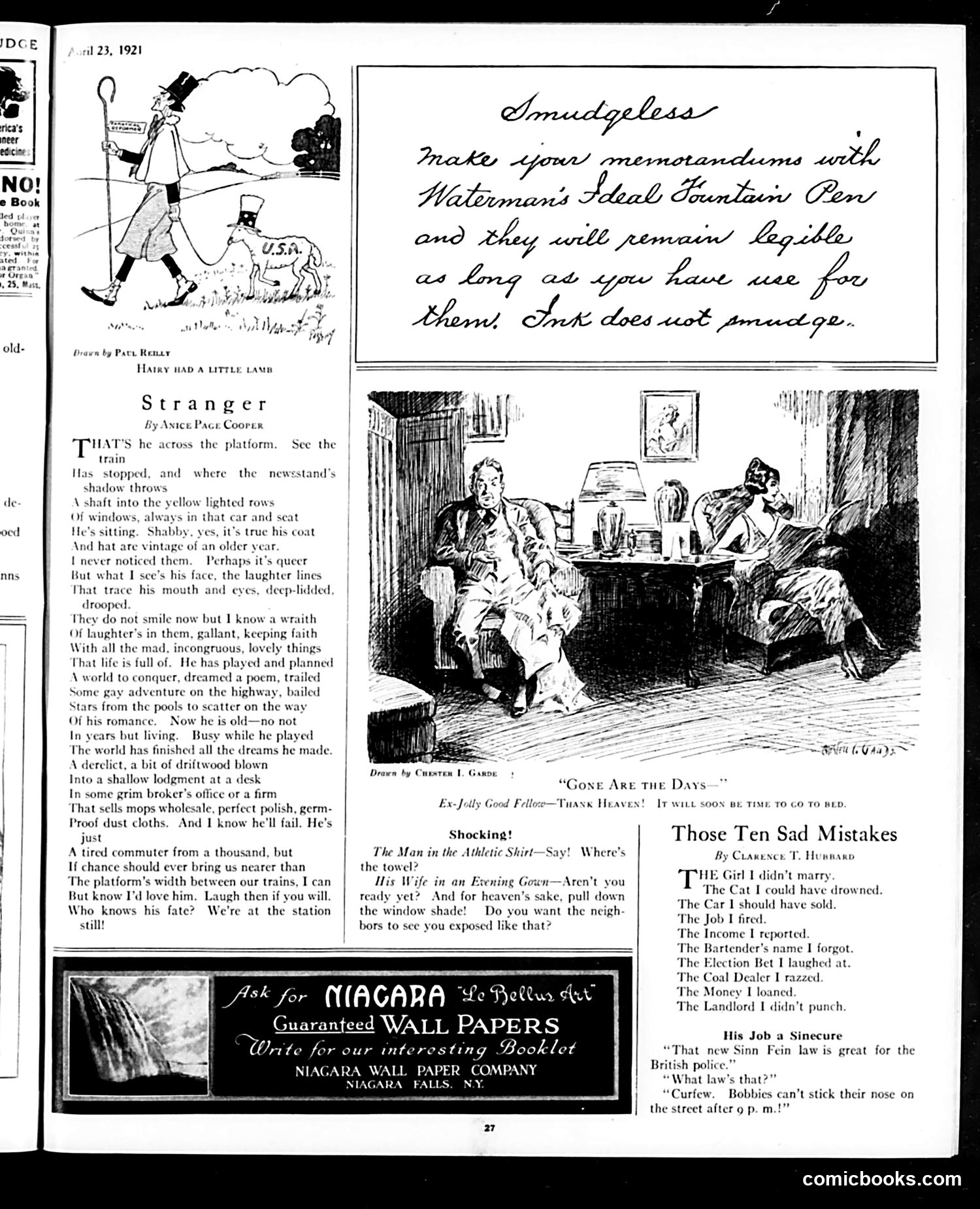
This page contains several satirical pieces typical of Judge's humor: **"Stranger"** (top left): A sentimental poem about observing a shabby, aging commuter on a train platform. The irony is that despite his worn appearance and failed life—now reduced to selling cleaning supplies wholesale—the narrator sees traces of his youthful dreams and romantic idealism. It's satirizing how modern industrial life crushes human aspiration. **"Shocking!"** (middle): A domestic humor cartoon mocking 1920s social propriety. A man in an undershirt prepares for bed while his dressed-up wife fusses about neighbors seeing him through the window—absurdly concerned with appearances while he's already in nightclothes. **"Those Ten Sad Mistakes"** and **"His Job a Sinecure"** (right): Brief comedic lists. The latter references the **Sinn Féin** and British curfew laws in Ireland (circa 1921), joking that Irish independence restrictions inadvertently benefit British police by preventing them from street patrols after 9 p.m. The page is primarily humor and advertising, reflecting post-WWI American satirical magazine conventions.
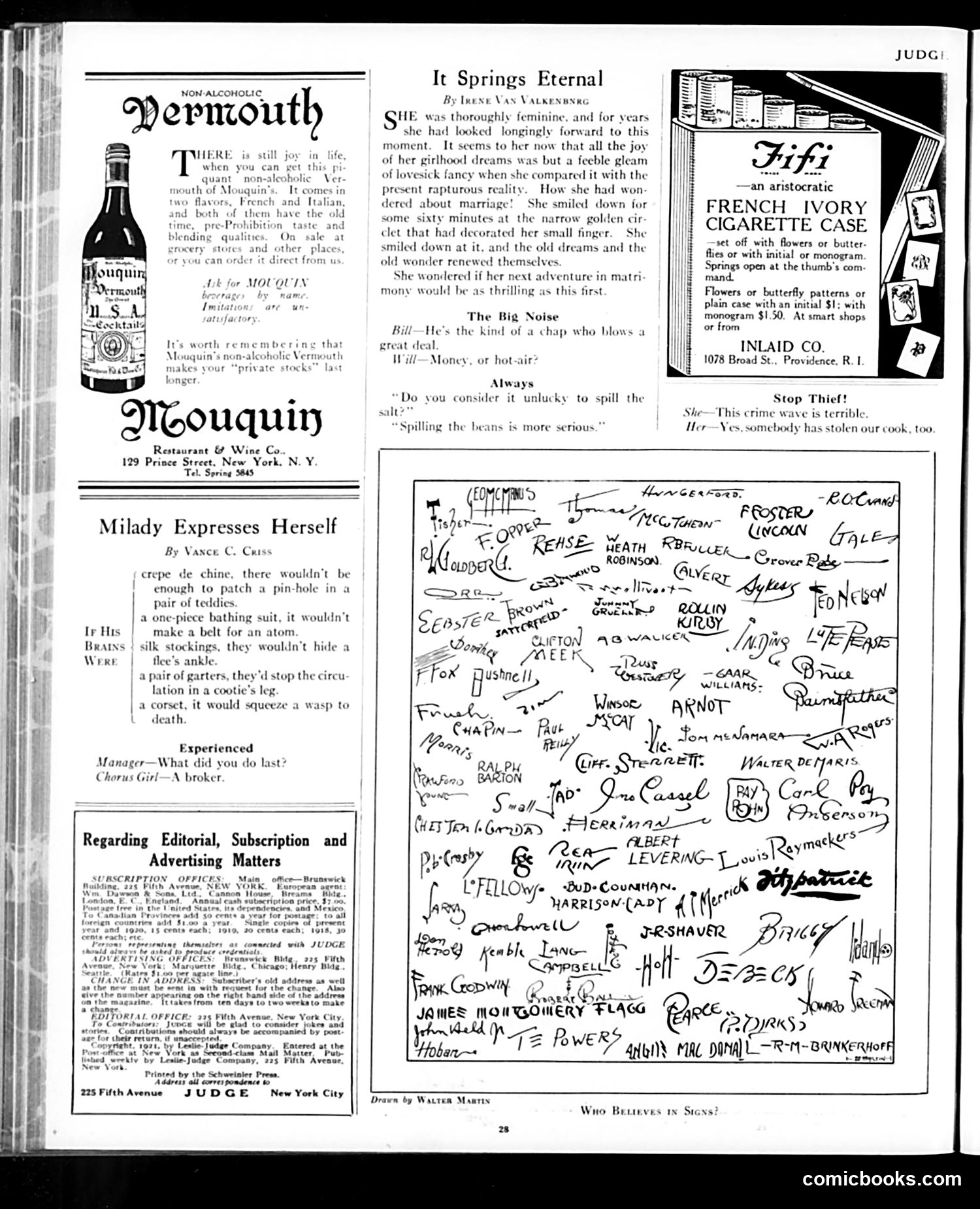
This page contains several short satirical pieces typical of Judge magazine's humor: **"Milady Expresses Herself"** mocks women's fashion and skimpy clothing by exaggerating how little fabric modern garments contain. The joke compares crepe de chine, bathing suits, silk stockings, and corsets unfavorably to their supposed functions—sarcastically suggesting they're so minimal they couldn't even patch teddies or hide an ankle. **"The Big Noise"** is a brief joke about a man who "blows a great deal"—playing on the dual meaning of boasting versus having actual substance (money or "hot-air"). **"Experienced"** offers a quick punchline: a manager asks a chorus girl what she did last, and she replies "A broker"—implying she seduced or financially ruined one. The page also includes advertisements for Vermouth and cigarette cases, subscription information, and a large illustration labeled "Who Believes in Signs?" featuring numerous handwritten names—likely a celebrity or social roster joke typical of Judge's content.
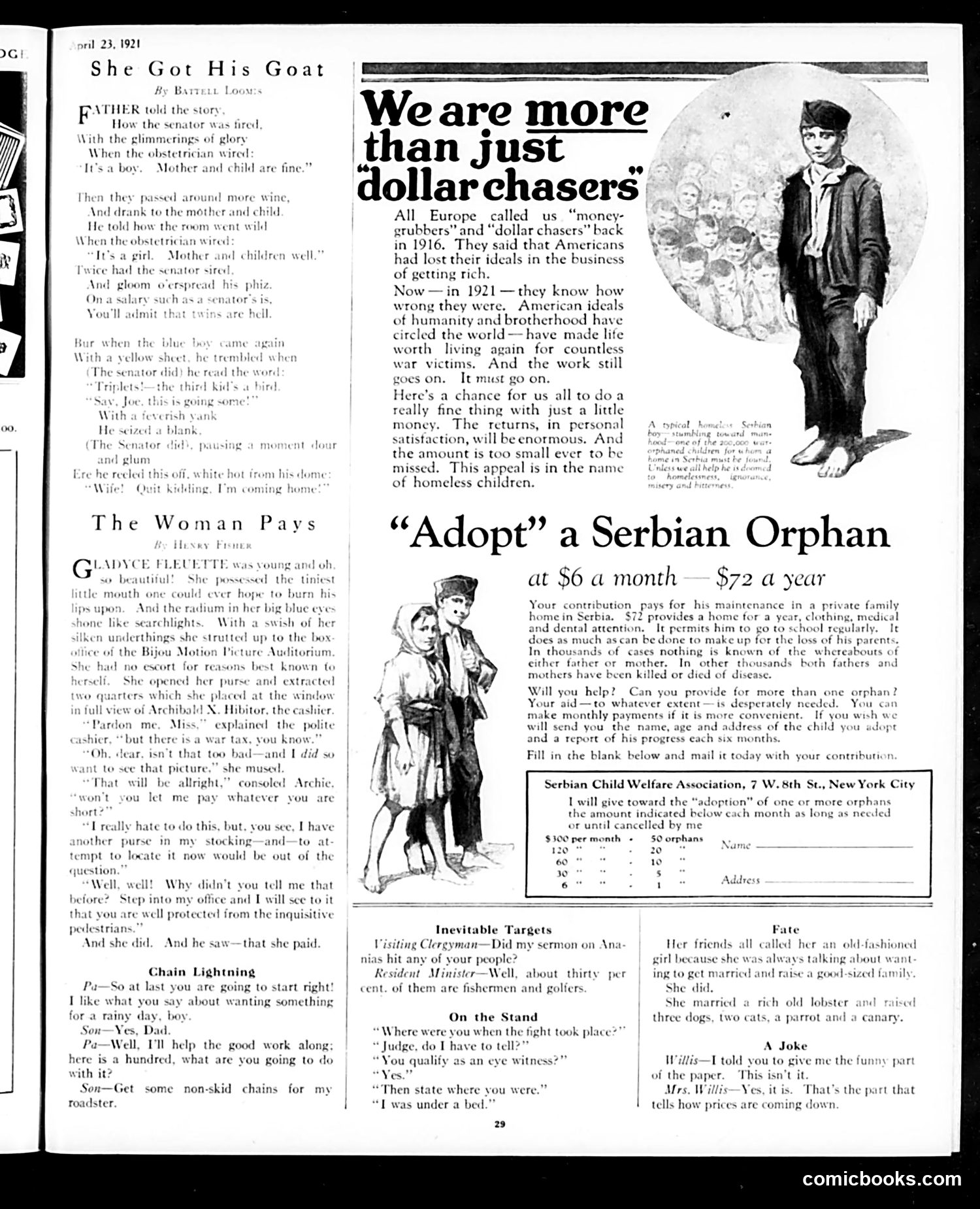
This page contains several short stories and a major charitable advertisement, reflecting post-WWI American concerns. **"She Got His Goat"** — A humorous poem about a senator who celebrates the birth of a son but is dismayed to learn he's fathered triplets instead, with the implication his reputation suffers from this embarrassment. **"The Woman Pays"** — A satirical story about a woman who enters a movie theater, flirts with the male cashier to avoid paying the new "tax" on admission, then ultimately pays anyway after being escorted to his office. The joke critiques both frivolous femininity and the cashier's attempted manipulation. **The dominant feature is an advertisement for "Adopt a Serbian Orphan"** — This reflects 1921 post-WWI relief efforts. The text directly addresses American "dollar chaser" criticism from Europe, arguing Americans have proven their humanitarian ideals by aiding war victims. It solicits $6/month ($72/year) contributions to support Serbian orphans. The smaller items ("Chain Lightning," "Inevitable Targets," etc.) are brief jokes about contemporary life and manners.
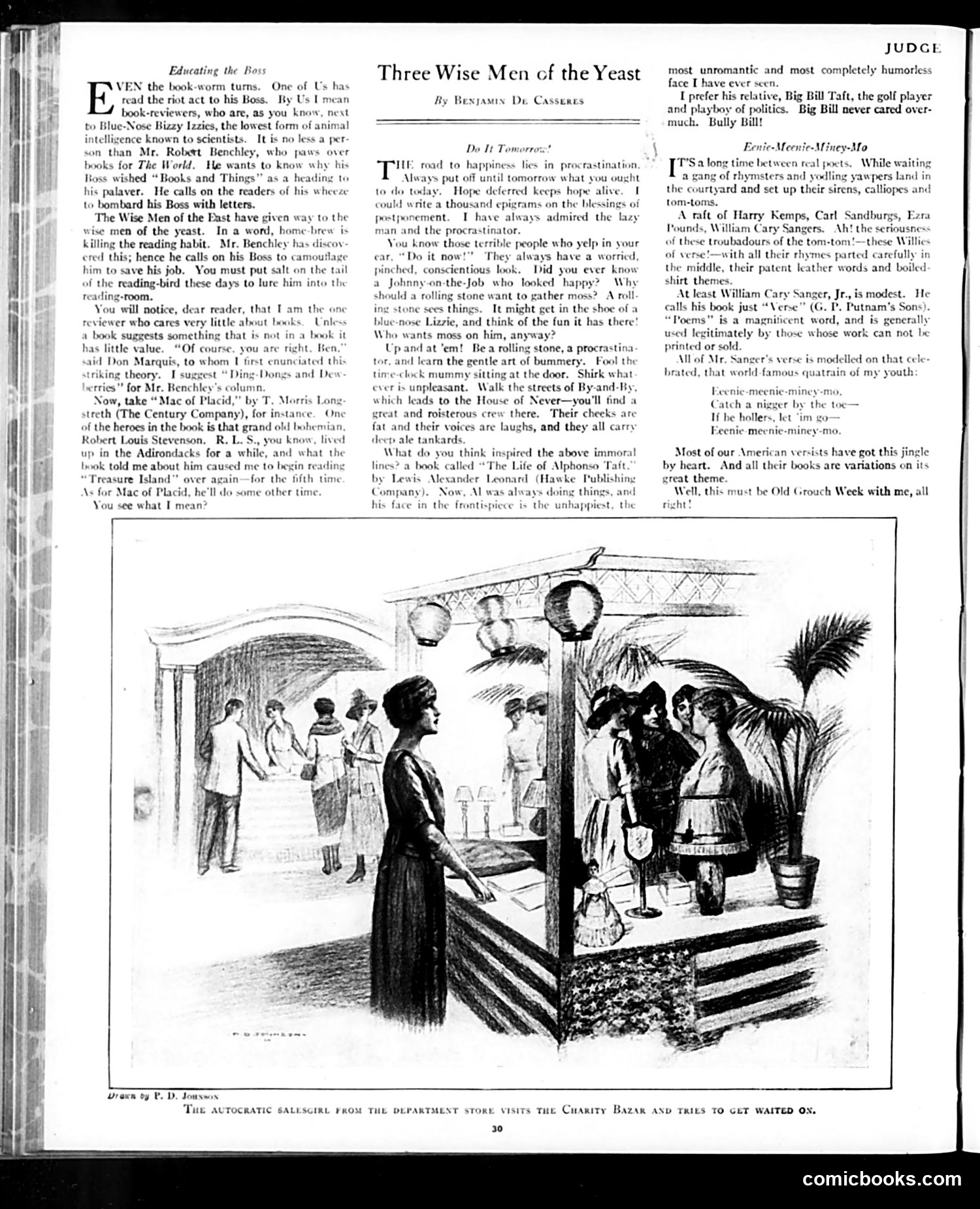
This page contains two satirical pieces mocking contemporary American attitudes and culture circa the 1920s. **"Educating the Boss"** criticizes book reviewers (specifically mentioning Robert Benchley of The World) for caring little about literature. The author argues reviewers prefer advertising content ("Books and Things") over serious book discussion, blaming "home-brew" (Prohibition-era illegal alcohol) for killing reading habits. **"Three Wise Men of the Yeast"** satirizes procrastination as a lifestyle, ironically celebrating laziness and avoiding work. It references a biography of Alphonso Taft, contrasting his humorless workaholism with his more appealing relative **Big Bill Taft** (William Howard Taft), the former president portrayed as a carefree golfer and "playboy of politics." **The cartoon** (credited to F. D. Johnson) depicts "an autocratic salesgirl from the department store visits the Charity Bazaar"—satirizing retail worker pretension in a public charity setting. The overall tone mocks modern American life: superficial book culture, work obsession versus idle pleasure, and social pretension.
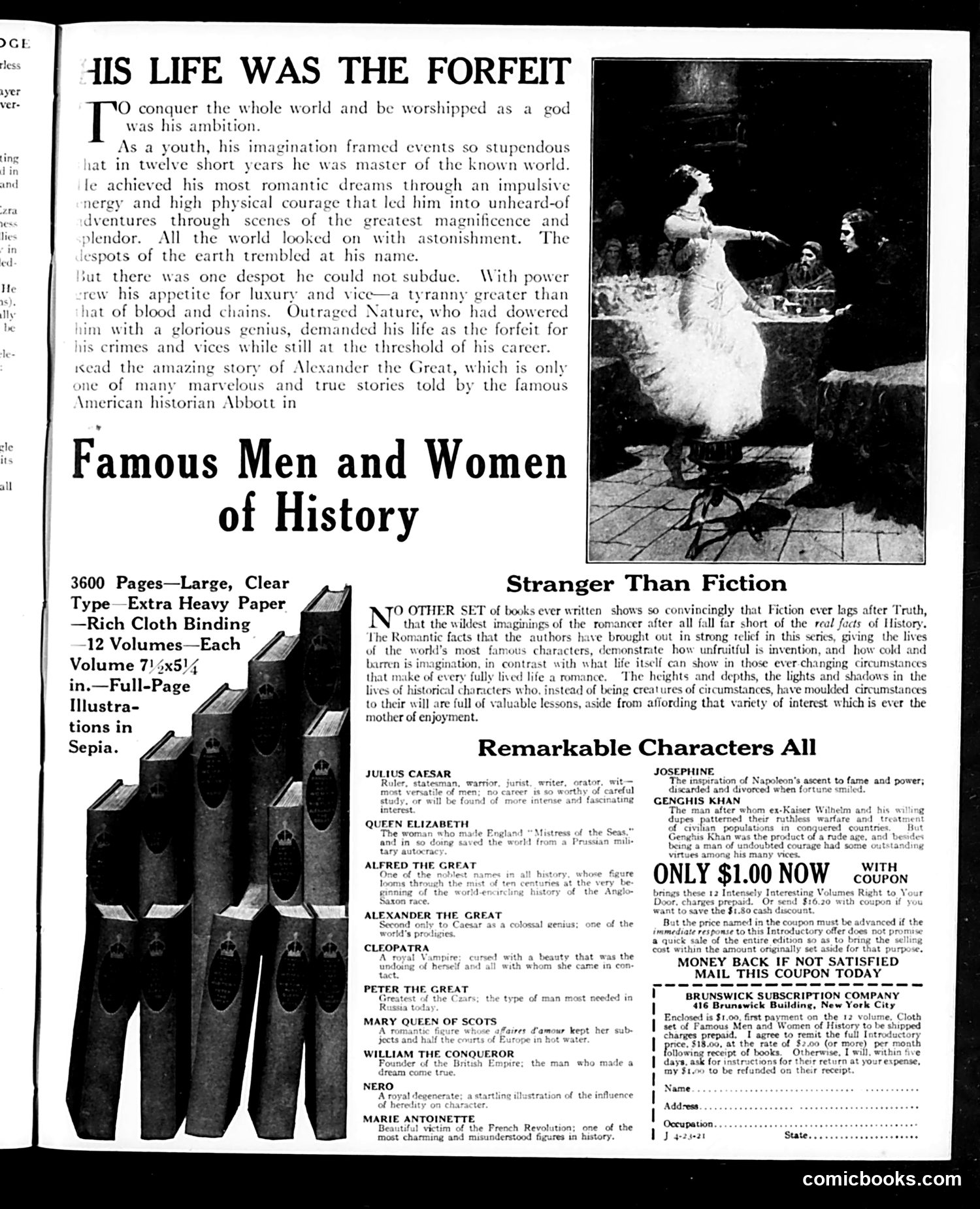
This is primarily an **advertisement**, not a political cartoon. It promotes "Famous Men and Women of History," a 12-volume encyclopedia set sold by Brunswick Subscription Company. The opening text uses **Alexander the Great** as a hook—describing his world conquest and ambition, then his downfall through vice and excess ("Outraged Nature" demands payment for his crimes). This is meant to entice readers: history contains dramatic human stories rivaling fiction. The ad emphasizes that real historical facts are "stranger than fiction" and more morally instructive than invented tales. Listed "Remarkable Characters" include Julius Caesar, Cleopatra, Alexander, Genghis Khan, and Marie Antoinette—famous figures whose lives demonstrate how individuals shape history. The accompanying photograph (right) appears to show a theatrical or promotional scene, likely meant to evoke the drama promised within the books. The coupon offers an introductory price of $1.00 for the first payment, with a money-back guarantee—typical early 20th-century subscription marketing tactics.
This is **not a cartoon or satirical piece**, but rather a **self-help advertisement** disguised as editorial content in Judge magazine. Alois P. Swoboda is promoting his "Subtle Principle of Success"—a vague, pseudoscientific life philosophy claiming to unlock wealth and well-being without effort, education, capital, or hard work. The pitch exploits desperation: he recounts his own misery (poverty, illness, failure) before discovering this miraculous principle. The page lists famous names (Roosevelt, Rockefeller, Carnegie, etc.) as alleged believers, a common marketing tactic of the era. Modern readers should recognize this as **early 20th-century snake oil**—promising effortless success through mysterious, unexplained means while remaining deliberately vague about what the "principle" actually is. The order form at bottom reveals the real agenda: selling his teachings, not sharing them freely. This predates modern self-help but uses identical manipulation tactics.