
Judge, 1921-04-23 · page 5 of 32
Judge — April 23, 1921 — page 5: what you’re looking at
What you’re looking at
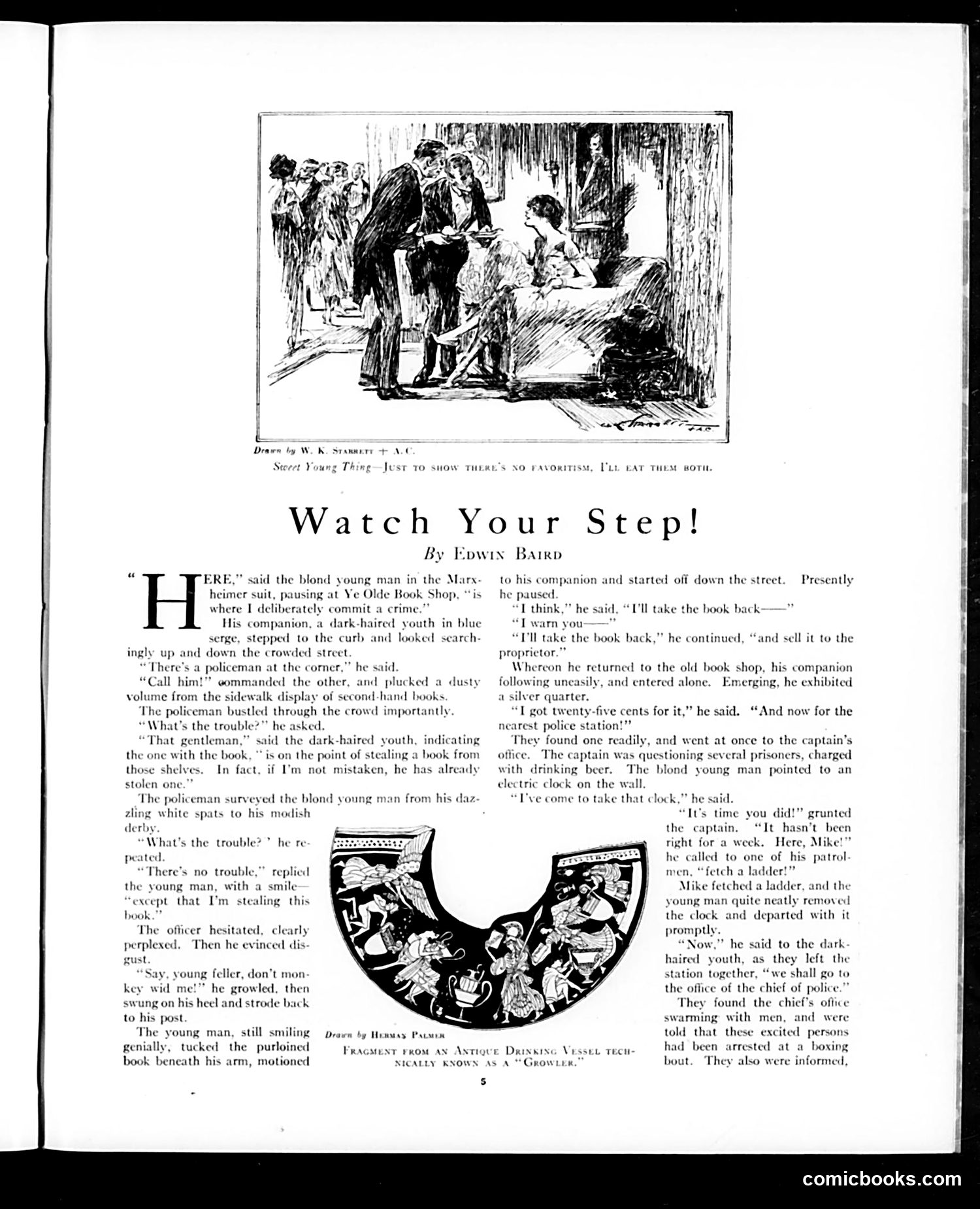
This page contains a short story by Edwin Baird rather than political satire. The narrative depicts two young men at an antiquarian bookshop—one attempting to steal a book while his companion watches nervously. When caught by a policeman, the thief confesses and is taken to the police station. The illustration shows the stolen book's interior decoration: "Fragment from an Antique Drinking Vessel technically known as a 'Growler.'" The story appears to be a morality tale about petty theft and its consequences, typical of Judge's lighter fare. The headpiece illustration by W.K. Stewart shows the scene of discovery. This is character-driven fiction rather than topical satire or political commentary.
📄 Transcribed text from this page (OCR, searchable)
Machine-transcribed from the original scan — historical spelling and the odd misread are preserved.
Drawn by W K. Sammons PAC Just To sHow THERE'S NO FAVORITE Tut car Tues worn. Watch Your Step! By Kowtx Baixo ERE,” said the blond young man in the Marx- heimer suit, pausing at Ye Olde Book Shop, “is where I deliberately commit a crime,” His companion, a dark-haired youth in blue serge, stepped to the curb and looked search- ingly up and down the crowded street “There's a policeman at the corner,” he said. “Call him!” gommanded the other, and plucked a dusty volume from the sidewalk display of second-hand books. The policeman bustled through the crowd importantly. “What's the trouble?” he asked. “That gentleman,” said the dark-haired youth, indicating the one with the book, * is on the point of stealing a book from those shelv In fact, if I'm not mistaken, he has already stolen one.” The policeman surveyed the zling white spats to his modish lond young man from his daz- derby “What's the peated “There's no trouble,” replied the young man, with a smile “except that I’m stealing this hook.”” The officer hesitated, clearly perplexed, Then he evinced dis gust. “Say, young feller, don’t mon- key wid me!” he growled, then swung on his heel and strode back to his post. The young man, still smiling genially, tucked the purloined book beneath his arm, motioned trouble? "he re Drawn by Wemaay Paisin Fracsent rrom aN Axtigve Darinninc NICALLY KNOWN AS A s to his companion and started off down the street. Presently he paused I think,” he said, “Ul take the book back “T warn you sd “T'll take the book back,” he continued, “and sell it to the proprietor.” Whereon he returned to the old book shop, his companion following uncasily, and entered alone. Emerging, he exhibited a silver quarter. “T got twent nearest police station!” ‘They found one readily, and went at once to the captain's otlice. The captain was questioning several prisoners, charged with drinking beer. The blond young man pointed to an electric clock on the wall. “T've come to take that clock,” he said. “Is time you did!” grunted the captain, “It hasn't been right for a week. Here, Mike!” he called to one of his patrol men, “fetch a ladder: Mike fetched a ladder, and the young man quite neatly removed the clock and departed with it promptly. “Now,” he said to the dark haired youth, as they left the station together, “we shall go to the office of the chief of police.” They found the chief's office swarming with men, and were told that these excited persons had been arrested at a boxing bout. They also were informed, five cents for it,” he said. “And now for the Vissen Tecu- “Growrer.” comicbooks.com