
Judge, 1921-04-23 · page 9 of 32
Judge — April 23, 1921 — page 9: what you’re looking at
What you’re looking at
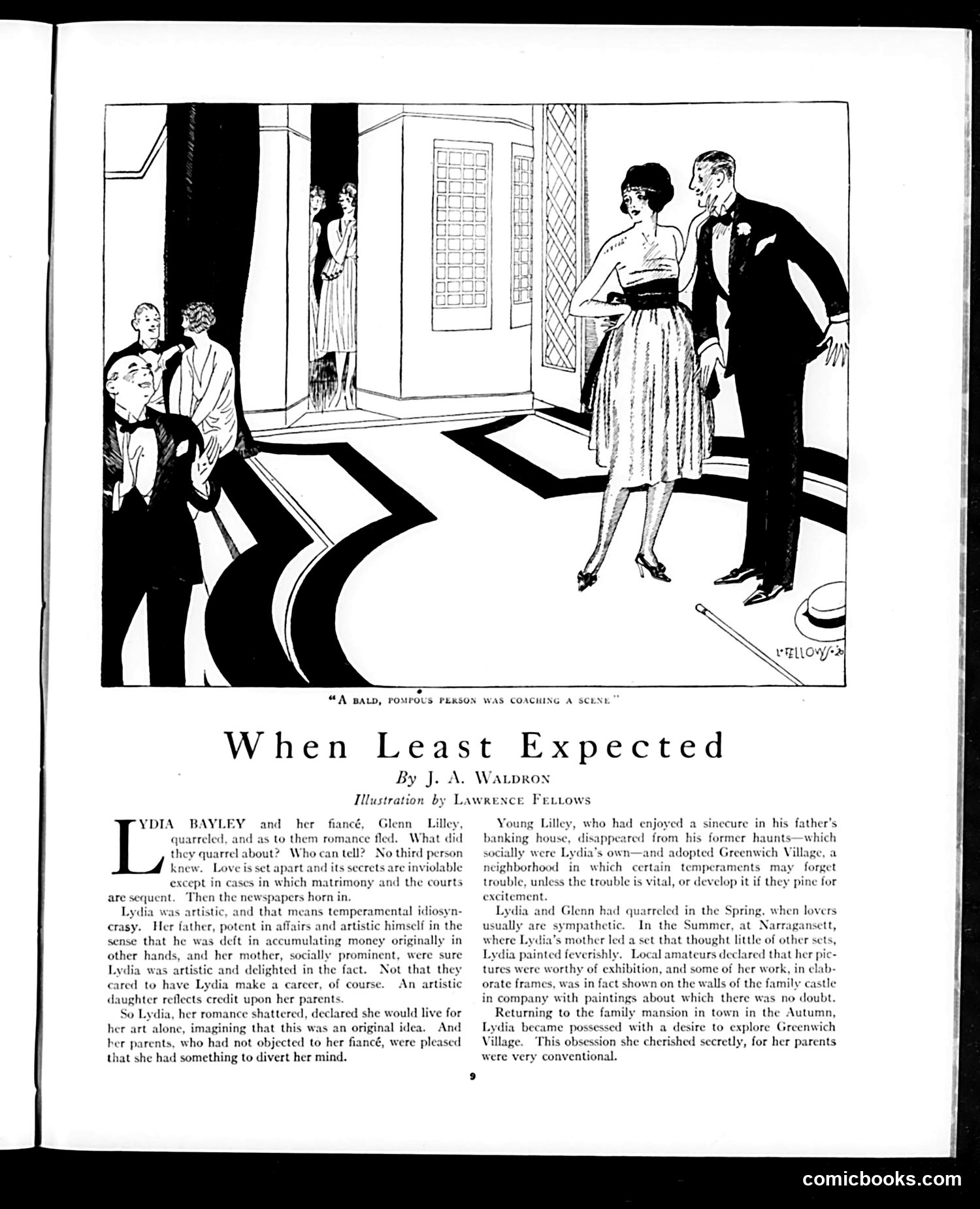
This is the opening page of a satirical short story, not a political cartoon. It mocks upper-class artistic pretension in 1920s America. **The Setup:** Lydia Bayley, a wealthy young woman from an established family, quarrels with her fiancé Glenn Lilley. She dramatically declares she'll live for art alone—an idea she imagines is original. Her parents, who view an "artistic daughter" as socially prestigious (though not a real career), approve. **The Satire:** The story ridicules how the idle rich perform bohemianism. Lydia "paints feverishly" at a summer resort, displaying her work in the family castle without serious merit. Glenn escapes to Greenwich Village (the actual bohemian neighborhood). The illustration shows their world of formal elegance—servants, stylish interiors—mocking the gap between their pretended artistic rebellion and their conventional, wealthy reality. The joke: their "artistic" identities are fashionable poses adopted by people too comfortable and privileged to genuinely sacrifice anything.
📄 Transcribed text from this page (OCR, searchable)
Machine-transcribed from the original scan — historical spelling and the odd misread are preserved.
vELoy/-a| “A BALD, POMPOUS PEKSON WAS COACHING A SCENE When Least Expected By J. A. Watpron Illustration by Lawrence Fettows BAYLEY and her fiancé, Glenn Lilley, quarreled, and as to them romance fled. What did they quarrel about? Who can tel No third person knew. Love is set apart and its secrets are inviolable except in cases in which matrimony and the courts YDIA are sequent. Then the newspapers horn in. Lydia was artistic, and that means temperamental idiosyn- crasy. Her father, potent in affairs and artistic himself in the sense that he was deft in accumulating moncy originally in other hands, and her mother, socially prominent, were sure Lydia was artistic and delighted in the fact. Not that they cared to have Lydia make a carcer, of course. An artistic daughter reflects credit upon her parents. So Lydia, her romance shattered, declared she would live for her art alone, imagining that this was an original idea. And her parents, who had not objected to her fiancé, were pleased that she had something to divert her mind. ng Lilley, who had enjoyed a sinecure in his father’s nking house, disappeared from his former haunts—which lly were Lydia’s own—and adopted Greenwich Village, a neighborhood in which certain temperaments may forget trouble, unless the trouble is vital, or develop it if they pine for excitement. Lydia and Glenn had quarreled in the Spring. usually are sympathetic. In the Summer, at Narragansett, where Lydia’s mother led a set that thought little of other sets, Lydia painted feverishly. Local amateurs declared that her pic- tures were worthy of exhibition, and some of her work, in elab- orate frames, was in fact shown on the walls of the family castle in company with paintings about which there was no doubt. Returning to the family mansion in town in the Autumn, Lydia became possessed with a desire to explore Greenwich Village. This obsession she cherished secretly, for her parents were very conventional. hen lovers comicbooks.com