
Judge, 1921-04-23 · page 8 of 32
Judge — April 23, 1921 — page 8: what you’re looking at
What you’re looking at
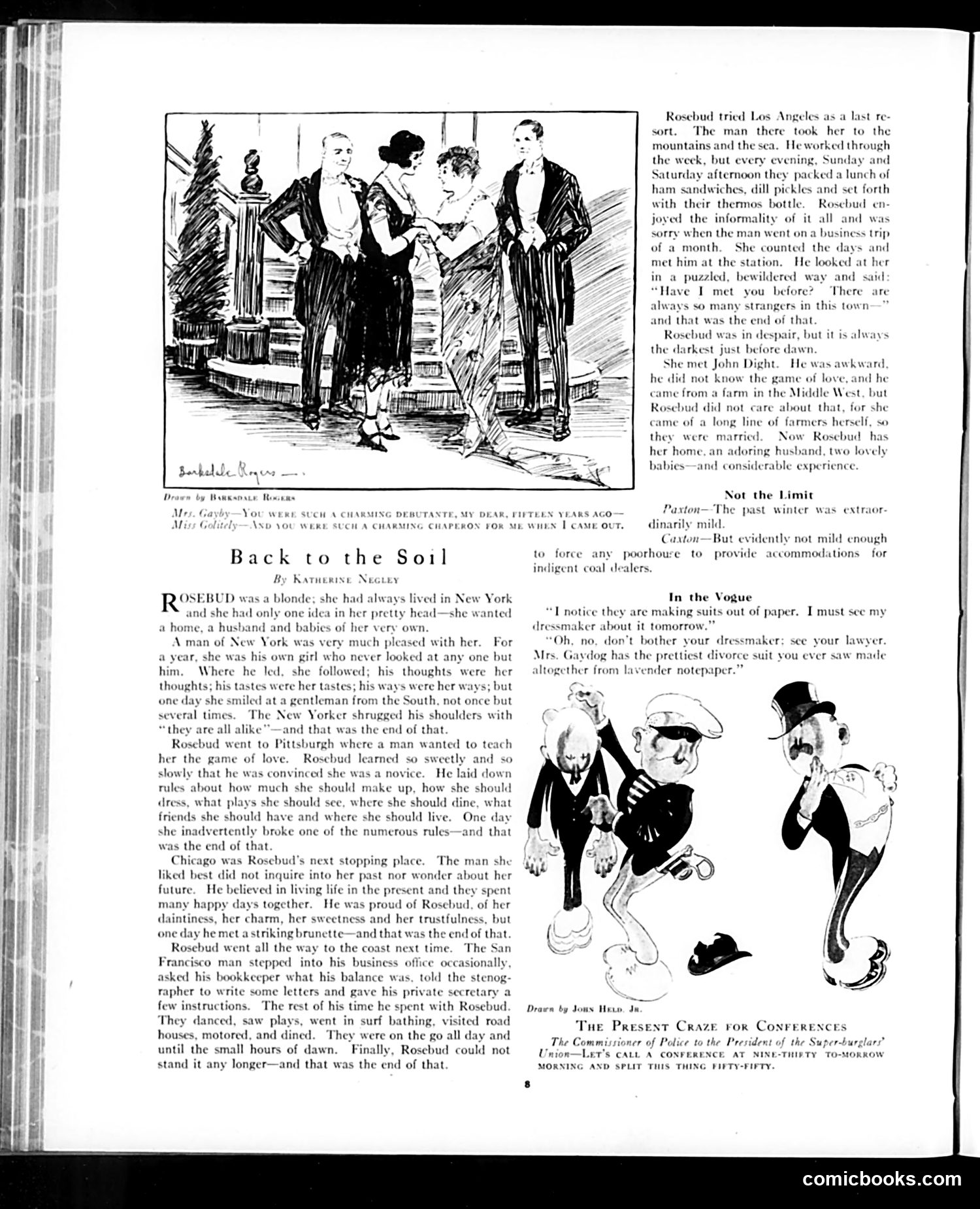
**The Main Story: "Back to the Soil"** This satirical narrative follows Rosebud, a naive young woman seeking marriage and domestic stability. The joke chronicles her romantic failures across American cities—New York, Pittsburgh, Chicago, and San Francisco—where each man abandons her when she inevitably disappoints him or he spots another woman. The satire targets early 20th-century gender expectations: Rosebud is portrayed as desirable precisely because she's obedient and malleable, yet this very passivity dooms her relationships. Only the unsophisticated farmer John Dight, from humble origins, accepts her unconditionally. The ironic title suggests returning to rural simplicity as the antidote to urban sophistication's failures. **The Cartoon and Sidebar Jokes** The illustration depicts fashionable society figures discussing past acquaintances. The sidebar humor mocks divorce culture among the wealthy—particularly Mrs. Gaydog's "prettiest divorce suit made from lavender notepaper," satirizing how casually the rich treat matrimonial dissolution. Overall, the page critiques both male fickleness and female dependence while suggesting that authentic happiness requires rejecting urban pretense.
📄 Transcribed text from this page (OCR, searchable)
Machine-transcribed from the original scan — historical spelling and the odd misread are preserved.
<a 5S Sees Droen by Boassosce Rockas Mrs. Ga Y Miss Golitel, TANTE CHAPERON cH ACH NG DEB MY DEAR, UCH A CHARMING Back to the Soil By Katnerixe Nec R‘ JSEBUD was a blonde; she had always lived in New York and she had only one idea in her pretty head—she wanted babies of her very own 1 with her. EY ne, a husband and A man of New York was very much pleas a year, she was his own girl who never looked at any one but him. Where he led, she followed; his thoughts were her thoughts; his tastes were her tastes; his ways were her ways; but one day she smiled at a gentleman from the South, not once but several times. The New Yorker shrugged his shoulders with “they are all alike—and that was the end of that Rosebud went to Pittsburgh where a man wanted to teach Rosebud learned so sweetly and so He laid down For ae SSS eee Ss a eee her the game of love slowly that he was convinced she was a novice ae rules about how much she should make up, how she should | dress, what plays she should see, where she should dine, what | friends she should have and where she should live. One day she inadvertently broke one of the numerous rules—and that was the end of that Chicago was Roscbud’s next stopping place liked best did not inquire into her past nor wonder about her future. He believed in living life in the present and they spent many happy day's together. He was proud of Rosebud, of her daintiness, her charm, her sweetness and her trustfulness, but one day he met a striking brunette—and that was the end of that. { Rosebud went all the way to the coast next time. The San Francisco man stepped into his business office occasionally, asked his bookkeeper what his balance was. told the stenog- rapher to write some letters and gave his private secretary a q. few instructions. The rest of his time he spent with Rosebud. They danced, saw plays, went in surf bathing, visited road houses, motored, and dined. They were on the go all day and until the small hours of dawn. Finally, Rosebud could not stand it any longer—and that was the end of that The man she rirt FOR MEY Rosebud tried Los Angeles as a last re- sort. The man there took her to the mountains and the sea. He worked through the week, but every evening, Sunday and Saturday afternoon they packed a lunch of ham sandwiches, dill pickles and set forth with their thermos bottle. Rosebud en- joyed the informality of it all and was sorry when the man went ona business trip of a month. She counted the days and met him at the station. He looked at her in a puzzled, bewildered way and said “Have I met you before? There are always so many strangers in this town and that was the end of that »sebud was in despair, but it is « rkest just before dawn. met John Dight. He was awkward he did not know the game of love, and he came from a farm in the Middle West, but care about that, for she line of farmers herself, so ow Rosebud band, two lovely ways sebud did ne a lon married of came they her home. an adoring onsiderable experience were has babies—and Not the Limit Paxton—The dinarily mild. Caaton—But evidently not mild cnough to for én VR RRAGS: past winter was extraor x I came out. poorhoure provide accommodations to indigent coal dealers. force any In the Vogue “T notice they are making suits out of dressmaker about it tomorrow.” Oh, no, don’t bother your dressmaker; see your lawyer. Mrs. Gaydog has the prettiest divorce suit you ever saw made altogether from lavender notepaper.” uper. I must see my Drawn by Jous Haro. Jn. Tue Present Craze The Commissioner of Police to the President Let's CALL A CONFERENCE AT NINE-THIPTY AND SPLIT THIS THING FIPTY-FIFTY. FOR CONFERENCES TO-MORROW Union MORNING comicbooks.com