
Judge, 1921-04-23 · page 20 of 32
Judge — April 23, 1921 — page 20: what you’re looking at
What you’re looking at
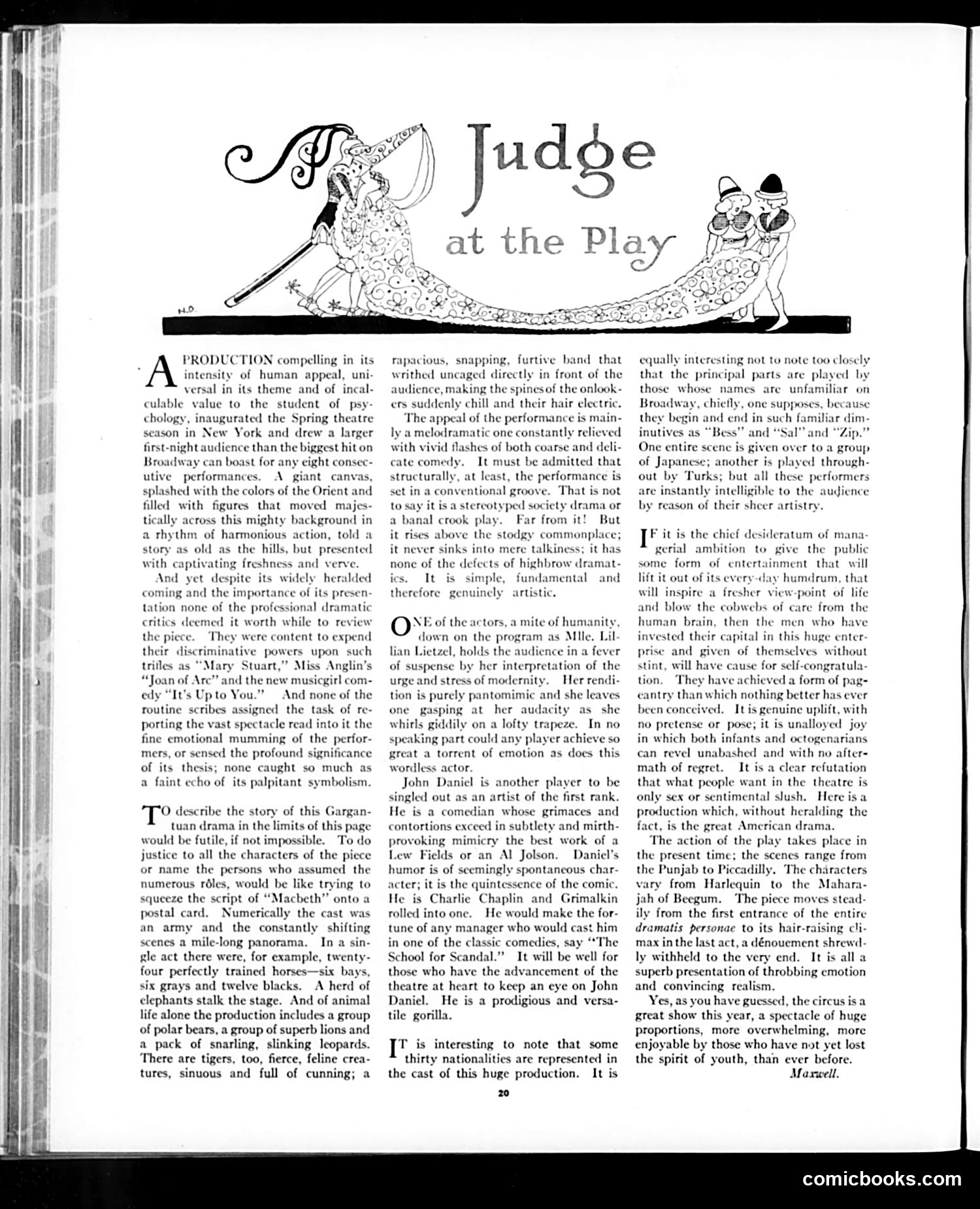
This page reviews a major theatrical production—likely *Macbeth* or a similar epic spectacle given the references to "thirty nationalities," massive animal acts (elephants, lions, leopards, tigers), and elaborate staging. The cartoon header depicts a judge character observing the theatrical extravaganza. The article criticizes New York's drama critics for ignoring this ambitious production while reviewing lesser "society dramas" like *Mary Stuart* and *Joan of Arc*. Judge argues the critics failed to recognize the show's artistic merit and emotional depth, particularly praising performer Lillian Lietzel's pantomime and John Daniel's comedic acting as comparable to Charlie Chaplin and Grimalkin. The satire targets critical snobbery: professional reviewers overlooked a genuinely innovative production to cover trivial commercial theater instead. The "judge" presumably represents the magazine itself, offering superior critical judgment.
📄 Transcribed text from this page (OCR, searchable)
Machine-transcribed from the original scan — historical spelling and the odd misread are preserved.
PRODUCTION compelling in its intensity of human appeal, uni- versal in its theme and of incal- culable value to the student of psy chology, inaugurated the Spring theatre season in New York and drew a larger first-night audience than the biggest hiton Broadway can boast for any eight consec- utive performances. A giant canvas, splashed with the colors of the Orient and filled with figures that moved majes- tically across this mighty background in a rhythm of harmonious action, told a story as old the hills, but presented with captivating freshness and verve. And yet despite its widely heralded coming and the importance of its presen. tation none of the professional dramatic critics deemed it worth while to review the piece. They were content to expend their discriminative powers upon such trifles as “Mary Stuart,” Miss Anglin’s “Joan of Arc” and the new musicgirl com- edy “It's Upto You.” And none of the routine scribes assigned the task of re- porting the vast spectacle read into it the fine emotional mumming of the perfor- mers, or sensed the profound significance of its thesis; none caught so much as a faint echo of its palpitant symbolism. T° describe the story of this Gargan- tuan drama in the limits of this page would be futile, if not impossible. To do justice to all the characters of the piece or name the persons who assumed the numerous réles, would be like trying to squeeze the script of “Macbeth” onte postal card. Numerically the cast was an army and the constantly shifting scenes a mile-long panorama. In a sin- gle act there were, for example, twenty- four perfectly trained horses—six bays, six grays and twelve blacks. A herd of elephants stalk the stage. And of animal life alone the production includes a group of polar bears, a group of superb lions and a pack of snarling, slinking leopards. There are tigers, too, fierce, feline crea- tures, sinuous and full of cunning; a rapacious, snapping, furtive band that writhed uncaged directly in front of the audience, making the spines of the onlook- ers suddenly chill and their hair electri The appeal of the performance is main- ly a melodramatic one constantly relieved with vivid flashes of both coarse and deli- cate comedy. It must be admitted that structurally, at least, the performance is set in a conventional groove. That is not to say it is a stereotyped society drama or a banal crook play. Far from it! But it rises above the stodgy commonplac it never sinks into mere talkiness; it has efects of highbrow dramat- amental and none of the ics. It is simple, fun therefore genuinely artistic. NE of the actors, a mite of humanity, down on the program as Mlle. Lil lian Lietzel, holds the audience in a fever of suspense by her interpretation of the urge and stress of modernity. Her rendi- tion is purely pantomimic and she leaves one gasping at her audacity as she whirls giddily on a lofty trapeze. In no speaking part could any player achieve so great a torrent of emotion as does this wordless actor. John Daniel is another player to be singled out as an artist of the first rank. He is a comedian whose grimaces and contortions exceed in subtlety and mirth- provoking mimicry the best work of Lew Fields or an Al Jolson. Daniel's humor is of seemingly spontancous char- acter; it is the quintessence of the comic, He Charlie Chaplin and Grimalkin rolled into one. He would make the for- tune of any manager who would cast him in one of the classic comedies, say ‘The School for Scandal.” It will be well for those who have the advancement of the theatre at heart to keep an eye on John Daniel. He is a prodigious and versa- tile gorilla. T is interesting to note that some thirty nationalities are represented in the cast of this huge production. It is 20 equally interesting not to note too closely that the principal parts are played by those whose names are unfamiliar on Broadway, chiefly, one supposes, because they begin and end in such familiar dim- inutiv s “Bess” and “Sal” and “Zip.” One entire scene is given over to a group of Japanese; another is played through- out by Turks; but all these performers are instantly intelligible to the audience by reason of their sheer artistry. F it is the chief desideratum of mana gerial ambition to give the public some form of entertainment that will lift it out of its every-day humdrum, that will inspire a fresher view-point of life and blow the cobwebs of care from the human brain, then the men who have invested their capital in this huge enter. prise and given of themselves without stint, will have cause for self-congratula- tion. They have achieved a form of pag- cantry than which nothing better has ever been conceived. It is genuine uplift, with 0 pretense or pose; it is unalloyed joy in which both infants and octogenarians can revel unabashed and with no after- math of regret. It is a clear refutation that what people want in the theatre is only sex or sentimental slush. Here is a production which, without heralding the fact, is the great American drama. The action of the play takes place in the present time; the scenes range from the Punjab to Piccadilly, The characters ury from Harlequin to the Mahar: h of Beegum. The piece moves ste: ily from the first entrance of the entire dramatis personae to its hair-raising cli- max inthe last act, a dénouement shrewd- ly withheld to the very end. It is all a superb presentation of throbbing emotion and convincing realism. Yes, as you have guessed, the circus is a great show this year, a spectacle of huge proportions, more overwhelming, more enjoyable by those who have not yet lost the spirit of youth, than ever before. Maxwell. comicbooks.com