
Judge, 1921-04-23 · page 10 of 32
Judge — April 23, 1921 — page 10: what you’re looking at
What you’re looking at
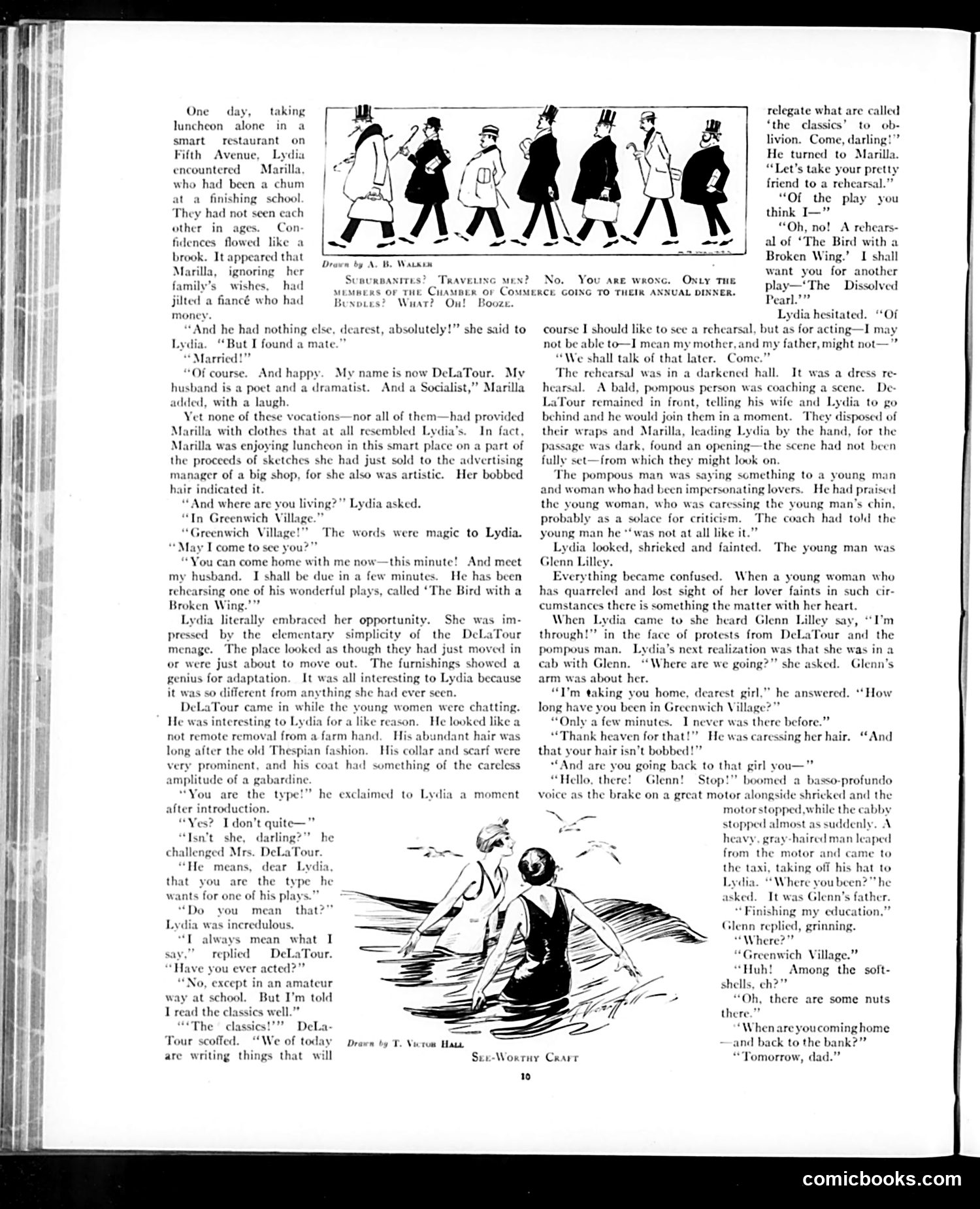
This satirical story mocks the affectations of 1920s Greenwich Village bohemians. Lydia, a wealthy Fifth Avenue woman, reunites with her old finishing-school friend Marilla, now living in Greenwich Village with her husband DeLaTour—a struggling playwright with pretentious socialist ideals and theatrical mannerisms (long hair, careless dress). DeLaTour epitomizes the satirized "artistic type": affected, grandiose, and dismissive of classical literature as outdated. He wants to cast Lydia in his play "The Bird with a Broken Wing," seeing her as fitting a particular social "type" rather than evaluating her actual talent. The cartoon accompanying the text (credited to T. Victor Hain) appears to depict a boating scene, though its specific satirical connection is unclear from the image alone. The piece ridicules both the pretension of struggling artists claiming socialist credentials while dependent on wealthy patrons' money, and the naïveté of society women enchanted by bohemian lifestyle aesthetics. "Sex-Worthy Craft" likely refers ironically to the calculated manipulation behind DeLaTour's artistic pronouncements.
📄 Transcribed text from this page (OCR, searchable)
Machine-transcribed from the original scan — historical spelling and the odd misread are preserved.
relegate what are called day, taking alone in a smart restaurant on Fifth Avenue, Lydia encountered — Marilla who had been a chum at a finishing school They had not seen cach other in Con One luncheon id ‘the classics’ to ob- livion. Come, darling!” He turned to Marilla. “Let's take your pretty friend to a rehearsal.” “Of the play you think I—” “Oh, no! A rehears- ages fidences flowed like a al of ‘The Bird with a brook. It appeared that : AAS Be Waieee Broken Wing.’ I shall Marilla, ignoring her P . , want you for another family’s: ‘wishes, had Supurpantres. RAVELING MeN? No. You are wroxc. Onty THE olay—'The Dissolved 18 # Wiens: MeaBeRs OF THE CHAMBER OF COMMERCE GOING TO THEIR ANNUAL DINNER. Pays aN jilted a fiancé who had Bunptes? Wuat? On! Booze. Pearl money. Lydia hesitated. “Of “And he had nothing else, dearest, absolutely!” she said to course I should like to sce a rehearsal, but as for acting—I may Lydia. ‘But I found a mate not be able to—I mean my mother, and my father, might not * Married!” “Of course. And happy husband is a poet and a dramatist. added, with a laugh. Yet none of these vocations—nor all of them—had provided Marilla with clothes that at all resembled Lydia's. In fact, Marilla was enjoying lunchcon in this smart place on a part of the proceeds of sketches she had just sold to the advertising manager of a big shop, for she also was artistic. Her bobbed hair indicated it. And where are you living?” ‘In Greenwich Village.” “Greenwich Village!” The words were magic to Lydia. “May I come to sce you?” *You can come home with me now—this minute! And meet my husband. I shall be due in a few minutes. He has been rehearsing one of his wonderful plays, called ‘The Bird with a Broken Wing.’” Lydia literally embraced her opportunity. She was im- pressed by the elementary simplicity of the DeLaTour menage. The place looked as though they had just moved in or were just about to move out. The furnishings showed a genius for adaptation. It was all interesting to Lydia because it was so different from anything she had ever seen. DeLaTour came in while the young women were chatting. He was interesting to Lydia for a like reason. He looked like a not remote removal from a farm hand. His abundant hair was long after the old Thespian fashion. His collar and scarf were prominent, and his coat had something of the careless of a gabardine. type!” he aTour. My Marilla My name is now De And a Socialist,” Lydia asked. very amplitude “You are the after introduction. “Yes? I don’t quite—" “Isn't she, darling?” he &e challenged Mrs. DeLaTour. “He means, dear Lydia, that you are the type he wants for one of his plays.” “Do you mean that?” Lydia was incredulous. “T always mean what I say,” replied ~~ DeLaTour. ave you ever acted?” vo, except in an amateur way at school. But I'm told I read the classics well.” The classics! DeLa- Tour scoffe “We of today are writing things that will exclaimed to Lydia a moment Drawn by T. Vicrom Haun Srx-Worrny Crart “We shall talk of that later. Come. The rehearsal was in a darkened hall. It was a dress re- hearsal. A bald, pompous person was coaching ne. De- LaTour remained in front, telling his wife and Lydia to g behind and he would join them in a moment. They disposed of their wraps and Marilla, leading Lydia by the hand, for the passage was dark, found an opening—the scene had not been fully set—from which they might look on. The pompous man was saying something to a young man and woman who had been impersonating lovers. He had praised the young woman, who was caressing the young man’s chin, probably as a solace for criticism. The coach had told the young man he “was not at all like it.” Lydia looked, shrieked and fainted. enn Lilley. Everything became confused. When a young woman who has quarreled and Jost sight of her lover faints in such cir- cumstances there is something the matter with her heart. When Lydia came to she heard Glenn Lilley say, through!”’ in the face of protests from DeLaTour and the pompous man. Lydia’s next realization was that she was in a cab with Glenn. “Where are we going?” she asked. Glenn's arm was about her. “I'm taking you home, dearest girl long have you been in Greenwich Villag “Only a few minutes. I never was there before.” “Thank heaven for that!" He was caressing her hair. “And that your hair isn’t bobbed!” “And are you going back to that girl you—" “Hello, there! Glenn! Stop!” basso-profundo voice as the brake on a great motor alongside shricked and the motor stopped, while the cabby y stopped almost as suddenly. A heavy. gray-haired man leaped from the the taxi The young man was G “rm * he answered. ‘How boomed a motor and came to taking off his hat to Lydia. “Where you been?” he asked. It was Glenn’s father. “Finishing my education. Glenn replied, grinning. “Where?” Greenwich Village.” “Huh! Among the soft- shells, ch? “Oh, there are some nuts there.” ‘When areyoucoming home ind back to the bank?” Tomorrow, da comicbooks.com