
A complete issue · 32 pages · 1920
Judge — December 11, 1920
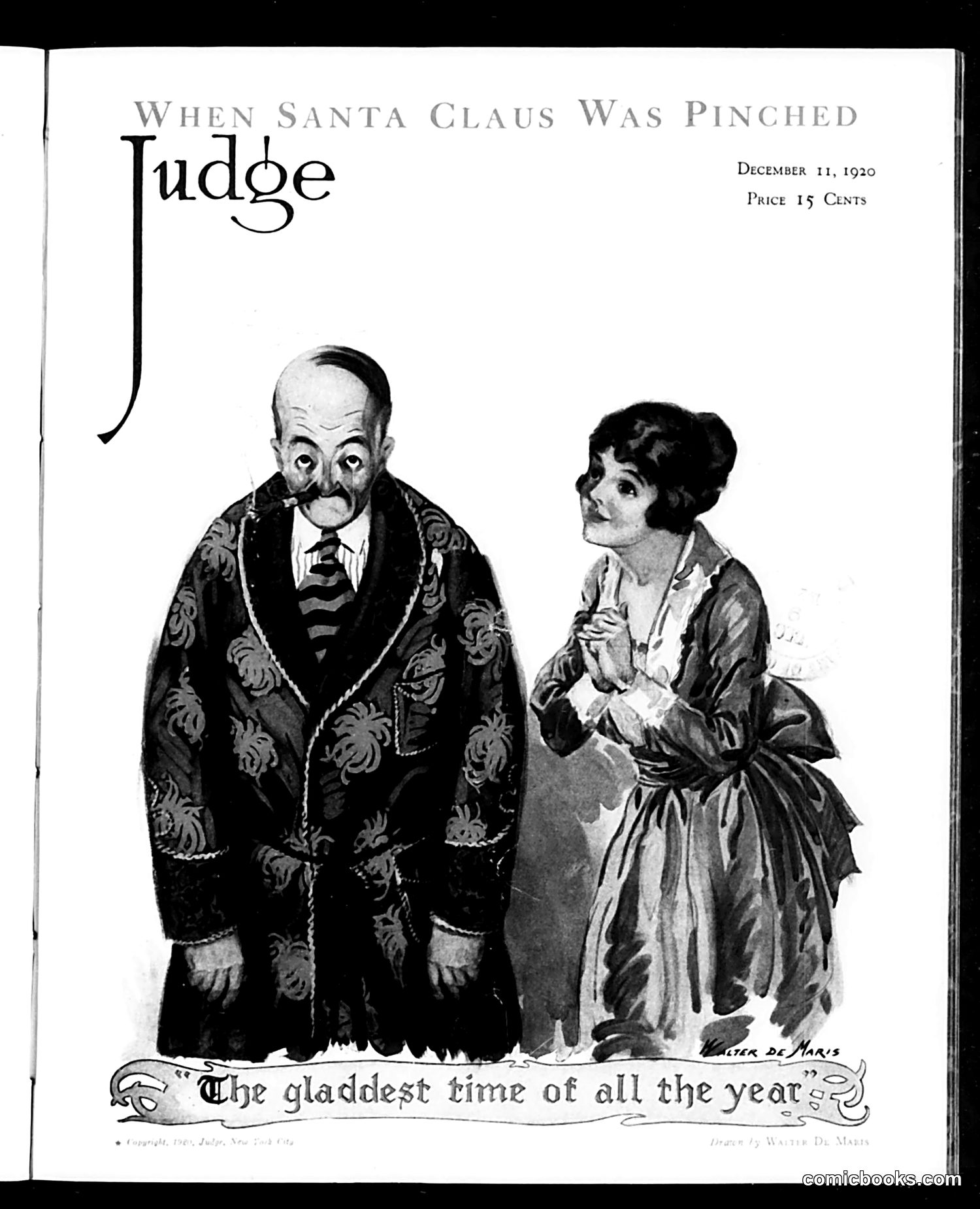
This December 1920 Judge cartoon satirizes the arrest of someone dressed as or associated with Santa Claus. The illustration shows a woman confronting a man in an ornate coat—likely depicting a arrest or legal confrontation scenario. The title's wordplay on "pinched" (slang for arrested) suggests commentary on holiday-season law enforcement. Given the 1920 date, this likely references Prohibition enforcement or holiday-related arrests that were topical during early Prohibition era. The caption "The gladdest time of all the year" is ironic, contrasting Christmas cheer with the arrest depicted. The cartoon appears to critique either overzealous law enforcement during the holidays or social disruption caused by Prohibition policies during what should be a joyful season. The specific figures remain unclear without additional context.
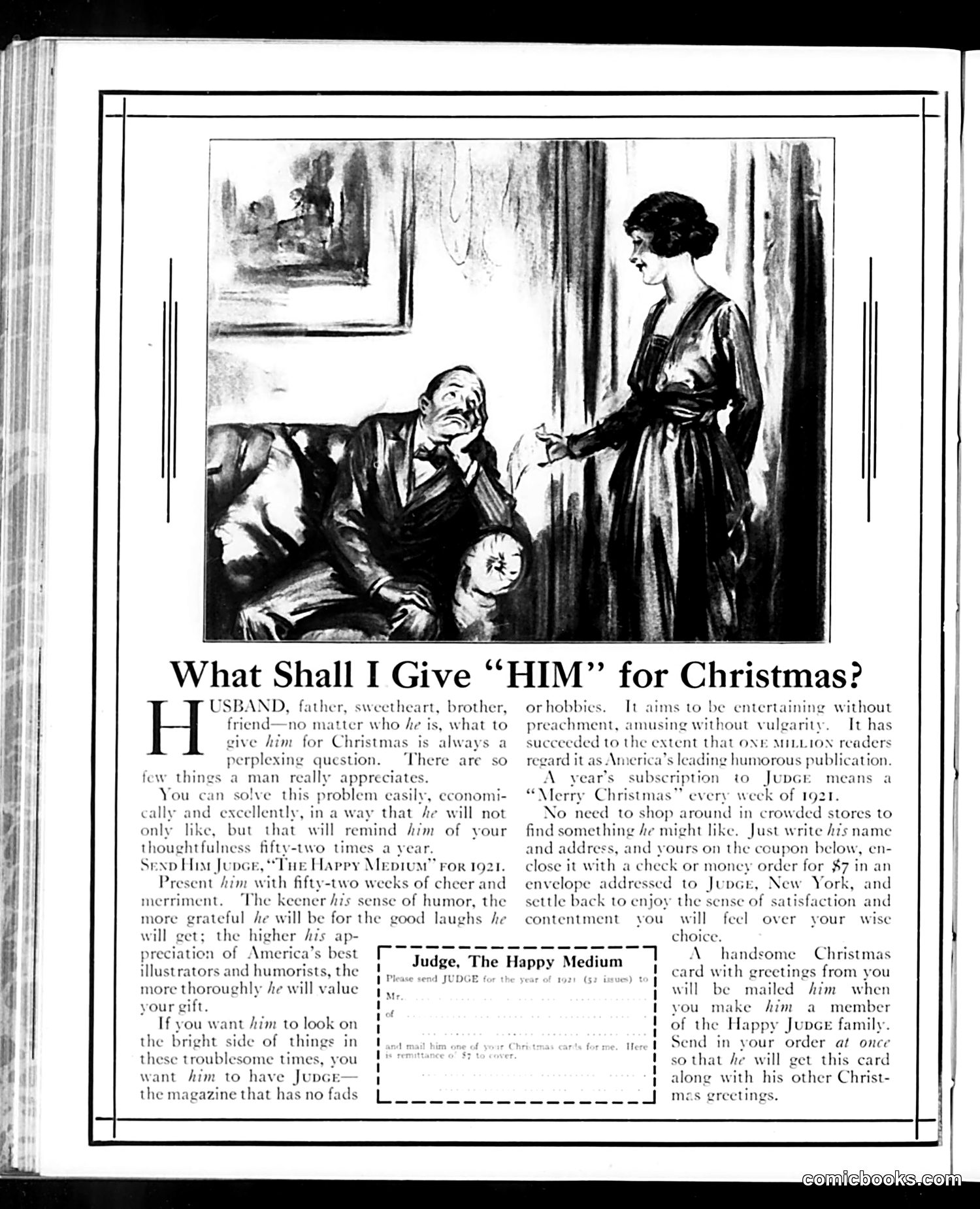
This page is primarily an **advertisement for Judge magazine itself**, disguised as gift advice. The cartoon illustrates a domestic scene where a woman presents a gift suggestion to a man seated with a child. The satire targets gift-giving anxiety: the text acknowledges that choosing Christmas presents for men is "a perplexing question." The solution proposed is Judge magazine—"the magazine that has no fads"—positioned as thoughtful and enduring entertainment. The humor lies in **self-promotion**: suggesting a year-long magazine subscription provides repeated reminders of the giver's thoughtfulness while offering "bright side of things" humor. The ad emphasizes Judge's reputation as "America's leading humorous publication" and appeals to masculine interests by contrasting it with frivolous alternatives. This represents early 1920s consumer advertising merged with editorial content.
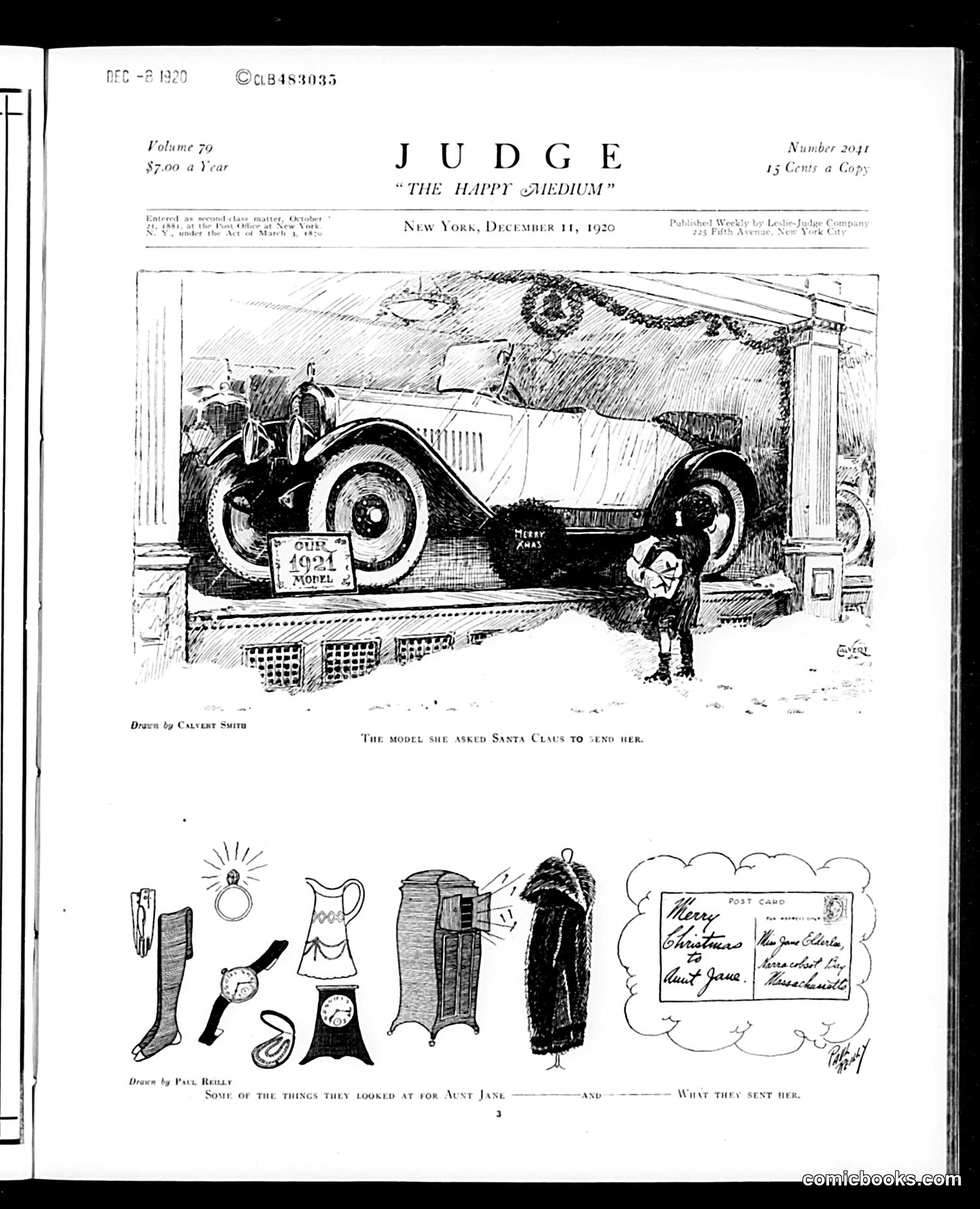
This page contains two cartoons satirizing Christmas gift-giving expectations. **Top cartoon** ("The Model She Asked Santa Claus to Send Her"): Shows a young woman gazing at a 1921 automobile model, suggesting materialistic desires—expensive cars as romantic fantasy gifts. **Bottom cartoon** ("Some of the Things They Looked at for Aunt Jane—and What They Sent Her"): Contrasts what people *wanted* to give (jewelry, wristwatch, pitcher, wardrobe items, fur coat) versus what they *actually* sent (a postcard). This satirizes the gap between generous gift-giving intentions and stingy reality, likely reflecting post-war economic concerns or simple tightfistedness among gift-givers. Both cartoons humorously mock Christmas materialism and the disconnect between desires and practical reality.
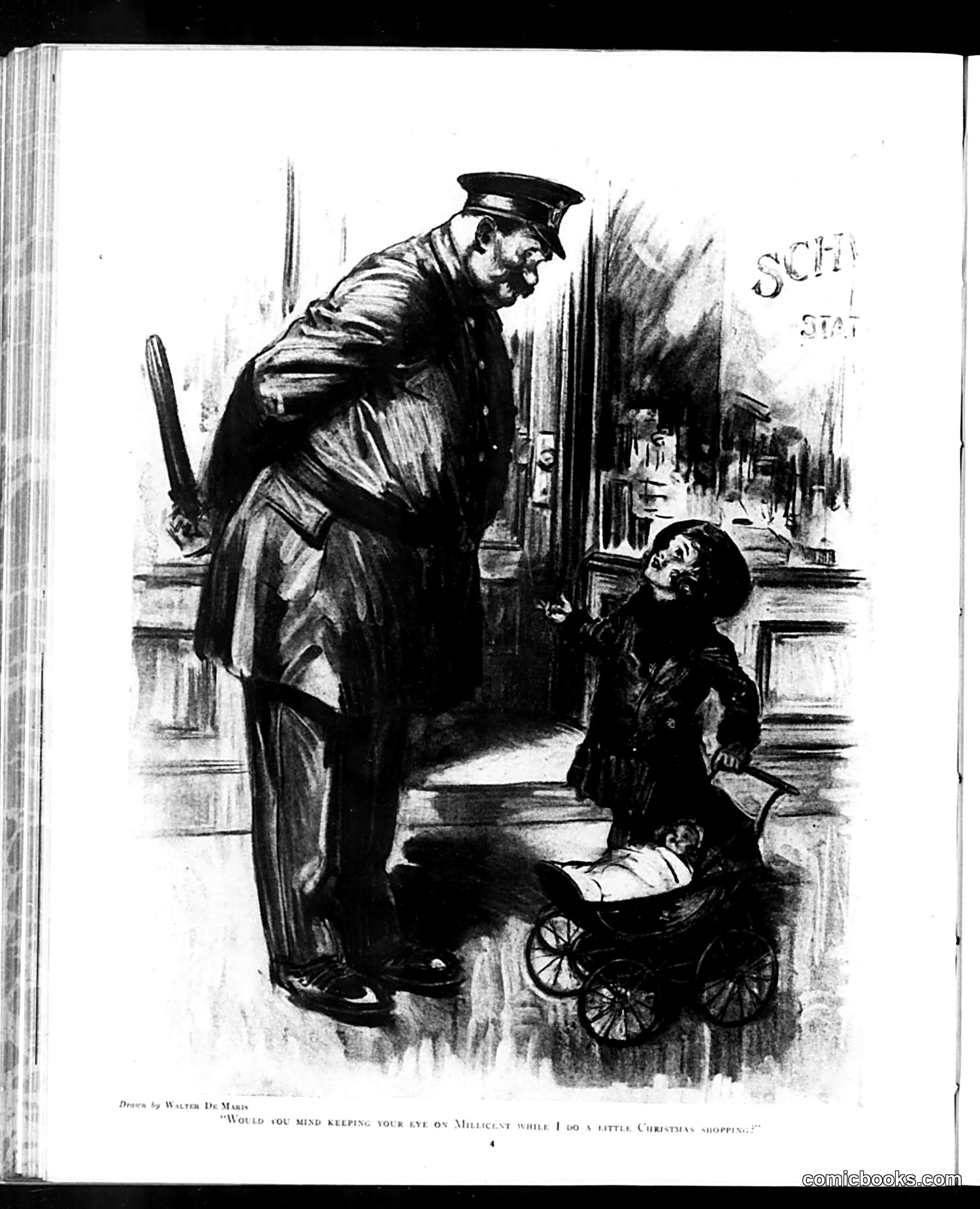
This Walter De Maris cartoon depicts a uniformed policeman (identifiable by his cap and formal attire) addressing a woman with a baby carriage on a city street. The caption reads: "Would you mind keeping your eye on Millicent while I do a little Christmas shopping?" The satire targets police conduct and public order. The joke relies on the absurdity of a cop abandoning his duty to ask a stranger—a woman with an infant—to watch someone (presumably a child or person named Millicent) while he shops. This mocks either police negligence or the assumption that any woman would naturally accept such responsibility, likely satirizing gender expectations and police priorities during the Christmas season. The cartoon critiques the casual disregard for proper procedure.
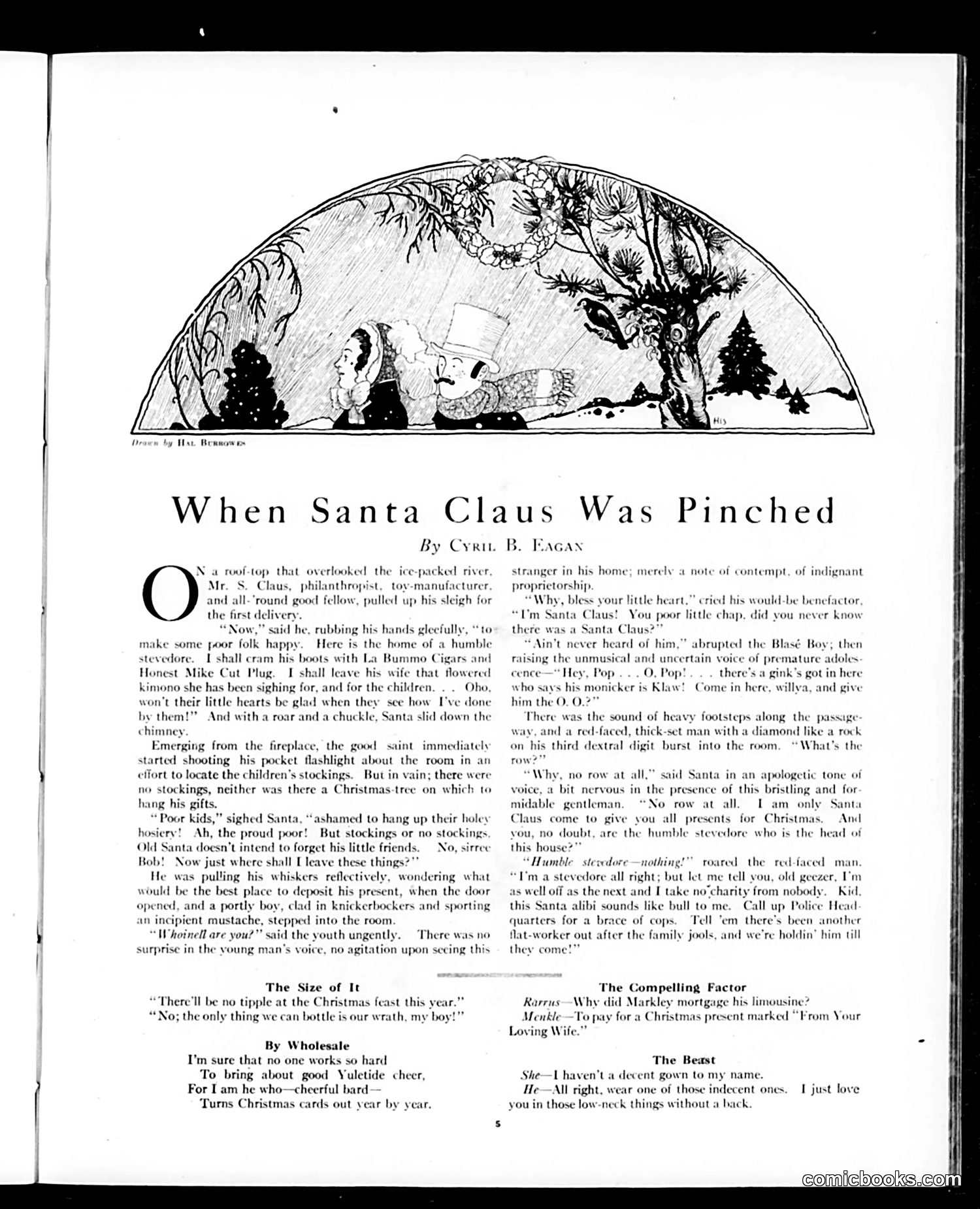
This is a satirical story by Cyril B. Fagan, not a political cartoon. The illustration shows Santa confronted by what appears to be a police officer or authority figure. The satire mocks a wealthy philanthropist ("Mr. S. Claus") who manufactures cigars and toys but is caught by police for some violation—likely tax evasion or labor law breaches (the text mentions "stevedore"). The joke plays on the hypocrisy of a self-styled "Santa" benefactor who gives Christmas presents to poor children while breaking the law himself. The accompanying short items (small jokes about Christmas and gift-giving) reinforce the theme of holiday hypocrisy and commercialism, characteristic of Judge magazine's social satire in the early 20th century.
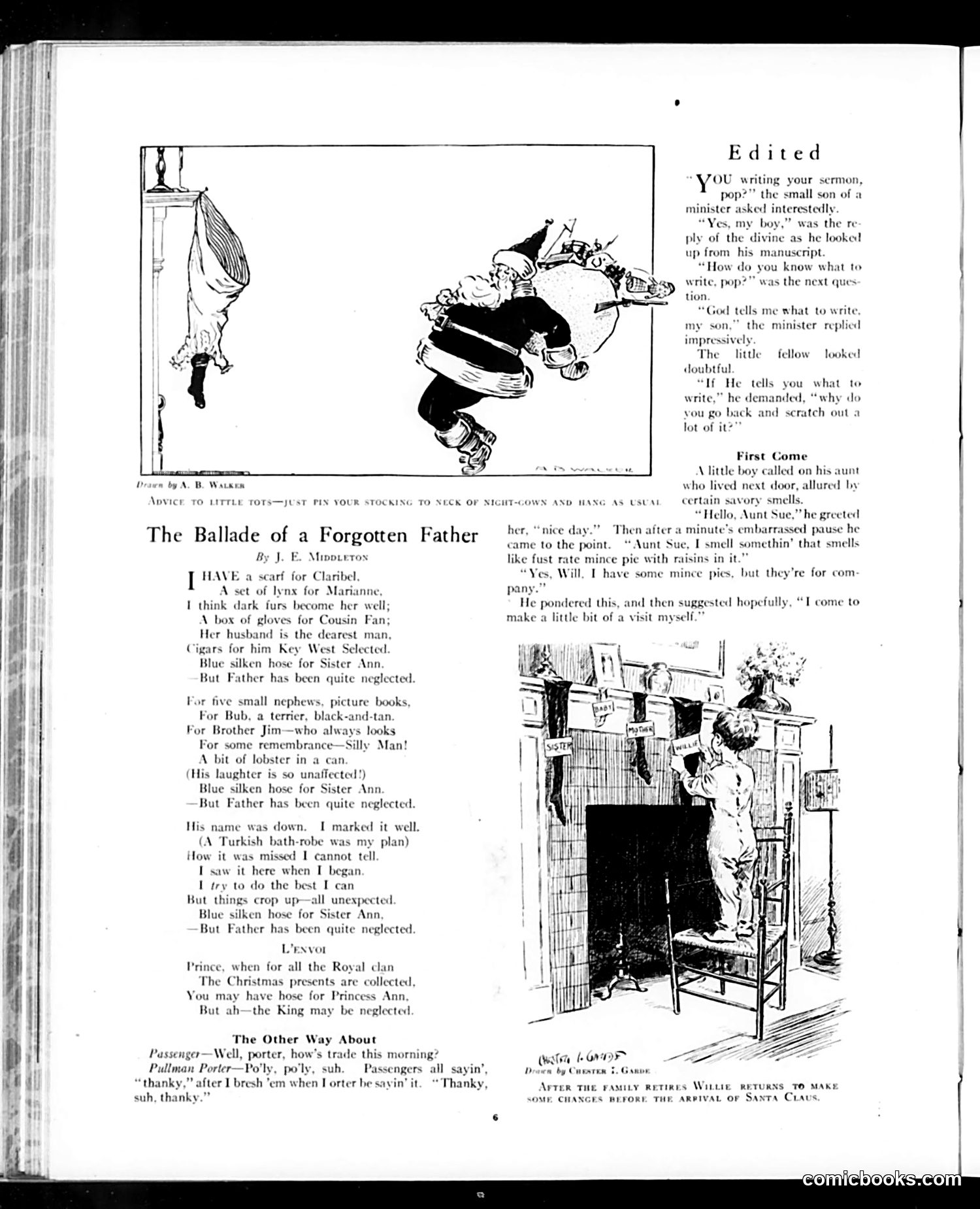
This page contains literary and illustrated content rather than political satire. "The Ballade of a Forgotten Father" by J.E. Middleton is a poem lamenting a father neglected during Christmas gift-giving—family members receive presents (nephews get picture books, sister gets silk hose, brother gets lobster) while "Father has been quite neglected." The accompanying illustrations show domestic scenes: one depicts acrobatic children, another shows a child preparing the house for Santa Claus's arrival. The "Edited" section presents a humorous dialogue between a minister and his young son about sermon-writing, establishing a whimsical tone rather than satirizing political figures or events. This appears to be holiday-themed family humor content rather than the political commentary Judge magazine was known for.
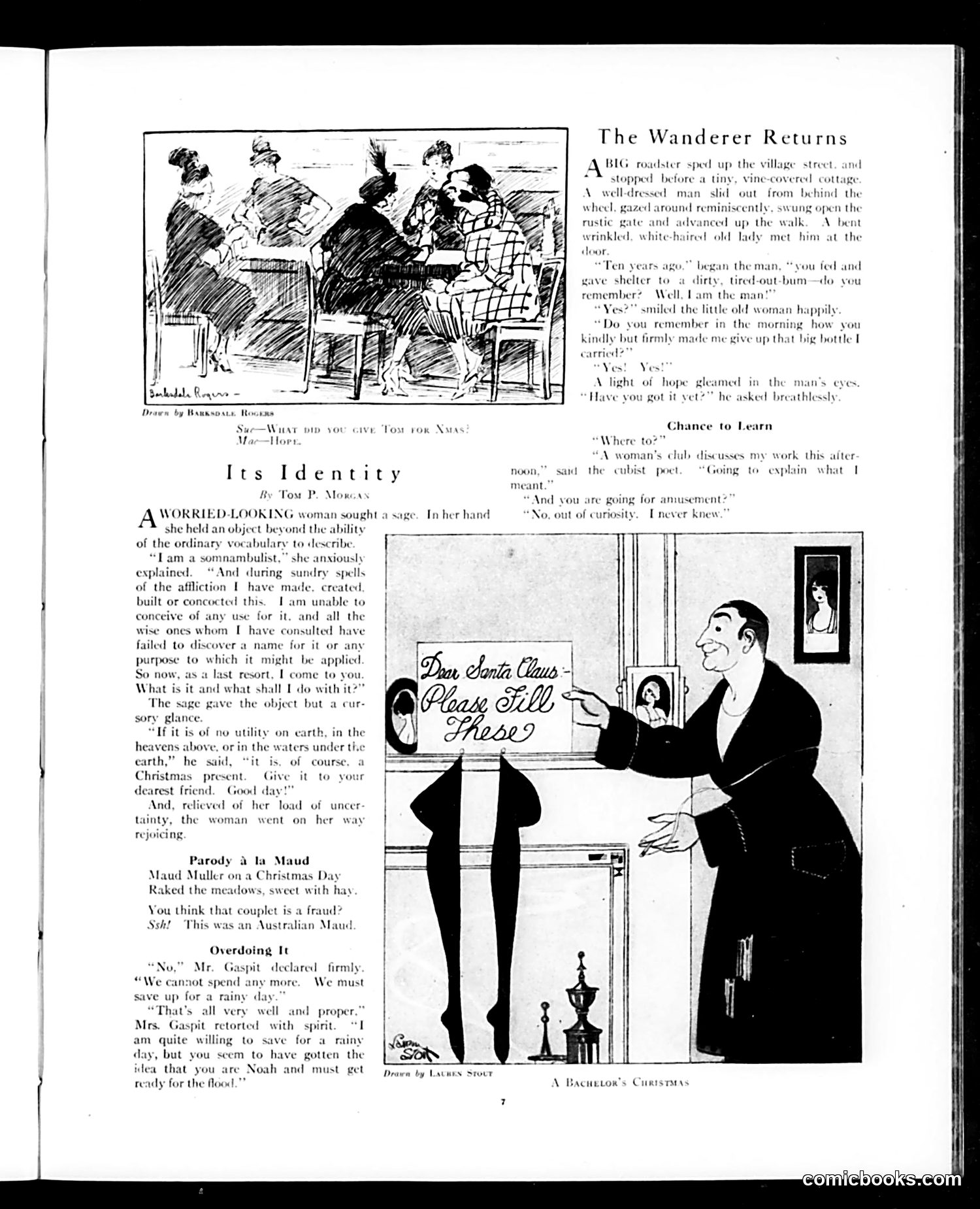
This page contains several unrelated humorous sketches typical of Judge's satirical format: **"The Wanderer Returns"**: A sentimental story where a successful man returns to thank an elderly woman who sheltered him as a vagrant years earlier and made him abandon his bottle—implying sobriety enabled his success. The joke plays on his hopeful question "Have you got it yet?"—ambiguously asking if she's kept his bottle or achieved her own redemption. **"Its Identity"**: A woman consults a sage about an object she created while sleepwalking, unable to name or purpose it. The sage advises giving it as a Christmas gift—standard absurdist humor about incomprehensible modern art or useless creations. **"Overdoing It"**: A domestic dispute where Mr. Gaspit refuses spending for emergencies, and Mrs. Gaspit sarcastically suggests he acts like Noah preparing for another flood—mocking excessive frugality. The cartoons satirize human nature: redemption narratives, modern art pretension, and marital financial disputes. No specific political figures or events appear identifiable.
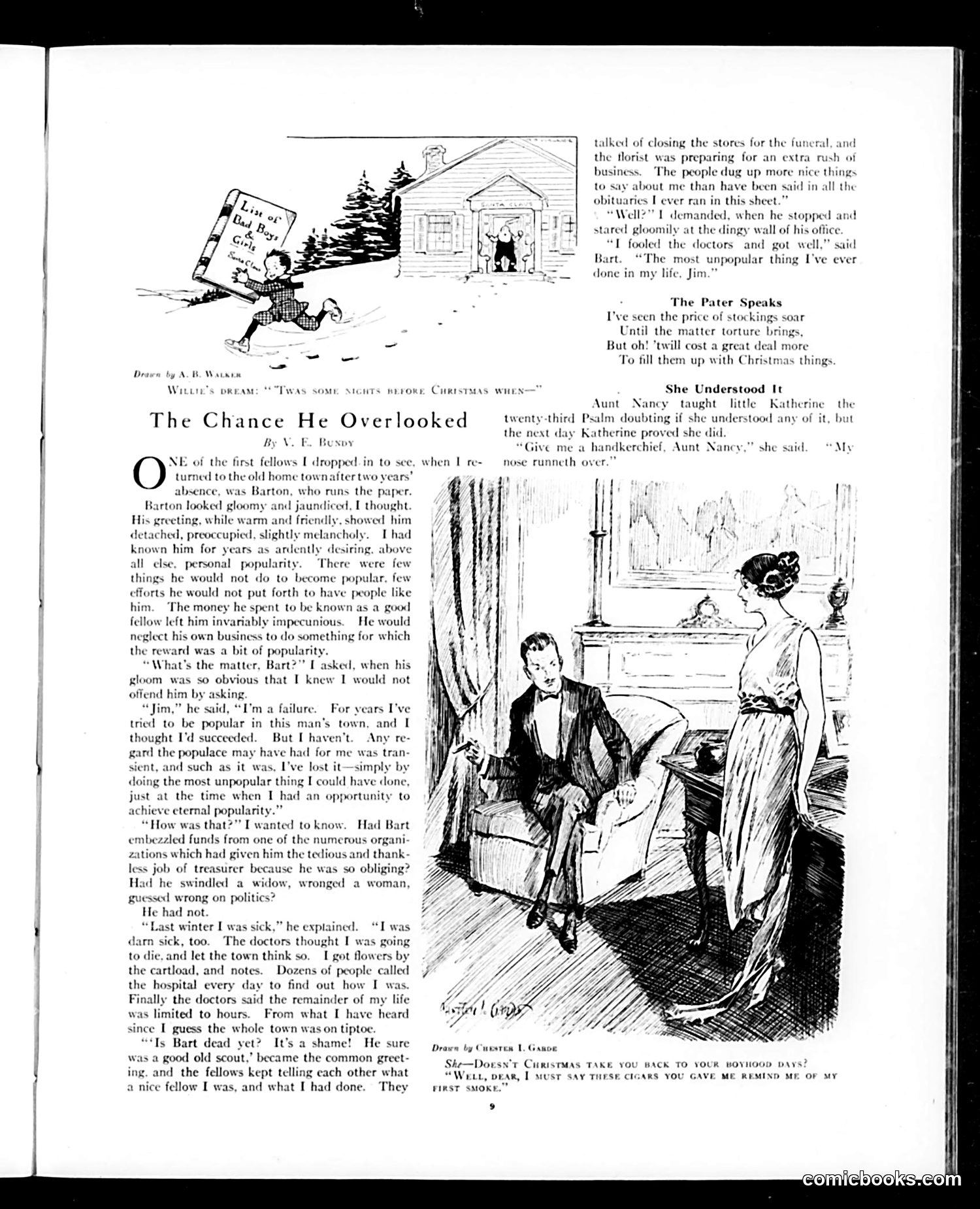
This story satirizes small-town social dynamics and the pursuit of popularity. Bart, a newspaper editor obsessed with being liked, orchestrates his own popularity by appearing to be dying—the town floods him with sympathy, flowers, and praise. However, when he recovers and lives, he becomes "unpopular" again, having squandered his chance at "eternal popularity" through the unforgivable act of *not dying*. The satire mocks both Bart's pathetic desperation for approval and the town's fickle sentimentality—people are kind only to the dying, not the living. By recovering, Bart commits "the most unpopular thing I could have done," exposing how shallow community affection truly is. The other brief items (holiday shopping costs, a child misunderstanding scripture) are light filler typical of Judge's format.
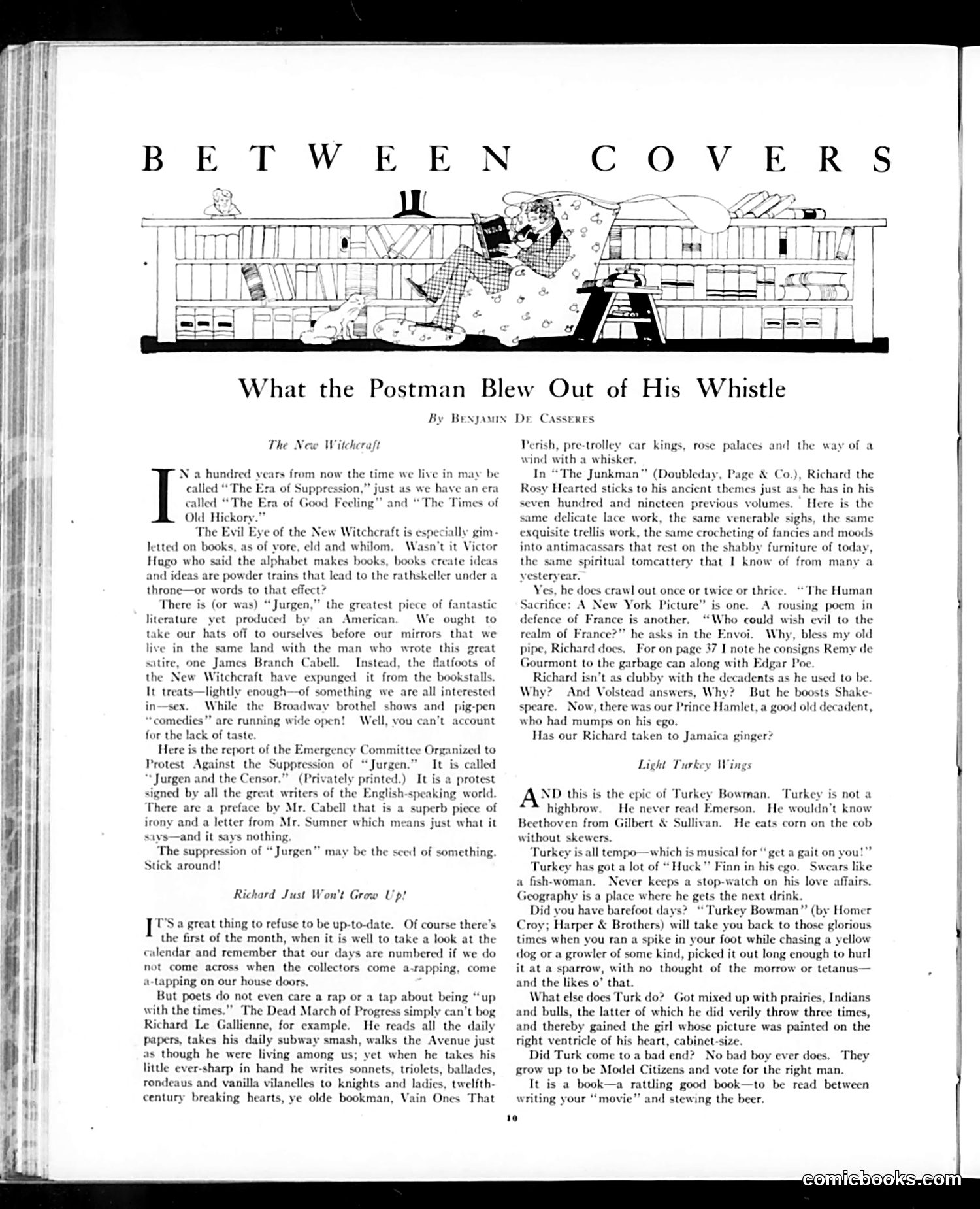
This page contains three book review essays satirizing American literary censorship and cultural attitudes circa the 1920s. **"What the Postman Blew Out of His Whistle"** attacks the suppression of James Branch Cabell's novel *Jurgen*, censored for sexual content despite being serious literature. The author condemns this "New Witchcraft" of book censorship—comparing it unfavorably to Broadway's openly permissive shows—while praising an emergency committee of major English-language writers protesting the ban. **"Richard Just Won't Grow Up"** mocks poet Richard Le Gallienne for writing archaic romantic verse (sonnets, villanelles) about medieval themes and "ye olde" imagery while living in modern times. The reviewer notes Le Gallienne occasionally engages contemporary subjects but mostly retreats into nostalgic, decorative writing. **"Light Turkey Wings"** (partially visible) appears to review a novel about an unsophisticated character named Turkey Bowman. The overall tone is satirical elitism—criticizing both literary censorship and sentimental antiquarianism as failures of modern American culture.
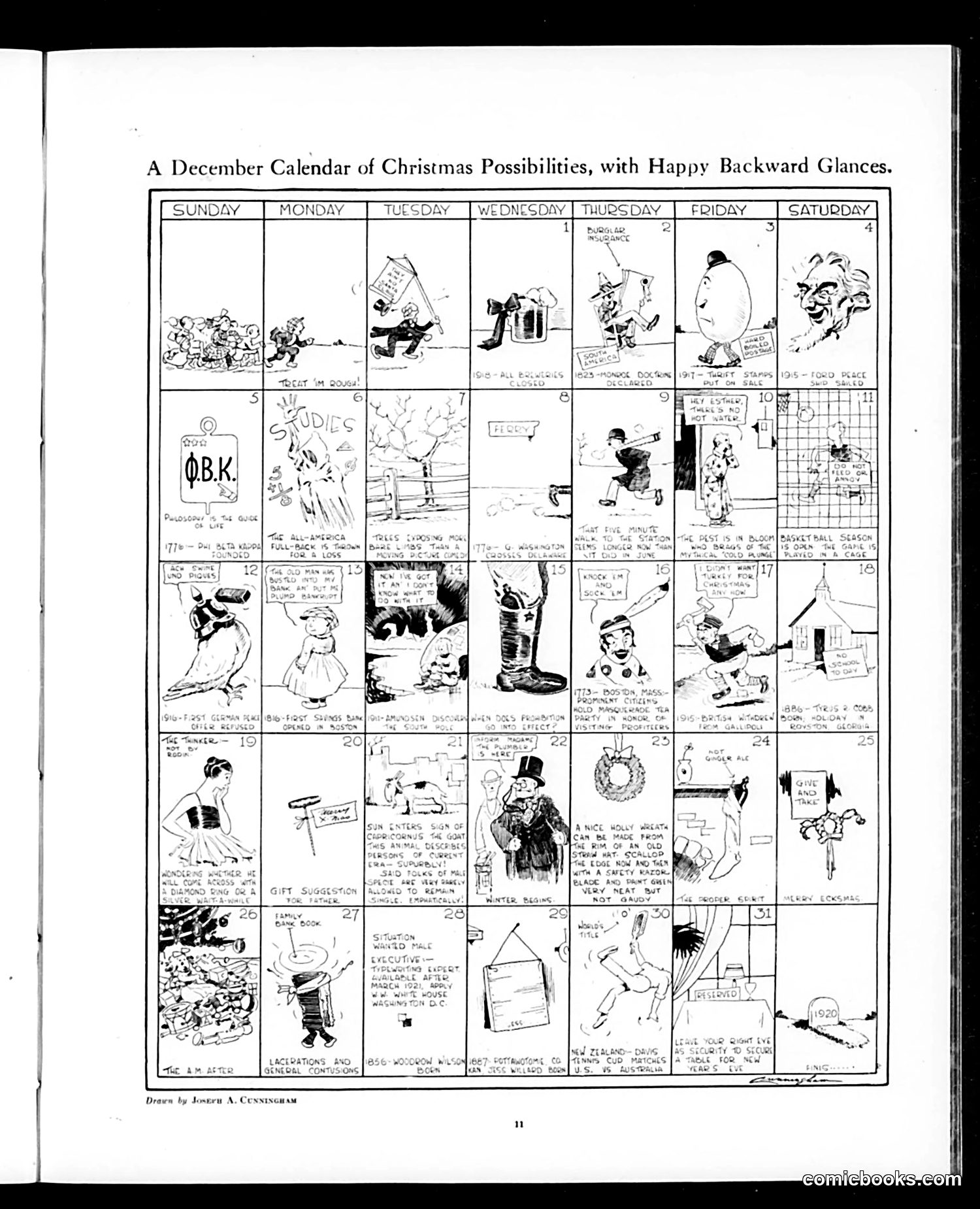
This is a humorous calendar page by Joseph A. Cunningham featuring 31 comic vignettes depicting various Christmas scenarios and holiday mishaps. Rather than identifying specific political figures, the cartoons satirize common domestic and social situations: gift-giving disasters, holiday parties gone wrong, Christmas shopping chaos, winter weather problems, and family gatherings. The "backward glances" reference suggests nostalgia for past Christmases, likely contrasting idealized holiday memories with realistic comedic outcomes. The drawings employ exaggerated expressions and slapstick situations typical of Judge magazine's satirical style. Without clearer text legibility on individual panels, specific plot details remain difficult to confirm, but the overall purpose is gentle social commentary on modern Christmas culture and consumer excess through visual humor.
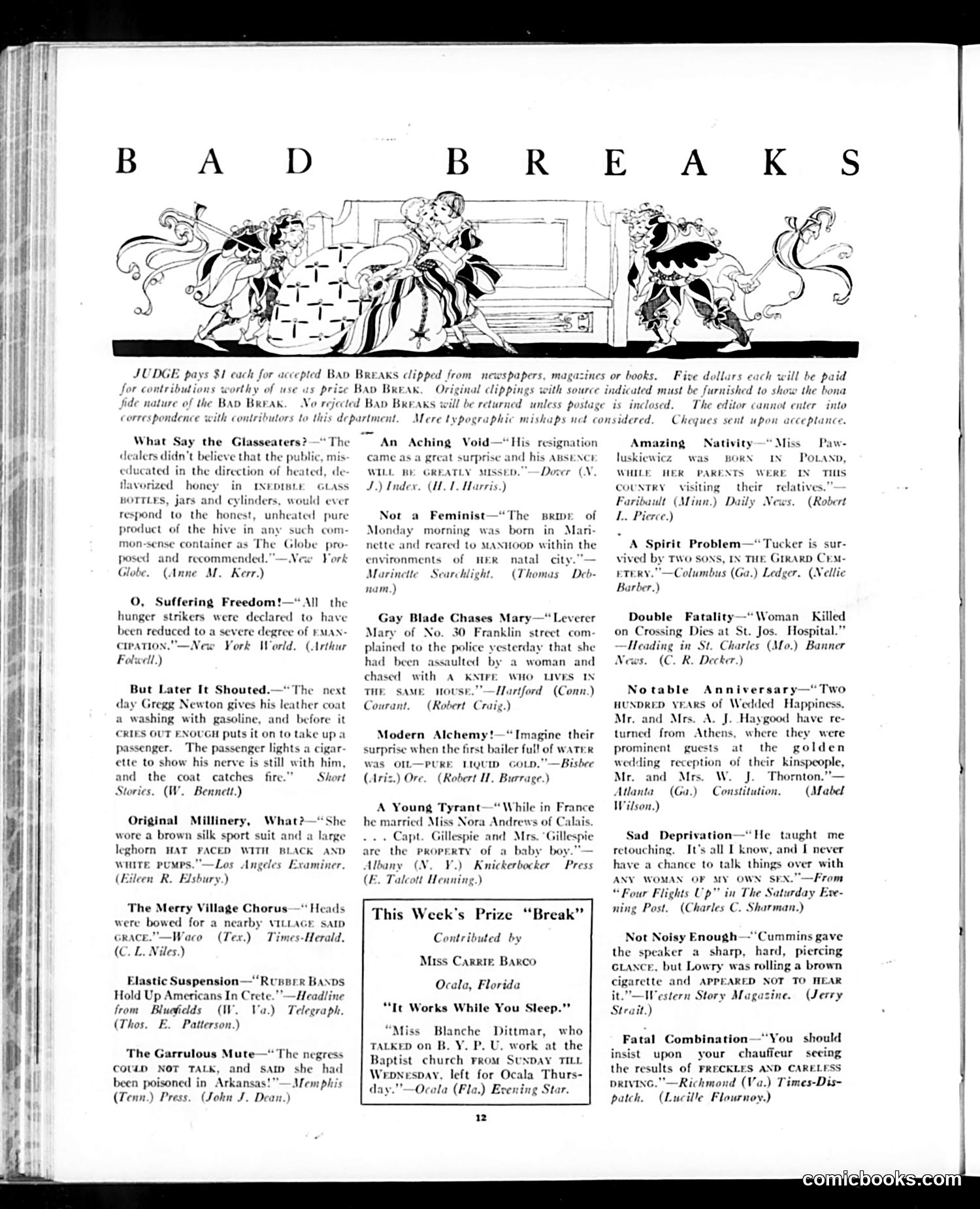
This page showcases the satirical "Bad Breaks" column, which pays readers for humorous typographical or logical errors clipped from newspapers. Rather than political satire, Judge ridicules sloppy newspaper writing. Examples highlighted include: - **Nonsensical claims**: Glass bottles that dissolve honey's purity; a woman "killed" yet dying later; a baby owning its parents as "property" - **Logical absurdities**: Parents visiting relatives *while* being born in Poland; a person surviving in a cemetery; a hat "faced" with pumps The cartoon header shows figures handling the "breaks" as physical items—comedic visual representation of collecting newspaper gaffes. This reflects Judge's role as a *humor magazine for educated readers*, celebrating verbal/print mistakes while mocking newspapers' carelessness. It's meta-humor: satirizing not politics but the press itself.
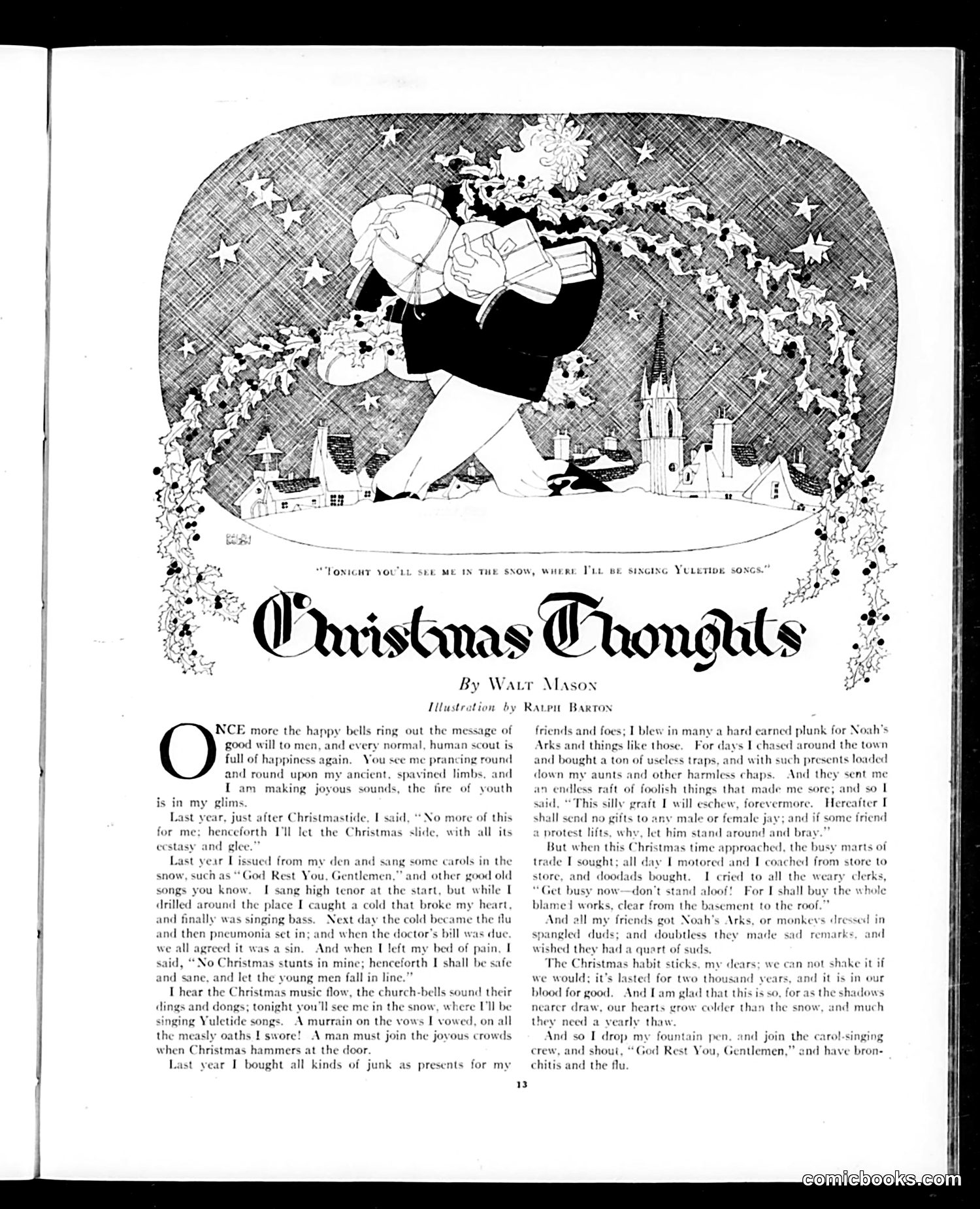
This is a humorous essay disguised as holiday sentiment. The narrator describes his cyclical relationship with Christmas excess: last year he swore off the holiday after caroling in the snow triggered a cold that became pneumonia and pneumonia became financial ruin. He vowed never again. Yet despite his resolution, he admits he's already succumbed—buying "junk" presents he can't afford, overspending at stores, and gifting unwanted items (Noah's Arks, monkey costumes) that irritate recipients. The satire targets human weakness and hypocrisy: we make sincere promises to ourselves, then immediately break them when social pressure returns. Mason gently mocks how Christmas "habit" is inescapable—a two-thousand-year tradition that compels spending despite financial and physical consequences. The ironic ending—he'll end up with bronchitis and flu anyway—suggests the cycle will repeat eternally. This reflects early-20th-century anxiety about commercialized Christmas and consumer excess.
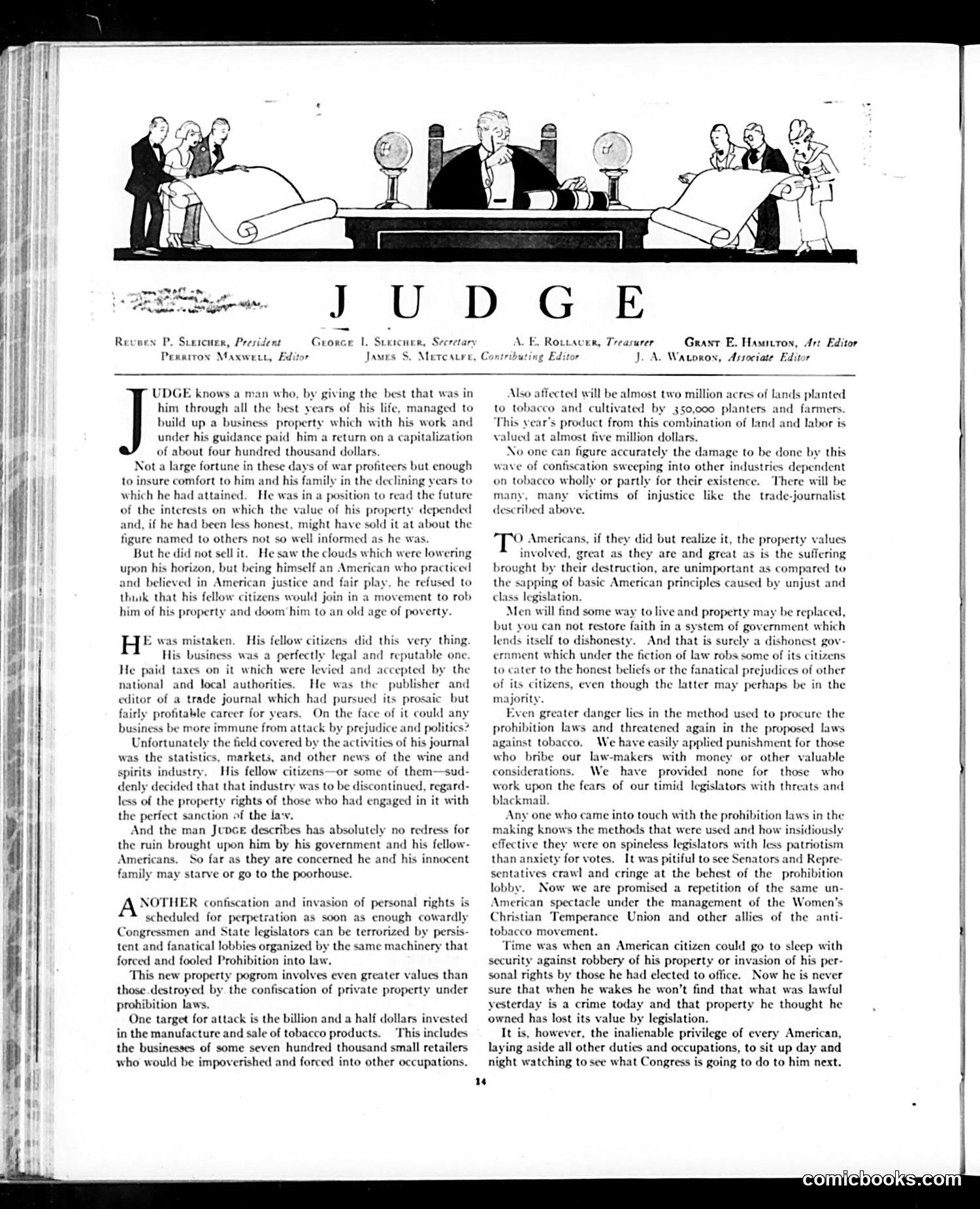
This editorial attacks Prohibition and threatened tobacco regulation as government overreach. The cartoon header depicts a judge presiding over competing petitioners—visualizing how legislation is decided. The text describes a specific businessman ruined by Prohibition: a trade journal publisher covering the wine and spirits industry. Though his legal, taxpaying business operated with government sanction, Prohibition destroyed it without compensation—a confiscation Judge frames as un-American injustice. The piece then warns of a second attack: anti-tobacco legislation that would eliminate 1.5 billion dollars in tobacco manufacturing and harm 700,000 small retailers and 350,000 farmers. Judge's central argument: beyond economic damage, such "confiscation" violates foundational American property rights and represents "class legislation"—law driven by fanatical lobbies and cowardly politicians rather than principle. The satire condemns what it views as mob-driven tyranny masquerading as reform.
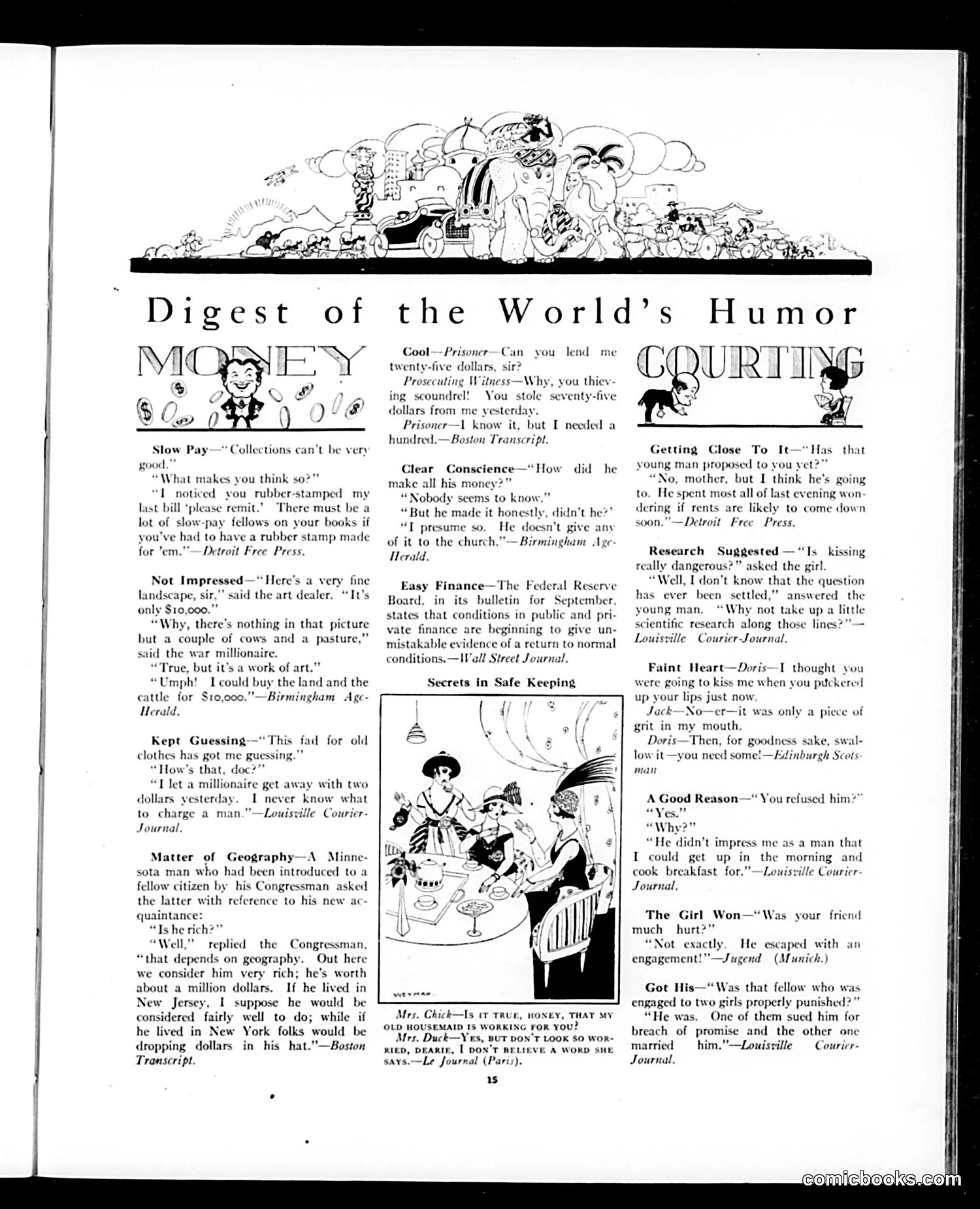
This page from *Judge* magazine compiles brief satirical jokes on contemporary social themes, circa early 20th century. The humor targets: **Financial hypocrisy**: Rich men haggling over art prices, millionaires underpaying workers, and the irony of someone who "made money honestly" but doesn't donate to church. **Economic anxiety**: A congressman explaining that wealth is relative by geography—a man considered rich in Minnesota would be poor in New York. **Class commentary**: A rubber stamp for "please remit" suggests widespread payment defaults; a vagrant coolly asking a robbery victim for a loan. **Domestic/courtship humor**: Young couples discussing marriage prospects tied to economics (rent prices), women evaluating suitors by their usefulness as breadwinners. **The cartoon** ("Secrets in Safe Keeping") depicts a woman assuring her friend not to believe gossip from their shared former housemaid—satirizing servants' knowledge of domestic secrets. The overall tone reflects post-WWI economic uncertainty and skepticism toward both wealth and institutions.
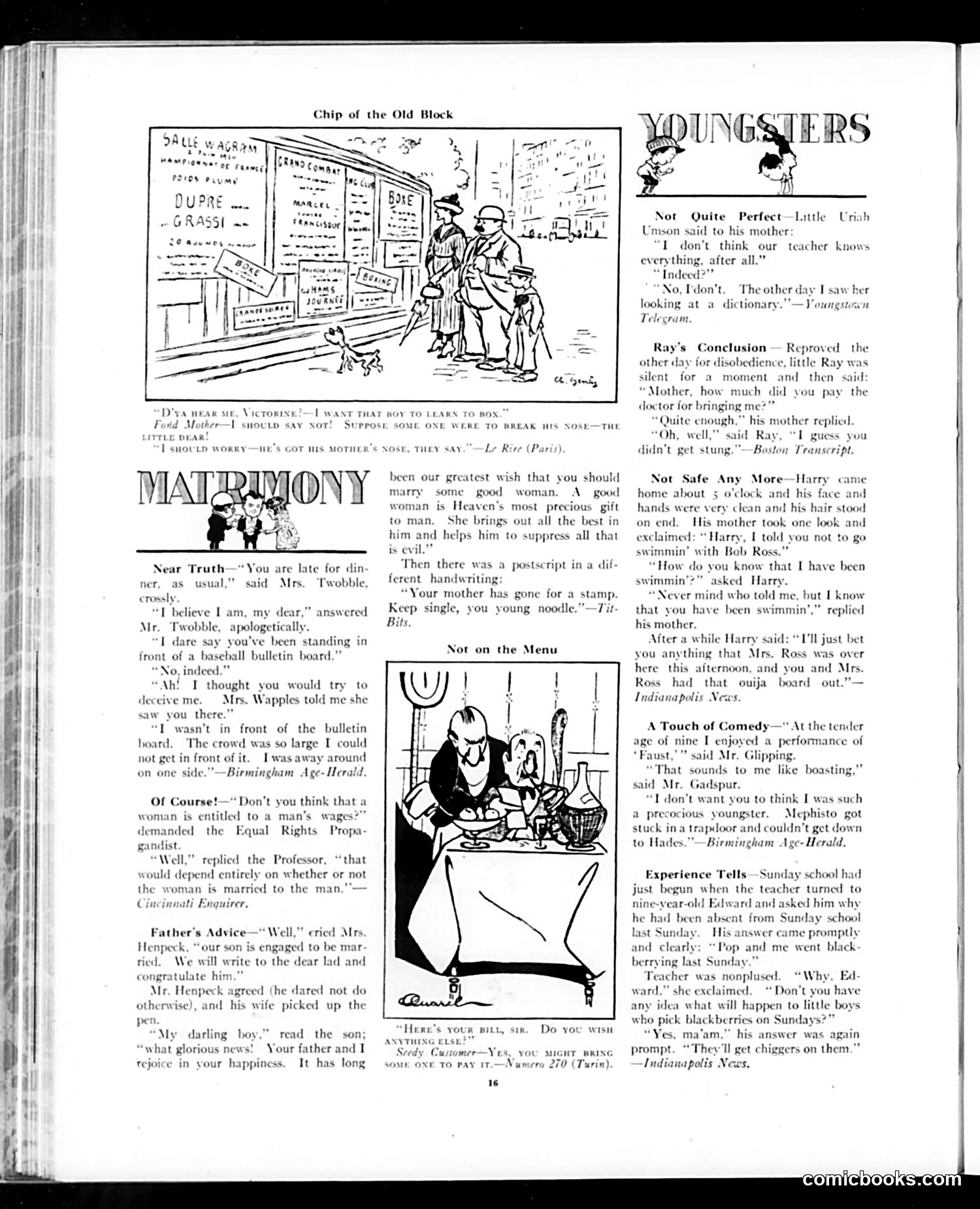
This page contains multiple short humorous anecdotes satirizing middle-class social conventions and domestic life, rather than explicit political cartoons. The sketches mock: **Marriage dynamics**: "Near Truth" and "Father's Advice" ridicule nagging wives and hen-pecked husbands—common Judge themes portraying marriage as adversarial. Mrs. Henpeck's postscript telling her son to stay single undercuts the sentimental opening. **Gender politics**: "Of Course!" satirizes equal-rights advocates by suggesting women only deserve equal pay if unmarried—a dismissive response to early feminism. **Parental authority**: Multiple pieces ("Not Safe Any More," "Ray's Conclusion," "Experience Tells") show children outwitting or embarrassing their parents through literal interpretations or clever logic. **The top cartoon** shows a mother wanting her son to learn boxing to toughen him—a commentary on masculine upbringing ideology. The overall tone is gently mocking of American middle-class pretension and family relations, typical of Judge's humor circa early 20th century.
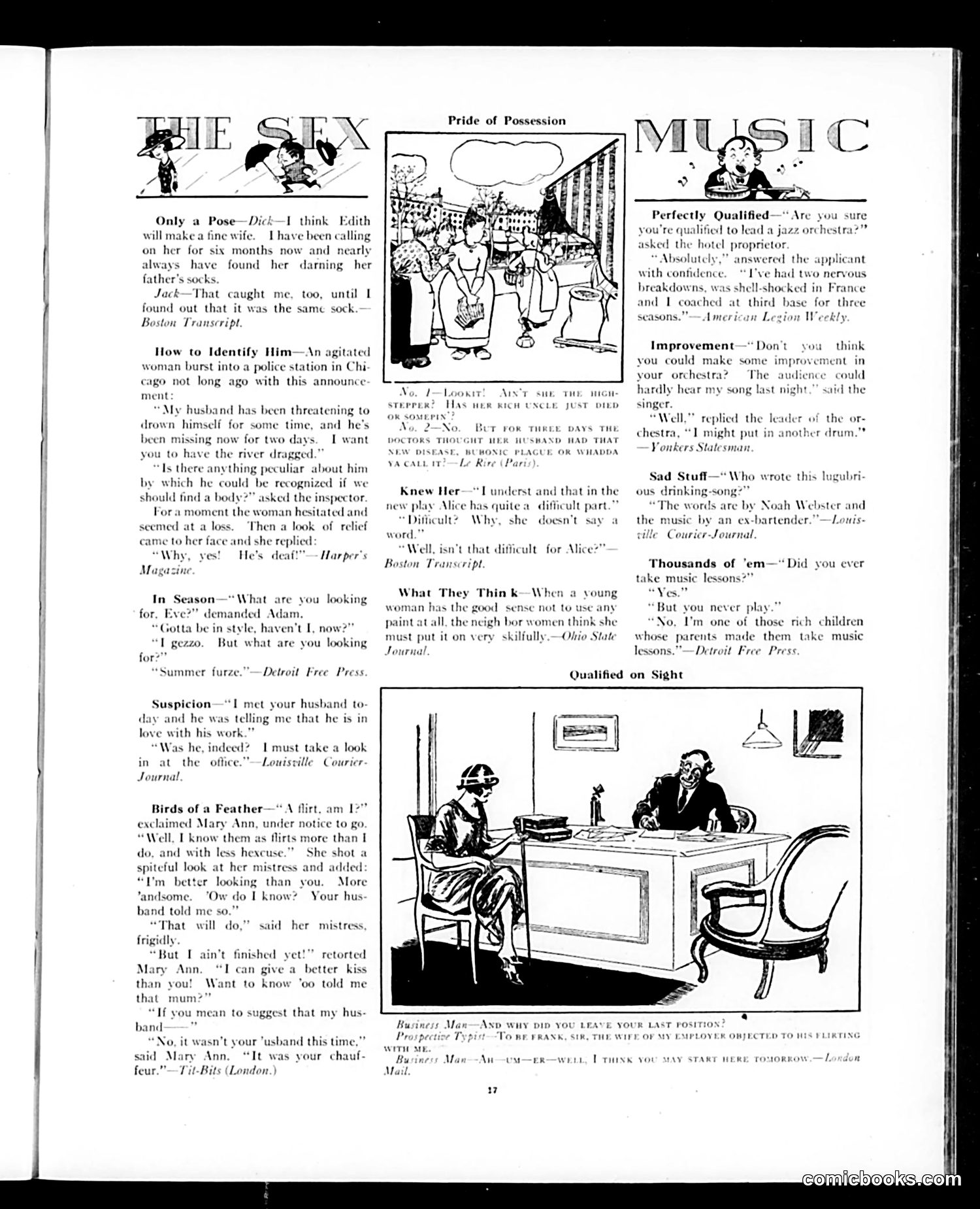
This page from Judge presents a collection of brief humorous anecdotes and one cartoon, all satirizing early 20th-century social conventions and gender relations. The jokes mock courtship rituals ("Only a Pose" ridicules women's performative domesticity), marriage suspicions, and servant impudence. One anecdote features a domestic worker ("Mary Ann") boldly insulting her mistress by claiming superiority in looks and kissing ability—humor derived from the servant's breach of class deference. The cartoon "Qualified on Sight" depicts a job interview where a man admits he left his previous position because "the wife of my employer objected to his flirting with me"—satirizing workplace sexual misconduct as an acceptable reason for employment termination. The employer accepts this without concern, suggesting the era's casual attitude toward such behavior. Other jokes target women taking music lessons (wasteful for the wealthy), jazz orchestras (mocking modern music), and women's fashion choices. The overall tone reflects period attitudes viewing women primarily through domestic and romantic lenses, with humor premised on gender stereotypes and class hierarchies now considered offensive.
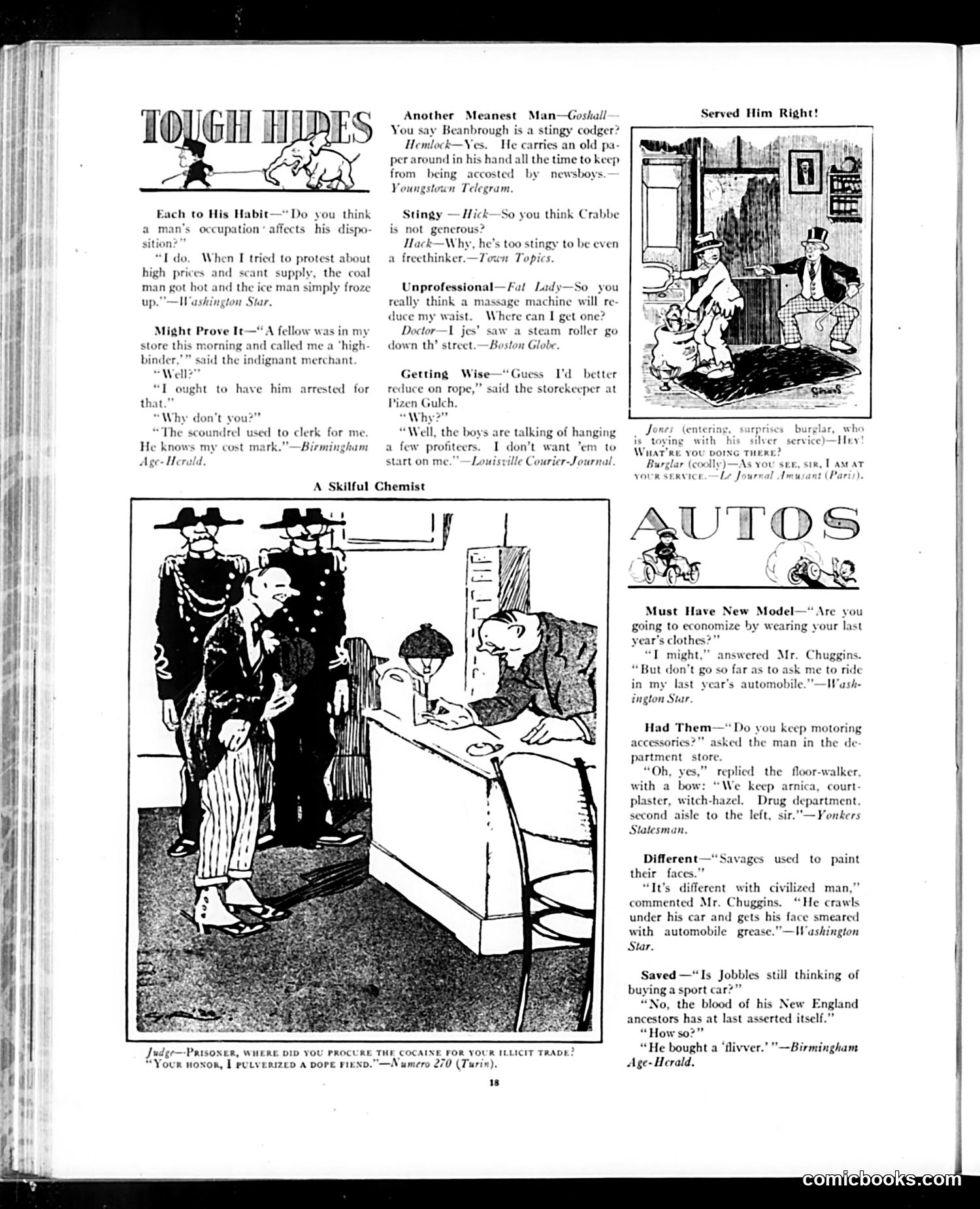
This page from *Judge* magazine contains humorous short jokes and cartoons satirizing early 20th-century American life. **"A Skilful Chemist"** (main cartoon): Shows a judge interrogating a prisoner about obtaining cocaine for illegal trade. The prisoner responds in mangled dialect, claiming he "pulverized a poor friend"—the joke being either a language mishap or suggesting he literally ground up someone. This reflects contemporary anxieties about drug trafficking and the stereotype of immigrant criminals. **"Served Him Right"** (upper right): A burglar surprises a servant; the caption suggests ironic comeuppance, though details are unclear. **Other items** are brief quips mocking: stingy wealthy men, profiteers during wartime (rope shortage joke), automobile culture (economizing on cars), and class differences. The "flivver" reference mocks affordable Model-T Fords as beneath New England's old money. Overall, the page reflects Jazz Age anxieties: inflation, profiteering, immigration, drug crime, and the automobile's social impact.
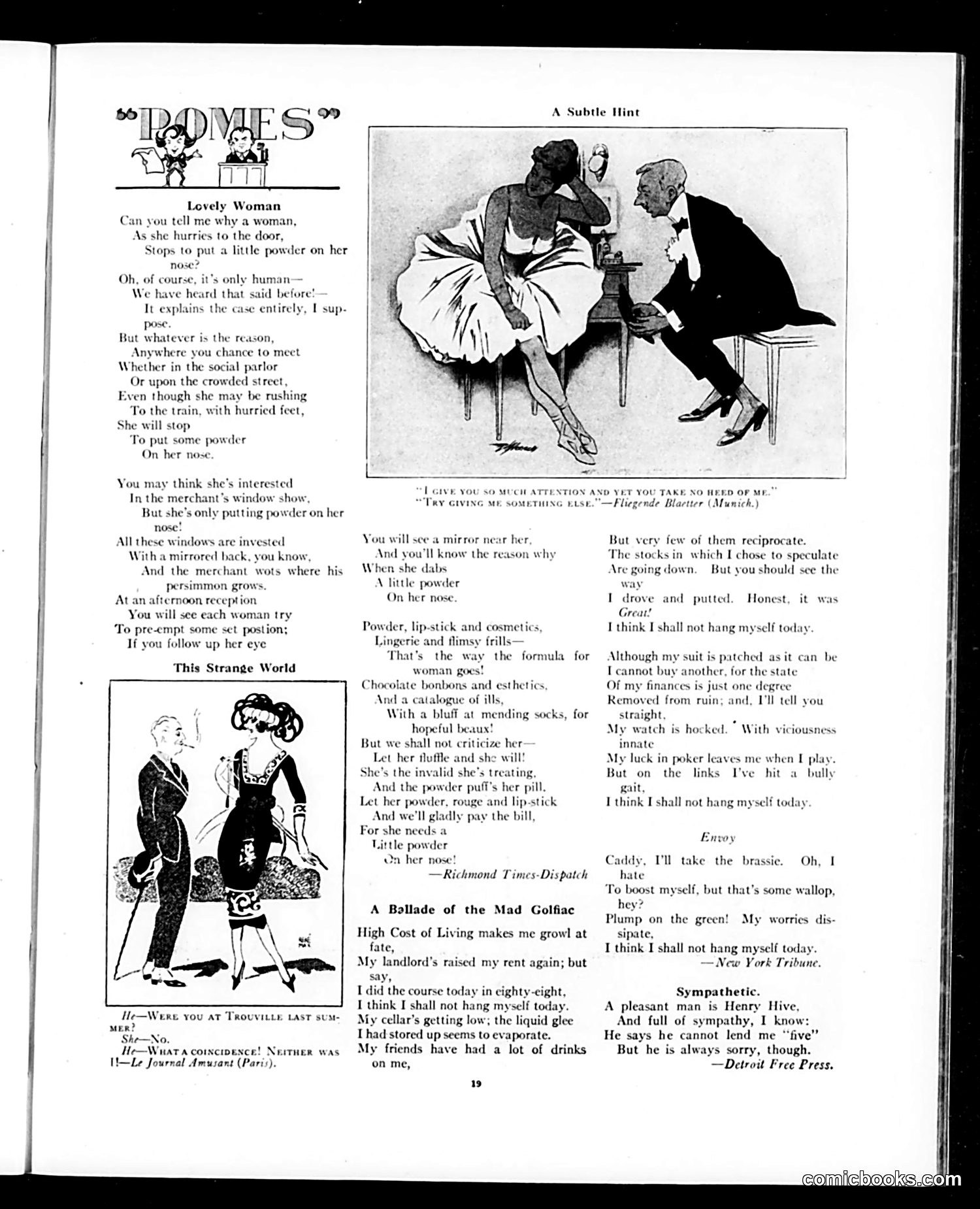
This Judge magazine page contains three satirical pieces: **"A Subtle Hint"** (main cartoon and poem): Mocks women's vanity by claiming they compulsively powder their noses everywhere—in shop windows, at social events, on the street. The satire suggests merchants deliberately install mirrors on storefronts to exploit this habit. The accompanying cartoon shows a man observing a woman primping. The joke relies on 1920s-era stereotypes about feminine frivolity and cosmetics obsession. **"This Strange World"** (small cartoon): A brief society joke about coincidence. **"A Ballad of the Mad Golfer"**: Dark humor about a financially ruined man—evicted, broke, his watch pawned, losing at poker—yet finding sole happiness in golfing well. The repeated refrain "I think I shall not hang myself today" gallows-humor suggests suicidal despair is temporarily relieved by recreational sports. This reflects post-WWI economic anxiety.
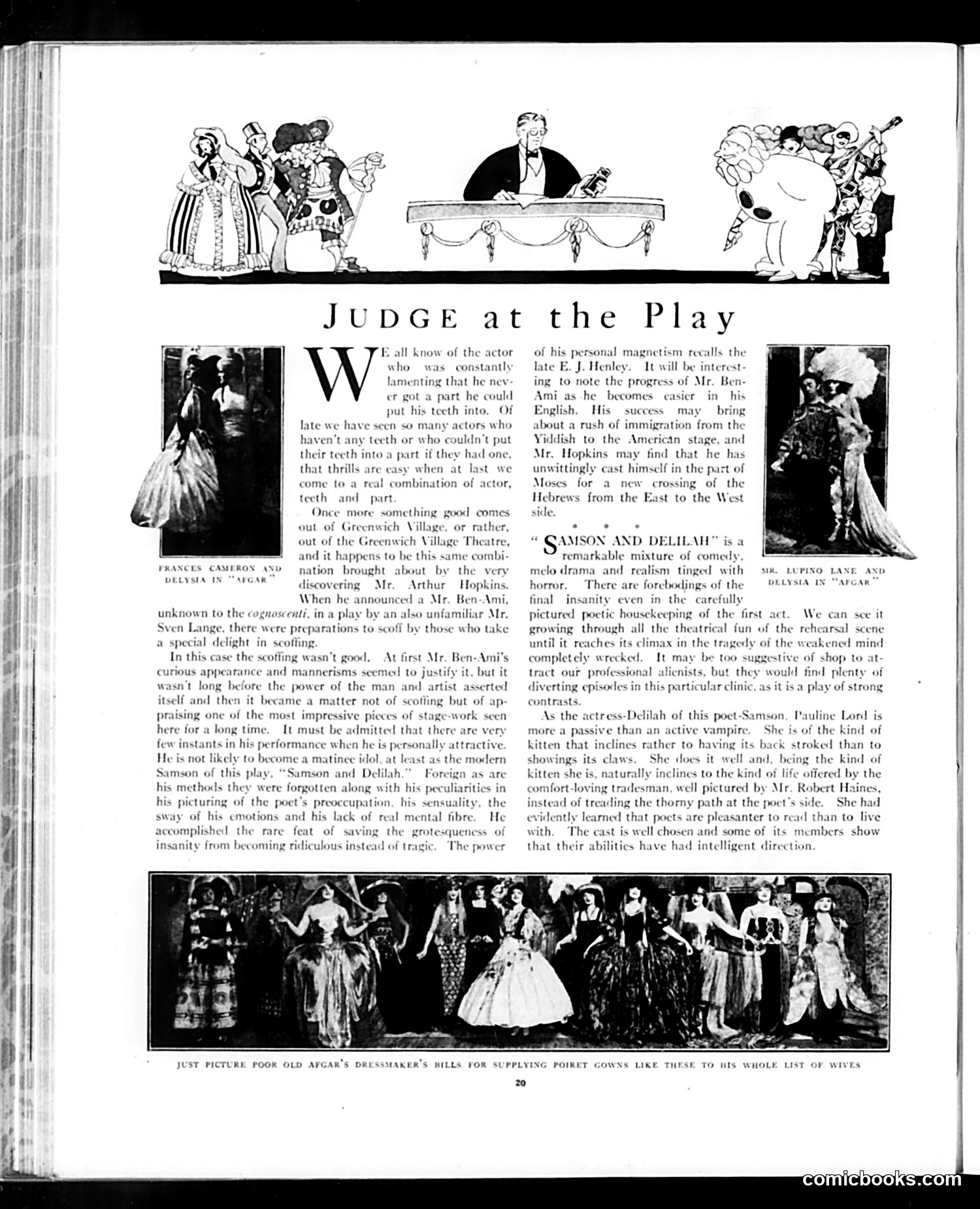
This is a theater review column critiquing two Broadway productions. The main subject is "Samson and Delilah," featuring actor Ben-Ami (identified as "unknown to the cognoscenti"), whom the reviewer initially expected to mock but found impressively talented. The review notes Ben-Ami's foreign accent and mannerisms may drive immigration from Yiddish theater to American stages. The secondary review covers "Samson and Delilah" with actress Pauline Lord, praised as a convincing passive femme fatale who naturally understands domestic life better than bohemian artistic passion—a gendered commentary typical of the era. The bottom photograph shows elaborate costume ball gowns, with a joke caption suggesting designer Poiret's bills for such garments rival the expenses of supporting multiple wives—a reference to the biblical Samson's polygamy. The cartoons at page top appear decorative, illustrating theatrical performance rather than making specific satirical points.
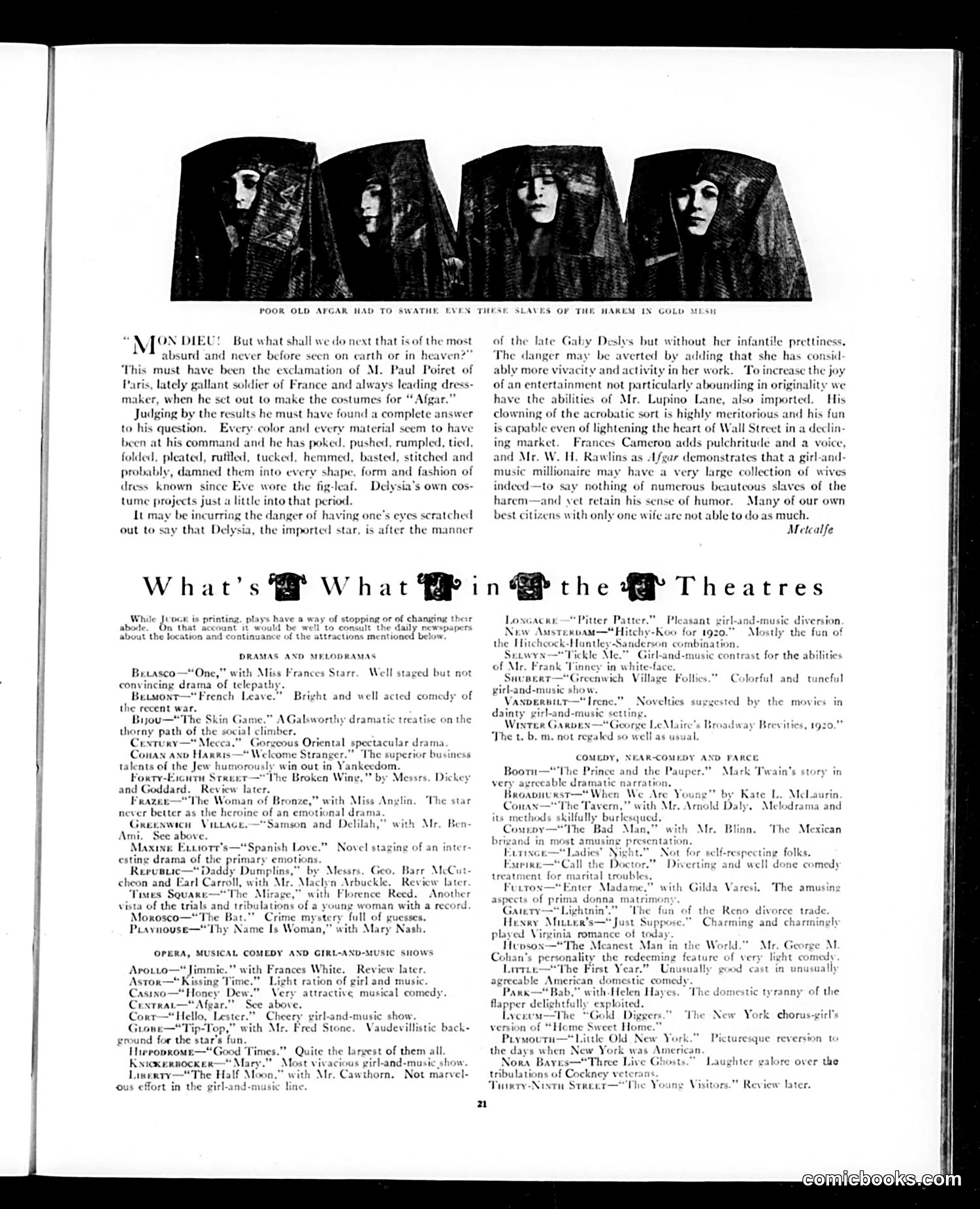
The top image depicts four women wearing elaborate, heavily draped costumes covered in gold fabric and ornate veiling—the costumes for a theatrical production called "Afgar." The caption jokes that the designer, famous Parisian couturier Paul Poiret, had to drape even the "slaves of the harem" in gold mesh. The text satirizes Poiret's costume design as absurdly over-elaborate, involving endless sewing techniques (pleating, tucking, hemming, stitching). It mocks the show's star, imported French actress Gaby Deslys, suggesting she lacks prettiness but compensates with vivacity. The bulk of the page is a theater review column listing contemporary Broadway and touring productions—dramas, comedies, musicals, and vaudeville shows. This is typical Judge magazine content: a mix of theatrical satire and entertainment listings for early 1920s audiences.
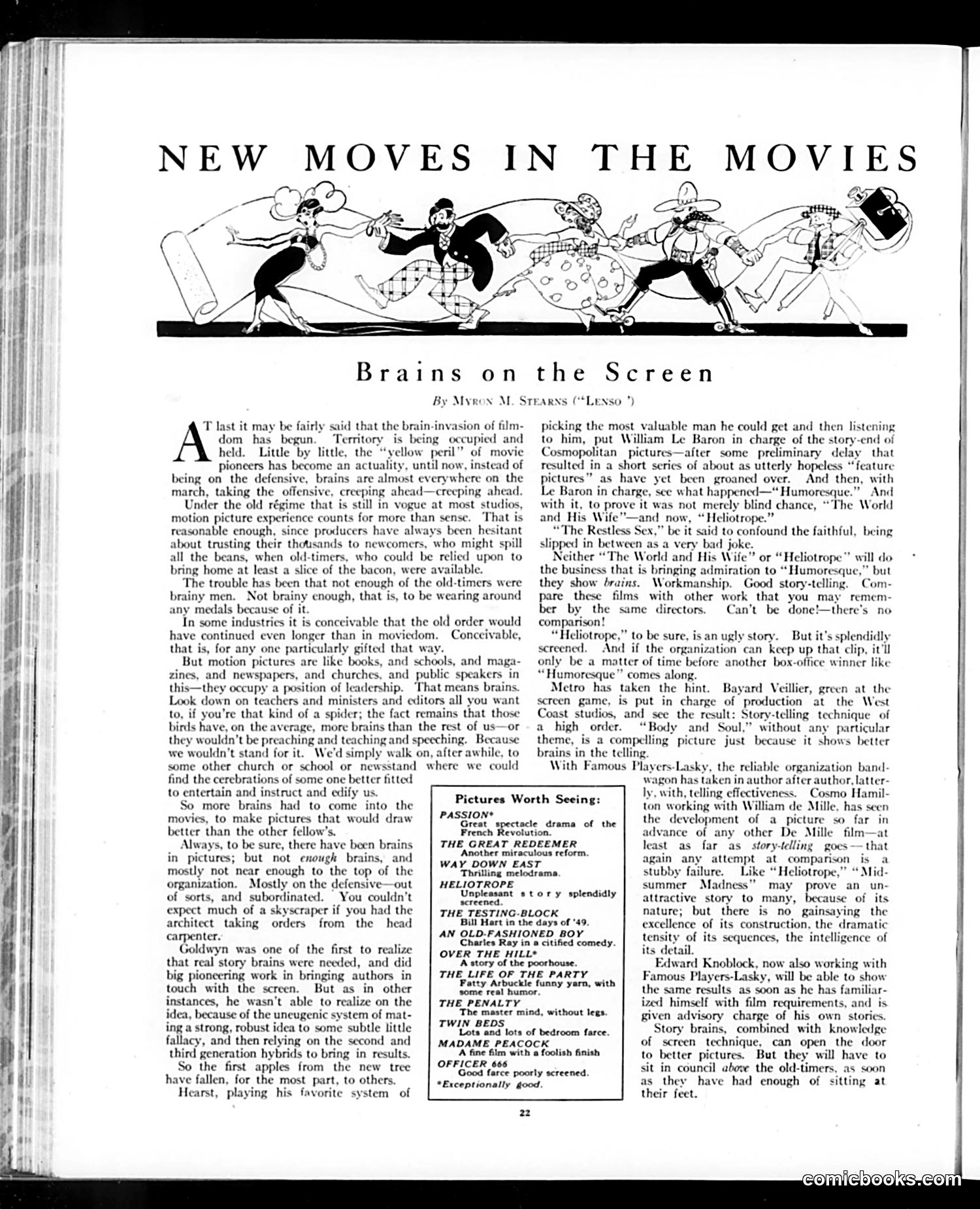
This article by Myron M. Stearns argues that Hollywood films have historically undervalued **intellectual talent** compared to experience. The author celebrates a recent shift where producers—notably **William Randolph Hearst** and **Samuel Goldwyn**—began hiring serious writers and intellectuals for film projects rather than relying solely on studio veterans. The satire targets the old studio system's reluctance to trust newcomers with expensive productions, even when those newcomers possessed superior creative talent. Stearns compares this to other leadership fields (churches, newspapers, schools) where **brains are essential** for quality output. The turning point mentioned is **William Le Baron's** appointment to oversee Cosmopolitan pictures' story department, which allegedly produced better results, exemplified by the film "Humoresque." The sidebar lists contemporary films worth viewing, rating them by quality. The cartoon header depicts various characters in exaggerated motion, visualizing the "invasion" of intelligent creative forces into filmmaking.
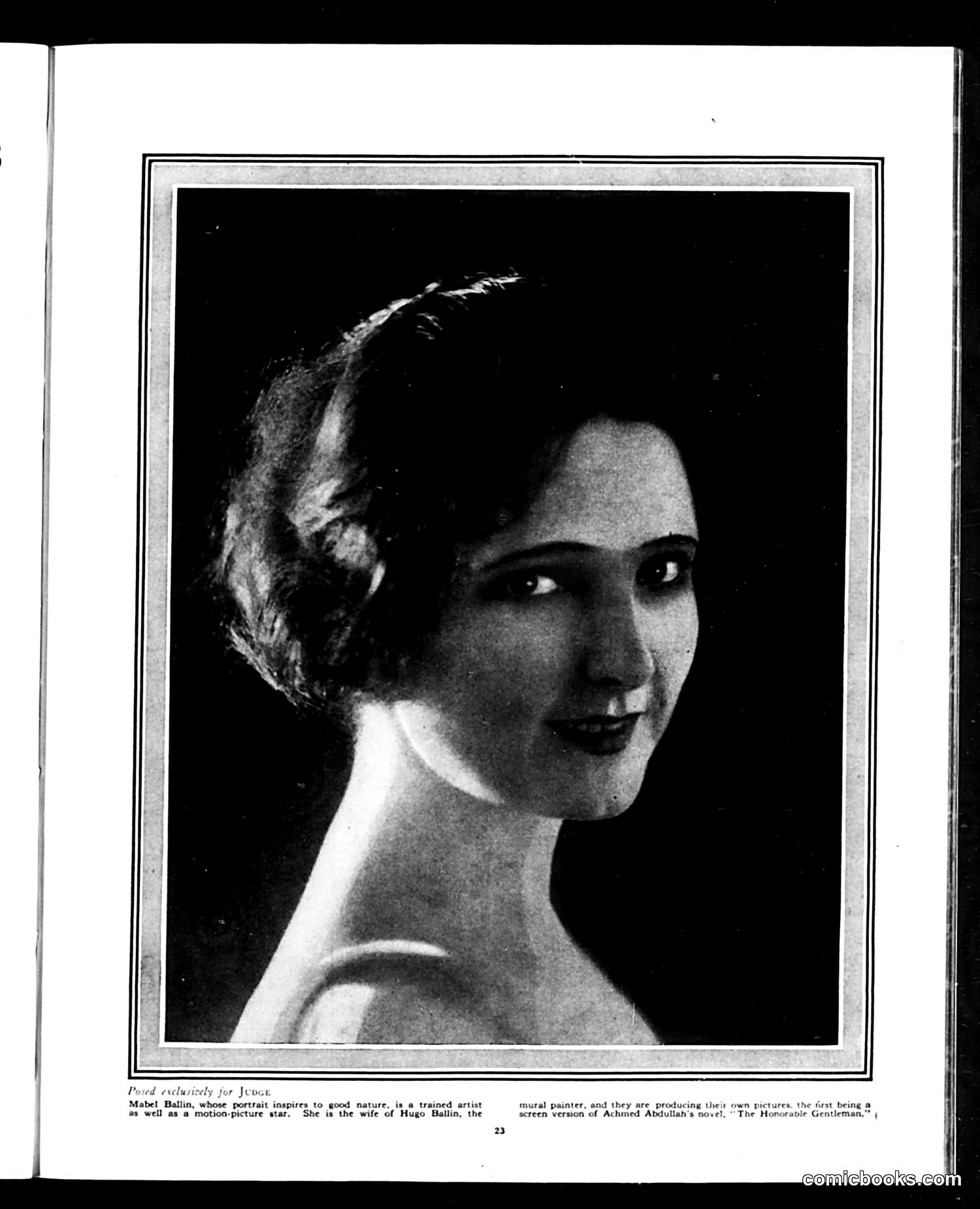
This page features a portrait photograph of Mabel Ballin, identified as a trained artist, mural painter, and motion picture star. The caption notes she is the wife of Hugo Ballin. The text references that Hugo Ballin is producing a screen adaptation of Achmed Abdullah's novel "The Honorable Gentleman," which appears to be their first collaborative picture project. The page functions as a celebrity profile rather than satire or political commentary. It highlights Mabel Ballin's professional accomplishments in both visual art and film during the silent film era, positioning her as a multi-talented creative figure—not merely a movie star's spouse, though her marriage to Hugo is mentioned as context. The "Judge" magazine appears to be covering prominent entertainment figures of the period.
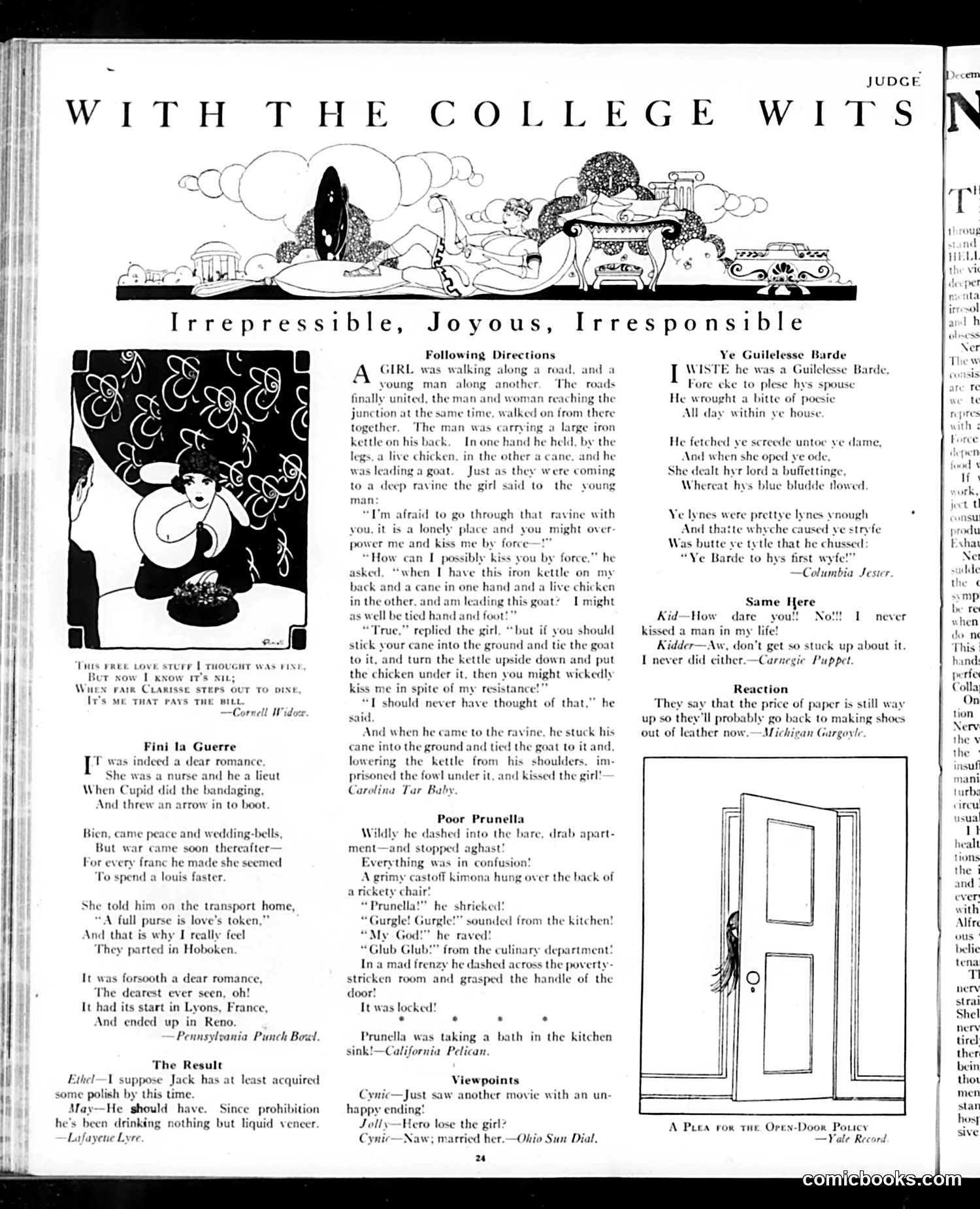
This page presents several short satirical pieces targeting post-WWI American social attitudes: **"Irrepressible, Joyous, Irresponsible"** (top): A darkly comic narrative mocking women's financial independence. A man laden with baggage claims he cannot force a kiss due to his encumbrances, but the girl logically suggests he set things down—which he does, then kisses her anyway. The satire targets both female gullibility and male manipulation. **"Fini la Guerre"** and related poems: These mock marriages destroyed by wives' extravagant spending post-WWI, ending in divorce (Reno was the divorce capital). The satire blames women for financial ruin. **"The Result"**: A Prohibition-era joke where a man drinks "liquid veneer" instead of alcohol—satirizing both Prohibition enforcement and men's desperation to drink. **"Poor Prunella"**: Slapstick domestic chaos mocking housewifely incompetence. **"Viewpoints"**: A cynic's joke equating marriage with unhappiness, reflecting period misogyny. The overall tone reflects 1920s upper-class anxieties about women's post-war independence, spending habits, and changing social roles.
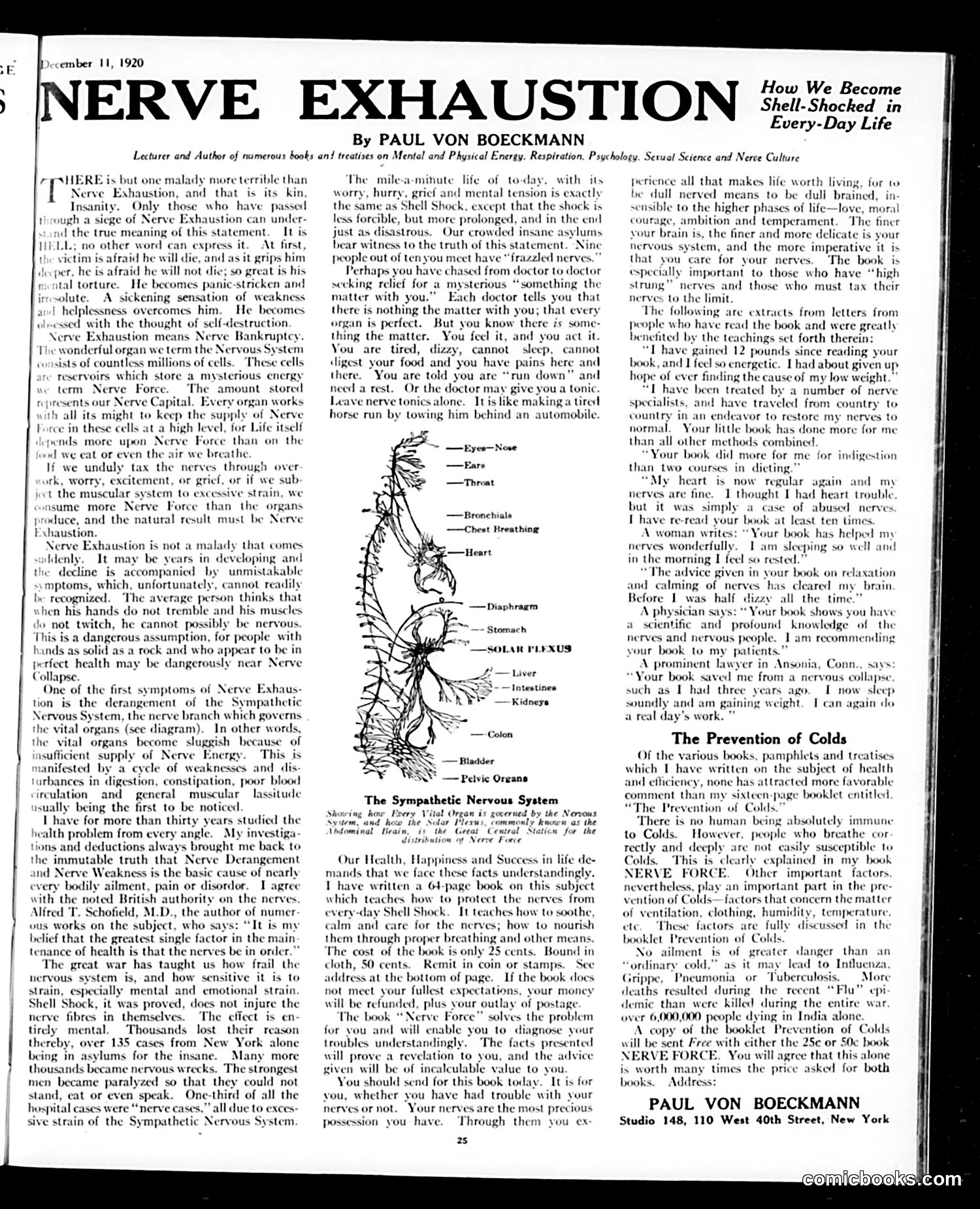
This page is primarily **advertising content disguised as editorial**, not satire. It's a 1920 advertisement for Paul von Boeckmann's book on "Nerve Exhaustion." The piece exploits post-WWI anxiety about "Shell Shock"—a newly recognized condition affecting returning soldiers. Von Boeckmann argues that modern life's stress ("mile-a-minute life") causes "Nerve Exhaustion," presenting it as a widespread epidemic affecting civilians too. The diagram of the "Sympathetic Nervous System" lends pseudo-scientific authority. Testimonials from readers claiming the book cured their conditions serve as endorsements. The satire here is subtle: Judge magazine is mocking the era's tendency toward medical pseudoscience and nervous disorders—genuine concerns after WWI, but often exploited by self-help authors selling questionable remedies. Von Boeckmann positions himself as offering salvation through a 25-cent book, capitalizing on anxiety about mental health at a moment when such conditions were poorly understood.
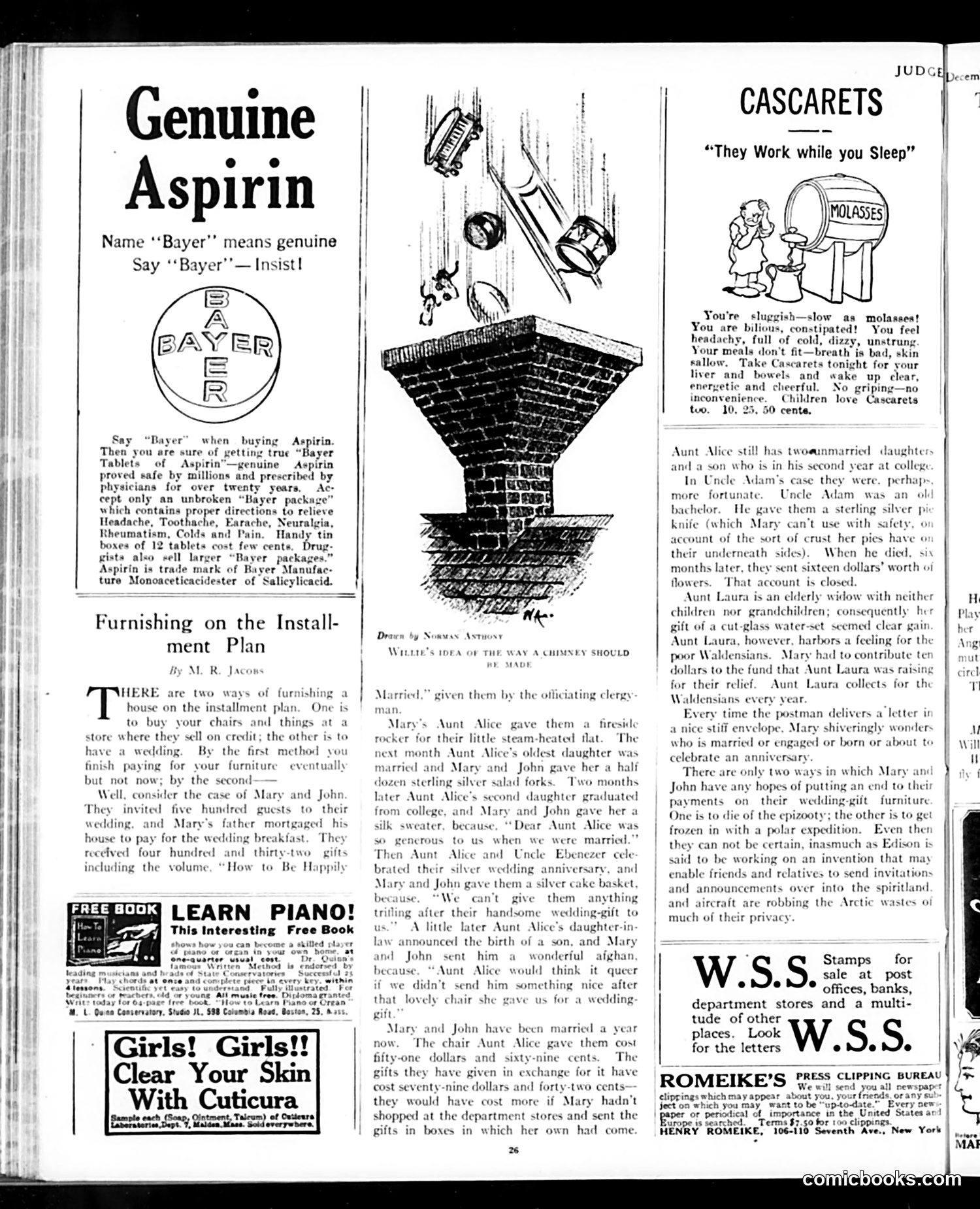
This page contains primarily **advertisements** mixed with a short satirical story titled "Furnishing on the Installment Plan." The central satire mocks the social obligation cycle created by wedding gifts. The story follows Mary and John, who receive expensive gifts (a $51.69 chair) from wealthy relatives. They then feel compelled to reciprocate with gifts to those relatives' subsequent life events—daughters' graduations, anniversaries, births—spending far more ($79.42) than they received, merely to avoid appearing ungrateful. The joke targets the exhausting social debt spiral: even when relatives give generously, recipients become trapped in an endless cycle of obligatory gift-giving that costs them money they may not have. It's social satire on middle-class manners and the unspoken rules governing relationships among the semi-wealthy. The surrounding ads (Bayer Aspirin, Cascarets laxative, piano lessons, Cuticura skin cream) are period commercial content typical of Judge's revenue model.
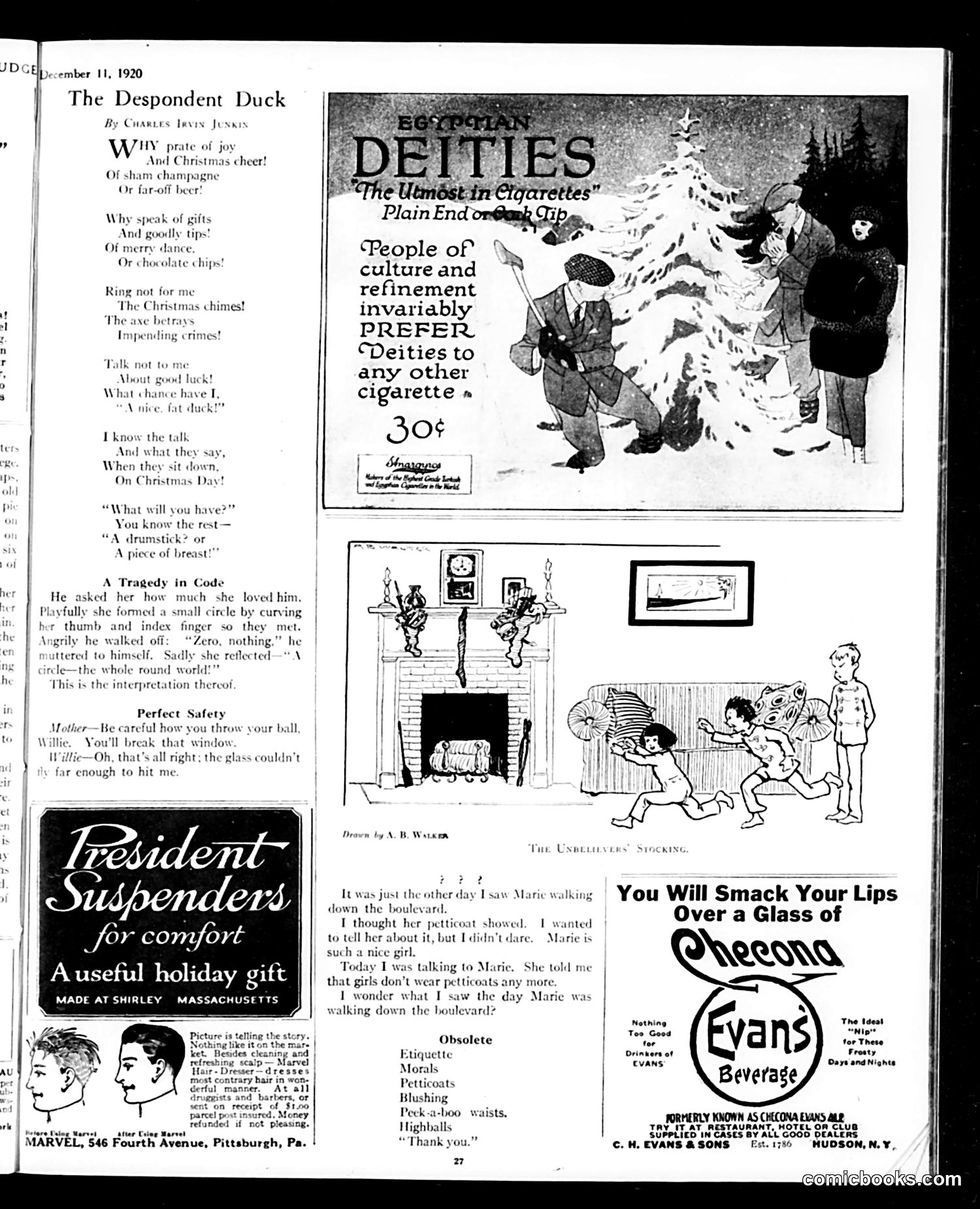
This page contains satirical poetry and social commentary typical of Judge's 1920 content. **"The Despondent Duck"** is a darkly humorous poem about a duck facing slaughter at Christmas—a mordant critique of seasonal hypocrisy. While society celebrates with champagne and gifts, the duck knows the holiday means death ("the axe betrays / Impending crimes"). It's gallows humor about inevitable fate. **"A Tragedy in Code"** mocks romantic miscommunication: a man interprets his lover's finger-circle gesture as "nothing" rather than understanding it as her heart. The woman's regret—that he missed her message—satirizes male obtuseness. **"Obsolete Etiquette"** lists social conventions considered quaint by 1920: petticoats, blushing, and "thank you"—reflecting post-WWI modernization and women's changing social roles (shorter skirts, less restrictive clothing, freer behavior). The advertisements (President Suspenders, Cheona Evans beverages, Egyptian Deities cigarettes) are period products, unremarkable except cigarette marketing to "cultured" audiences.
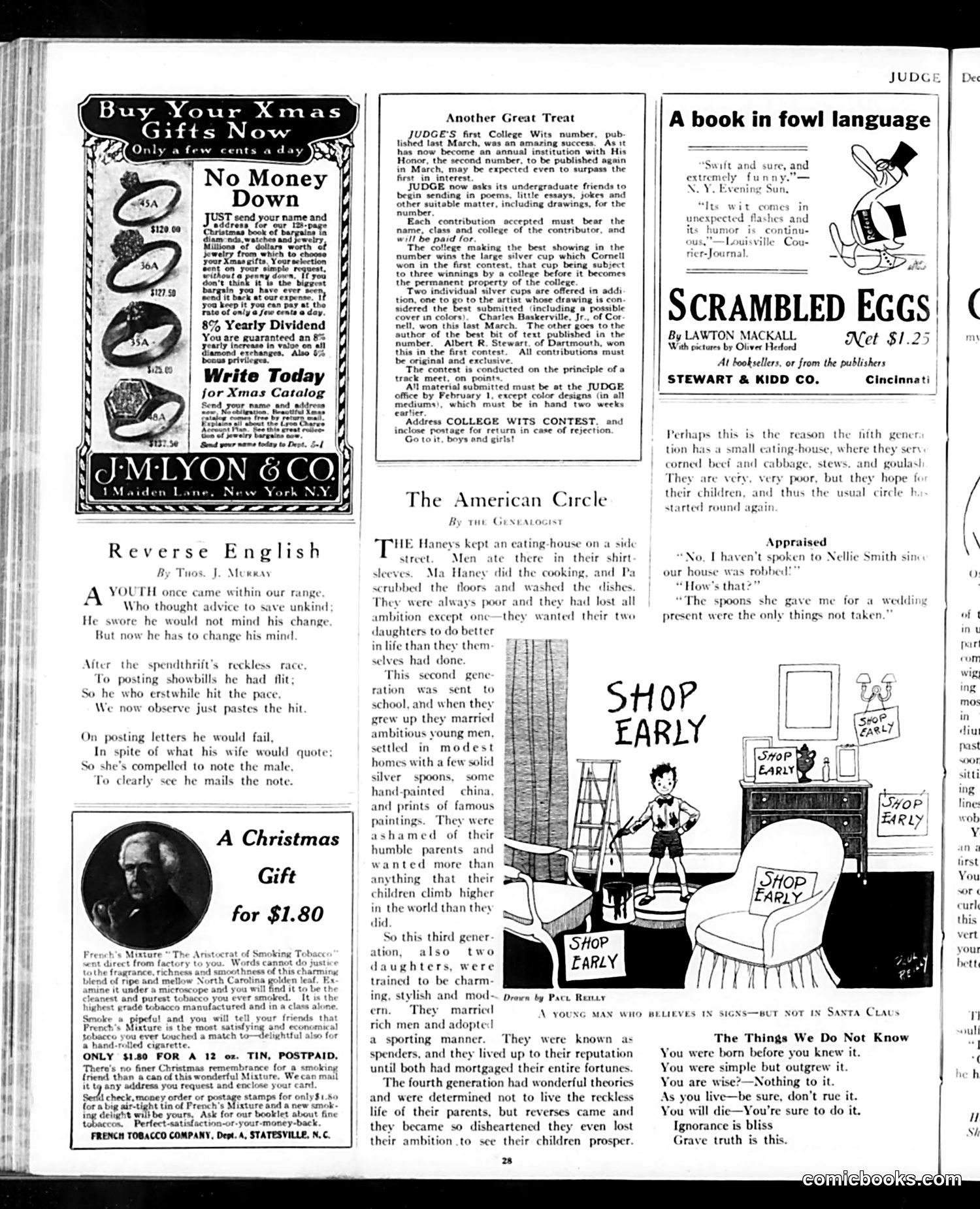
This page from *Judge* magazine (a satirical weekly founded 1881) contains: **Main Content:** A nostalgic essay titled "The American Circle" describes a working-class family's immigrant aspirations—a mother keeping a modest eating house, parents working menial jobs, investing everything in their daughters' education. The unspoken point: this represents the American dream of upward mobility across generations. **Satire/Humor:** The poem "Reverse English" mocks a spendthrift youth forced into humble work posting bills and letters—satirizing both reckless spending and the comeuppance of irresponsible young men. **Advertising:** The page is dominated by luxury goods ads—diamond jewelry, French tobacco—positioned ironically against the humble narratives above, highlighting the economic divide between aspirational working families and wealthy consumers. The overall message reflects early 20th-century middle-class anxiety about labor, class mobility, and consumption during industrial expansion.
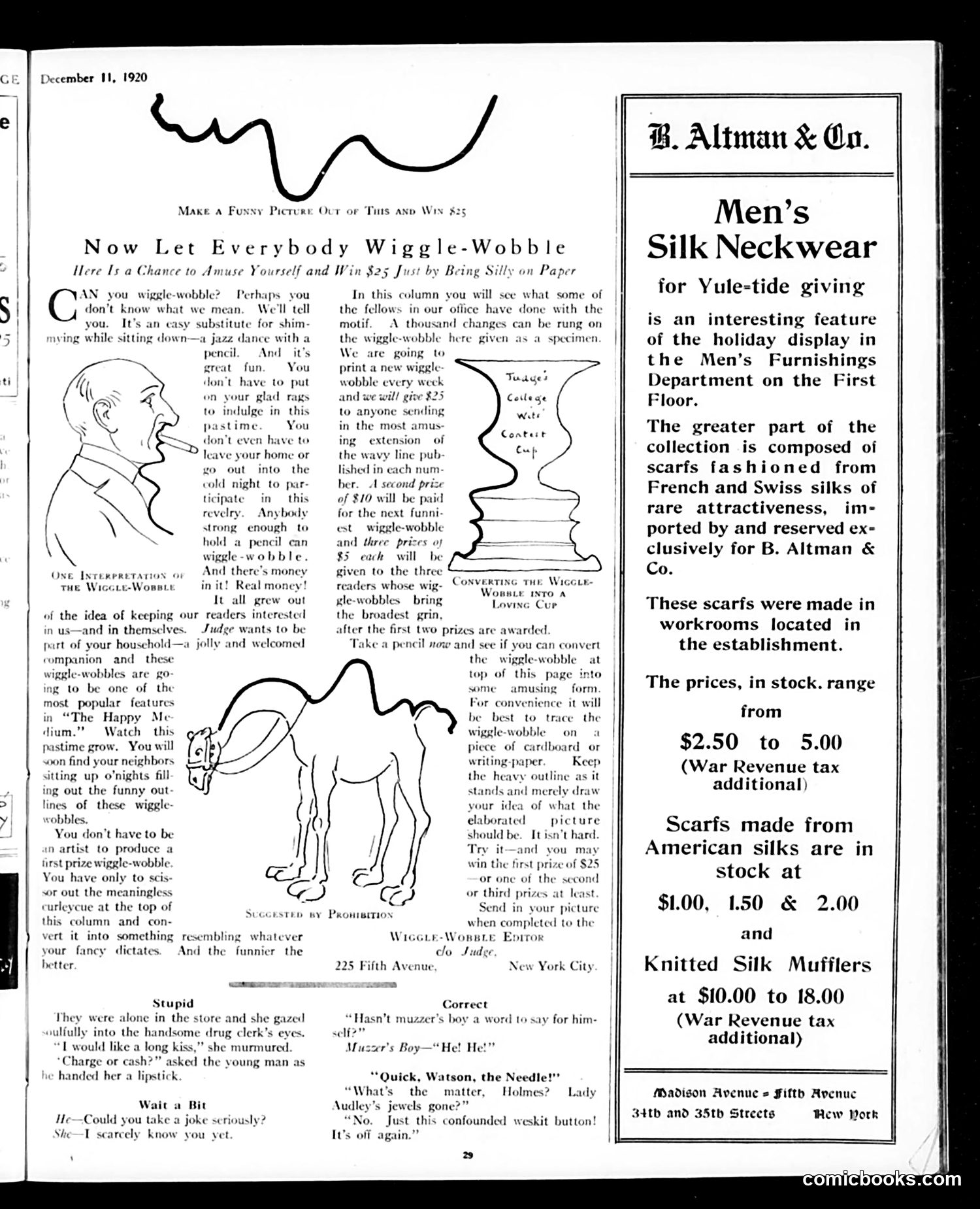
This page features Judge magazine's reader-participation contest: the "Wiggle-Wobble," a drawing game where readers convert a wavy line into amusing pictures for cash prizes ($25 first prize, $10 second, $5 for three third-place winners). The "wiggle-wobble" itself is explained as a playful substitute for the "shimmy"—a jazz dance popular in the 1920s. The page includes humorous examples and brief comic strips showcasing typical Judge humor: a drug-store clerk asking "Charge or cash?" when a woman requests a kiss (playing on the lipstick purchase), and Sherlock Holmes jokes. The satire reflects post-WWI American leisure culture—this was entertainment during Prohibition, when such harmless home amusements were promoted. The right side advertises B. Altman & Co.'s silk neckwear, typical of Judge's advertising model. The humor feels quaint today: earnest, pun-based, and designed for middle-class readers seeking wholesome indoor entertainment.
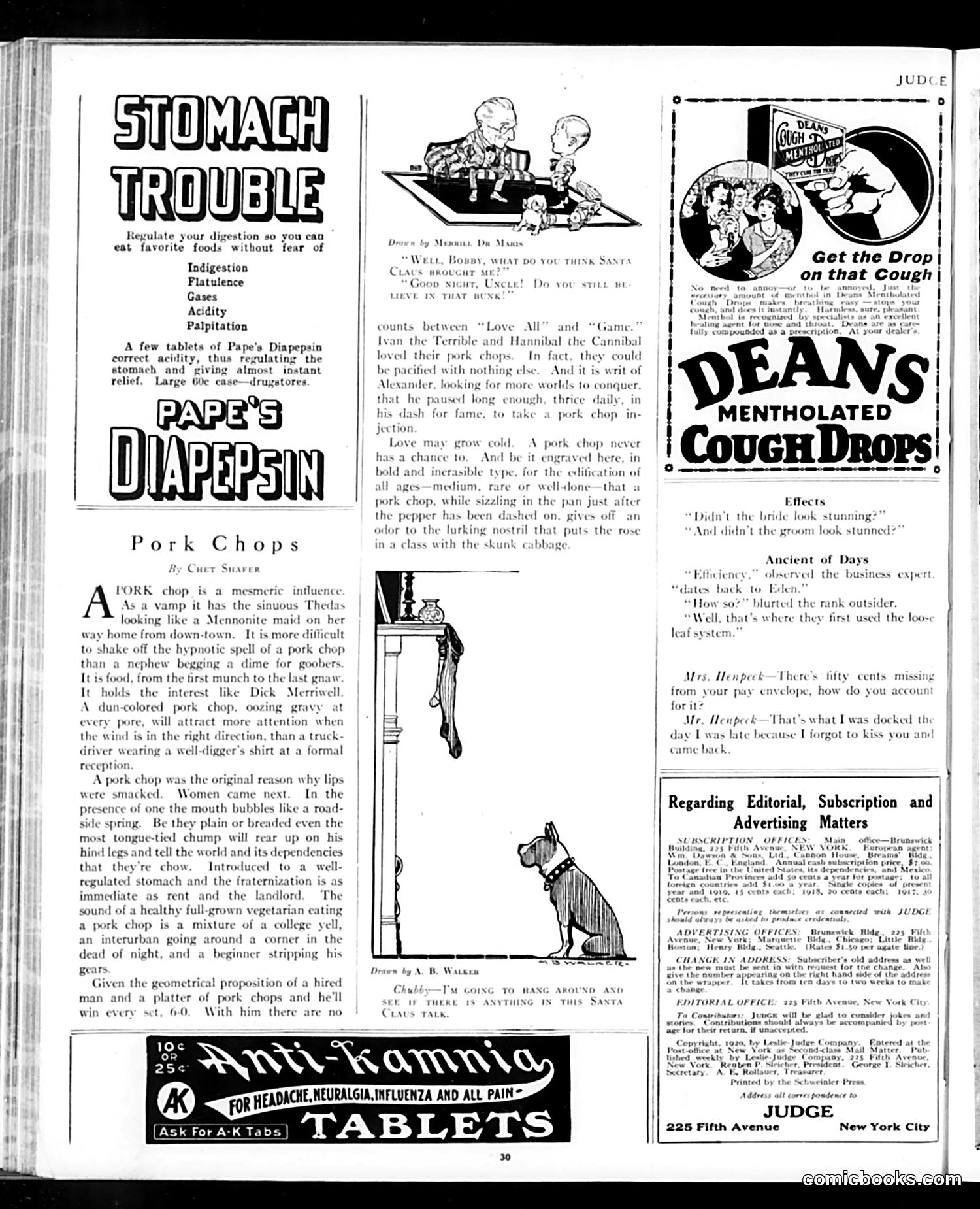
This page from the satirical magazine *Judge* contains several elements: **Main Article: "Pork Chops"** by Chef Shafer is a humorous essay celebrating pork chops using exaggerated, poetic language. It compares the meat's appeal to famous seductive figures (Theda Bara, "the Vamp") and suggests pork chops possess an irresistible, mesmerizing influence over humans—more powerful than most temptations. The piece is tongue-in-cheek social commentary disguised as food writing. **Small Cartoon/Dialogue** depicts an Uncle and Bobby discussing Santa Claus, suggesting the Uncle is skeptical about Christmas mythology while Bobby still believes—a gentle satire on childhood innocence versus adult cynicism. **Advertisements** promote Papa's Diapepsin (digestive aid) and Dean's Menthol Cough Drops—products reflecting the article's ironic point: eating appealing foods like pork chops causes stomach troubles requiring medicinal relief. The page blends humor, advertising, and social observation typical of early 20th-century *Judge* content—lighthearted rather than hard-hitting political satire.
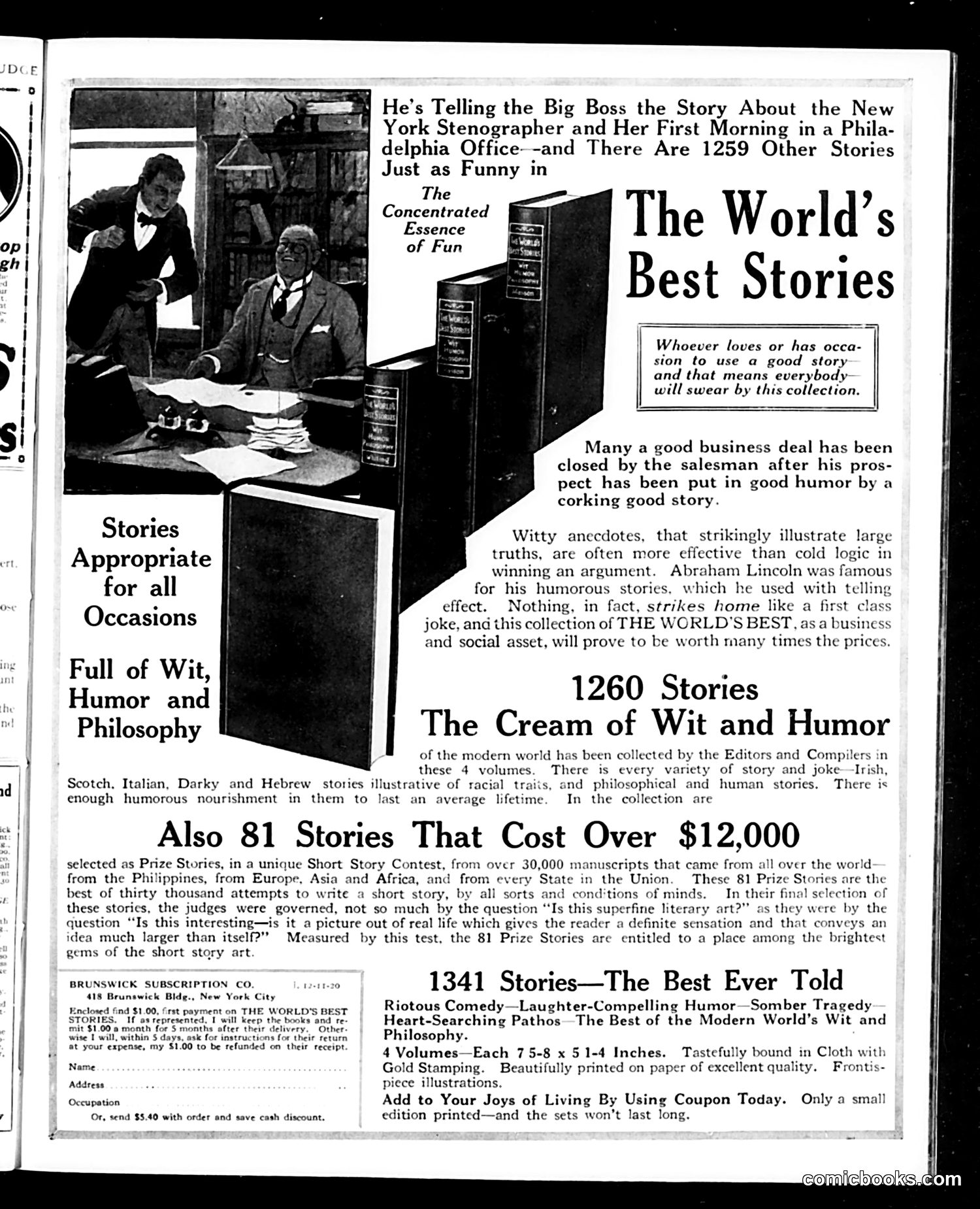
This page is primarily **advertising**, not political satire. It promotes "The World's Best Stories," a 4-volume collection of 1,260+ humorous anecdotes. The small illustration shows a **office scene** where one man tells the boss a funny story (about "a New York stenographer and her first morning in a Philadelphia office") to amuse him—the ad's central pitch: humor as a business tool. The text emphasizes anecdotes' practical value in persuasion and deal-making, citing Abraham Lincoln's use of humorous stories. It references **period ethnic stereotypes** (listing "Irish, Scotch, Italian, Darky and Hebrew stories"), which would be offensive today but reflected common categorization in early 20th-century publishing. The ad highlights 81 premium stories from a $12,000 contest and uses sales language ("won't last long") to create urgency. This is a product advertisement, not editorial commentary—typical Judge content mixing satire with commercial pitches.
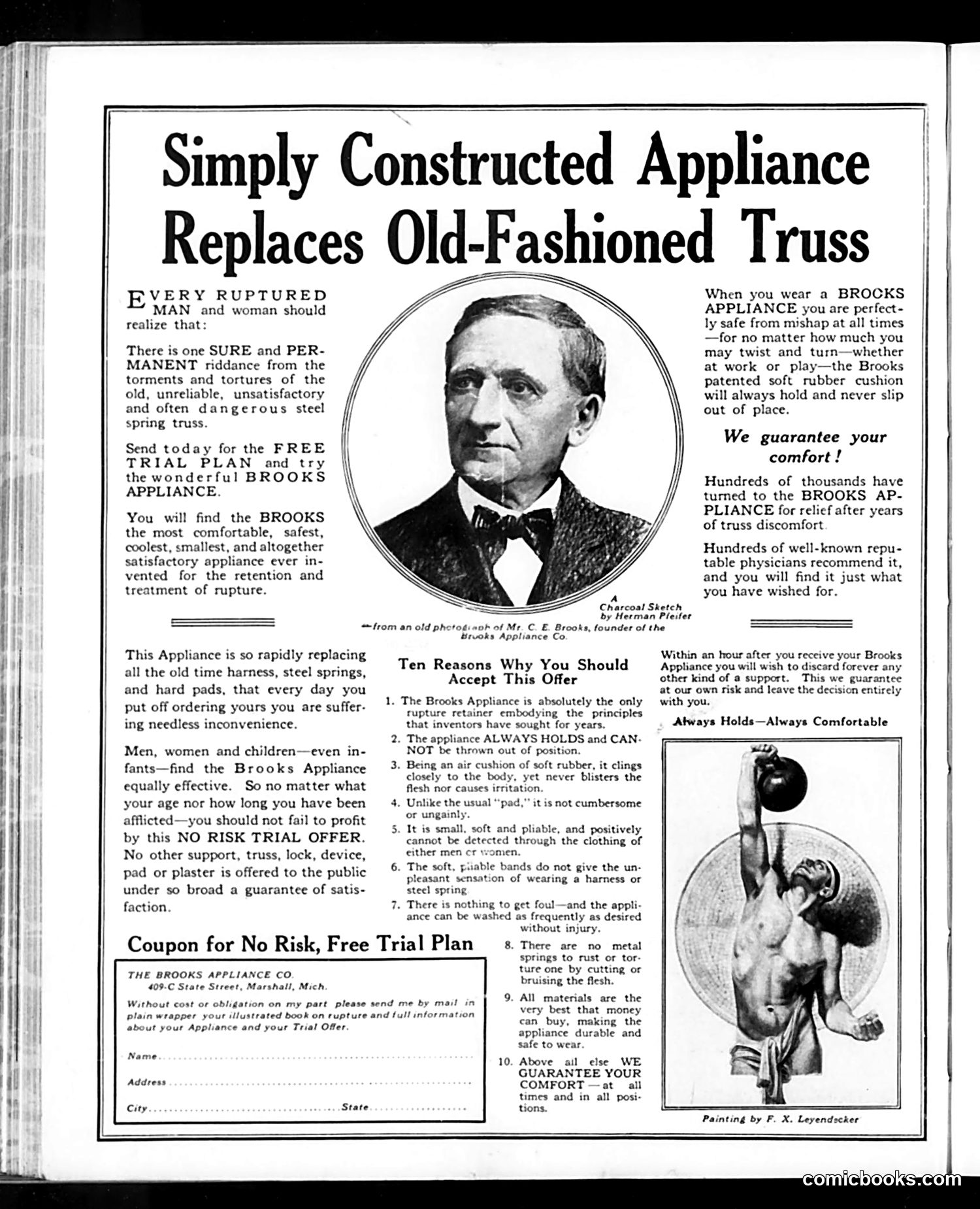
This is **not a political cartoon or satire**—it's a straightforward medical device advertisement masquerading as editorial content in *Judge* magazine. The page advertises the "Brooks Appliance," a hernia truss (support device for ruptured abdominal muscles). The portrait shows C.E. Brooks, the product's founder. The accompanying illustration demonstrates the device's supposed comfort and security during physical activity. The ad employs typical early-20th-century marketing tactics: testimonials from "hundreds of thousands" and physicians, numbered lists of benefits, claims of superiority over competitors' "old-fashioned" steel-spring trusses, and a free trial coupon to remove purchase risk. For modern readers, this reflects an era when medical devices faced minimal regulation and advertisements made sweeping health claims without evidence. The inflammatory language ("torments and tortures") and endorsement strategy would be considered unethical today. The prominence given to this ad in a satirical magazine shows how openly commercial content infiltrated editorial spaces.