
Judge, 1920-12-11 · page 14 of 32
Judge — December 11, 1920 — page 14: what you’re looking at
What you’re looking at
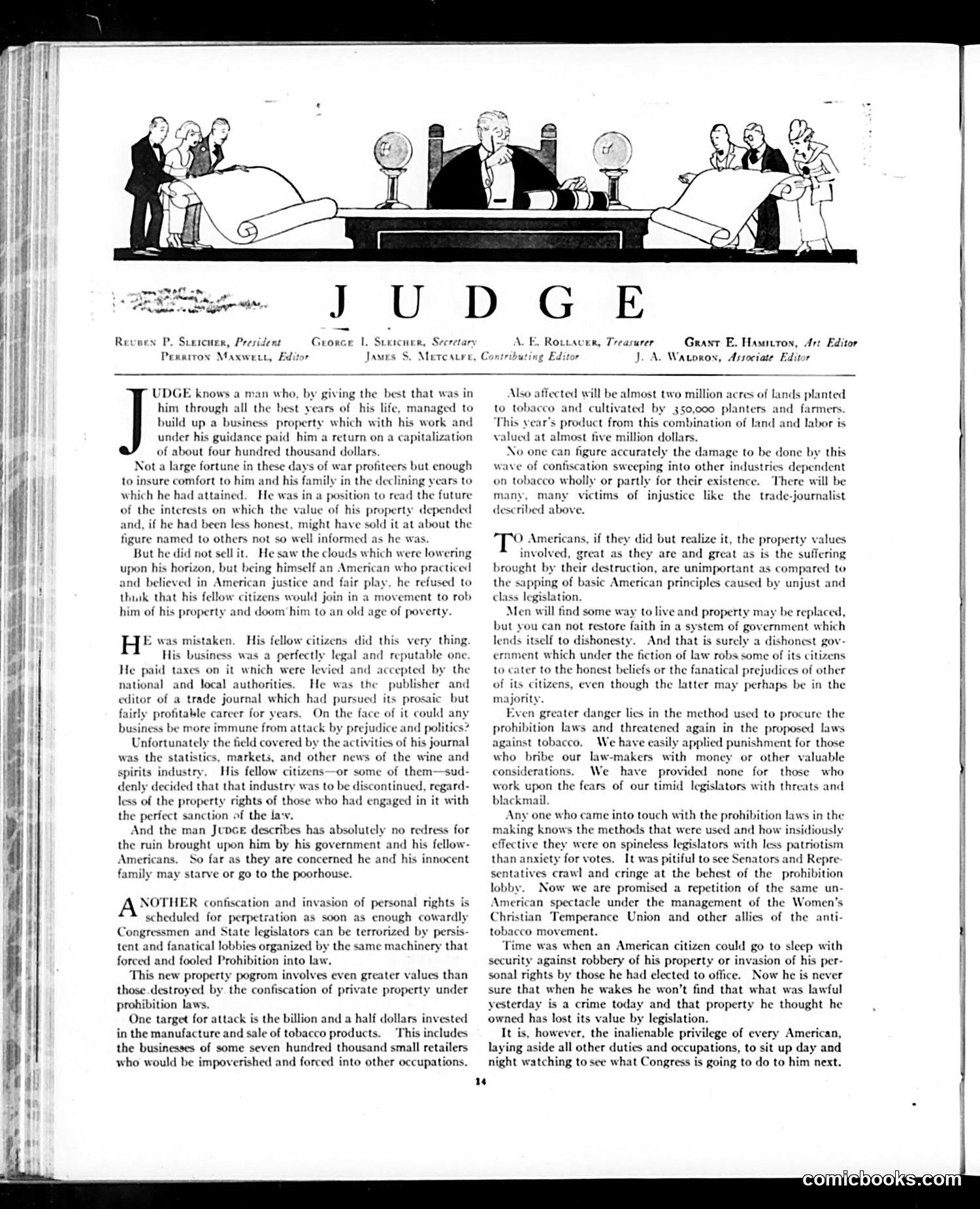
This editorial attacks Prohibition and threatened tobacco regulation as government overreach. The cartoon header depicts a judge presiding over competing petitioners—visualizing how legislation is decided. The text describes a specific businessman ruined by Prohibition: a trade journal publisher covering the wine and spirits industry. Though his legal, taxpaying business operated with government sanction, Prohibition destroyed it without compensation—a confiscation Judge frames as un-American injustice. The piece then warns of a second attack: anti-tobacco legislation that would eliminate 1.5 billion dollars in tobacco manufacturing and harm 700,000 small retailers and 350,000 farmers. Judge's central argument: beyond economic damage, such "confiscation" violates foundational American property rights and represents "class legislation"—law driven by fanatical lobbies and cowardly politicians rather than principle. The satire condemns what it views as mob-driven tyranny masquerading as reform.
📄 Transcribed text from this page (OCR, searchable)
Machine-transcribed from the original scan — historical spelling and the odd misread are preserved.
torce I. Sterner, Secretary Jawes S. Metcacre, Revoen P. Srercuer, President Perarrox Maxwett, JUDGE \. FE. Routaver, Treasurer ontributing Ed: J. A. Watoron, Associate Editor UDGE knows a man who, by giving the best that was in him through all the best vears of his life, managed to build up a business property which with his work and under his guidance paid him a return on a capitalization of about four hundred thousand dollars. Not a large fortune in these days of war profiteers but enough to insure comfort to him and his family in the declining years to which he had attained. He was in a position to read the future of the interests on which the value of his property depended and, if he had been less honest, might have sold it at about the figure named to others not so well informed as he was. But he did not sell it. He saw the clouds which were lowering upon his horizon, but being himself an American who practiced and believed in American justice and fair play, he refused to think that his fellow citizens would join in a movement to rob him of his property and doom’him to an old age of povert HE was mistaken. His fellow citizens did this very thing. His business was a perfectly legal and reputable one. He paid taxes on it which were levied and accepted by the national and local authorities. He was the publisher and editor of a trade journal which had pursued its prosaic but fairly profitable career for years. On the face of it could any business be more immune from attack by prejudice and politics? Unfortunately the field covered by the activities of his journal was the statistics, markets, and other news of the wine and spirits industry. His fellow citizens—or some of them—sud- denly decided that that industry was to be discontinued, rey less of the property rights of those who had engaged in it with the perfect sanction of the lav. And the man Jupce describes has absolutely no redress for the ruin brought upon him by his government and his fellow- Americans. So far as they ate concerned he and his innocent family may starve or go to the poorhouse. NOTHER confiscation and invasion of personal rights is scheduled for perpetration as soon as enough cowardly Congressmen and State legislators can be terrorized by persis- tent and fanatical lobbies organized by the same machinery that forced and fooled Prohibition into law. This new property pogrom involves even greater values than those destroyed by the confiscation of private property under prohibition laws. One target for attack is the billion and a half dollars invested in the manufacture and sale of tobacco products. This includes the businesses of some seven hundred thousand small retailers who would be impoverished and forced into other occupations. u“ Also affected will be almost two million acres of lands planted to tobacco and cultivated by 350,000 planters and farmers. This year’s product from this combination of land and labor is valued at almost five million dollars, » one can figure accurately the damage to be done by this wave of confiscation sweeping into other industries dependent on tobacco wholly or partly for their existence. There will be many, many victims of injustice like the trade-journalist described above. ) Americans, if they did but realize it, the property values involved, great as they are and great as is the suffering brought by their destruction, are unimportant as compared to the sapping of basic American principles caused by unjust and class legislation. Men will find some way to live and property may be replaced, but you can not restore faith in a system of government which lends itself to dishonesty. And that is surely a dishonest gov- ernment which under the fiction of law robs some of its citizens to cater to the honest beliefs or the fanatical prejudices of other of its citizens, even though the latter may perhaps be in the majority. Even greater danger lics in the method used to procure the prohibition laws and threatened again in the proposed laws against tobacco. We have easily applied punishment for those who bribe our law-makers with money or other valuable considerations. We have provided none for those who work upon the fears of our timid legislators with threats and blackmail. Any one who came into touch with the prohibition laws in the making knows the methods that were used and how insidiously effective they were on spineless legislators with less patriotism than anxiety for votes. It was pitiful to sce Senators and Repre- sentatives crawl and cringe at the behest of the prohibition lobby. Now we are promised a repetition of the same un- American spectacle under the management of the Women’s Christian Temperance Union and other allies of the anti- tobacco movement. Time was when an American citizen could go to sleep with security against robbery of his property or invasion of his per- sonal rights by those he had elected to office. Now he is never sure that when he wakes he won't find that what was lawful yesterday is a crime today and that property he thought he owned has lost its value by legislation. It is, however, the inalienable privilege of every American, laying aside all other duties and occupations, to sit up day and night watching to see what Congress is going to do to him next. Grant E. Hamicton, drt Editor a