
Judge, 1920-12-11 · page 22 of 32
Judge — December 11, 1920 — page 22: what you’re looking at
What you’re looking at
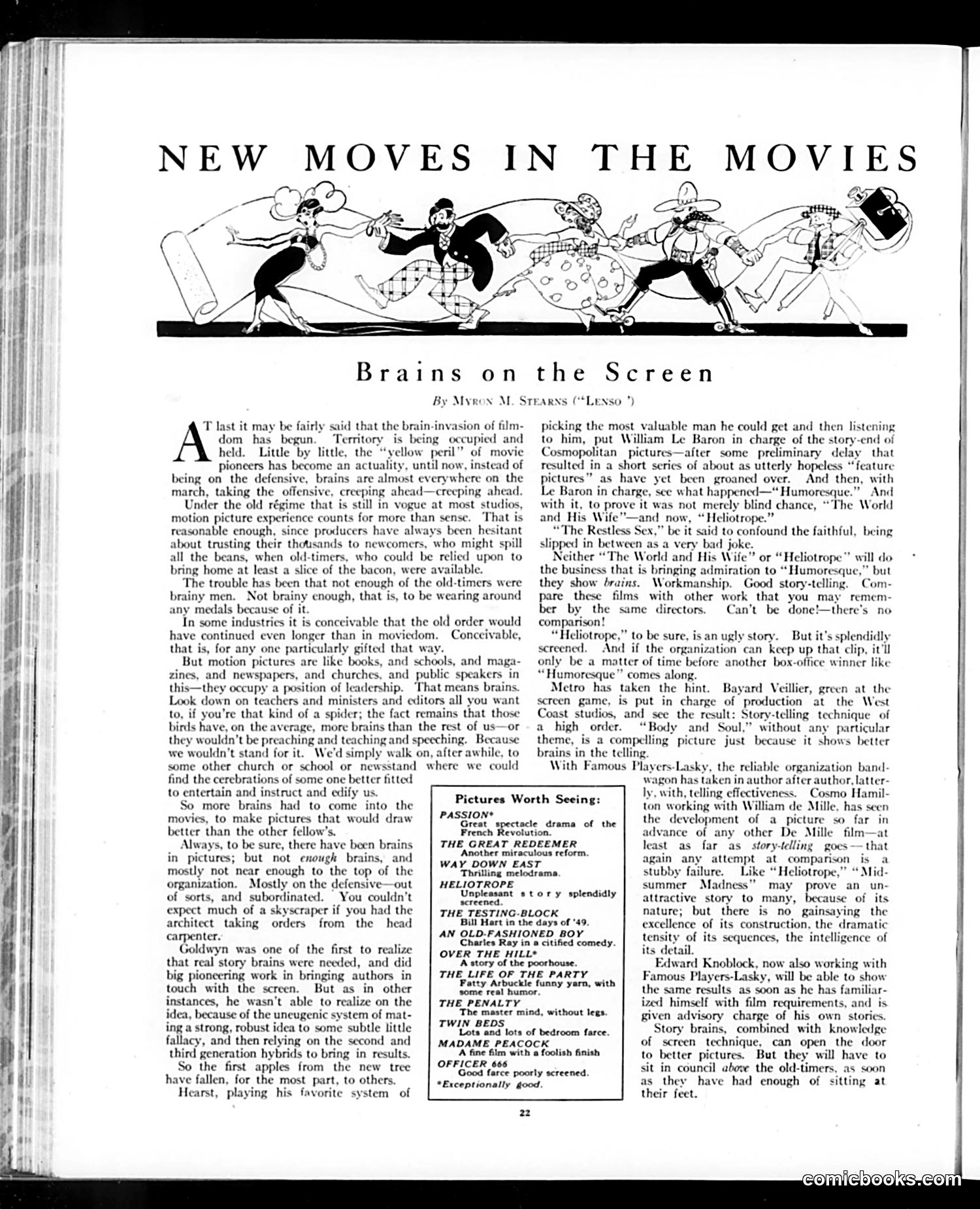
This article by Myron M. Stearns argues that Hollywood films have historically undervalued **intellectual talent** compared to experience. The author celebrates a recent shift where producers—notably **William Randolph Hearst** and **Samuel Goldwyn**—began hiring serious writers and intellectuals for film projects rather than relying solely on studio veterans. The satire targets the old studio system's reluctance to trust newcomers with expensive productions, even when those newcomers possessed superior creative talent. Stearns compares this to other leadership fields (churches, newspapers, schools) where **brains are essential** for quality output. The turning point mentioned is **William Le Baron's** appointment to oversee Cosmopolitan pictures' story department, which allegedly produced better results, exemplified by the film "Humoresque." The sidebar lists contemporary films worth viewing, rating them by quality. The cartoon header depicts various characters in exaggerated motion, visualizing the "invasion" of intelligent creative forces into filmmaking.
📄 Transcribed text from this page (OCR, searchable)
Machine-transcribed from the original scan — historical spelling and the odd misread are preserved.
Brains on By Myron M.S T last it may be fairly said that the brain-invasion of film- dom has begun. Territory is being occupied and held. Little by little, the “yellow peril” of movie pioneers has become an actuality, until now, instead of being on the defensive, brains are almost everywhere on the march, taking the offensive, creeping ahead—crecping ahead. Under the old régime that is still in vogue at most studios, motion picture experience counts for more than sense. That is reasonable enough, since producers have always been hesitant about trusting their thousands to newcomers, who might spill all the beans, when old-timers, who could be relied upon to bring home at least a slice of the bacon, were available. The trouble has been that not enough of the old-timers were brainy men. Not brainy enough, that is, to be wearing around any medals because of it. In some industries it is conceivable that the old order would have continued even longer than in movicdom. Conccivable, that is, for any one particularly gifted that But motion pictures are like books, and schools, zines, and newspapers, and churches, and public sp this—they occupy a position of leadership. That means brains. Look down on teachers and ministers and editors all you want to, if you're that kind of a spider; the fact remains that those birds have, on the average, more brains than the rest of us—or they wouldn't be preaching and teaching and speeching. Because we wouldn't stand for it. We'd simply walk on, after awhile, to some other church or school or newsstand where we could find the cerebrations of some one better fitted to entertain and instruct and edify us. So more brains had to come into the movies, to make pictures that would draw better than the other fellow’s. Always, to be sure, there been brains in pictures; but not enough brains, and mostly not near enough to the top of the organization. Mostly on the defensive—out of sorts, and subordinated. You couldn't Unplones expect much of a skyscraper if you had the architect taking orders from the head carpenter. Goldwyn was one of the first to realize that real story brains were needed, and did big pioncering work in bringing authors in touch with the screen. But as in other instances, he wasn’t able to realize on the dea, because of the uneugenic system of mat- ing a strong, robust idea to some subtle litle fallacy, and then relying on the second and third generation hybrids to bring in results. So the first apples from the new tree have fallen, for the most part, to others. Hearst, playing his favorite system of PASSION* ‘Another mi Thrilling mel HELIOTROPE Bill Hart int AN OLD-FASHI. Charles Ray THE PENALTY TWIN BEDS A fine film wit OFFICER 666 Pictures Worth Seeing: Great spectacle drama of the French Revolution. THE GREAT REDEEMER WAY DOWN EAST Unpleasant story splendidly THE_TESTING-BLOCK OVER THE HILL* A story of the poorhouse. THE_LIFE OF THE PARTY Fatty Arbuckle funny yarn, with some real humor, The master mind, without legs. Lots and lots of bedroom farce. MADAME PEACOCK Good farce poorly screened. *Exceptionally good. the Screen TEARNS (““LENso ') picking the most valuable man he could get and then listening to him, put William Le Baron in charge of the story-end of Cosmopolitan pictures—after some preliminary de that resulted in a short series of about as utterly hopeless “feature pictures” as have yet been groaned over. And then, with Le Baron in charge, sce what happened—* Humoresque.” | And with it, to prove it was not merely blind chance, “The World and His Wife’—and now, “Heliotrope.” “The Restless Sex,” be it said to confound the faithful, being slipped in between as a very bad joke. Neither “The World and His Wife” or “Heliotrope” will do the business that is bringing admiration to “ Humoresque,” but they show brains. Workmanship. Good story-telling. Com- pare these films with other work that you may remem- ber by the same directors. Can't be done!—there’s no comparison! “Heliotrope,” to be sure, is an ugly story. But it ’s splendidly screened. And if the organization can keep up that clip, it'll only be a matter of time before another box-office winner like “Humoresque” comes along. Metro has taken the hint. Bayard Veillier, green at the screen game, is put in charge of production at the West Coast studios, and see the result: Story- telling technique of a high order. “Body and Soul,” without any particular theme, is a compelling picture just because it shows better br: ins in the telling. With Famous Players-Lasky, the reliable organization band- wagon has taken in author after author, latter- ly, with, telling effectiveness. Cosmo Hamil- ‘on working with William de Mille, has seen the development of a picture so far in advance of any other De Mille film—at least as far as_ story-telling goes— that again any attempt at comparison is a stubby failure. Like “Heliotrope,” “ Mid- summer Madness” may prove an un- attractive story to many, because of its nature; but there is no gainsaying the excellence of its construction, the dramatic tensity of its sequences, the intelligence its detail. Edward Knoblock, now also working with Famous Players-Lasky, will be able to show the same results as soon as he has familiar- ized himself with film requirements, and is given advisory charge of his own stories. Story brains, combined with knowledge of screen technique, can open the door to better pictures. But they will have to sit in council above the old-timers, as soon as they have had enough of sitting at their feet. \culous reform. lodrama. he days of '49, 'ONED BOY in a citified comedy. th a foolish finish 22