
A complete issue · 32 pages · 1920
Judge — November 13, 1920
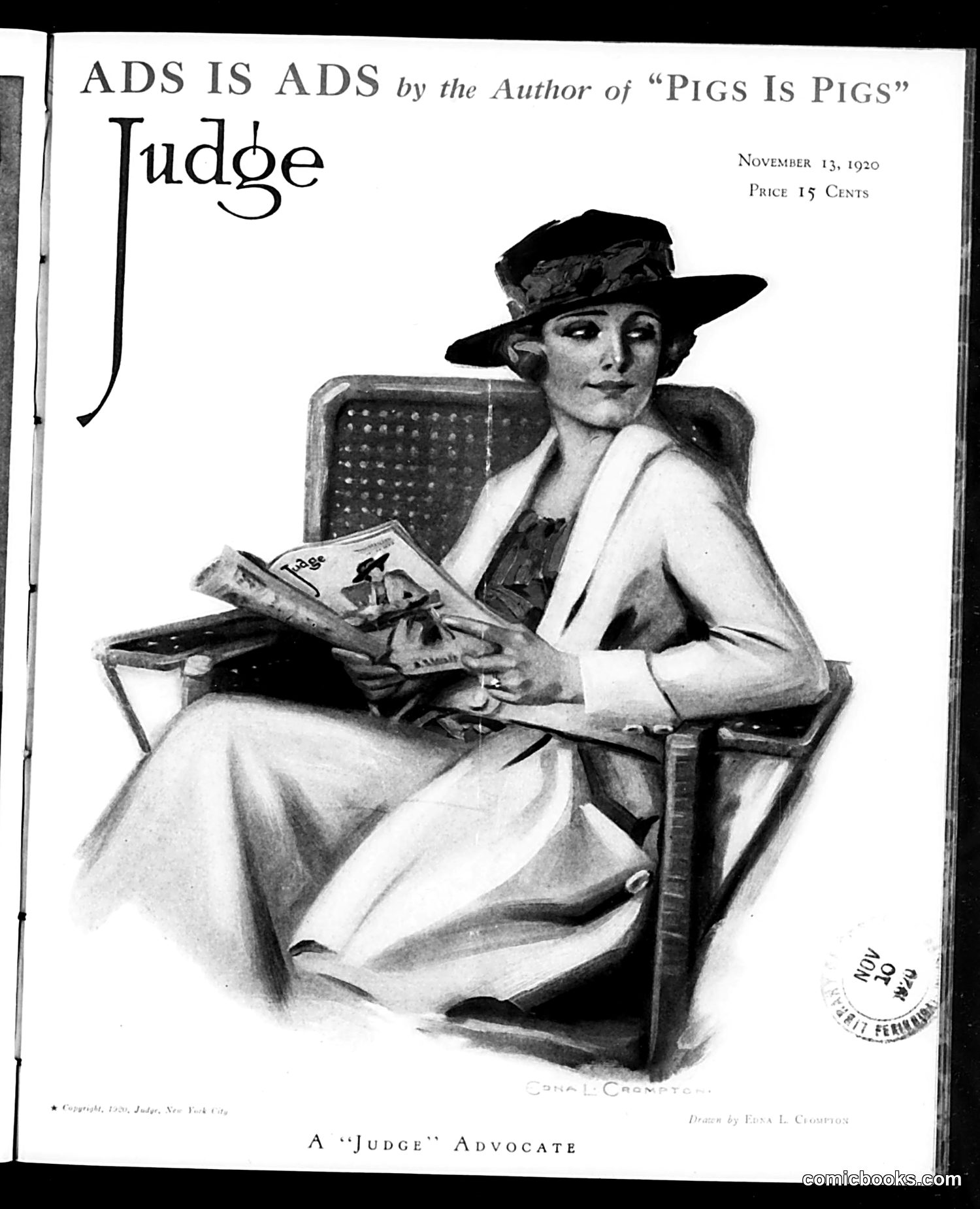
This is primarily a **magazine cover, not political satire**. The illustration shows a fashionable woman seated in a chair, reading Judge magazine itself—a common self-promotional device. She wears 1920s fashion (cloche hat, draped dress) and appears elegant and leisurely. The subtitle "A 'Judge' Advocate" plays on the magazine's name, suggesting readers become advocates for Judge by enjoying it. The header advertises "Ads Is Ads by the Author of 'Pigs Is Pigs'"—referencing a popular contemporary story by Ellis Parker Butler about literal interpretation of contract language. This appears to be a straightforward circulation-building cover rather than political commentary. The satire referenced in the header concerns advertising and language, not current events.
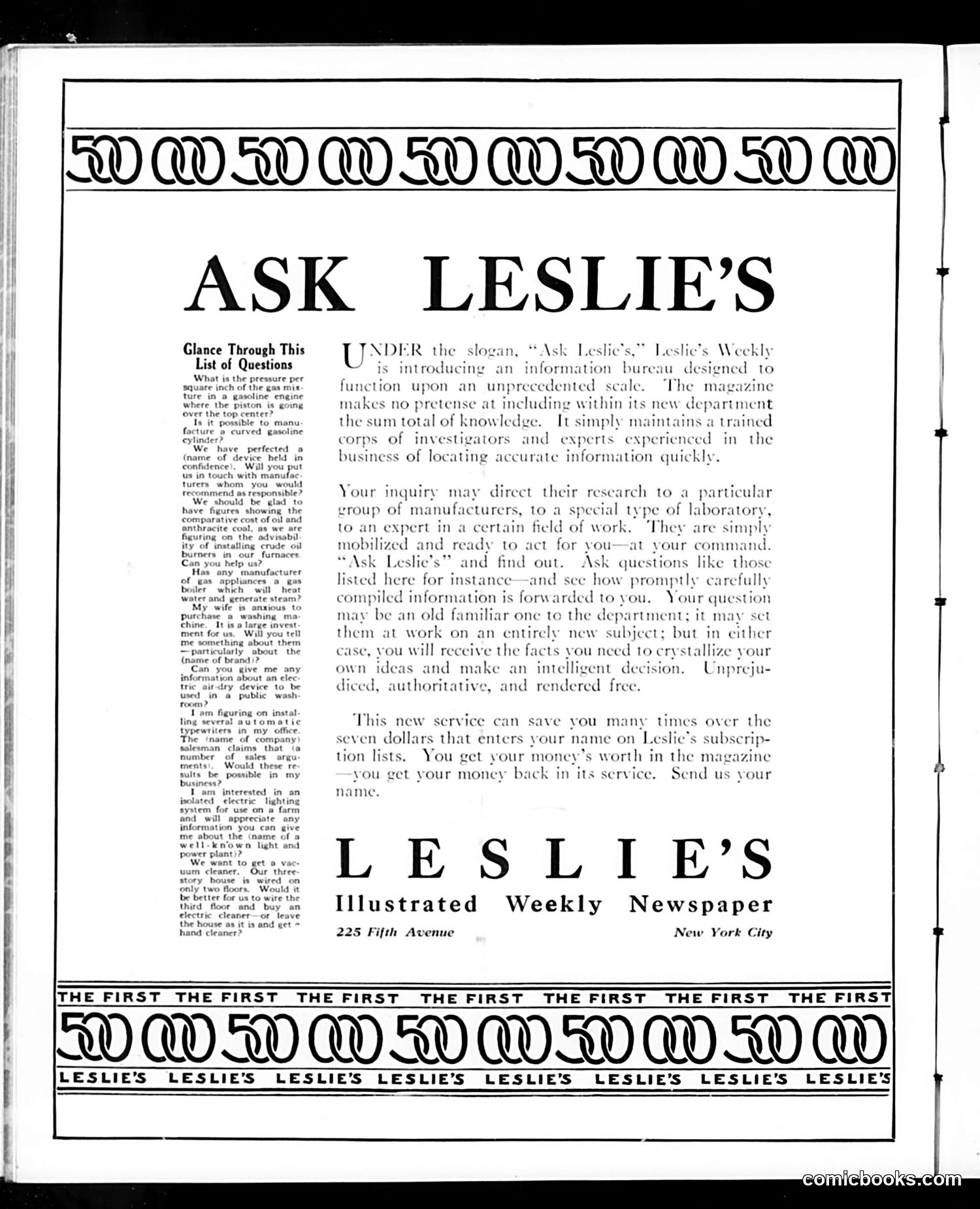
This page is primarily **advertising, not satire or editorial content**. It's an advertisement for Leslie's Illustrated Weekly Newspaper's new "Ask Leslie's" information bureau service. The ad explains that Leslie's is launching a research department to answer reader questions on any topic—from technical manufacturing questions to laboratory expertise to specialized fields. The service promises quick, accurate information compiled by trained experts, positioning it as a money-saving benefit that justifies the magazine's subscription cost. The decorative border elements featuring "50" repeated are styling flourishes typical of period advertisements. There are sample reader questions listed on the left, but these are illustrative examples, not satire. This represents early 20th-century magazine marketing emphasizing customer service and research capabilities.
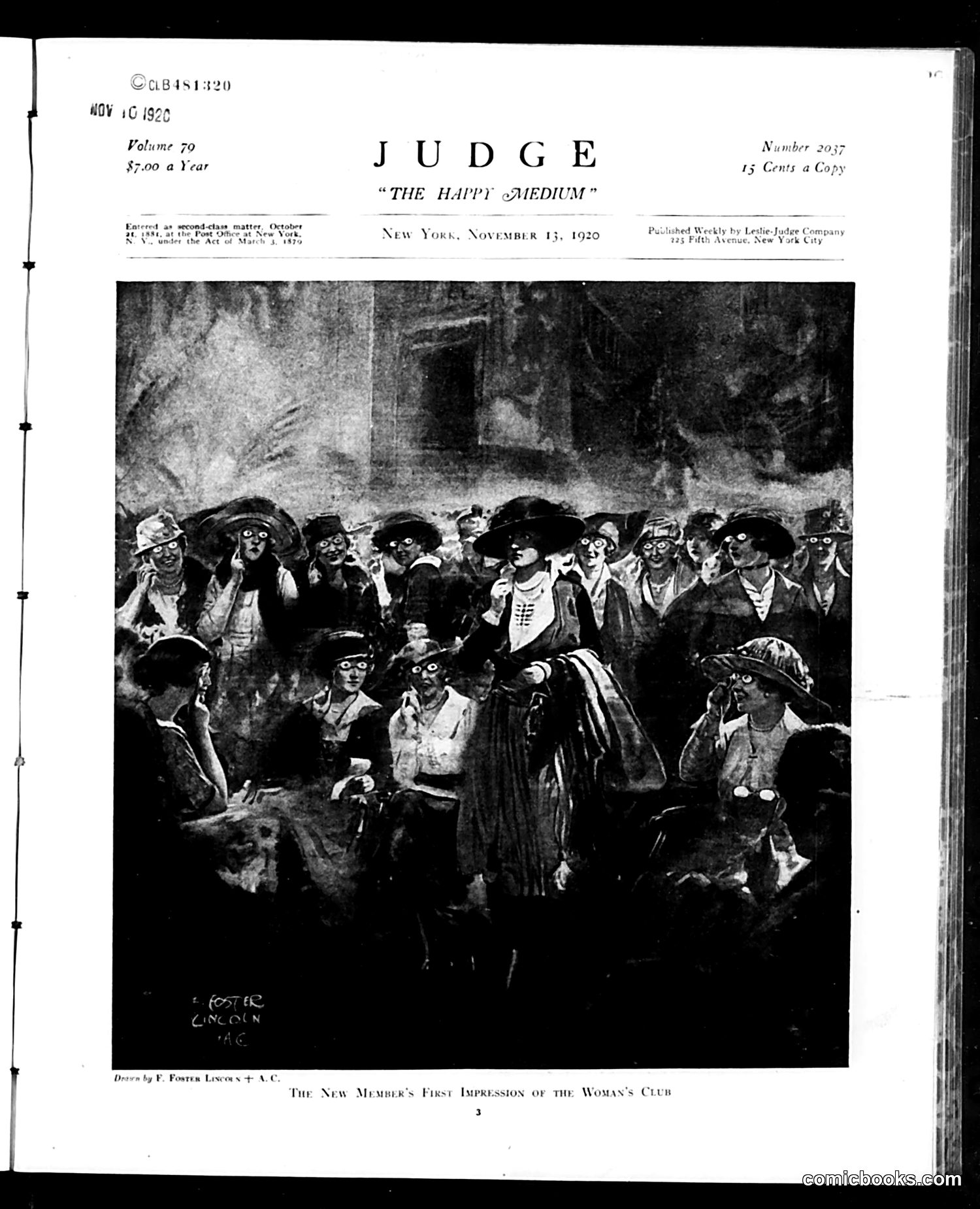
This is the cover of Judge magazine's "Happy Medium" issue from November 15, 1920. The central illustration, credited to F. Foster Lincoln, depicts "The New Member's First Impression of the Woman's Club." The cartoon satirizes women's club culture by showing a new female member entering an established group. The scene appears crowded and chaotic, with numerous women in elaborate hats and period clothing. The satire likely targets the pretentiousness, social hierarchies, or gossipy nature of exclusive women's organizations that were prominent in early 20th-century American society. The exaggerated expressions and densely packed composition emphasize the overwhelming or superficial nature of such social institutions.
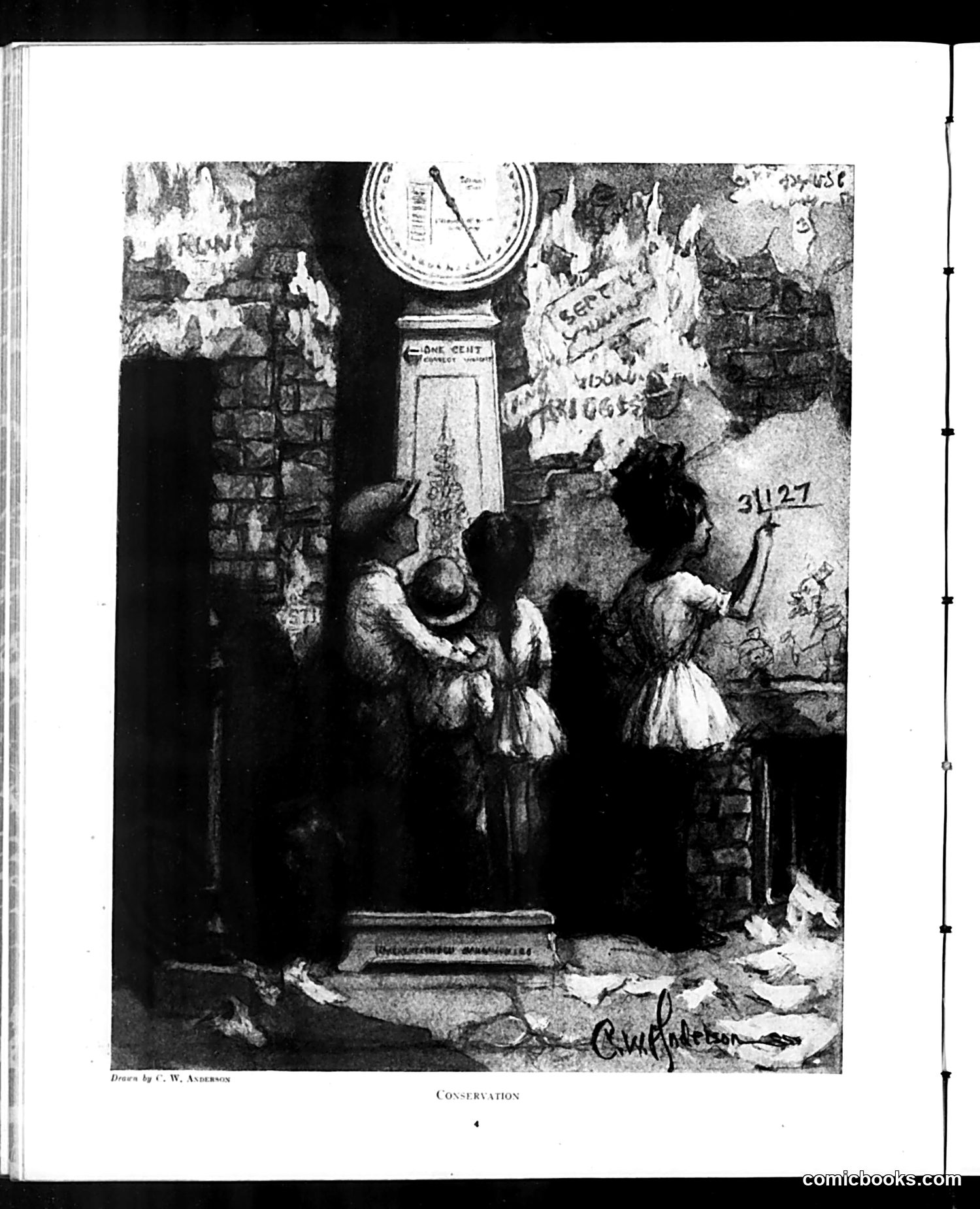
This cartoon, drawn by C.W. Anderson, depicts children at a weighing scale labeled "ONE CENT" (likely a public health checkup station). The title "Conservation" is ironic commentary on Progressive Era conservation policy. The satire appears to target government efforts to "conserve" public resources or health while children appear impoverished or malnourished—evident from their thin builds and worn clothing. The scale suggests measurement/monitoring of welfare, but the shabby surroundings and the children's condition suggest these conservation programs fail to actually improve citizens' lives. The cartoon critiques the gap between Progressive rhetoric about conservation and public welfare versus the actual lived experiences of poor urban children, implying government policies are ineffective or hypocritical.
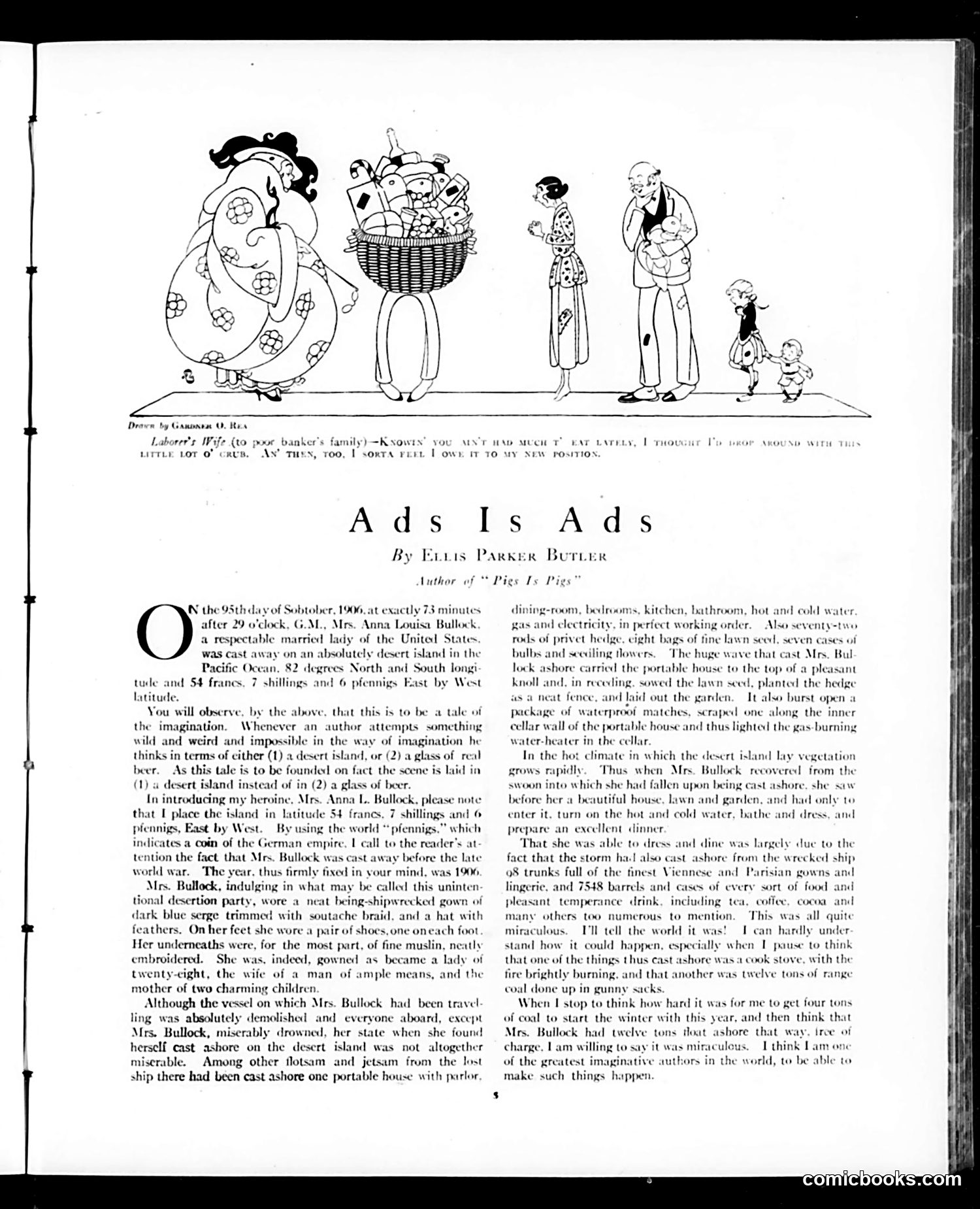
This page contains a short story titled "Ads Is Ads" by Ellis Parker Butler, not a political cartoon. The illustration at the top is a humorous vignette accompanying the fiction. The story concerns Mrs. Anna Louisa Bullock, a respectable married lady cast away on a desert island in the Pacific Ocean in 1906 with her portable house and possessions. The narrative satirizes the absurdity of her situation—that despite being marooned, she maintains her refined lifestyle, complete with fashionable clothes, servants' quarters, and abundant provisions. The cartoon above illustrates the story's premise: the rotund Mrs. Bullock and her improbably well-stocked household goods, alongside elegantly-dressed figures, emphasizing the comedy of civilized pretension in an uncivilized setting.
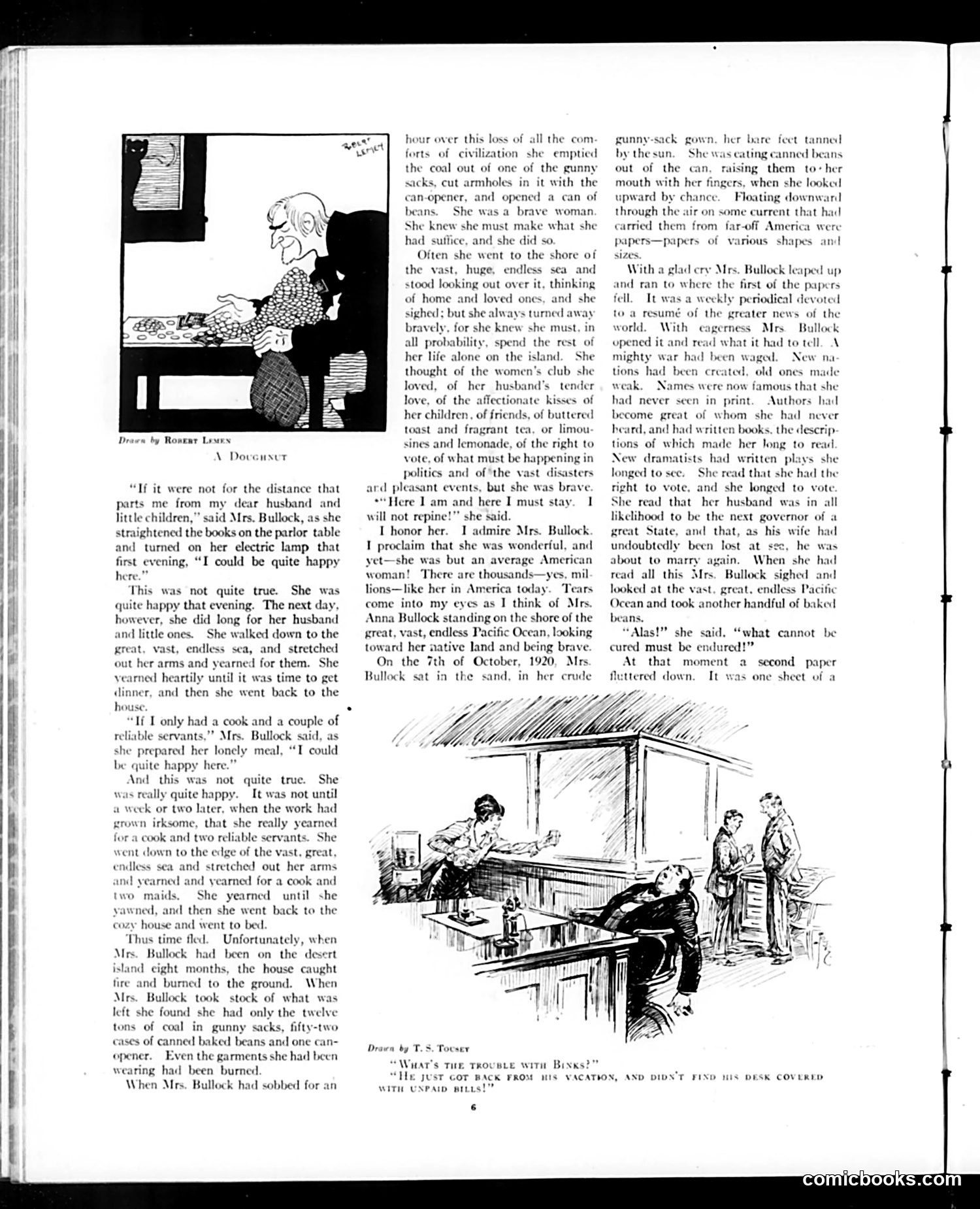
This page contains a short story titled "A Doughnut" illustrated by Robert Lemos, centered on Mrs. Bullock, stranded on a Pacific island after her husband's ship was lost at sea in 1920. The lower cartoon by T.S. Tousey depicts a man returning from vacation to find his desk buried under unpaid bills—the caption reads "What's the trouble with Binns? He just got back from his vacation, and didn't find his desk covered with unpaid bills!" This is straightforward domestic humor about the unpleasant surprise of accumulated bills awaiting vacation-goers, a timeless relatable joke requiring no historical context to understand.
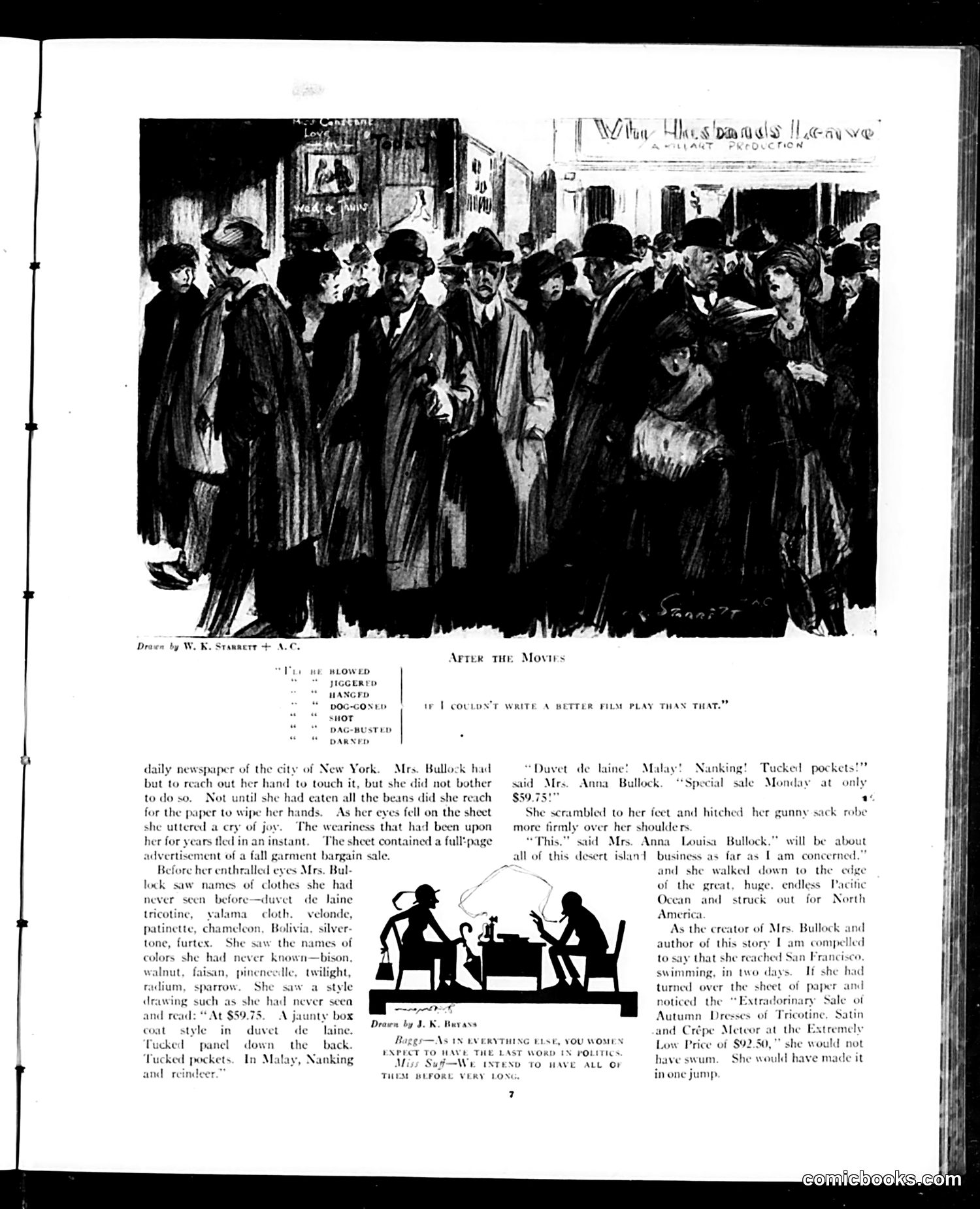
This page satirizes working-class women's susceptibility to consumer advertising. Mrs. Bullock, a poor woman eating beans from a newspaper, becomes ecstatic upon discovering a full-page department store advertisement featuring fashionable coats with exotic fabric names ("duvet de laine," "tricotine," "velonde") and mysterious colors ("bison," "faisan," "twilight"). The joke: she's so entranced by these foreign-sounding, aspirational product names that she abandons her meager existence and swims to San Francisco—only to become even more obsessed upon noticing another advertisement for $92.50 dresses, which would have driven her to jump in the ocean immediately. The satire mocks both advertising's manipulative appeal and the desperation of poor women's desire for unattainable luxury goods. The exaggerated silhouette cartoon reinforces the absurdist humor of the narrative.
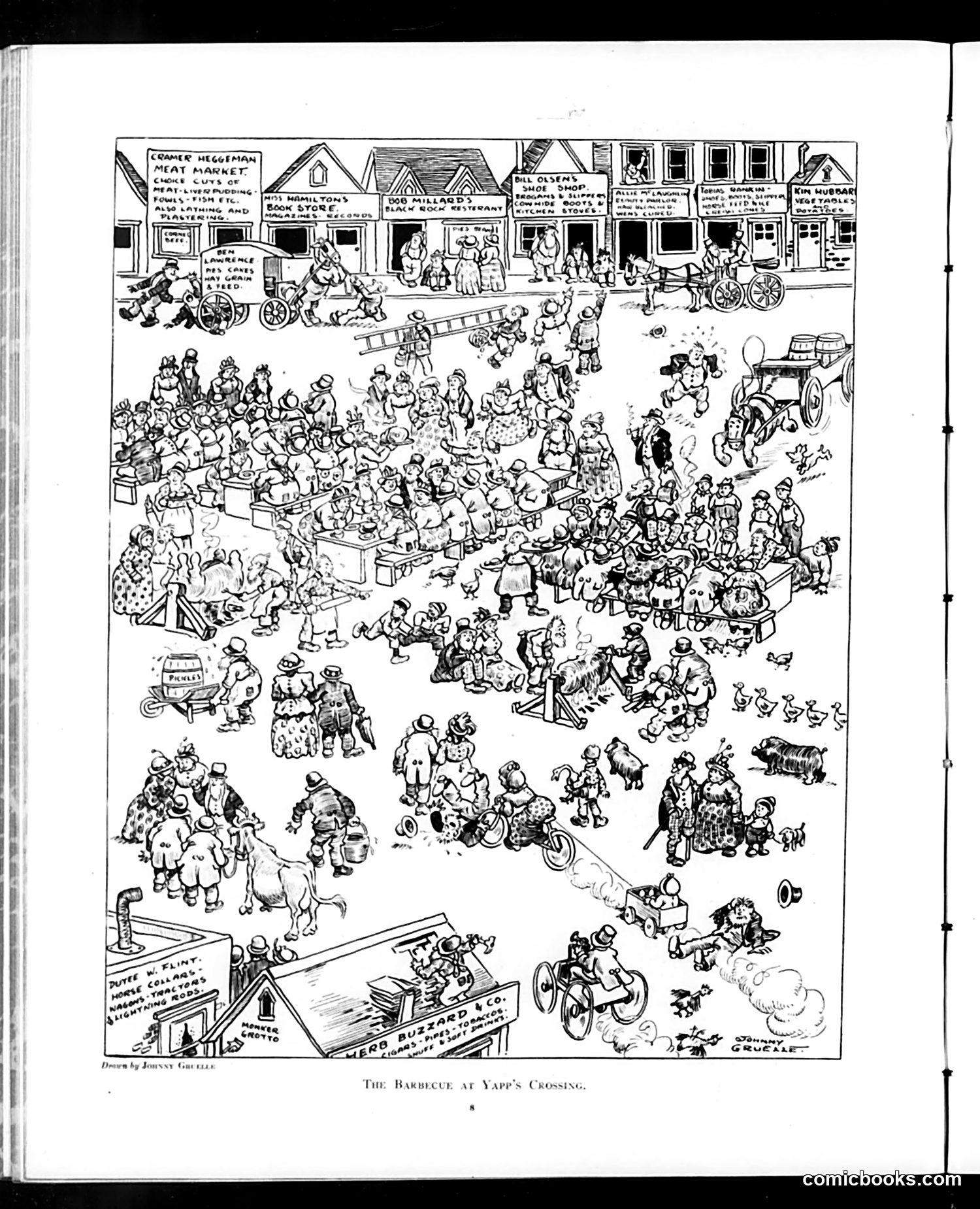
This is a densely-packed satirical illustration depicting a rural community gathering or fair, drawn by Johnny Gruelle. The scene shows numerous figures engaged in various activities around storefronts and open areas—eating, socializing, playing, with children, dogs, and period vehicles visible throughout. The storefront signs reference local businesses (Cramer Heggeman Meat Market, Bill Olsen's Shoe Shop, and others), suggesting this satirizes a specific small-town event or gathering. The chaotic energy and abundance of activity appears to mock or humorously exaggerate rural American social life and commerce of the era. Without clearer historical context about "Yapp's Crossing" or the specific date, the precise satirical target remains unclear, though it's clearly commenting on small-town Americana.
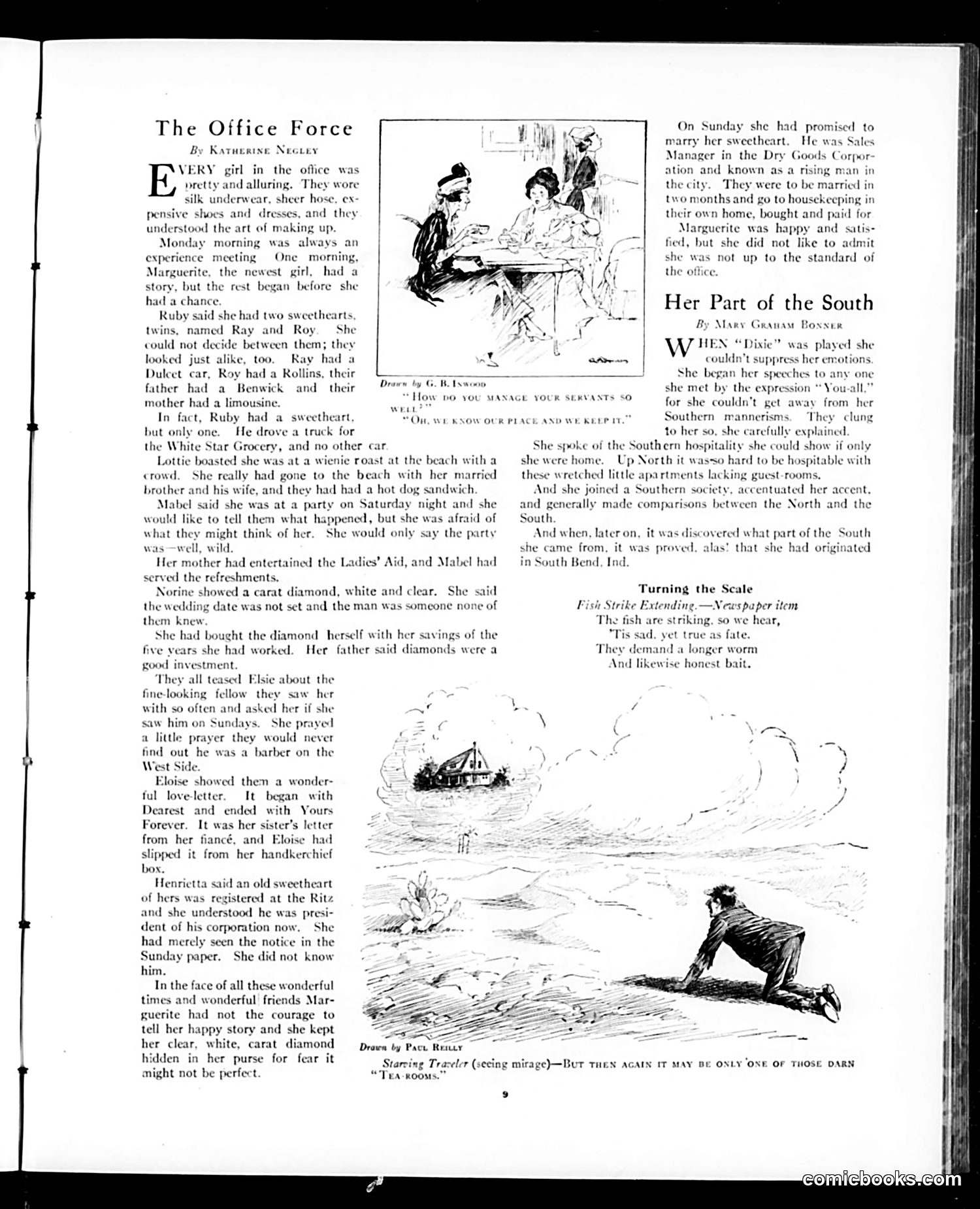
This page contains three satirical pieces mocking office workers and social pretense in the early 20th century. **"The Office Force"** portrays young female office workers who compulsively lie about their social lives to impress colleagues. Each invents elaborate stories—about multiple wealthy suitors, fancy outings, romantic letters, and wealthy acquaintances—when the reality is far more modest (truck drivers, home visits with family, self-purchased diamonds). Marguerite, the "newest girl," keeps silent about her genuine engagement to a respectable sales manager, fearing her peers' judgment of her actual circumstances. The satire targets women's insecurity and competitive status-seeking in the workplace. **"Her Part of the South"** ridicules a woman who performs exaggerated "Southern belle" mannerisms—saying "you-all," claiming superior hospitality—only to be exposed as being from South Bend, Indiana, not the actual South. The joke exposes her pretentiousness and inauthenticity. The page satirizes workplace vanity, class anxiety, and the gap between people's real and performed lives.
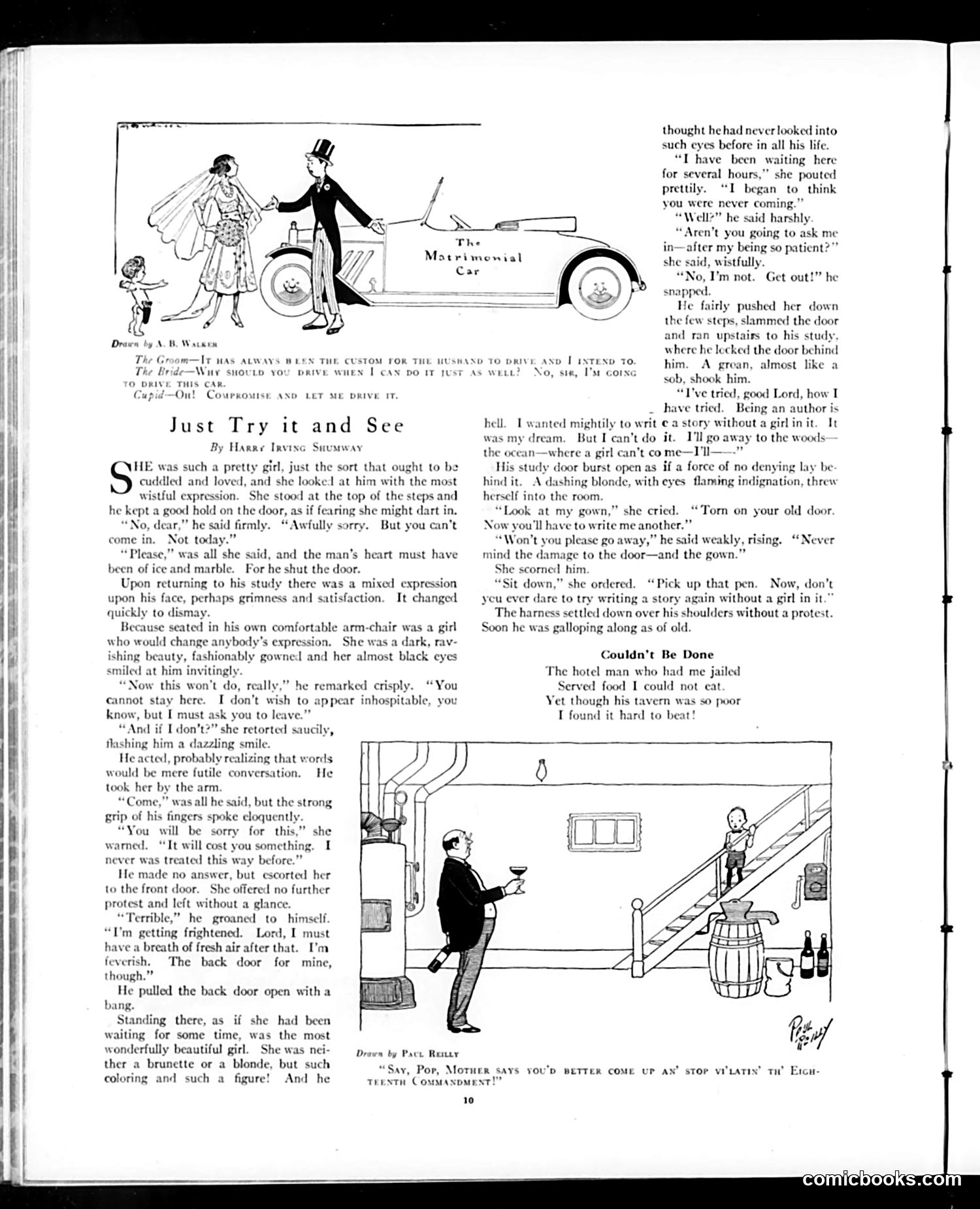
This page contains a humorous short story titled "Just Try it and See" about a male author struggling to write without including female characters. The narrative satirizes romantic entanglement and male weakness regarding women. The plot: An author repeatedly refuses entry to various women visiting his home, insisting he wants to write a story without "a girl in it." However, women keep appearing—first a rejected visitor, then a dark-haired beauty who infiltrates his study, and finally a blonde who bursts through his back door. Despite his protests and attempts at resolve, he ultimately surrenders to their presence. The satire targets early 20th-century gender dynamics and masculine pretense. The joke suggests that men cannot escape female company or influence, and that their stated independence is illusory. The story mocks both male weakness and female persistence in pursuing romantic attention. The accompanying cartoon at top shows a newlywed couple with a car labeled "The Matrimonial Car," reinforcing themes about male resistance to female-centered domestic life.
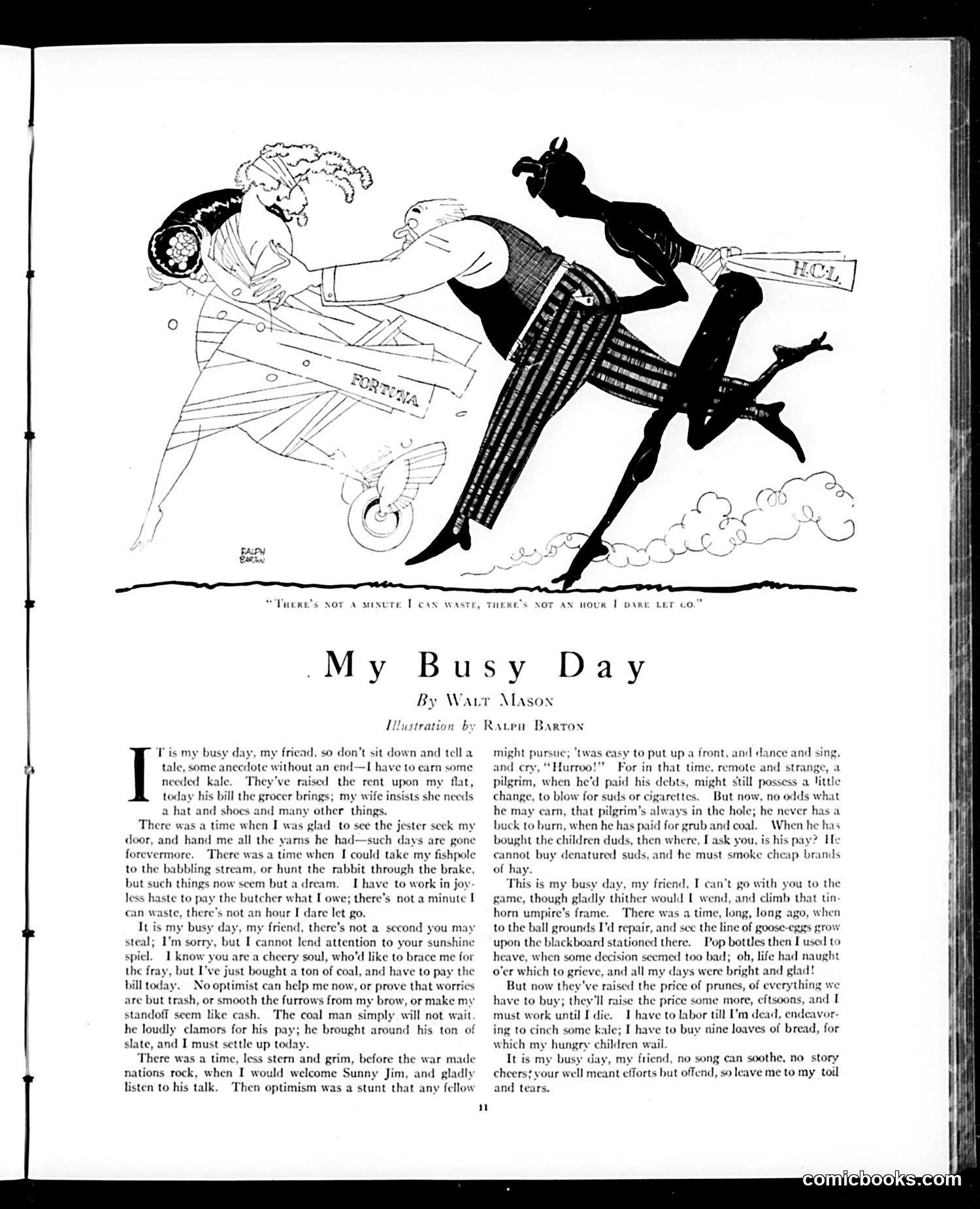
This 1910s story/cartoon illustrates post-WWI American economic anxiety. The illustration shows a man being pulled in opposite directions—one figure labeled "Fortuna" (Lady Luck) on the left, and a darker, more aggressive figure on the right holding what appears to be a bill or debt notice. The text by Walt Mason contrasts pre-war optimism with current hardship. The author laments lost leisure time and "Sunny Jim" cheerfulness, blaming wartime economic disruption. He catalogs relentless expenses: raised rent, groceries, coal bills, children's clothing, and food—all while wages remain stagnant. The satire targets both the false optimism of pre-war times and the false comfort of motivational speakers ("no optimist can help me now"). For modern readers, this captures how WWI inflation and economic strain transformed American middle-class life from one of modest leisure into grinding, endless labor with no financial relief possible.
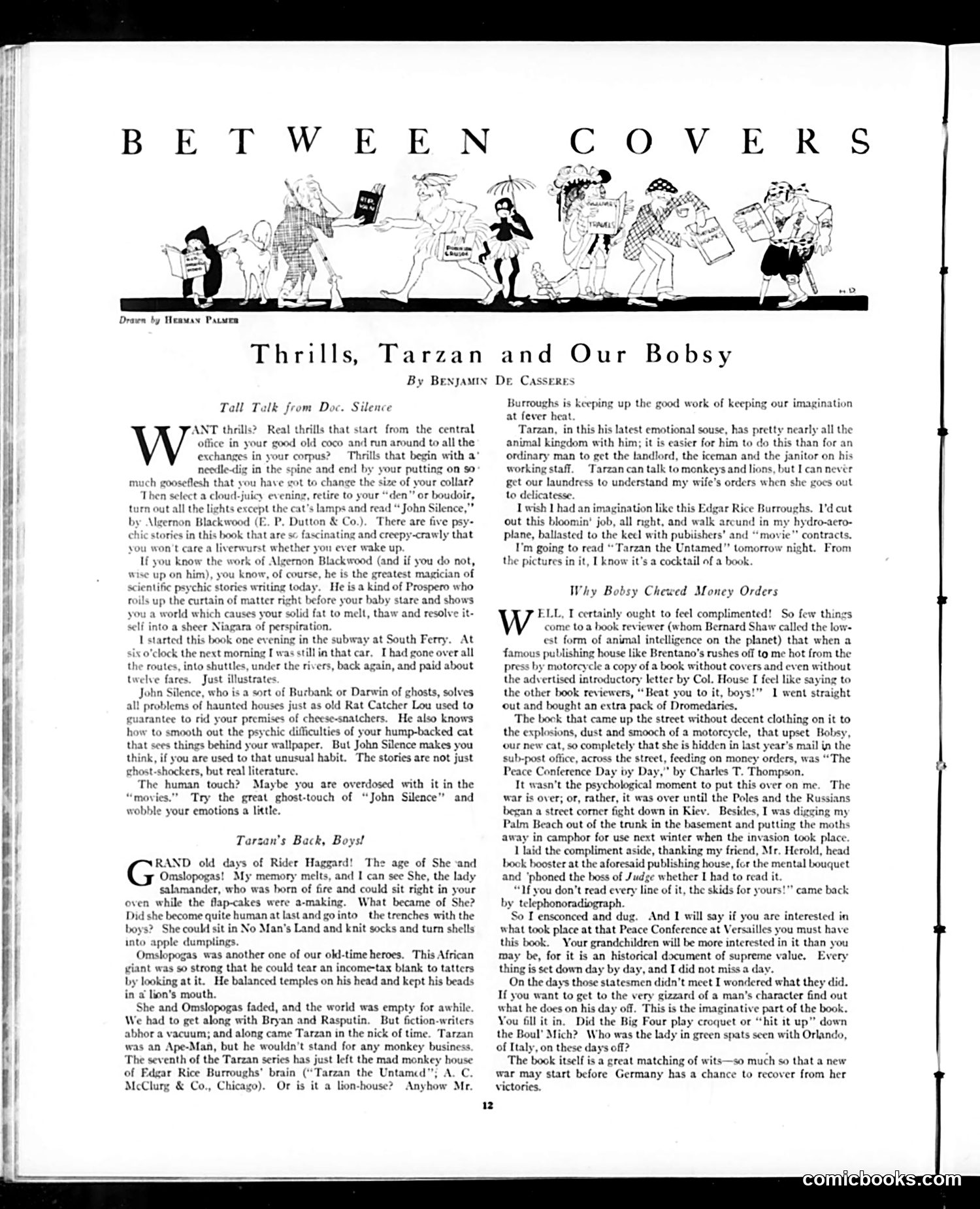
This page from Judge magazine contains two book review essays critiquing popular literature of the era. **"John Silence" review**: The critic praises Algernon Blackwood's ghost stories as genuinely thrilling psychological horror, contrasting them favorably with modern entertainment that has allegedly made readers emotionally numb. The reviewer suggests readers have become desensitized and need authentic literary scares. **"Tarzan" review**: The critic compares Edgar Rice Burroughs' Tarzan series to older adventure fiction (referencing Rider Haggard's *She* and *King Solomon's Mines*), noting that Tarzan has replaced those earlier heroes in popular imagination. The commentary is lighthearted—the reviewer jokes about Tarzan's superior ability to manage animal companions compared to ordinary people managing household staff and service workers, likely satirizing class relationships and modern domestic frustrations. Both reviews reflect Judge's intellectual posture: defending "serious" literature while acknowledging mass entertainment's cultural dominance.
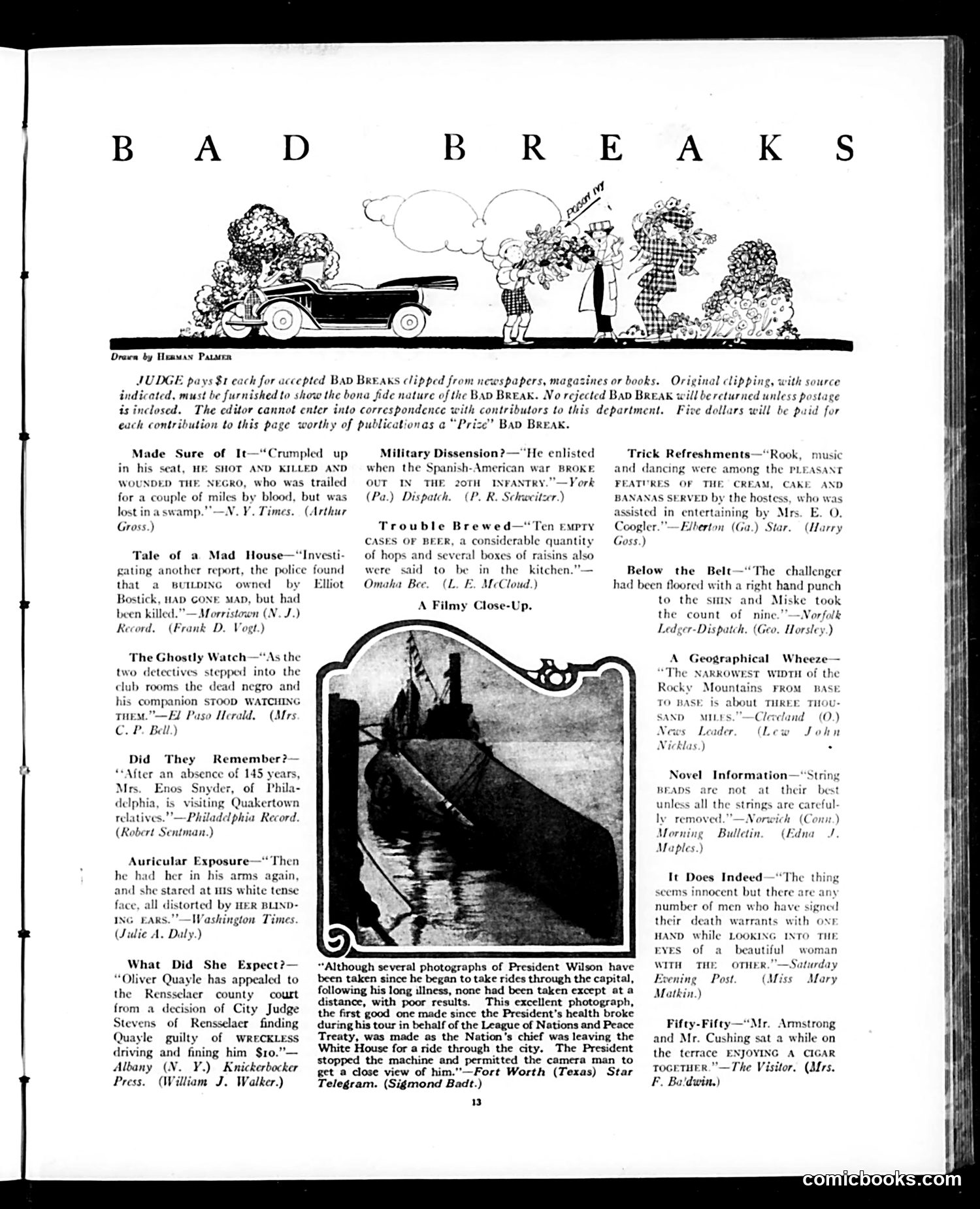
This is a humor collection from *Judge* magazine featuring "Bad Breaks"—unintentionally funny or absurd newspaper clippings submitted by readers. The page showcases accidental double meanings and nonsensical reporting. Key examples of the satire: - **"Made Sure of It"**: A news account reads as if someone casually murdered a man, then casually murdered him again to be thorough. - **"The Ghostly Watch"**: A dead person somehow stands watching—impossible without being a ghost. - **"Trouble Brewed"**: Lists beer and raisins as kitchen contents, implying bootleg beer-making during Prohibition. The central cartoon ("A Filmy Close-Up") features President Wilson leaving the White House, likely satirizing overly formal or awkwardly distant press photography of political figures. The page relies on readers finding humor in journalism's careless word choices and logical absurdities—a staple of *Judge*'s satirical approach to American culture and media.
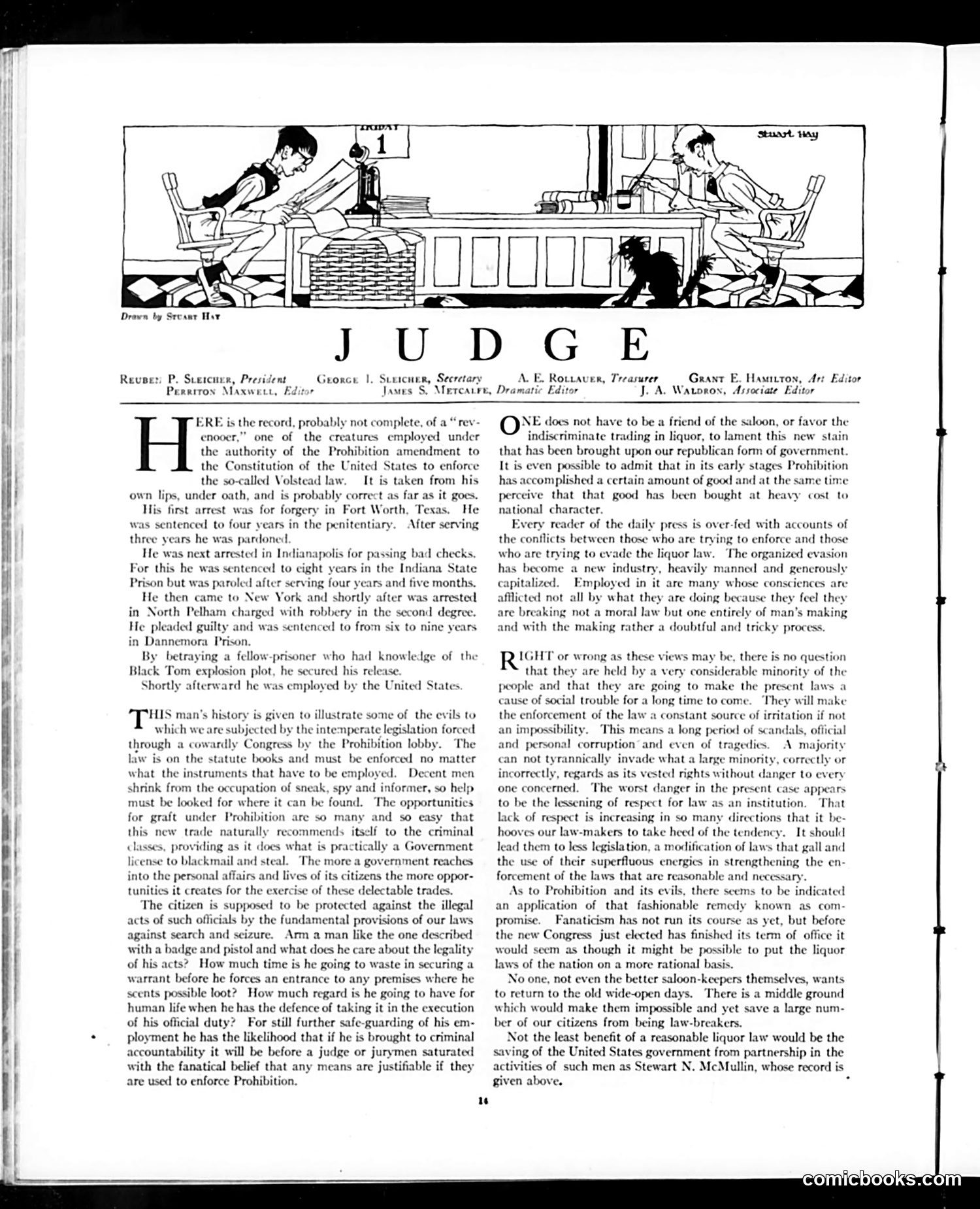
This editorial page critiques Prohibition enforcement by exposing the character flaws of federal agents hired to enforce the Volstead Law (the constitutional amendment banning alcohol). The cartoon at the top depicts two men at desks with a third figure between them—likely representing a corrupt federal "revenueer" (prohibition agent) being interrogated or judged. The text documents a specific agent's criminal history: forged documents in Texas, bad checks in Indiana, armed robbery in New York—crimes for which he'd been imprisoned. Yet this convicted felon was subsequently employed by the U.S. government as a prohibition enforcer because "decent men shrink from the occupation of sneak, spy and informer." **The satire's point**: Judge argues that Prohibition's enforcement mechanisms force government to hire criminals and grant them badges, guns, and legal authority—creating opportunities for corruption, blackmail, and abuse of citizens' rights to search and seizure. The magazine contends this corrupts the republic itself, regardless of whether one opposes or supports alcohol prohibition.
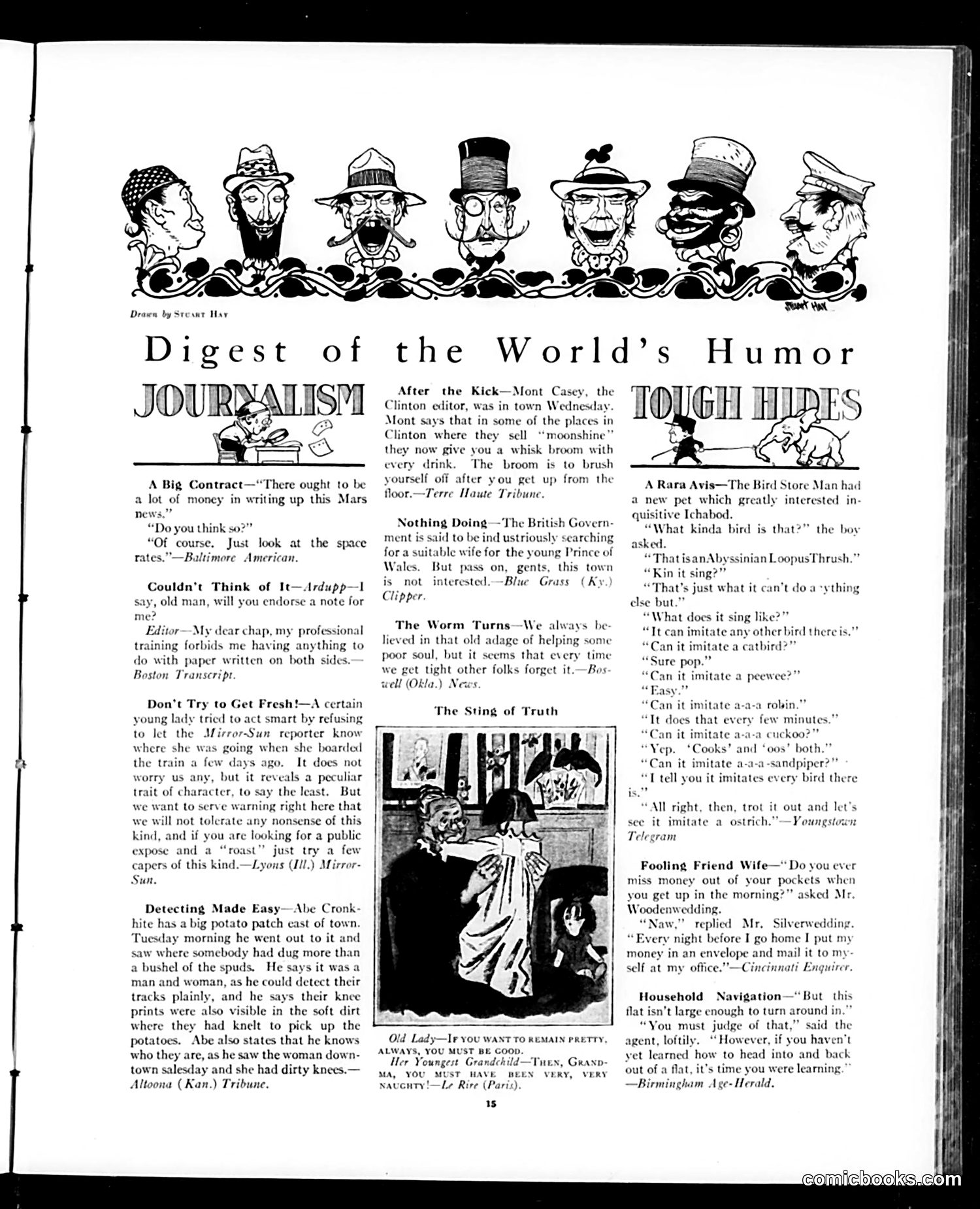
This page from Judge magazine compiles brief humorous anecdotes and one cartoon about early 20th-century American life. **The Cartoon ("The Sting of Truth"):** Shows a grandmother warning her granddaughter that being good is necessary to remain pretty. The child replies the grandmother "must have been very, very naughty"—a cheeky insult implying the grandmother's plainness results from moral failings. **The Anecdotes** mock small-town life and human nature: - Journalists seeking payment for covering non-news (Mars reports) - Prohibition-era "moonshine" bars so rough customers need brooms to clean up after falling - A detective who identifies potato thieves by observing dirt on a woman's knees - A bird that imitates other birds but can't sing - Petty marital deceptions (hiding money from spouses) The humor relies on rural simplicity, gentle mockery of journalism ethics, Prohibition-era drinking culture, and domestic absurdities. The overall tone is lighthearted social commentary typical of early Judge magazine's satirical digest format.
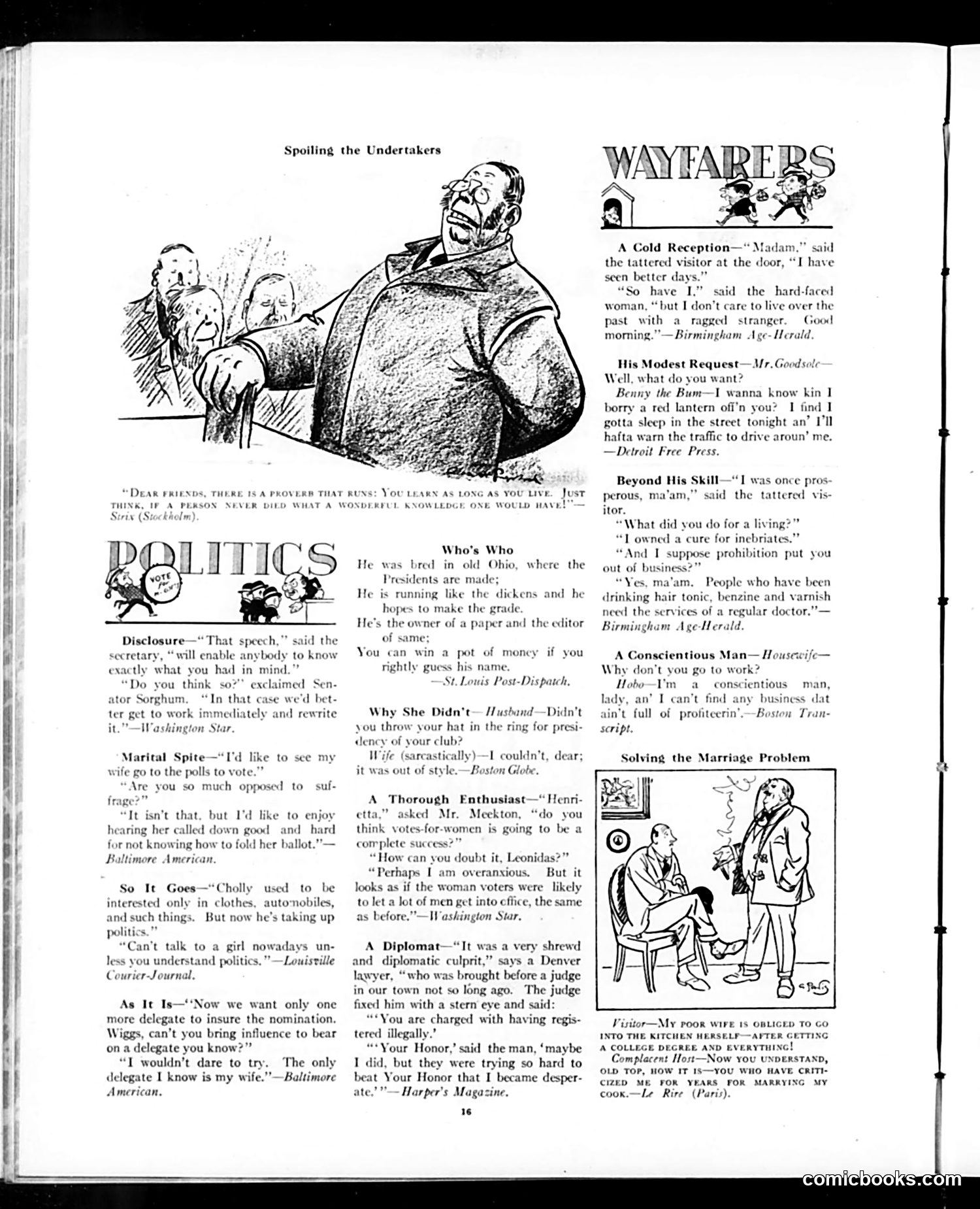
This page contains multiple short humorous anecdotes satirizing American political and social life, likely from the early 20th century. **Key satirical targets:** - **Politics and politicians**: Senator Sorghum represents evasive politicians who obscure their actual positions; jokes mock delegates, nominations, and backroom influence. - **Women's suffrage**: Multiple jokes reference "votes-for-women," a contemporary debate. One satirizes women voters as potentially no better than men at selecting candidates; another mocks a wife refusing to campaign ("it was out of style"). - **Class and pretense**: Several anecdotes mock the fallen genteel ("I have seen better days") and unemployed ("Benny the Bum"), presenting them as persistent urban figures. - **Prohibition**: One joke references cures for "inebriation"—likely patent medicines containing alcohol—now obsolete after Prohibition. - **Marriage dynamics**: The final cartoon satirizes educated wives reduced to domestic labor, while the host defends hiring a cook as a wife. The humor assumes readers recognize contemporary political figures and debates while mocking class pretense and social hypocrisy.
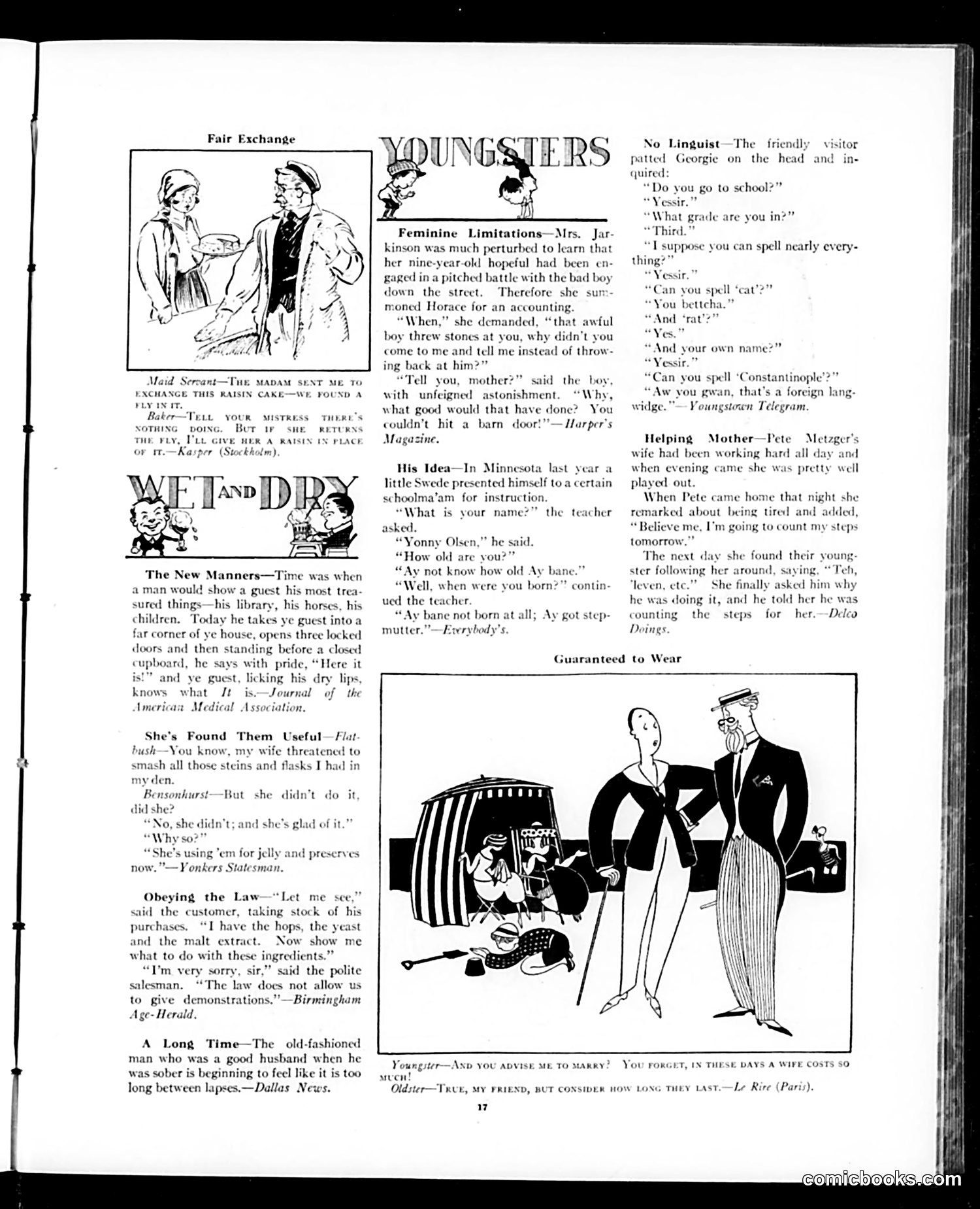
This page contains multiple short humorous anecdotes satirizing early 20th-century American life and social customs. **Key Satires:** 1. **"Fair Exchange"**: A maid reports a fly in a cake; the butler quips he'll return it with a raisin—mocking servants' cheek and class dynamics. 2. **"The New Manners"**: Guests are no longer shown treasured possessions (libraries, children) but instead locked liquor cabinets—satirizing Prohibition-era hypocrisy and hidden drinking. 3. **"Feminine Limitations"**: A boy tells his mother she couldn't hit a barn door, so reporting stones thrown at him would be useless—mocking women's perceived physical weakness and parental authority. 4. **"Guaranteed to Wear"**: A caption advises marriage because wives last long and are expensive—cynical humor about marital commitment and cost. 5. **Immigrant humor**: Several pieces feature stereotyped Swedish and Eastern European accents ("Ay," "stepmother"), typical of period comedy targeting recent immigrants. The overall tone reflects 1920s-era attitudes: class snobbery, anti-Prohibition sentiment, gender stereotypes, and casual ethnic mockery.
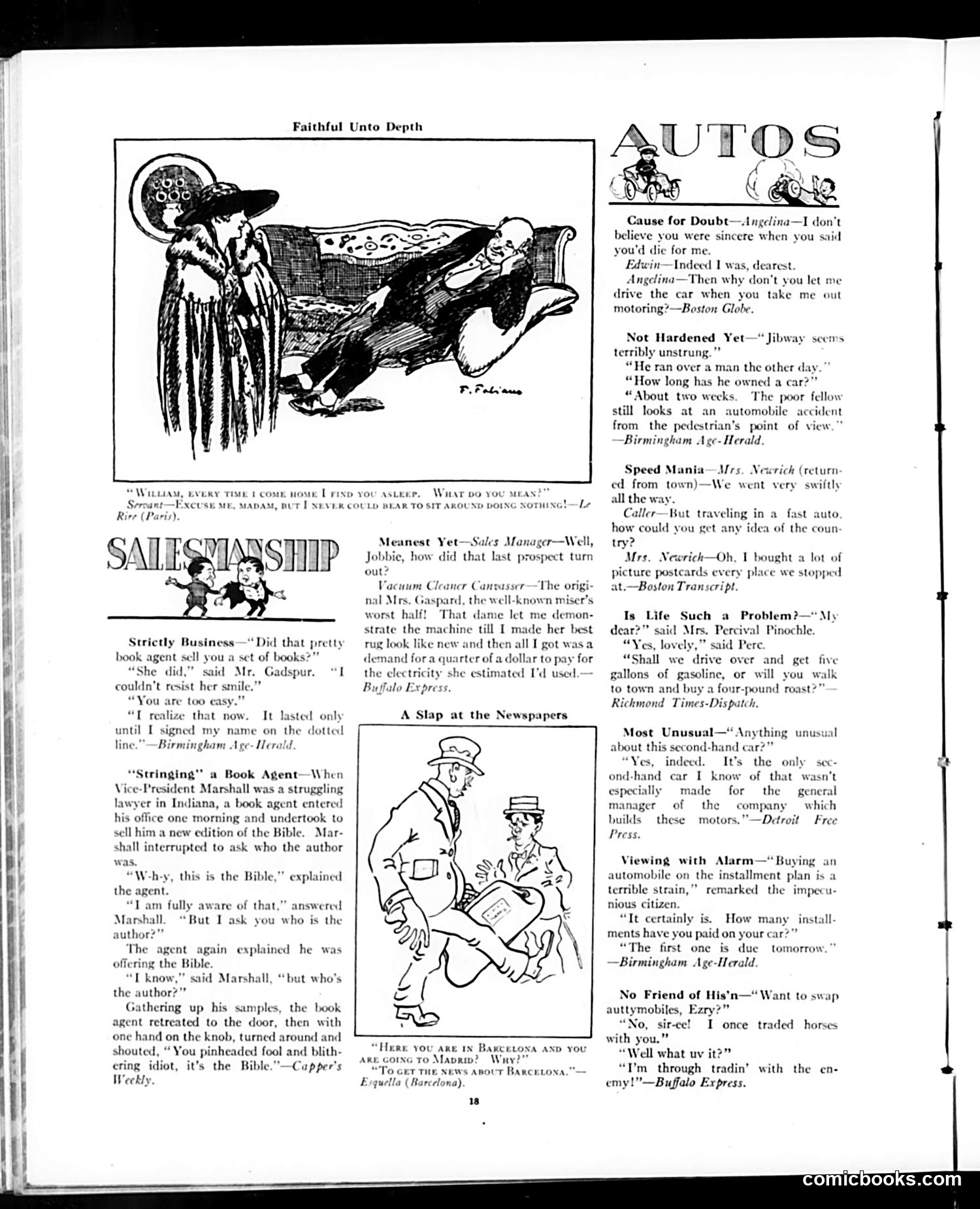
This page contains multiple brief humorous anecdotes satirizing early 20th-century American consumer culture and social pretension, particularly around automobiles and sales tactics. The main cartoons mock: 1. **"Strictly Business"** and **"Stringing a Book Agent"**: Sales agents' aggressive tactics. The anecdote about Vice-President Marshall humorously depicts a book agent's absurdity—trying to sell a Bible while unable to name its author, then insulting the prospect when rejected. 2. **Automobile-related humor dominates the right column**: These jokes satirize the nouveaux riches ("Mrs. Newrich"), the psychological shift from pedestrian to driver, and installment-plan debt. "Not Hardened Yet" mocks a new car owner so traumatized by hitting someone that he still thinks like a pedestrian. 3. **"A Slap at the Newspapers"** (cartoon): Depicts a newspaper vendor, likely critiquing journalism's sensationalism or triviality. The overall tone targets consumer excess, social climbing, and the disorienting effects of new technology—common Judge Magazine themes reflecting 1910s anxieties about modernity and materialism.
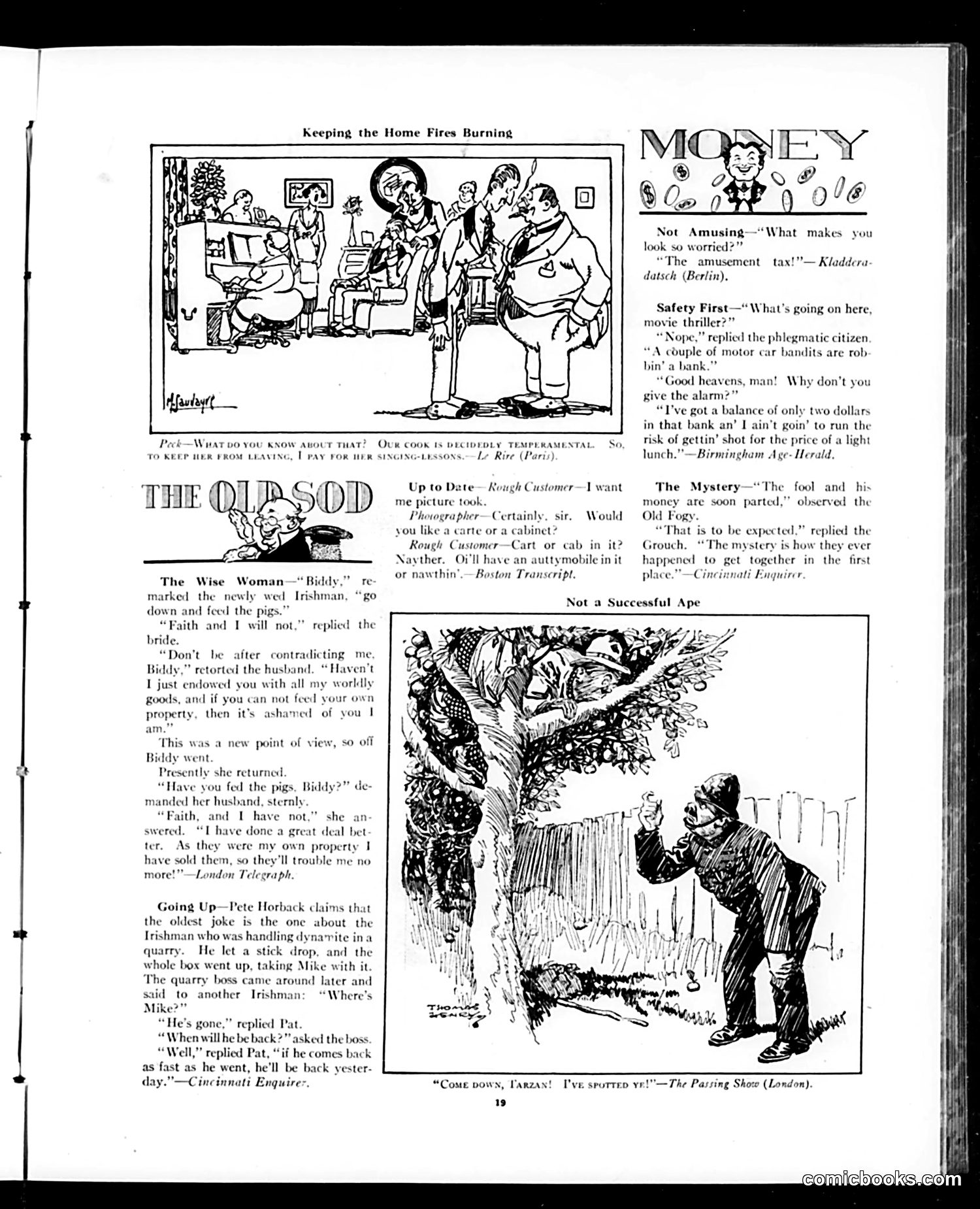
This page contains multiple humorous anecdotes reflecting early 20th-century concerns and stereotypes: **Top cartoon** depicts a domestic scene about wartime sacrifice ("Keeping the Home Fires Burning"), with jokes about an "amusement tax" and bank robbers—suggesting economic anxiety during WWI era. **"The Wise Woman"** and **"Going Up"** feature Irish immigrant characters ("Biddy," "Mike," "Pat") using heavy dialect. These ethnic humor pieces were standard for the period, depicting Irish workers in comedic, sometimes unflattering scenarios (explosives, stubbornness). **"Up to Date"** pokes fun at class mobility—a rough laborer wants portrait photography in an automobile rather than traditional studio formats, suggesting aspiration mixed with crude manners. **Bottom cartoon, "Not a Successful Ape,"** shows someone attempting to teach a chimpanzee, likely mocking failed attempts at "civilizing" or educating those deemed inferior—reflecting period-typical racist pseudoscience humor. The page emphasizes contemporary anxieties: taxation, crime, class tensions, and servant-labor dynamics, all filtered through the magazine's irreverent satirical lens.
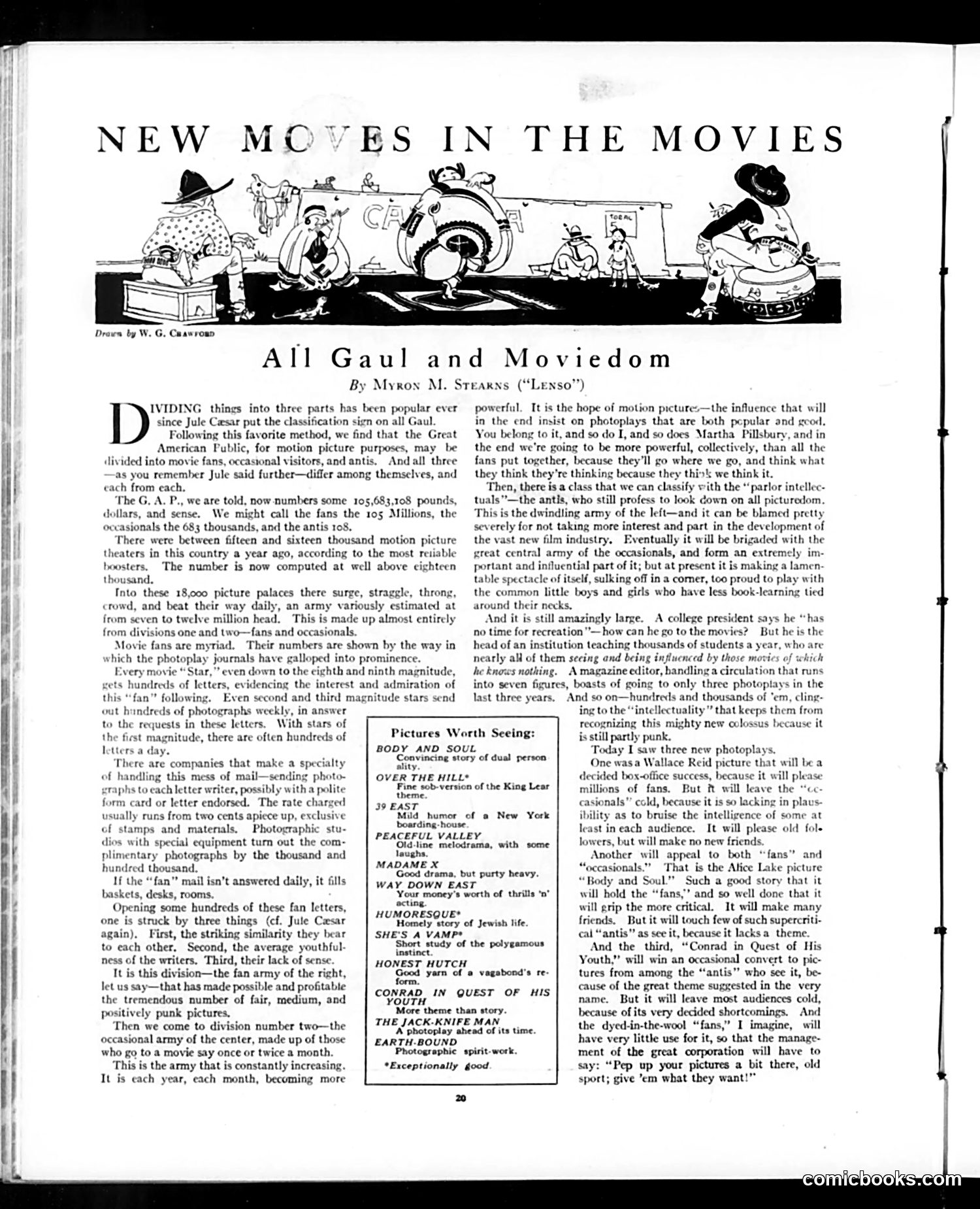
This page from *Judge* magazine discusses the film industry's explosive growth and social impact, using Julius Caesar's division of Gaul as a framework for satirizing American society's relationship with movies. The article classifies "the Great American Public" into three groups: devoted movie fans (105 million), occasional moviegoers (683 thousand), and "antis"—intellectual snobs who refuse to attend films. The satire targets the "antis" mercilessly, mocking educated elites (college presidents, magazine editors) who claim "no time for recreation" yet ignore cinema's influence on thousands of students they teach or reach. The cartoon header (drawn by W.G. Crawford) depicts various film industry figures and equipment in silhouette. The piece argues that occasional viewers will eventually outnumber and out-influence committed fans, making the reluctant intellectuals' snobbery irrelevant. The satire suggests that dismissing popular cinema as beneath one's dignity is both pretentious and socially irresponsible—a distinctly modern argument for taking mass entertainment seriously.
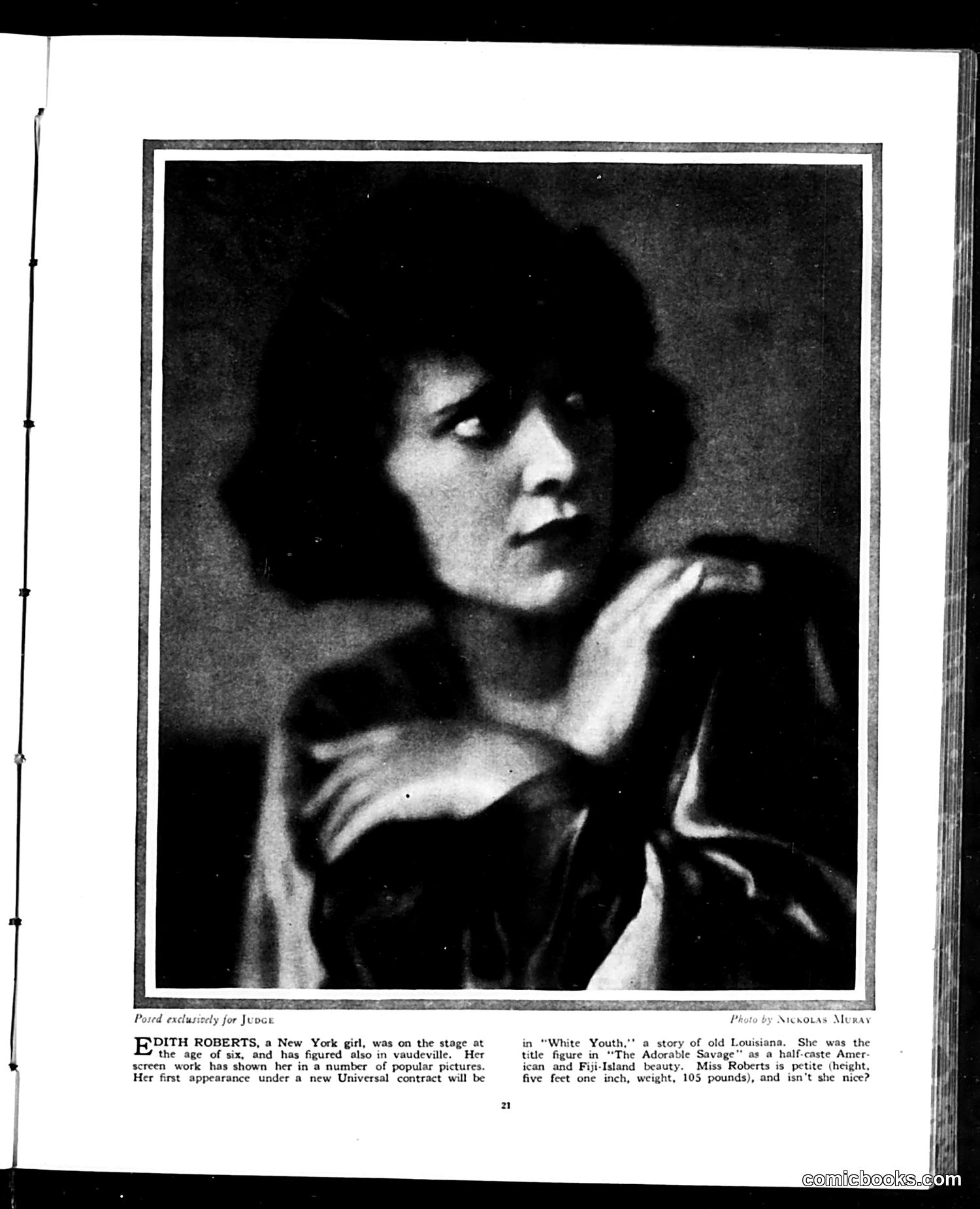
This is a **portrait and biographical entry** rather than a political cartoon. The page features a glamour photograph of **Edith Roberts**, a young actress, taken by renowned photographer Nicholas Murray. The text announces Roberts as a stage and vaudeville performer transitioning to film under a Universal contract. It highlights her roles in "White Youth" (a Louisiana period piece) and "The Adorable Savage" (featuring her as a mixed-race character), emphasizing her petite stature and physical attractiveness. The final rhetorical question ("isn't she nice?") reflects **early 20th-century entertainment journalism's approach**: reducing actresses to physical descriptions and charm rather than discussing their craft. This page exemplifies how Judge magazine mixed satire with celebrity promotion and entertainment industry coverage typical of that era.
This page reviews two theatrical productions for Judge magazine's theater column. **"The Skin Game"** (by John Galsworthy): The critic examines a class-conflict drama pitting an old English aristocratic family against a nouveau-riche social climber ("parvenu") trying to destroy their way of life because money cannot buy him social acceptance. The reviewer argues Galsworthy inadvertently makes the audience sympathize with the aristocrats despite their underhanded tactics, undermining any intended social commentary about inequality. He finds the play competently made but unremarkable, marred by British actors' accents making dialogue unintelligible to American audiences. **"The Outrageous Mrs. Palmer"**: The critic humorously suggests actress Mary Young is channeling Mrs. Patrick Campbell (a famous contemporary actress) so perfectly that it must be actual "telepathy" or supernatural possession rather than imitation—since Young denies studying Campbell. The performance supposedly captures Campbell's mannerisms with eerie accuracy. Both reviews are somewhat dismissive, treating these as minor entertainment rather than significant drama.
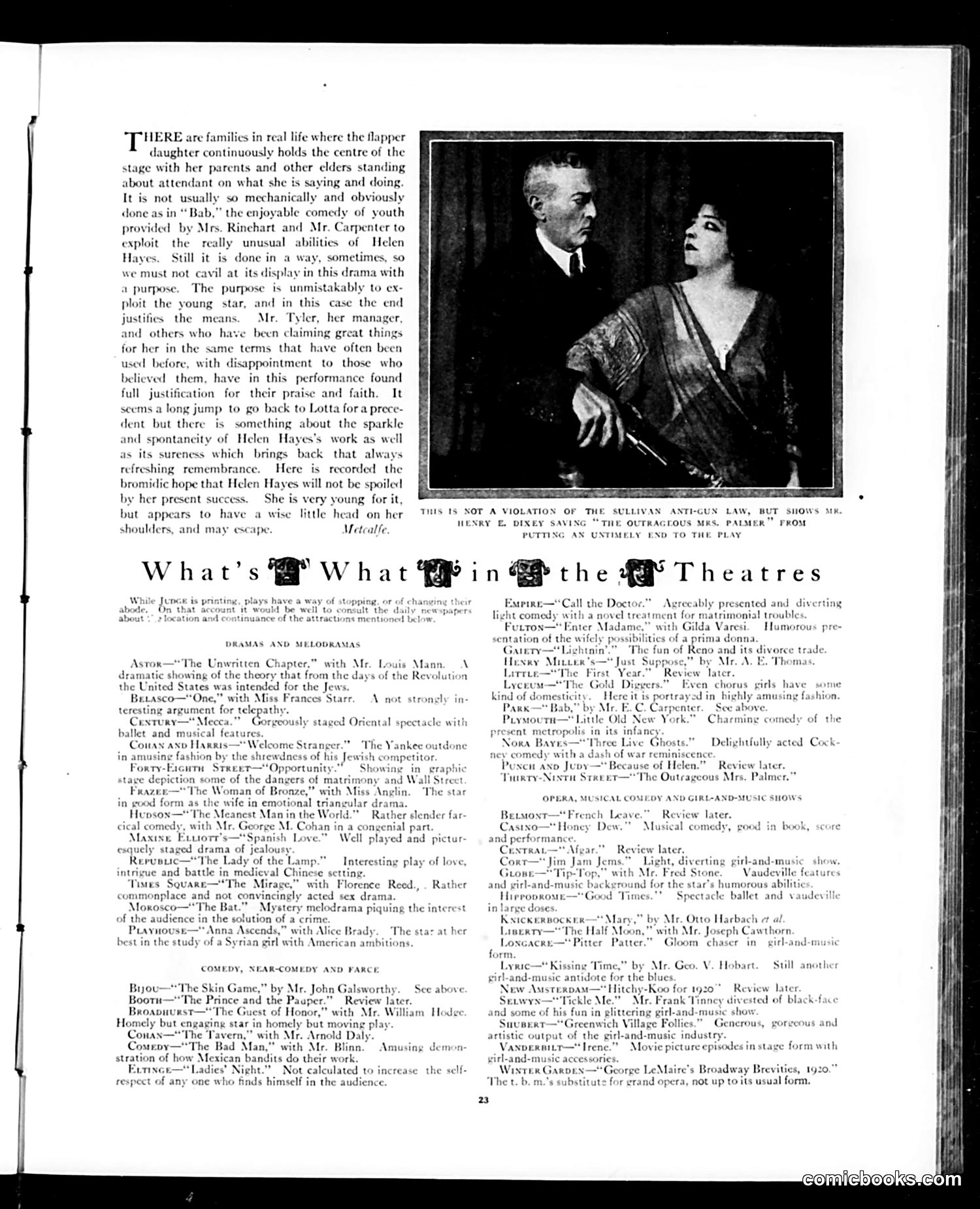
This page contains **theater reviews and listings**, not political cartoons. The photograph shows **Helen Hayes** (identified in the text) with an older man, likely her manager Mr. Tyler, discussing the play "Bab." The main article praises Hayes's performance in "Bab," a comedy about a flapper daughter who dominates family attention. The reviewer notes this exploits Hayes's "unusual abilities" and compares her favorably to the 19th-century star Lotta Crabtree, hoping success won't spoil her youthful talent. The page's humor appears mild by modern standards—it's essentially entertainment journalism celebrating a young actress's breakthrough role during the 1920s flapper era. The only satirical element is a caption about Henry E. Dixey "saving" a character named Mrs. Palmer from "putting an untimely end to the play"—likely a joke about dramatic plot mechanics rather than political satire. This page documents **theatrical culture and star-making in 1920s America**, not social or political commentary.
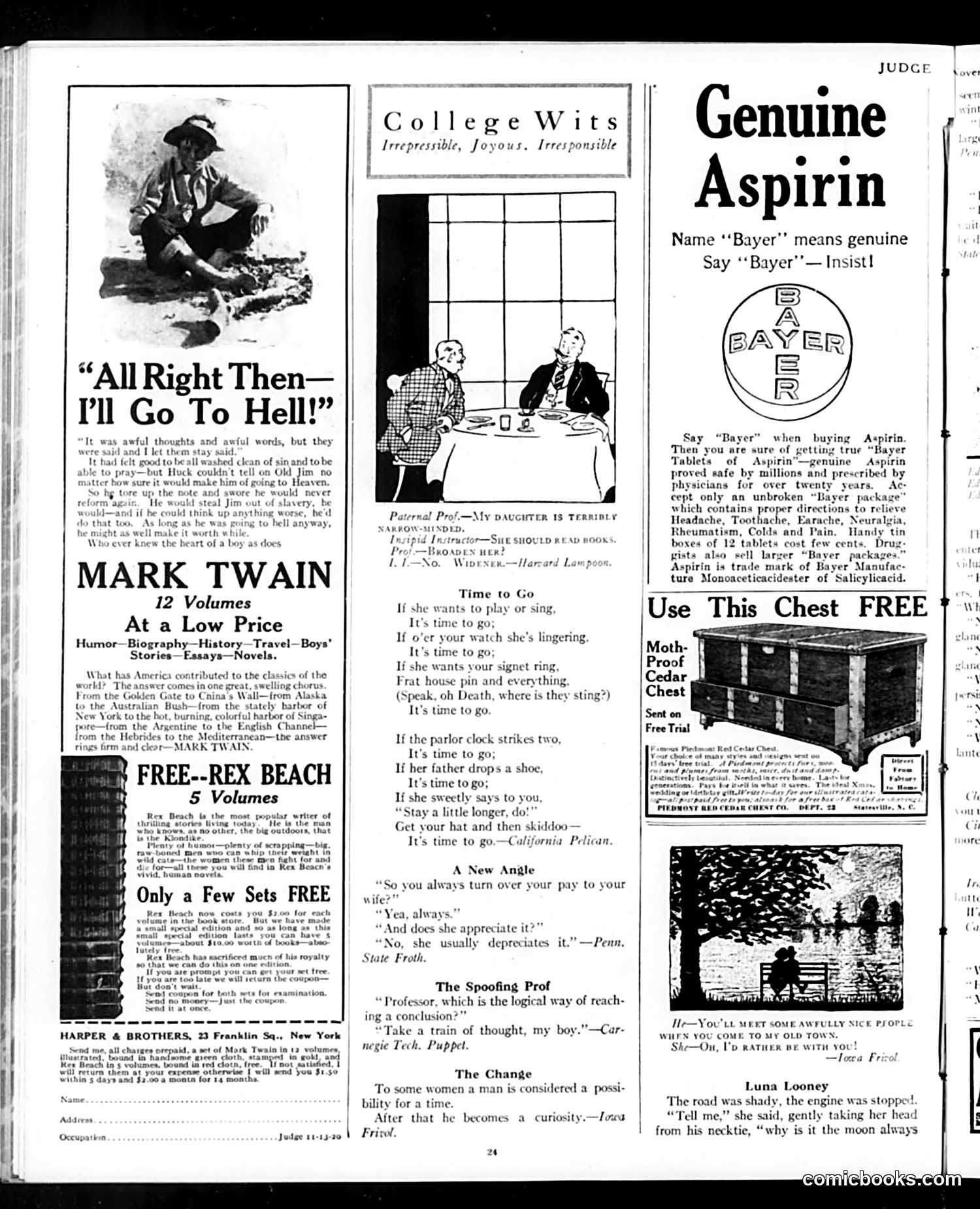
This page is primarily **advertising** with some light satirical content typical of early-20th-century humor magazines. **Main Content:** The "College Wits" section contains brief, mild jokes about student life and romantic situations—standard fare for the era. "Time to Go" is a poem about overstaying one's welcome on a date. "A New Angle," "The Spoofing Prof," and other short pieces are pun-based humor with no specific political targets. **Advertisements dominate:** - Mark Twain's complete works (12 volumes) - Rex Beach books - **Bayer Aspirin** (prominent, emphasizing the brand name means "genuine")—this is significant because aspirin was a trademarked product at this time, not yet generic - A "Moth-Proof Cedar Chest" on free trial The Luna Looney cartoon at bottom appears to be a mild romantic joke about a woman questioning her suitor. **Overall:** This page reflects early-1900s consumer culture and light collegiate humor rather than political satire. The Bayer ad is notable as it shows aggressive trademark protection during the early pharmaceutical industry era.
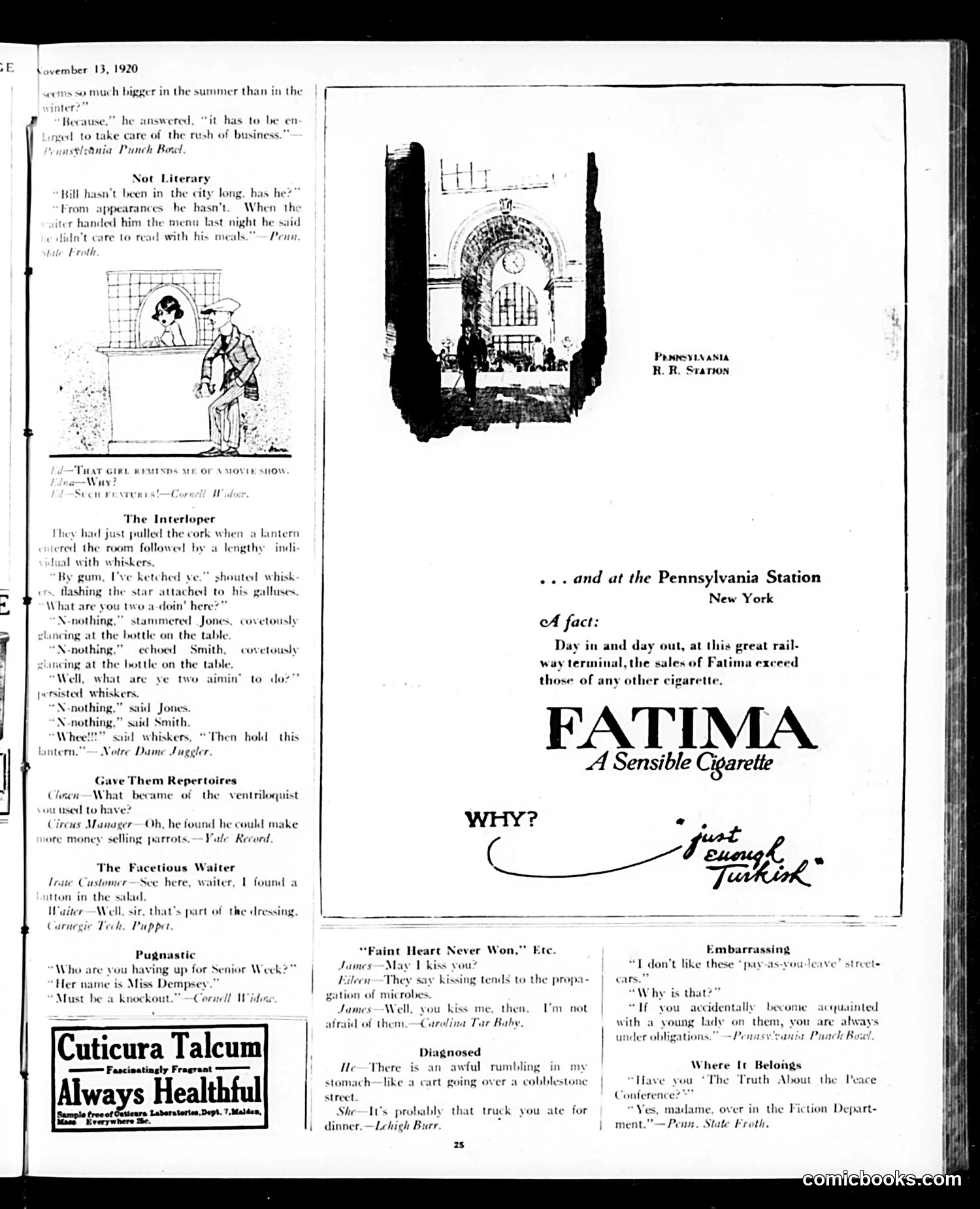
This page mixes brief humor pieces with advertising. The cartoons and jokes reflect early 1920s college and urban social life: **"Not Literary"** mocks a newcomer to the city who asks a waiter to read a menu aloud—suggesting rusticity or illiteracy. **"The Interloper"** depicts two men caught drinking (likely during Prohibition, which began in January 1920) startled by a police officer with a star badge ("whiskers" slang for cops). Their repeated "N-nothing" protests are comedic understatement. Other pieces satirize minor social situations: a ventriloquist selling parrots instead, a button in salad, kissing spreading germs (a common 1920s concern). The **Fatima cigarette advertisement** claims superior sales at Pennsylvania Station—a major New York terminal—presenting cigarette consumption as an established public fact. Overall, the page captures Jazz Age humor focused on Prohibition violations, dating anxieties, and consumer culture, targeting an educated, urban audience.
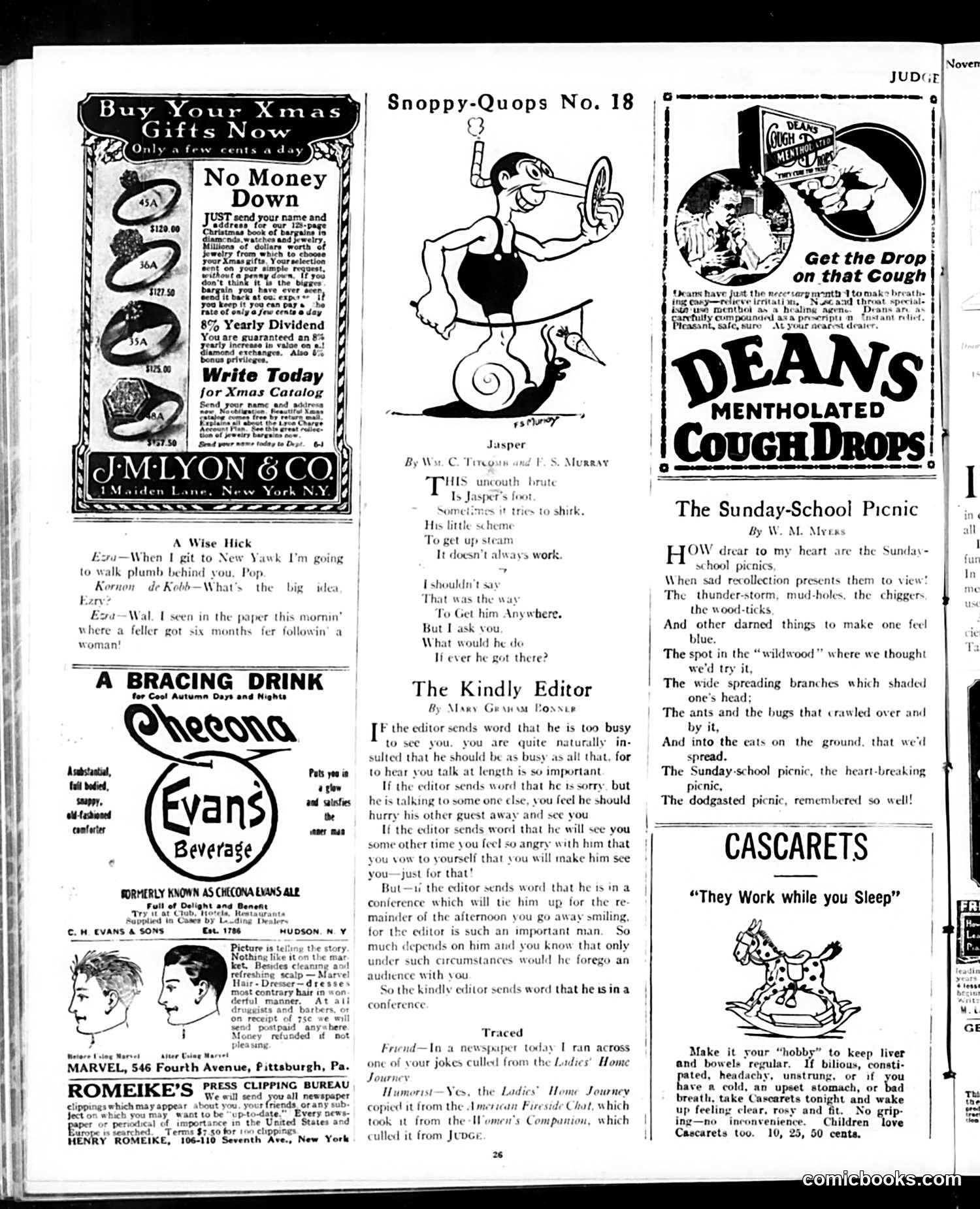
This page from *Judge* magazine contains mostly **advertisements and light humor pieces** rather than political satire. **"Jasper" cartoon**: A slapstick comic strip about an uncouth character whose unrefined behavior prevents him from getting anywhere in life—a morality tale suggesting that manners matter. **"The Kindly Editor"**: A humorous piece explaining office psychology: people feel slighted when editors claim to be "too busy" to see them, but feel respect when told the editor is in an important conference. The joke is about human vanity and how we interpret rejection differently depending on the stated reason. **"The Sunday-School Picnic"**: A nostalgic poem mocking the disappointing reality of church outings—muddy, bug-infested, and generally miserable despite romantic expectations. **Advertisements dominate**: For jewelry, beverages (Evans Ale), cough drops, laxatives, and press clipping services. The content reflects early 20th-century consumer culture rather than political commentary. This is primarily a **commercial publication** masquerading as humor and satire.
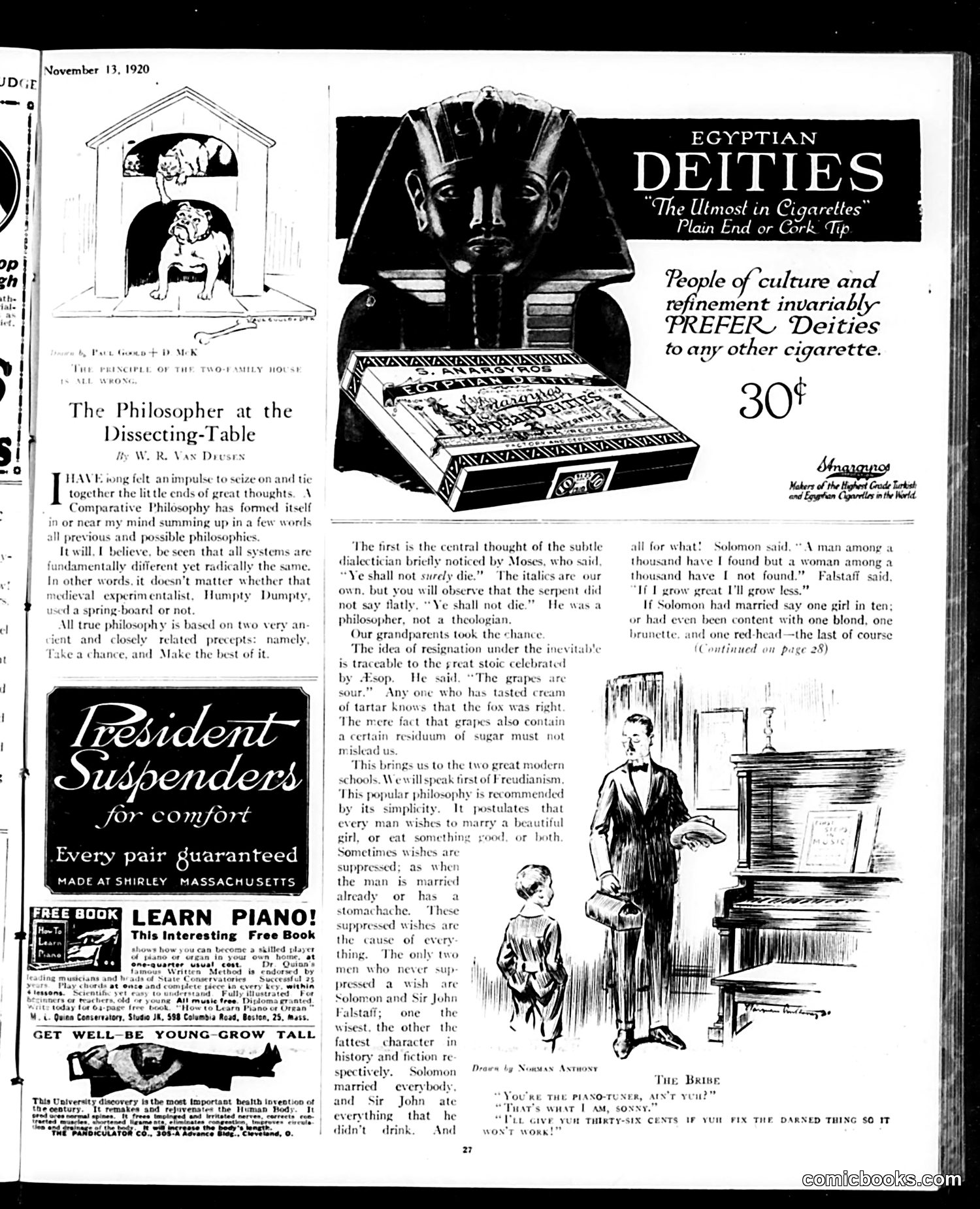
This page contains three main elements: **"The Philosopher at the Dissecting-Table"** (article by W.R. Van Dresser): A humorous philosophical essay comparing two schools of thought—Freudianism and Stoicism. It uses Solomon and Sir John Falstaff as examples: Solomon (who "married everybody") represents unchecked desire, while Falstaff represents indulgence. The piece satirizes pop-psychology trends by reducing complex philosophy to absurd oversimplification. The joke references contemporary fascination with Freud's ideas about repressed desires. **"The Bride"** (cartoon): A sketch showing a piano-tuner and young woman with dialogue about fixing "the darned thing." It's a double-entendre joke—ostensibly about piano repair but with sexual innuendo typical of 1920s humor. **Advertisements**: Egyptian Deities cigarettes (priced 30¢) and President Suspenders dominate the lower portion. The page mainly functions as satirical entertainment mixed with period advertising—no major political content visible.
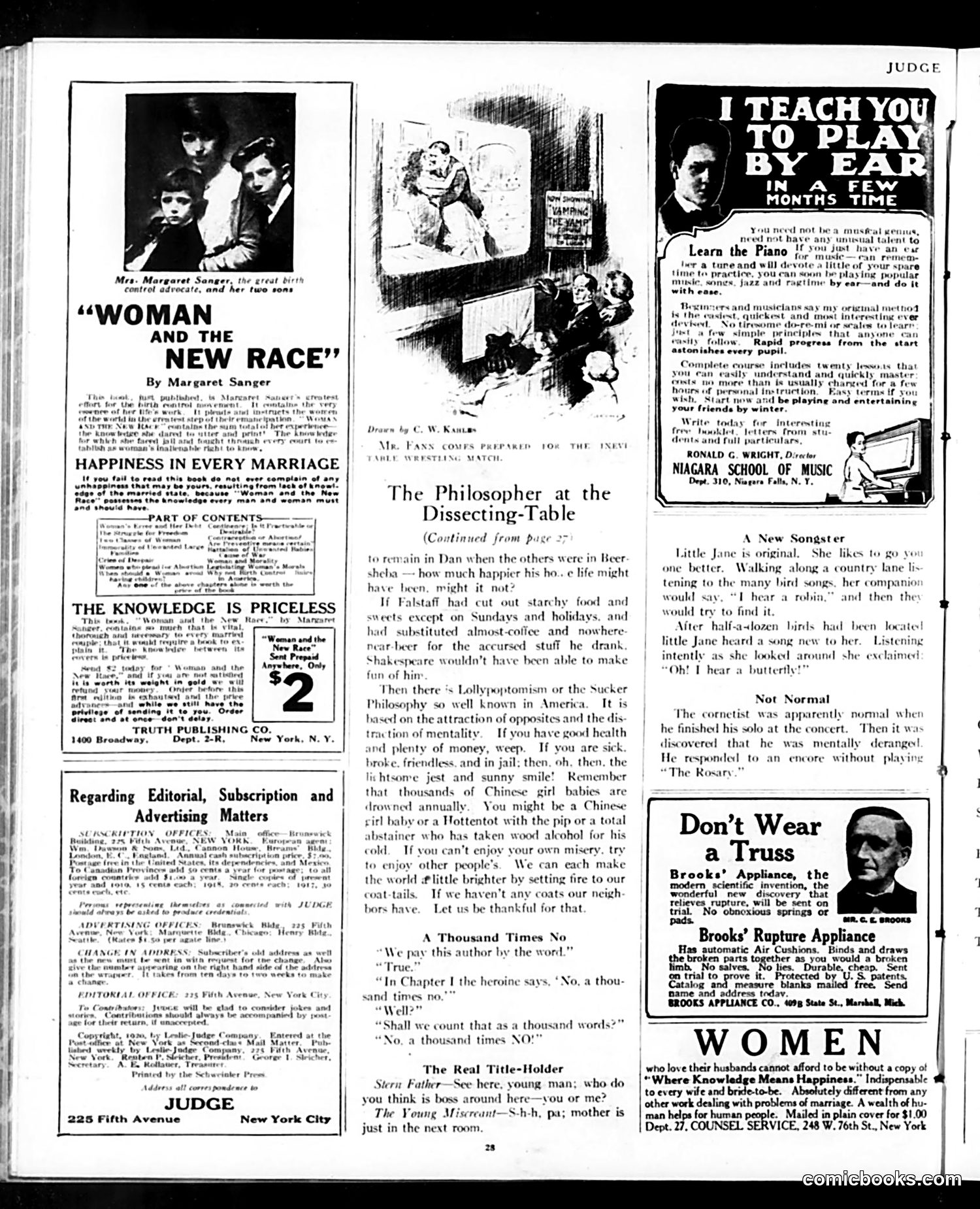
This page mixes advertising and editorial content typical of Judge magazine. The main illustrated article features **Margaret Sanger**, the birth control advocate, and promotes her book "Woman and the New Race"—referencing the eugenic and population-control arguments common in 1920s progressive circles. The cartoons below include philosophical humor pieces with no clear political figures—they're general satire about human nature and pretension. "The Philosopher at the Dissecting-Table" mocks pseudo-intellectual "Lollypoptomism," appearing to critique shallow optimism popular in America. The rest comprises **advertisements** (piano lessons, a truss/rupture appliance, marriage advice). The page reflects Judge's typical blend: social satire targeting intellectual fashions, prominent advocacy journalism (Sanger), and commercial messaging—all characteristic of 1920s American humor magazines addressing educated, upper-middle-class readers.
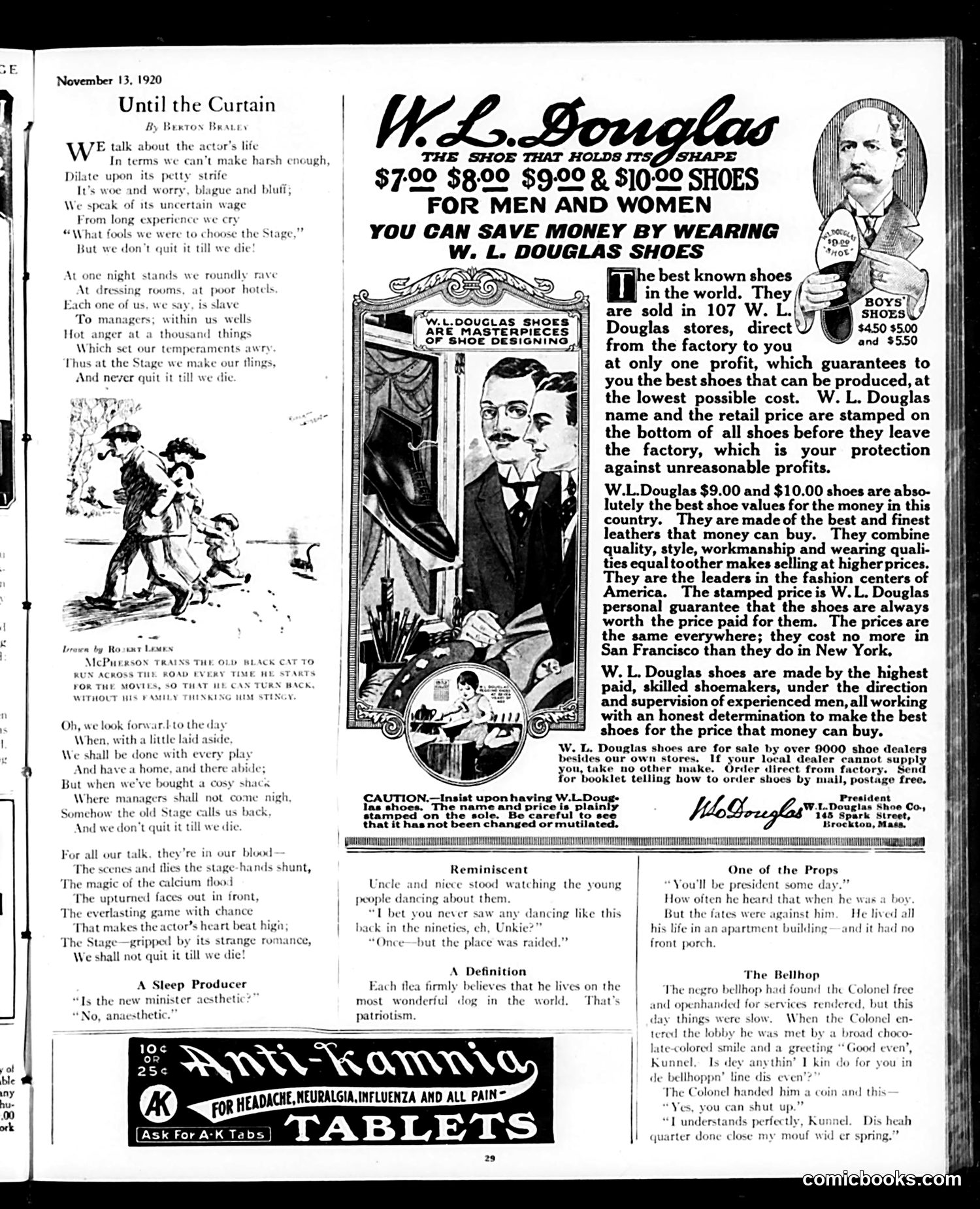
This page combines a poem about theatrical life with a W.L. Douglas shoe advertisement. **"Until the Curtain"** by Berton Braley is a sentimental poem romanticizing actors' devotion to the stage despite its hardships—uncertain wages, poor conditions, constant worry. The repeated refrain "we don't quit it till we die" celebrates theatrical commitment as a calling transcending practical concerns. The accompanying cartoon by Robert Lawes shows a cat being trained to run across a road to stop a moving car—illustrating the poem's theme of actors accepting dangerous, precarious work without complaint. The page is primarily dominated by a W.L. Douglas shoe advertisement emphasizing value and quality control (prices stamped on soles to prevent markup). The ad includes the shoe company's president portrait and addresses consumer concerns about fair pricing. The remaining columns contain humorous short pieces unrelated to the main content: anecdotes about theatrical life, definitions, and nostalgic observations—typical filler for this satirical magazine.
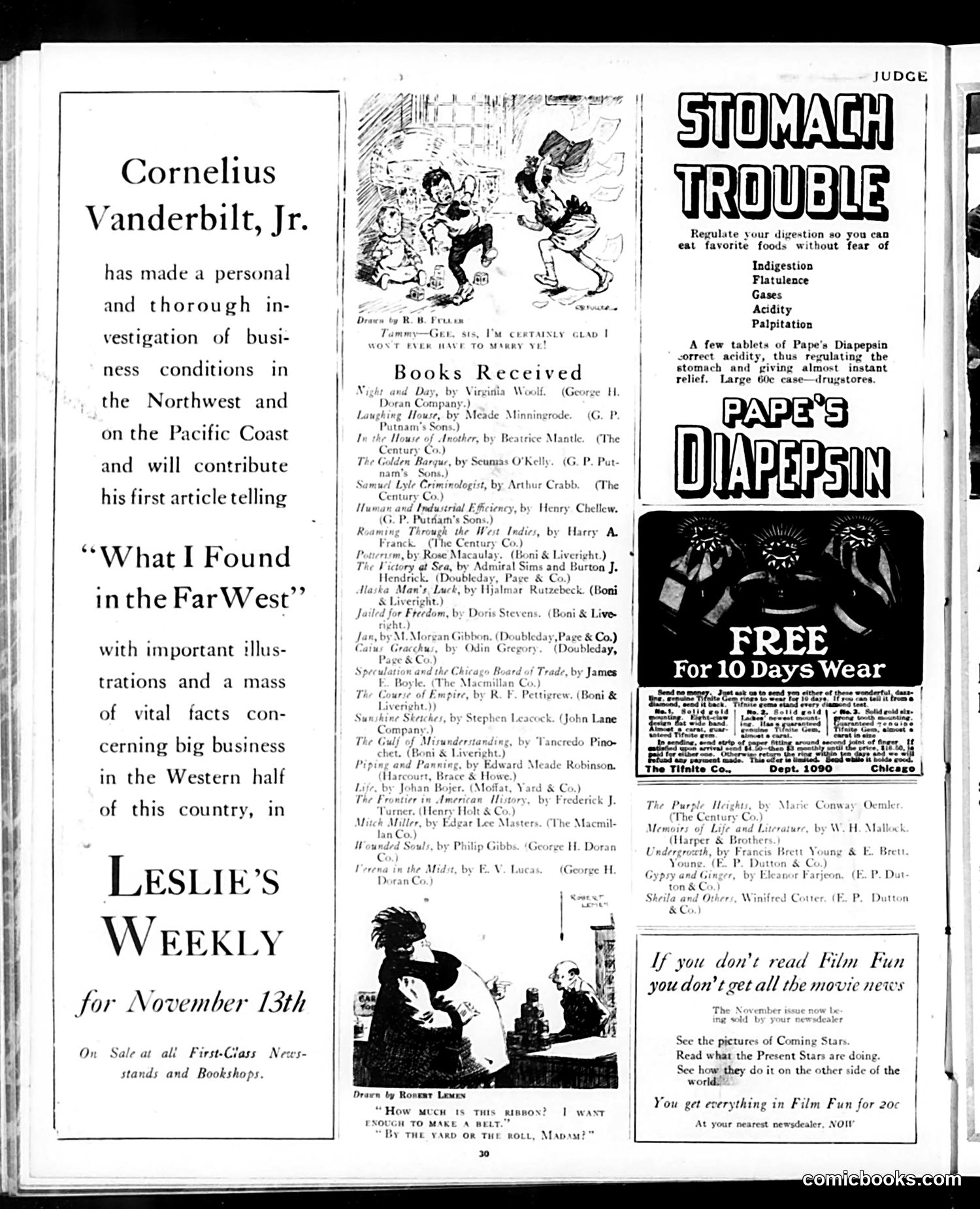
This page is primarily **advertisements and editorial promotion** rather than political satire. The main content announces Cornelius Vanderbilt Jr.'s upcoming article "What I Found in the Far West" in Leslie's Weekly, promoting his investigation of business conditions in the Northwest and Pacific Coast—positioning him as an authoritative voice on Western commerce. The cartoons shown are minor: one depicts a couple where the woman rejects marriage, another shows figures discussing ribbon measurements. These appear to be generic humor rather than political commentary. The page is dominated by **product advertisements**: Pape's Diapepsin (digestive tablets), and promotions for Film Fun and Leslie's Weekly magazines. This reflects early 20th-century magazine culture where advertising subsidized publication costs. The "Books Received" section lists recent publications, typical of literary journals of the era. Overall, this is a commercial page with limited satirical content—Judge here functions as a vehicle for advertising and promotion rather than political critique.
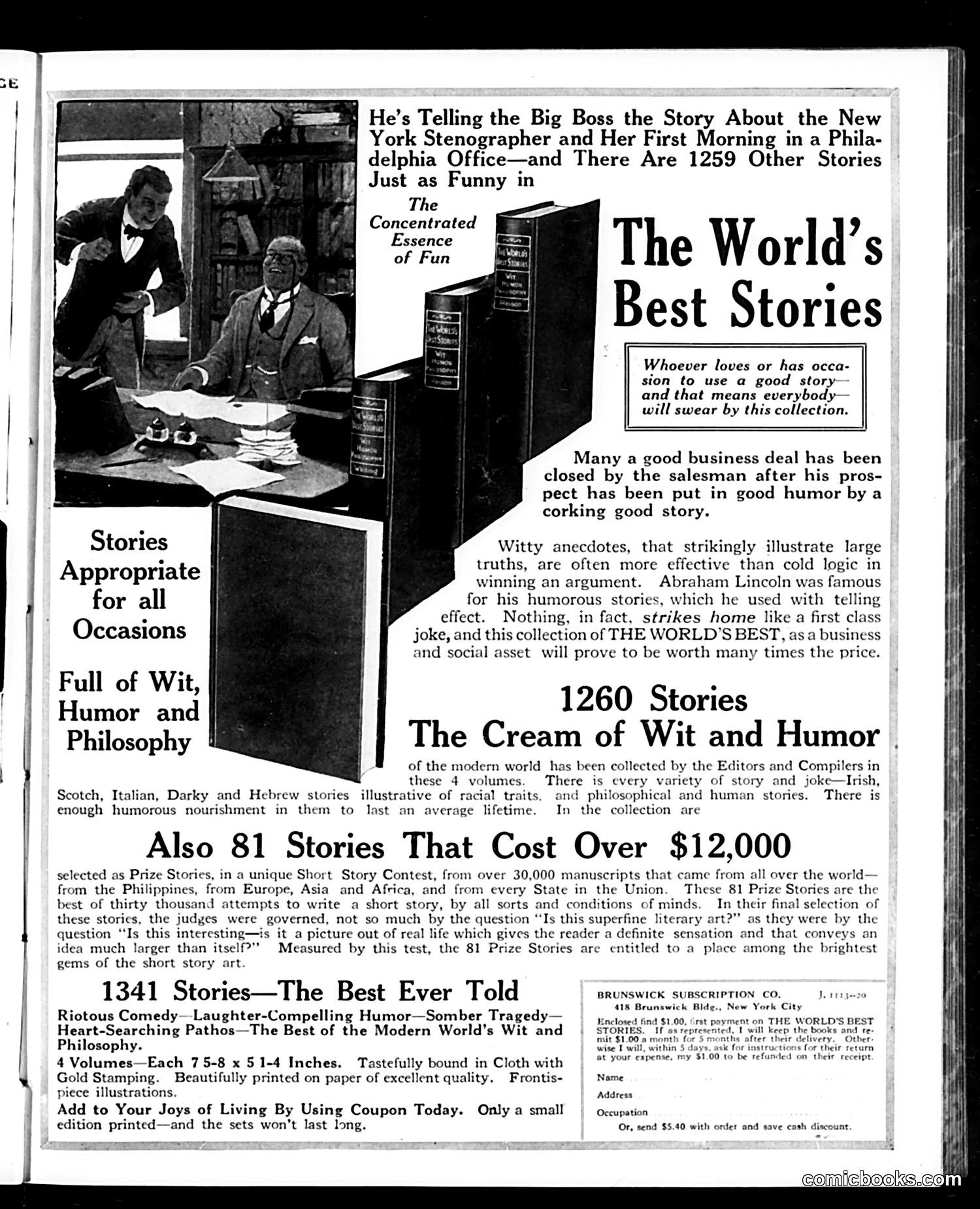
This is primarily a **book advertisement**, not political satire. The page promotes a four-volume story collection marketed as a business and social tool. The cartoon depicts a salesman telling his boss a humorous story—illustrating the book's central marketing pitch: that good stories are valuable for closing business deals and winning arguments. The ad explicitly references Abraham Lincoln's use of humor for persuasion. The collection includes **1,260 stories categorized by ethnic and racial stereotypes**: "Irish, Scotch, Italian, Darky and Hebrew stories." This racial categorization reflects early 20th-century attitudes; such groupings were standard in period publications but are now recognized as offensive. The ad emphasizes practical utility over literary merit, asking whether stories create "a picture of real life" rather than whether they constitute "superfine literary art"—positioning humor and entertainment as commercial assets for salesmen and professionals. This represents vintage advertising that valued stories instrumentally while casually employing ethnic stereotypes typical of the era.
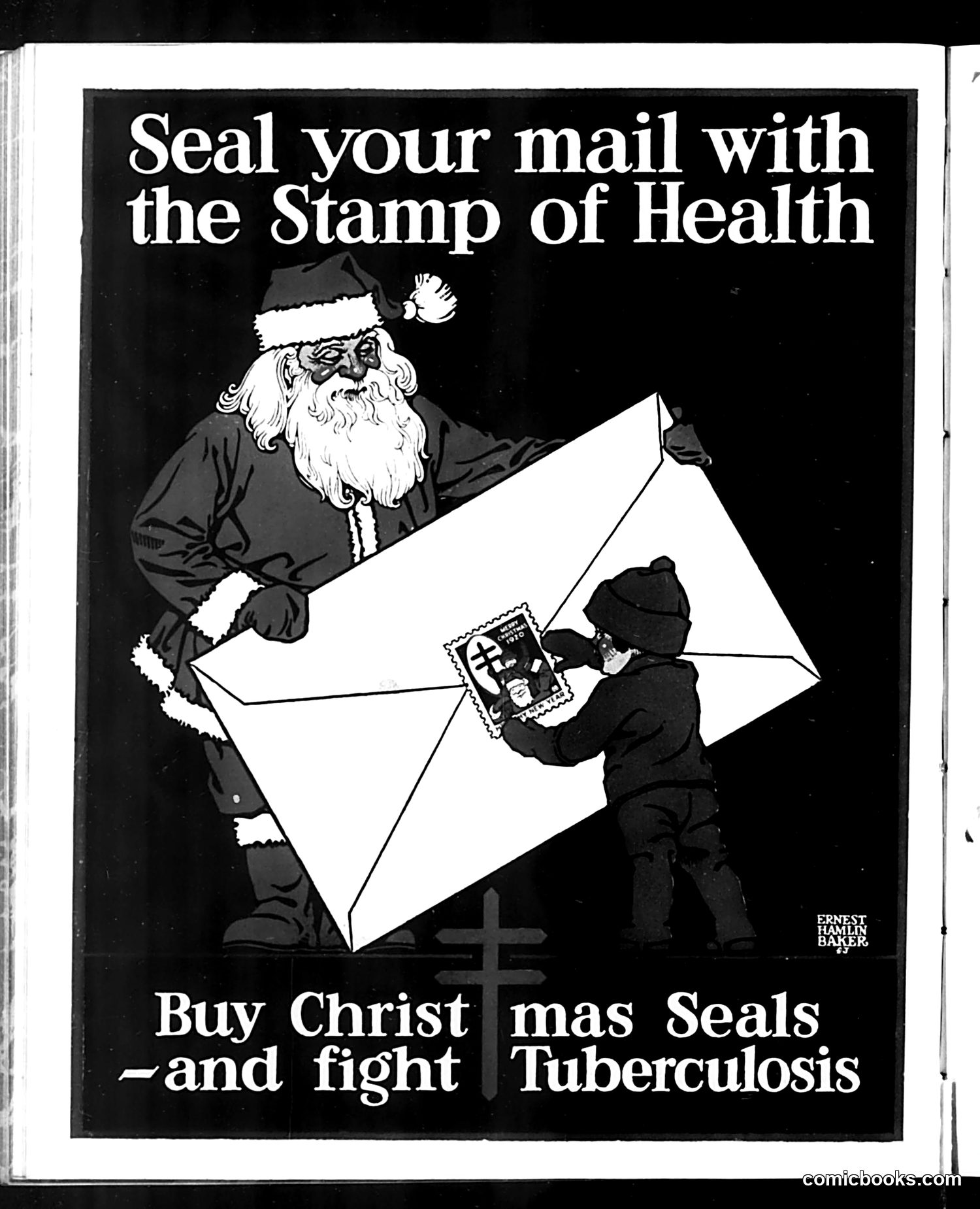
This is a public health advertisement, not political satire. It promotes Christmas Seals—decorative stamps sold to fund tuberculosis prevention efforts, a major public health concern in the early 20th century. The imagery depicts Santa Claus helping a child seal an envelope with a Christmas Seal stamp, framed as a patriotic health act. The "Stamp of Health" pun plays on both postal stamps and the seal's symbolic power. The cross visible in the design references tuberculosis organizations' charitable mission. Christmas Seals were a fundraising innovation: purchasers would affix decorative stamps to holiday mail, with proceeds supporting TB sanatoriums and research. This ad positions buying seals as a moral duty—combining Christmas generosity with disease fighting—typical of early Progressive Era public health campaigns. The artist is credited as Ernest Hamlin Baker.