
Judge, 1920-11-13 · page 9 of 32
Judge — November 13, 1920 — page 9: what you’re looking at
What you’re looking at
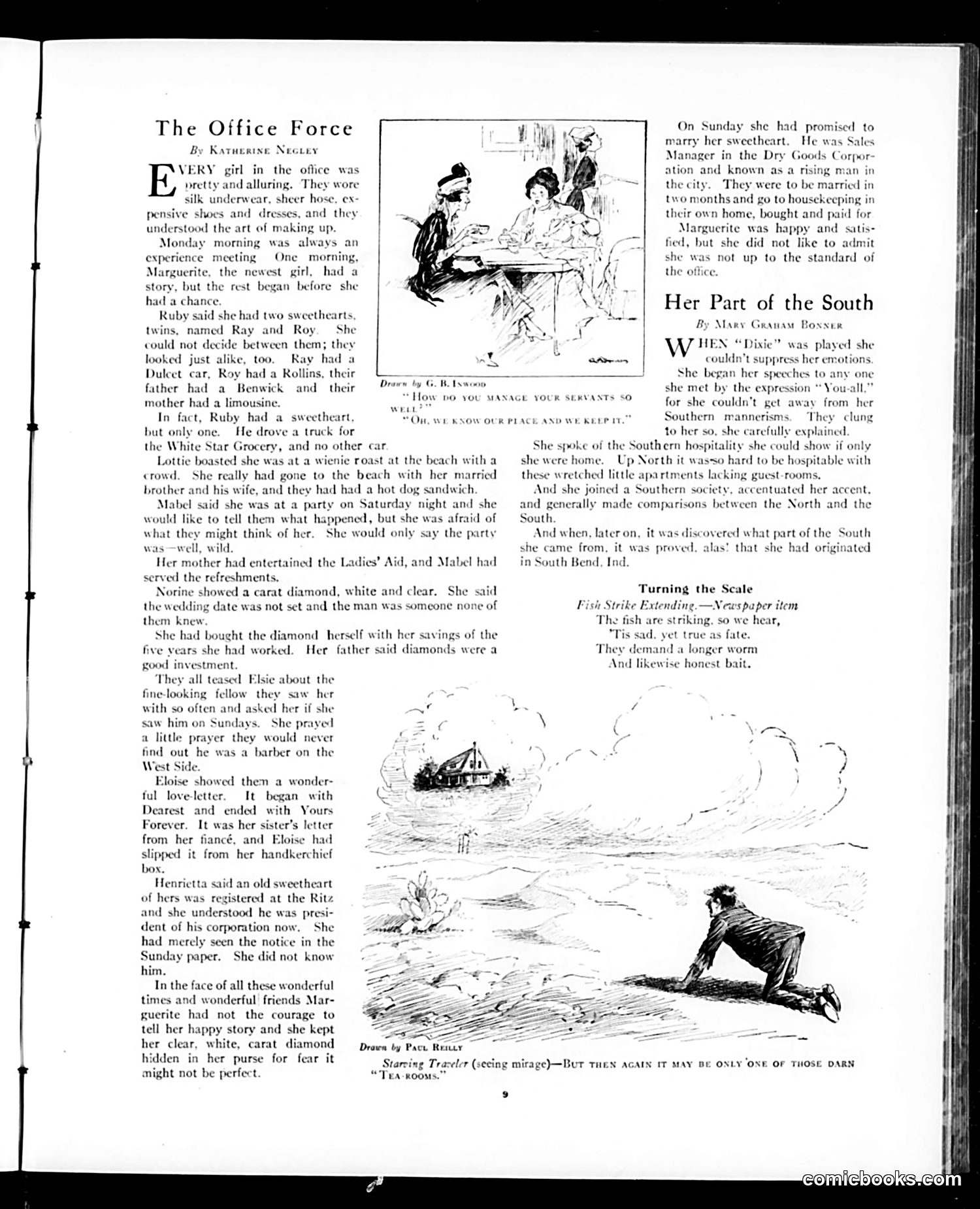
This page contains three satirical pieces mocking office workers and social pretense in the early 20th century. **"The Office Force"** portrays young female office workers who compulsively lie about their social lives to impress colleagues. Each invents elaborate stories—about multiple wealthy suitors, fancy outings, romantic letters, and wealthy acquaintances—when the reality is far more modest (truck drivers, home visits with family, self-purchased diamonds). Marguerite, the "newest girl," keeps silent about her genuine engagement to a respectable sales manager, fearing her peers' judgment of her actual circumstances. The satire targets women's insecurity and competitive status-seeking in the workplace. **"Her Part of the South"** ridicules a woman who performs exaggerated "Southern belle" mannerisms—saying "you-all," claiming superior hospitality—only to be exposed as being from South Bend, Indiana, not the actual South. The joke exposes her pretentiousness and inauthenticity. The page satirizes workplace vanity, class anxiety, and the gap between people's real and performed lives.
📄 Transcribed text from this page (OCR, searchable)
Machine-transcribed from the original scan — historical spelling and the odd misread are preserved.
The Office Force f[ By Katucrine Necrey \ RY girl in the office was pretty and alluring. They wore silk underwear, sheer hose, ex- pensive shoes and dresses, and they understood the art of making up. Monday morning was always an experience meeting One morning, Marguerite, the newest girl, had a | story, but the rest began before she had a chance. Ruby said she had two sweethearts, twins, named Ray and Roy. She could not decide between them; they looked just alike, too. Ray had a Dulcet car, Roy had a Rollins, their father had a Benwick and _ their mother had a limousine. In fact, Ruby had a sweetheart, but only one. He drove a truck for the White Star Grocery, and no other car Lottie boasted she was at a wienie roast at the beach with a crowd. She really had gone to the beach with her married brother and his wife, and they had had a hot dog sandwich: Mabel said she was at a party on Saturday night and she would like to tell them what happened, but she was afraid of what they might think of her. She would only say the party was —well, wild. Her mother had entertained the Ladies’ Aid, and Mabel had served the refreshments. Norine showed a carat diamond, white and clear. She said ¢ date was not set and the man was someone none of Drawn by GB Asm weet the weddii them knew She had bought the diamond herself with her savings of the five years she had worked. Her father said diamonds were a good investment. ‘They all teased Elsie about the fine-looking fellow they saw her with so often and asked her if she saw him on Sundays. She prayed a little prayer they would never find out he was a barber on the West Side. Eloise showed them a wonder- ful love-letter, It began with Dearest and ended with Yours Forever. It was her sister’s letter from her fiancé, and Eloise had slipped it from her handkerchief box. Henrictta said an old sweetheart of hers was registered at the Ritz and she understood he was presi- dent of his corporation now. She had merely seen the notice in the Sunday paper. She did not know him. In the face of all these wonderful times and wonderful friends Mar- guerite had not the courage to tell her happy story and she kept her clear, white, carat diamond youn by Pact Rear hidden in her purse for fear it might not be perfect. “Tea-rooms. % “How po YOU MANAGE YOUR SERVANTS SO. “OW, WE KNOW OUR PLACE AND WE KEEP IT.” On Sunday she had promised to marry her sweetheart. He was Sales Manager in the Dry (¢ ion and known as a rising man i -city. They were to be married in o months and go to housekeeping in cir own home, bought and paid for Marguerite was happy and sati: but she did not like to admit she was not up to the standard of the of Her Part of the South By Mary Geanas Boxner WHEN “Dixie” was played she couldn't suppress her emotions. She began her speeches to any one she met by the expression * You-all,” for she couldn't get away from her Southern mannerisms. They clung to her so, she carefully explained She spoke of the Southern hospitality she could show if only she were home. Up North it wasso hard to be hospitable with these wretched little apartments lacking guest-rooms, And she joined a Southern society, accentuated her acc and generally made comparisons between the North and the South, And when, later on, it was discovered what part of the South she came from, it was proved, alas! that she had originated n South Bend, Ind. ds Corpor ce. Turning the Scale Fish Strike Extending. —News paper item The fish are striking. so we hear, "Tis sad. yet true as fate. They demand a longer worm And likewise honest bait. Starving Traceler (seeing mirage)—BUT THEN AGAIN IT MAY BE ONLY ONE OF THOSE DARN