
Judge, 1920-11-13 · page 6 of 32
Judge — November 13, 1920 — page 6: what you’re looking at
What you’re looking at
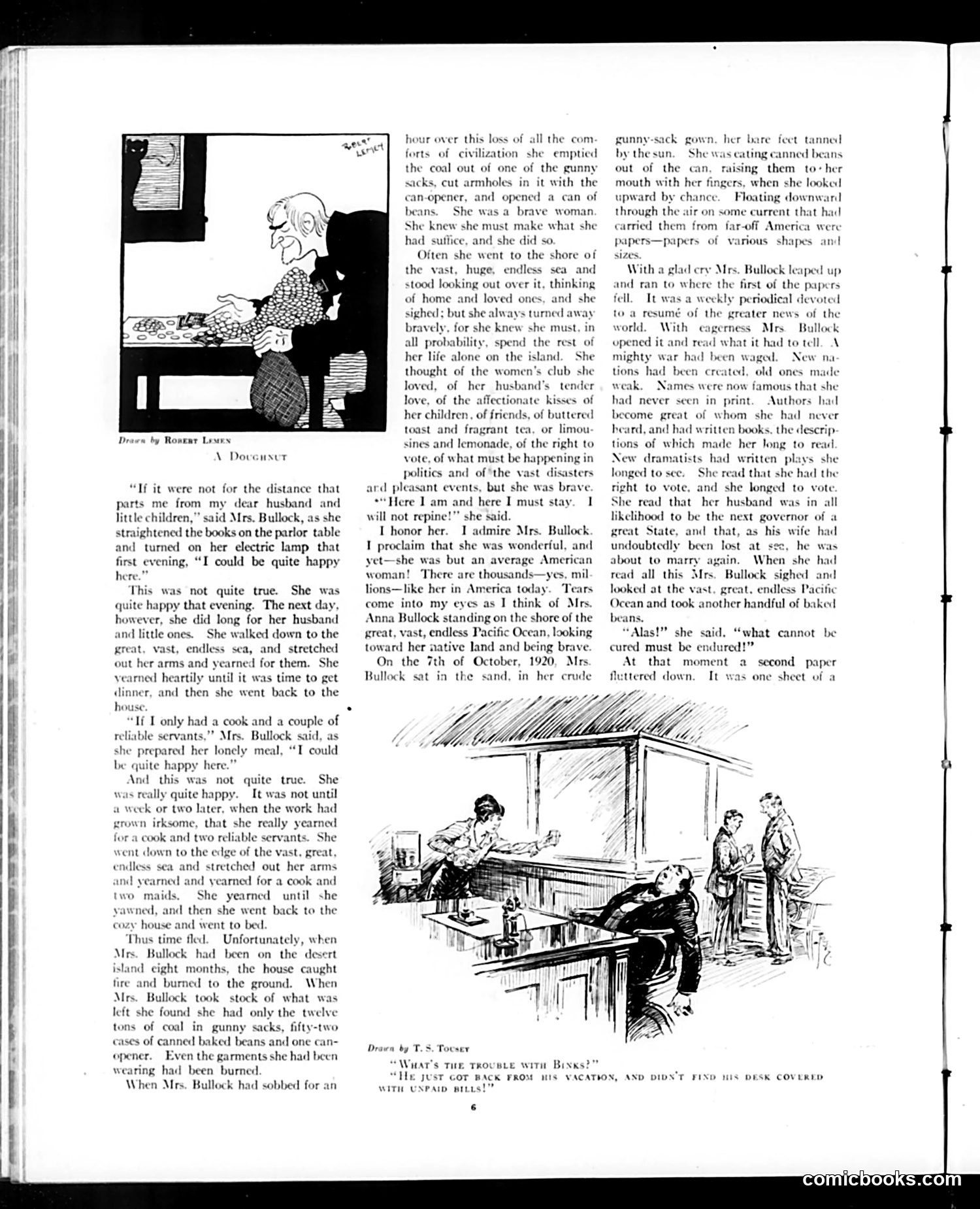
This page contains a short story titled "A Doughnut" illustrated by Robert Lemos, centered on Mrs. Bullock, stranded on a Pacific island after her husband's ship was lost at sea in 1920. The lower cartoon by T.S. Tousey depicts a man returning from vacation to find his desk buried under unpaid bills—the caption reads "What's the trouble with Binns? He just got back from his vacation, and didn't find his desk covered with unpaid bills!" This is straightforward domestic humor about the unpleasant surprise of accumulated bills awaiting vacation-goers, a timeless relatable joke requiring no historical context to understand.
📄 Transcribed text from this page (OCR, searchable)
Machine-transcribed from the original scan — historical spelling and the odd misread are preserved.
h a ad a ee by Rosear Leurw \ Doveuset “If it were not for the distance that parts me from my dear husband and little children,” said Mrs. Bullock, as she straightened the books on the parlor table and turned on her electric lamp that first evening, “I could be quite happy here.” This was not quite true. She was quite happy that evening. The next day, however, she did long for her husband and little ones. She walked down to the great, vast, endless sea, and stretched out her arms and yearned for them. She yearned heartily until it was time to get er, and then she went back to the house If I only had a cook and a couple of reliable servants,’’ Mrs. Bullock said, as she prepared her lonely meal, “T could ite happy here.” this was not quite true. She as really quite happy. It was not until week or two later, when the work had grown irksome, that she really yearned for a cook and two reliable servants. She vent down to the edge of the vast, great, endless sea and stretched out her arms 1 yearned and yearned for a cook and She yearned until she and then she went back to the cozy house and went to bed. Thus time fled. Unfortunately, when Mrs. Bullock had been on the desert island eight months, the house caught fire and burned to the ground. When Mrs. Bullock took stock of what was left she found she had only the twelve te 1 in gunny sacks, fifty-two cases of canned baked beans and one can- opener. Even the garments she had been wearing had been burned. When Mrs. Bullock had sobbed for an be q yawned, ns of co h over this loss of all the com forts of civilization she emptied the coal out of one of the gunny sacks, cut armholes in it with the can-opener, and opened a can of beans. She was a brave woman. She knew she must make what she had sutlice, and she did so. Often she went to the shore of the vast, huge, endless sea and stood looking out over it, thinking of home and loved ones, and she sighed ; but she always turned away bravely, for she knew she must, in all probability, spend the rest of her life alone on the island. She thought of the women’s club she loved, of her husband's tender love, of the affectionate kisses of her children, of friends, of buttered toast and fragrant tea, or limou sines and lemonade, of the right to », of what must be happening in and ofthe vast disasters nd here I must stay. 1 will not repine!” she Said. I honor her. I admire Mrs. Bullock I proclaim that she was wonderful, and yet—she was but an average American woman! There are thousands—yes, mil lions—like her in America today. Tears come into my eyes as I think of Mrs. Anna Bullock standing on the shore of the great, vast, endless Pacific Ocean, looking toward her native land and being brave. On the 7th of October, 1920, Mrs. Bullock sat in the sand, in her crude Drawn by T.S. Towser “What's THE TROUBLE WiTH Binks gunny-sack ge her bare fect tanned by thesun. She was cating eanned bea out of the can, raising them to+ her mouth with her fingers, when she looked upward by chance. Floating downward through the air on some current that had carried them from far-off America were papers—papers of various shapes and sizes With a glad ery Mrs. Bullock leaped up and ran to where the first of the papers fell. It was a weekly periodical devoted to a resumé of the greater news of the world. With eagerness Mrs Bullock opened it and read what it had to tell. A mighty war had been waged. New na tions had been created, old ones made weak. Names were now famous that she had never seen in print. Authors had become great of whom she had never heard, and had written books, the descrip tions of which made her long to read New dramatists had written plays she longed to see. She read that she had the right to vote, and she longed to vote. She read that her husband was in all likelihood to be the next governor of a great State, and that, as his wife had undoubtedly been lost at he was about to marry again. When she had read all this Mrs. Bullock sighed and looked at the vast, great. endless Pacific Ocean and took another handful of baked be: s!” she said, “what cannot be cured must be endured!” At that moment fluttered down. It second paper was one sheet of a ‘P= “He JUST GOT BACK FROM IIS VACATION, AND DIDN'T FIND 118 DESK COVERED WITH UNPAID pitts!”