
A complete issue · 32 pages · 1920
Judge — October 30, 1920
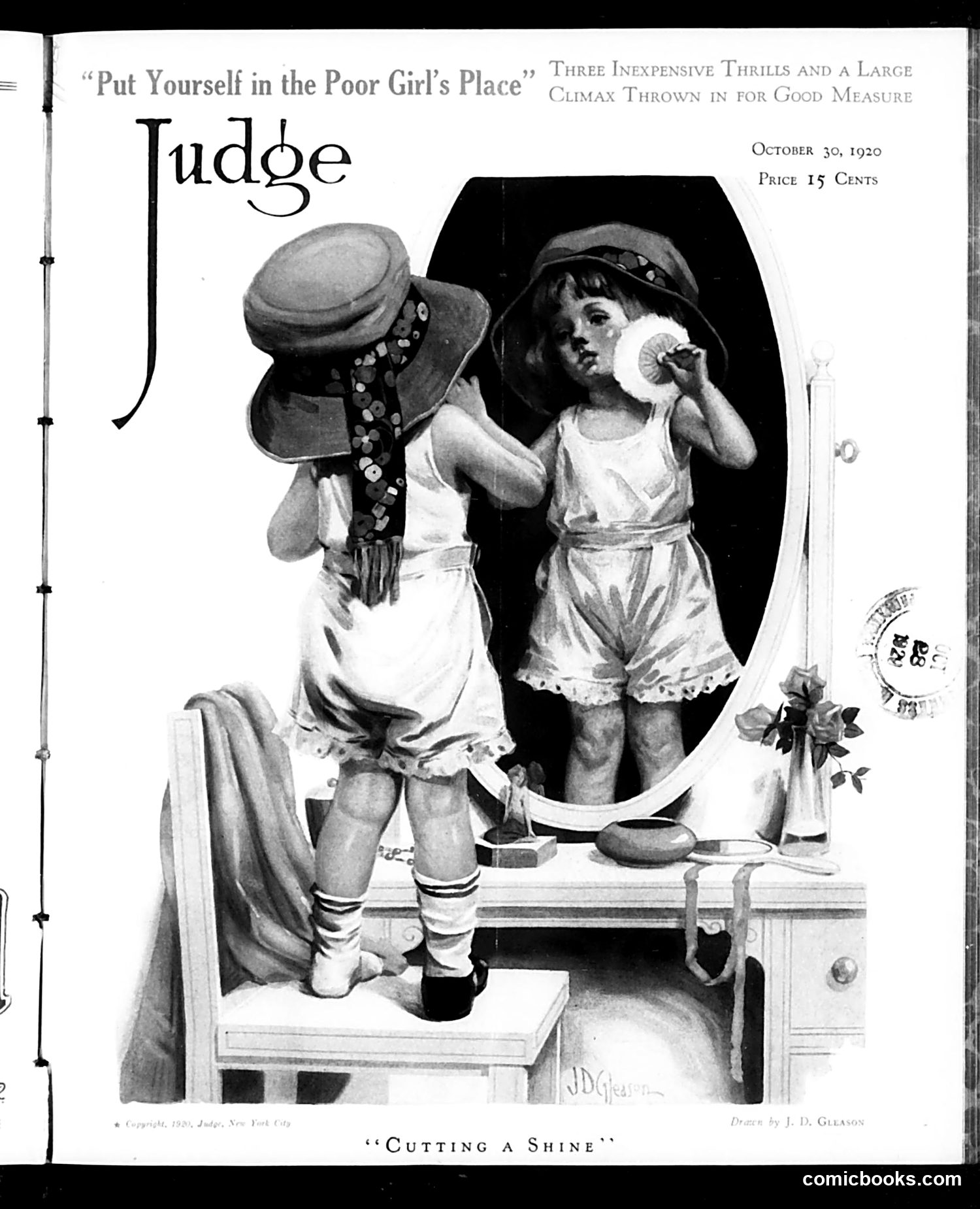
This cover illustrates the phrase "Put Yourself in the Poor Girl's Place," depicting two young children at a vanity mirror. The child on the left wears an ornate, decorative hat and holds fancy accessories, while the child on the right gazes at her reflection, admiring or envying the finery. The caption reads "Cutting a Shine." The satire appears to mock class pretension and children's mimicry of adult vanity culture. By showing poor or working-class children playing dress-up with elaborate hats and cosmetics, Judge satirizes either: - The aspirational materialism of lower classes - Adults' indulgence of children's vanity - The fashion industry's excess The phrase "put yourself in the poor girl's place" suggests ironic sympathy, inviting readers to contemplate what drives such acquisitive behavior across social classes.

This page is **primarily a Camel cigarette advertisement**, not satire or political commentary. The ad features a camel (the brand mascot) with the slogan "You tell 'em, Camels, you've got the quality!" The imagery shows cigarette packages and emphasizes Camels' blend of Turkish and domestic tobaccos, marketed as giving a "mellow mild body." The text uses period-appropriate advertising language ("smoke-wise," "bank on Camels") typical of early-to-mid 20th century tobacco marketing. The phrase "When you flash a deck of Camels you tell the world you're smoke-wise" reflects how cigarettes were then openly promoted as status symbols. There is no discernible political cartoon or satire present—this is straightforward vintage commercial advertising from R.J. Reynolds Tobacco Company.
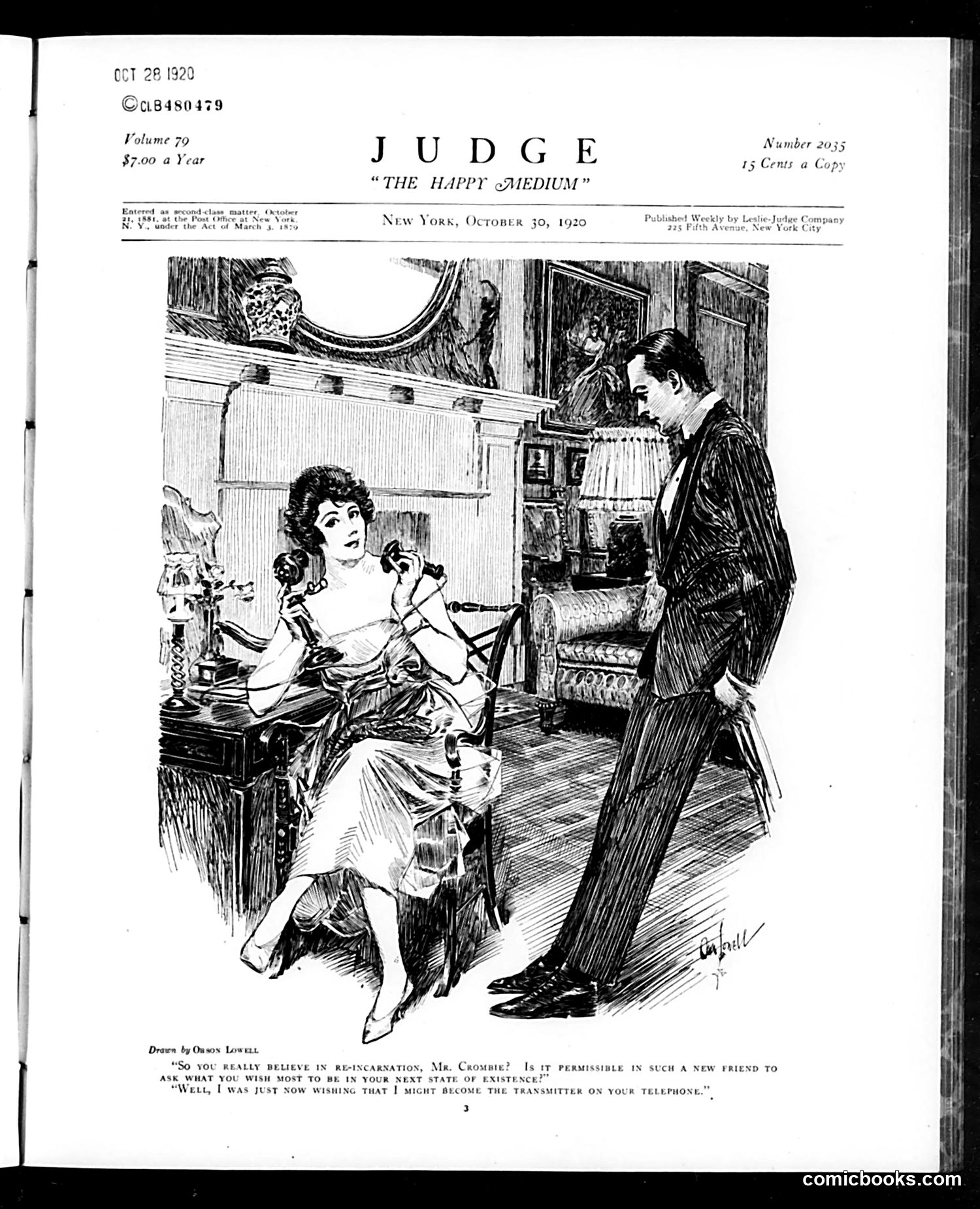
This cartoon satirizes spiritualism and reincarnation beliefs that were popular in the early 20th century. A woman sits at her vanity while a man (labeled "Mr. Crommie") stands nearby. The dialogue mocks the spiritualist notion that one might be reincarnated as something different in an afterlife. The joke hinges on the woman's flippant response: she wishes she could become "the transmitter on your telephone"—suggesting she wants to literally be inside the telephone so she can monitor her male companion's conversations. This reflects period anxieties about relationship trust and control, while simultaneously ridiculing both spiritualism and the telephone as technologies that intrude on privacy. The cartoon illustrates 1920s skepticism toward supernatural beliefs.
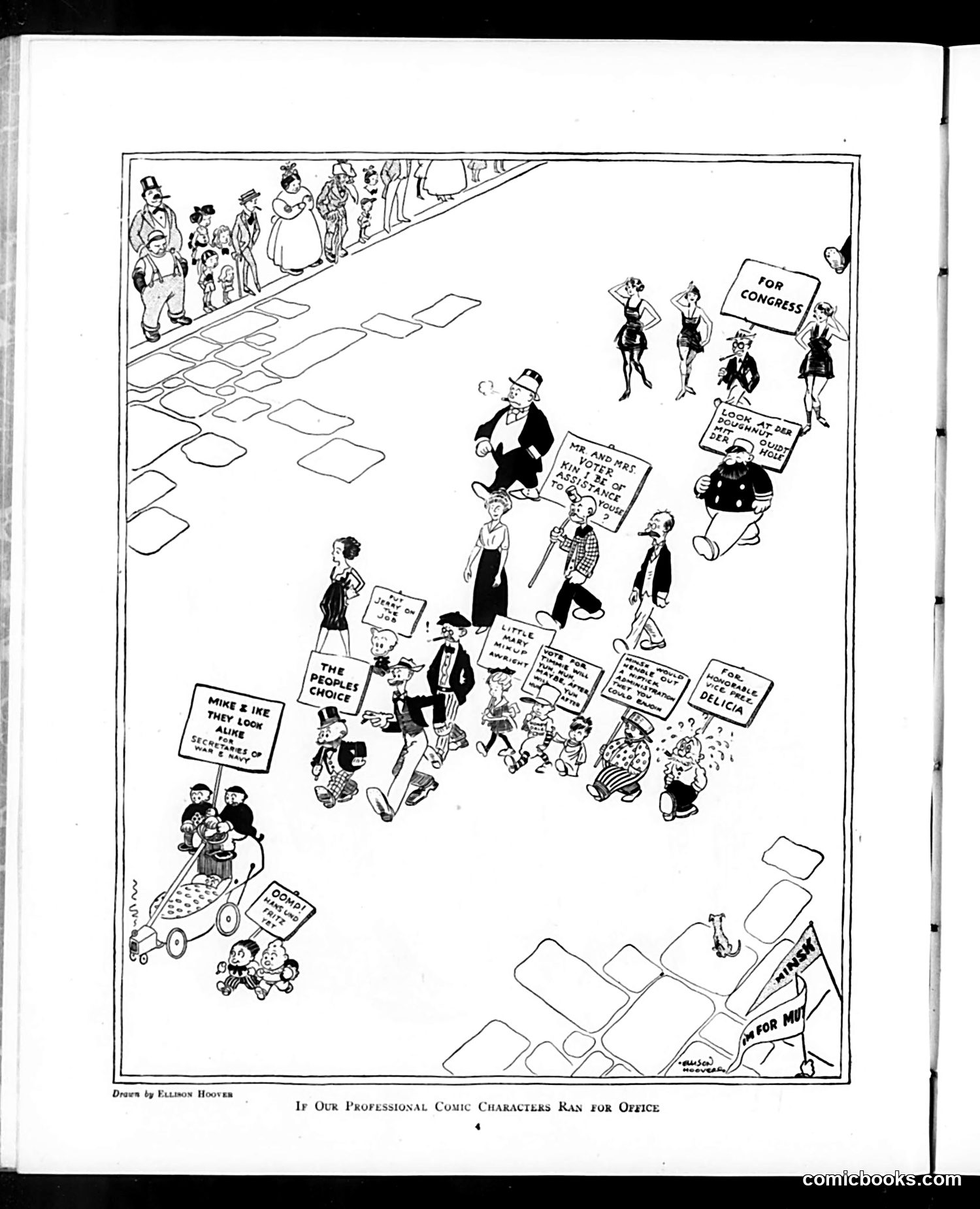
This cartoon by Ellinor Hoover satirizes comic strip characters entering electoral politics. The central figures appear to be popular newspaper comic characters (identifiable by their distinctive styles) carrying campaign signs and marching as if running for office. The joke mocks the idea of fictional comic characters—known for humorous, often absurd situations—competing seriously for Congress and other positions. Signs visible include "FOR CONGRESS" and references to various platforms. The satire likely critiques either the quality of actual political candidates (comparing them unfavorably to comic strips) or comments on how entertainment figures were entering politics. The contrasting "serious" observers at the page's top emphasizes the absurdity of this scenario, suggesting that comic-strip logic applied to real governance would be ridiculous.
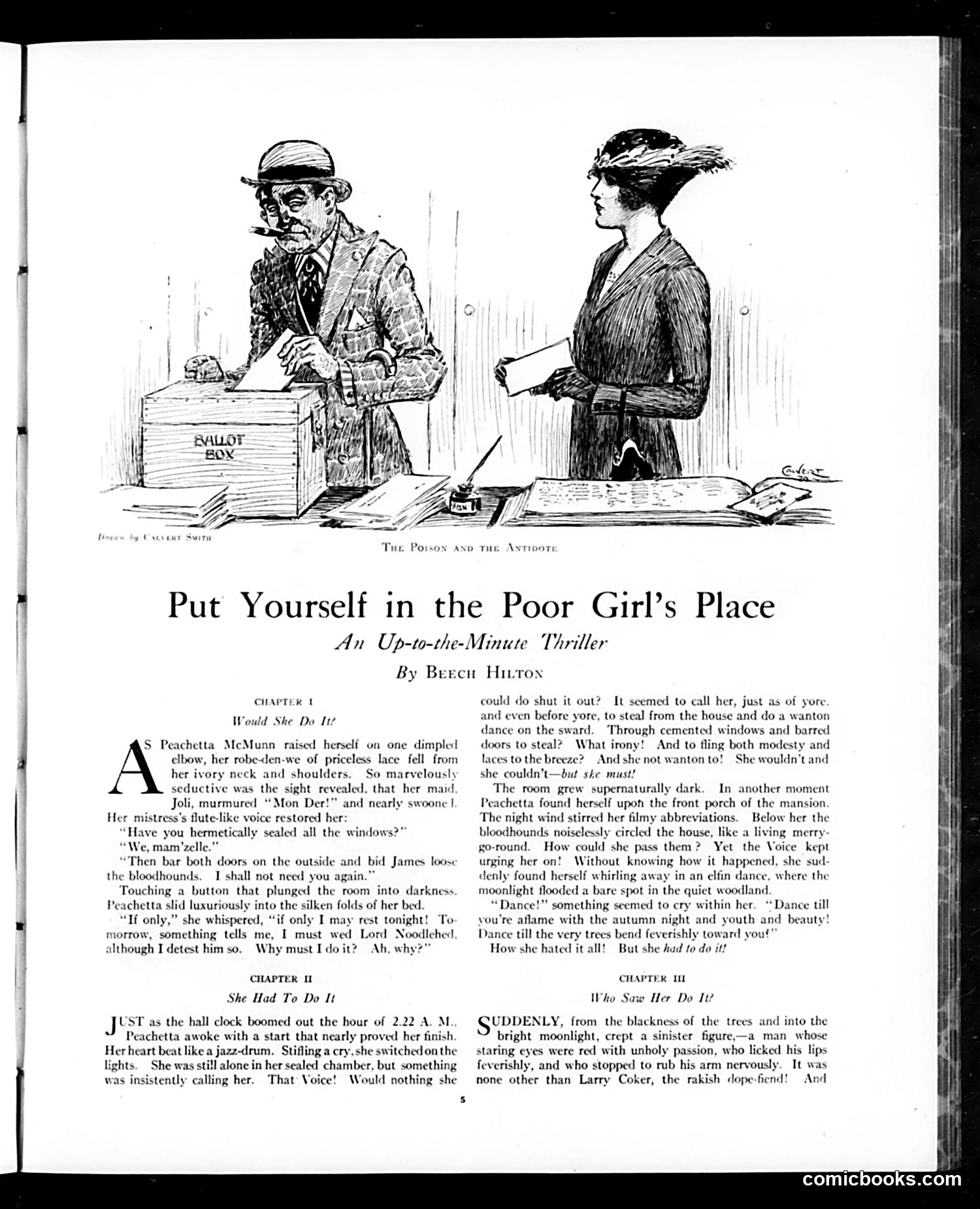
This page presents a serialized thriller story by Beecher Hilton, not political satire. The cartoon at top, titled "The Poison and the Antidote," depicts a man at a ballot box speaking with a woman—likely contrasting corrupting influences (poison) with corrective ones (antidote) in voting contexts. The story itself follows Peachetta McMun, a servant girl experiencing supernatural horror: mysterious voices, bloodhounds, and a sinister male figure (Larry Coker, described as a "rakish dope-fiend") emerging from darkness. The narrative emphasizes her helplessness and fear, designed to create suspense for readers. The "up-to-the-minute thriller" format reflects early 1900s popular entertainment mixing melodrama with gothic elements, targeting readers seeking sensational serialized fiction.
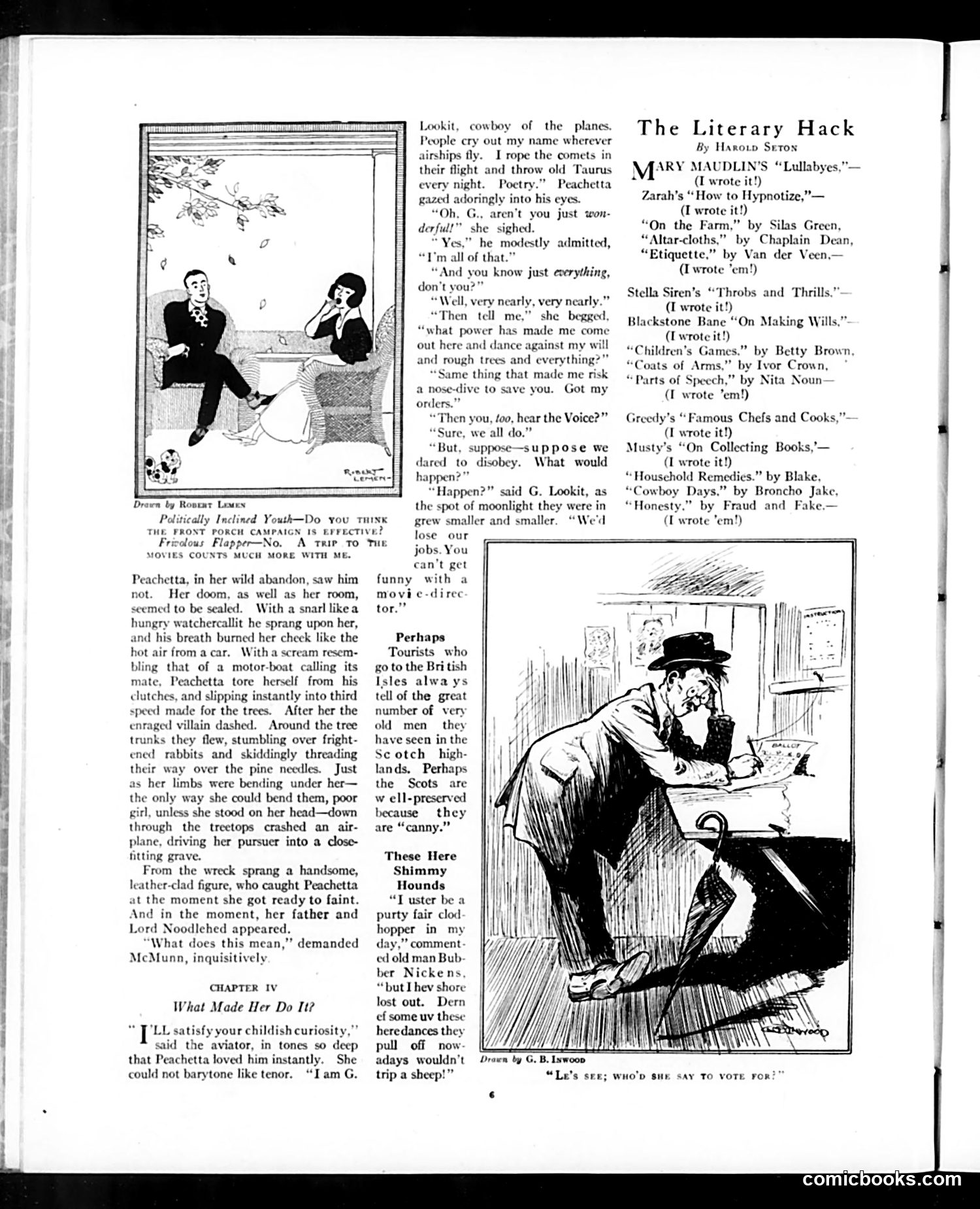
This page contains a serialized fiction story titled "The Literary Hack" by Harold Sexton, featuring two illustrated scenes. The top cartoon shows a man and woman in an animated conversation, with dialogue about "dancing against my will" and references to "the Voice"—apparently a supernatural or fantastical plot element. The bottom illustration depicts an older man at a desk, captioned "Let's see; who's she say to vote for?" This appears to be satirizing a writer or journalist character who cynically manufactures opinions or political positions. The page also includes a sidebar listing books supposedly written or reviewed by the hack, satirizing prolific but mediocre literary output. The overall satire targets lazy, commercially-driven writers who produce work without genuine merit or conviction.
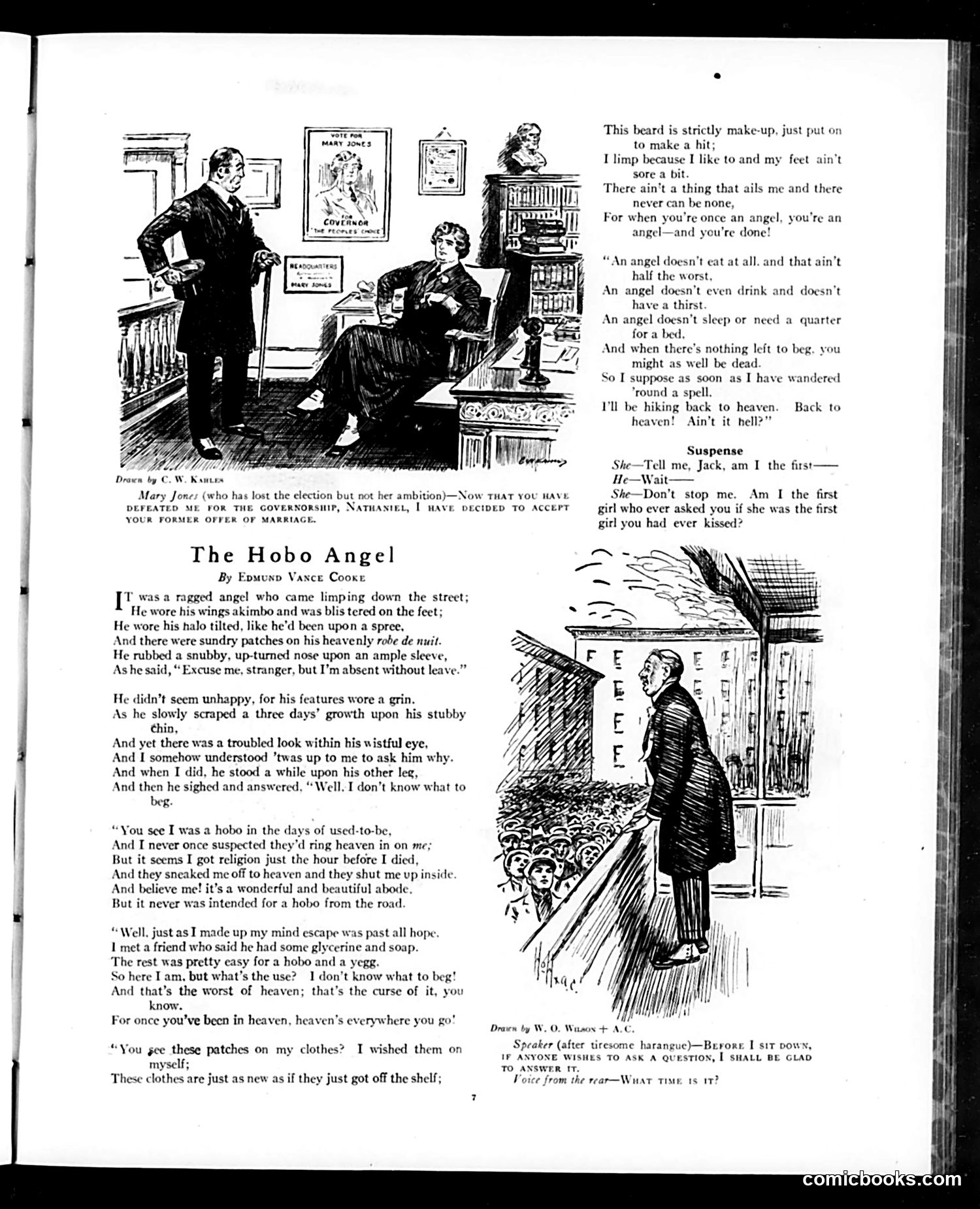
**Top Cartoon:** A woman named Mary Jones, who lost a gubernatorial election, proposes marriage to her opponent Nathaniel now that he's defeated her. The satire mocks women's political ambition as insincere—suggesting she only wanted power, and now settles for marriage as a consolation prize. This reflects early 20th-century attitudes dismissing women's serious political aspirations. **"The Hobo Angel":** A poem about a deceased vagrant who unexpectedly enters heaven but finds it unbearable. The satire critiques both paradise and the poor: heaven's perfection (no hunger, pain, or need) removes the hobo's entire identity and purpose. He escapes back to earth, preferring struggle to purposeless comfort. It's darkly humorous social commentary on class and meaning. **Bottom Cartoon:** A speaker offers to answer questions; someone shouts "What time is it?"—trivial compared to his serious address. It satirizes audience inattention or heckling at public speeches.
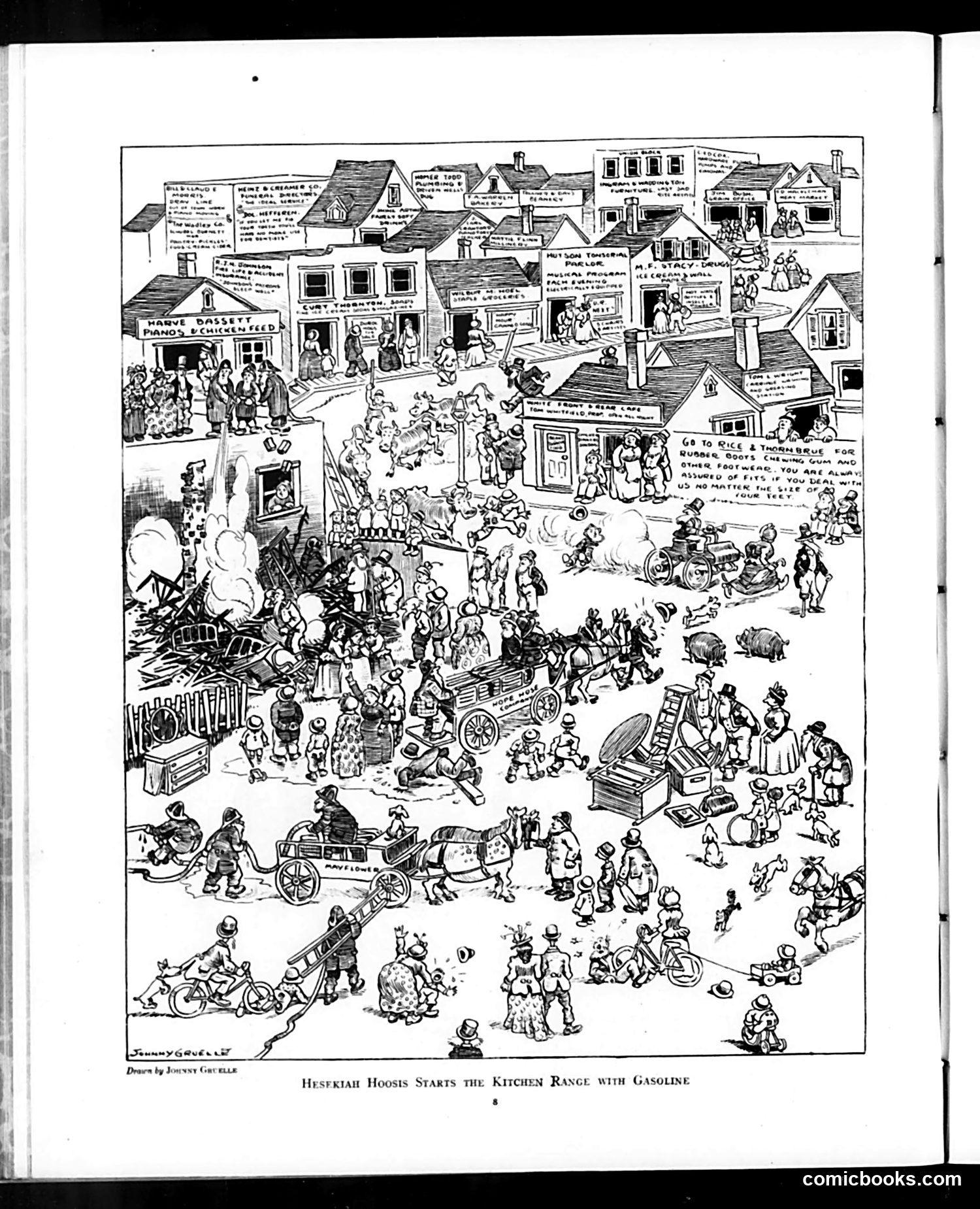
This is a humorous domestic accident cartoon by Johnny Gruelle. The title character, Heskiah Hoosis (a comedic rustic name), attempts to ignite a kitchen stove using gasoline—an extremely dangerous and ill-advised method. The resulting explosion has created spectacular chaos in what appears to be a small town or village street, with dozens of townspeople, animals, vehicles, and debris scattered everywhere in comic pandemonium. The satire mocks rural ignorance about modern appliances and the misuse of flammable liquids. It's also commentary on the early gasoline era's hazards, when people often lacked proper instruction for handling fuel. The exaggerated destruction and crowded scene of chaos represent the absurd consequences of such recklessness, played for comedic effect typical of Judge magazine's satirical humor.
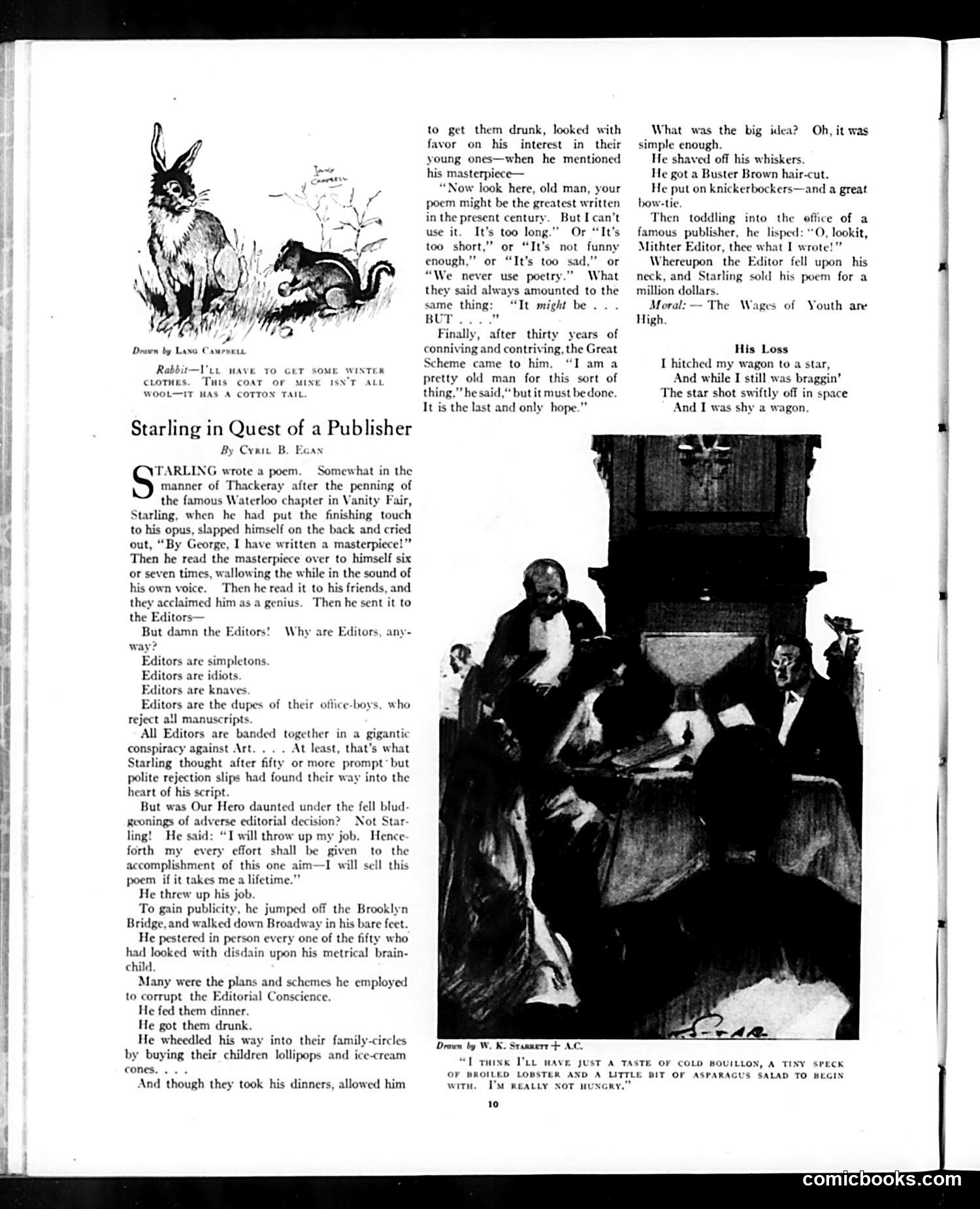
This satirical story mocks both struggling writers and publishing gatekeepers. Starling writes a poem, believes it's a masterpiece, then faces fifty rejections from editors—whom he bitterly characterizes as "simpletons," "idiots," and "knaves" in a "gigantic conspiracy against Art." After thirty years of failed schemes (bribing editors with dinners, drinks, and gifts to their children), Starling's final strategy succeeds: he disguises himself as a child by shaving his whiskers, getting a Buster Brown haircut, and wearing knickerbockers with a bow-tie. The publisher, apparently charmed by this childish presentation, accepts the poem for "a million dollars." The satire cuts multiple ways: mocking both the editor's apparent gullibility and suggesting that literary merit matters less than presentation or novelty. The "moral"—"The Wages of Youth are High"—implies youth (or its appearance) sells better than genuine talent.
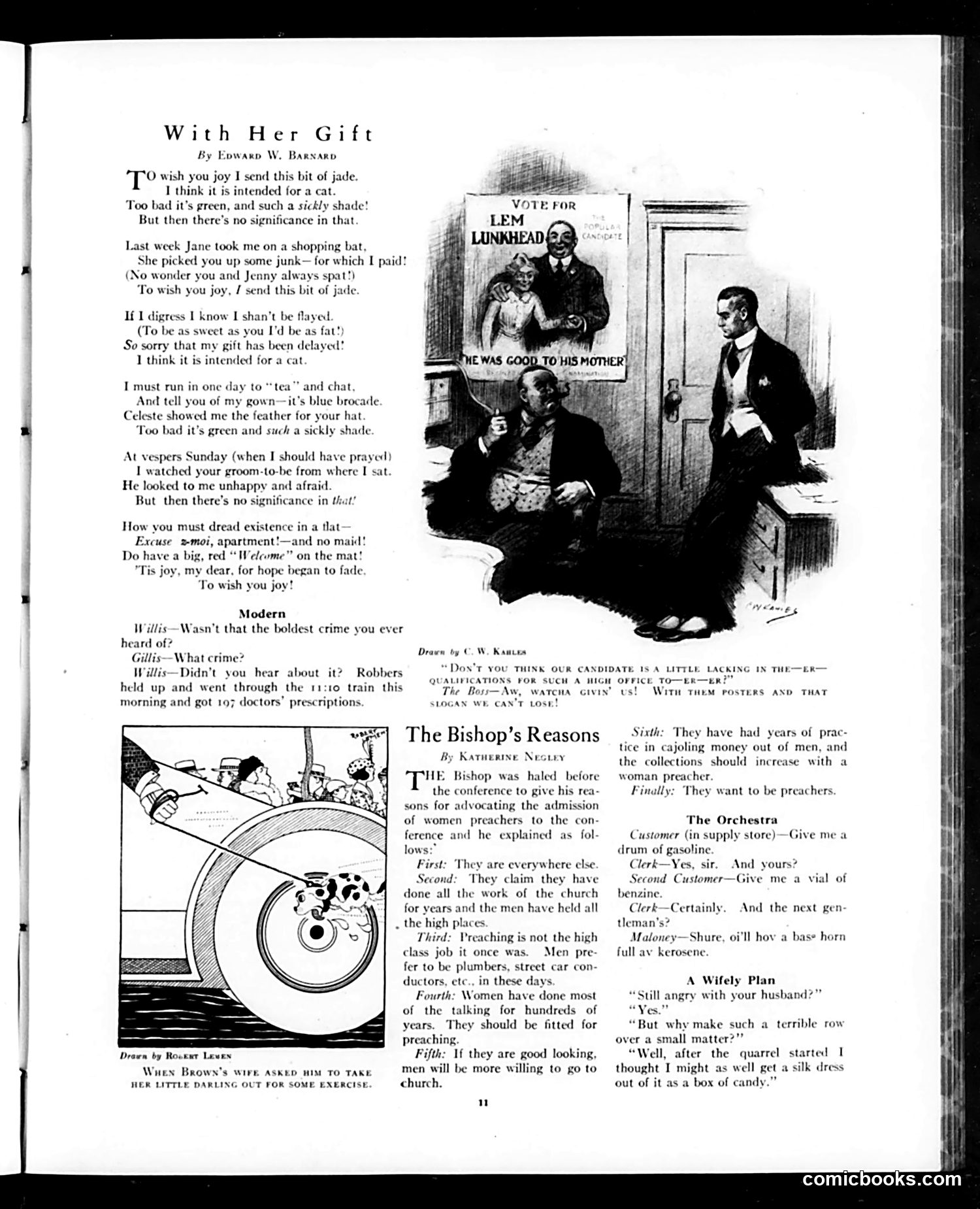
This page contains several satirical pieces: **"With Her Gift"** is a catty society poem mocking shallow aristocratic women—specifically their gossip, materialism, and passive-aggressive gift-giving. The speaker feigns politeness while criticizing the recipient's engagement and fiancé. **"Modern"** is a brief joke about a train robbery targeting doctors' prescriptions—satirizing either prescription drug abuse or the medical profession's prevalence. **The main cartoon** shows a politician with a campaign poster reading "Vote for Lem Lunkhead." The caption mockingly asks whether their candidate lacks qualifications for high office, but claims "With them posters and that slogan we can't lose!"—satirizing how political campaigns rely on catchy slogans rather than actual merit. **"The Bishop's Reasons"** satirizes arguments for admitting women preachers, presenting increasingly absurd justifications that undermine the actual case for gender equality in the church. The remaining pieces offer light domestic humor about wives, orchestras, and gasoline purchases—typical period comedy without obvious political content.
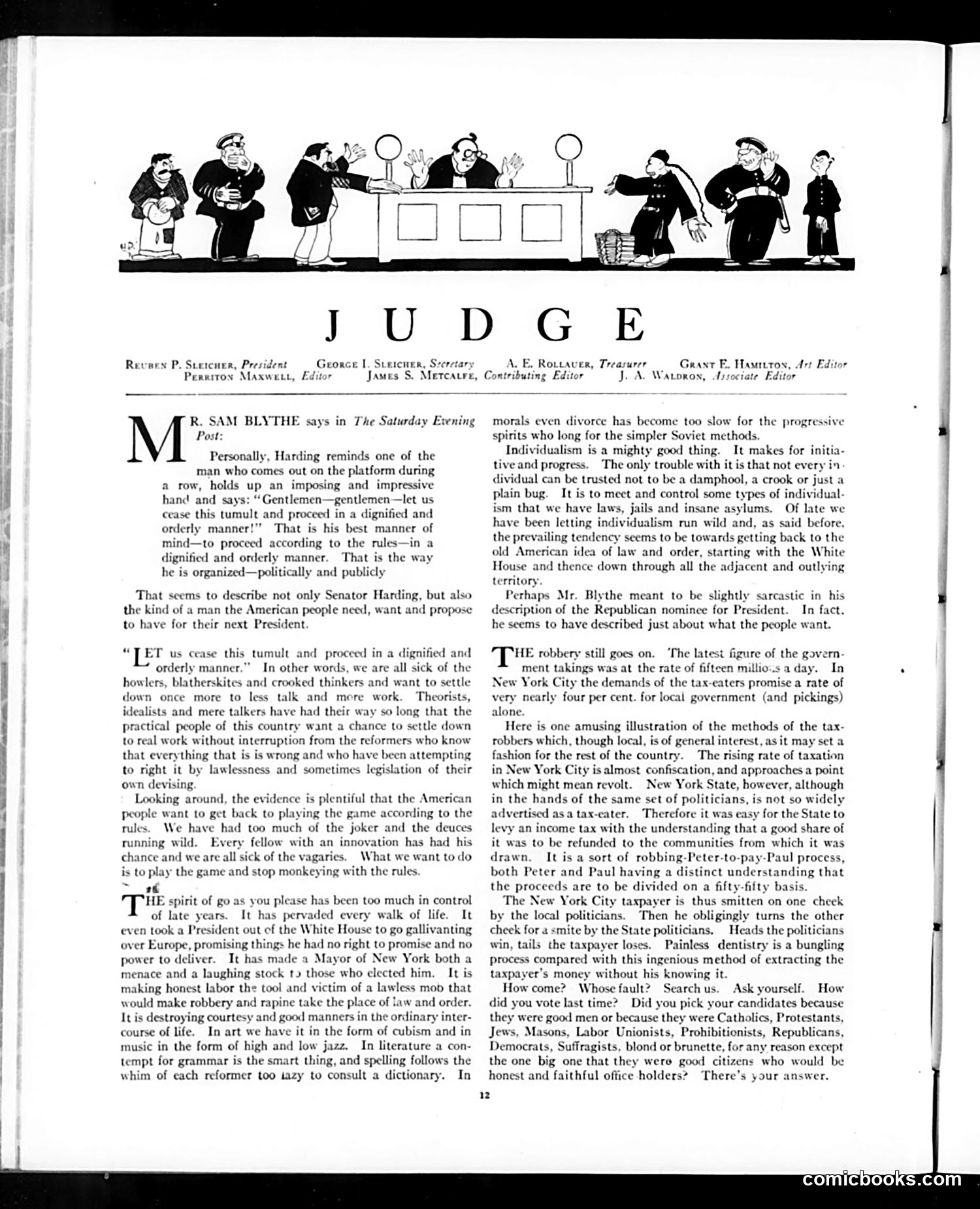
This page features an editorial by Sam Blythe (from *The Saturday Evening Post*) endorsing Warren G. Harding for president. The cartoon header depicts a judge's bench with various figures, likely representing political factions or interests. Blythe praises Harding as embodying what Americans want: order, dignity, and adherence to rules—contrasting him with recent progressive excess. The text criticizes the "spirit of go as you please" pervading American life, blaming it for labor unrest, mayoral corruption (likely NYC Mayor Jimmy Walker), cubism, jazz, and Soviet-style radicalism. The satire targets progressive reformers and individualists who reject traditional rules. Blythe argues strict governance is necessary because "not every individual can be trusted"—justifying laws, jails, and asylums. A secondary section attacks New York City government corruption and tax-eaters, connecting local Democratic mismanagement to national moral decline. The overall message: America needs Harding's conservative, rule-based approach to restore order after years of progressive chaos.
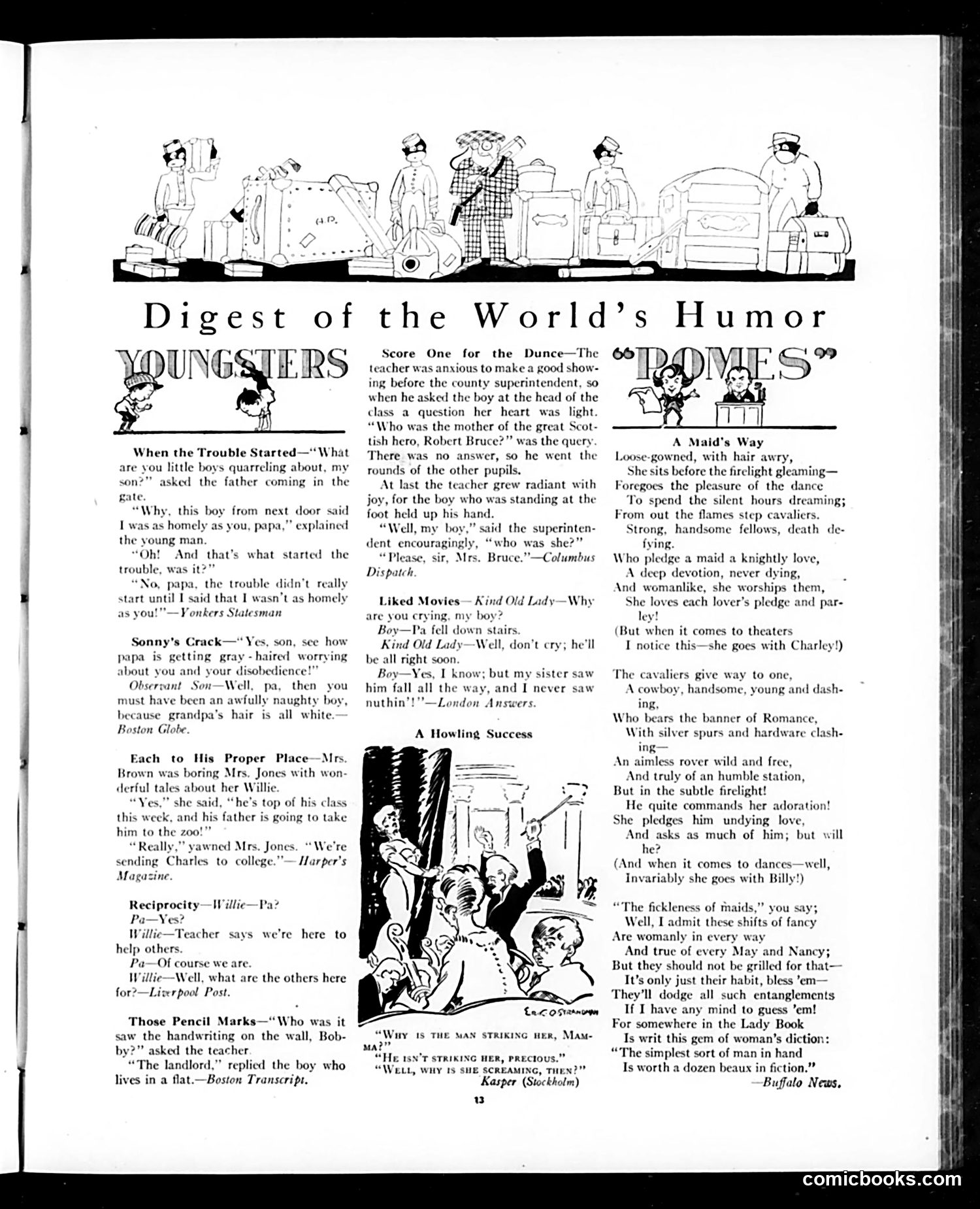
This page collects brief humorous anecdotes and comic verses typical of early-20th-century American humor magazines. The content reflects period attitudes and concerns: **The jokes** satirize family dynamics, class pretension, and childhood logic. "Score One for the Dunce" mocks educational theater—a superintendent's visit prompts a teacher to manipulate student rankings for appearance. "Each to His Proper Place" ridicules mothers boasting about their children. Several pieces feature children's literal-minded observations exposing adult hypocrisy. **"A Maid's Way"** is a longer verse poem about female fickleness: a young woman daydreams of romantic cavaliers and cowboys while alone, but chooses ordinary suitors (Charley, Billy) for actual social outings. The conclusion suggests real "gems of woman's diction" value practical men over romantic fantasy. **The cartoon** (bottom left) shows slapstick violence—a man striking a woman—presented humorously to a child asking why she's screaming. This reflects period tolerance for depicting domestic violence as comedy. Overall, the page showcases early-1900s humor: gentle mockery of bourgeois pretension, children's innocent observations, and gendered stereotypes about female romanticism versus pragmatism.
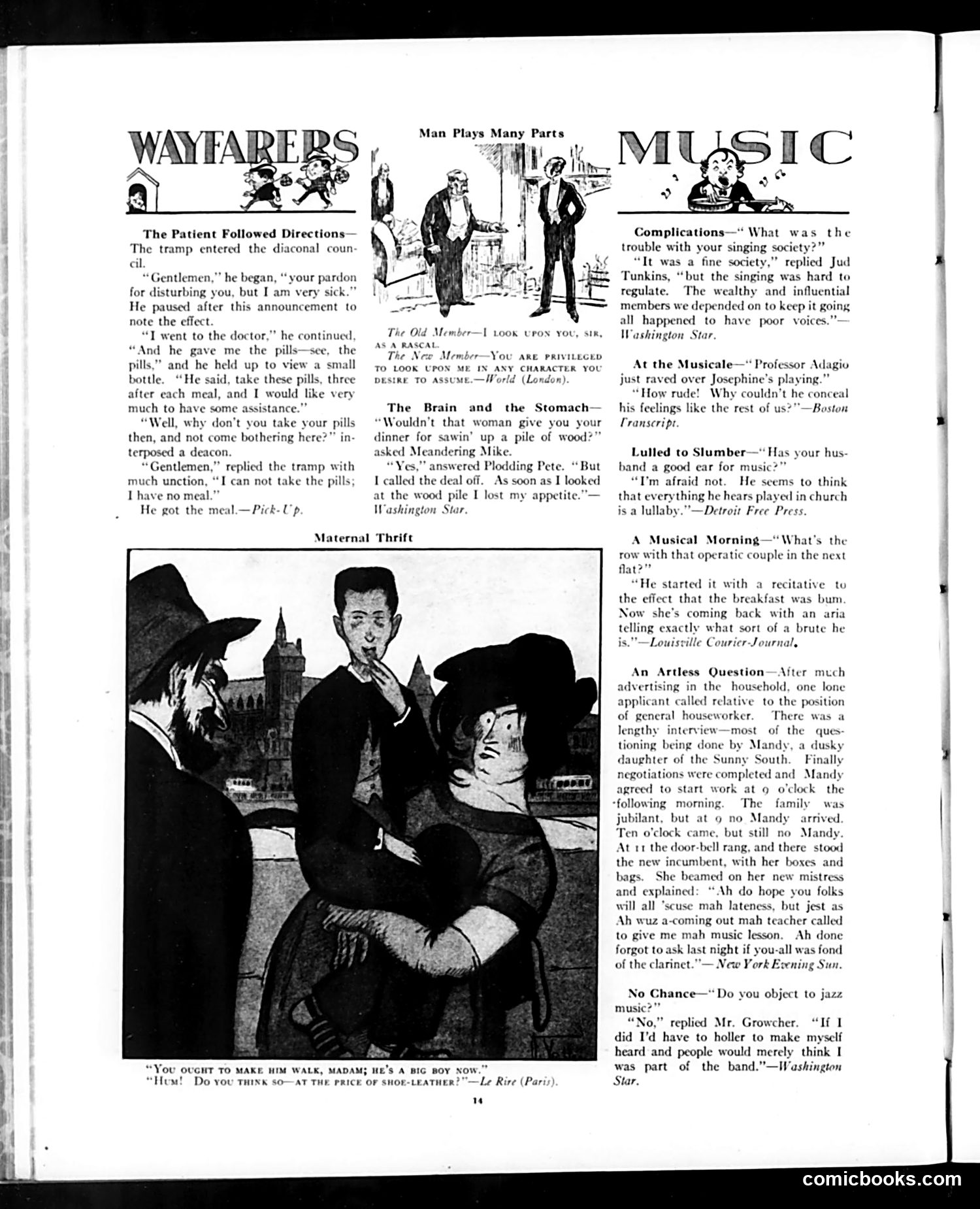
This page contains multiple satirical vignettes mocking different aspects of American social life: **"The Patient Followed Directions"** ridicules charity hypocrisy: a tramp visits a deacon's council claiming illness, shows pills prescribed by a doctor, then admits he cannot take them because he has no food. The joke exposes how the deacons offer medical advice while ignoring actual poverty. **"Maternal Thrift"** satirizes working-class mothers' penny-pinching: a woman won't give a laborer dinner for work because shoe leather (worn through walking) costs money. **"Man Plays Many Parts"** appears to reference someone who adjusts his character based on audience—a commentary on hypocrisy. **"Maternal Thrift" illustration** shows a mother with children, mocking cheap parenting. The **music-related jokes** mock amateur singing societies (where wealthy members with poor voices dominate), operatic couples, and tone-deaf music appreciation. **"An Artless Question"** stereotypes a Black female domestic worker arriving late because her music teacher kept her—the "joke" relies on racist assumptions about priorities and dialect. The page reflects Judge's formula: class satire, domestic humor, and unfortunately, period racial stereotyping.
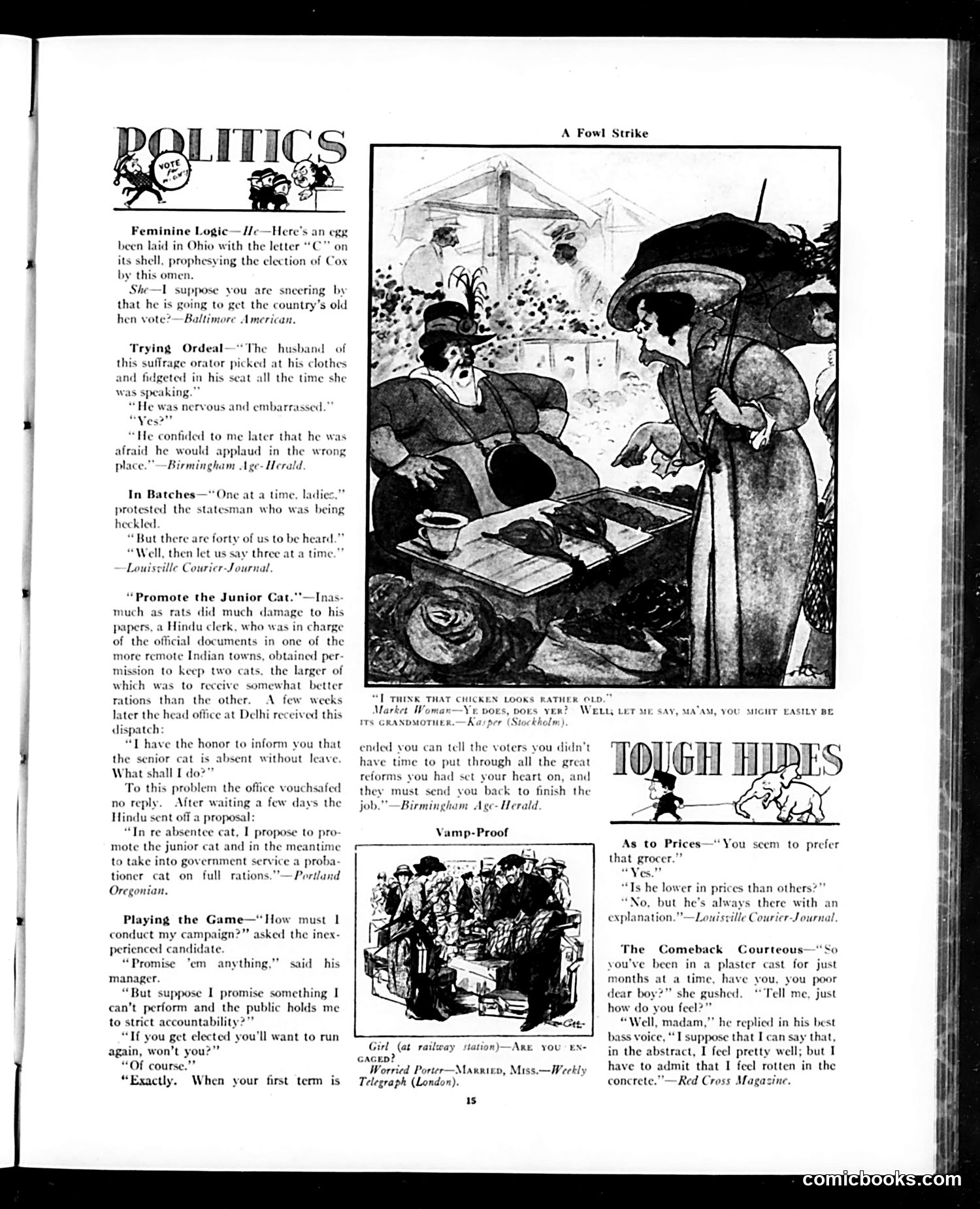
This page contains multiple brief satirical pieces mocking early-20th-century American politics and social customs: **"Feminine Logic"** ridicules women's voting by portraying a woman using absurd reasoning about an egg and Ohio to predict election outcomes—a dig at newly enfranchised female voters. **"Trying Ordeal"** jokes about a suffragette speaker whose husband is embarrassed to applaud publicly, satirizing the social awkwardness surrounding women's political activism. **"In Batches"** mocks overcrowded public hearings where multiple women demand to speak simultaneously. **"Playing the Game"** cynically depicts campaign advice: promise anything to get elected, then claim insufficient time to deliver, guaranteeing re-election bids. **"A Fowl Strike"** and other bottom pieces are brief, largely untranslatable jokes from international sources. The cartoons throughout employ heavy caricature typical of period humor. Overall, the page reflects anti-suffrage sentiment and skepticism toward democratic reform common in early-1900s satirical magazines.
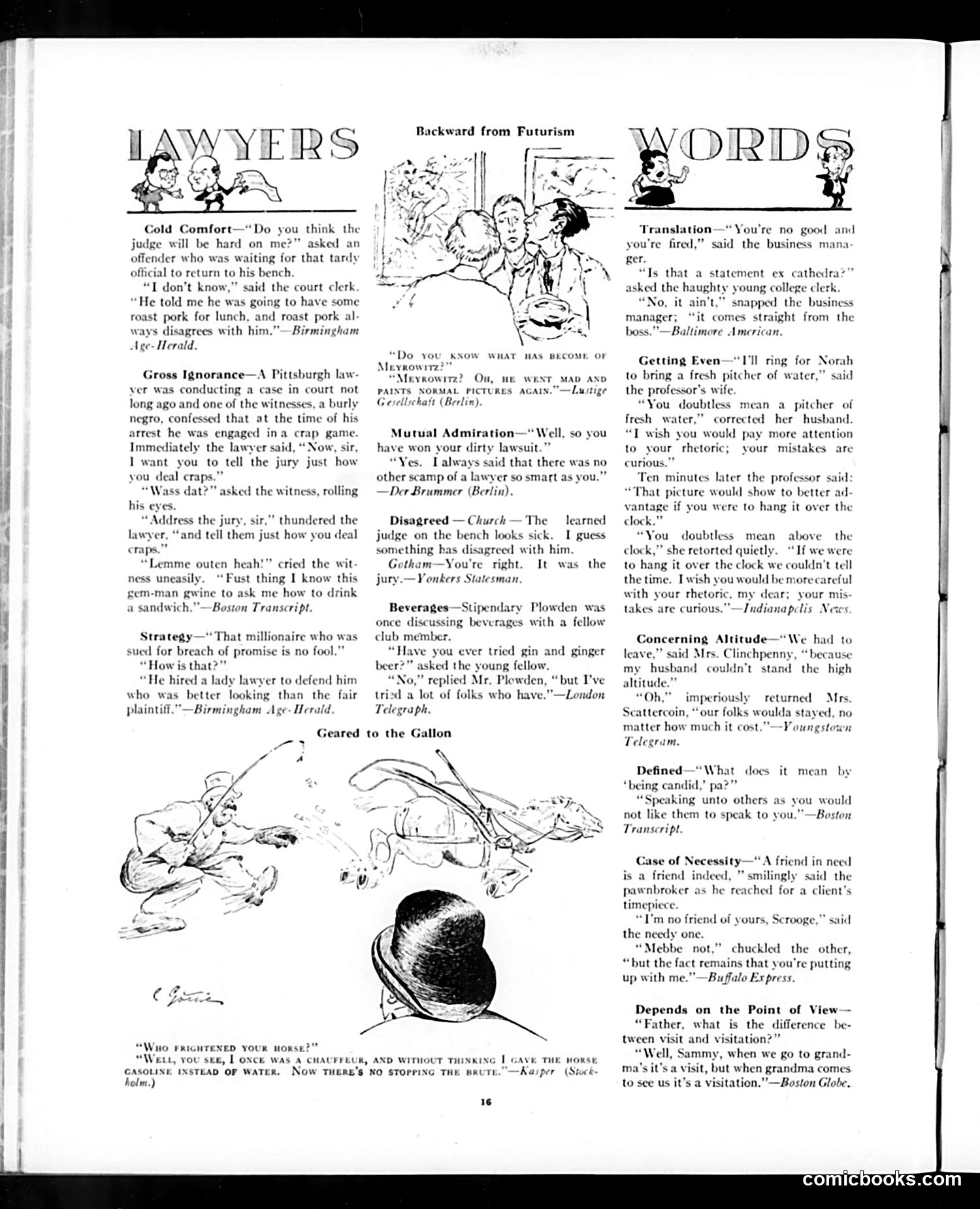
This page from *Judge* magazine contains short humorous anecdotes and one cartoon satirizing early 20th-century American life. **The cartoon** ("Geared to the Gallon") depicts a runaway horse, illustrating a man's confession that he once mistakenly gave a horse gasoline instead of water—now the animal won't stop. It's slapstick humor about automobile-age confusion. **The text jokes** target various social types: an ignorant lawyer questioning a Black witness about "dealing craps" (who flees in fear); a millionaire hiring an attractive female lawyer; a clergyman whose stomach rejects jury duty; and marital squabbles over grammatical corrections ("above" vs. "over"). The satire reflects early 1900s prejudices and class attitudes—mocking working-class dialect, celebrating trickery in lawsuits, and depicting women as pedantic or materialistic. The "Futurism" anecdote mocks modern art movements. Overall, the humor depends on recognizing stock characters and social anxieties of the era—automobile dangers, changing gender roles, and pretentious education.
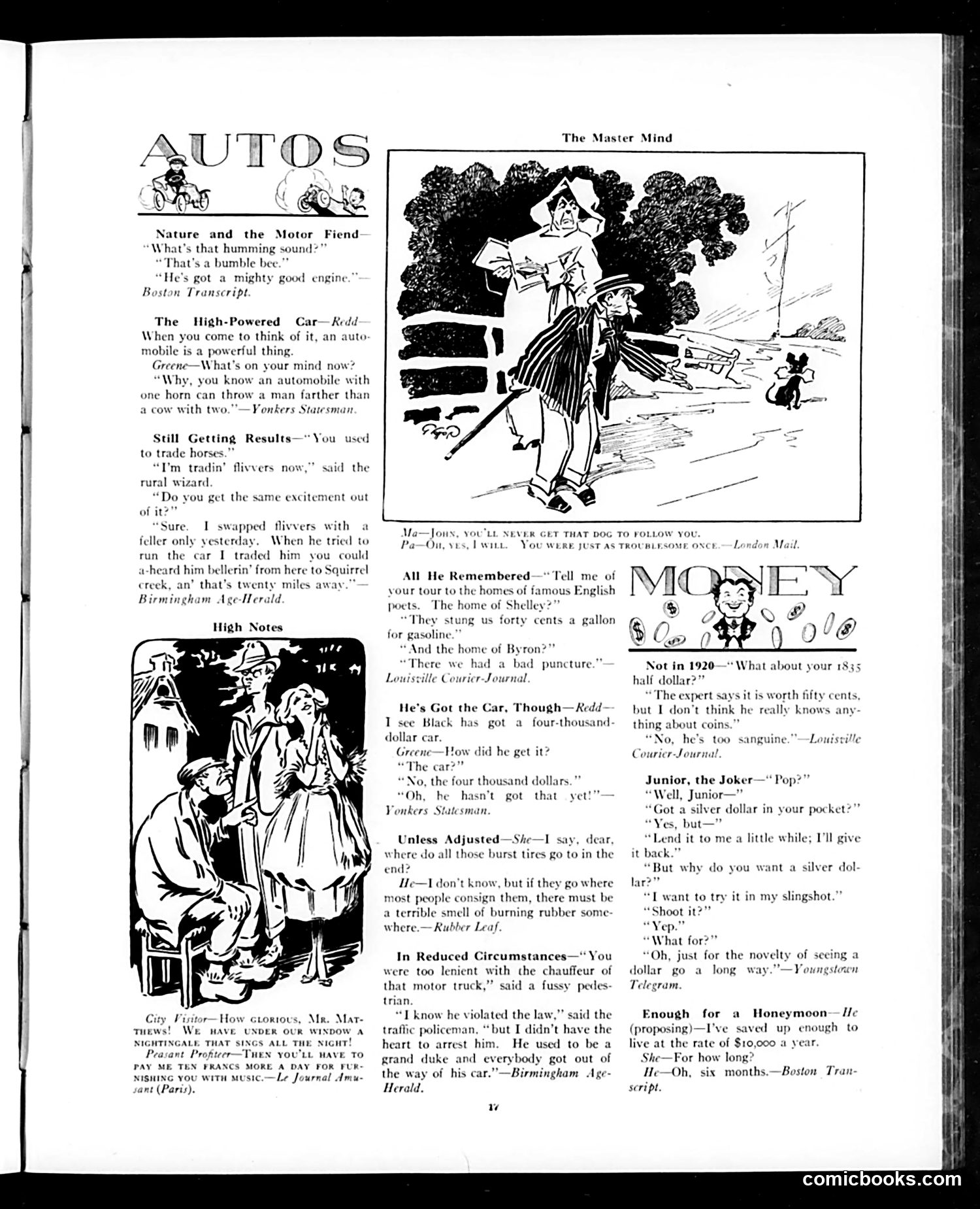
This page from *Judge* (a satirical American magazine) collects automotive-era humor circa 1920s, when cars were still novelties causing social disruption. **Main Content:** The "Autos" section features brief jokes about automobiles' impact on society. Key themes include: - **Cars as status symbols**: "He's Got the Car, Though" mocks someone wealthy enough to own a $4,000 vehicle but unable to afford it—satirizing nouveau riche pretension. - **Rural vs. urban culture clash**: The "rural wizard" trading "flivvers" (cheap cars) mirrors old horse-trading, suggesting country folk adopting new technology. - **Tourist disappointment**: "All He Remembered" jokes that a literary tour's highlights were gasoline prices and tire punctures—cars dominate experience over culture. - **Class commentary**: A "grand duke" reference implies even formerly aristocratic Russians now drive trucks, inverting old hierarchies. The cartoons mock early automobile culture's absurdities: expense, unreliability, social pretension, and how mechanization overwhelms traditional values. The humor assumes readers recognize cars as transformative but fundamentally ridiculous.
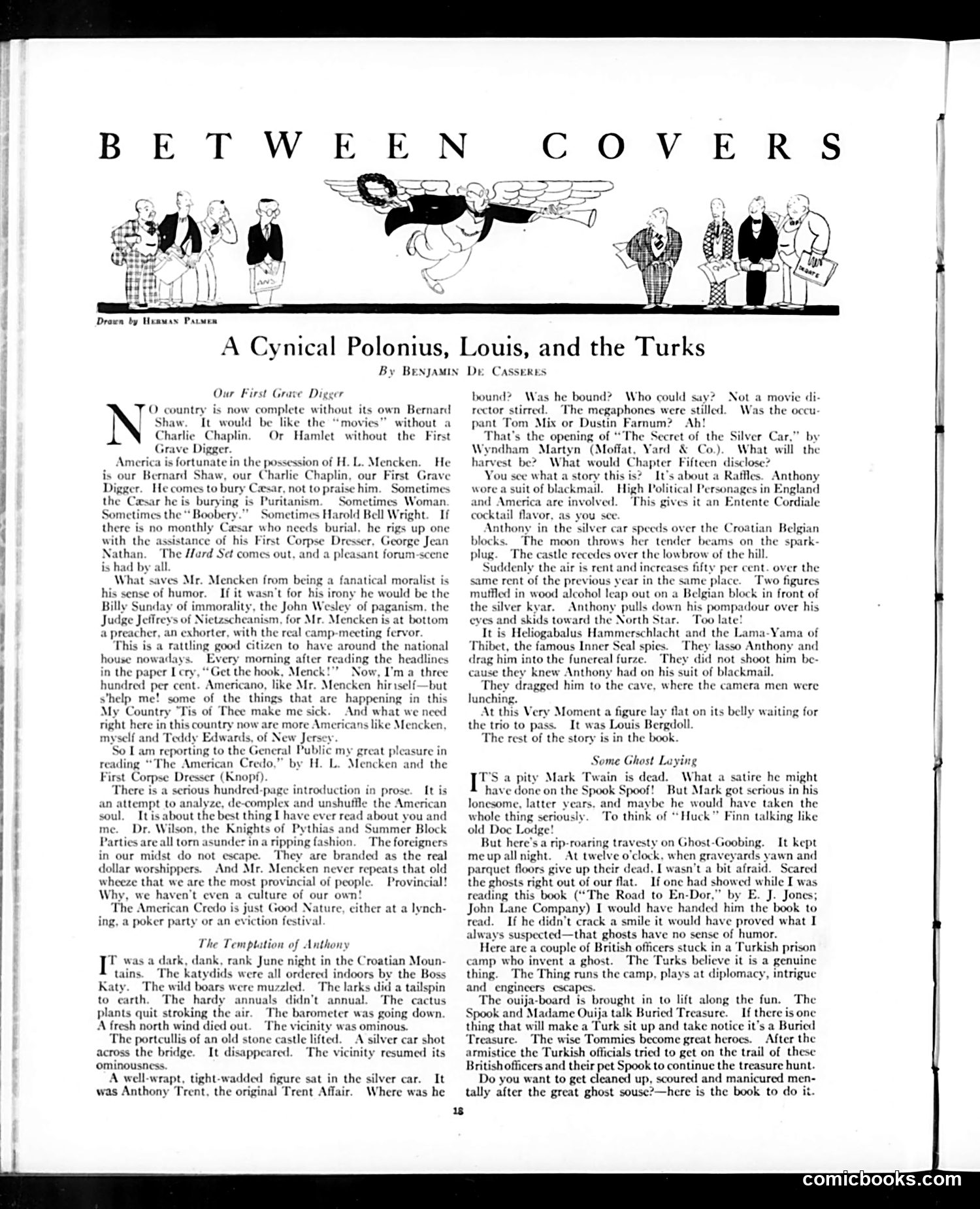
This is a book review section from *Judge* magazine praising H.L. Mencken, the prominent American social critic and editor. The author compares Mencken to Shakespeare's First Grave Digger—someone who irreverently exposes society's flaws through satire and humor. The piece celebrates Mencken's acerbic criticism of American institutions: Puritanism, sentimentality ("the Boobery"), and mediocre authors like Harold Bell Wright. The reviewer argues Mencken's saving grace is his ironic wit; without it, he'd be dogmatic like Billy Sunday (a famous evangelist). The second section reviews "The Secret of the Silver Car," a pulp adventure novel featuring an anti-hero character. The breathless opening—with its gothic atmosphere and mysterious intrigue—is presented as typical popular entertainment: melodramatic, plot-driven fiction appealing to mass audiences. Together, these sections contrast sophisticated literary criticism with lowbrow popular fiction, reflecting *Judge's* role satirizing American culture across highbrow and mass-market extremes.
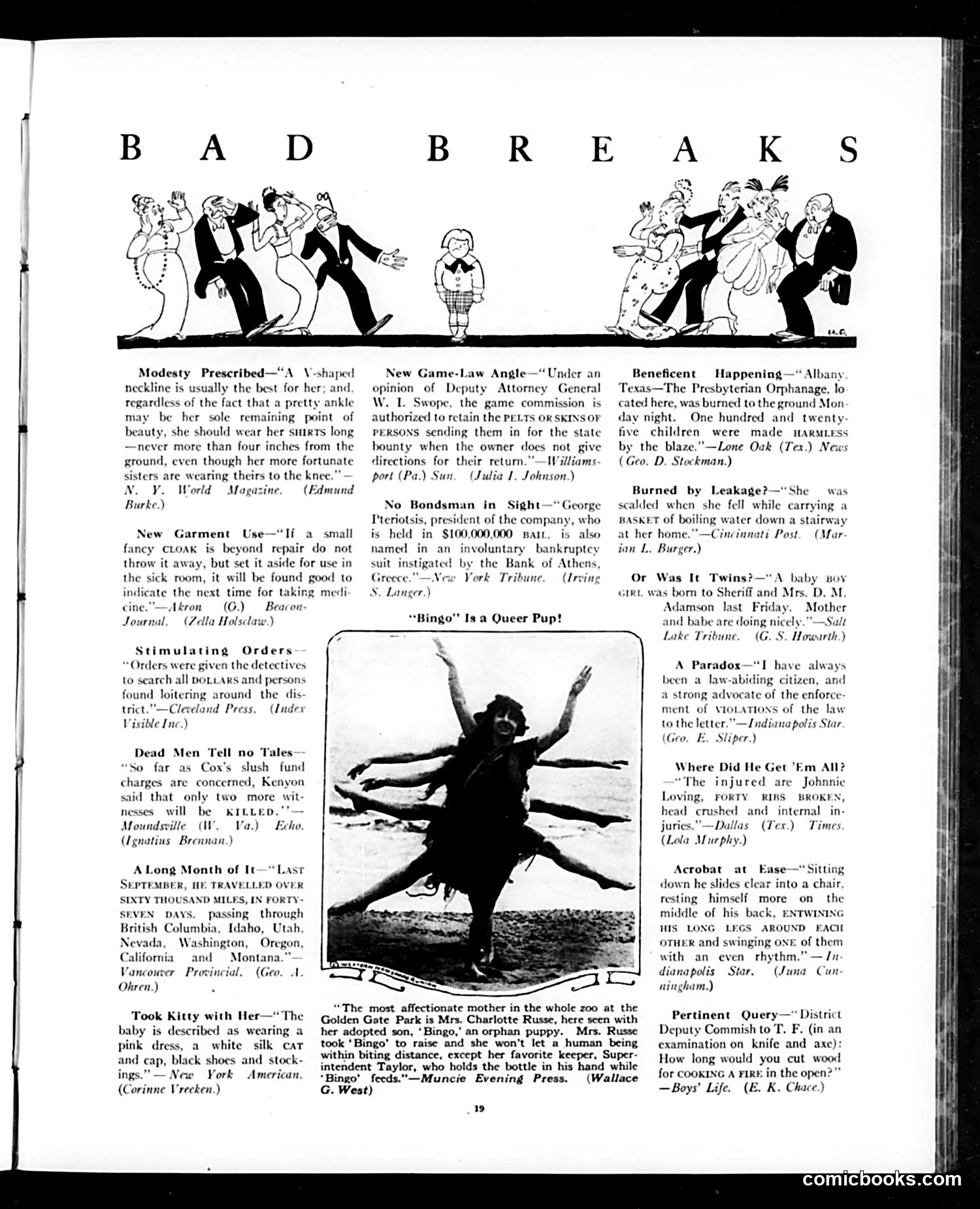
This page from Judge presents a recurring humor feature: satirical excerpts from real newspaper and magazine articles containing **absurd or contradictory statements**, highlighted through capitalization. The jokes exploit unintentional nonsense in published writing. Examples include: - A bootlegger "KILLED" as a witness (dark mob reference) - Game commission authorized to keep "PELTS OR SKINS OF PERSONS" (treating people like animals) - Orphanage fire leaving children "HARMLESS" instead of "homeless" - A man with "FORTY RIBS BROKEN" (anatomically impossible) - An advocate of "VIOLATIONS of the law" The central image shows a chimpanzee ("Bingo") at the Golden Gate Zoo—a genuine newspaper story about an animal, included presumably because newspaper coverage of zoo animals often produced equally absurd quotations. The humor relies on readers recognizing how careless newspaper editing creates unintentional dark comedy, malapropisms, and logical impossibilities in print.
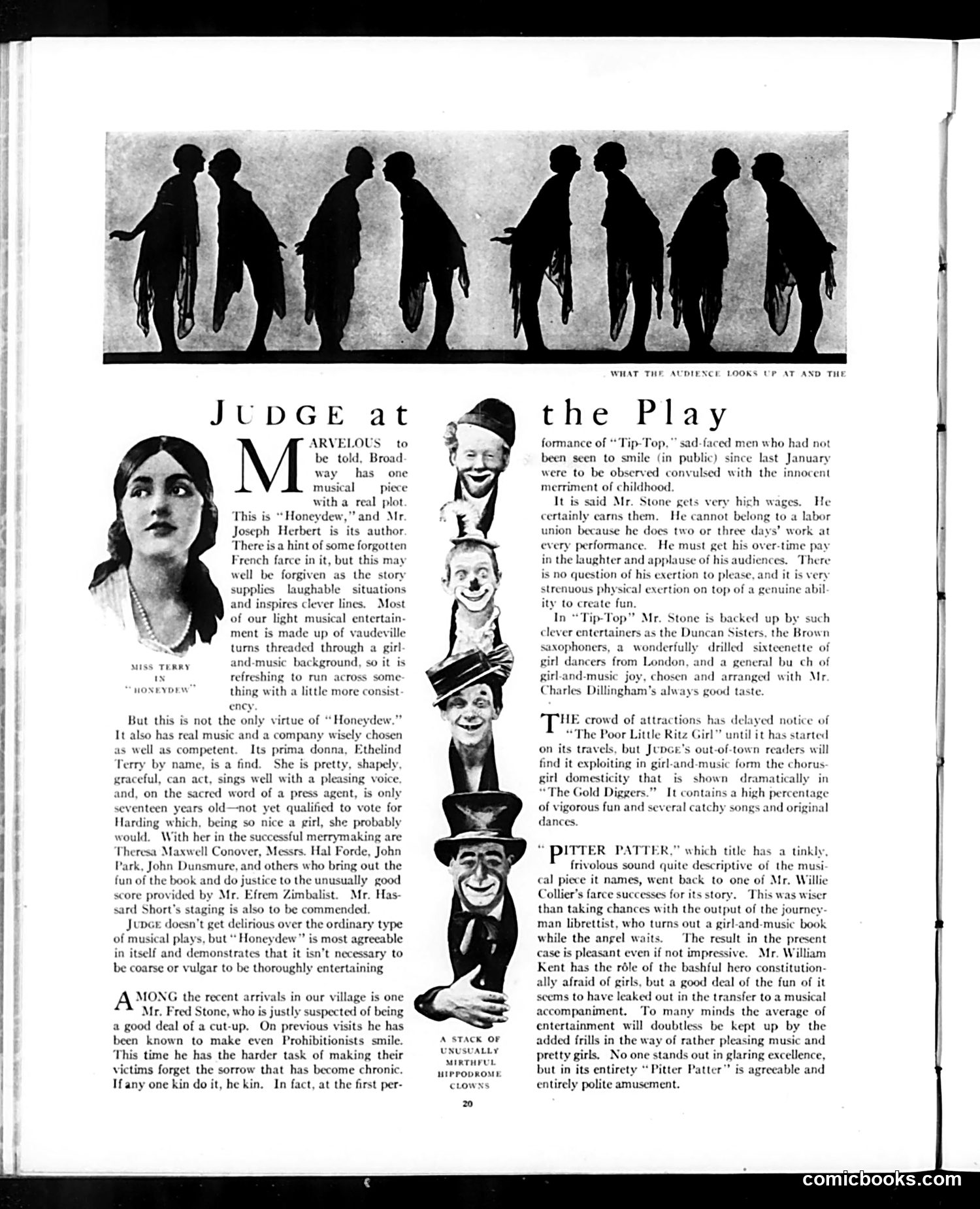
This page reviews several Broadway musical comedies from the early 1920s. The top illustration shows silhouettes of performers—likely depicting the comedic physical comedy typical of these shows. The reviews discuss: - **"Honeydew"**: A musical with an actual plot (unusual for the era), starring young actress Ethelind Terry. Judge praises it for having coherent storytelling rather than just vaudeville turns strung together. - **"Tip-Top"**: Featuring Fred Stone, a famous physical comedian who "gets very high wages" and performs strenuous physical exertion to make audiences laugh. The review notes Stone makes even serious people smile during Prohibition-era hardship. - Other shows: "The Poor Little Ritz Girl," "Pitter Patter," and references to "The Gold Diggers." The satire targets the formulaic nature of 1920s Broadway musicals—typically girl-and-music spectacles with minimal plot—while praising shows that break this mold with actual stories or exceptional performers.
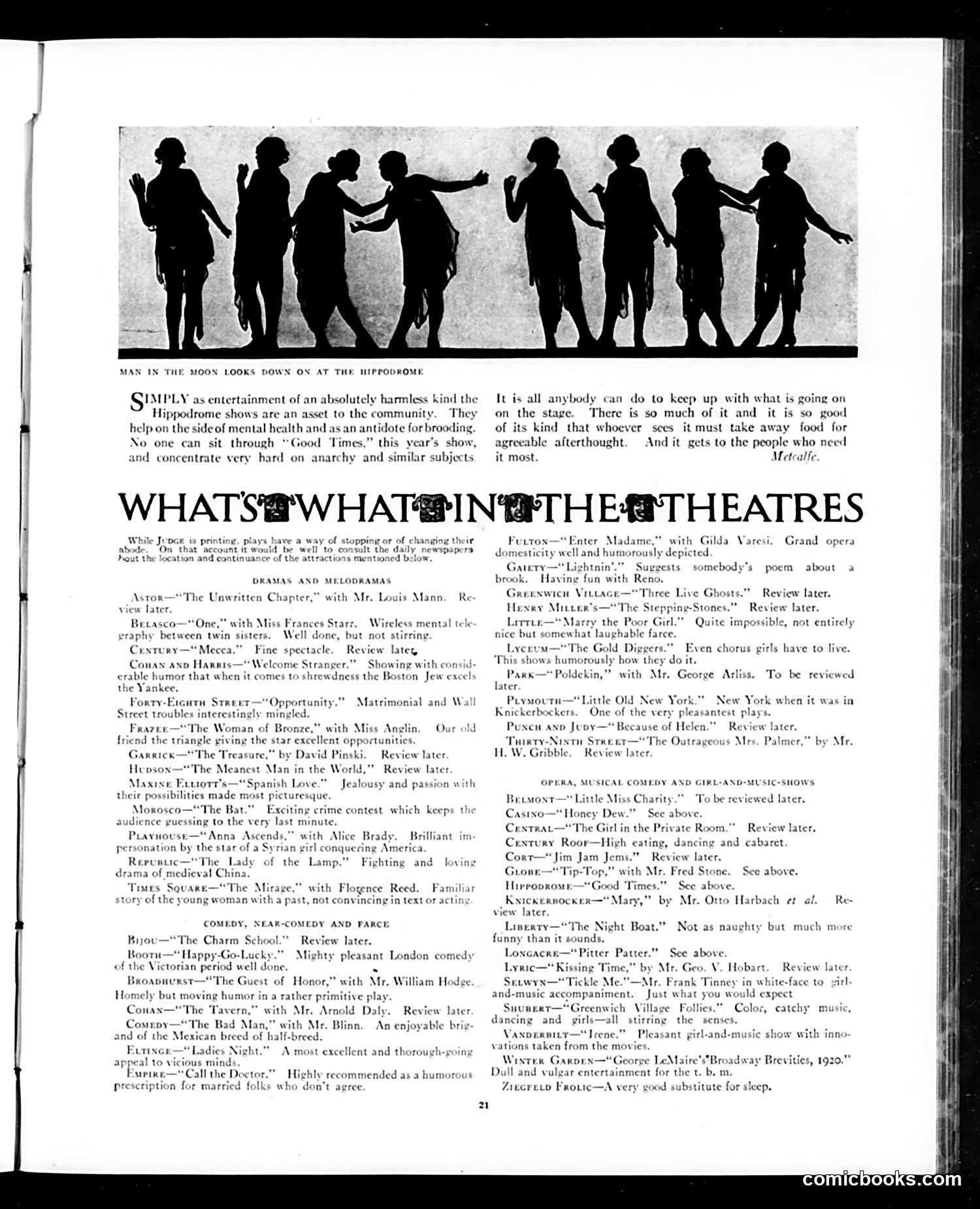
This page from *Judge* magazine presents theater reviews rather than political satire. The silhouette illustration at top—showing children in a line gazing upward at "the moon"—is a whimsical header for a section titled "What's What in the Theatres." The accompanying text explains the *Hippodrome* (a major New York entertainment venue) as wholesome, "absolutely harmless" family entertainment that provides mental health benefits as "an antidote for brooding." The reviewer argues theater-going is valuable because audiences needn't concentrate on serious subjects—they can simply enjoy spectacle. Below this are capsule reviews of Broadway productions from the era, listing theater names, show titles, and performers. Most are comedies, musicals, and dramatic pieces typical of 1920s American theater. The satire is gentle: the text suggests theater-goers need entertainment precisely *because* keeping up with real-world events is exhausting and bewildering—implying post-WWI social chaos makes escapism necessary.
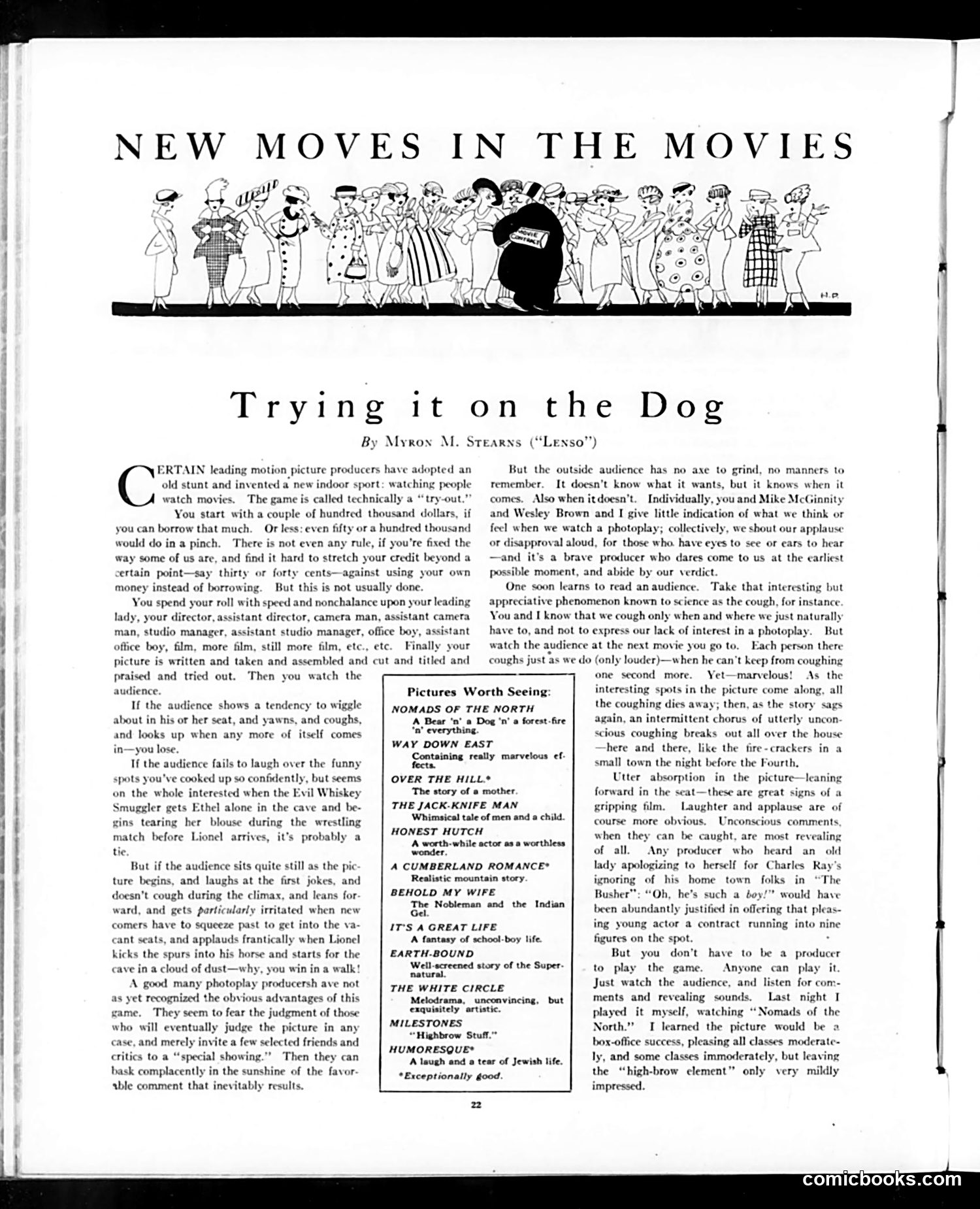
This is a satirical article about Hollywood producers testing new films on audiences. The cartoon illustrations represent women in fashionable 1920s dress—likely depicting how female audience members' reactions are studied. The satire mocks the emerging industry practice of pre-screening films to gauge public response before release. Stearns describes this as an "old stunt" disguised as a new "sport," critiquing producers who spend vast budgets then anxiously watch audiences to determine commercial viability. The title's "trying it on the dog" is a period idiom meaning to test something risky. The joke is that producers treat audiences as unwitting test subjects while obsessively analyzing every physical reaction—coughs, restlessness, laughter—seeking clues to their film's success. Stearns argues audiences naturally respond unconsciously and honestly, unlike industry insiders who mask opinions. The featured films listed represent typical 1920s fare—melodramas, stories about nature and working-class life—common box-office subjects the industry hoped would resonate.
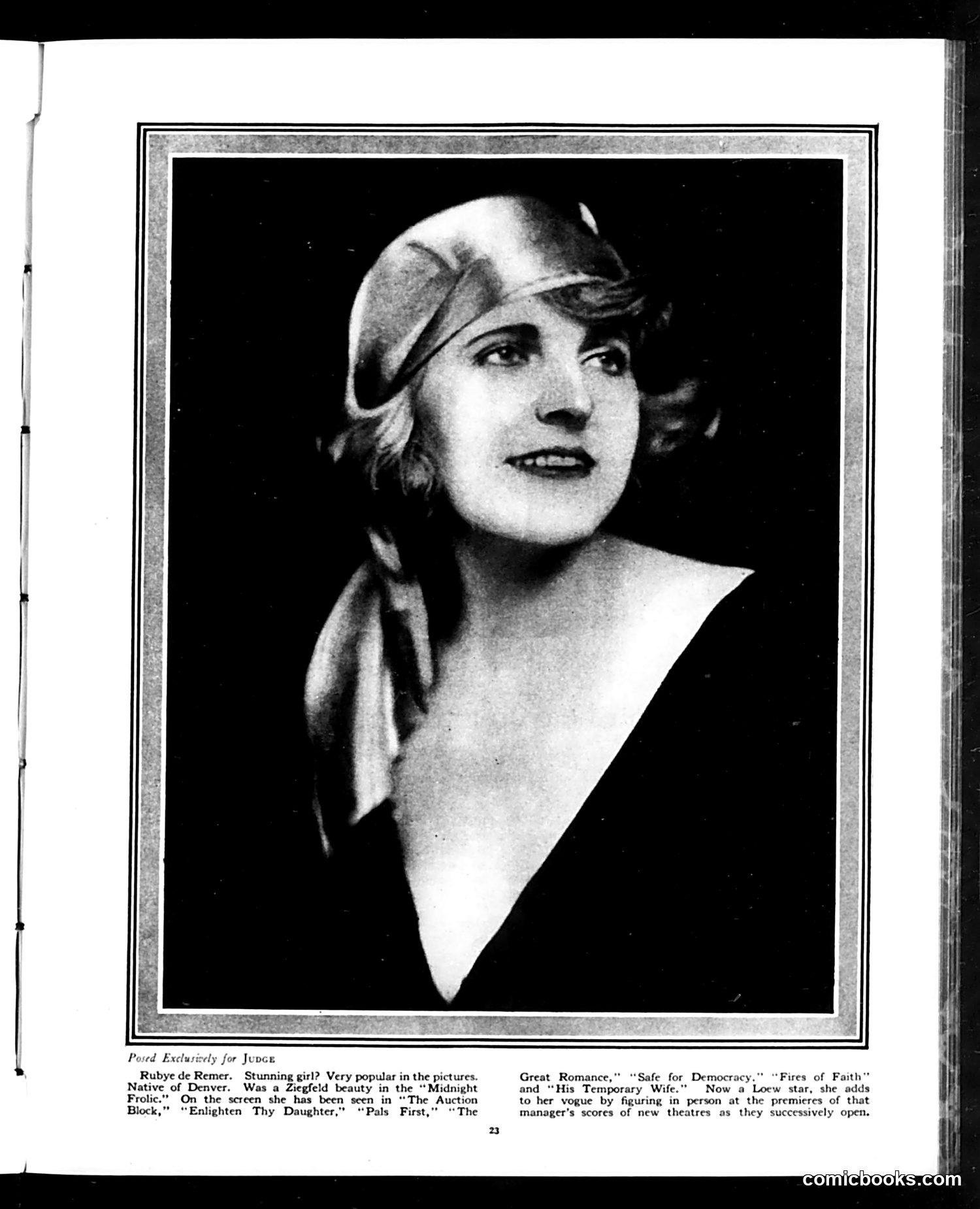
This page features a glamour photograph of **Rubye de Remer**, described as a "Stunning girl" and "Native of Denver" who was "Very popular in the pictures." The text indicates she was a Ziegfeld beauty and silent film actress, appearing in movies including "The Midnight Frolic," "The Auction Block," "Enlighten Thy Daughter," and "Pals First." The caption credits her popularity partly to her personal appearances at theater premieres, where she drew audiences to see new films. This appears to be a **studio publicity feature** rather than satire or political commentary. It's a typical entertainment page from Judge magazine, showcasing a minor Hollywood starlet of the silent film era to readers interested in cinema personalities.
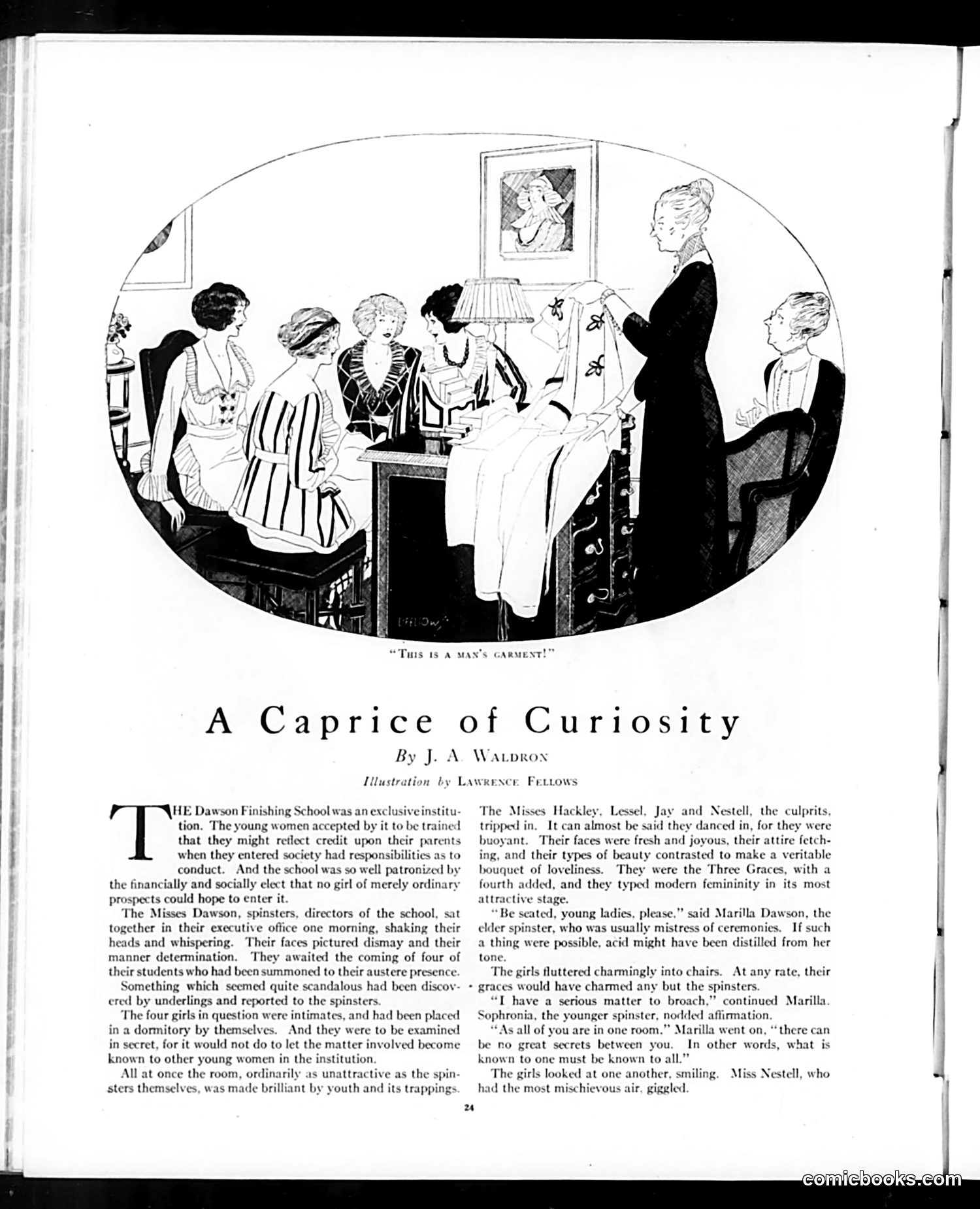
This short story illustration satirizes the rigid moral standards of elite finishing schools for young women in the early 20th century. The setup presents the Dawson Finishing School as an exclusive institution where wealthy families send daughters to acquire proper conduct and social polish. The "scandal" that has alarmed the prim, joyless spinster administrators involves four beautiful, vivacious students. The caption "This is a man's garment!" suggests the girls have been discovered with an inappropriate male possession—likely a coat or shirt—implying improper contact with men, which was strictly forbidden. The satire lies in the contrast: the administrators are portrayed as dour and colorless, while the young women embody youth, charm, and vitality. The text emphasizes their beauty while the spinsters are presented as bitter and repressed. The girls' mischievous response suggests the rules are absurd rather than genuinely protective. The story mocks both institutional rigidity and the hypocrisy of those enforcing outdated moral codes.
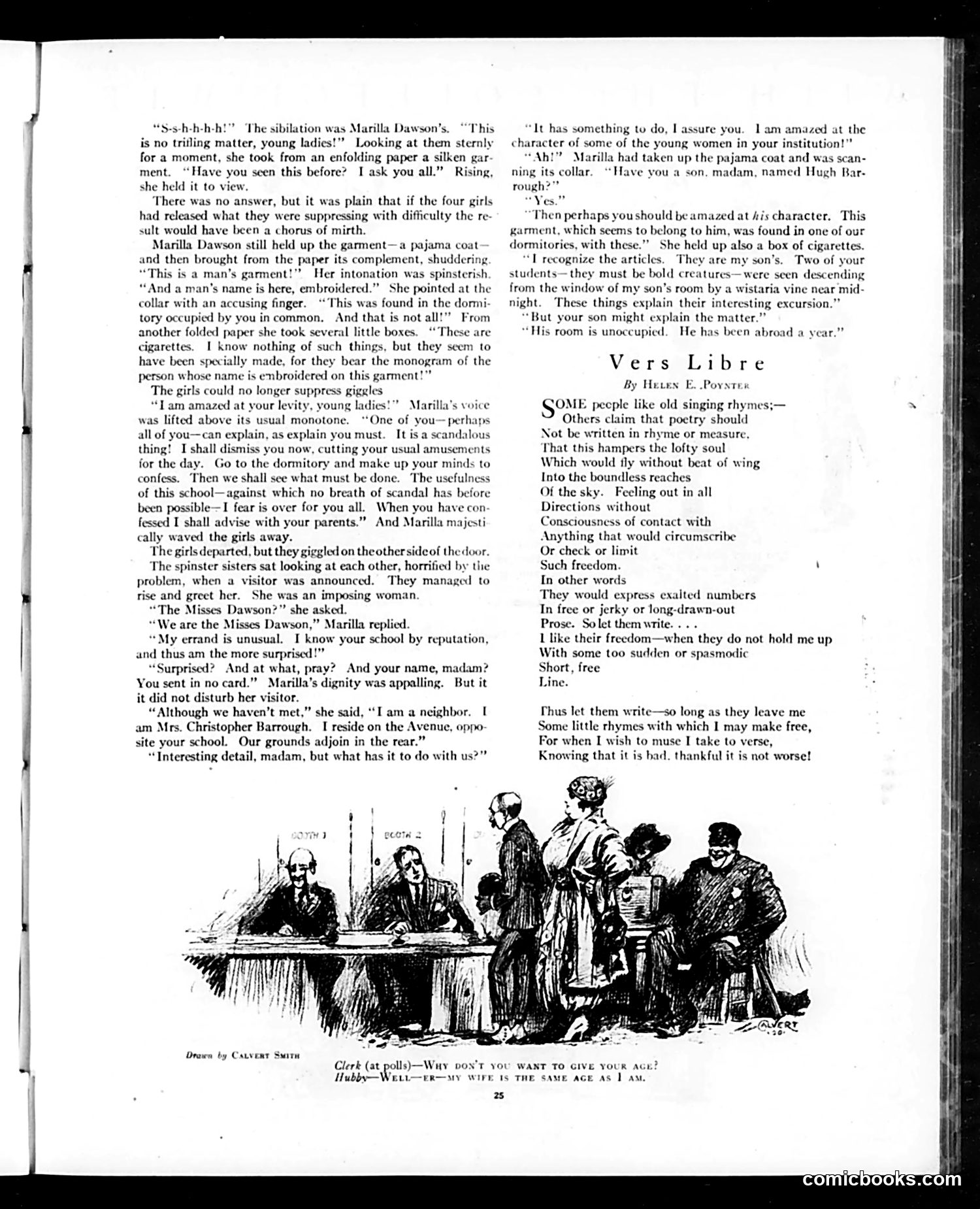
This page contains two distinct pieces satirizing early-20th-century social hypocrisy. **The main narrative** mocks prudish female school administrators. Headmistress Marilla Dawson discovers a man's monogrammed pajama coat and cigarettes in the girls' dormitory, threatening expulsion for moral scandal. However, a neighbor reveals the items belong to her son, Hugh Barrough, who's been abroad a year—meaning the girls couldn't possibly have entertained him recently. The joke exposes Dawson's self-righteous moral panic as baseless while suggesting the girls' knowing giggles indicate they're not actually innocent. **The cartoon below** shows a couple discussing age disparity: a clerk asks why a husband won't reveal his wife's age, and the husband replies she's the same age as he is—a joke about wives lying about their age, playing on contemporary anxieties about female deception. **"Vers Libre"** is a poem satirizing free-verse poetry's pretensions to artistic freedom while criticizing its formlessness. The overall page mocks institutional hypocrisy, female sexuality, and modern literary affectation.
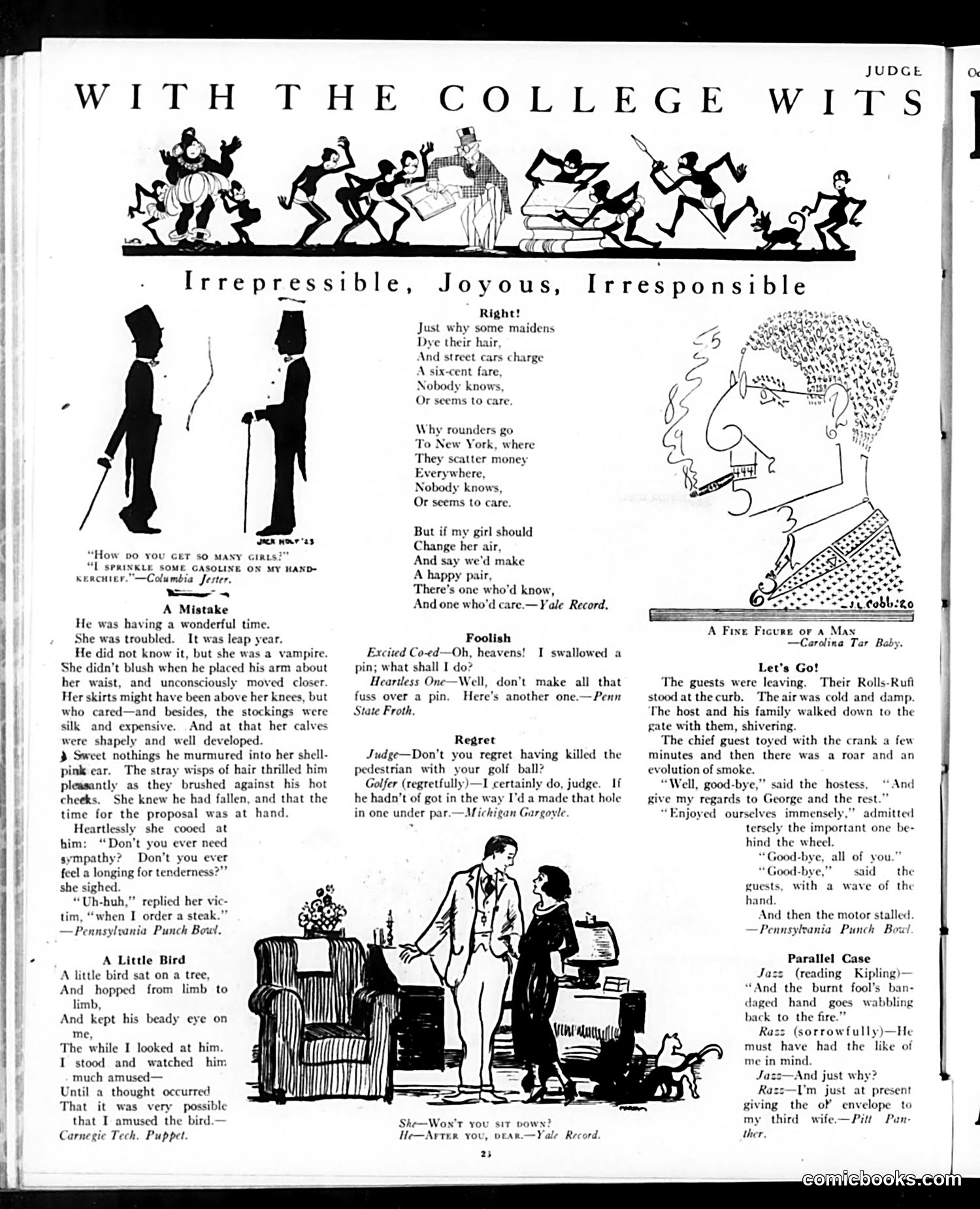
This page from Judge (appears to be early 20th century based on style) collects brief humorous pieces about college life and romance, reflecting period attitudes toward courtship and gender roles. **Key satirical content:** - **"With the College Wits"** header mocks collegiate humor as frivolous - **"A Mistake"** satirizes the "leap year" convention (when women traditionally propose), portraying the woman as predatory ("vampire") and materialistic, caring only about securing a proposal - **Dating humor** jokes about men's romantic tactics and women's superficiality (dyed hair, expensive stockings) - **"Foolish" section** depicts a careless golfer regretting only that a pedestrian's death prevented his golf achievement—dark satire on male callousness - **Motor car scene** gently mocks wealthy hosts whose new automobile breaks down The overall tone reflects Jazz Age attitudes: young women as manipulative, men as emotionally shallow, and automobiles as status symbols. The satire targets both genders' romantic inauthenticity and materialism.
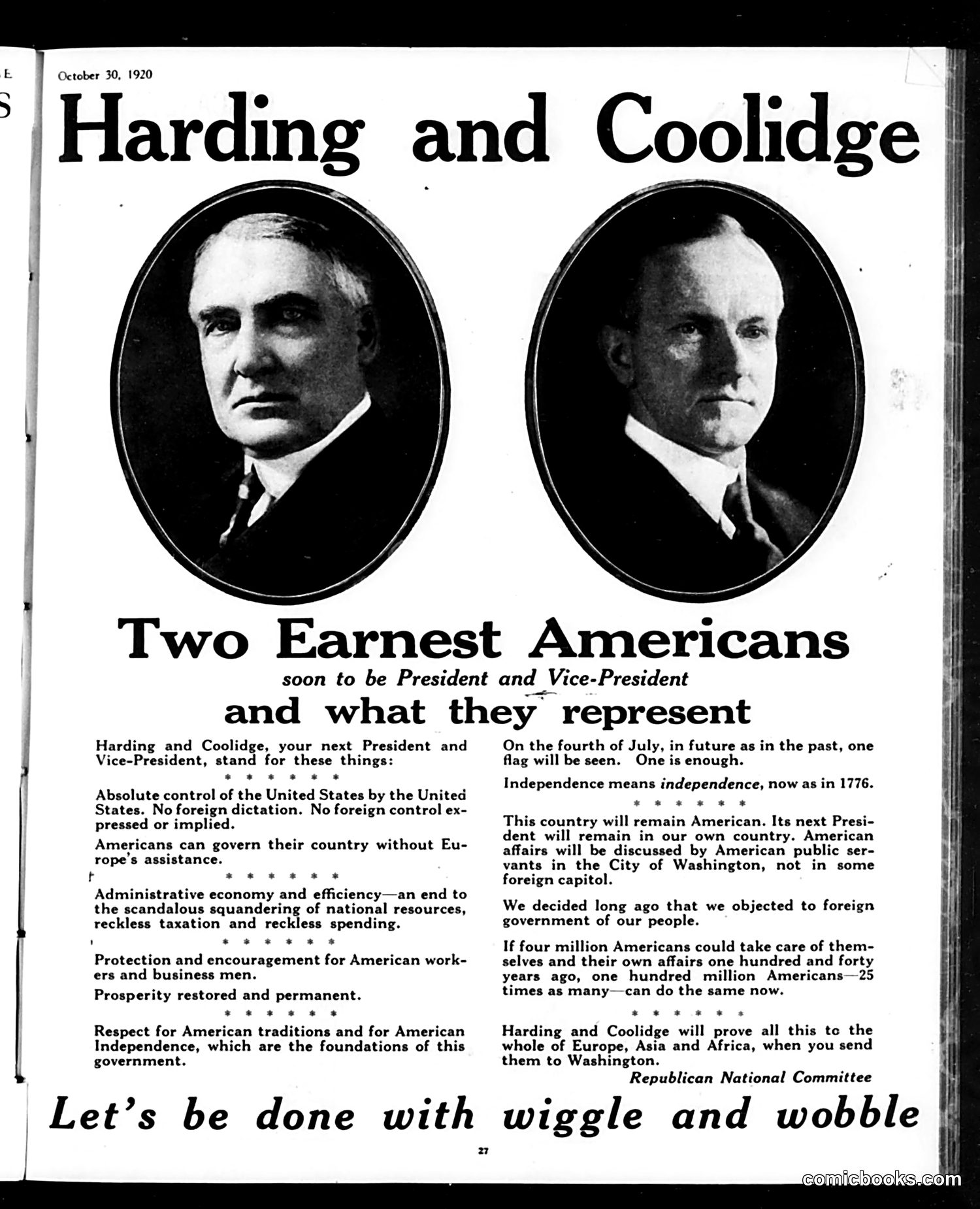
This is a **campaign advertisement**, not a satirical cartoon, from the Republican National Committee dated October 30, 1920—one week before the presidential election. The two portraits show **Warren G. Harding** (left, presidential candidate) and **Calvin Coolidge** (right, vice-presidential candidate). The ad promotes their platform emphasizing: - American isolationism and rejection of foreign influence (likely referencing opposition to the League of Nations) - Government fiscal responsibility and efficiency - Protection of American workers - Economic prosperity The final line, "Let's be done with wiggle and wobble," is a dig at the **incumbent Wilson administration**, implying inconsistent or weak leadership. The phrase invokes American independence (referencing 1776) to frame their candidacy as a return to traditional American values. This represents mainstream Republican messaging of 1920: nationalist, isolationist, and critical of Wilson's internationalism and wartime spending.
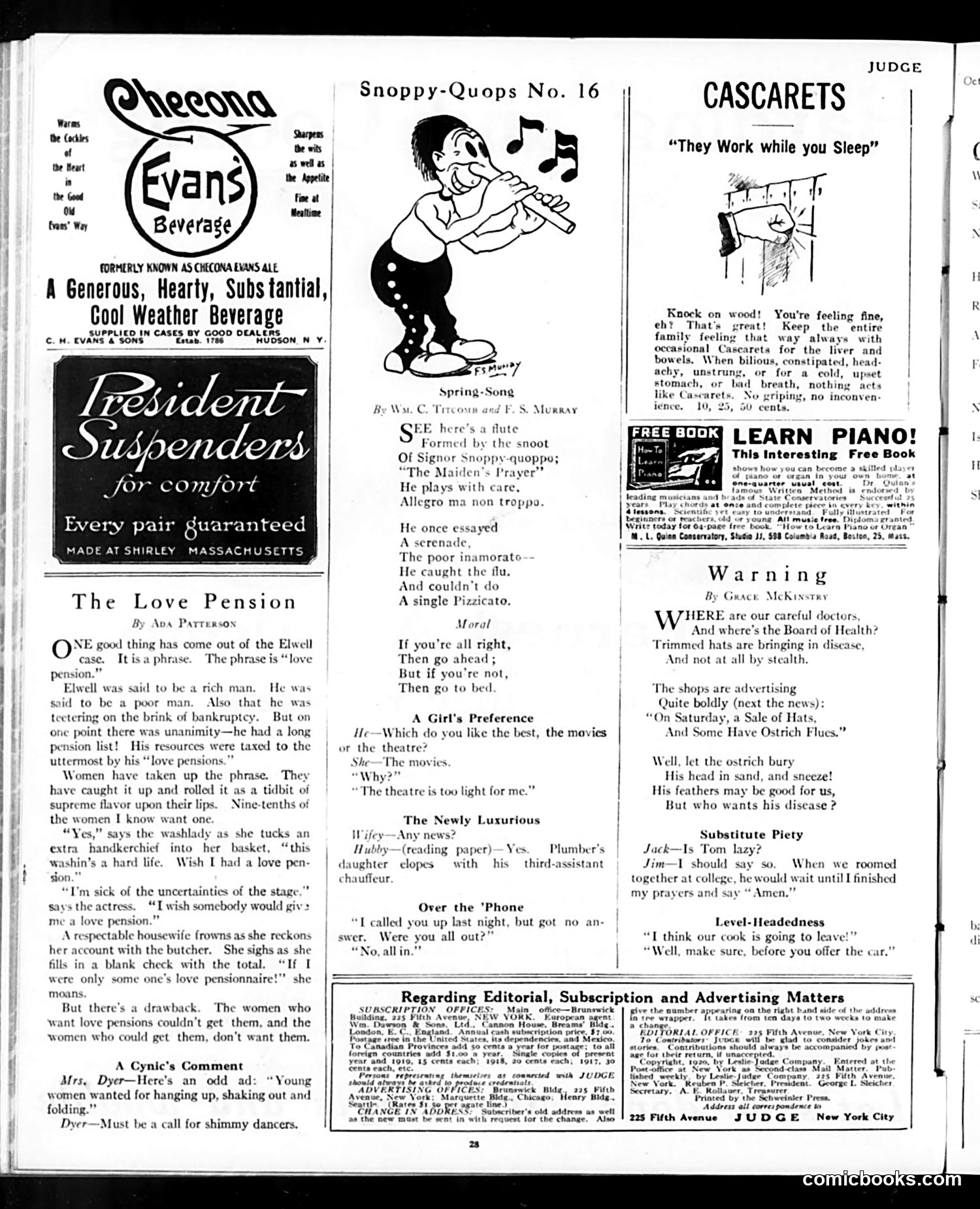
This page from Judge magazine (undated but early 20th century) is primarily **advertising and humorous short pieces** rather than political satire. The main content includes: **"The Love Pension"** — A satirical essay referencing the real Elwell case (a wealthy man's death linked to his many mistresses). The piece jokes about society women wanting "love pensions" — financial support from romantic relationships — as an escape from hard labor and financial uncertainty. **"Snoopy-Quops"** — A light comic feature about a flute player named Signor Snoopy-quoppo, apparently a recurring character. **Minor humor pieces** like "A Girl's Preference" (movies vs. theater) and social commentary on ostrich feathers spreading disease. **Heavy advertising**: Checona Evans beverage, President Suspenders, and a free piano lesson offer dominate the layout. The overall tone is genteel satire about domestic life, gender relations, and consumer culture — typical Judge magazine fare. Without specific date markers visible, the exact topical references remain unclear, though the economic anxieties expressed reflect early 20th-century concerns.
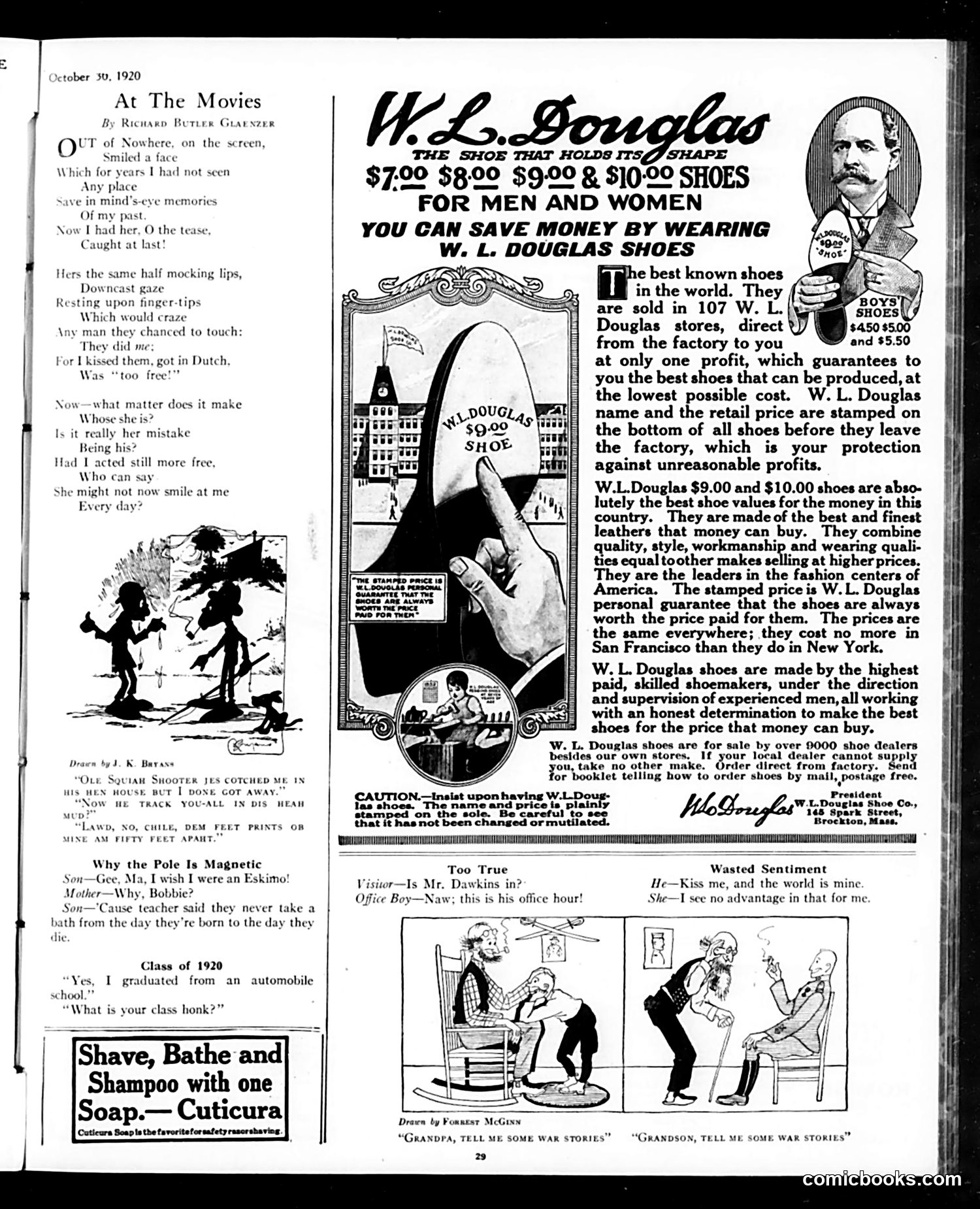
This page is primarily advertising (W.L. Douglas shoes dominate) with scattered humor pieces and cartoons. **"At The Movies"** is a poem about encountering a woman from one's past on screen—apparently someone the speaker once kissed too boldly ("got in Dutch"). It's wistful romantic nostalgia with mild regret. **Two cartoons by I.K. Baynass** show a rural/dialect-heavy scene (appearing to use African American vernacular stereotypes common in 1920s humor) about a man being chased and leaving footprints. **Small jokes** include: a reference to Eskimos not bathing (playing on racial stereotypes); someone graduating from "automobile school" with a car horn pun; a visitor asking if Mr. Dawkins is in, being told "this is his office hour"—the joke being he's not there despite it theoretically being his scheduled time. **"Wasted Sentiment"** depicts a woman rejecting romantic flattery, finding no personal advantage in it. **Bottom cartoons** show a grandfather/grandson exchange about war stories—likely commenting on generational attitudes toward WWI, which had ended two years prior. The page reflects 1920s humor conventions, including heavy use of ethnic/racial stereotypes now considered offensive.
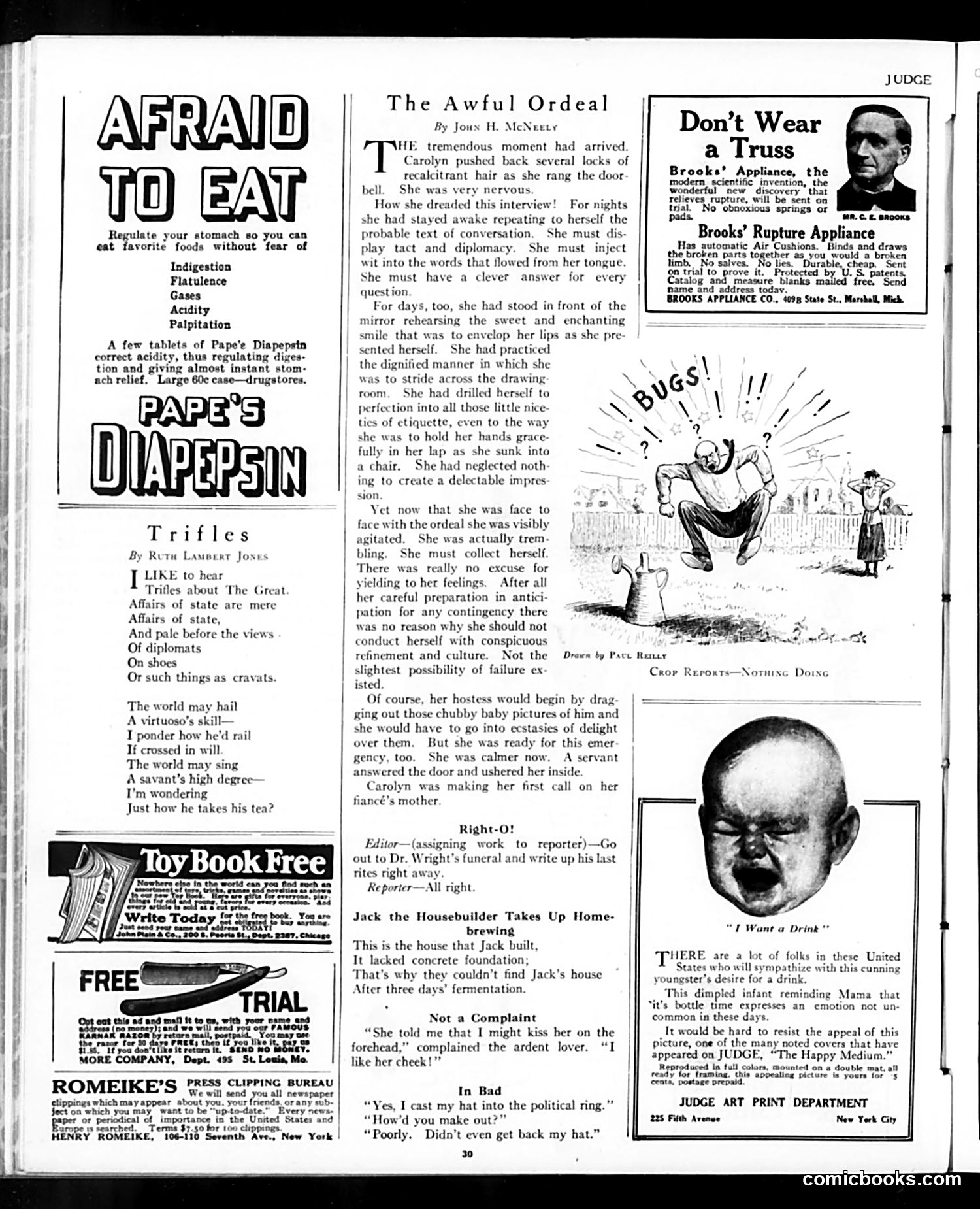
This page features a humorous short story about a young woman, Carolyn, nervously preparing to meet her fiancé's mother for the first time. The satire mocks Victorian courtship anxieties and gender expectations: she obsessively rehearses conversations, practices her smile and posture, and drills etiquette—only to discover the "ordeal" is simply a social call. The humor lies in the exaggerated disproportion between her elaborate preparation and the mundane reality of meeting in-laws. Additional satirical pieces mock male vanity ("how he takes his tea"), romantic clichés ("ardent lover" complaining about forehead kisses), and political disappointment. The page is primarily advertising and light humor content typical of Judge magazine's satirical approach to American social conventions.
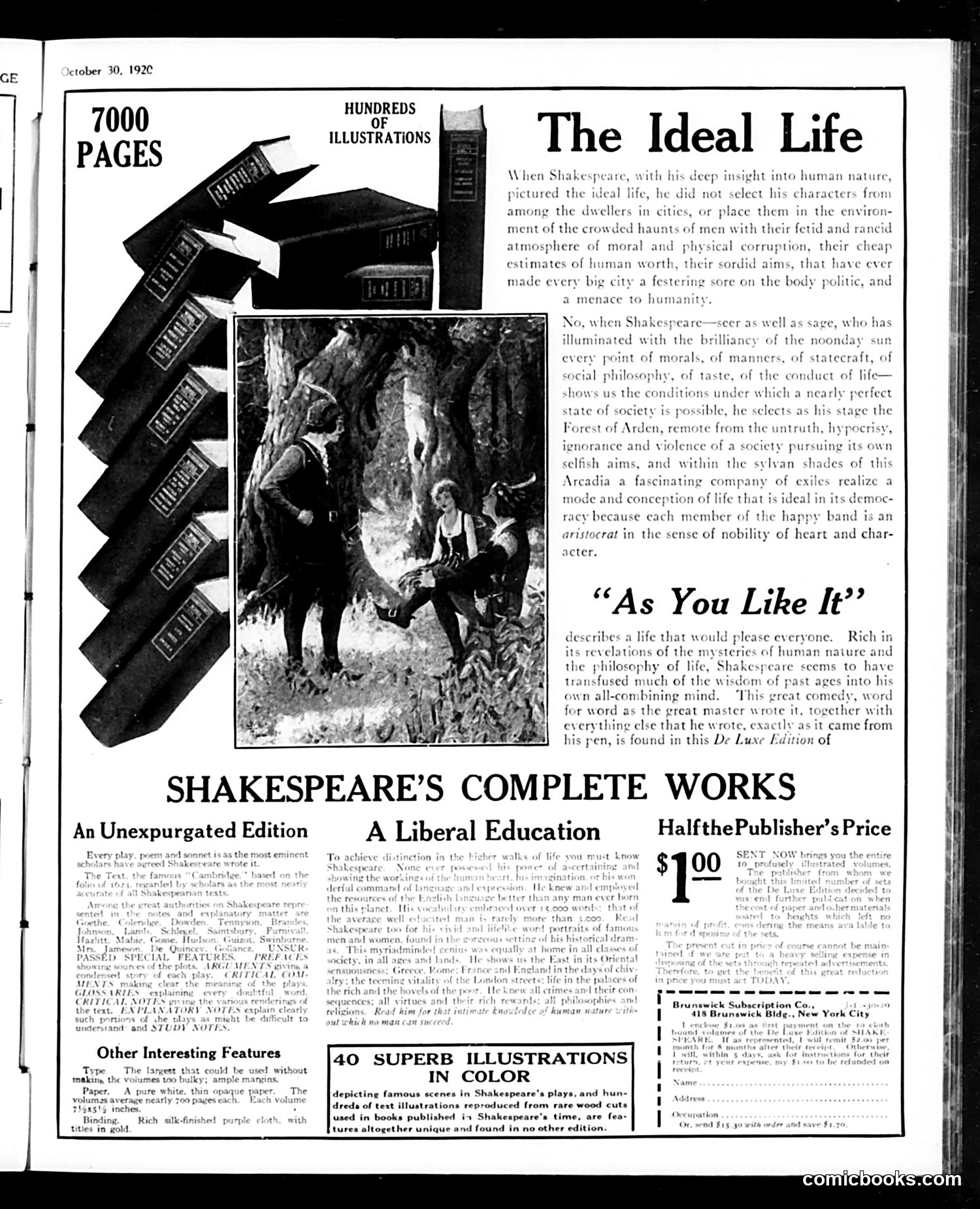
This is primarily **advertising**, not political satire. The page promotes a deluxe edition of Shakespeare's Complete Works published by the Brunswick Subscription Company (October 10, 1920). The ad uses romantic rhetoric about Shakespeare's idealism—specifically praising *As You Like It* for depicting an "ideal life" in the Forest of Arden, where exiles achieve democracy and nobility of character removed from corrupt city life. This appeals to early 20th-century nostalgia and anti-urban sentiment. The marketing emphasizes the edition's exclusivity: 7,000 pages, hundreds of illustrations, 40 superb color plates, and rare woodcut reproductions from Shakespeare's era. The price ($1.00, "half the publisher's price") suggests it's a mail-order subscription offer. There is **no political cartoon** here—just a commercial pitch using Shakespeare's pastoral idealism to sell a luxury product to educated readers during the Jazz Age.
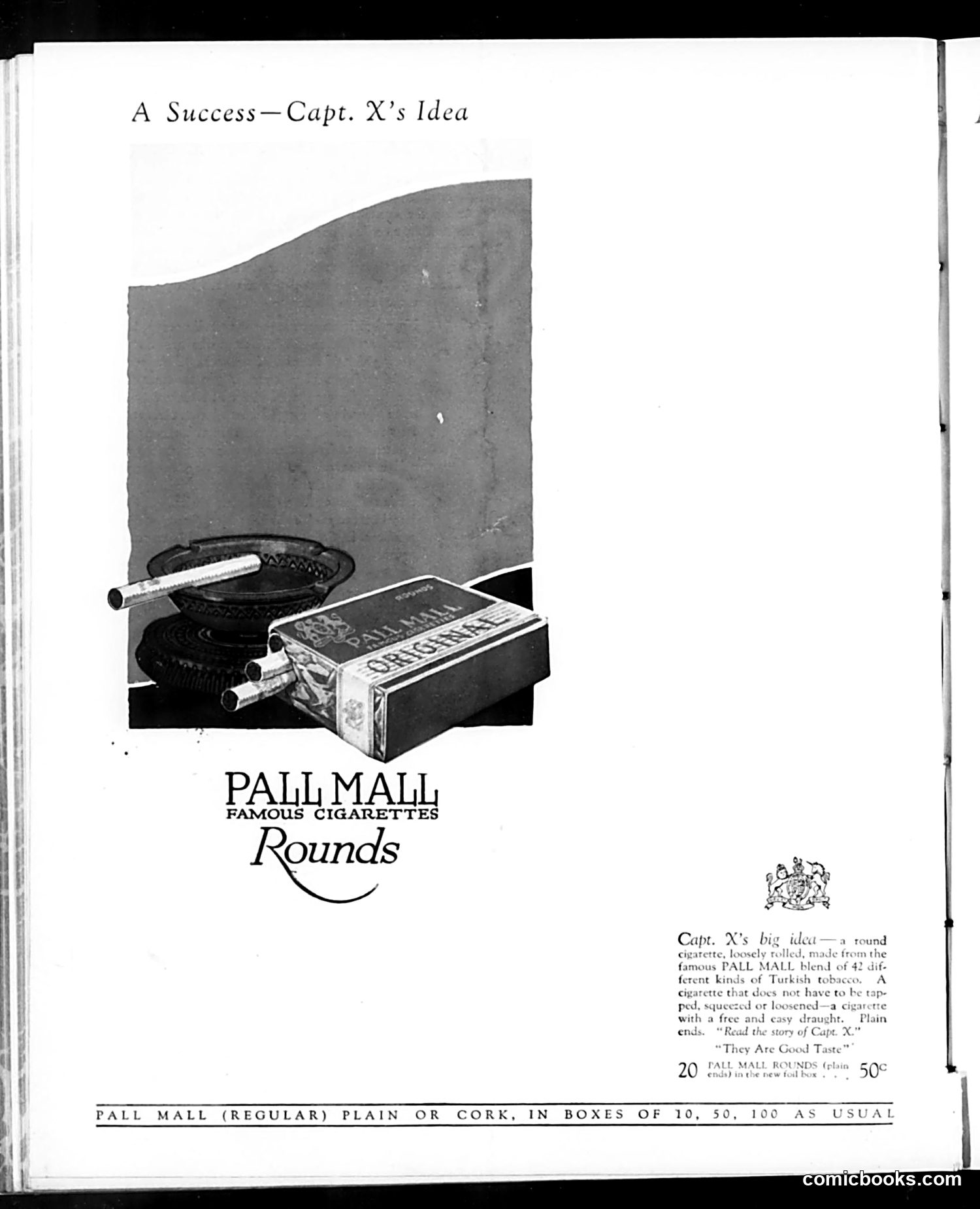
This page is primarily a **cigarette advertisement**, not a political cartoon. It advertises Pall Mall's new "Rounds" cigarettes, marketed as "Capt. X's big idea"—a round, loosely rolled cigarette made from a blend of 42 types of Turkish tobacco. The "satire" is minimal and subtle: the headline frames the round cigarette shape as an ingenious innovation ("A Success"), while the accompanying still-life image shows the product alongside a pipe and ashtray. The humor appears to be gentle marketing—presenting an ordinary product redesign as a major creative breakthrough, likely poking fun at cigarette advertising's tendency to oversell minor variations. The phrase "They Are Good Taste" serves as the product's slogan. This is fundamentally a commercial advertisement using Judge magazine's pages to reach readers, rather than satirical editorial content.