
Judge, 1920-10-30 · page 25 of 32
Judge — October 30, 1920 — page 25: what you’re looking at
What you’re looking at
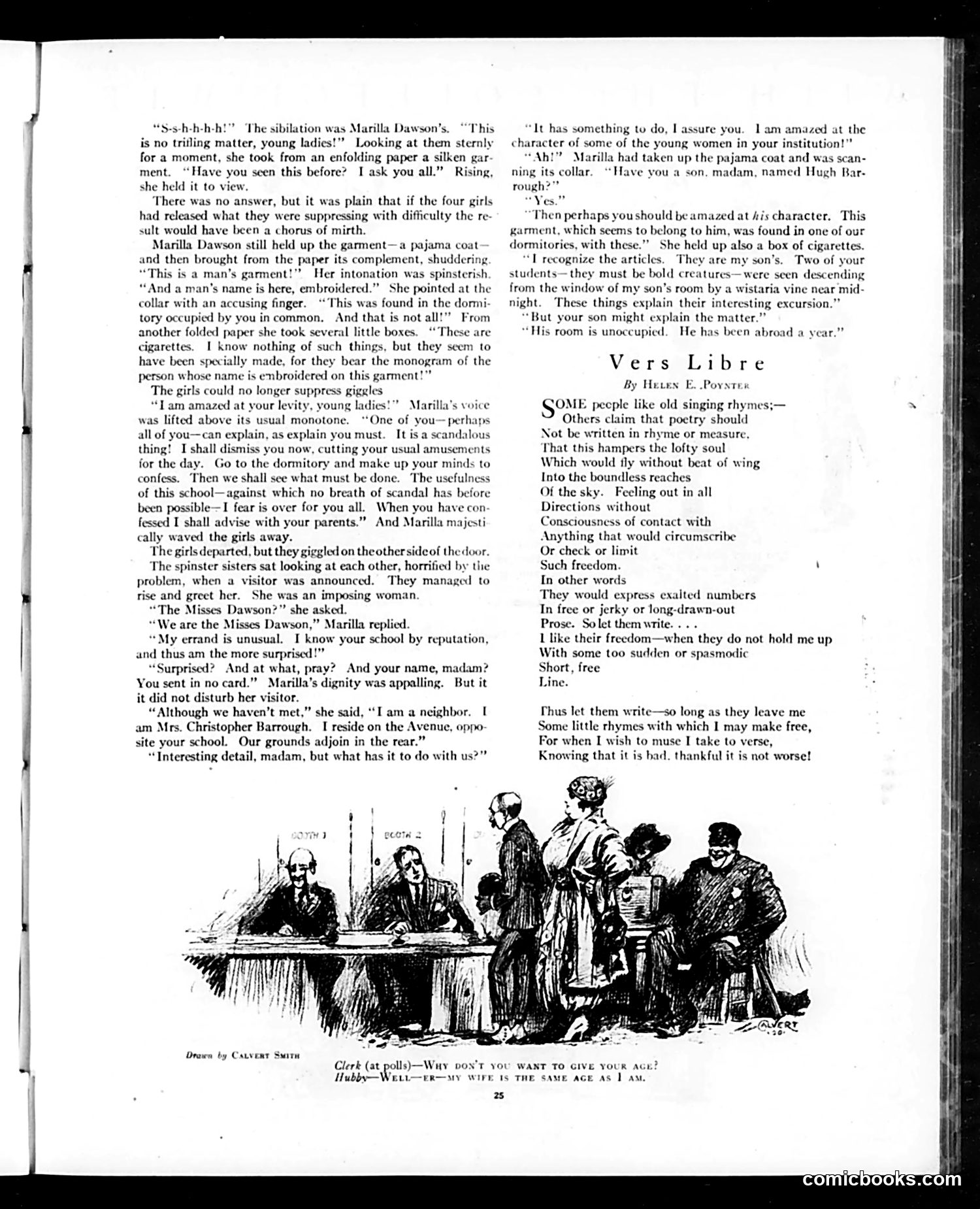
This page contains two distinct pieces satirizing early-20th-century social hypocrisy. **The main narrative** mocks prudish female school administrators. Headmistress Marilla Dawson discovers a man's monogrammed pajama coat and cigarettes in the girls' dormitory, threatening expulsion for moral scandal. However, a neighbor reveals the items belong to her son, Hugh Barrough, who's been abroad a year—meaning the girls couldn't possibly have entertained him recently. The joke exposes Dawson's self-righteous moral panic as baseless while suggesting the girls' knowing giggles indicate they're not actually innocent. **The cartoon below** shows a couple discussing age disparity: a clerk asks why a husband won't reveal his wife's age, and the husband replies she's the same age as he is—a joke about wives lying about their age, playing on contemporary anxieties about female deception. **"Vers Libre"** is a poem satirizing free-verse poetry's pretensions to artistic freedom while criticizing its formlessness. The overall page mocks institutional hypocrisy, female sexuality, and modern literary affectation.
📄 Transcribed text from this page (OCR, searchable)
Machine-transcribed from the original scan — historical spelling and the odd misread are preserved.
TT | — one — “S-s-h-h-h-h!””) The sibilation was Marilla Dawson's. “This is no trifling matter, young ladies!” Looking at them sternly for a moment, she took from an enfolding paper a silken gar- ment. “Have you seen this before? I ask you all.” Rising, she held it to view. There was no answer, but it was plain t had released what they were suppressing with sult would have been a chorus of mirth. Marilla Dawson still held up the garment—a pajama coat and then brought from the paper its complement, shuddering. “This is a man’s garment!” Her intonation was spinsterish “And a man’s name is here, embroidered.” She pointed at the collar with an accusing finger. ‘This was found in the dormi: tory occupied by you in common, And that is not all!” From another folded paper she took several little boxes. “ These are cigarettes. I know nothing of such things, but they seem to have been specially made, for they bear the monogram of the person whose name is enbroidered on this garment!” The girls could no longer suppress giggles “Tam amazed at your levity, young ladies!” Marilla’s voice was lifted above its usual monotone. “One of you— perh all of you—can explain, as explain you must. It is a scandalous thing! I shall dismiss you now, cutting your usual amusements for the day. Go to the dormitory and make up your minds to confess. Then we shall see what must be done. The usefulness of this school—against which no breath of scandal has before been possible—I fear is over for you all. When you have con fessed I shall advise with your parents.” And Marilla majesti cally waved the girls away. The girls departed, but they giggled on theothersideof the door. The spinster sisters sat looking at each other, horrified by the problem, when a visitor was announced. They managed to rise and greet her. She was an imposing woman. “The Misses Dawson?” she asked. “We are the Misses Dawson,” Marilla replied. “My errand is unusual. I know your school by reputation, and thus am the more surprised “Surprised? And at what, pray? And your name, madam? You sent in no card.” Marilla’s dignity was appalling. But it it did not disturb her visitor. “Although we haven’t met,” she said, ‘I am a neighbor. [ am Mrs. Christopher Barrough. I reside on the Avenue, oppo site your school. Our grounds adjoin in the rear.” “Interesting detail, madam, but what has it to do with us?” if the four girls ficulty the re- 2 Drawn by Carvent Ssarn Clore (ee pale) WSF DON'T you IS THE SAME AGE AS TAM. Hubby—' ELL—ER—MY WIFE 2s “It has something to do, I assure you. lam amazed at the character of some of the young women in your institution!” “Ah!” Marilla had taken up the pajama coat and was scan- ning its collar. “Have you a son, madam, named Hugh Bar- rough?” “Yes.” “Then perhaps you should be amazed at Ais character. This garment, which seems to belong to him, was found in one of our dormitories, with thes She held up also a box of cigarettes. “I recognize the articles. They are my son’s. Two of your students—they must be bold creatures—were seen descending from the window of my son’s room by a wistaria vine near mid- night. These things explain their interesting excursion.” “But your son might explain the matter.” “His room is unoccupied. He has been abroad a year.” Vers Libre By Hees E. SOME peceple like old singing rhymes;— Others claim that poetry should Not be written in rhyme or measure, That this hampers the lofty soul Which would tly without beat of wing Into the boundless reaches Of the sky. Feeling out in all Directions without Consciousness of contact with Anything that would circumscribe Or check or limit Such freedom. ‘ In other words They would express exalted numbers In free or jerky or long-drawn-out Prose. Solet them write... . L like their freedom—when they do not hold me up With some too sudden or spasmodic Short, free Line. DY NTEH Thus let them write—so long as they leave me Some little rhymes with which I may make free, For when I wish to muse I take to verse, Knowing that it is bad. thankful it is not worse! WANT TO GIVE YOUR A