
Judge, 1920-10-30 · page 12 of 32
Judge — October 30, 1920 — page 12: what you’re looking at
What you’re looking at
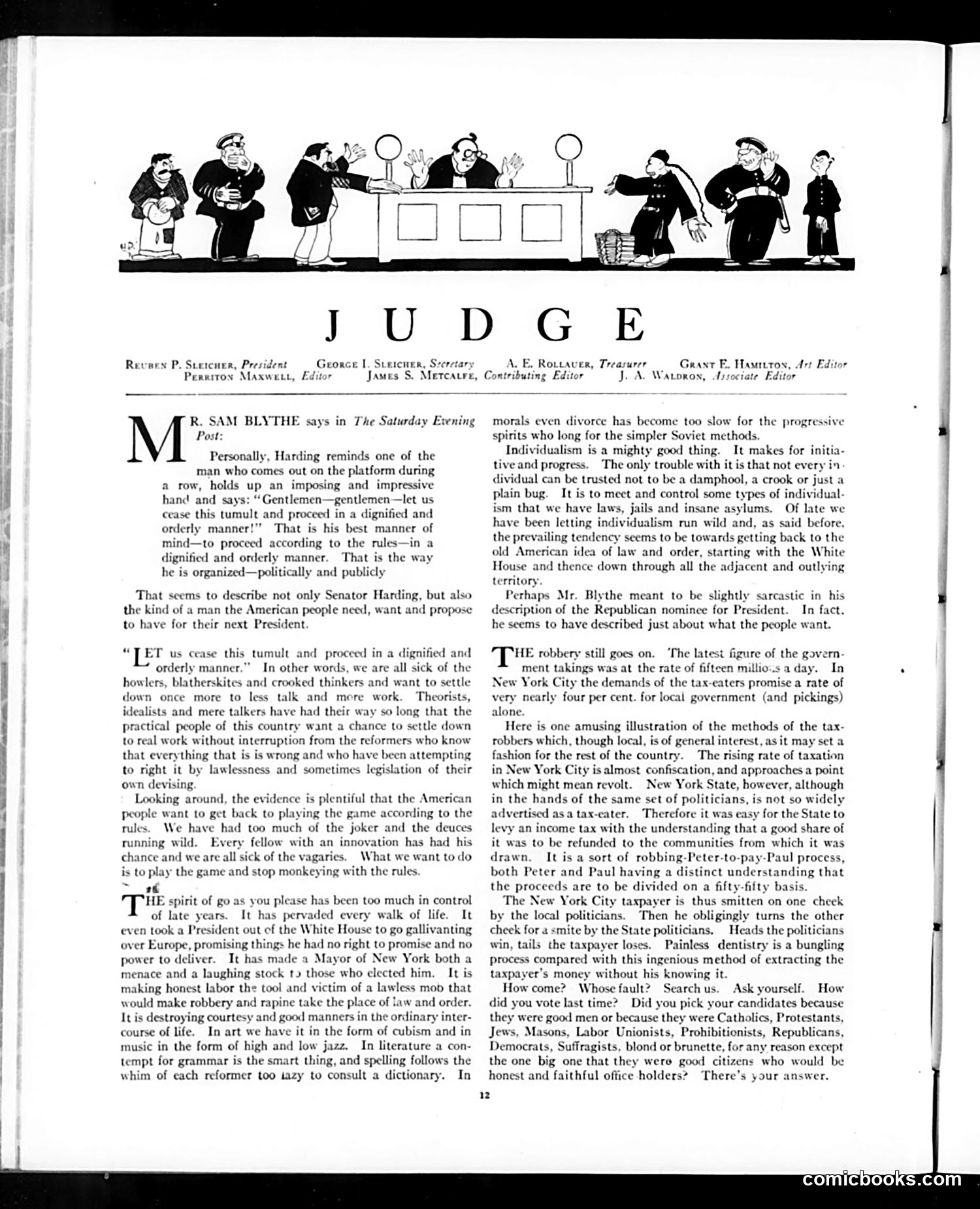
This page features an editorial by Sam Blythe (from *The Saturday Evening Post*) endorsing Warren G. Harding for president. The cartoon header depicts a judge's bench with various figures, likely representing political factions or interests. Blythe praises Harding as embodying what Americans want: order, dignity, and adherence to rules—contrasting him with recent progressive excess. The text criticizes the "spirit of go as you please" pervading American life, blaming it for labor unrest, mayoral corruption (likely NYC Mayor Jimmy Walker), cubism, jazz, and Soviet-style radicalism. The satire targets progressive reformers and individualists who reject traditional rules. Blythe argues strict governance is necessary because "not every individual can be trusted"—justifying laws, jails, and asylums. A secondary section attacks New York City government corruption and tax-eaters, connecting local Democratic mismanagement to national moral decline. The overall message: America needs Harding's conservative, rule-based approach to restore order after years of progressive chaos.
📄 Transcribed text from this page (OCR, searchable)
Machine-transcribed from the original scan — historical spelling and the odd misread are preserved.
Satta Saas Ee JUDGE Grorce I. Stercner, Srerctary Revaen P. Srercner, Presi Penattox Maxwett, Editor James S. Metcatre, Contributing Edi Hasnttos, Art Editor octate Editor A. E, Routaver, Treasurer Grast tor J. A. Watprox, fs R. SAM BLYTHE says in The Saturday Evening Post Personally, Harding reminds one of the man who comes out on the platform during a row, holds up an imposing and impressive hand and says: “Gentlemen—gentlemen—let us cease this tumult and proceed in a dignified and orderly manner!’ That is his best manner of mind—to proceed according to the rules—in a dignified and orderly manner. That is the way he is organized—politically and publicly That scems to describe not only Senator Harding, but also the kind of a man the American people need, want and propose to have for their next President T us cease this tumult and proceed in a dignified and orderly manner.” In other words, we are all sick of the howlers, blatherskites and crooked thinkers and want to settle down once more to less talk and more work. Theorists, idealists and mere talkers have had their way so long that the practical people of this country want a chance to settle down to real work without interruption from the reformers who know that everything that is is wrong and who have been attempting to right it by lawlessness and sometimes legislation of their own devising Looking around, the evidence is plentiful that the American people want to get back to playing the game according to the rules. We have had too much of the joker and the deuces running wild. Every fellow with an innovation has had his chance and we are all sick of the vagaries. What we want todo is to play the game and stop monkeying with the rules. a HE spirit of go as you please has been too much in control of late years. It has pervaded every walk of life. It even took a President out of the White House to go gallivanting over Europe, promising things he had no right to promise and no power to deliver. It has made a Mayor of New York both a menace and a laughing stock t» those who elected him. It is making honest labor the tool and victim of a lawless mob that would make robbery and rapine take the place of law and order. It is destroying courtesy and good manners in the ordinary inter- course of life. In art we have it in the form of cubism and in music in the form of high and low jazz. In literature a con- tempt for grammar is the smart thing, and spelling follows the whim of each reformer too tazy to consult a dictionary. In morals even divorce has become too slow for the progressive spirits who long for the simpler Soviet methods. Individualism is a mighty good thing. It makes for initia- tive and progress. The only trouble with it is that not every in dividual can be trusted not to be a damphool, a crook or just a plain bug. It is to meet and control some types of individual- ism that we have laws, jails and insane asylums. Of late we have been letting individualism run wild and, as said before, the prevailing tendency seems to be towards getting back to the old American idea of law and order, starting with the White House and thence down through all the adjacent and outlying territory . Blythe meant to be slightly sarcastic in his description of the Republican nomince for President. In fact. he seems to have described just about what the people want. 'HE robbery still goes on. ‘The latest figure of the govern- ment takings was at the rate of fifteen millio.s aday. In New York City the demands of the tax-eaters promise a rate of very nearly four per cent. for local government (and pickings) alone. Here is one amusing illustration of the methods of the tax- robbers which, though local, is of general interest, as it may set a fashion for the rest of the country. The rising rate of taxation in New York City is almost confiscation, and approaches a point which might mean revolt. New York State, however, although in the hands of the same set of politicians, is not so widely advertised asa tax-eater. Therefore it was casy for the State to levy an income tax with the understanding that a good share of it was to be refunded to the communities from which it was drawn, It is a sort of robbing-Peter-to- Paul proce: both Peter and Paul having a distinct understanding that the proceeds are to be divided on a fifty-filty basis. The New York City taxpayer is thus smitten on one cheek by the local politicians. Then he obligingly turns the other cheek for a smite by the State politicians, Heads the pol ns win, tails the taxpayer loses. Painless dentistry is a bungling process compared with this ingenious method of extracting the taxpayer’s money without his knowing it. How come? Whose fault? Search us. Ask yourself. How did you vote last time? Did you pick your candidates because they were good men or because they were Catholics, Protestants, Jews, Masons, Labor Unionists, Prohibitionists, Republicans, Democrats, Suffragists, blond or brunette, for any reason except the one big one that they were good citizens who would be honest and faithful office holders? There’s your answer. 12