
Judge, 1920-10-30 · page 20 of 32
Judge — October 30, 1920 — page 20: what you’re looking at
What you’re looking at
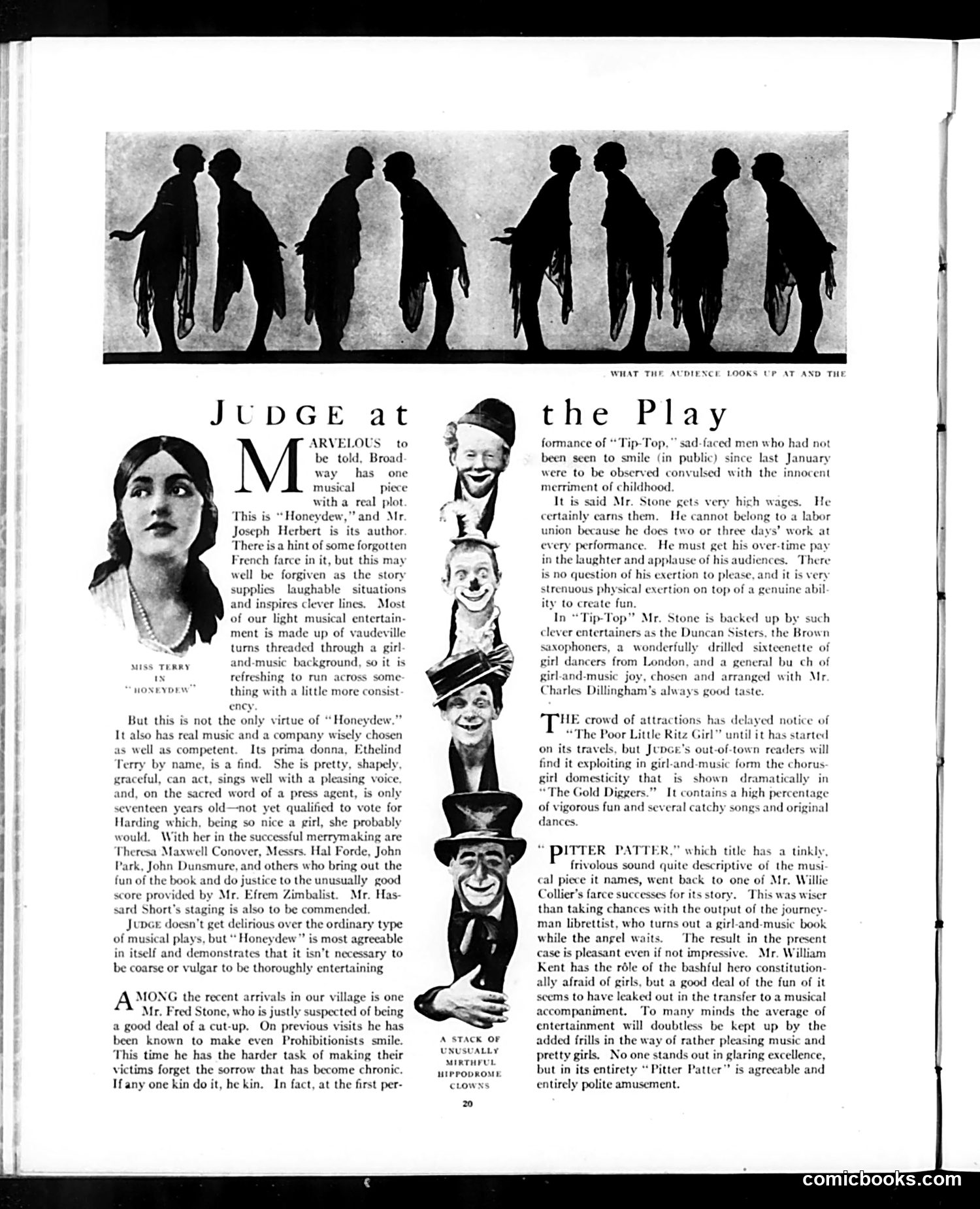
This page reviews several Broadway musical comedies from the early 1920s. The top illustration shows silhouettes of performers—likely depicting the comedic physical comedy typical of these shows. The reviews discuss: - **"Honeydew"**: A musical with an actual plot (unusual for the era), starring young actress Ethelind Terry. Judge praises it for having coherent storytelling rather than just vaudeville turns strung together. - **"Tip-Top"**: Featuring Fred Stone, a famous physical comedian who "gets very high wages" and performs strenuous physical exertion to make audiences laugh. The review notes Stone makes even serious people smile during Prohibition-era hardship. - Other shows: "The Poor Little Ritz Girl," "Pitter Patter," and references to "The Gold Diggers." The satire targets the formulaic nature of 1920s Broadway musicals—typically girl-and-music spectacles with minimal plot—while praising shows that break this mold with actual stories or exceptional performers.
📄 Transcribed text from this page (OCR, searchable)
Machine-transcribed from the original scan — historical spelling and the odd misread are preserved.
JUDGE at ARVELOUS to be told, Broad way has one musical piece with a real plot This is “Honeydew,” and Mr Joseph Herbert is its author There is a hint of some forgotten French farce in it, but this may well be forgiven as the story supplies laughable situations and inspires clever lines. Most of our light musical entertain- ment is made up of vaudeville turns threaded through a girl I-music background, so it is a MISS TERRY IN refreshing to run across some HONEYDEW thing with a little more consist eney But this is not the only virtue of “Honeydew.” It also has real music and a company wisely chosen as well as competent. Its prima donna, Ethelind Terry by name, is a find. She is pretty, shapely graceful, can act, sings well with a pleasing voice, and, on the sacred word of a press agent, is only seventeen years old—not yet qualified to vote for Harding which, being so nice a girl, she probably would. With her in the successful merrymaking are Theresa Maxwell Conover, Messrs. Hal Forde, John Park, John Dunsmure, and others who bring out the fun of the book and do justice to the unusually good score provided by Mr. Efrem Zimbalist. Mr. Has- sard Short’s staging is also to be commended. Jupce doesn’t get delirious over the ordinary type of musical plays, but “ Honeydew” is most agreeable in itself and demonstrates that it isn’t necessary to be coarse or vulgar to be thoroughly entertaining MONG the recent arrivals in our village is one Mr. Fred Stone, who is justly suspected of being a good deal of a cut-up. On previous visits he has been known to make even Prohibitionists smile. This time he has the harder task of making their victims forget the sorrow that has become chronic. If any one kin do it, he kin. In fact, at the first per- A STACK OF UNUSUALLY MIRTHPUL MIPPODROME CLOWNS 20 WHAT THE AUDIENCE LOOKS UP AT AND THE the Play formance of “Tip-Top,” sad-faced men who had not been seen to smile (in public) since last January were to be observed convulsed with the innocent merriment of childhood. It is said Mr. Stone gets very hich wages. He certainly earns them. He cannot be! union because he every performance. He must get his over-time pay in the laughter and applause of his audiences. There is no question of his exertion to please, and it is very strenuous physical exertion on top of a genuine abil ity to create fun. In “Tip-Top” Mr. Stone is backed up by such clever entertainers as the Duncan Sisters, the Brown saxophoners, a wonderfully drilled sixteenette of girl dancers from London, and a general bu ch of girl-and-music joy, chosen and arranged with Mr Charles Dillingham’s always good taste. ig to a labor Joes two or three days’ work at HE crowd of attractions has delayed notice of “The Poor Little Ritz Girl” until it has started on its travels, but Jupce's out-of-town readers will find it exploiting in girl-and-music form the chorus girl domesticity that is shown dramatically in “The Gold Diggers.” It contains a high percentage of vigorous fun and several catchy songs and original dances, “ DITTER PATTER,” which title has a tinkly frivolous sound quite descriptive of the musi cal piece it names, went back to one of Mr. Willie Collier's farce successes for its story. This was wiser than taking chances with the output of the journey. man librettist, who turns out a girl-and-music book while the angel waits. The result in the present case is pleasant even if not impressive. Mr. William Kent has the réle of the bashful hero constitution- ally afraid of girls, but a good deal of the fun of it scems to have leaked out in the transfer to a musical accompaniment. To many minds the average of entertainment will doubtless be kept up by the added frills in the way of rather pleasing music and pretty girls, No one stands out in glaring excellence, but in its entirety “Pitter Patter” is agreeable and entirely polite amusement. comicbooks.com