
Judge, 1920-10-30 · page 10 of 32
Judge — October 30, 1920 — page 10: what you’re looking at
What you’re looking at
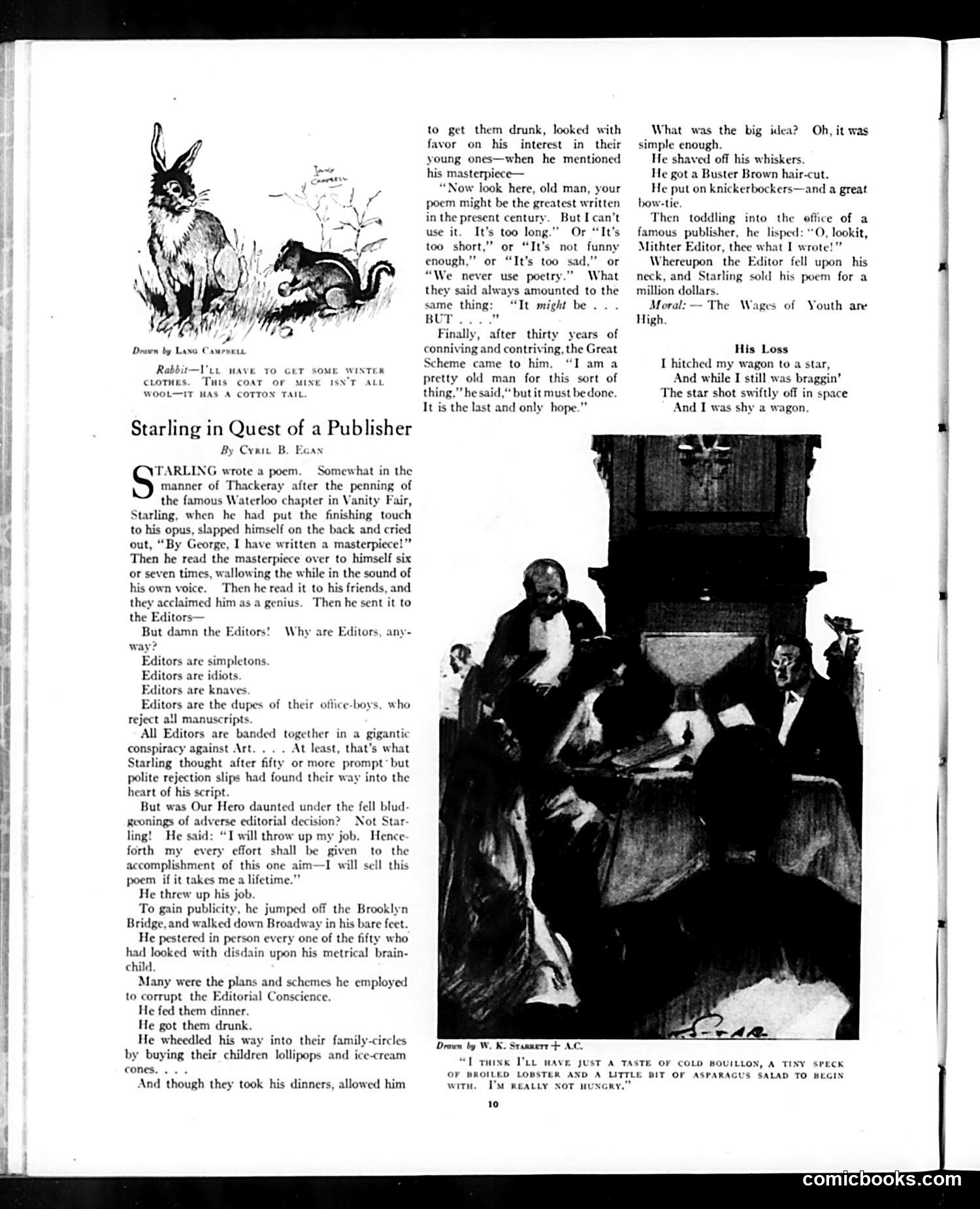
This satirical story mocks both struggling writers and publishing gatekeepers. Starling writes a poem, believes it's a masterpiece, then faces fifty rejections from editors—whom he bitterly characterizes as "simpletons," "idiots," and "knaves" in a "gigantic conspiracy against Art." After thirty years of failed schemes (bribing editors with dinners, drinks, and gifts to their children), Starling's final strategy succeeds: he disguises himself as a child by shaving his whiskers, getting a Buster Brown haircut, and wearing knickerbockers with a bow-tie. The publisher, apparently charmed by this childish presentation, accepts the poem for "a million dollars." The satire cuts multiple ways: mocking both the editor's apparent gullibility and suggesting that literary merit matters less than presentation or novelty. The "moral"—"The Wages of Youth are High"—implies youth (or its appearance) sells better than genuine talent.
📄 Transcribed text from this page (OCR, searchable)
Machine-transcribed from the original scan — historical spelling and the odd misread are preserved.
Drawn by Lana Cawpnets Rabbit—l'tt WAVE TO GET SOME WINTER cLrotues. Tuts COAT OF MINE ISN'T ALL WOOL—IT HAS A COTTON Tait Starling in Quest of a Publisher By Cyan B. Ecan TARLING wrote a poem. Somewhat in the S manner of Thackeray after the penning of the famous Waterloo chapter in ity Fair, Starling, when he had put the finishing touch to his opus, slapped himself on the back and cried out, “By George, I have written a masterpiece!” Then he read the masterpiece over to himself six or seven times, wallowing the while in the sound of his own voice. Then he read it to his friends, and they acclaimed him as a genius. Then he sent it to the Editors— But damn the Editors!’ Why are Editors, any- way? Editors are simpletons. Editors are idiots. Editors are knaves. Editors are the dupes of their office-boys, who reject a!l manuscripts All Editors are banded together in a gigantic conspiracy against Art. At least, that’s what Starling thought after fifty or more prompt’ but polite rejection slips had found their way into the heart of his script. But was Our Hero daunted under the fell blud. geonings of adverse editorial decision? Not Star, ling! He said: “I will throw up my job. Hence forth my every effort shall be given to the accomplishment of this one aim—I will sell this poem if it takes me a lifetime.” He threw up his job. To gain publicity, he jumped off the Brooklyn Bridge, and walked down Broadway in his bare feet. He pestered in person every one of the fifty who had looked with disdain upon his metrical brain- child Many were the plans and schemes he employed to corrupt the Editorial Conscience. He fed them dinner. He got them drunk. He wheedled his way into their family-circles by buying their children lollipops and ice-cream And though they took his dinners, allowed him to get them drunk, looked with favor on his interest in their young ones—when he mentioned his masterpiece— “Now look here, old man, your poem might be the greatest written in the present century. But I can’t use it. It's too long.” Or “It's too short,” or “It’s not funny enough,” or “It’s too sad,”’ or “We never use poetry.” What they said always amounted to the same thing: “It might be. . . BUT . id Finally, after thirty years of conniving and contriving, the Great Scheme came to him, “I am a pretty old man for this sort of thing,” he said, but it must bedone. It is the last and only hope.” Drown by W. K. Stanmert + A.C. What was the big idea? Oh, it was simple enough. He shaved off his whiskers. He got a Buster Brown hair-cut. He put on knickerbockers—and a great bow-tie. Then toddling into the effice of a famous publisher, he lisped: “0, lookit, Mithter Editor, thee what I wrote!” Whereupon the Editor fell upon his neck, and Starling sold his poem for a million dollars. Moral: — The Wages of Youth are High His Loss I hitched my wagon to a star, And while I still was braggin’ The star shot swiftly off in space And I was shy a wagon “Trunk I'Lt WAVE JUST A TASTE OF COLD BOUILLON, A TINY SPECK OF BROILED LOBSTER AND A LITTLE BIT OF ASPARAGUS SALAD TO BEGIN with, I'M REALLY NOT HUNGRY | comicbooks.com