
A complete issue · 32 pages · 1920
Judge — September 11, 1920
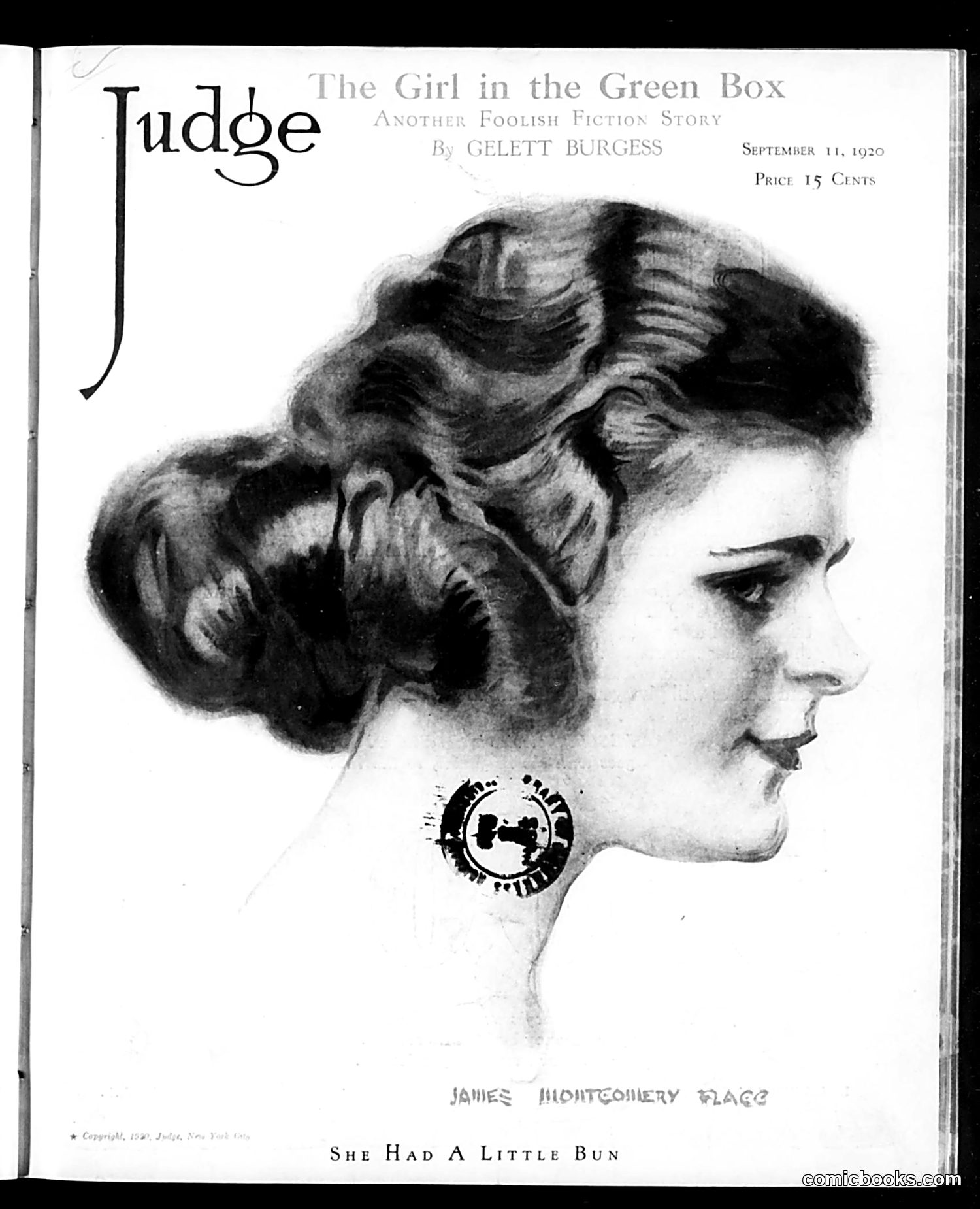
This cover features a profile portrait titled "The Girl in the Green Box: Another Foolish Fiction Story" by Gelett Burgess. The subtitle "She Had a Little Bun" references the woman's prominent upswept hairstyle—a fashionable Gibson Girl-style coiffure popular in the early 1900s. The circular earring contains what appears to be a small figure or emblem, though its specific meaning is unclear from the image alone. The artwork is credited to James Montgomery Flagg, a prominent American illustrator of the era. This appears to be a humorous story announcement rather than political satire, likely poking fun at contemporary romance fiction tropes and fashionable women's styling of the period. The "foolish fiction" subtitle suggests ironic commentary on popular magazine stories.
This page is primarily an **advertisement**, not editorial content or satire. It promotes Leslie's magazine (likely *Leslie's Weekly*, a major American publication) and its "Ask Leslie's" service department. The ad explains that magazine readers could submit business questions to Leslie's experts—about purchasing materials, merchandise sourcing, and commercial information—and receive answers. This was positioned as an exclusive reader benefit. The large "500,000" figure advertises the scale of this service, suggesting Leslie's had answered that many inquiries. The tagline "You get your money's worth in the magazine—you get your money back in its service" emphasizes the added value beyond the publication itself. This reflects early-20th-century magazine marketing, where service departments were genuine competitive advantages before internet search engines existed.
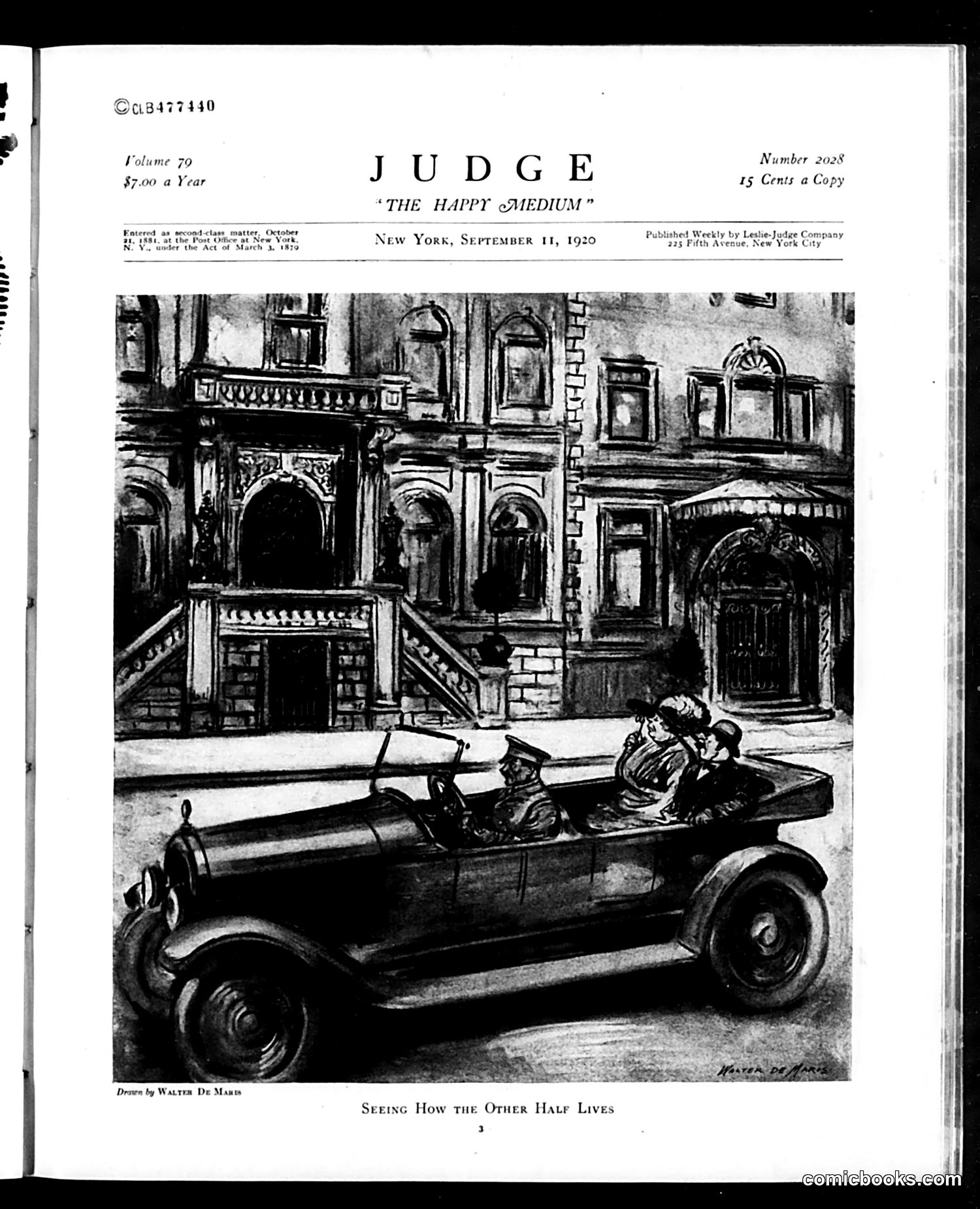
This Judge magazine cover from September 11, 1920 shows a wealthy couple in an open-air automobile touring past tenement buildings in a poor neighborhood. The title "Seeing How the Other Half Lives" references the famous 1890 Jacob Riis exposé documenting urban poverty. The satire is straightforward: the wealthy are sightseeing through slums as entertainment or curiosity, treating poverty as a spectacle rather than a serious social problem. Their casual, leisurely automobile ride contrasts sharply with the decrepit architecture behind them. The cartoon mocks both the indifference of the rich toward urban inequality and the patronizing attitude of treating poverty as an exotic attraction worthy of a Sunday drive.
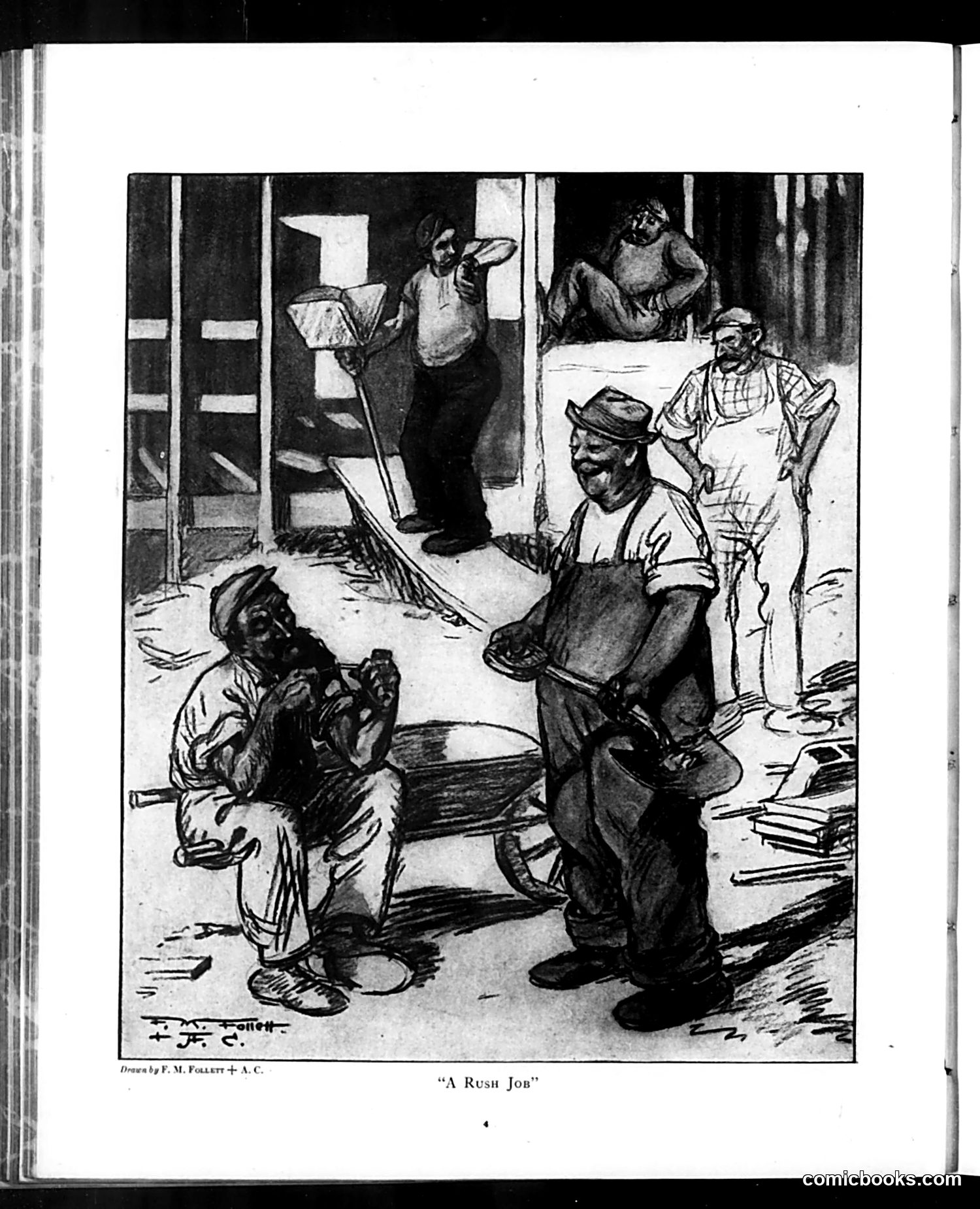
This cartoon depicts workers in what appears to be a construction or carpentry site, titled "A Rush Job." The sketch shows multiple laborers in work clothes and hats gathered around wooden materials and tools in an interior space with exposed beams. The satire likely critiques hasty, sloppy workmanship—the "rush job" being done carelessly or without proper attention to quality. The crowded, disorganized scene with multiple workers suggests inefficiency, confusion, or corner-cutting in pursuit of speed. This was a common Judge magazine theme: mocking poor labor practices, management incompetence, or the pursuit of profit at the expense of craftsmanship. Without additional context, the specific industry or event referenced remains unclear, but the general critique targets the consequences of prioritizing speed over quality in American labor.
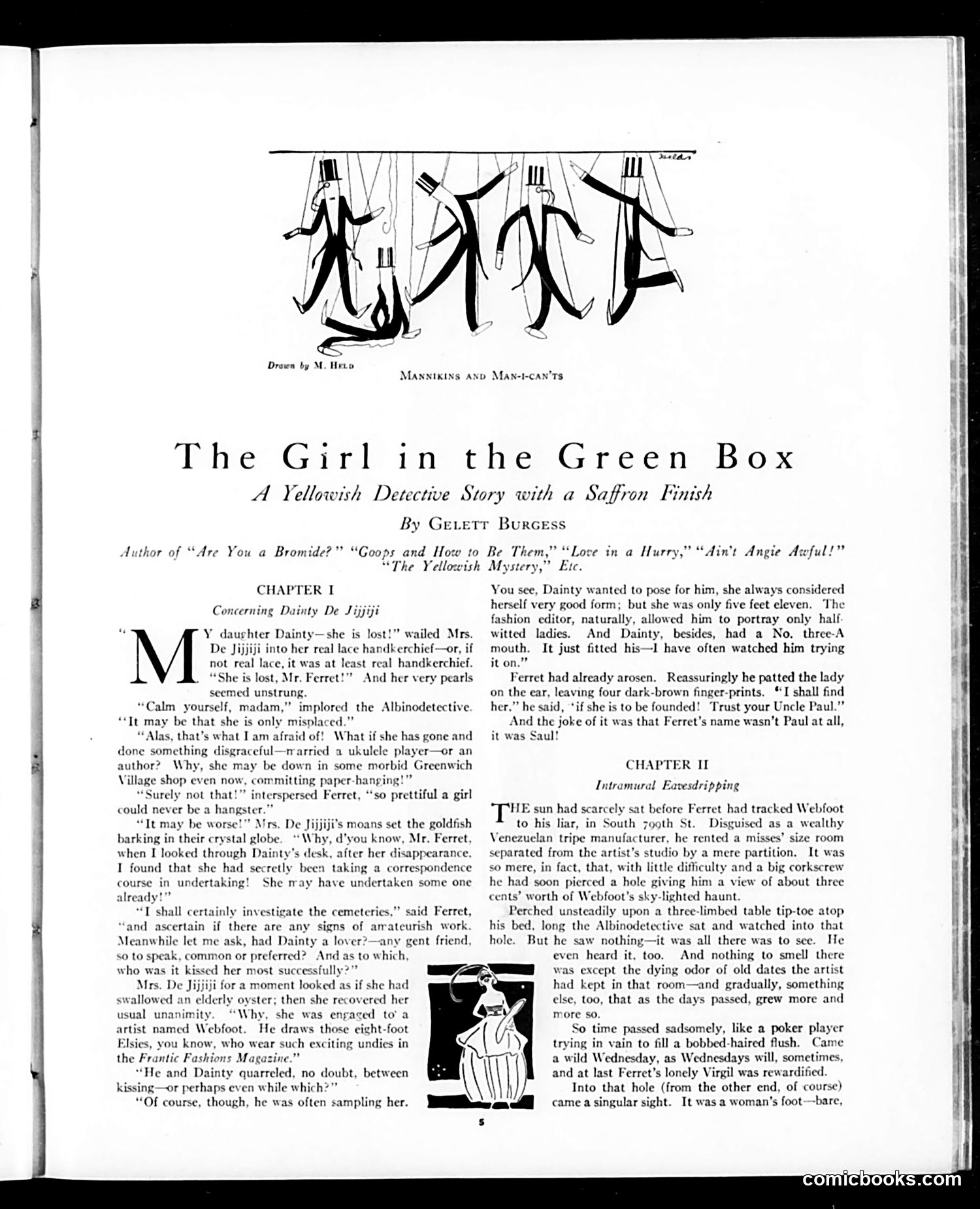
This page presents the opening of a detective fiction story by Gelett Burgess, not a political cartoon. The illustrated header shows five men in formal attire (top hats and suits) hanging from a rod—a visual pun suggesting "hanging men" or suspended gentlemen, likely foreshadowing the story's mystery plot. The narrative begins with a missing woman named Dainty and involves detective work, involving characters named Ferret and Uncle Paul. The story appears to be a humorous mystery tale set in fashionable society circles, referencing contemporary elements like fashion magazines and wealthy Manhattan locations. This is entertainment content rather than political satire—typical of Judge magazine's literary offerings alongside its better-known cartoons.
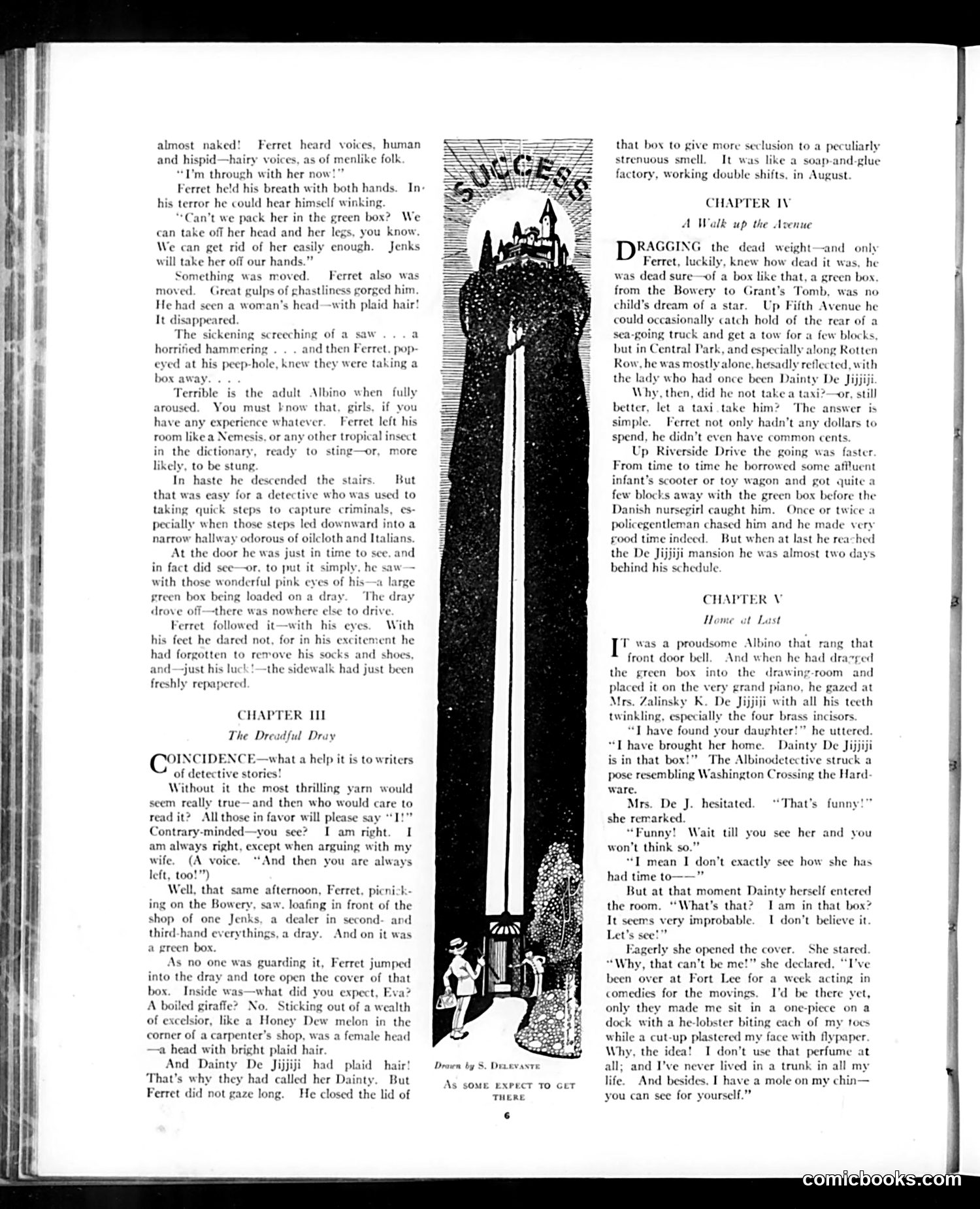
This page contains a serialized fiction story ("The Dreadful Dray," Chapters III-V) rather than political satire or editorial cartoons. The central illustration shows a tall urban building (possibly Fifth Avenue, as mentioned in the text) with figures at street level. The story follows a character named Ferret involved in criminal activities—stealing from a dray (delivery cart). The narrative includes references to New York locations (Fifth Avenue, Central Park, Riverside Drive) and working-class characters like nursemaids and shop owners. This appears to be **popular serialized crime fiction** rather than Judge's typical satirical commentary. The content reflects early 20th-century urban crime narratives common in magazines of this era, aimed at entertainment rather than political messaging.
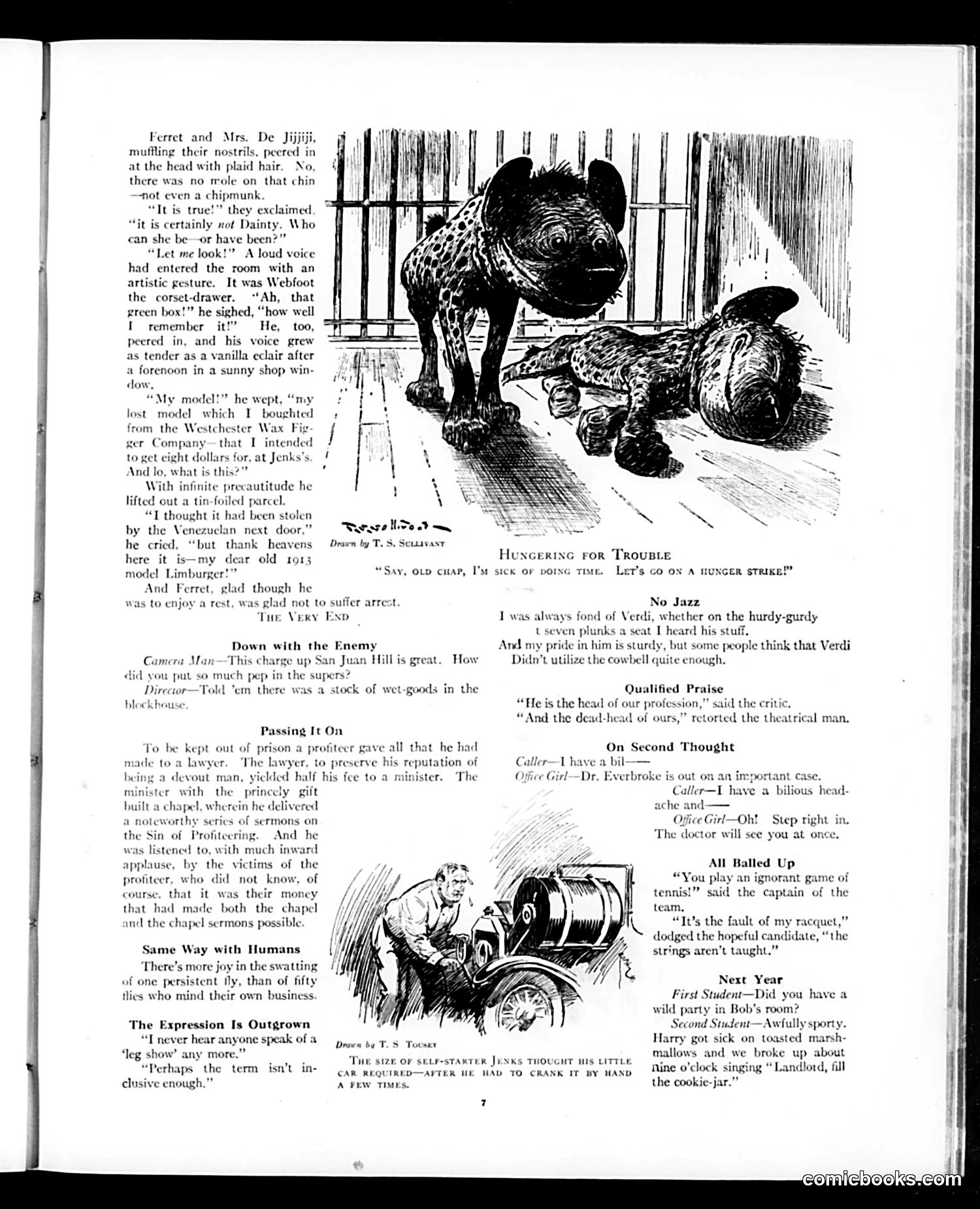
This page contains multiple brief satirical pieces typical of Judge's format: **Main cartoon** ("Hungering for Trouble"): Two dogs—one thin, one fat—discuss a "hunger strike." The fat dog suggests they protest by refusing food, a joke mocking the seriousness of actual labor strikes by applying them absurdly to animals. **Other short pieces** include workplace humor ("On Second Thought"—a doctor sees a "bilious" patient thinking he said "bilious ache"), sports satire ("All Balled Up"—blaming equipment for poor tennis), and theatrical commentary ("Qualified Praise"—contrasting a critic's praise with an actor's earnings). **Lower cartoon** depicts a man hand-cranking a self-starter car repeatedly—satirizing early automobile technology's unreliability, when even supposedly automatic starters required manual cranking. The page reflects early 20th-century preoccupations: labor unrest, emerging automotive technology, and entertainment industry gossip—delivered through Judge's characteristic rapid-fire gag format.
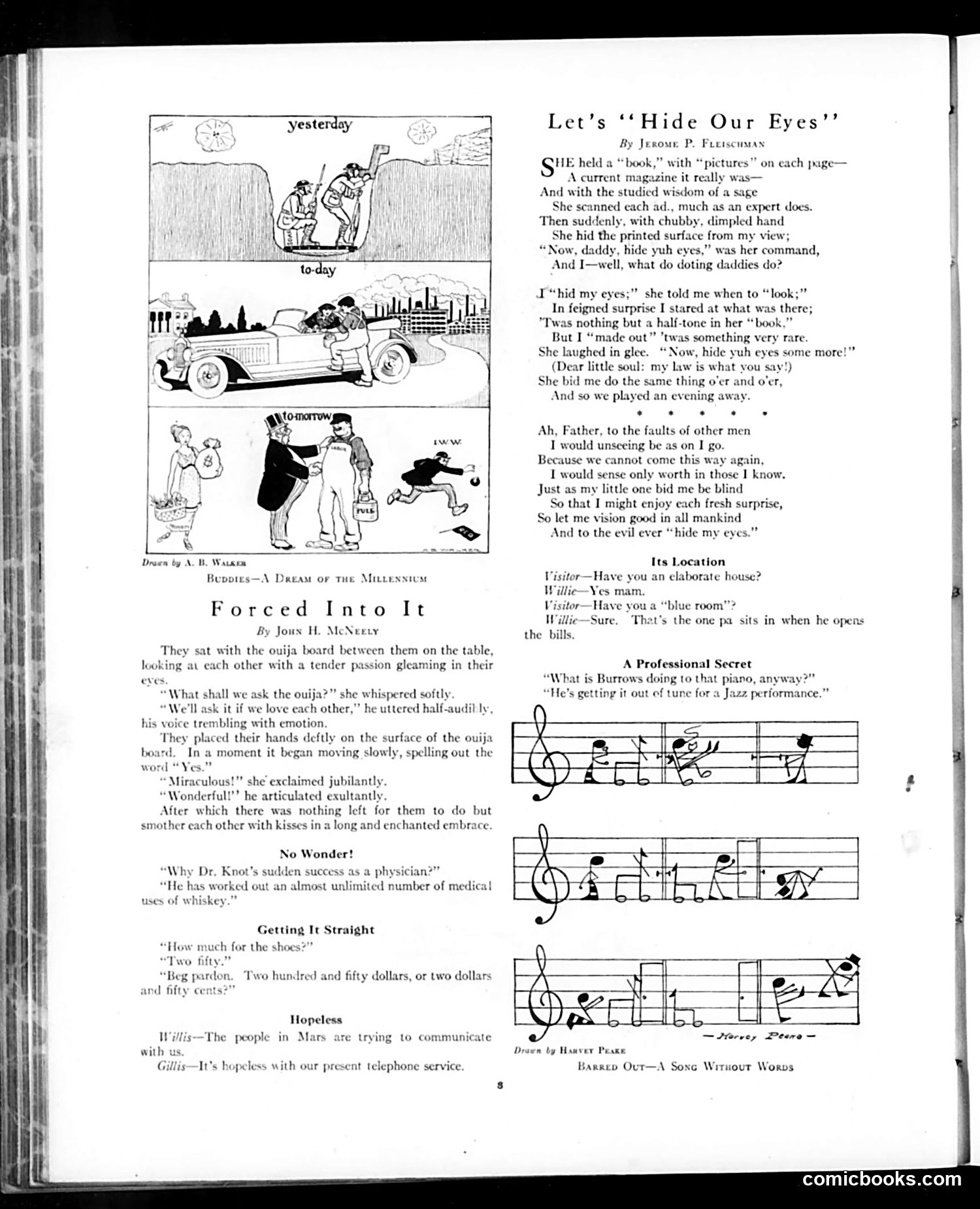
This page contains several satirical pieces reflecting early 20th-century American attitudes: **"Let's Hide Our Eyes"** depicts a father and daughter playing with a magazine. The satire suggests that advertising—particularly objectionable ads—fills publications so thoroughly that one must literally hide from them to enjoy content. The poem's closing plea to "hide my eyes" to evil in mankind reflects period anxieties about moral corruption. **"Forced Into It"** mocks spiritualism's popularity, showing a couple using a Ouija board. The joke: the "supernatural" answer "Yes" to whether they love each other is so obvious that the supernatural apparatus becomes pointless—they simply need an excuse to embrace. **"A Professional Secret"** jokes about Jazz music being intentionally out-of-tune, reflecting conservative disapproval of jazz as discordant and illegitimate. **Smaller gags** reference Prohibition-era medicine (whiskey as cure-all), real estate pretension ("blue room" as euphemism for debt), and telephone technology limitations. The overall tone reflects genteel, middle-class satirical humor of the Jazz Age era.
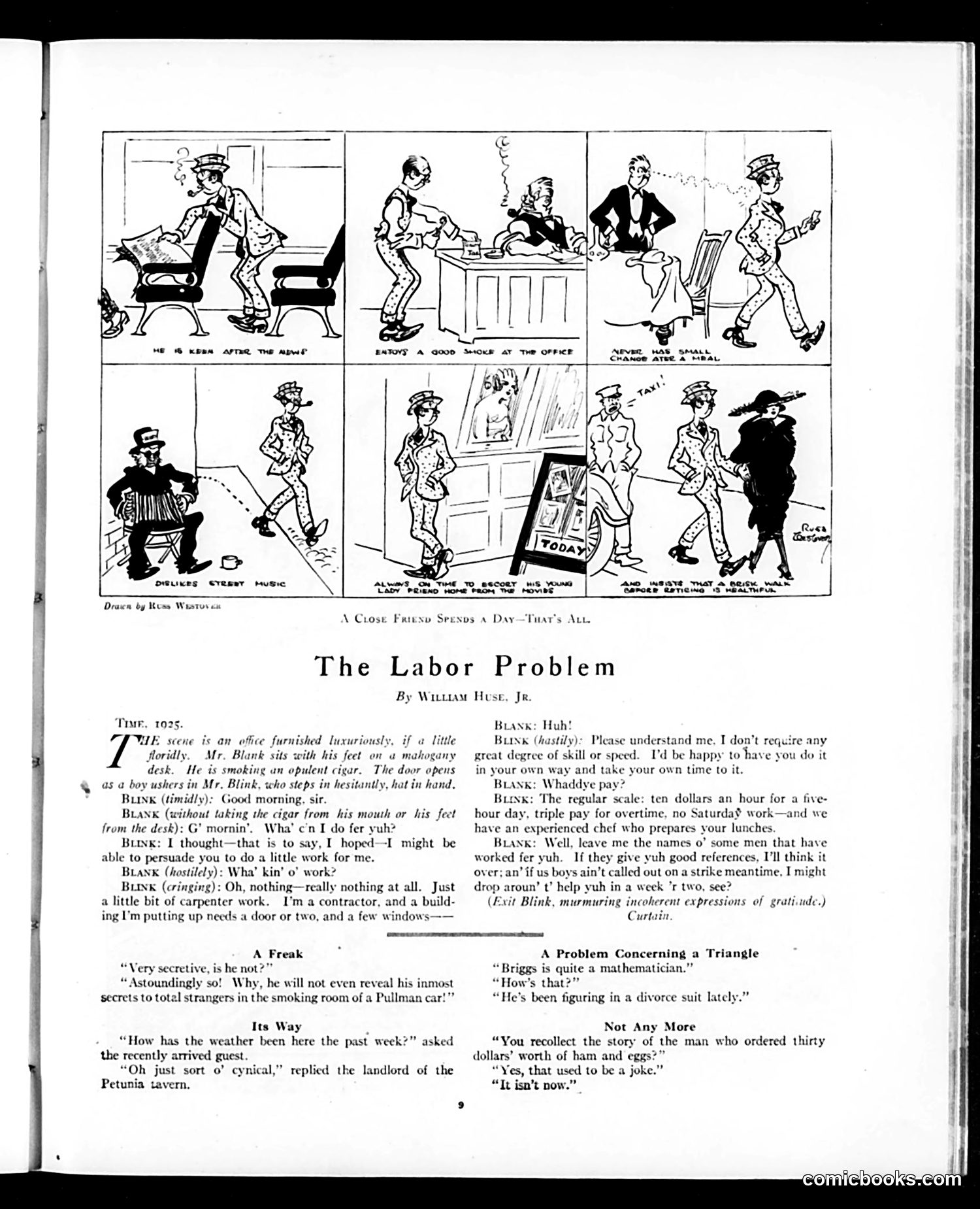
This satirical piece mocks the perceived arrogance of laborers in the 1920s. Mr. Blank, a wealthy contractor seeking to hire a carpenter (Mr. Blink) for minor work, is shocked by Blink's wage demands: ten dollars hourly, triple overtime pay, no Saturday work, and provided meals—plus requirements for references and threats of striking. The humor inverts typical power dynamics: the desperate job-seeker becomes the demanding party, while the employer is reduced to supplication. The accompanying comic strip shows various scenarios of a "close friend" spending a day together, likely illustrating wasteful leisure that contrasts with the carpenter's high-maintenance work expectations. This reflects post-WWI labor tensions, when unionization and worker organizing gained strength. Judge magazine, a conservative publication, used this piece to ridicule what it portrayed as unreasonable worker demands and entitlement—a common editorial stance among elite publications opposing labor movements.
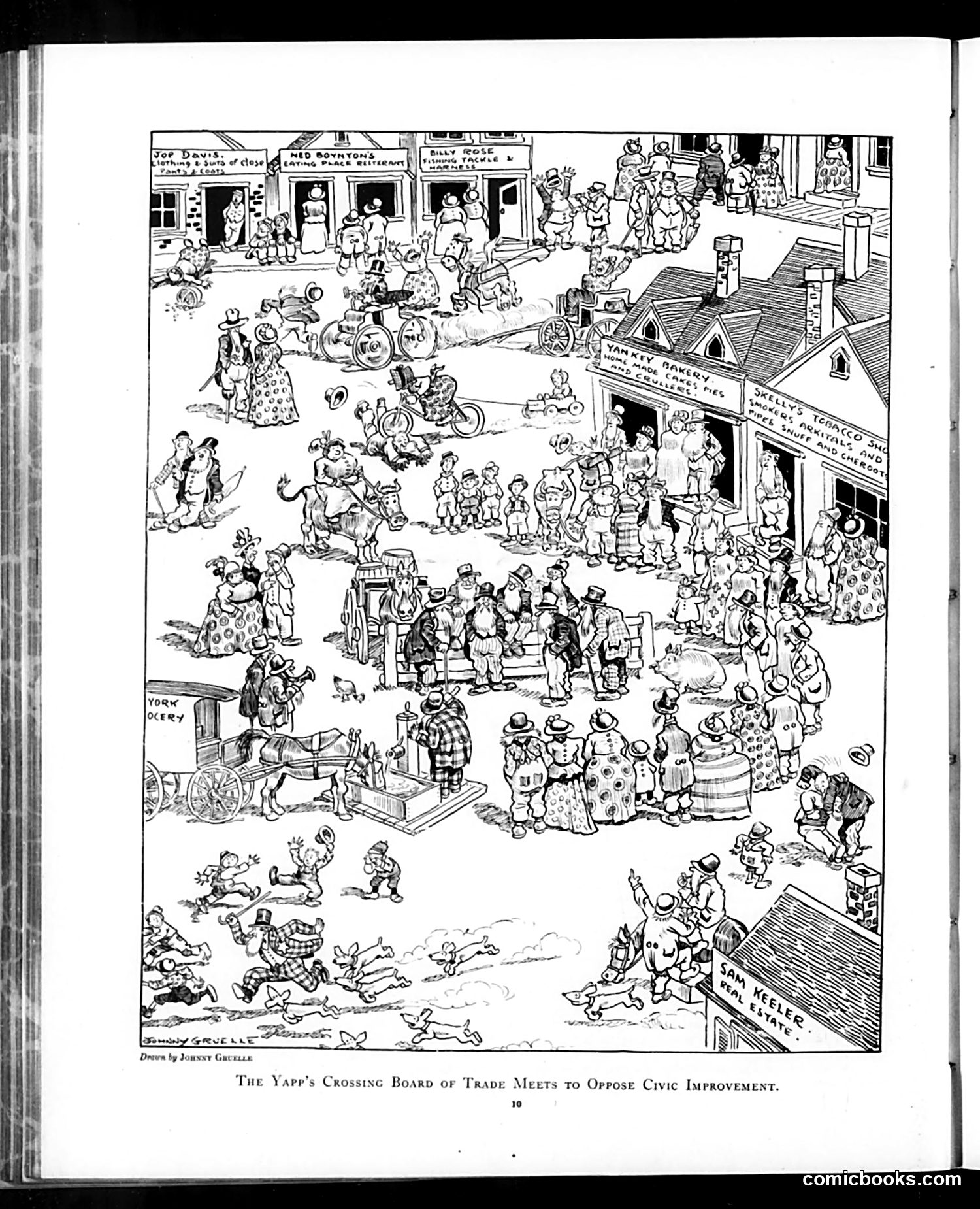
This is a single satirical cartoon titled "The Yarr's Crossing Board of Trade Meets to Oppose Civic Improvement." The cartoon depicts a crowded street scene with storefronts (Joe Davis, Mid Boynton's, Billy Rose) and numerous figures engaged in various activities—some playing instruments, children running, adults socializing. The scene appears chaotic and bustling. The satire targets a local "Board of Trade" (a merchants' association) for opposing civic improvements to what appears to be a neighborhood thoroughfare or public space. The cartoon suggests these business interests resist improvements that would modernize or beautify their area, likely fearing costs or disruption to commerce. The detailed street-life illustration emphasizes the working-class or immigrant neighborhood character, satirizing how business groups prioritize profit over community welfare. The artist is credited as Johnny Gruelle (likely the illustrator).
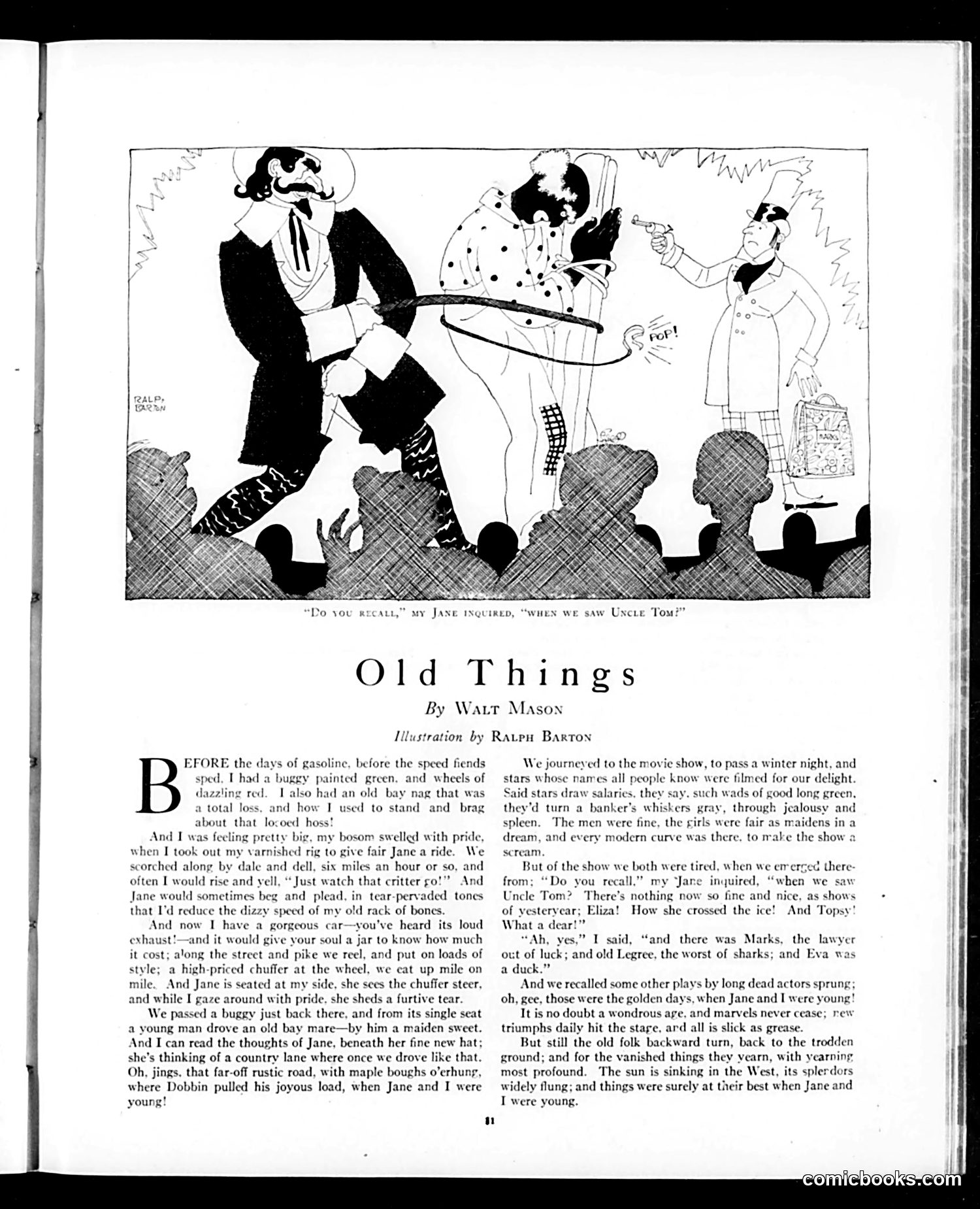
This nostalgic essay-poem laments the loss of simpler pleasures displaced by modern technology and entertainment. The accompanying illustration by Ralph Barton depicts a theater scene where an elegantly dressed couple watches a performance—likely referencing the contemporaneous popularity of cinema over older theatrical forms. Mason contrasts two eras: his youth, when a modest buggy ride with "Jane" felt thrilling, versus the present, where expensive automobiles and lavish movie productions leave him emotionally hollow. Crucially, the text references *Uncle Tom's Cabin*—specifically the characters Marks, Legree, Eliza, and Eva—indicating these were once popular stage productions that moved audiences deeply. The satire targets modern materialism and spectacle. Despite technological advancement and expensive entertainments, the narrator finds them spiritually empty compared to the genuine connection he felt during simpler courtship days and older theatrical works. The "old folk" who "backward turn" represent a broader 1920s anxiety about progress displacing authentic human experience.
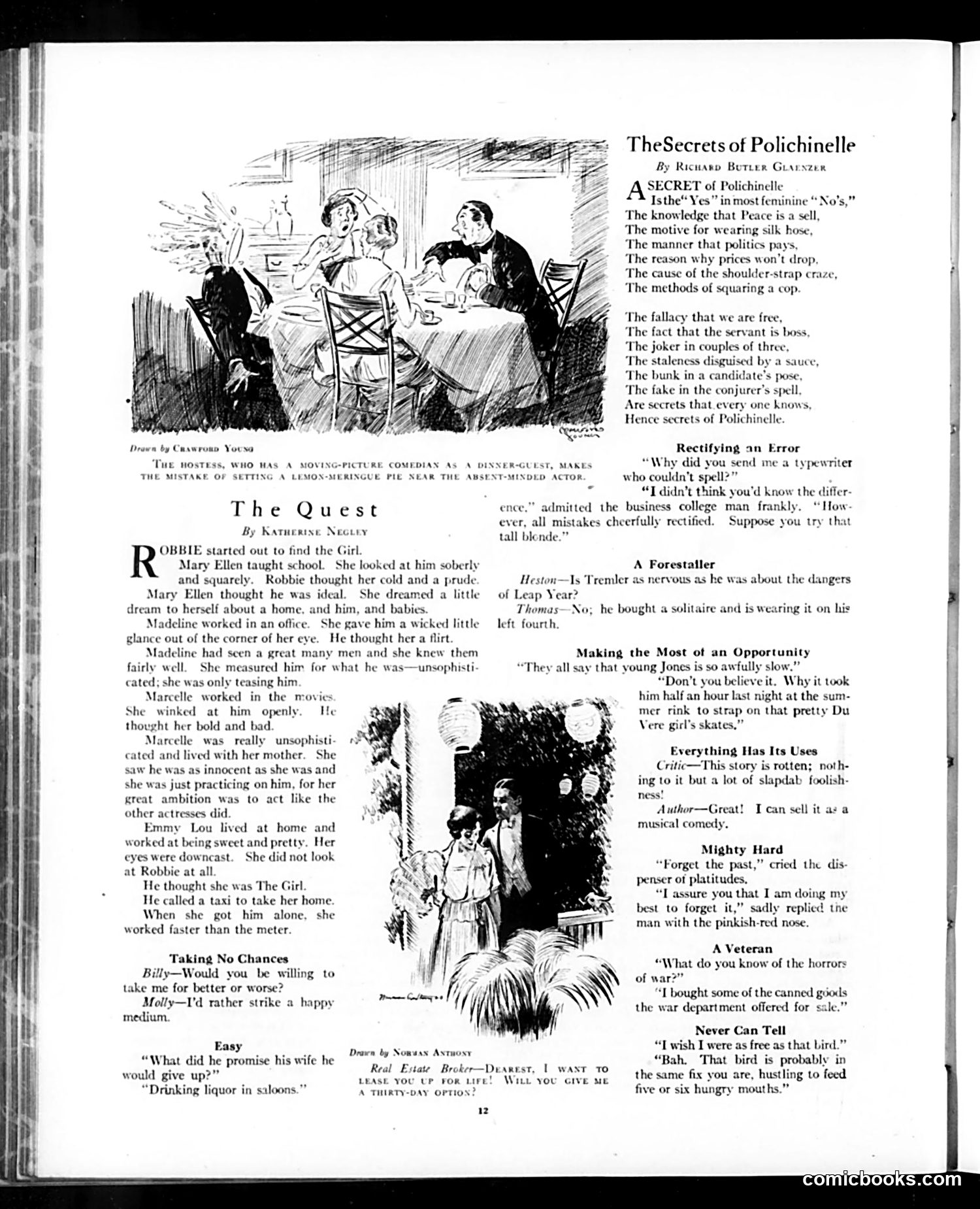
This page contains several short satirical pieces typical of early 20th-century American humor magazine content. **"The Secrets of Polichinelle"** (top right) lists supposedly hidden truths about society that "everyone knows" — that peace is a commodity, servants actually control households, politicians are corrupt, and one can bribe police ("squaring a cop"). The satire mocks the pretense that these obvious facts remain secret. **"The Quest"** (center) is a romantic short story parodying sentimental fiction, where an innocent man mistakes various women's behavior (coldness, flirtation, practiced seduction) for genuine emotion. The remaining items are brief one-liners satirizing contemporary concerns: business incompetence, materialism disguised as romance (buying jewelry for "Leap Year" proposals), the commercialization of art (bad stories sold as musicals), prohibition-era drinking, wartime profiteering, and poverty. The humor relies on cynicism about human nature and social hypocrisy — characteristic of Judge's satirical approach.
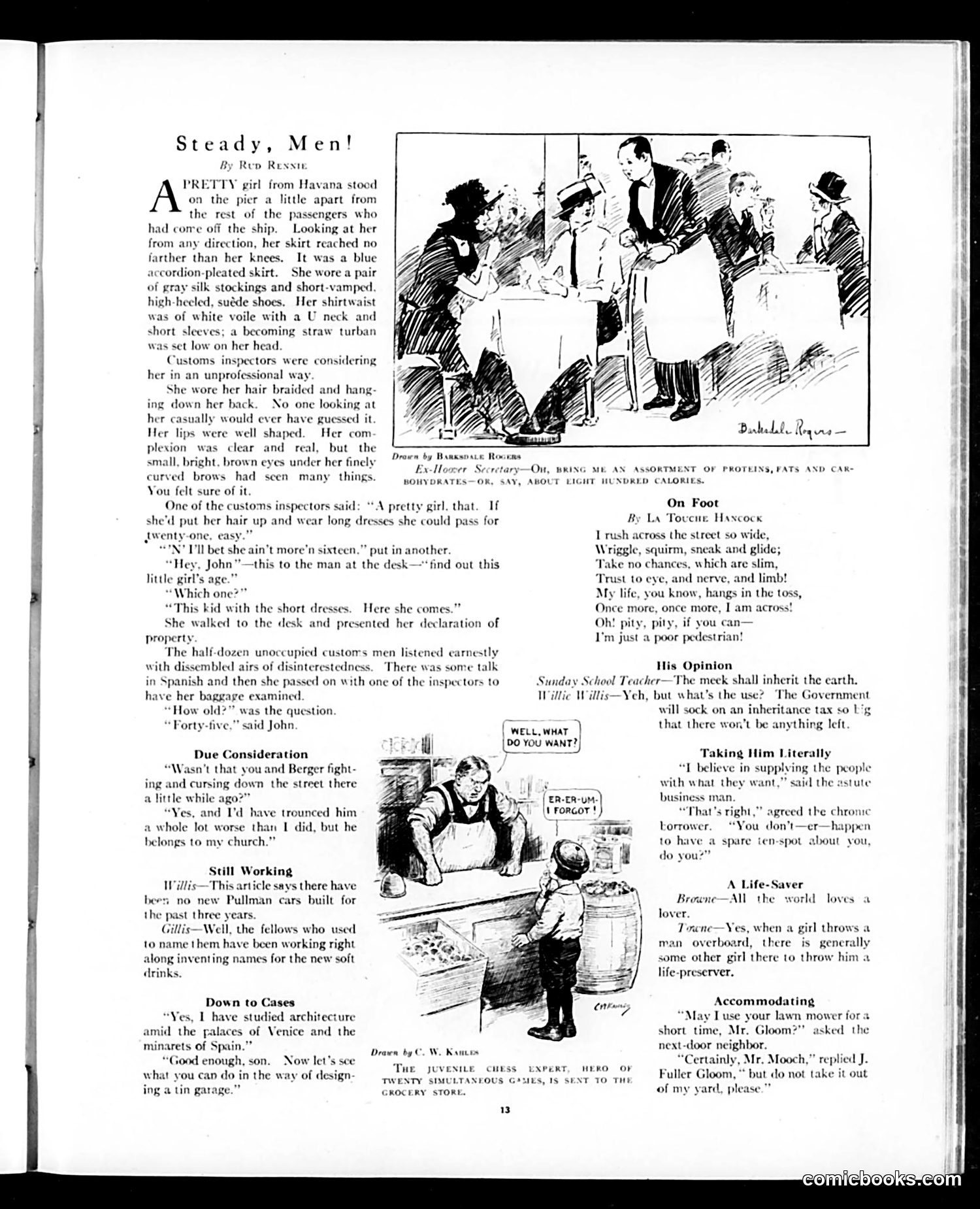
This page contains multiple short humor pieces typical of early 20th-century American satire. The main story, "Steady, Men!" mocks customs inspectors at a port (likely New York) who become distracted by an attractive young woman from Havana. The joke hinges on her declaring her age as "forty-five" to pass inspection—suggesting she's actually much younger and the inspectors were too smitten to verify her claim properly. This satirizes both male workplace conduct and lax customs enforcement. The surrounding comic vignettes target various social absurdities: a chess prodigy confused with grocery goods, pedestrian traffic dangers, and class pretensions (studying Venetian architecture but designing tin garages). The "His Opinion" piece mocks both progressive wealth redistribution and Sunday school platitudes about meekness. Overall, the page reflects early 1900s concerns about immigration, gender dynamics, and urban modernization, presented through gentle, domestic humor rather than sharp political critique.
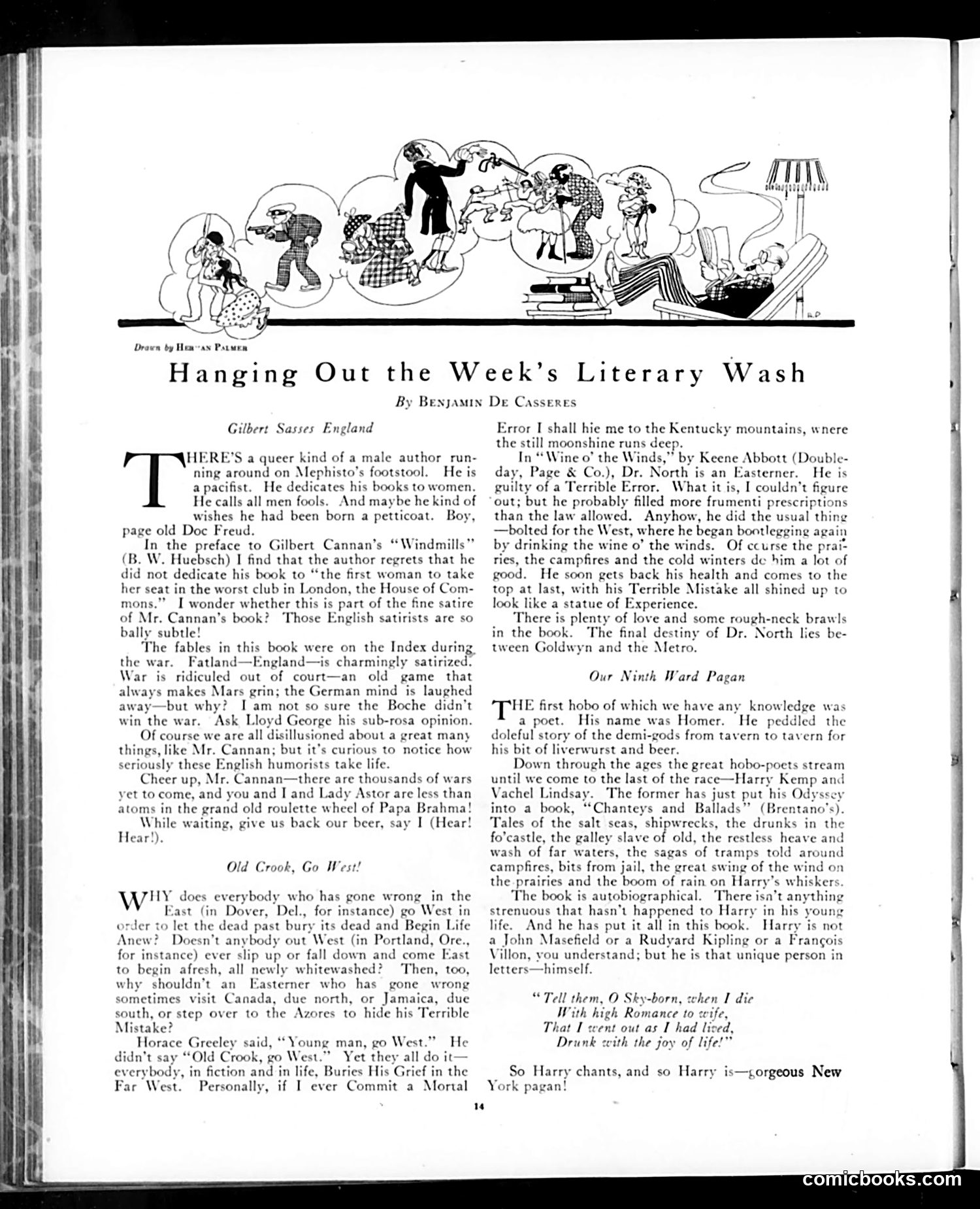
This satirical literary review by Benjamin De Casseres critiques three contemporary books through mock-serious commentary. The title cartoon shows various authors being hung out like laundry—a humorous visual metaphor for reviewing recent literary output. **Gilbert Cannan's *Windmills***: Casseres mocks Cannan as an effeminate pacifist who dedicates books to women and calls men fools, invoking Freud satirically. He notes Cannan's regret at not dedicating work to "the first woman to take her seat" in Parliament, sarcastically questioning whether this represents subtle English satire. **Keene Abbott's *Wine o' the Winds***: The reviewer ridicules the clichéd literary trope of the disgraced protagonist fleeing East to reinvent himself in the West—here, a doctor with a vague "Terrible Error" who bootlegs moonshine and finds redemption through frontier hardship. **Harry Kemp's *Chanteys and Ballads***: Casseres celebrates Kemp as the last in a lineage of "hobo-poets" from Homer onward, praising his autobiographical tales of maritime and vagrant life. Throughout, Casseres employs sardonic humor and cultural allusions to deflate literary pretensions of the era.
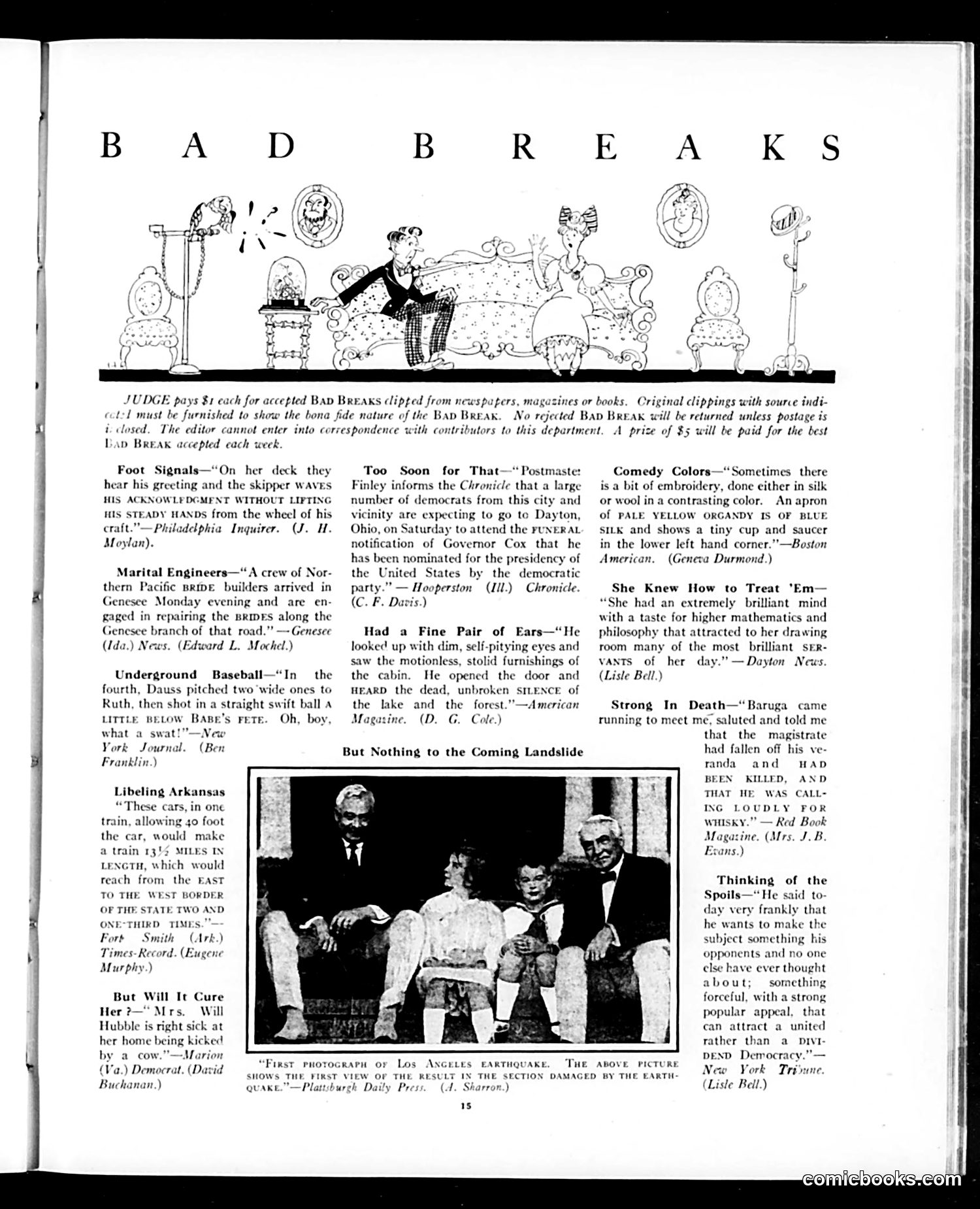
This page features Judge magazine's "Bad Breaks" column—a satirical feature that paid readers $1 for humorous printing errors or awkward phrasings clipped from newspapers and magazines. The examples mock unintentional double meanings created by poor editing: - **"Foot Signals"**: A ship captain's waves become hilariously ambiguous - **"Underground Baseball"**: Ruth's position "below base" creates an unintended joke - **"Marital Engineers"**: A phrase about railroad builders becomes accidentally suggestive - **"Too Soon for That"**: Democrats attending Governor Cox's funeral notification for his presidential nomination—the timing seems inappropriately connected The photograph shows the 1915 Los Angeles earthquake aftermath, contextualizing contemporary events. The joke is fundamentally about **careless journalism**—how rushed editing produces absurd, often risqué meanings that mock both the original publications and reading comprehension. It's early 20th-century media criticism disguised as humor, celebrating Judge's superiority over inferior competitors' proofreading.
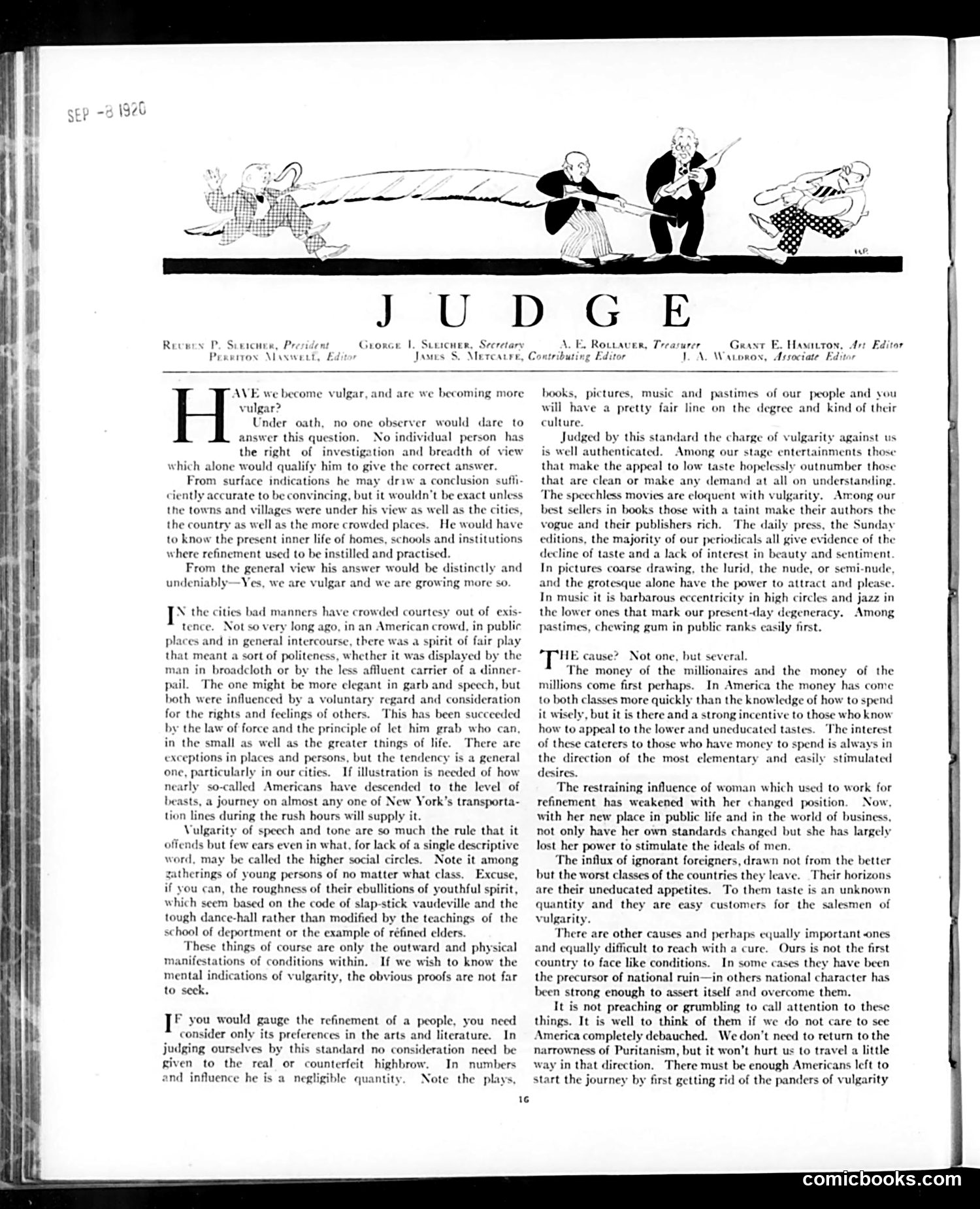
This editorial piece, not a political cartoon, tackles American cultural decline. The decorative header shows figures in a tug-of-war, symbolizing societal tension. The article argues Americans are becoming increasingly vulgar—evidenced by declining manners in cities, coarse language among youth, and poor taste in entertainment. The author claims this vulgarity reflects deeper moral decay: entertainment prioritizes lowbrow appeal over refinement; bestselling books contain "taint"; movies are "eloquent with vulgarity." The piece blames multiple causes: wealth enabling poor taste, women's weakened "restraining influence" as they entered public life and business, and ignorant immigrants lacking education. The author suggests America has descended to "the level of beasts," citing subway behavior during rush hours. This reflects 1920s anxieties about modernization, immigration, and changing social roles—common Judge magazine themes during this period of rapid cultural transformation and generational conflict.
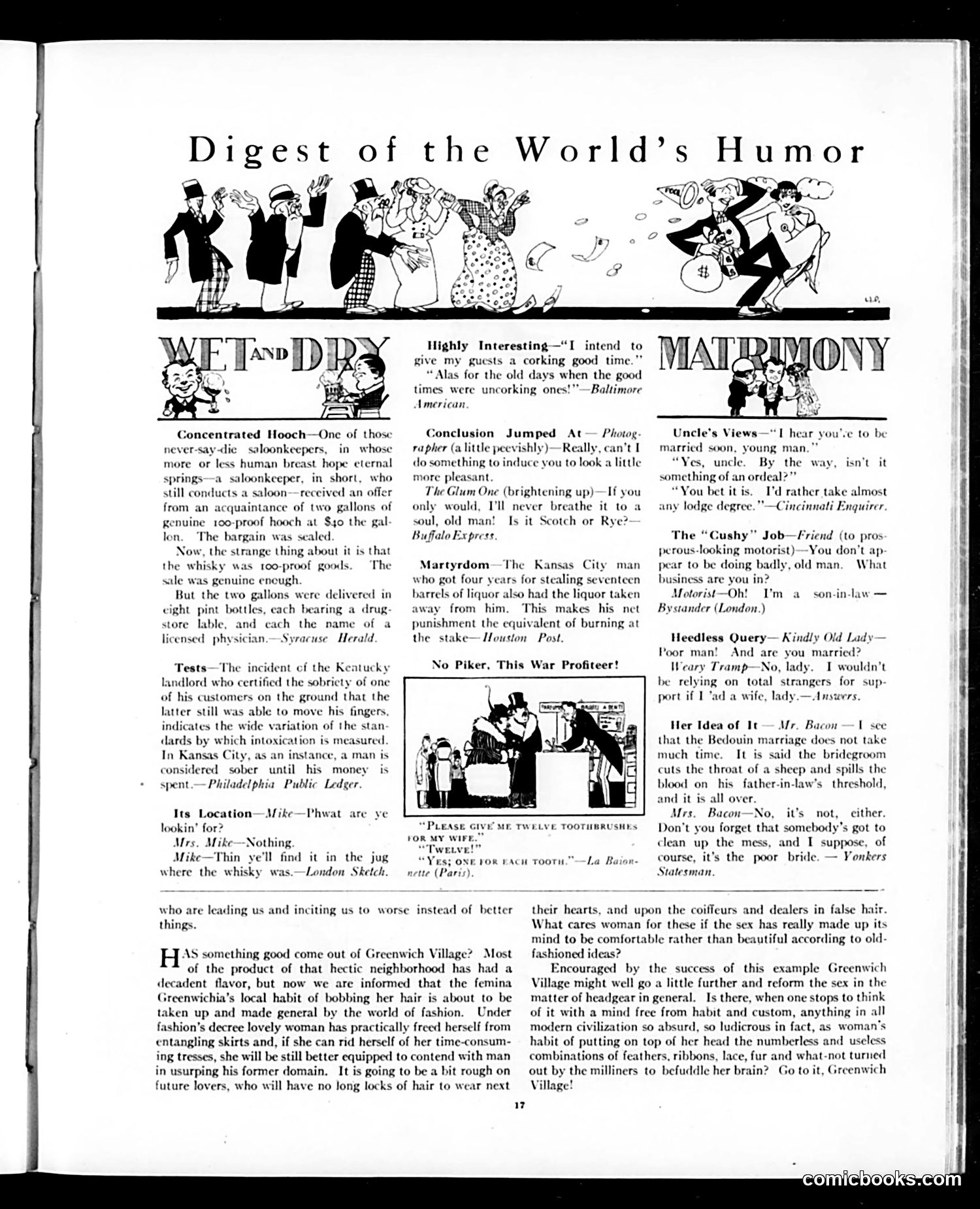
This page from Judge presents multiple short humorous pieces satirizing Prohibition-era America and social customs. **"Concentrated Hooch"** mocks a saloonkeeper selling whisky disguised in medicine bottles labeled with fake doctors' names—a common Prohibition-era workaround to evade alcohol bans. **"Tests" and "Location"** joke about varying standards for measuring drunkenness and the obsessive search for hidden liquor. **"No Piker, This War Profiteer!"** appears to criticize war profiteers (likely from WWI) who exploited the conflict for personal gain. **The Greenwich Village passage** sarcastically notes that while bohemian culture typically produces poor results, at least women's bobbed hair fashion is spreading—though this freedom from "entangling skirts" gives women unfair advantage over men. The remaining items satirize marriage customs, class differences ("The Cushy Job"), and dated gender expectations—all typical Judge humor targeting contemporary social pretensions and hypocrisy.
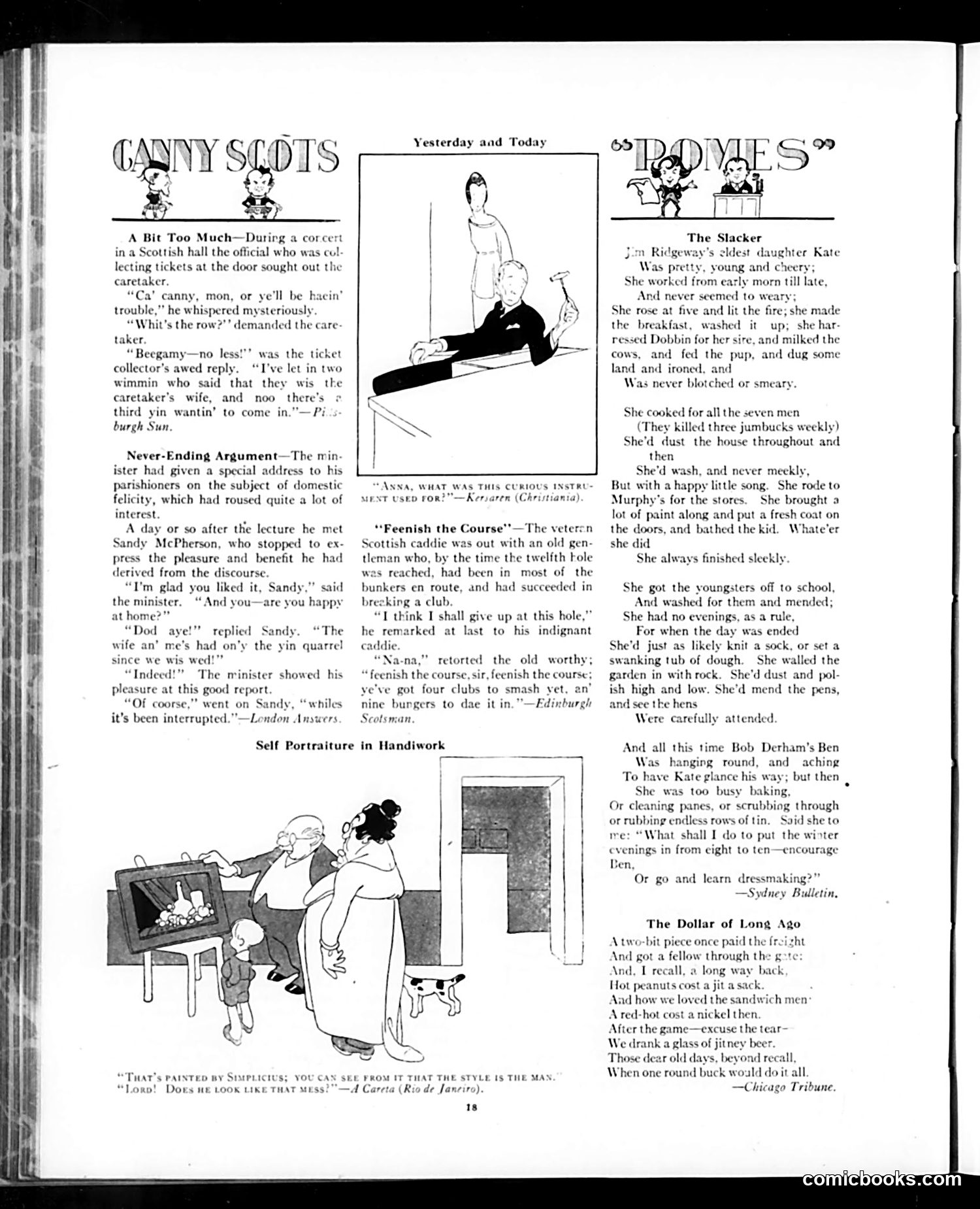
This page from *Judge* contains Scottish humor and domestic satire typical of early 20th-century American publications. **"Gandy Scots"** presents three brief Scottish anecdotes emphasizing dialect comedy and marital conflict: - A ticket collector's mishap (a man admits his wife *and* two other women claiming to be his wife) - A minister's surprise that a parishioner's marriage quarrel only seemed interrupted (implying constant fighting) - A golf caddie's persistence, encouraging a struggling player to finish despite breaking clubs **"Domes"** contains "The Slacker"—a poem contrasting a hardworking rural woman (Kate) with Bob Derham's idle "Ben." Kate performs endless labor (cooking, cleaning, farming, childcare) while Ben merely hangs around hoping for her attention, unable to compete with her work ethic. The satire targets male idleness. **"Self Portraiture in Handiwork"** shows a couple viewing a Simplicius painting, with the woman sarcastically noting the artist's "style" matches the messy subject—likely satirizing modern art's lack of realism. These pieces reflect period attitudes: Scottish caricature, domestic discord as humor, and gender expectations around work.
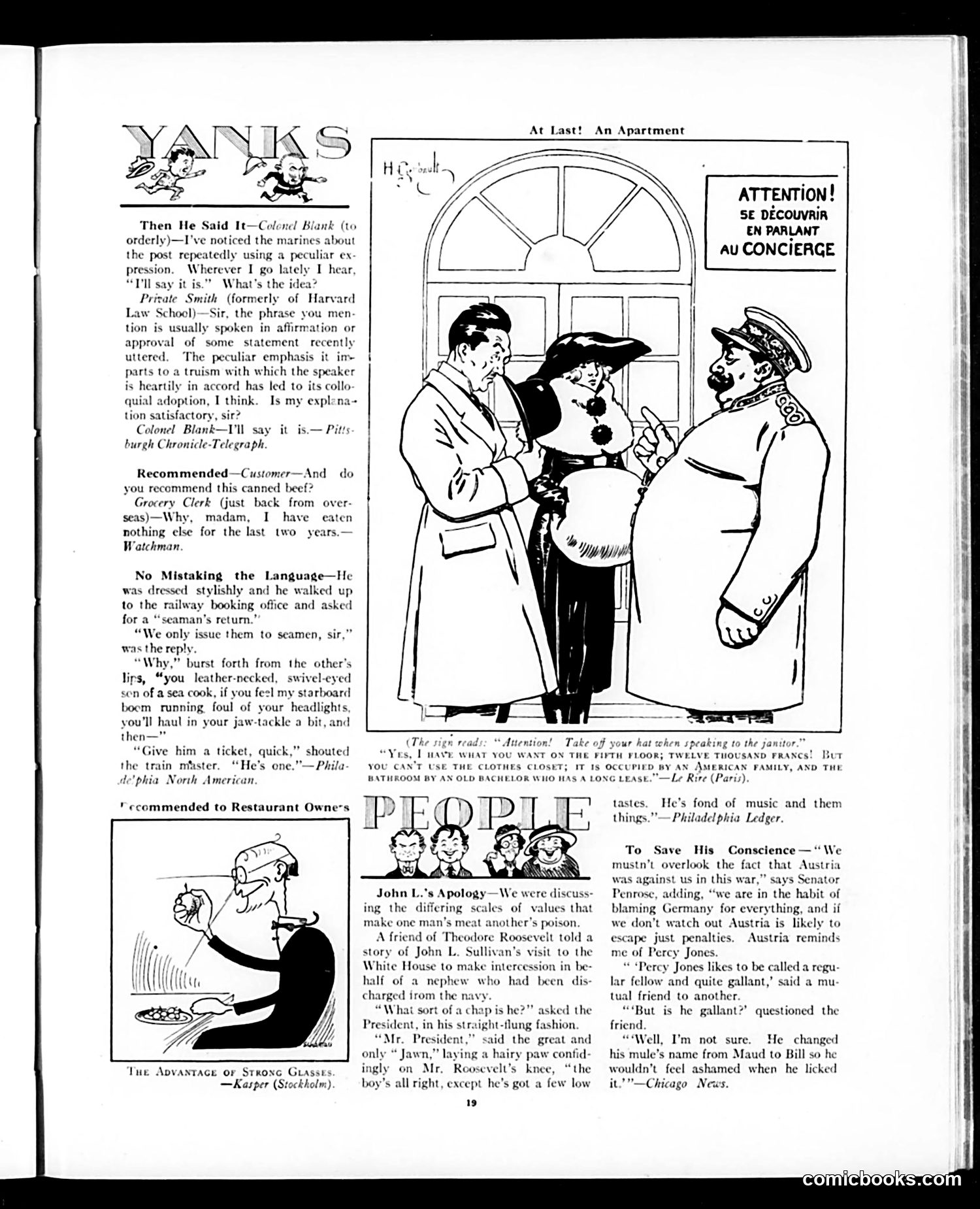
This page contains several short humor pieces typical of early 20th-century American satirical magazines: **Main Cartoon ("At Last! An Apartment"):** A Parisian apartment-hunting scene mocking post-WWI housing scarcity in France. The joke depicts a landlord offering an apartment but admitting the closet is occupied by an American family and the bathroom by a long-term tenant—suggesting desperate overcrowding and that even Americans were staying in Paris (likely related to post-war occupation or reconstruction). **Other Jokes:** Include military humor ("I'll say it is"), grocery clerks bragging about eating canned rations during wartime, and wordplay about "seaman's return" train tickets. **"John L.'s Apology":** References boxer John L. Sullivan's (apparent) visit to President Theodore Roosevelt's White House, playing on cultural differences in how working-class figures speak and value things. The page reflects post-WWI American humor—housing crises in Europe, lingering military experiences, and cross-cultural observations about returning servicemen and European reconstruction.
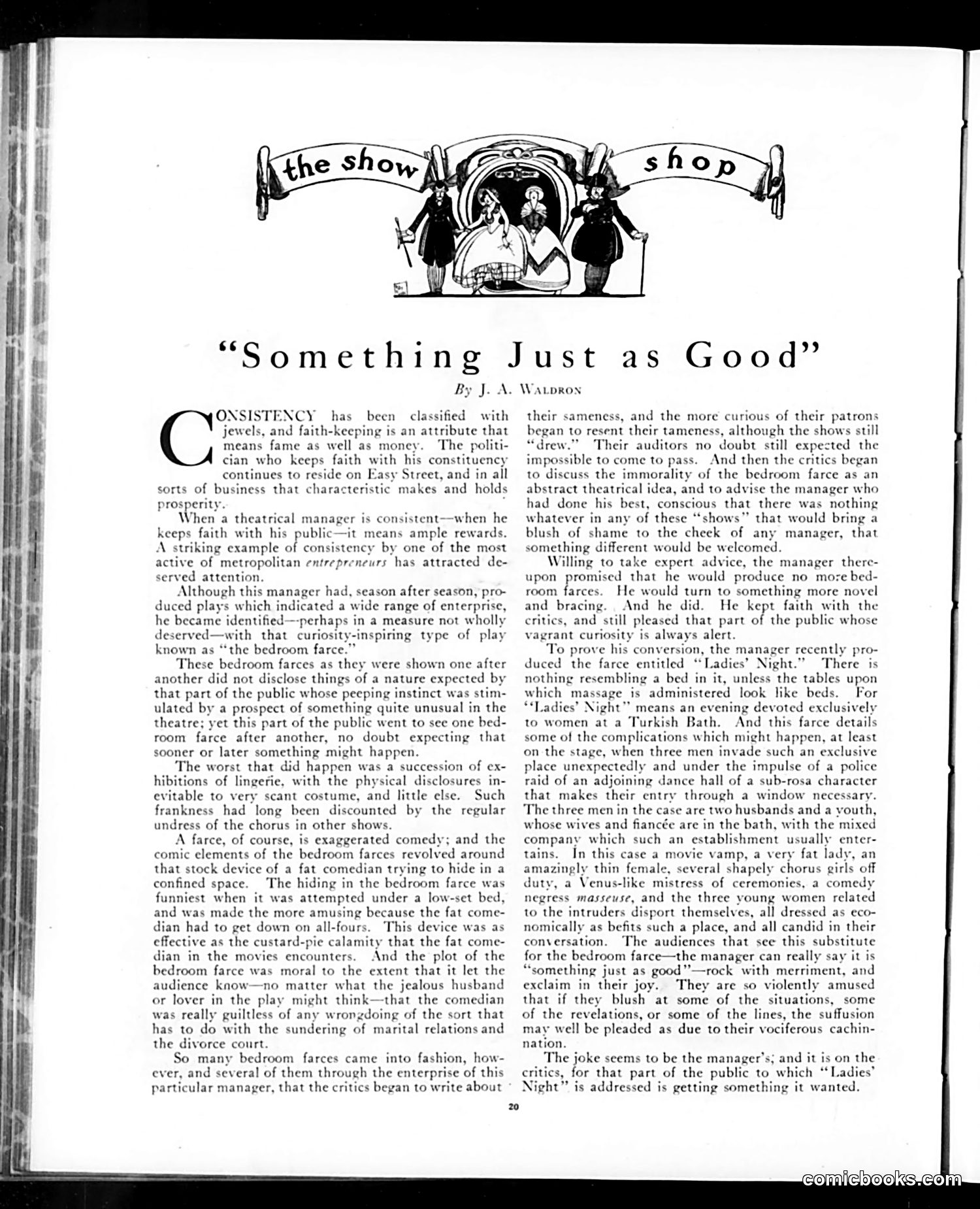
This article satirizes a Broadway manager who produces "bedroom farces"—light comedies featuring scantily-clad women and slapstick humor (fat comedians hiding under beds). Critics attacked these shows as immoral, though they were actually harmless and morally innocent. The satire's point: When critics demanded the manager produce "something different," he obliged by creating "Ladies' Night"—set in a Turkish bath instead of a bedroom, but essentially the same show with the same thin pretense of respectability. The cartoon's header illustration depicts a theatrical production, supporting the article's discussion of stage entertainment. The author mocks both the prudish critics and the manager's cynical "solution"—proving that changing a farce's *location* doesn't change its fundamental nature or intent to titillate audiences with lingerie and female bodies.
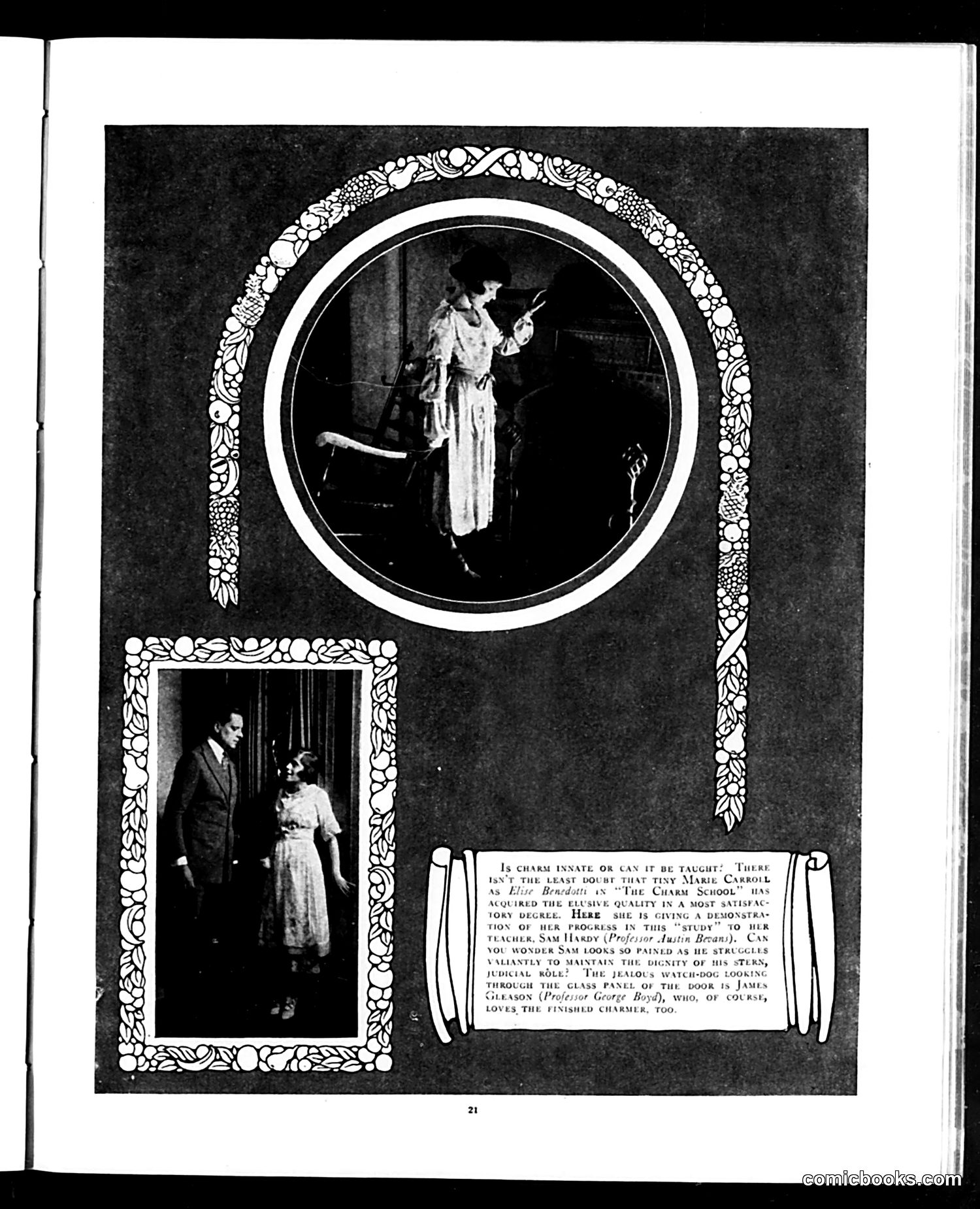
This page presents two theatrical scenes with decorative Art Nouveau framing. The upper circular image shows a woman in a light gown appearing to teach or demonstrate charm to another figure. The lower rectangular image depicts what appears to be a domestic or social interaction between two people. The visible text discusses whether charm "can be taught" and references a character named Marie Carroll who has "acquired the elusive quality." It mentions professors Sam Harry and George Boyd observing her progress in a "study" demonstrating charm development. The satire appears to mock the early 20th-century fascination with etiquette instruction and self-improvement courses—particularly the notion that refined social graces could be systematically taught rather than naturally possessed. The decorative framing and theatrical presentation emphasize the artificiality of such instruction, suggesting skepticism about manufactured "charm" as a teachable commodity.
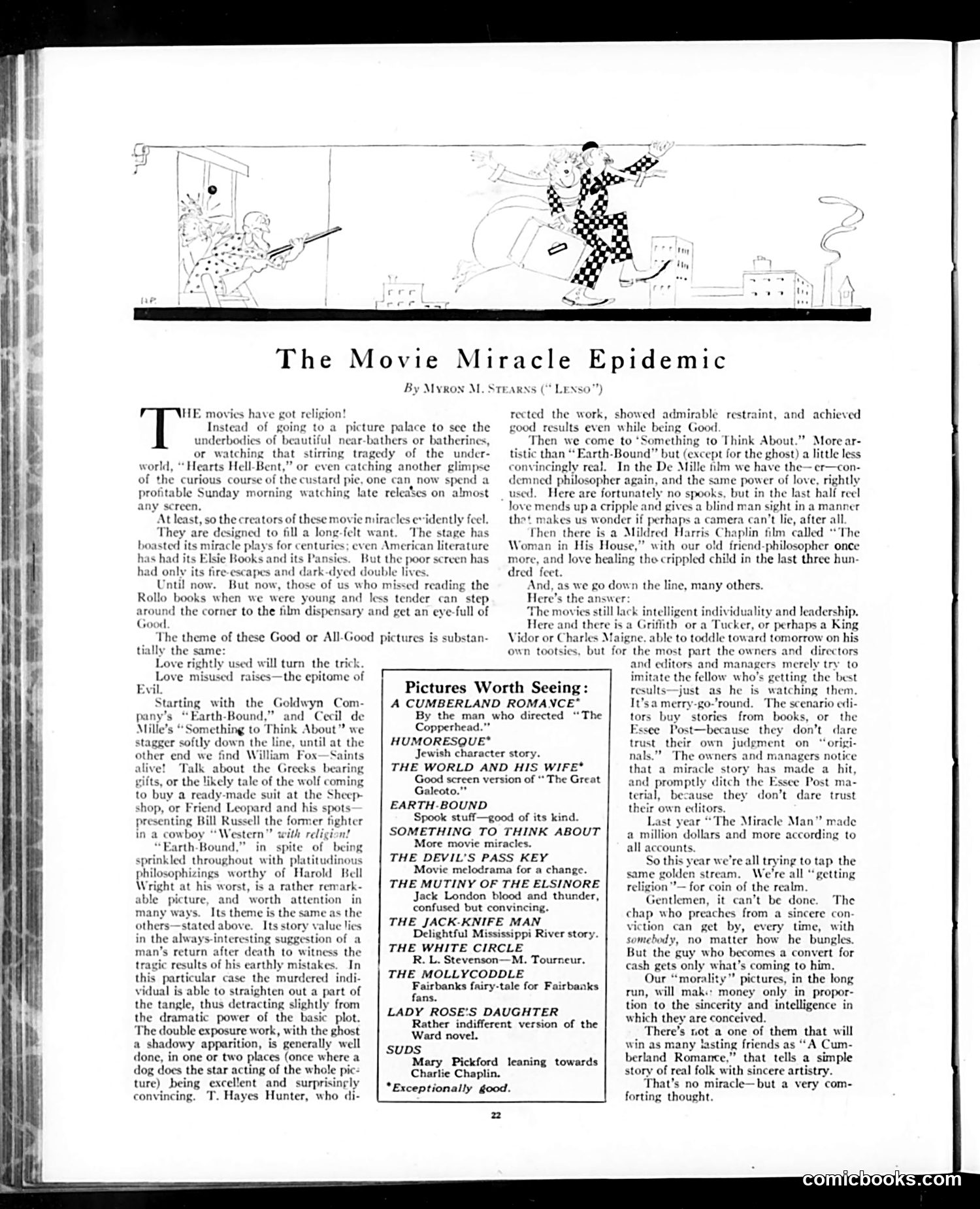
This satirical article by Myron M. Stearns critiques a trend in 1920s cinema: "religious" or morality-focused films where love solves all problems. The piece mocks movies like Cecil B. DeMille's "Something to Think About," "Earth-Bound," and Mildred Harris Chaplin's "The Woman in His House"—films featuring ghosts, crippled children healed by love, and philosophical platitudes. Stearns' satire targets the formulaic nature of these pictures: they all repeat the same message that "love rightly used will turn the trick" while "love misused raises the epitome of Evil." He ridicules the absurdity of casting unlikely figures (like boxer Bill Russell) in religious roles and mocks the reliance on special effects (double-exposure ghosts) to create emotional impact. The cartoon at top shows filmmakers literally "shooting" moral lessons like weapons at audiences. Stearns concludes these films lack "intelligent individuality and leadership"—they're manufactured sentiment rather than genuine artistry, cynically exploiting audiences' desire for moral uplift.
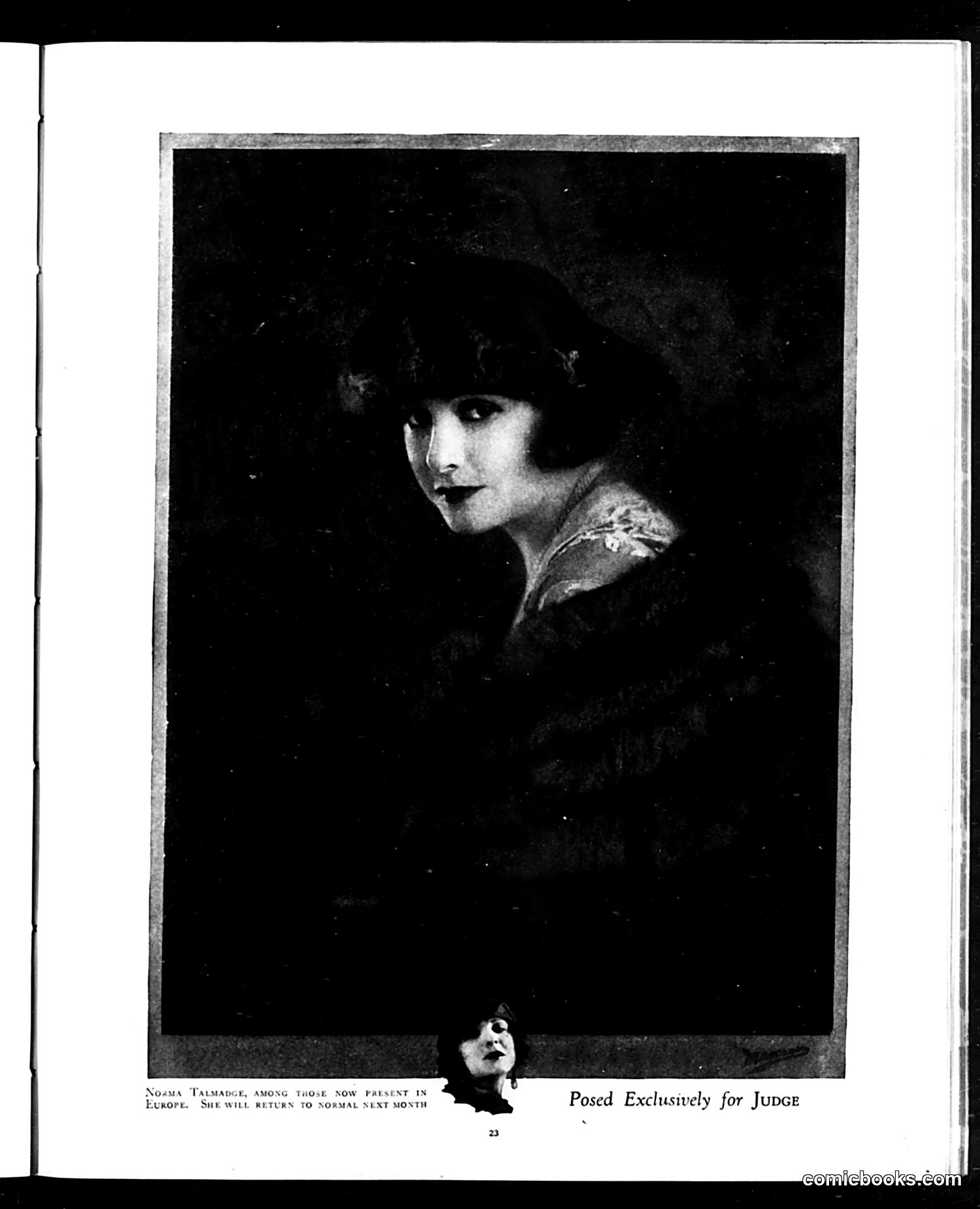
This page features a portrait photograph rather than a political cartoon. The caption identifies the subject as "Norma Talmadge," a silent film actress, noting she is currently in Europe and will return to normal next month. The photograph is labeled "Posed Exclusively for Judge." This appears to be a celebrity feature rather than satire—Judge magazine frequently published glamour photography of entertainment figures alongside their editorial content. The "normal" reference likely means she'll resume her regular film work. The page demonstrates how early 20th-century magazines blended celebrity culture with satirical commentary, using star power to boost readership. Without additional context about Talmadge's 1920s activities or any concurrent scandal, the specific topical relevance remains unclear.
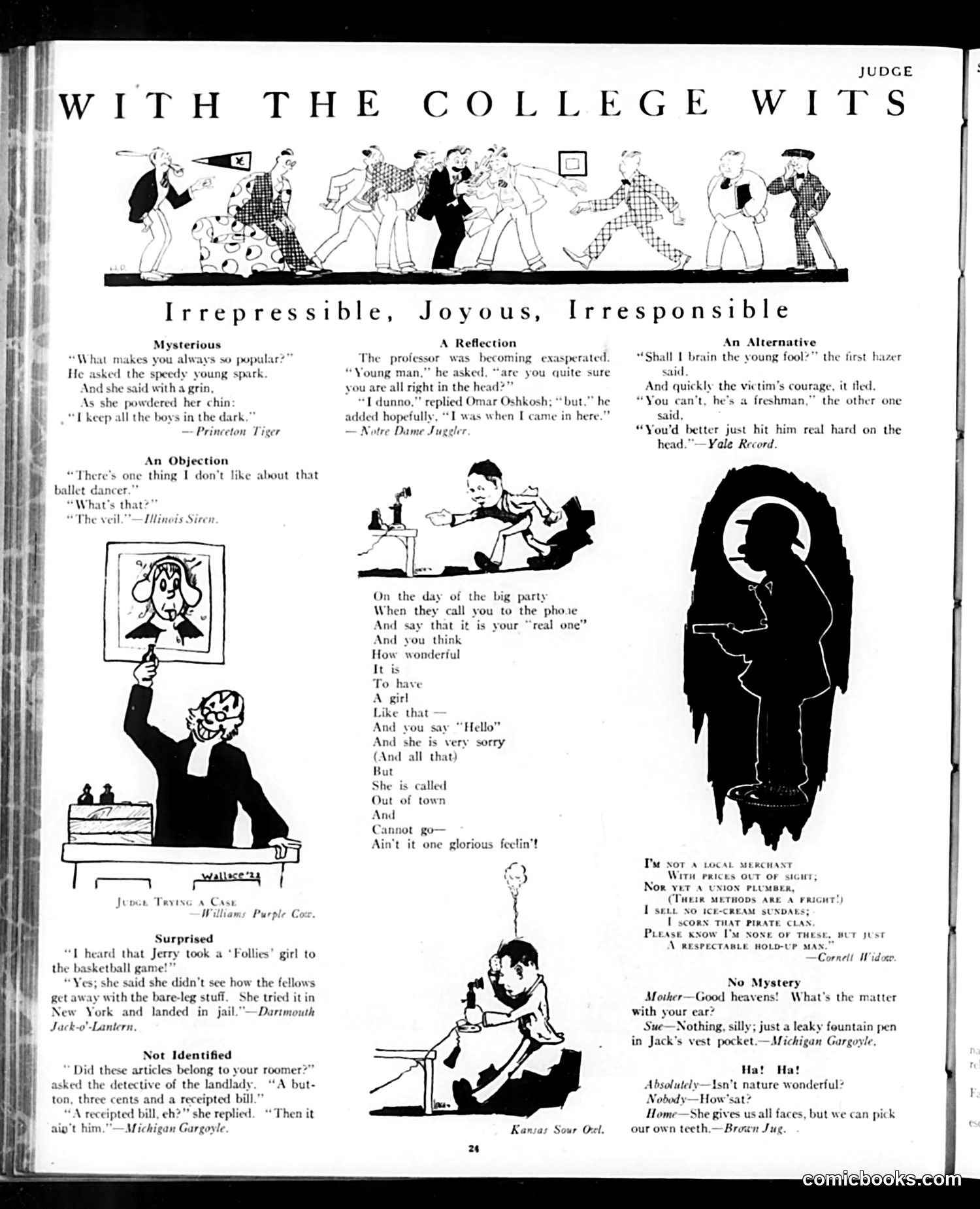
This is a college humor page from *Judge* magazine featuring jokes and cartoons about dating, hazing, and young adult misbehavior circa 1920s. **Key content:** - **"Mysterious"**: A young woman's popularity secret is keeping boys confused/in the dark. - **"An Objection"**: A ballet dancer wearing a veil is criticized—the joke implies the veil is the only modest thing about the performance. - **"Surprised"**: A woman who attended a Broadway "Follies" show (famous for scantily-clad dancers) attempted similar costuming in New York and was arrested. - **"An Alternative"**: Yale hazing joke about whether to "brain" (hit) a freshman. - **"A Reflection"**: A poem about romantic disappointment when a date cancels last-minute. The page satirizes college-age romance, risqué entertainment (the Follies), petty crime, and hazing culture. The cartoons assume readers understand Jazz Age social conventions and collegiate traditions now largely obsolete.
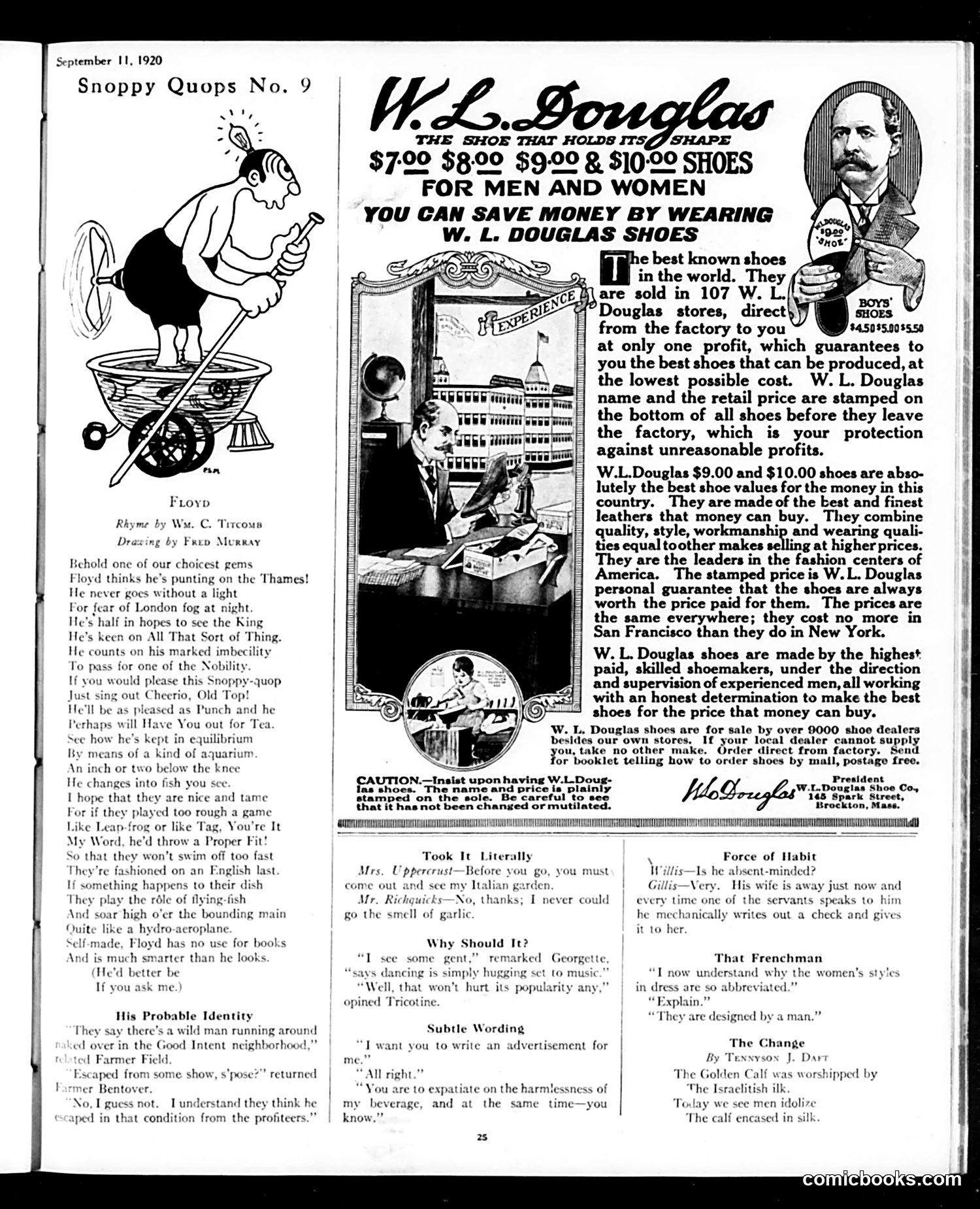
The cartoon depicts "Floyd," a comically exaggerated British-obsessed character. The satire targets the type of American who slavishly imitates English mannerisms and pretends to aristocratic status. Floyd's defining trait is his absurd affectation: he carries a light to protect himself from "London fog," constantly references the King, and adopts English phrasing ("Cheerio, Old Top"). The poem mocks his transparent social climbing, noting he "counts on his marked imbecility / To pass for one of the Nobility." The cartoonist (Fred Murray, writer W.C. Titcomb) ridicules this performative Anglophilia as pretentious and ridiculous. The surreal image—Floyd standing in an aquarium-like device to maintain balance—suggests the artificiality and instability of his affected persona. A secondary joke appears in "His Probable Identity," where a "wild man" escaping from profiteers is discussed, likely referencing post-WWI economic anxieties about war profiteers. The page is otherwise dominated by a W.L. Douglas shoe advertisement.
This is primarily an **advertising and humor page** from Judge magazine, likely from the early 1900s (WWI era, based on references to "the war" and Prohibition/"Demon Rum"). **Main Content:** The central feature is "American Notes of My Butler, Horatio Chutney"—a humorous poem in exaggerated Cockney dialect mocking a British butler's observations of America. The satire targets American social contrasts: working classes spending lavishly while the wealthy seem less affluent, the aggressive bill-collecting of tradespeople, and Americans' public physical affection compared to British restraint. The butler's dropped h's and malapropisms (e.g., "h'aristocratic people") were standard period humor mocking working-class British accents. **Sidebar jokes** include typical magazine filler: marriage misunderstandings, a waiter's sarcastic response about soup quality, and commentary on telephone service changes. The page is **primarily advertising-driven**, featuring garter hose, diamonds, dog medicine, and shipping bureaus—reflecting Judge's commercial model.
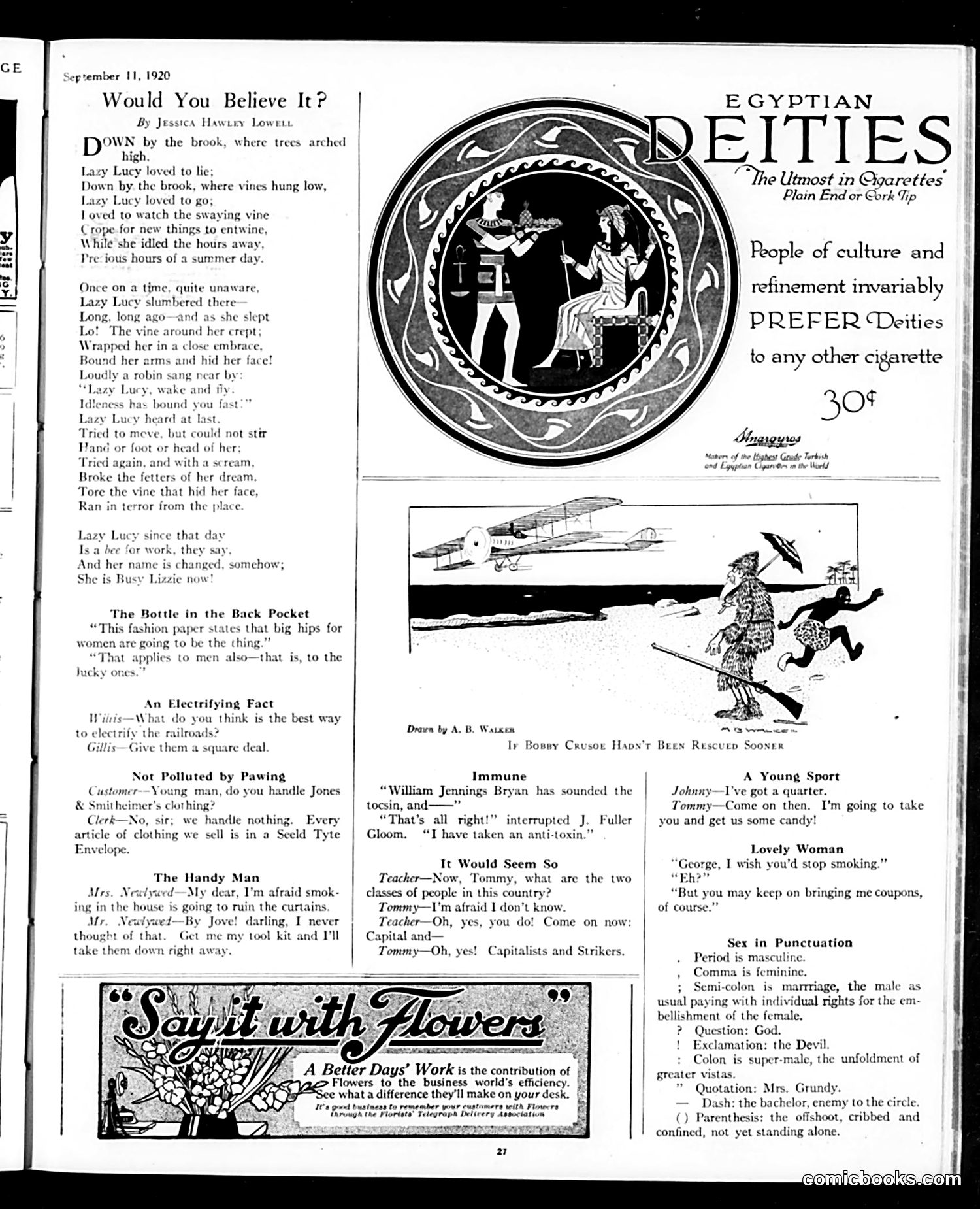
This page contains **short humorous pieces and advertisements** typical of Judge's satirical format. **Notable items:** - **"Would You Believe It?"** by Jessica Hawley Lowell: A whimsical poem explaining the origin of "Busy Lizzie" (the plant)—lazy Lucy becomes entangled by vines and is transformed into an industrious person. - **Brief joke items** mock contemporary issues: labor disputes ("Capitalists and Strikers"), fashion trends (hip size), and railroad regulation. The "Anti-toxin" joke references William Jennings Bryan, a prominent politician. - **"Sex in Punctuation"**: A clever piece gendering punctuation marks—periods as masculine, commas as feminine, dashes as "the bachelor, enemy to the circle"—reflecting 1920s gender stereotypes and social commentary. - **Egyptian Deities cigarette advertisement**: Appeals to "people of culture and refinement," using Egyptian imagery as a luxury marketing strategy. The page exemplifies Judge's blend of light satire, social commentary, and commercial advertising aimed at educated audiences.
This page from the satirical magazine *Judge* contains primarily **humorous verse and comic dialogues** rather than political cartoons. ## Main Content: **"The Limerick that Couldn't Let Go"** is a lengthy comic poem about a Princess Irma from Burma visiting New York seeking a well-fitting dress. The limerick structure breaks down as the narrative spirals—a joke about the form itself becoming ungovernable, matching the princess's inability to find satisfaction. The satire targets aristocratic pretension and consumerism: a wealthy royal complains about costs while shopping for luxury goods. The page also includes brief **comic dialogues** like "Prima Facie," "A Better Front," and "Sure Proof"—wordplay-driven jokes about social climbing, marital dynamics, and Prohibition-era bootlegging (the "home-made booze" reference). **Advertisements** for President Suspenders, Cortez Cigars, and piano lessons fill margins. The humor is primarily **domestic and absurdist** rather than political—focused on fashion, marriage troubles, and everyday American social anxieties of the Jazz Age era.
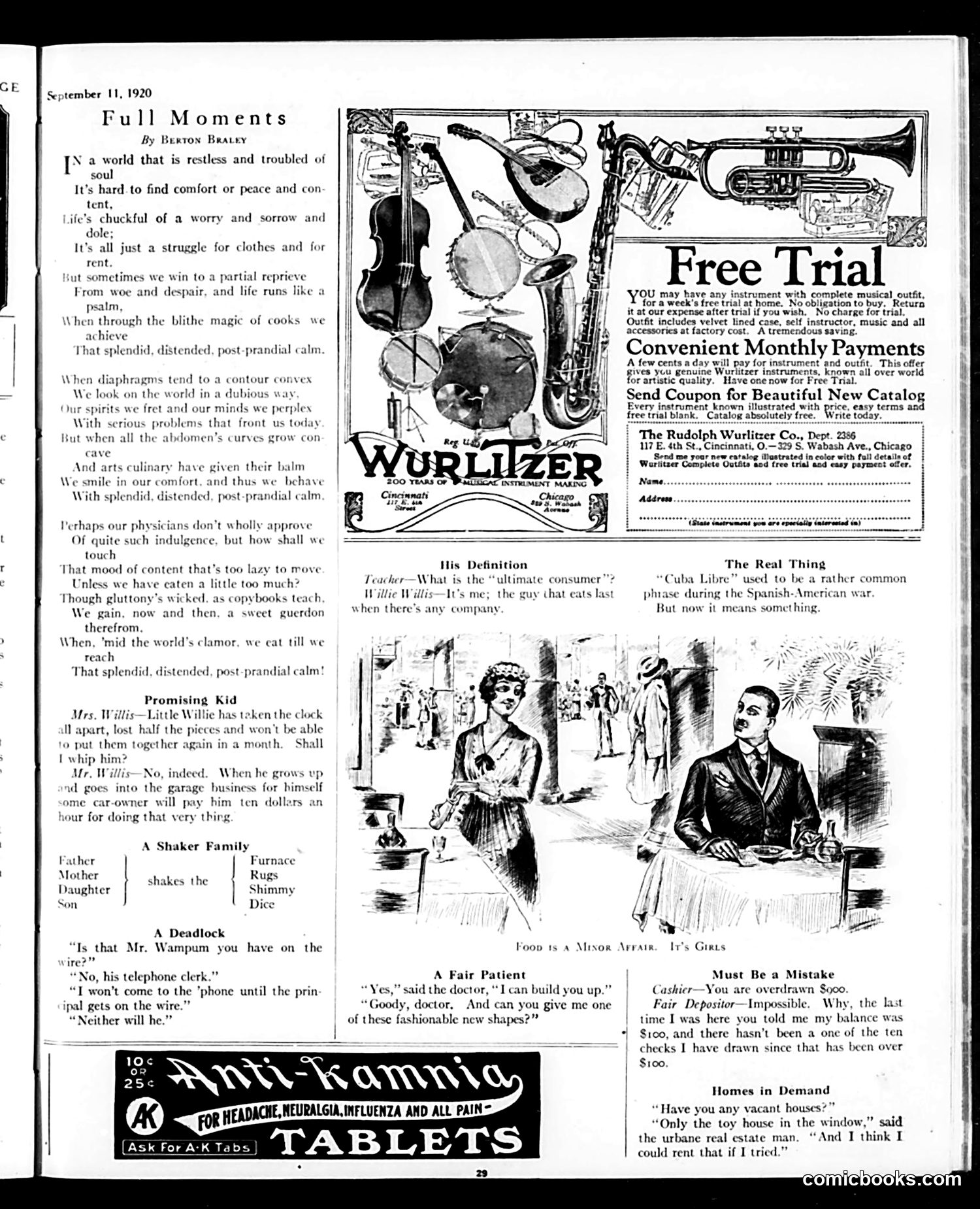
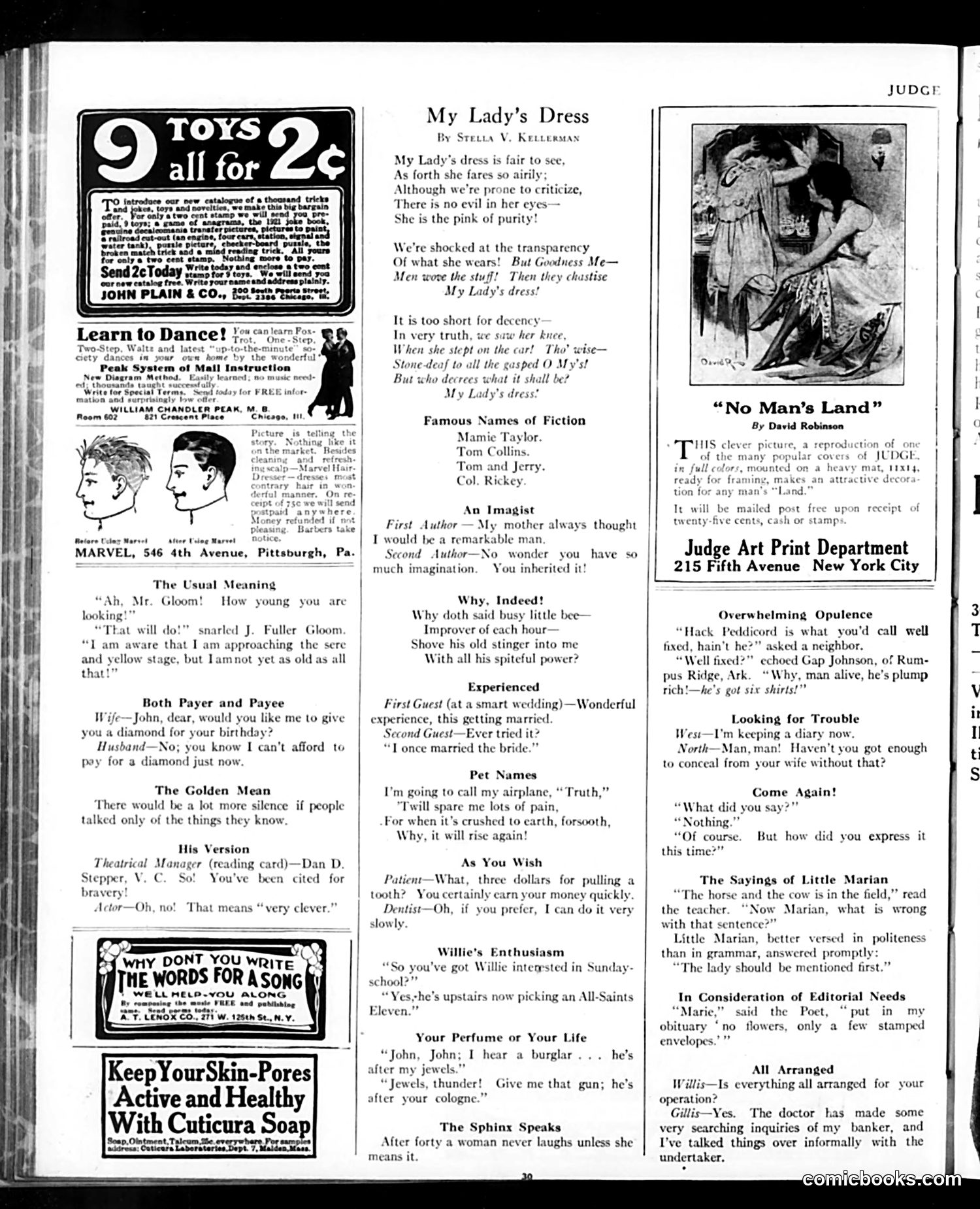
This page consists primarily of **advertisements and humorous short pieces** rather than political cartoons. The content reflects early 20th-century American humor and social commentary. **Key items:** The poem **"My Lady's Dress"** satirizes Victorian hypocrisy about women's fashion. It mocks male critics who condemn women's increasingly revealing clothing (showing knees, transparent fabrics) while ignoring that men historically wore similar garments. The satire highlights the double standard in dress codes. **Short humor pieces** include domestic jokes ("Both Payer and Payee" about affording diamonds), wordplay on fictional character names (Tom Collins the drink), and observational comedy about human nature ("The Golden Mean" about silence being golden). **Advertisements** dominate—toy catalogs, dance lessons, Cuticura soap—typical of the era's magazine marketing. The overall tone is light satire aimed at middle-class readers, with no apparent political content. The page emphasizes social commentary on gender roles, marriage, and consumer culture rather than serious political critique.
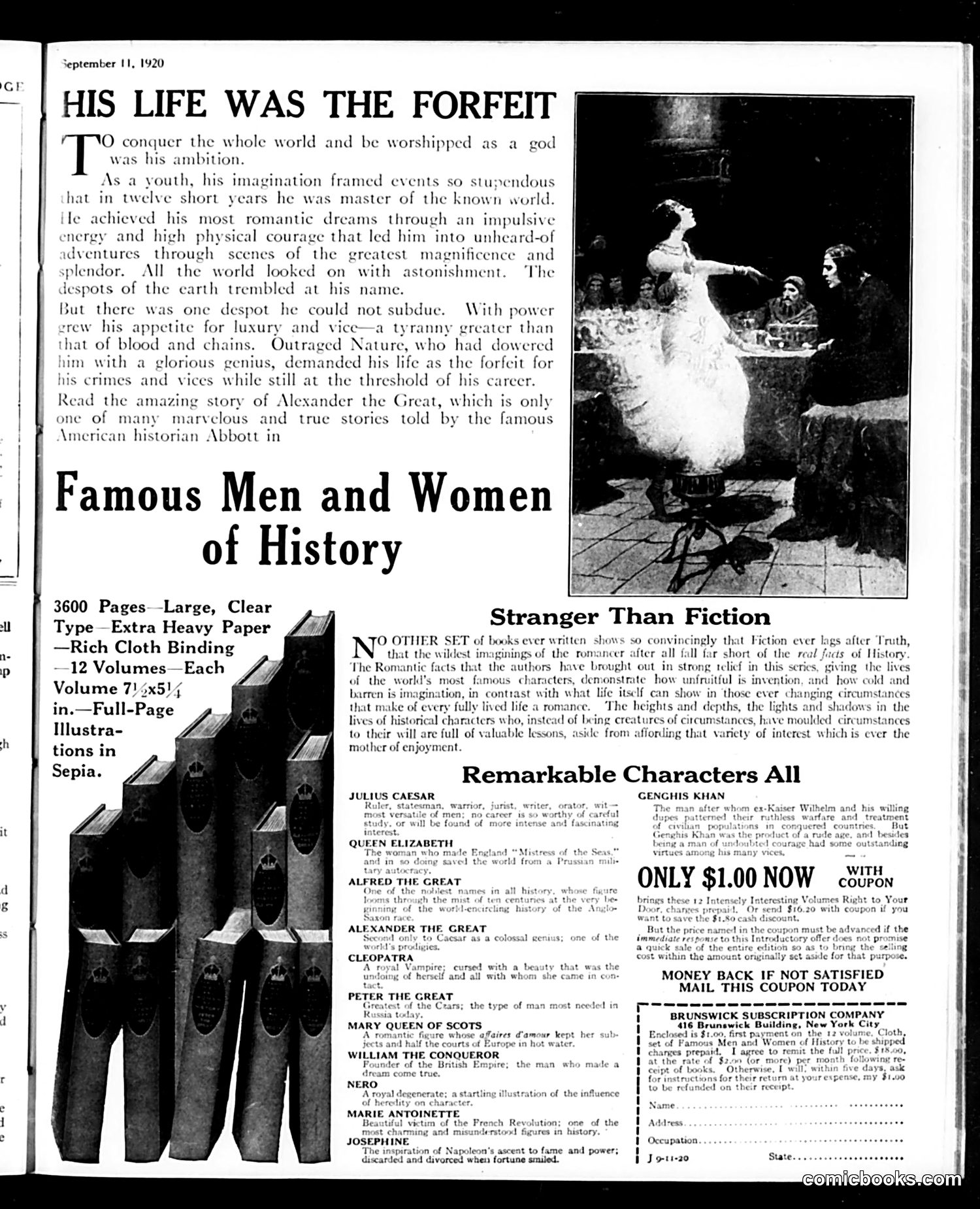
This is primarily a **book advertisement**, not a satirical cartoon. The page promotes "Famous Men and Women of History," a 12-volume encyclopedia set published by Brunswick Subscription Company. The header narrative about Alexander the Great—ambitious, conquering the world, yet ultimately destroyed by his own appetites—serves as marketing copy. It's designed to intrigue readers by suggesting the books contain dramatic, morally instructive historical tales "stranger than fiction." The "Remarkable Characters All" section lists famous historical figures included: Julius Caesar, Queen Elizabeth, Alfred the Great, Alexander the Great, Cleopatra, Peter the Great, and others. The accompanying photograph (right) appears to show a theatrical or dramatic scene, likely meant to evoke the "magnificence and splendor" promised in the text. The coupon at bottom offering the set for "$1.00 NOW" with a money-back guarantee is a standard early-20th-century direct-mail sales tactic. This is advertising copy masquerading as editorial content—typical of Judge magazine's revenue model.
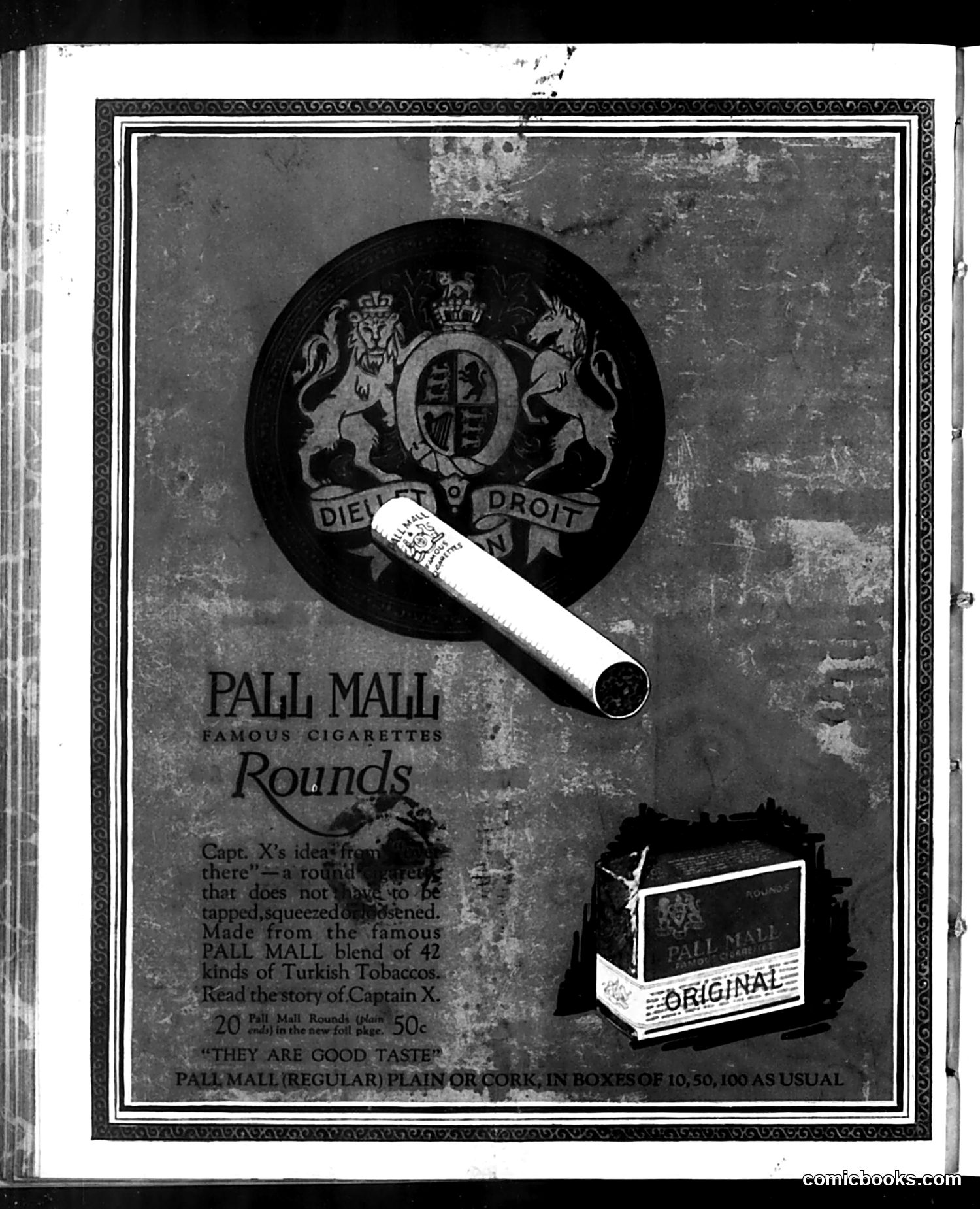
This is a **cigarette advertisement**, not satire or political commentary. It advertises Pall Mall "Rounds" cigarettes, featuring the brand's heraldic coat of arms (lions, crown, shield with "DIEU ET DROIT"). The ad uses a fictional "Captain X" whose invention is a round cigarette that "does not have to be tapped, squeezed or pinched." The copy emphasizes the product's unique shape and mentions the "famous PALL MALL blend of 42 kinds of Turkish Tobaccos." The tagline "THEY ARE GOOD TASTE" suggests smoking these cigarettes signals sophistication. Pricing and packaging options are listed at bottom. This represents typical early 20th-century cigarette marketing in *Judge* magazine—luxury products advertised through lifestyle appeals rather than health claims.